Topic 4
Water and aquatic food production
systems and societies
4.1 Introduction to water systems
Summary of topic 4.1
Ecosystems
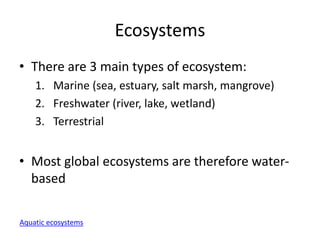
• There are 3 main types of ecosystem:
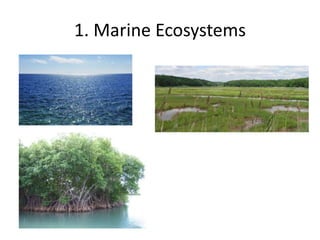
1. Marine (sea, estuary, salt marsh, mangrove)
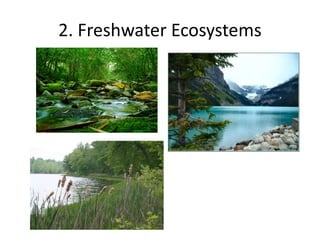
2. Freshwater (river, lake, wetland)
3. Terrestrial
• Most global ecosystems are therefore water-
based
Aquatic ecosystems
1. Marine Ecosystems
2. Freshwater Ecosystems
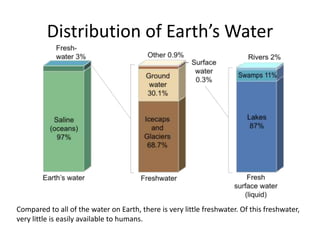
Distribution of Earth’s Water
Compared to all of the water on Earth, there is very little freshwater. Of this freshwater,
very little is easily available to humans.
Water systems
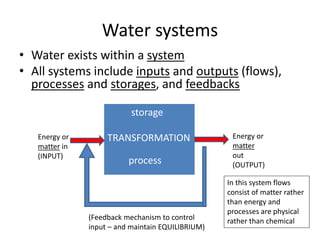
• Water exists within a system
• All systems include inputs and outputs (flows),
processes and storages, and feedbacks
storage
Energy or
matter in
(INPUT)
Energy or
matter
out
(OUTPUT)
TRANSFORMATION
(Feedback mechanism to control
input – and maintain EQUILIBRIUM)
process
In this system flows
consist of matter rather
than energy and
processes are physical
rather than chemical
Water systems
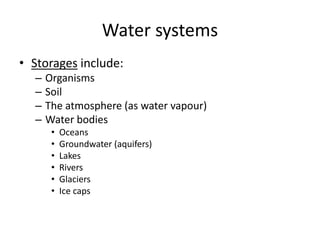
• Storages include:
– Organisms
– Soil
– The atmosphere (as water vapour)
– Water bodies
• Oceans
• Groundwater (aquifers)
• Lakes
• Rivers
• Glaciers
• Ice caps
Water systems
• Flows include
– Evapotranspiration (evaporation coupled with transpiration)
– Sublimation (solid directly to gas at high pressures)
– Evaporation
– Condensation
– Advection (movement by winds)
– Precipitation
– Melting
– Freezing
– Flooding
– Surface runoff
– Infiltration (movement of surface water into soil)
– Percolation (movement of water through soil and rock pores)
– Streamflow
– Currents
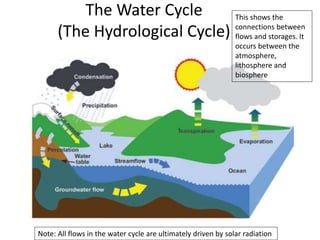
The Water Cycle
(The Hydrological Cycle)
The
This shows the
connections between
flows and storages. It
occurs between the
atmosphere,
lithosphere and
biosphere
Note: All flows in the water cycle are ultimately driven by solar radiation
How does the water cycle affect global climate?
• There are differences in temperature and salinity
throughout the world’s oceans
• This results in differences in water density (which leads to
movements of huge masses of water)
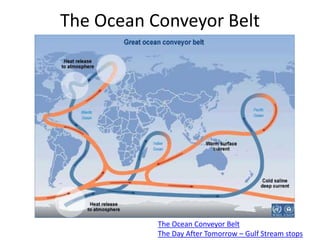
• The greatest of these is the Ocean Conveyor Belt
• The northern part of the Conveyor is the Gulf Stream
• Warmer water rises to the surface and is advected by winds
• Colder water sinks and is moved by deep-water currents
• The Ocean Conveyor Belt therefore distributes heat around
the world and helps to control climate
• There are worries that continued anthropomorphic climate
change will lead to disruption of the Ocean Conveyor Belt
(and therefore result in a positive feedback effect)
The Ocean Conveyor Belt
The Day After Tomorrow – Gulf Stream stops
Human impacts on the water cycle
• Unsustainable water use
– There are over a billion people without access to clean
drinking water and more than 2.6 billion without proper
sanitation (water is a replenishable but finite resource).
Water demand is increasing in both MEDCs and LEDCs
• Changes to flows and storages
– Humans affect this on the small and large scales e.g. large-
scale agricultural irrigation, abstraction of groundwater
and surface water and desalination of seawater
• Water pollution
– Rivers and lakes become polluted when they are used for
the disposal of domestic and industrial wastes
Questions
1. List possible storages of global water
2. List possible flows of global water
3. List and evaluate human impacts on the
water cycle

Summary of topic 4.1

  • 1.
    Topic 4 Water andaquatic food production systems and societies 4.1 Introduction to water systems Summary of topic 4.1
  • 2.
    Ecosystems • There are3 main types of ecosystem: 1. Marine (sea, estuary, salt marsh, mangrove) 2. Freshwater (river, lake, wetland) 3. Terrestrial • Most global ecosystems are therefore water- based Aquatic ecosystems
  • 3.
  • 4.
  • 5.
    Distribution of Earth’sWater Compared to all of the water on Earth, there is very little freshwater. Of this freshwater, very little is easily available to humans.
  • 6.
    Water systems • Waterexists within a system • All systems include inputs and outputs (flows), processes and storages, and feedbacks storage Energy or matter in (INPUT) Energy or matter out (OUTPUT) TRANSFORMATION (Feedback mechanism to control input – and maintain EQUILIBRIUM) process In this system flows consist of matter rather than energy and processes are physical rather than chemical
  • 7.
    Water systems • Storagesinclude: – Organisms – Soil – The atmosphere (as water vapour) – Water bodies • Oceans • Groundwater (aquifers) • Lakes • Rivers • Glaciers • Ice caps
  • 8.
    Water systems • Flowsinclude – Evapotranspiration (evaporation coupled with transpiration) – Sublimation (solid directly to gas at high pressures) – Evaporation – Condensation – Advection (movement by winds) – Precipitation – Melting – Freezing – Flooding – Surface runoff – Infiltration (movement of surface water into soil) – Percolation (movement of water through soil and rock pores) – Streamflow – Currents
  • 9.
    The Water Cycle (TheHydrological Cycle) The This shows the connections between flows and storages. It occurs between the atmosphere, lithosphere and biosphere Note: All flows in the water cycle are ultimately driven by solar radiation
  • 10.
    How does thewater cycle affect global climate? • There are differences in temperature and salinity throughout the world’s oceans • This results in differences in water density (which leads to movements of huge masses of water) • The greatest of these is the Ocean Conveyor Belt • The northern part of the Conveyor is the Gulf Stream • Warmer water rises to the surface and is advected by winds • Colder water sinks and is moved by deep-water currents • The Ocean Conveyor Belt therefore distributes heat around the world and helps to control climate • There are worries that continued anthropomorphic climate change will lead to disruption of the Ocean Conveyor Belt (and therefore result in a positive feedback effect)
  • 11.
    The Ocean ConveyorBelt The Ocean Conveyor Belt The Day After Tomorrow – Gulf Stream stops
  • 12.
    Human impacts onthe water cycle • Unsustainable water use – There are over a billion people without access to clean drinking water and more than 2.6 billion without proper sanitation (water is a replenishable but finite resource). Water demand is increasing in both MEDCs and LEDCs • Changes to flows and storages – Humans affect this on the small and large scales e.g. large- scale agricultural irrigation, abstraction of groundwater and surface water and desalination of seawater • Water pollution – Rivers and lakes become polluted when they are used for the disposal of domestic and industrial wastes
  • 13.
    Questions 1. List possiblestorages of global water 2. List possible flows of global water 3. List and evaluate human impacts on the water cycle