


CORE-PERIPHERY
MODEL
Master of Population Studies
International Institute for Population Science
Mumbai, Maharashtra
Session:2019-20
Mihir Adhikary
&
Kaushal Monk
INTRODUCTION
 The core periphery model shows spatially how economic, political,
and cultural authority is dispersed in core or dominant regions
and the surrounding peripheral and semi-peripheral regions.
 American Economist John Friedmann has given the concept of
core-periphery in his book “Regional Development policy: A case
study of Venezuela” in the year 1966.
 To describe the economic development of any region he
emphasized the importance of core and periphery regions.
 He tried to show how Core and periphery regions are related to
each other for development of any region.
CORE-PERIPHERY
MODEL
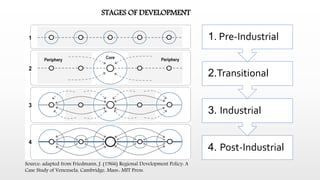
 The core-periphery model of development, tries to represent the
emergence of an urban system in four major stages.
 It helps to explain why some inner city areas enjoy considerable
prosperity, while others display all the signs of urban deprivation
and poverty.
 From an initial state of inequalities, disparities are reduced and a
functionally integrated urban system emerges.
 Discusses how the core as well as periphery regions can be
developed such a way where inequalities will be less.
 Approaches to development of some defined regions like core
region, resource frontier and downward transitional area.
The core-periphery model works on many scales, from towns and
cities, to a global scale. Although it has been heatedly debated but the
balance of the evidence points strongly in its favor.
“World, Continent, Nation and city- the centre-periphery hypothesis
appears on all the relevant scales of explanation simultaneously as
cause and as effect of economic transformation”- John Friedmann.
Several researches and studies of different economists (Meier and
Baldwin, Harvey S. Perlof and Lowdon Wingo, T.W Schultz etc.) proofs
that it is true that the core-periphery relationship plays the major role
for the development of cities, states, continents as well as the
development for a global scale.
Continued…
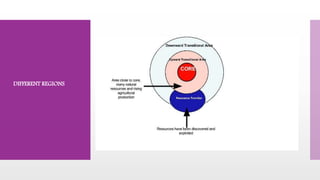
DIFFERENT REGIONS
Core Region
Upward Transition Region
Resource Frontier Region
Downward Transition Region
DIFFERENT REGIONS
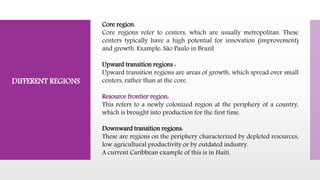
Core region:
Core regions refer to centers, which are usually metropolitan. These
centers typically have a high potential for innovation (improvement)
and growth. Example: São Paulo in Brazil
Upward transition regions :
Upward transition regions are areas of growth, which spread over small
centers, rather than at the core.
Resource frontier region:
This refers to a newly colonized region at the periphery of a country,
which is brought into production for the first time.
Downward transition regions:
These are regions on the periphery characterized by depleted resources,
low agricultural productivity or by outdated industry.
A current Caribbean example of this is in Haiti.
DIFFERENT REGIONS
Source: adapted from Friedmann, J. (1966) Regional Development Policy: A
Case Study of Venezuela, Cambridge, Mass.: MIT Press.
4. Post-Industrial
3. Industrial
2.Transitional
1. Pre-Industrial
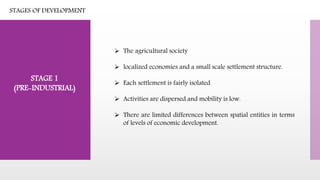
STAGES OF DEVELOPMENT
 The agricultural society
 localized economies and a small scale settlement structure.
 Each settlement is fairly isolated
 Activities are dispersed and mobility is low.
 There are limited differences between spatial entities in terms
of levels of economic development.
STAGE 1
(PRE-INDUSTRIAL)
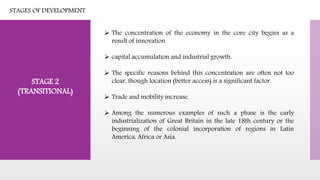
STAGE 2
(TRANSITIONAL)
 The concentration of the economy in the core city begins as a
result of innovation.
 capital accumulation and industrial growth.
 The specific reasons behind this concentration are often not too
clear, though location (better access) is a significant factor.
 Trade and mobility increase.
 Among the numerous examples of such a phase is the early
industrialization of Great Britain in the late 18th century or the
beginning of the colonial incorporation of regions in Latin
America, Africa or Asia.
STAGES OF DEVELOPMENT
STAGE 3
(INDUSTRIAL)
 Through a process of economic growth and diffusion, other
growth centers emerge.
 The main reasons for de-concentration are increasing input
costs (mainly labor and land) in the core area.
 This diffusion is linked with increased interactions between
elements of the urban system and the construction of
transport infrastructures.
STAGES OF DEVELOPMENT
STAGE 4
(POST INDUSTRIAL)
 The urban system becomes fully integrated and spatial
inequalities are reduced significantly.
 The distribution of economic activities creates a specialization
and a division of labor linked with intense flows along high
capacity transport corridors.
 The factors that have favored spatial inequalities in the
previous phases of development have structured dominant
poles of the urban system and favored the setting of a large
commercial gateway, usually a world city.
STAGES OF DEVELOPMENT
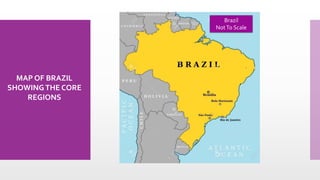
 A great example of core and periphery is Brazil with the
'golden triangle' at its core and the Amazon being its main
peripheral area.
 There are reasons why the core area is developed and not
other areas.
 Sau Paulo developed because of it coffee industry.
 Rio de Janeiro developed because it's a port and became big
with imports and exports.
 In contrast, the peripheral areas haven't developed because
of the lack of accessibility to the area or a lack in human
and physical resources.
EXAMPLE
 Within cities like Sao Paulo, Belo Horizonte and Rio de Janeiro,
overheating has become a serious problem.
 Large amounts of people from the peripheral areas within Brazil move
to the core area.This causes many problems such as:
 Overcrowding.
 Lack of housing.
 And sometimes the formation of favelas (slum).
 As well as the problems cuses to the cities, the peripheral areas are
also effected.
 A large majority of the people who are moving into the core area are
young adults. The peripheral areas are then therefore loosing young,
potentially educated, adults.
Continued….
MAP OF BRAZIL
SHOWINGTHE CORE
REGIONS
Brazil
NotTo Scale
Thank You
MihirAdhikary, 2019

Core-Periphery Model of John Friedmann

  • 1.
    CORE-PERIPHERY MODEL Master of PopulationStudies International Institute for Population Science Mumbai, Maharashtra Session:2019-20 Mihir Adhikary & Kaushal Monk
  • 2.
    INTRODUCTION  The coreperiphery model shows spatially how economic, political, and cultural authority is dispersed in core or dominant regions and the surrounding peripheral and semi-peripheral regions.  American Economist John Friedmann has given the concept of core-periphery in his book “Regional Development policy: A case study of Venezuela” in the year 1966.  To describe the economic development of any region he emphasized the importance of core and periphery regions.  He tried to show how Core and periphery regions are related to each other for development of any region.
  • 3.
    CORE-PERIPHERY MODEL  The core-peripherymodel of development, tries to represent the emergence of an urban system in four major stages.  It helps to explain why some inner city areas enjoy considerable prosperity, while others display all the signs of urban deprivation and poverty.  From an initial state of inequalities, disparities are reduced and a functionally integrated urban system emerges.  Discusses how the core as well as periphery regions can be developed such a way where inequalities will be less.  Approaches to development of some defined regions like core region, resource frontier and downward transitional area.
  • 4.
    The core-periphery modelworks on many scales, from towns and cities, to a global scale. Although it has been heatedly debated but the balance of the evidence points strongly in its favor. “World, Continent, Nation and city- the centre-periphery hypothesis appears on all the relevant scales of explanation simultaneously as cause and as effect of economic transformation”- John Friedmann. Several researches and studies of different economists (Meier and Baldwin, Harvey S. Perlof and Lowdon Wingo, T.W Schultz etc.) proofs that it is true that the core-periphery relationship plays the major role for the development of cities, states, continents as well as the development for a global scale. Continued…
  • 5.
    DIFFERENT REGIONS Core Region UpwardTransition Region Resource Frontier Region Downward Transition Region
  • 6.
  • 7.
    Core region: Core regionsrefer to centers, which are usually metropolitan. These centers typically have a high potential for innovation (improvement) and growth. Example: São Paulo in Brazil Upward transition regions : Upward transition regions are areas of growth, which spread over small centers, rather than at the core. Resource frontier region: This refers to a newly colonized region at the periphery of a country, which is brought into production for the first time. Downward transition regions: These are regions on the periphery characterized by depleted resources, low agricultural productivity or by outdated industry. A current Caribbean example of this is in Haiti. DIFFERENT REGIONS
  • 8.
    Source: adapted fromFriedmann, J. (1966) Regional Development Policy: A Case Study of Venezuela, Cambridge, Mass.: MIT Press. 4. Post-Industrial 3. Industrial 2.Transitional 1. Pre-Industrial STAGES OF DEVELOPMENT
  • 9.
    STAGES OF DEVELOPMENT The agricultural society  localized economies and a small scale settlement structure.  Each settlement is fairly isolated  Activities are dispersed and mobility is low.  There are limited differences between spatial entities in terms of levels of economic development. STAGE 1 (PRE-INDUSTRIAL)
  • 10.
    STAGE 2 (TRANSITIONAL)  Theconcentration of the economy in the core city begins as a result of innovation.  capital accumulation and industrial growth.  The specific reasons behind this concentration are often not too clear, though location (better access) is a significant factor.  Trade and mobility increase.  Among the numerous examples of such a phase is the early industrialization of Great Britain in the late 18th century or the beginning of the colonial incorporation of regions in Latin America, Africa or Asia. STAGES OF DEVELOPMENT
  • 11.
    STAGE 3 (INDUSTRIAL)  Througha process of economic growth and diffusion, other growth centers emerge.  The main reasons for de-concentration are increasing input costs (mainly labor and land) in the core area.  This diffusion is linked with increased interactions between elements of the urban system and the construction of transport infrastructures. STAGES OF DEVELOPMENT
  • 12.
    STAGE 4 (POST INDUSTRIAL) The urban system becomes fully integrated and spatial inequalities are reduced significantly.  The distribution of economic activities creates a specialization and a division of labor linked with intense flows along high capacity transport corridors.  The factors that have favored spatial inequalities in the previous phases of development have structured dominant poles of the urban system and favored the setting of a large commercial gateway, usually a world city. STAGES OF DEVELOPMENT
  • 13.
     A greatexample of core and periphery is Brazil with the 'golden triangle' at its core and the Amazon being its main peripheral area.  There are reasons why the core area is developed and not other areas.  Sau Paulo developed because of it coffee industry.  Rio de Janeiro developed because it's a port and became big with imports and exports.  In contrast, the peripheral areas haven't developed because of the lack of accessibility to the area or a lack in human and physical resources. EXAMPLE
  • 14.
     Within citieslike Sao Paulo, Belo Horizonte and Rio de Janeiro, overheating has become a serious problem.  Large amounts of people from the peripheral areas within Brazil move to the core area.This causes many problems such as:  Overcrowding.  Lack of housing.  And sometimes the formation of favelas (slum).  As well as the problems cuses to the cities, the peripheral areas are also effected.  A large majority of the people who are moving into the core area are young adults. The peripheral areas are then therefore loosing young, potentially educated, adults. Continued….
  • 15.
    MAP OF BRAZIL SHOWINGTHECORE REGIONS Brazil NotTo Scale
  • 16.