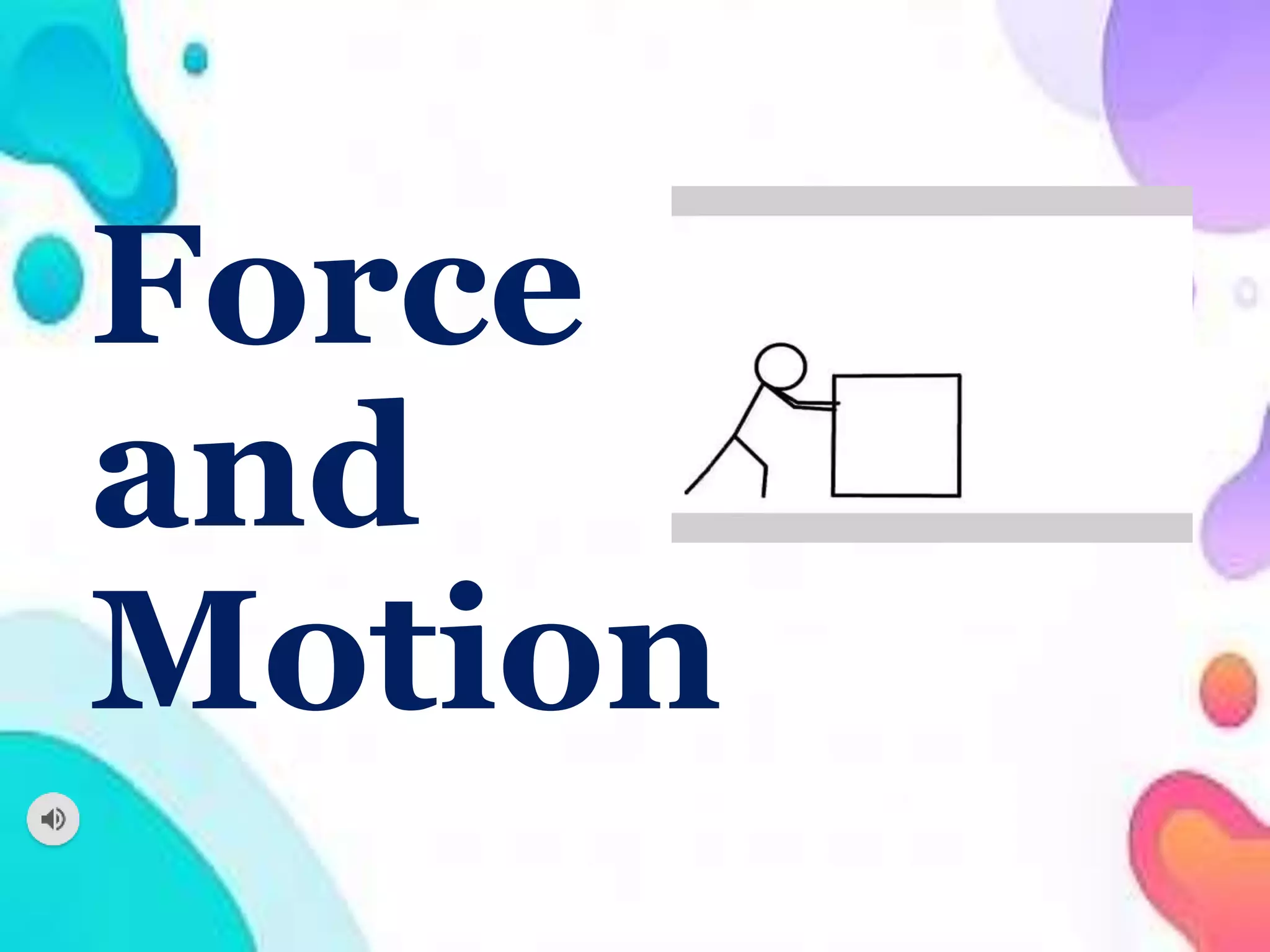
Force
and
Motion
Lesson Objectives:
1. Define force and motion and their
relationship to each other;
2. Differentiate the types of forces;
3. Understand how to compute the value of net
force;
4. State the 3 Laws of Motion
5. How the 3 Laws of Motion is important in
everyday living.
Force
Force
- is defined as push and
pull acting upon an object
as a result of its
interaction with another
object.
How do we describe force:
1. It can make an object move or stop;
2. It produces changes in motion
3. It can make an object change its shape and
size;
4. It acts on objects;
5. Expressed in NEWTON (N);
6. It is a vector quantity: magnitude and direction.
Motion
- define as change of position over
time, when we apply force.
How do we know if something has
moved?
-
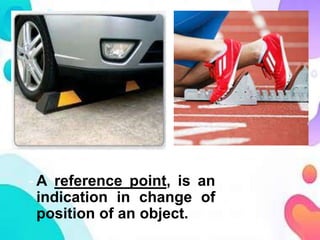
- A reference point, is an
indication in change of
position of an object.
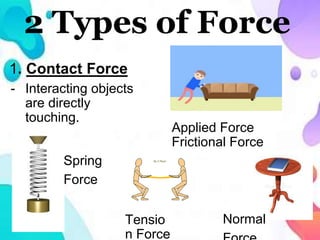
2 Types of Force
1. Contact Force
- Interacting objects
are directly
touching.
Applied Force
Frictional Force
Tensio
n Force
Spring
Force
Normal
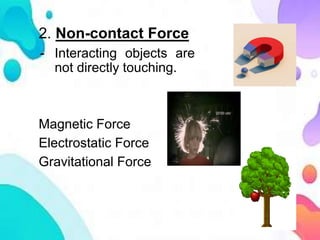
2. Non-contact Force
- Interacting objects are
not directly touching.
Magnetic Force
Electrostatic Force
Gravitational Force
Balanced Force and
Unbalanced Force
•A stationary object will not move
while the forces acting on it are
balanced, equal or zero.
•A stationary object will move if the
forces acted upon is unbalanced.
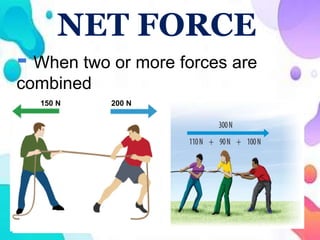
NET FORCE
- When two or more forces are
combined
150 N 200 N
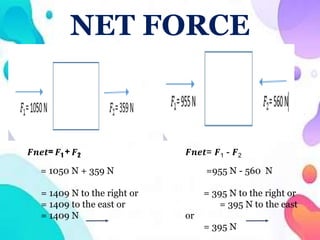
NET FORCE
𝑭𝒏𝒆𝒕= 𝑭1 + 𝑭2
= 1050 N + 359 N
= 1409 N to the right or
= 1409 to the east or
= 1409 N
𝑭𝒏𝒆𝒕= 𝑭1 - 𝑭2
=955 N - 560 N
= 395 N to the right or
= 395 N to the east
or
= 395 N
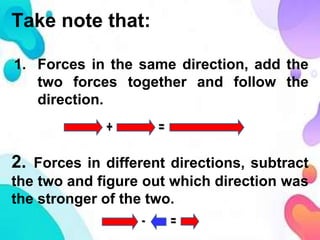
Take note that:
1. Forces in the same direction, add the
two forces together and follow the
direction.
2. Forces in different directions, subtract
the two and figure out which direction was
the stronger of the two.
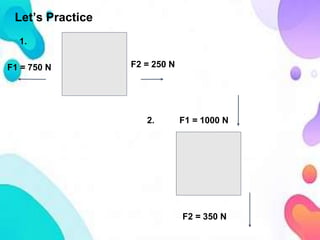
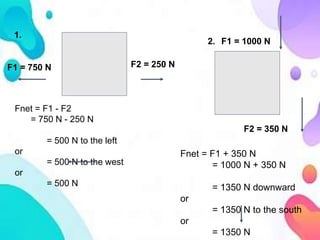
F1 = 750 N F2 = 250 N
1.
Let’s Practice
2. F1 = 1000 N
F2 = 350 N
F1 = 750 N F2 = 250 N
Fnet = F1 - F2
= 750 N - 250 N
= 500 N to the left
or
= 500 N to the west
or
= 500 N
1.
2. F1 = 1000 N
F2 = 350 N
Fnet = F1 + 350 N
= 1000 N + 350 N
= 1350 N downward
or
= 1350 N to the south
or
= 1350 N
3 Laws
of
Motion
Sir Isaac Newton
- was an English mathematician,
physicist, astronomer and author
who is widely recognized as one
of the most influential scientists
of all time
1st Law of
Motion
Law of Inertia
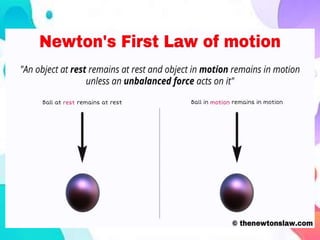
An object at rest stays at rest and an
object in motion stays in motion with the
same speed and in the same
direction unless acted upon by an
unbalanced force.
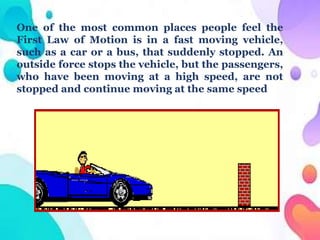
One of the most common places people feel the
First Law of Motion is in a fast moving vehicle,
such as a car or a bus, that suddenly stopped. An
outside force stops the vehicle, but the passengers,
who have been moving at a high speed, are not
stopped and continue moving at the same speed
INERTIA
tendency of a body to stay at rest when it is at
rest or stay in uniform motion when it is in
motion unless acted upon by an external force.
MASS is related to the inertia of an object.
The higher the mass the greater the INERTIA
The lower the mass the lesser the INERTIA
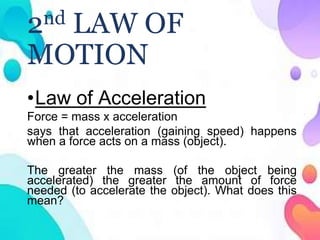
2nd LAW OF
MOTION
•Law of Acceleration
Force = mass x acceleration
says that acceleration (gaining speed) happens
when a force acts on a mass (object).
The greater the mass (of the object being
accelerated) the greater the amount of force
needed (to accelerate the object). What does this
mean?
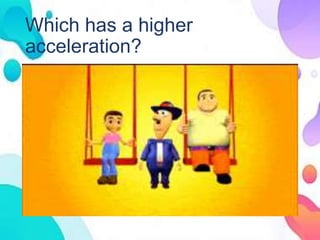
Which has a higher
acceleration?
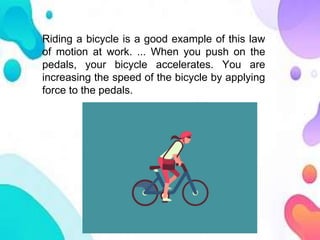
Riding a bicycle is a good example of this law
of motion at work. ... When you push on the
pedals, your bicycle accelerates. You are
increasing the speed of the bicycle by applying
force to the pedals.
3rd LAW OF MOTION
Law of Interaction
For every action there is an equal
and opposite reaction.
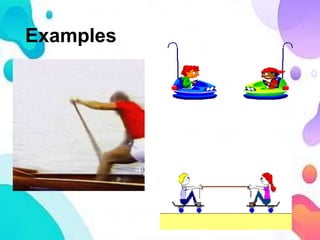
Examples
Be ready for our
seatwork
tomorrow!
Prepare 1 whole sheet of bond paper.
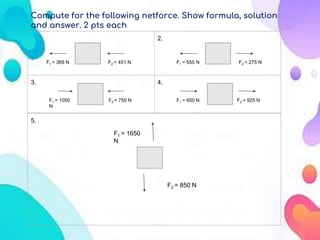
2.
3. 4.
F1 = 369 N F2 = 451 N F1 = 555 N F2 = 275 N
F1 = 1050
N
F2 = 750 N F1 = 650 N F2 = 925 N
5.
F1 = 1650
N
F2 = 850 N
Compute for the following netforce. Show formula, solution
and answer. 2 pts each
Activity 15pts
Demonstrate one situation for each 3 Laws of
Motion.

Force and Motion PPT.pptx

  • 1.
  • 2.
    Lesson Objectives: 1. Defineforce and motion and their relationship to each other; 2. Differentiate the types of forces; 3. Understand how to compute the value of net force; 4. State the 3 Laws of Motion 5. How the 3 Laws of Motion is important in everyday living.
  • 3.
  • 4.
    Force - is definedas push and pull acting upon an object as a result of its interaction with another object.
  • 5.
    How do wedescribe force: 1. It can make an object move or stop; 2. It produces changes in motion 3. It can make an object change its shape and size; 4. It acts on objects; 5. Expressed in NEWTON (N); 6. It is a vector quantity: magnitude and direction.
  • 6.
    Motion - define aschange of position over time, when we apply force. How do we know if something has moved? -
  • 7.
    - A referencepoint, is an indication in change of position of an object.
  • 8.
    2 Types ofForce 1. Contact Force - Interacting objects are directly touching. Applied Force Frictional Force Tensio n Force Spring Force Normal
  • 9.
    2. Non-contact Force -Interacting objects are not directly touching. Magnetic Force Electrostatic Force Gravitational Force
  • 10.
    Balanced Force and UnbalancedForce •A stationary object will not move while the forces acting on it are balanced, equal or zero. •A stationary object will move if the forces acted upon is unbalanced.
  • 12.
    NET FORCE - Whentwo or more forces are combined 150 N 200 N
  • 13.
    NET FORCE 𝑭𝒏𝒆𝒕= 𝑭1+ 𝑭2 = 1050 N + 359 N = 1409 N to the right or = 1409 to the east or = 1409 N 𝑭𝒏𝒆𝒕= 𝑭1 - 𝑭2 =955 N - 560 N = 395 N to the right or = 395 N to the east or = 395 N
  • 14.
    Take note that: 1.Forces in the same direction, add the two forces together and follow the direction. 2. Forces in different directions, subtract the two and figure out which direction was the stronger of the two.
  • 15.
    F1 = 750N F2 = 250 N 1. Let’s Practice 2. F1 = 1000 N F2 = 350 N
  • 16.
    F1 = 750N F2 = 250 N Fnet = F1 - F2 = 750 N - 250 N = 500 N to the left or = 500 N to the west or = 500 N 1. 2. F1 = 1000 N F2 = 350 N Fnet = F1 + 350 N = 1000 N + 350 N = 1350 N downward or = 1350 N to the south or = 1350 N
  • 17.
  • 19.
    Sir Isaac Newton -was an English mathematician, physicist, astronomer and author who is widely recognized as one of the most influential scientists of all time
  • 20.
    1st Law of Motion Lawof Inertia An object at rest stays at rest and an object in motion stays in motion with the same speed and in the same direction unless acted upon by an unbalanced force.
  • 24.
    One of themost common places people feel the First Law of Motion is in a fast moving vehicle, such as a car or a bus, that suddenly stopped. An outside force stops the vehicle, but the passengers, who have been moving at a high speed, are not stopped and continue moving at the same speed
  • 25.
    INERTIA tendency of abody to stay at rest when it is at rest or stay in uniform motion when it is in motion unless acted upon by an external force. MASS is related to the inertia of an object. The higher the mass the greater the INERTIA The lower the mass the lesser the INERTIA
  • 27.
    2nd LAW OF MOTION •Lawof Acceleration Force = mass x acceleration says that acceleration (gaining speed) happens when a force acts on a mass (object). The greater the mass (of the object being accelerated) the greater the amount of force needed (to accelerate the object). What does this mean?
  • 28.
    Which has ahigher acceleration?
  • 29.
    Riding a bicycleis a good example of this law of motion at work. ... When you push on the pedals, your bicycle accelerates. You are increasing the speed of the bicycle by applying force to the pedals.
  • 31.
    3rd LAW OFMOTION Law of Interaction For every action there is an equal and opposite reaction.
  • 32.
  • 33.
    Be ready forour seatwork tomorrow! Prepare 1 whole sheet of bond paper.
  • 34.
    2. 3. 4. F1 =369 N F2 = 451 N F1 = 555 N F2 = 275 N F1 = 1050 N F2 = 750 N F1 = 650 N F2 = 925 N 5. F1 = 1650 N F2 = 850 N Compute for the following netforce. Show formula, solution and answer. 2 pts each
  • 35.
    Activity 15pts Demonstrate onesituation for each 3 Laws of Motion.