Constructivist Theory
Constructivism is based on a type of learning in
which the learner forms, or constructs, much of
what he or she learns or comprehends.
Cognitive-how the individual learner undsertand
things in terms of developmental stages a nd
learning styles
Social- how meanings and understandings grow
out of social encounters
Key People/Key Points
Jean Piaget (1896-1980)
Believed children are constructing new knowledge
as they move through cognitive stages.
Interpret knowledge differently through different
stages.
Cognitive Stages Ages (Approximate) Characteristics of
Learning
Sensorimotor Birth to 2 years Imitation, learn through
senses and motor
activities, do not
understand the world
around them, and
egocentric
Preoperational 2 to 6/7 years Egocentric, pretend play,
drawing ability, speech
and communication
development, concrete
thinking, and intuitive
reasoning
Concrete operational 6/7 years to 11/12 years Classification, logical
reasoning, problem
solving, and beginnings
of abstract thinking
Formal operational 11/12 years through
adulthood
Comparative reasoning,
abstract thinking,
deductive logic, and test
hypotheses
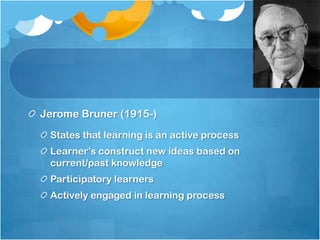
Jerome Bruner (1915-)
States that learning is an active process
Learner’s construct new ideas based on
current/past knowledge
Participatory learners
Actively engaged in learning process
Lev Vygotsky (1894-1934)
Zone of Proximal Development (ZPD)
Refers to what learner can do with help
Kids worked better when collaborating
John Dewey (1859-1952)
Teachers should create activities that is concrete
and relevant to students
Education is a social process
Viewed learning as student-directed
Teacher is a guide
Students learn by doing
Classroom Implications
Teachers without technology
Analyze and study
students
Create activities that
build upon findings
Serve as guide for
resources
Make education relevant
Teachers with technology
Use computers to track
progress
Use teacher resource
websites for activities
Find technology
appropriate for students
Classroom Implications
Students without
technology
Cooperate with others
Discovery learning
Learn by doing
Analyze problems and
think critically
Students with
technology
Use the internet for
research
Electronic flashcards
Use of digital media
Use of technology as a
tool to learn
What we think
We all actually really like this theory a lot. In a lot of
our classes, the three of us have had professors say
that this is actually the direction that teaching is
heading, where the students lead in the education,
and we, as the educators, are there as a guide. We
think that it’s always interesting to hear what the
students have to say during discussions and we do
agree with this theory that learning by doing is the
best way to go about it. The students not only retain
more information that way, but they also are an active
participant in their own education.
Credits
Information gathered from:
Atherton J S (2011) Learning and Teaching;
Constructivism in learning [On-line: UK] retrieved 18 April
2013 from
http://www.learningandteaching.info/learning/constructivi
sm.htm
Shelly, Gary B., Glenda A. Gunter, and Randolph E. Gunter.
Teachers Discovering Computers: Integrating Technology
in a Connected World. Boston, MA: Course Technology
Cengage Learning, 2012. Print.
Credits
Pictures gathered from:
http://www.learningandteaching.info/learning/constructivism.htm
(ZDP)
http://www.nndb.com/people/359/000094077/ (Jean Piaget)
http://dewey.pragmatism.org (John Dewey)
http://edtech2.boisestate.edu/flemmerl/EDTECH575/jeromebruner
.html (Jerome Bruner)
Shelly, Gary B., Glenda A. Gunter, and Randolph E. Gunter.
Teachers Discovering Computers: Integrating Technology in a
Connected World. Boston, MA: Course Technology Cengage
Learning, 2012. Print (Cognitive Stages Chart)

Group 5 Constructivism Learning Theorist PowerPoint

  • 2.
    Constructivist Theory Constructivism isbased on a type of learning in which the learner forms, or constructs, much of what he or she learns or comprehends. Cognitive-how the individual learner undsertand things in terms of developmental stages a nd learning styles Social- how meanings and understandings grow out of social encounters
  • 3.
    Key People/Key Points JeanPiaget (1896-1980) Believed children are constructing new knowledge as they move through cognitive stages. Interpret knowledge differently through different stages.
  • 4.
    Cognitive Stages Ages(Approximate) Characteristics of Learning Sensorimotor Birth to 2 years Imitation, learn through senses and motor activities, do not understand the world around them, and egocentric Preoperational 2 to 6/7 years Egocentric, pretend play, drawing ability, speech and communication development, concrete thinking, and intuitive reasoning Concrete operational 6/7 years to 11/12 years Classification, logical reasoning, problem solving, and beginnings of abstract thinking Formal operational 11/12 years through adulthood Comparative reasoning, abstract thinking, deductive logic, and test hypotheses
  • 5.
    Jerome Bruner (1915-) Statesthat learning is an active process Learner’s construct new ideas based on current/past knowledge Participatory learners Actively engaged in learning process
  • 6.
    Lev Vygotsky (1894-1934) Zoneof Proximal Development (ZPD) Refers to what learner can do with help Kids worked better when collaborating
  • 7.
    John Dewey (1859-1952) Teachersshould create activities that is concrete and relevant to students Education is a social process Viewed learning as student-directed Teacher is a guide Students learn by doing
  • 8.
    Classroom Implications Teachers withouttechnology Analyze and study students Create activities that build upon findings Serve as guide for resources Make education relevant Teachers with technology Use computers to track progress Use teacher resource websites for activities Find technology appropriate for students
  • 9.
    Classroom Implications Students without technology Cooperatewith others Discovery learning Learn by doing Analyze problems and think critically Students with technology Use the internet for research Electronic flashcards Use of digital media Use of technology as a tool to learn
  • 10.
    What we think Weall actually really like this theory a lot. In a lot of our classes, the three of us have had professors say that this is actually the direction that teaching is heading, where the students lead in the education, and we, as the educators, are there as a guide. We think that it’s always interesting to hear what the students have to say during discussions and we do agree with this theory that learning by doing is the best way to go about it. The students not only retain more information that way, but they also are an active participant in their own education.
  • 11.
    Credits Information gathered from: AthertonJ S (2011) Learning and Teaching; Constructivism in learning [On-line: UK] retrieved 18 April 2013 from http://www.learningandteaching.info/learning/constructivi sm.htm Shelly, Gary B., Glenda A. Gunter, and Randolph E. Gunter. Teachers Discovering Computers: Integrating Technology in a Connected World. Boston, MA: Course Technology Cengage Learning, 2012. Print.
  • 12.
    Credits Pictures gathered from: http://www.learningandteaching.info/learning/constructivism.htm (ZDP) http://www.nndb.com/people/359/000094077/(Jean Piaget) http://dewey.pragmatism.org (John Dewey) http://edtech2.boisestate.edu/flemmerl/EDTECH575/jeromebruner .html (Jerome Bruner) Shelly, Gary B., Glenda A. Gunter, and Randolph E. Gunter. Teachers Discovering Computers: Integrating Technology in a Connected World. Boston, MA: Course Technology Cengage Learning, 2012. Print (Cognitive Stages Chart)