Conscious parentingConscious parenting
By Formative AgeBy Formative Age
Introduction
• The first 2 yrs of life are very important
for the development of the child>
• Learning the right answers may get a
child through school but learning how to
become a life long independent learner
will take the child anywhere.
• So are we as parents going to entrust this
important job to the school, teachers or
are we going to partnership with them
Philosophy of “The
Montessori Method”
• The Montessori Method was started
by Dr. Maria Montessori.
• Dr. Montessori taught us to look at
each child as a unique being.
• Each child is born with a
predetermined pattern of unique
potentials.
Philosophy cont.
• Children carry within themselves a
key to their own development
• Hence education must march to the
tune of their development.
• Environment helps this process.
Creating Just The Right
Environment
• Engaging Cooperation
• Encouraging Independence
• Freedom Within limits
• Rewards
• Punishments
• Praise
• Role Modeling
Activity
Take a few mins to think about what it
is that you insist your children do or
don’t do during a typical day.
Commonly used methods to
get children to cooperate
• Blaming and accusing.
• Threats.
• Commands.
• Lecturing
• Warning
• Comparison
• Sarcasm
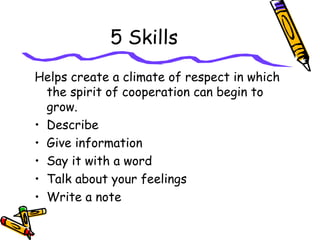
5 Skills
Helps create a climate of respect in which
the spirit of cooperation can begin to
grow.
• Describe
• Give information
• Say it with a word
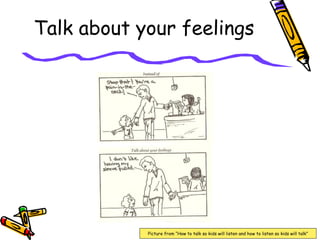
• Talk about your feelings
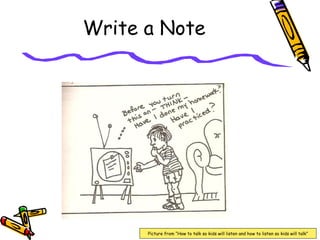
• Write a note
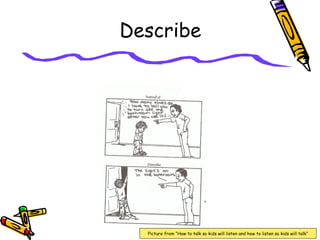
Describe
Picture from “How to talk so kids will listen and how to listen so kids will talk”
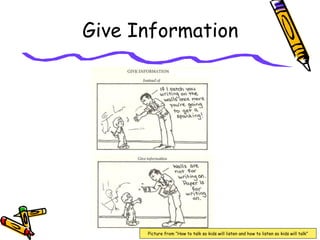
Give Information
Picture from “How to talk so kids will listen and how to listen so kids will talk”
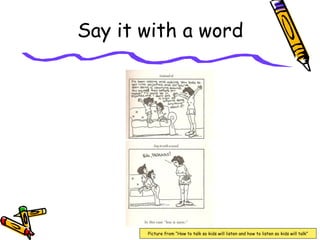
Say it with a word
Picture from “How to talk so kids will listen and how to listen so kids will talk”
Talk about your feelings
Picture from “How to talk so kids will listen and how to listen so kids will talk”
Write a Note
Picture from “How to talk so kids will listen and how to listen so kids will talk”
Encouraging
Independence
• To encourage Independence
• Allow children to do things by
themselves
• Let them wrestle with their own
problems.
• Learn from their own mistakes.
• Let them make their own choices
Independence cont.
• Show respect for a child’s
struggle/efforts.
• Don’t rush to answer questions.
• Don’t take away hope.
• Don’t talk about a child in front of
him.
• Encourage children to use sources
outside the home.
Freedom within limits
• For the child’s personality to unfold itself
he has to be given the freedom within
limits.
• Give the child an opportunity to choose
the food he eats, the clothes he wears,
etc.
• When there is a difference in opinion see
it from the child’s perspective before you
say no.There may be a point
Rewards
• Children are intrinsically motivated
with a desire to become independent
and competent beings.
• Rewards create a dependency on
external motivation.
• Observation of Dr. Montessori.
Punishments
• Punishing deprives a child of the
very important inner process of
facing his own behavior.
• Mistakes are an opportunity for
learning
Common Punishments Given
• Spanking,scolding,depriving.
Alternatives to
Punishment
• Help your child develop a friendly
relationship with mistakes.
• Express strong disapproval without
attacking character.
• State expectations.
• Take action.
• Allow the child to experience the
consequence of his misbehavior.
Praise and self esteem
• The nature of a child’s self evaluation has
profound effect on his thinking process,
emotions , desires values and goals.
• Self esteem is the single most significant
key to his behavior.
• What can parents do to enhance self
esteem?
• Story of Bruce and David
Being a Role model
• Children look up to parents as their
role models.
• Do not get defensive when your child
catches you misbehaving.
• Take responsibility for your
misbehavior.
• Children learn by experiencing
things in their surroundings.
How to Praise
• Describe what you see/ not blanket
praise
• Describe what you feel
• Sum up the child’s praise worthy
behavior with a word.
TO SUM UP
• We communicate volumes about how
we feel about our children by the
kind of home we make for them.
• By including children in our family
and showing concerns for their
feelings and respecting their
interests, we tell them how much
they really mean to us

Conscious Parenting

  • 1.
    Conscious parentingConscious parenting ByFormative AgeBy Formative Age
  • 2.
    Introduction • The first2 yrs of life are very important for the development of the child> • Learning the right answers may get a child through school but learning how to become a life long independent learner will take the child anywhere. • So are we as parents going to entrust this important job to the school, teachers or are we going to partnership with them
  • 3.
    Philosophy of “The MontessoriMethod” • The Montessori Method was started by Dr. Maria Montessori. • Dr. Montessori taught us to look at each child as a unique being. • Each child is born with a predetermined pattern of unique potentials.
  • 4.
    Philosophy cont. • Childrencarry within themselves a key to their own development • Hence education must march to the tune of their development. • Environment helps this process.
  • 5.
    Creating Just TheRight Environment • Engaging Cooperation • Encouraging Independence • Freedom Within limits • Rewards • Punishments • Praise • Role Modeling
  • 6.
    Activity Take a fewmins to think about what it is that you insist your children do or don’t do during a typical day.
  • 7.
    Commonly used methodsto get children to cooperate • Blaming and accusing. • Threats. • Commands. • Lecturing • Warning • Comparison • Sarcasm
  • 8.
    5 Skills Helps createa climate of respect in which the spirit of cooperation can begin to grow. • Describe • Give information • Say it with a word • Talk about your feelings • Write a note
  • 9.
    Describe Picture from “Howto talk so kids will listen and how to listen so kids will talk”
  • 10.
    Give Information Picture from“How to talk so kids will listen and how to listen so kids will talk”
  • 11.
    Say it witha word Picture from “How to talk so kids will listen and how to listen so kids will talk”
  • 12.
    Talk about yourfeelings Picture from “How to talk so kids will listen and how to listen so kids will talk”
  • 13.
    Write a Note Picturefrom “How to talk so kids will listen and how to listen so kids will talk”
  • 14.
    Encouraging Independence • To encourageIndependence • Allow children to do things by themselves • Let them wrestle with their own problems. • Learn from their own mistakes. • Let them make their own choices
  • 15.
    Independence cont. • Showrespect for a child’s struggle/efforts. • Don’t rush to answer questions. • Don’t take away hope. • Don’t talk about a child in front of him. • Encourage children to use sources outside the home.
  • 16.
    Freedom within limits •For the child’s personality to unfold itself he has to be given the freedom within limits. • Give the child an opportunity to choose the food he eats, the clothes he wears, etc. • When there is a difference in opinion see it from the child’s perspective before you say no.There may be a point
  • 17.
    Rewards • Children areintrinsically motivated with a desire to become independent and competent beings. • Rewards create a dependency on external motivation. • Observation of Dr. Montessori.
  • 18.
    Punishments • Punishing deprivesa child of the very important inner process of facing his own behavior. • Mistakes are an opportunity for learning Common Punishments Given • Spanking,scolding,depriving.
  • 19.
    Alternatives to Punishment • Helpyour child develop a friendly relationship with mistakes. • Express strong disapproval without attacking character. • State expectations. • Take action. • Allow the child to experience the consequence of his misbehavior.
  • 20.
    Praise and selfesteem • The nature of a child’s self evaluation has profound effect on his thinking process, emotions , desires values and goals. • Self esteem is the single most significant key to his behavior. • What can parents do to enhance self esteem? • Story of Bruce and David
  • 21.
    Being a Rolemodel • Children look up to parents as their role models. • Do not get defensive when your child catches you misbehaving. • Take responsibility for your misbehavior. • Children learn by experiencing things in their surroundings.
  • 22.
    How to Praise •Describe what you see/ not blanket praise • Describe what you feel • Sum up the child’s praise worthy behavior with a word.
  • 23.
    TO SUM UP •We communicate volumes about how we feel about our children by the kind of home we make for them. • By including children in our family and showing concerns for their feelings and respecting their interests, we tell them how much they really mean to us