Fostering Autonomy: Wonder, 
Confidence, and Motivation 
Chapter 7 in Guiding Children’s Social and Emotional Development: A 
Reflective Approach; Katz, Janice Englander; 2014
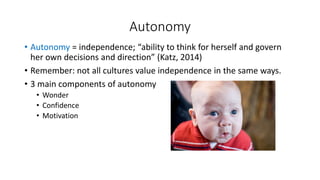
Autonomy 
• Autonomy = independence; “ability to think for herself and govern 
her own decisions and direction” (Katz, 2014) 
• Remember: not all cultures value independence in the same ways. 
• 3 main components of autonomy 
• Wonder 
• Confidence 
• Motivation
Theory in Practice 
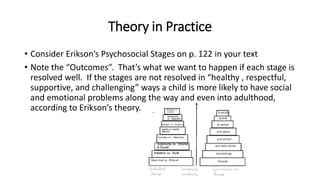
• Consider Erikson’s Psychosocial Stages on p. 122 in your text 
• Note the “Outcomes”. That’s what we want to happen if each stage is 
resolved well. If the stages are not resolved in “healthy , respectful, 
supportive, and challenging” ways a child is more likely to have social 
and emotional problems along the way and even into adulthood, 
according to Erikson’s theory.
3 Components of Autonomy 
• Wonder – curiosity mixed with amazement! 
• Confidence – one’s belief in his/her abilities and influence 
• Does a child believe he is capable of accomplishing a task? 
• Does he recognize that effort contributes to his success? 
• Or, is he fatalistic? In other words, does he believe stuff happens and there is 
little in his control that can change it? 
“I’m a Great Believer in Luck. The Harder I Work, the More Luck I Have” 
(While this is often attributed to Thomas Jefferson, there is no evidence that 
this quote is from him. Good quote, nonetheless)
3 Components of Autonomy (cont.) 
• Remember “Not in Praise of Praise” and similar articles and video clips 
from an earlier module? Look carefully at the bottom of p. 124 in your 
text. 
• Consider the research! Rather than telling a child “You are so smart!”, 
encourage the child and his efforts. Help him build that intrinsic 
motivation! Be specific in offering praise: “How did you manage to balance 
all of those pieces to build that awesome tower?” 
• Caveat: Children with challenging behaviors (often your children with 
special needs) may need extrinsic motivation as they learn new behavior 
skills. The challenge is to know when to wean children off of extrinsic 
motivators. People are rarely satisfied over the long term with extrinsic 
motivators.
Trophies for Everyone 
• Carefully read the bottom of p. 125 to the next section on p. 126. You 
will have a Discussion Board on that section  
We’re All The Best All 
of the time!!!!
What Happens to Wonder, Confidence, and 
Motivation? 
• Do we encourage curiosity and wonder or do we hamper children’s 
interests? 
• Are we still full of wonder, too, or do we squash children’s excitement 
and wonder? 
• Do we encourage kids to complete exciting projects or are we always 
telling them it’s time to clean up and, no, they can’t keep it out to 
finish it tomorrow? 
• Do we encourage creativity or expect everyone to complete 
worksheets and get the “right” answers?
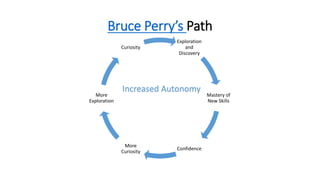
Bruce Perry’s Path 
Exploration 
and 
Discovery 
Mastery of 
New Skills 
Confidence 
More 
Curiosity 
More 
Exploration 
Curiosity 
Increased Autonomy
Contributions to Good Self-Concept and Self- 
Esteem 
• New skills and increased confidence 
• Ability to self-direct and self govern 
• Confidence to work hard, take healthy risks and tackle challenges 
• Confidence to try, fail, rethink, and try again while problem solving and striving to reach 
goals 
• All of these are indicators of self-confidence and a positive self-esteem 
• Note: those suggestions do not include meaningless “praise”, extrinsic motivators, or 
getting all the answers right! We must allow our children to face and accept challenges. 
We do them no favors if we work too hard to make life easier for them or expect them to 
follow our carefully orchestrated script! Of course, all of this needs to be done based on 
our knowledge of child development. A healthy dose of the familiar with new challenges 
help our children grow and learn in “healthy, respectful, and supportive environments” 
(NAEYC Key Element 1c)
Other Benefits 
• Cognitive flexibility 
• Success in the workplace – begins in the early childhood years 
• Positive relationships 
• Even today, employers tell us at CCC that they want employees who 
can problem solve and are team oriented. They say they can train 
employees to do needed tasks, but it is the soft skills associated with 
autonomy make the best employees.
Causes of Variations in Skill Levels 
• Temperament – set by nature, influenced by experiences 
• Reactions to new situations – who is uninhibited and who needs prompting? 
• Ability to adapt – Who adjusts to change easily and who lacks flexibility? 
• Ability to persist – Who can follow through to achieve results and who fails to finish? 
• Attachment and relationships 
• Secure attachments or failure to bond? – may be the result of family dynamics 
and/or exceptionalities 
• Social referencing – a typical behavior in young children with healthy and secure 
attachments. As they wander away to explore new experiences, they will look back 
or come back for approval before continuing on. 
• Responding to a baby’s cry helps develop secure attachments and does not spoil a 
baby! As a baby gets older, she is developmentally ready to begin comforting herself 
and should be given the opportunity to do so.
Safety and Security or Crushing Autonomy 
Skills? 
• Childproofing or “I’ll teach them what they can’t touch” 
• A safe area for gross motor development or “Don’t climb (jump, run) 
because you might get hurt” 
• Multiple items and/or lessons in taking turns or “If you can’t share, we will 
just put the toy away” 
• Places for long-term projects to continue or “We have to put everything 
away because center time is over” 
• “What an interesting idea for ____. What made you think of that?” or 
“Stay in your center and do not get items from one center and take them to 
another.” 
• Read the vignettes on pp. 130 and 131 in your text. Tilly certainly is a “good 
little girl”, huh?
Reflections 
• Consider the paragraph that begins on p. 132 in your text with “What 
are you passionate about?” (Katz, 2014) 
• Unfortunately, many of us have had our curiosity and wonder 
discouraged and squashed. Consider the “Looking in the Mirror. . .” 
questions on pp. 132 and 133. How can we regain some of our 
wonder, confidence, and motivation so we can model and share with 
the children in our care? 
• How do we balance Developmentally Appropriate Practice with the 
current academic school climate that focuses on math and reading 
and testing? 
• If a child can’t learn the way we teach, maybe we should teach the 
way they learn. Michael J. Fox
What to Do! 
• Know each and every child as individuals. 
• Provide interesting, creative (not cookie cutter!) activities and 
opportunities based on their interests 
• Find ways to understand children’s behaviors to help them learn to find 
fulfillment in more appropriate ways (rather than always reacting with 
punishment) 
• Know child development so that materials and activities that are provided 
are safe and developmentally appropriate for the age and development 
• Allow children to get messy in positive ways but utilize natural 
consequences 
• Provide choices on developmentally appropriate levels
More Vignettes! 
• Read the vignettes on pp. 136 and 137 in your text 
• How often do we limit the number of children in a center? 
• According to ECERS (Harms, Clifford, and Cryer, 2005) and Item 35. Free 
Play, children should have free play that “occurs for a substantial portion of 
the day both indoors and outdoors” in 5.1. In Notes for Clarification for 
Item 35 in general, it says “Child is permitted to select materials and 
companions, and as far as possible manage play independently. . . 
Situations in which children are assigned to centers by staff or staff select 
the materials that individual children may use do not count as free play.” 
• And, in Notes for Clarification 3.1 – “. . .The number of centers may be 
limited as long as the children may choose where, with what, and with 
whom they play. . .”
What to Do! (cont.) 
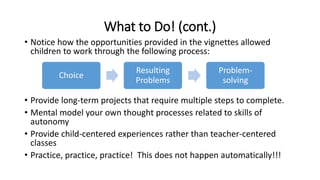
• Notice how the opportunities provided in the vignettes allowed 
children to work through the following process: 
Choice 
Resulting 
Problems 
Problem-solving 
• Provide long-term projects that require multiple steps to complete. 
• Mental model your own thought processes related to skills of 
autonomy 
• Provide child-centered experiences rather than teacher-centered 
classes 
• Practice, practice, practice! This does not happen automatically!!!
References 
• Harms, T. (2005). Early childhood environment rating scale: Revised 
edition (Rev. ed.). New York: Teachers College Press. 
• Katz, J. (2014). Guiding children's social and emotional development: 
A reflective approach. Boston: Pearson. 
• Perry, Bruce D (2001, March 1). Curiosity: The Fuel of Development. 
Retrieved October 15, 2014, from Scholastic: 
http://teacher.scholastic.com/professional/bruceperry/curiosity.htm

Fostering autonomy

  • 1.
    Fostering Autonomy: Wonder, Confidence, and Motivation Chapter 7 in Guiding Children’s Social and Emotional Development: A Reflective Approach; Katz, Janice Englander; 2014
  • 2.
    Autonomy • Autonomy= independence; “ability to think for herself and govern her own decisions and direction” (Katz, 2014) • Remember: not all cultures value independence in the same ways. • 3 main components of autonomy • Wonder • Confidence • Motivation
  • 3.
    Theory in Practice • Consider Erikson’s Psychosocial Stages on p. 122 in your text • Note the “Outcomes”. That’s what we want to happen if each stage is resolved well. If the stages are not resolved in “healthy , respectful, supportive, and challenging” ways a child is more likely to have social and emotional problems along the way and even into adulthood, according to Erikson’s theory.
  • 4.
    3 Components ofAutonomy • Wonder – curiosity mixed with amazement! • Confidence – one’s belief in his/her abilities and influence • Does a child believe he is capable of accomplishing a task? • Does he recognize that effort contributes to his success? • Or, is he fatalistic? In other words, does he believe stuff happens and there is little in his control that can change it? “I’m a Great Believer in Luck. The Harder I Work, the More Luck I Have” (While this is often attributed to Thomas Jefferson, there is no evidence that this quote is from him. Good quote, nonetheless)
  • 5.
    3 Components ofAutonomy (cont.) • Remember “Not in Praise of Praise” and similar articles and video clips from an earlier module? Look carefully at the bottom of p. 124 in your text. • Consider the research! Rather than telling a child “You are so smart!”, encourage the child and his efforts. Help him build that intrinsic motivation! Be specific in offering praise: “How did you manage to balance all of those pieces to build that awesome tower?” • Caveat: Children with challenging behaviors (often your children with special needs) may need extrinsic motivation as they learn new behavior skills. The challenge is to know when to wean children off of extrinsic motivators. People are rarely satisfied over the long term with extrinsic motivators.
  • 6.
    Trophies for Everyone • Carefully read the bottom of p. 125 to the next section on p. 126. You will have a Discussion Board on that section  We’re All The Best All of the time!!!!
  • 7.
    What Happens toWonder, Confidence, and Motivation? • Do we encourage curiosity and wonder or do we hamper children’s interests? • Are we still full of wonder, too, or do we squash children’s excitement and wonder? • Do we encourage kids to complete exciting projects or are we always telling them it’s time to clean up and, no, they can’t keep it out to finish it tomorrow? • Do we encourage creativity or expect everyone to complete worksheets and get the “right” answers?
  • 8.
    Bruce Perry’s Path Exploration and Discovery Mastery of New Skills Confidence More Curiosity More Exploration Curiosity Increased Autonomy
  • 9.
    Contributions to GoodSelf-Concept and Self- Esteem • New skills and increased confidence • Ability to self-direct and self govern • Confidence to work hard, take healthy risks and tackle challenges • Confidence to try, fail, rethink, and try again while problem solving and striving to reach goals • All of these are indicators of self-confidence and a positive self-esteem • Note: those suggestions do not include meaningless “praise”, extrinsic motivators, or getting all the answers right! We must allow our children to face and accept challenges. We do them no favors if we work too hard to make life easier for them or expect them to follow our carefully orchestrated script! Of course, all of this needs to be done based on our knowledge of child development. A healthy dose of the familiar with new challenges help our children grow and learn in “healthy, respectful, and supportive environments” (NAEYC Key Element 1c)
  • 10.
    Other Benefits •Cognitive flexibility • Success in the workplace – begins in the early childhood years • Positive relationships • Even today, employers tell us at CCC that they want employees who can problem solve and are team oriented. They say they can train employees to do needed tasks, but it is the soft skills associated with autonomy make the best employees.
  • 11.
    Causes of Variationsin Skill Levels • Temperament – set by nature, influenced by experiences • Reactions to new situations – who is uninhibited and who needs prompting? • Ability to adapt – Who adjusts to change easily and who lacks flexibility? • Ability to persist – Who can follow through to achieve results and who fails to finish? • Attachment and relationships • Secure attachments or failure to bond? – may be the result of family dynamics and/or exceptionalities • Social referencing – a typical behavior in young children with healthy and secure attachments. As they wander away to explore new experiences, they will look back or come back for approval before continuing on. • Responding to a baby’s cry helps develop secure attachments and does not spoil a baby! As a baby gets older, she is developmentally ready to begin comforting herself and should be given the opportunity to do so.
  • 12.
    Safety and Securityor Crushing Autonomy Skills? • Childproofing or “I’ll teach them what they can’t touch” • A safe area for gross motor development or “Don’t climb (jump, run) because you might get hurt” • Multiple items and/or lessons in taking turns or “If you can’t share, we will just put the toy away” • Places for long-term projects to continue or “We have to put everything away because center time is over” • “What an interesting idea for ____. What made you think of that?” or “Stay in your center and do not get items from one center and take them to another.” • Read the vignettes on pp. 130 and 131 in your text. Tilly certainly is a “good little girl”, huh?
  • 13.
    Reflections • Considerthe paragraph that begins on p. 132 in your text with “What are you passionate about?” (Katz, 2014) • Unfortunately, many of us have had our curiosity and wonder discouraged and squashed. Consider the “Looking in the Mirror. . .” questions on pp. 132 and 133. How can we regain some of our wonder, confidence, and motivation so we can model and share with the children in our care? • How do we balance Developmentally Appropriate Practice with the current academic school climate that focuses on math and reading and testing? • If a child can’t learn the way we teach, maybe we should teach the way they learn. Michael J. Fox
  • 14.
    What to Do! • Know each and every child as individuals. • Provide interesting, creative (not cookie cutter!) activities and opportunities based on their interests • Find ways to understand children’s behaviors to help them learn to find fulfillment in more appropriate ways (rather than always reacting with punishment) • Know child development so that materials and activities that are provided are safe and developmentally appropriate for the age and development • Allow children to get messy in positive ways but utilize natural consequences • Provide choices on developmentally appropriate levels
  • 15.
    More Vignettes! •Read the vignettes on pp. 136 and 137 in your text • How often do we limit the number of children in a center? • According to ECERS (Harms, Clifford, and Cryer, 2005) and Item 35. Free Play, children should have free play that “occurs for a substantial portion of the day both indoors and outdoors” in 5.1. In Notes for Clarification for Item 35 in general, it says “Child is permitted to select materials and companions, and as far as possible manage play independently. . . Situations in which children are assigned to centers by staff or staff select the materials that individual children may use do not count as free play.” • And, in Notes for Clarification 3.1 – “. . .The number of centers may be limited as long as the children may choose where, with what, and with whom they play. . .”
  • 16.
    What to Do!(cont.) • Notice how the opportunities provided in the vignettes allowed children to work through the following process: Choice Resulting Problems Problem-solving • Provide long-term projects that require multiple steps to complete. • Mental model your own thought processes related to skills of autonomy • Provide child-centered experiences rather than teacher-centered classes • Practice, practice, practice! This does not happen automatically!!!
  • 17.
    References • Harms,T. (2005). Early childhood environment rating scale: Revised edition (Rev. ed.). New York: Teachers College Press. • Katz, J. (2014). Guiding children's social and emotional development: A reflective approach. Boston: Pearson. • Perry, Bruce D (2001, March 1). Curiosity: The Fuel of Development. Retrieved October 15, 2014, from Scholastic: http://teacher.scholastic.com/professional/bruceperry/curiosity.htm