SPC - 7 BASIC TOOLS
2013.10.22
By ML
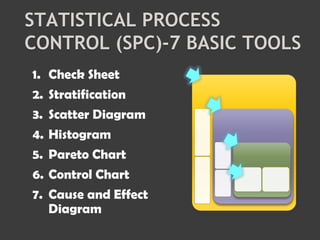
STATISTICAL PROCESS
CONTROL (SPC)-7 BASIC TOOLS
1.
2.
3.
4.
5.
6.
7.

Check Sheet
Stratification
Scatter Diagram
Histogram
Pareto Chart
Control Chart
Cause and Effect
Diagram
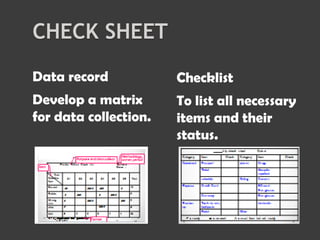
CHECK SHEET
Data record

Checklist

Develop a matrix
for data collection.

To list all necessary
items and their
status.
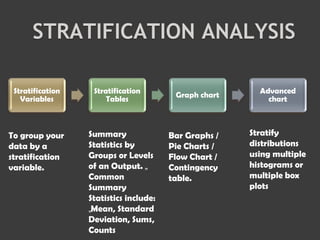
STRATIFICATION ANALYSIS
Stratification
Variables

To group your
data by a
stratification
variable.

Stratification
Tables

Summary
Statistics by
Groups or Levels
of an Output. „
Common
Summary
Statistics include:
„Mean, Standard
Deviation, Sums,
Counts

Graph chart

Bar Graphs /
Pie Charts /
Flow Chart /
Contingency
table.

Advanced
chart

Stratify
distributions
using multiple
histograms or
multiple box
plots
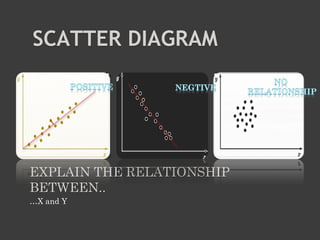
SCATTER DIAGRAM

EXPLAIN THE RELATIONSHIP
BETWEEN..
…X and Y
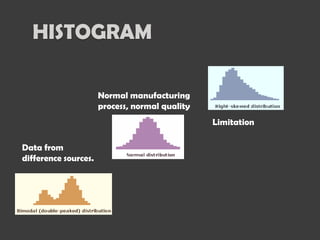
HISTOGRAM
Normal manufacturing
process, normal quality
Limitation
Data from
difference sources.
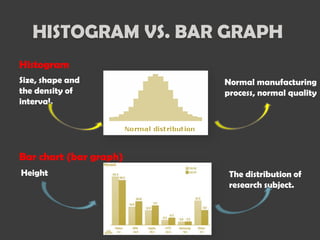
HISTOGRAM VS. BAR GRAPH
Histogram
Size, shape and
the density of
interval.

Normal manufacturing
process, normal quality

Bar chart (bar graph)
Height

The distribution of
research subject.
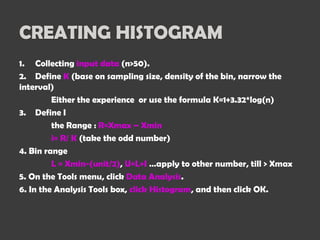
CREATING HISTOGRAM
1. Collecting input data (n>50).
2. Define K (base on sampling size, density of the bin, narrow the
interval)
Either the experience or use the formula K=1+3.32*log(n)
3. Define I
the Range : R=Xmax – Xmin
i= R/ K (take the odd number)
4. Bin range
L = Xmin-(unit/2), U=L+I …apply to other number, till > Xmax
5. On the Tools menu, click Data Analysis.
6. In the Analysis Tools box, click Histogram, and then click OK.
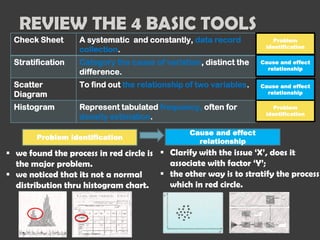
REVIEW THE 4 BASIC TOOLS
Check Sheet

A systematic and constantly, data record
collection.

Stratification

Category the cause of variation, distinct the
difference.

Cause and effect
relationship

Scatter
Diagram

To find out the relationship of two variables.

Cause and effect
relationship

Histogram

Represent tabulated frequency, often for
density estimation.

Problem identification

Problem
identification

Problem
identification

Cause and effect
relationship

 we found the process in red circle is  Clarify with the issue ‘X’, does it
associate with factor ‘Y’;
the major problem.
 the other way is to stratify the process
 we noticed that its not a normal
which in red circle.
distribution thru histogram chart.
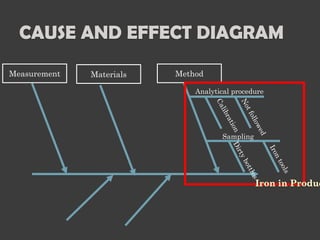
CAUSE AND EFFECT DIAGRAM
Measurement

Materials

Method
Analytical procedure

Sampling
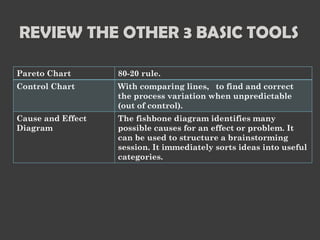
REVIEW THE OTHER 3 BASIC TOOLS
Pareto Chart

80-20 rule.

Control Chart

With comparing lines, to find and correct
the process variation when unpredictable
(out of control).

Cause and Effect
Diagram

The fishbone diagram identifies many
possible causes for an effect or problem. It
can be used to structure a brainstorming
session. It immediately sorts ideas into useful
categories.
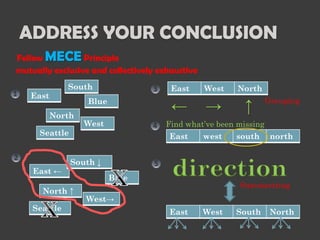
ADDRESS YOUR CONCLUSION
Follow MECE Principle
mutually exclusive and collectively exhaustive
South

East

East

North
Seattle

East ←

→

↑

Grouping

Find what’ve been missing
East

South ↓

North ↑
Seattle

West

North

←

Blue

West

Blue

west

south

north

direction

Summarizing

West→
East

West

South

North

Statistical Process Control (SPC) Tools - 7 Basic Tools

  • 1.
    SPC - 7BASIC TOOLS 2013.10.22 By ML
  • 2.
    STATISTICAL PROCESS CONTROL (SPC)-7BASIC TOOLS 1. 2. 3. 4. 5. 6. 7. Check Sheet Stratification Scatter Diagram Histogram Pareto Chart Control Chart Cause and Effect Diagram
  • 3.
    CHECK SHEET Data record Checklist Developa matrix for data collection. To list all necessary items and their status.
  • 4.
    STRATIFICATION ANALYSIS Stratification Variables To groupyour data by a stratification variable. Stratification Tables Summary Statistics by Groups or Levels of an Output. „ Common Summary Statistics include: „Mean, Standard Deviation, Sums, Counts Graph chart Bar Graphs / Pie Charts / Flow Chart / Contingency table. Advanced chart Stratify distributions using multiple histograms or multiple box plots
  • 5.
    SCATTER DIAGRAM EXPLAIN THERELATIONSHIP BETWEEN.. …X and Y
  • 6.
    HISTOGRAM Normal manufacturing process, normalquality Limitation Data from difference sources.
  • 7.
    HISTOGRAM VS. BARGRAPH Histogram Size, shape and the density of interval. Normal manufacturing process, normal quality Bar chart (bar graph) Height The distribution of research subject.
  • 8.
    CREATING HISTOGRAM 1. Collectinginput data (n>50). 2. Define K (base on sampling size, density of the bin, narrow the interval) Either the experience or use the formula K=1+3.32*log(n) 3. Define I the Range : R=Xmax – Xmin i= R/ K (take the odd number) 4. Bin range L = Xmin-(unit/2), U=L+I …apply to other number, till > Xmax 5. On the Tools menu, click Data Analysis. 6. In the Analysis Tools box, click Histogram, and then click OK.
  • 9.
    REVIEW THE 4BASIC TOOLS Check Sheet A systematic and constantly, data record collection. Stratification Category the cause of variation, distinct the difference. Cause and effect relationship Scatter Diagram To find out the relationship of two variables. Cause and effect relationship Histogram Represent tabulated frequency, often for density estimation. Problem identification Problem identification Problem identification Cause and effect relationship  we found the process in red circle is  Clarify with the issue ‘X’, does it associate with factor ‘Y’; the major problem.  the other way is to stratify the process  we noticed that its not a normal which in red circle. distribution thru histogram chart.
  • 10.
    CAUSE AND EFFECTDIAGRAM Measurement Materials Method Analytical procedure Sampling
  • 11.
    REVIEW THE OTHER3 BASIC TOOLS Pareto Chart 80-20 rule. Control Chart With comparing lines, to find and correct the process variation when unpredictable (out of control). Cause and Effect Diagram The fishbone diagram identifies many possible causes for an effect or problem. It can be used to structure a brainstorming session. It immediately sorts ideas into useful categories.
  • 12.
    ADDRESS YOUR CONCLUSION FollowMECE Principle mutually exclusive and collectively exhaustive South East East North Seattle East ← → ↑ Grouping Find what’ve been missing East South ↓ North ↑ Seattle West North ← Blue West Blue west south north direction Summarizing West→ East West South North