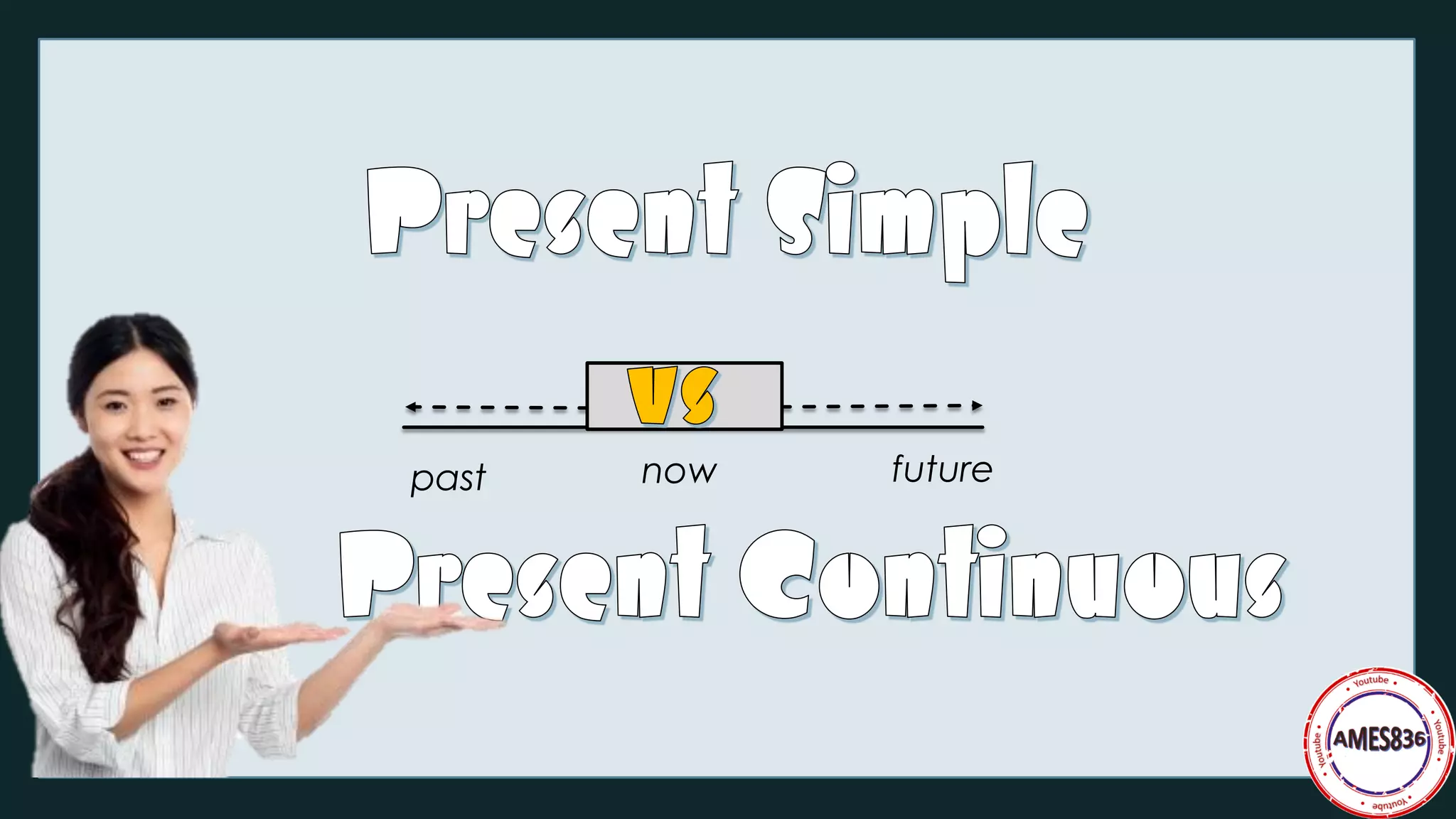
past now future
Present Simple Present Continuous
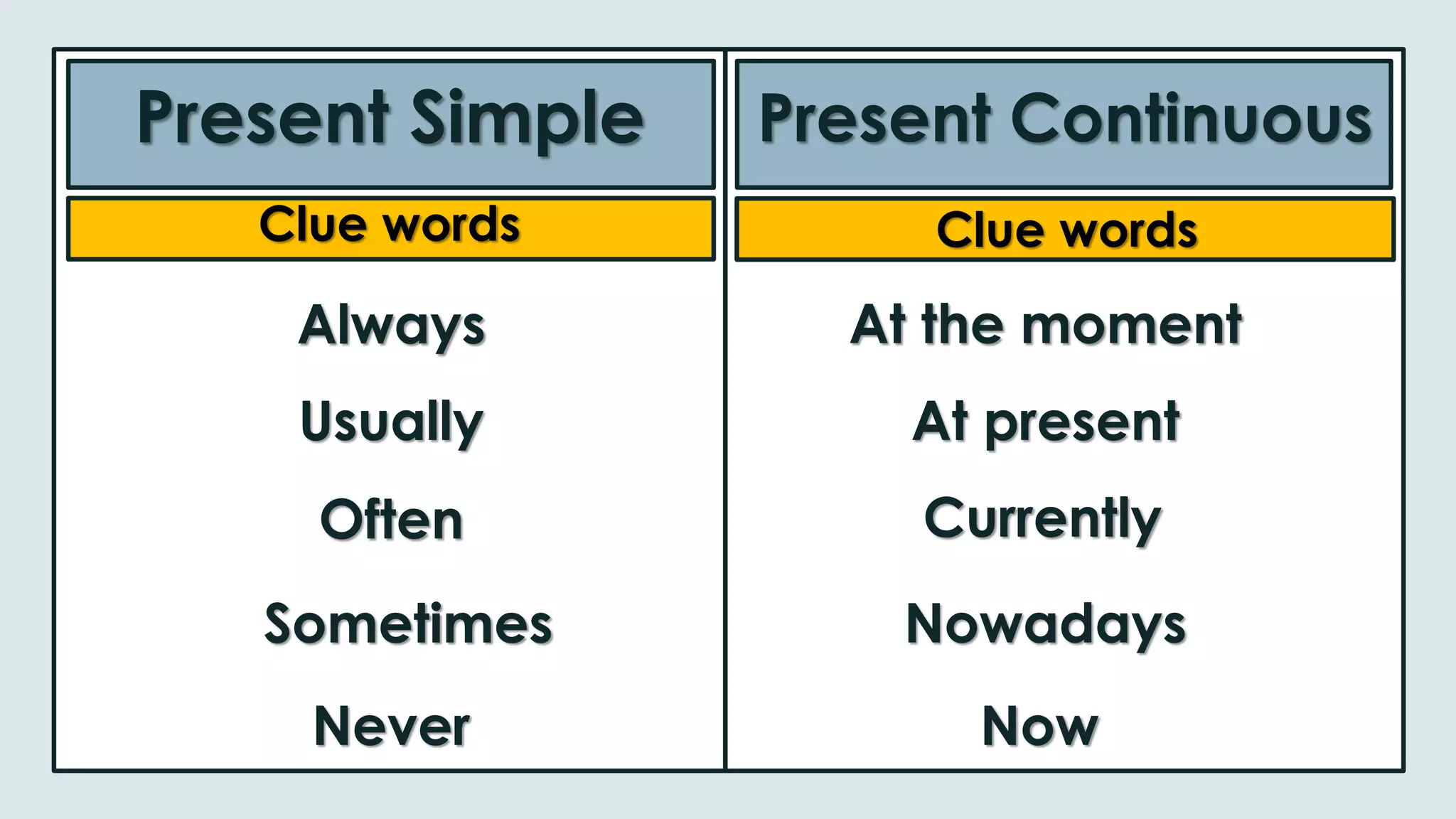
Clue words Clue words
At present
Currently
Usually
Often
Never
NowadaysSometimes
Now
Always At the moment
Present Simple Present Continuous
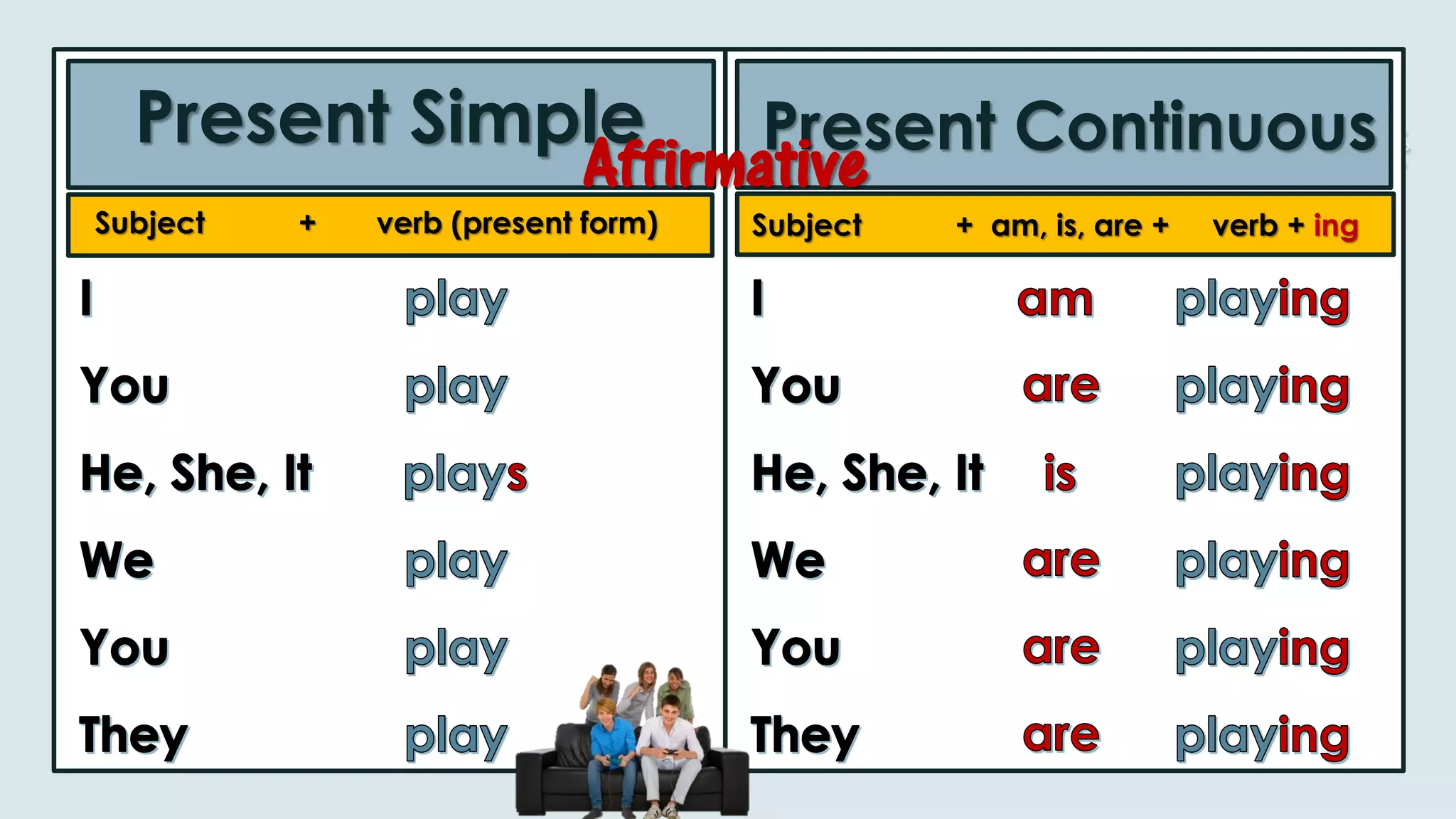
Subject + verb (present form) Subject + am, is, are + verb + ing
Affirmative
Present Simple Present Continuous
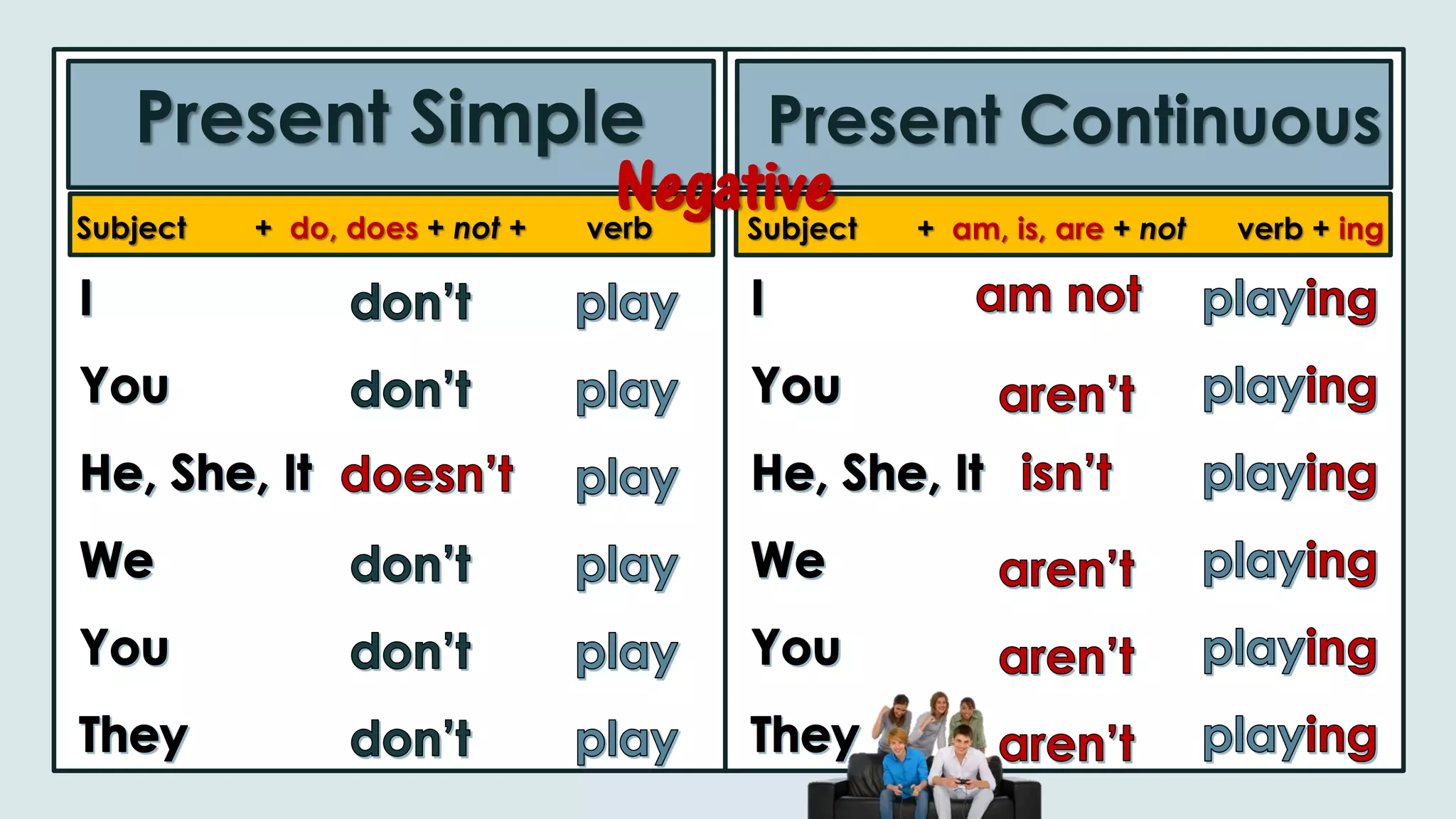
Subject + do, does + not + verb Subject + am, is, are + not verb + ing
Negative
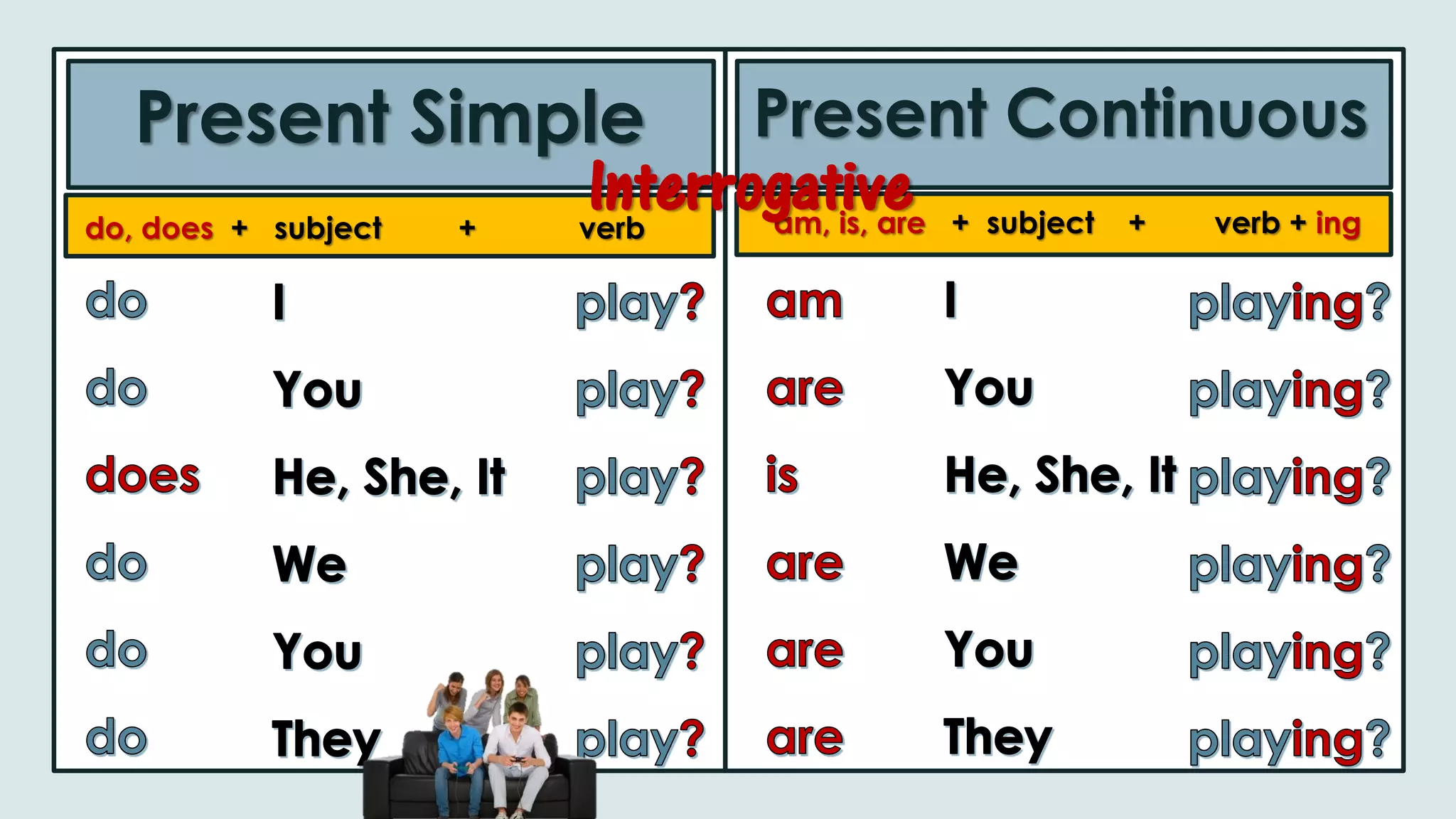
Present Simple Present Continuous
do, does + subject + verb am, is, are + subject + verb + ing
Interrogative
Present Simple Present Continuous
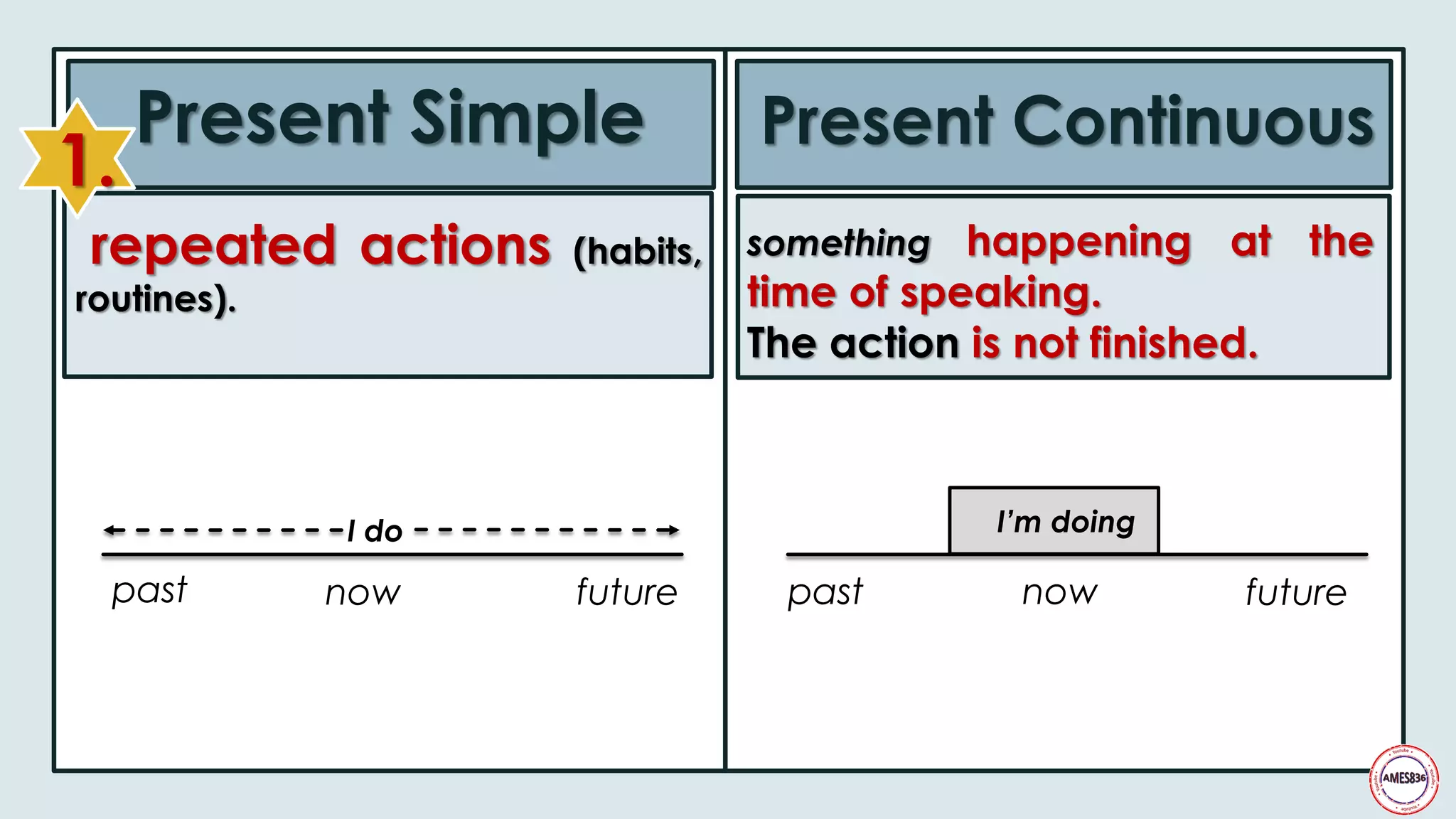
past now past nowfuture future
I’m doingI do
repeated actions (habits,
routines).
something happening at the
time of speaking.
The action is not finished.
1.
Present Simple Present Continuous
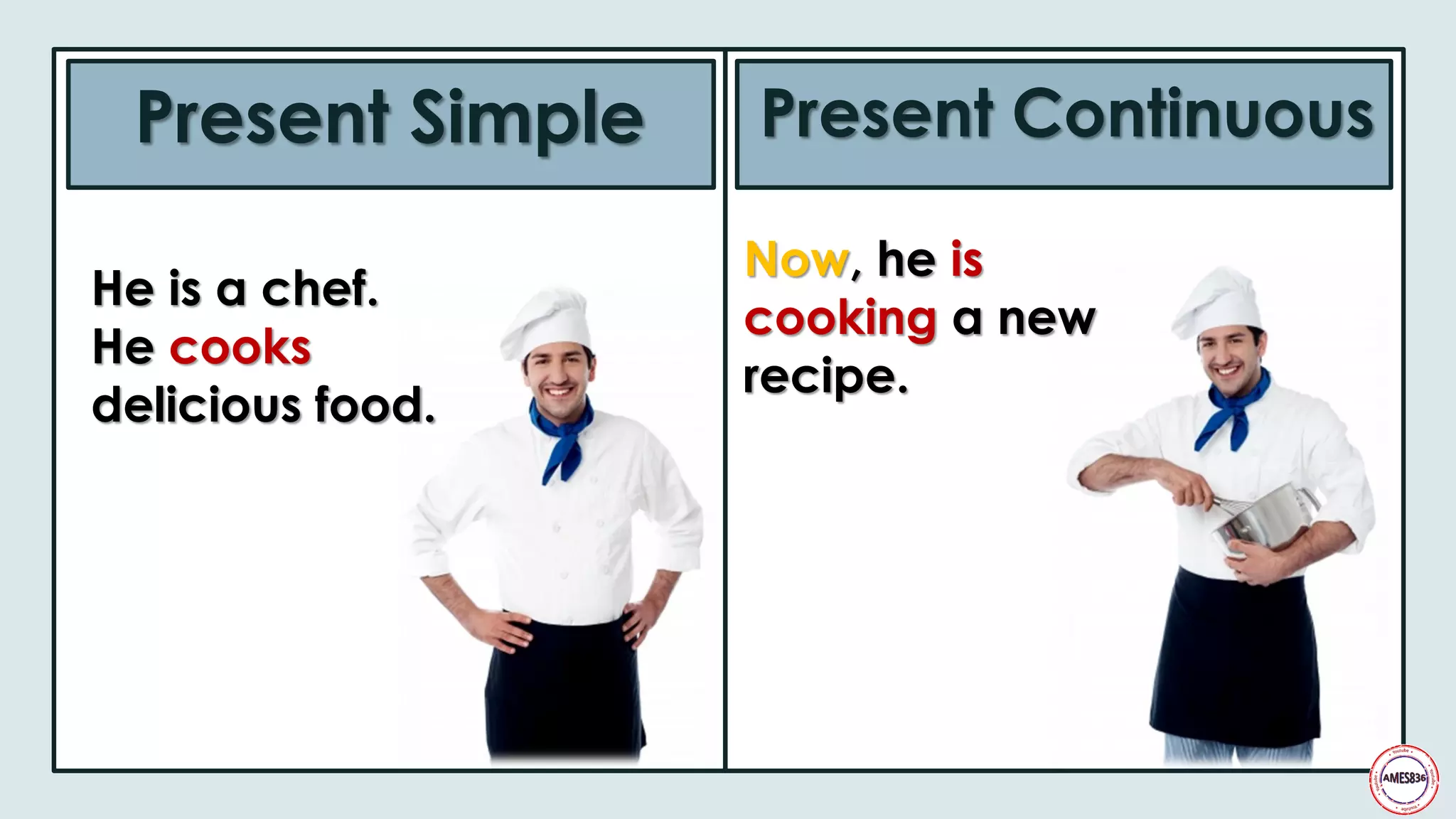
He is a chef.
He cooks
delicious food.
Now, he is
cooking a new
recipe.
Present Simple Present Continuous
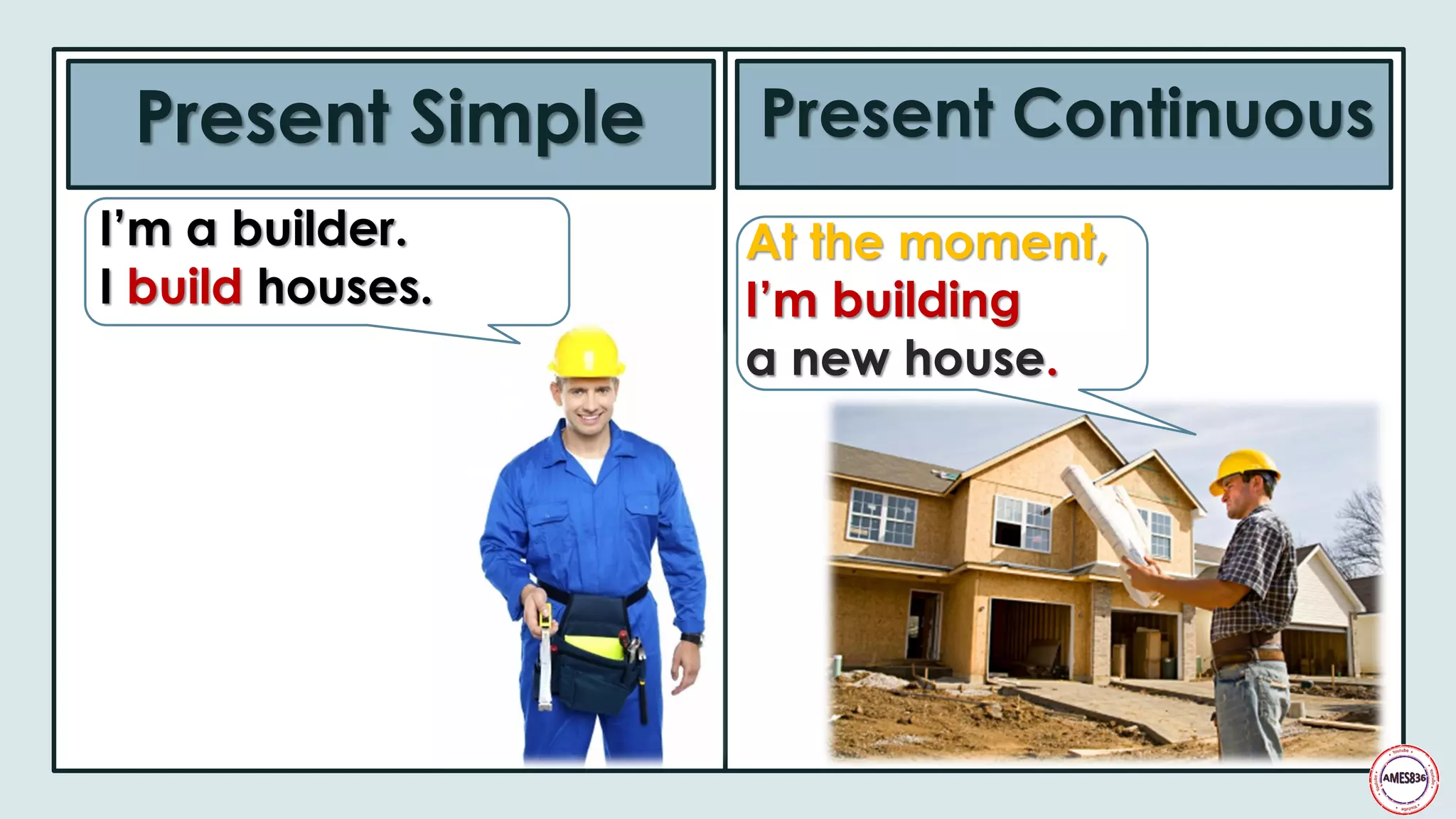
At the moment,
I’m building
a new house.
I’m a builder.
I build houses.
Present Simple Present Continuous
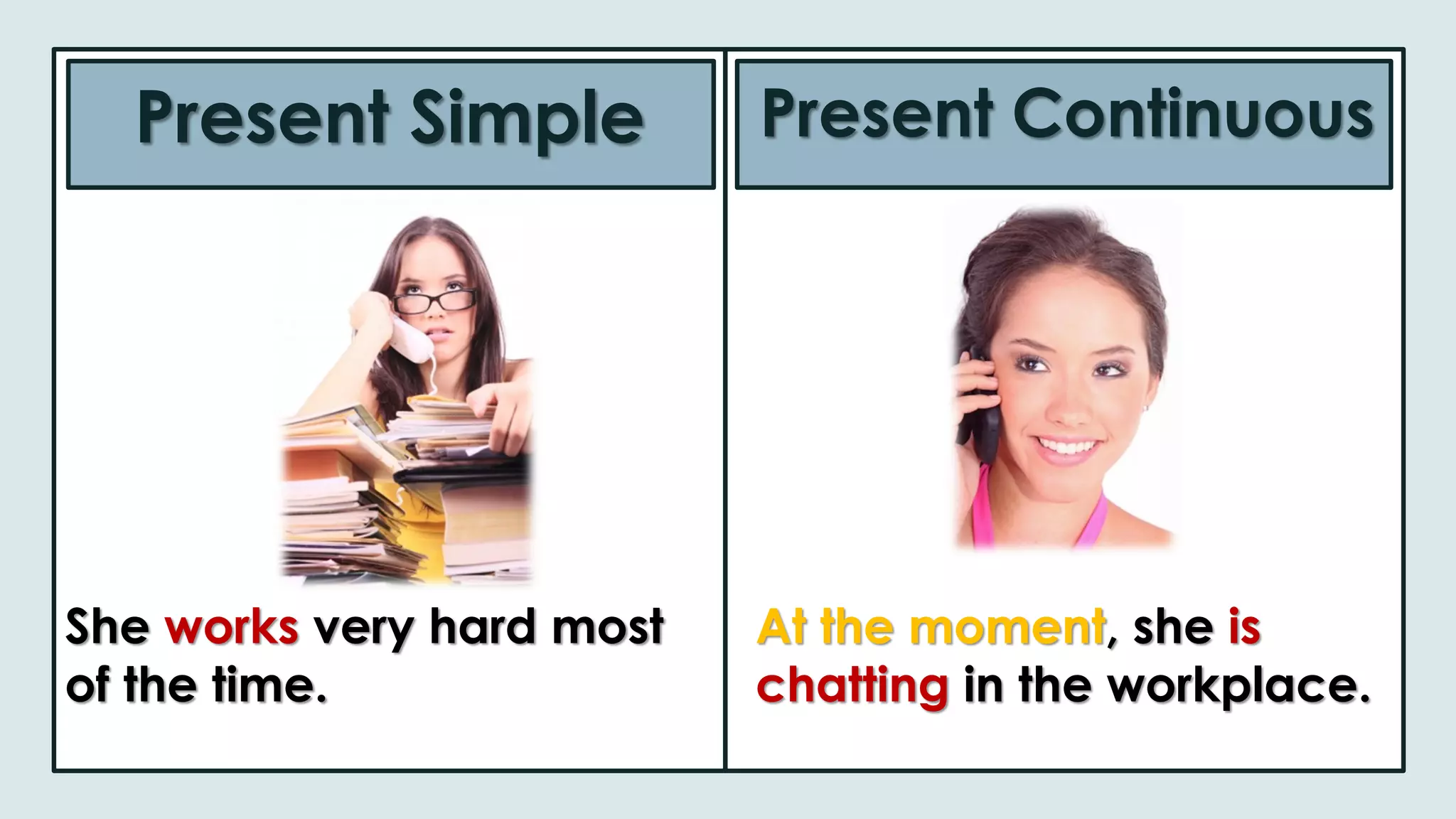
She works very hard most
of the time.
At the moment, she is
chatting in the workplace.
Present Simple Present Continuous
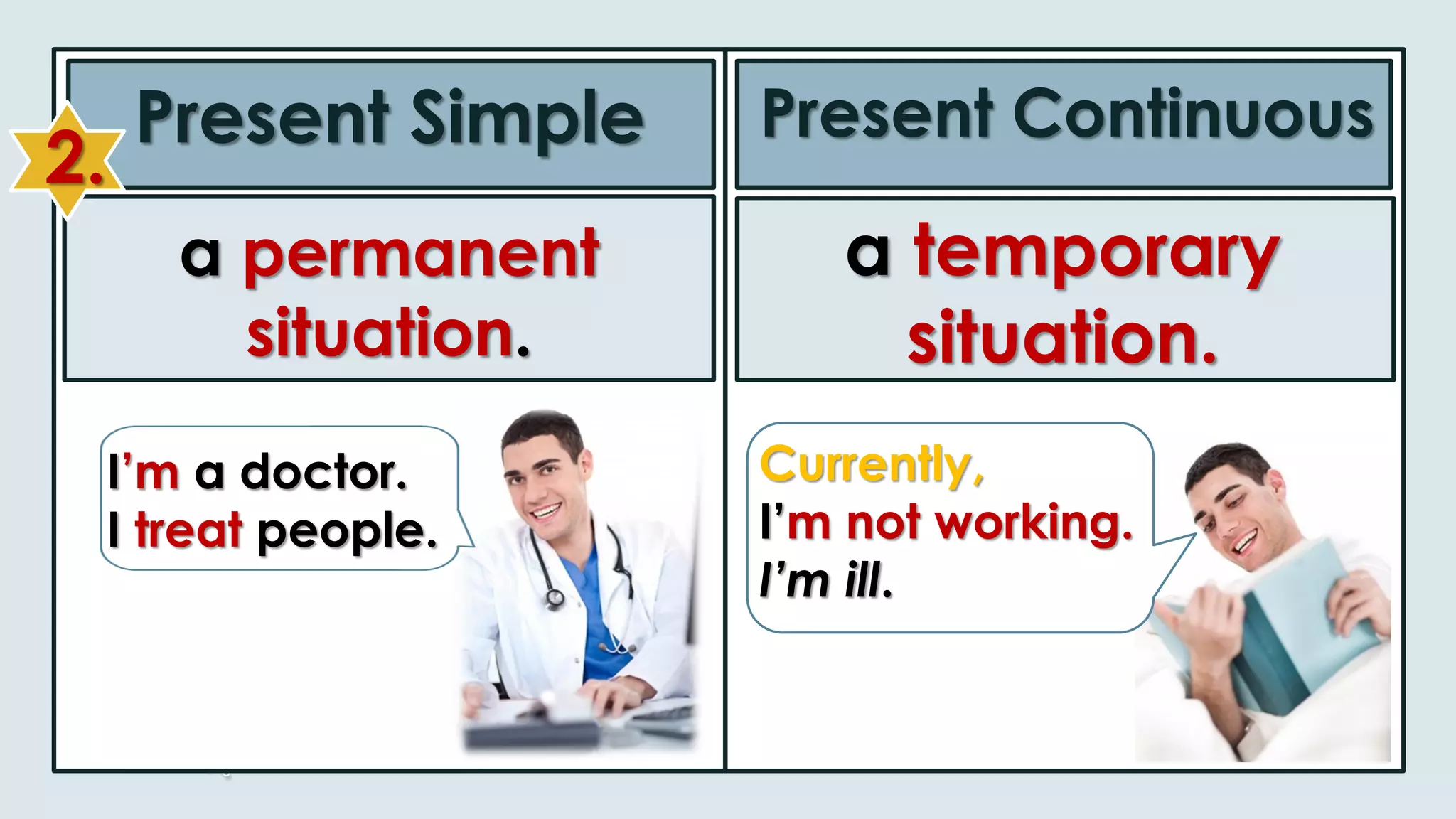
a permanent
situation.
a temporary
situation.
2.
I’m a doctor.
I treat people.
Currently,
I’m not working.
I’m ill.
Present Simple Present Continuous
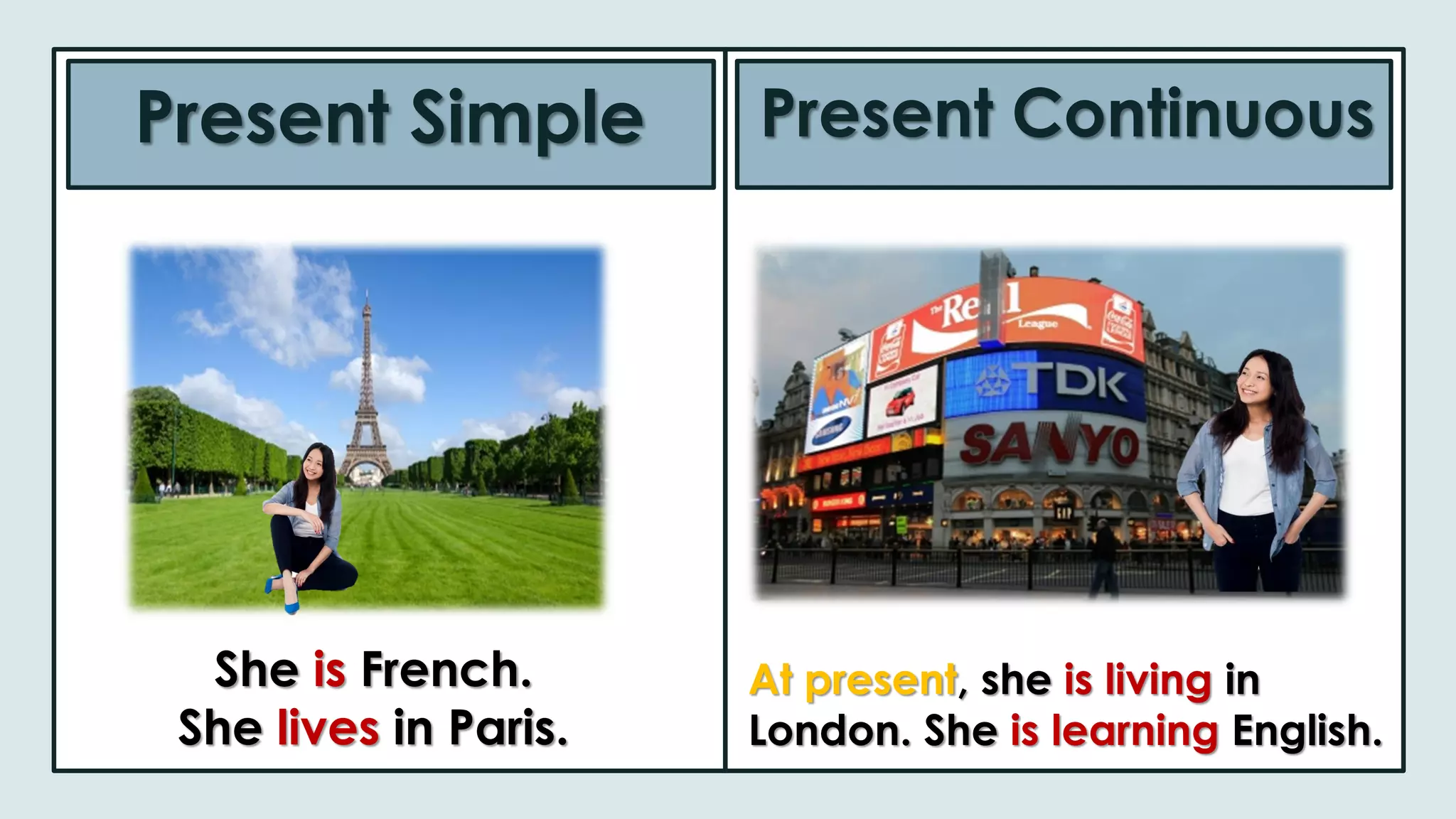
She is French.
She lives in Paris.
At present, she is living in
London. She is learning English.
Present Simple Present Continuous
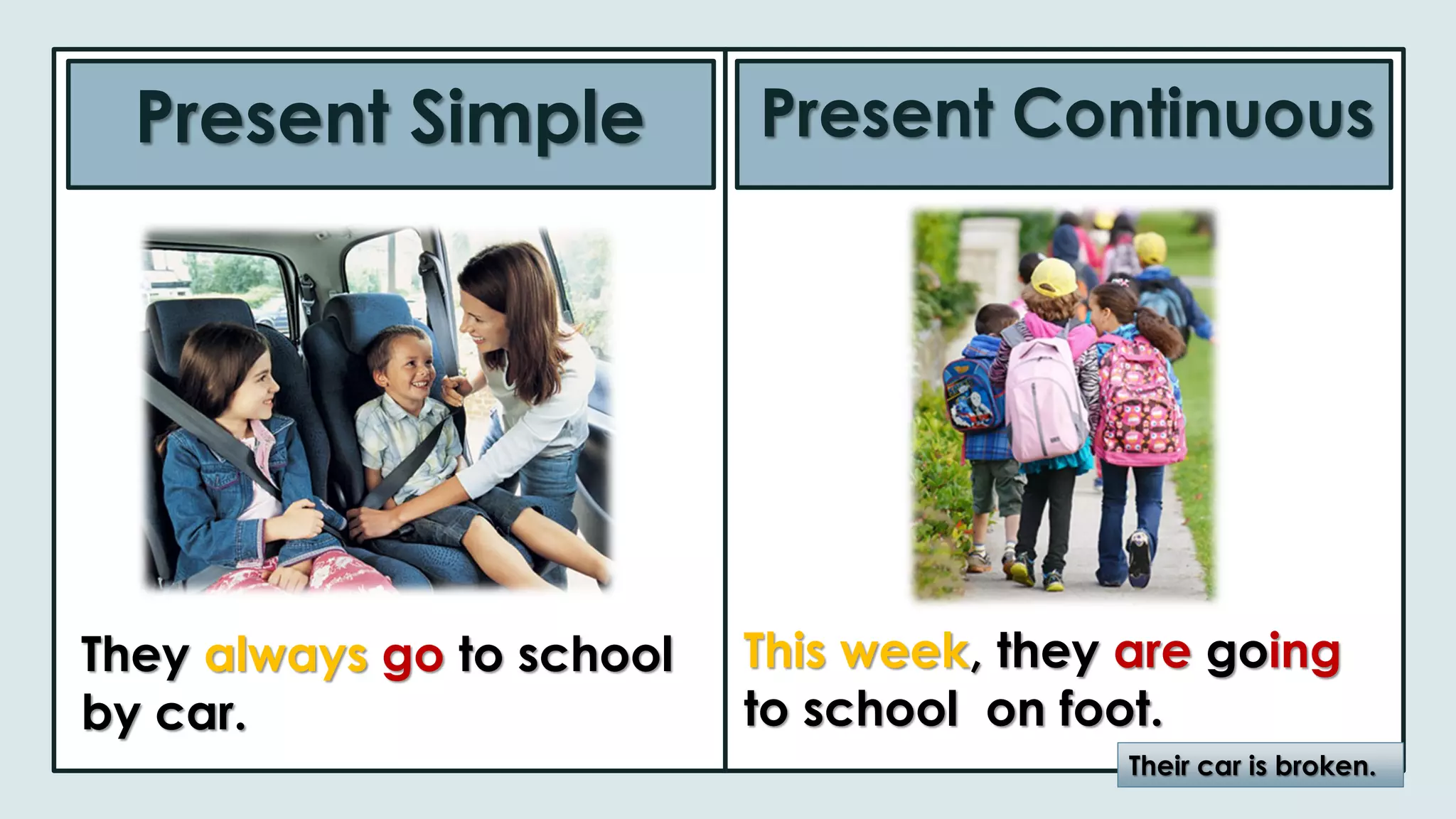
They always go to school
by car.
This week, they are going
to school on foot.
Their car is broken.
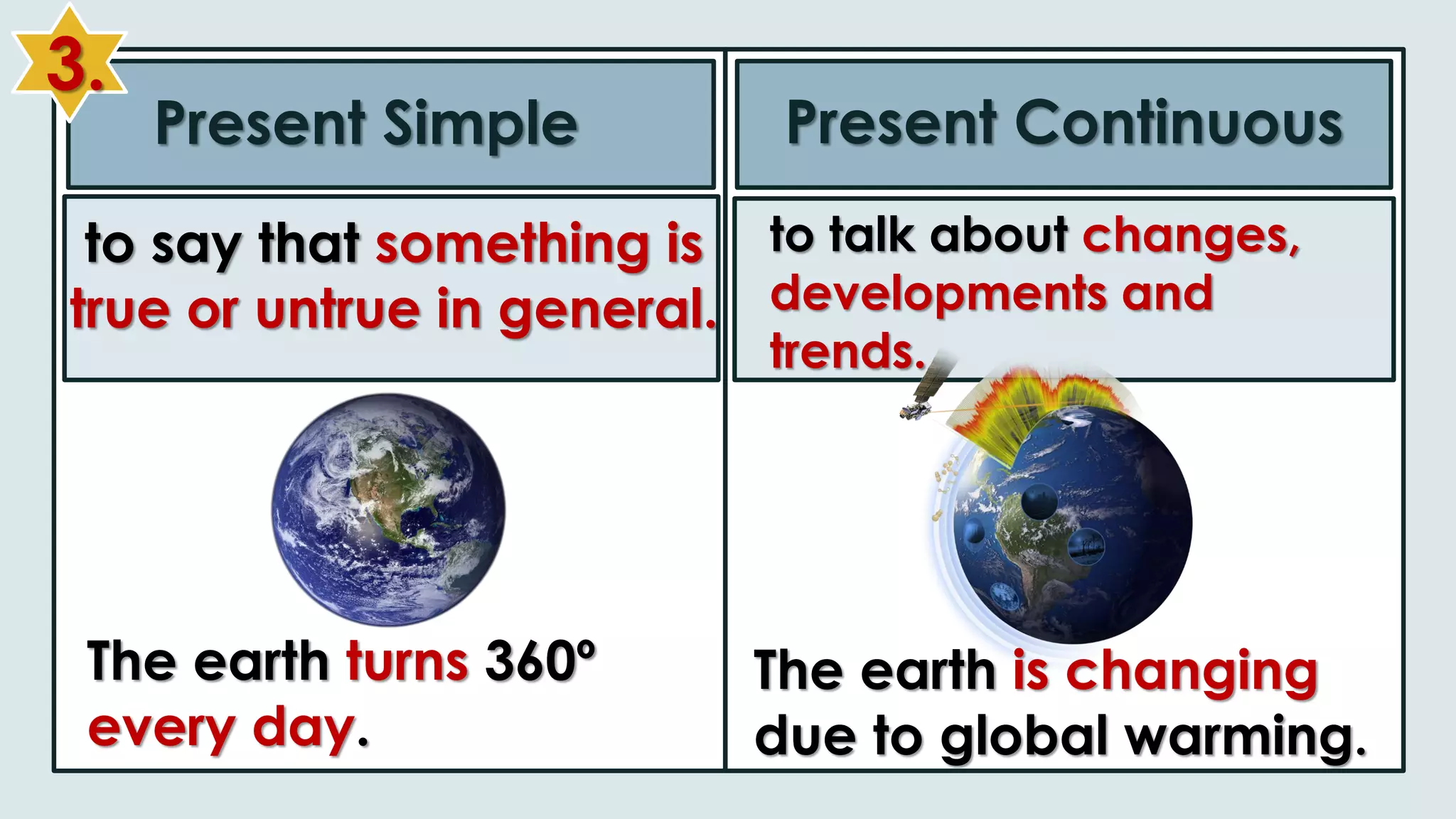
to say that something is
true or untrue in general.
3.
Present Simple Present Continuous
to talk about changes,
developments and
trends.
The earth turns 360º
every day.
The earth is changing
due to global warming.
Present Simple Present Continuous
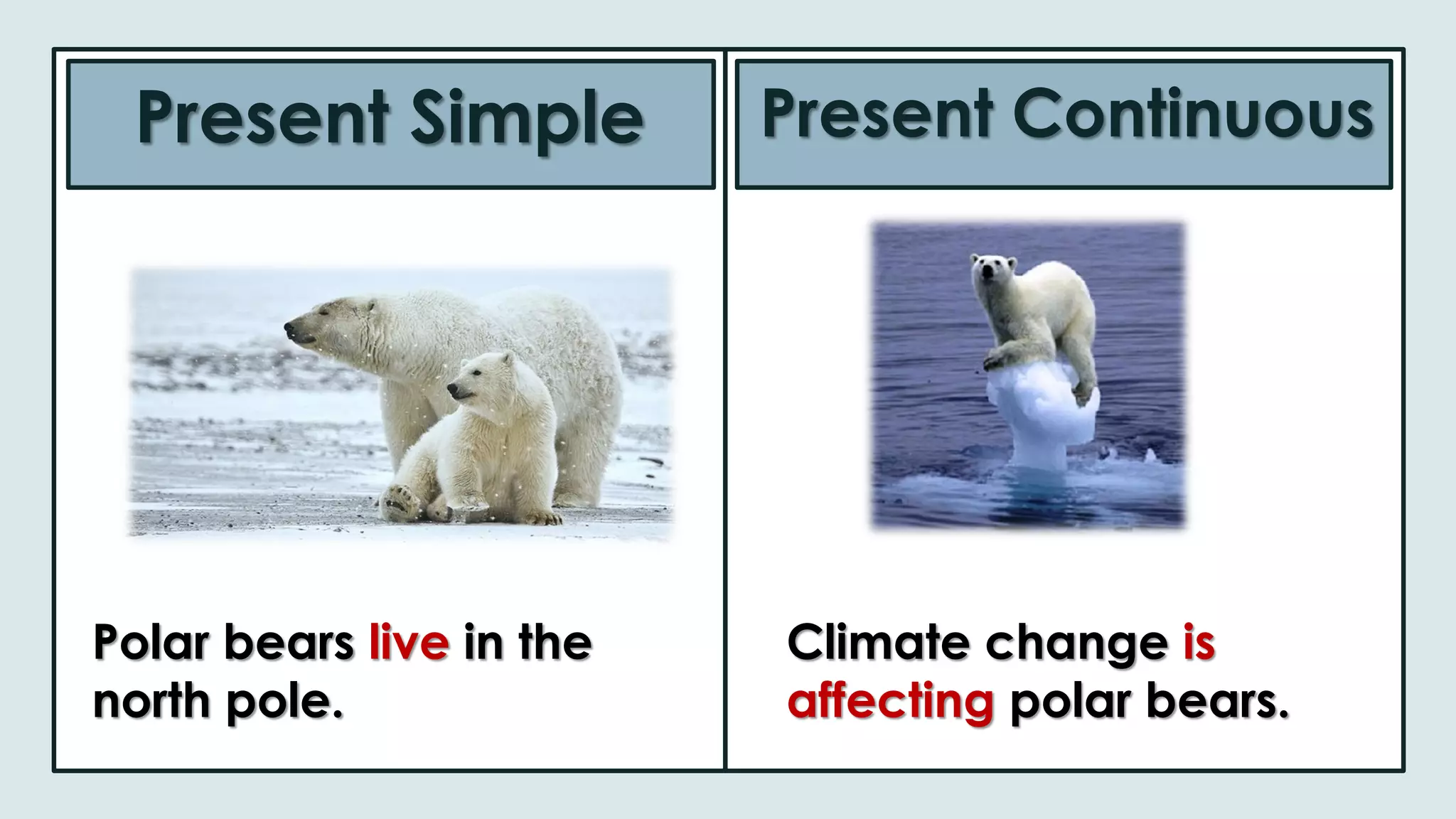
Polar bears live in the
north pole.
Climate change is
affecting polar bears.
Present Simple Present Continuous
like – love - hate – want - be
prefer - know – suppose – mean
believe – understand- seem,…
These verbs are not normally used in
continuous/ progressive tenses.
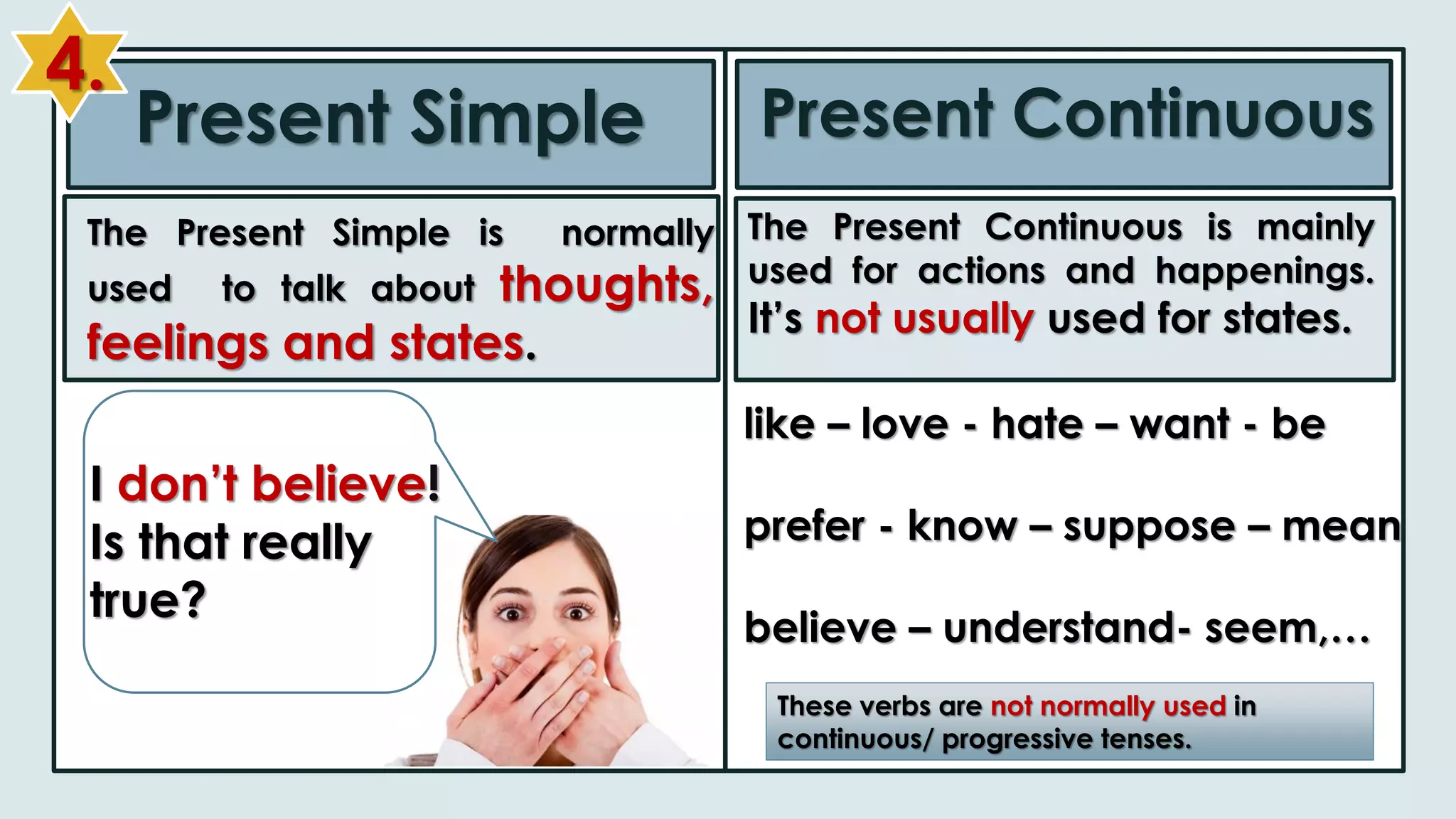
I don’t believe!
Is that really
true?
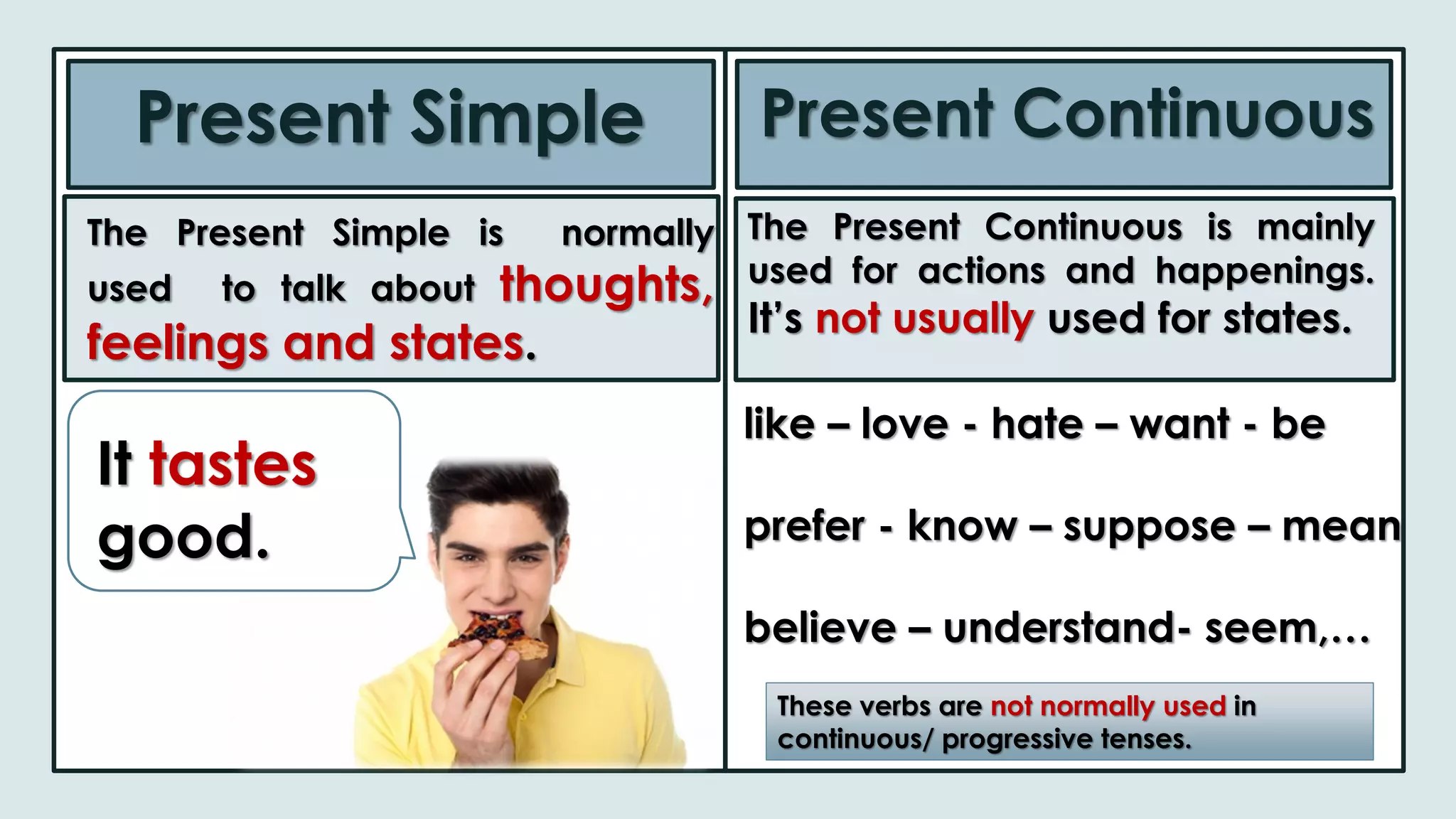
The Present Simple is normally
used to talk about thoughts,
feelings and states.
The Present Continuous is mainly
used for actions and happenings.
It’s not usually used for states.
4.
Present Simple Present Continuous
The Present Continuous is mainly
used for actions and happenings.
It’s not usually used for states.
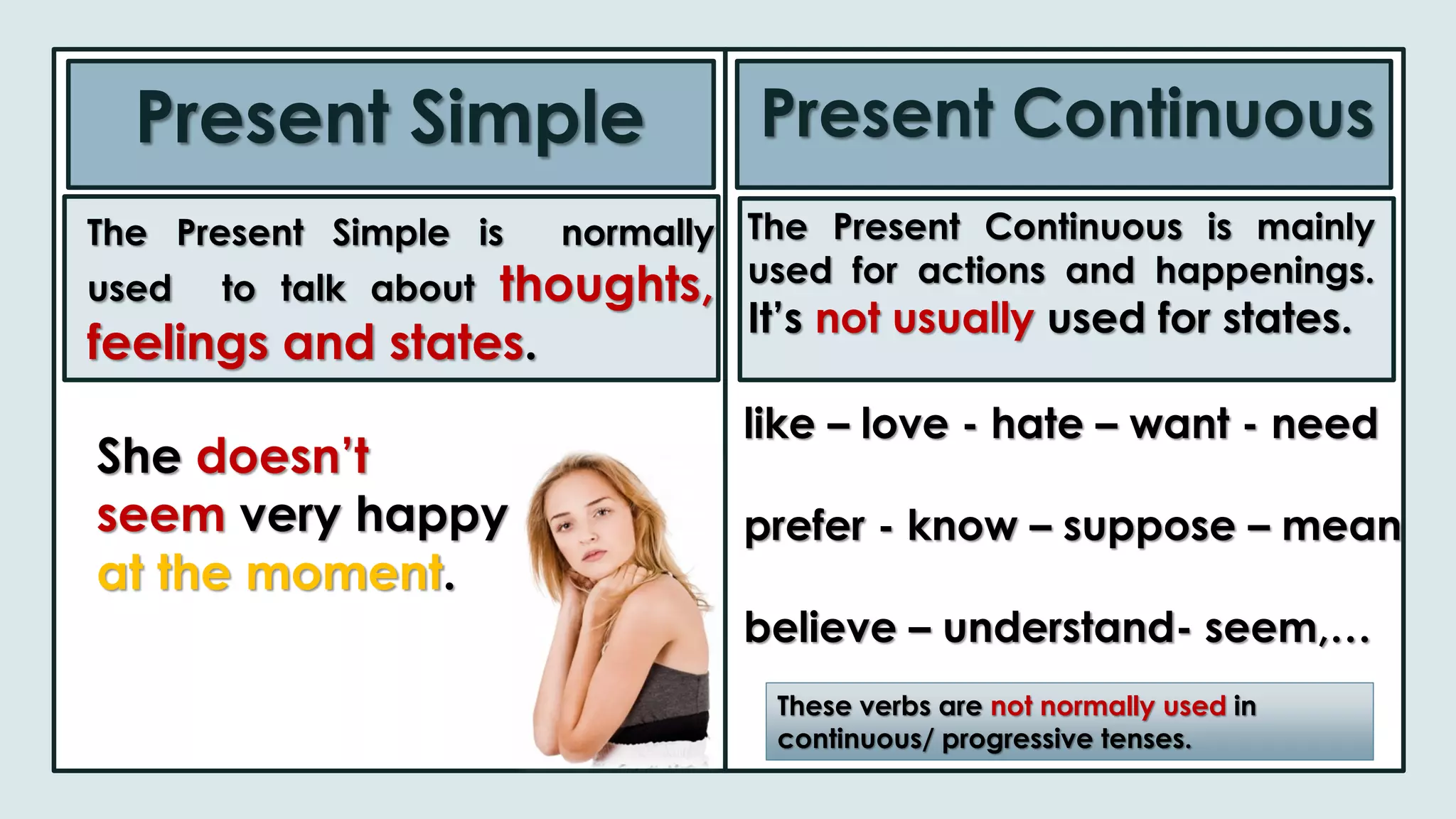
She doesn’t
seem very happy
at the moment.
like – love - hate – want - need
prefer - know – suppose – mean
believe – understand- seem,…
These verbs are not normally used in
continuous/ progressive tenses.
The Present Simple is normally
used to talk about thoughts,
feelings and states.
Present Simple Present Continuous
like – love - hate – want - be
prefer - know – suppose – mean
believe – understand- seem,…
These verbs are not normally used in
continuous/ progressive tenses.
It tastes
good.
The Present Simple is normally
used to talk about thoughts,
feelings and states.
The Present Continuous is mainly
used for actions and happenings.
It’s not usually used for states.
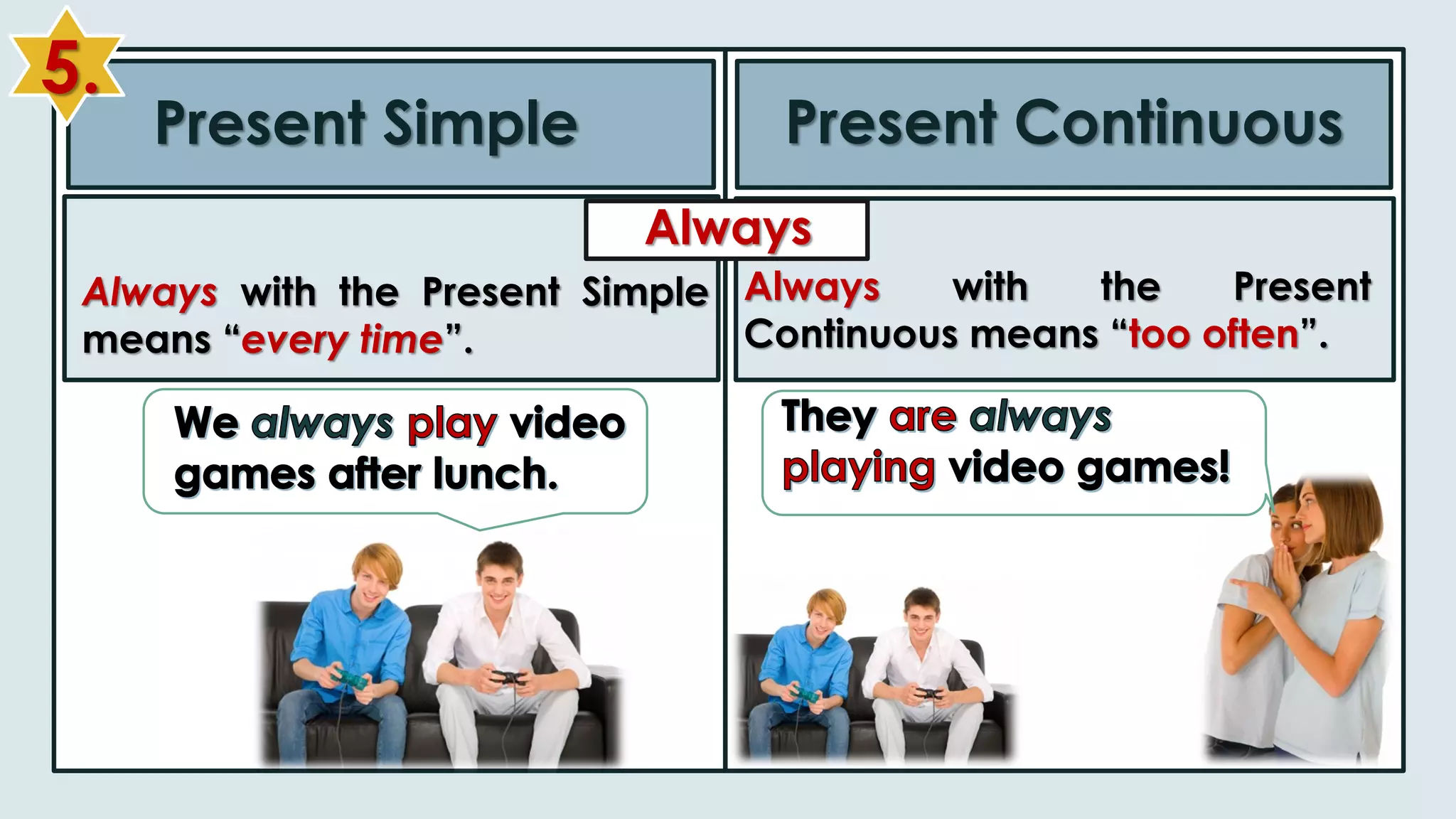
Always with the Present
Continuous means “too often”.
Present Simple Present Continuous
Always with the Present Simple
means “every time”.
Always
5.
Present Simple Present Continuous
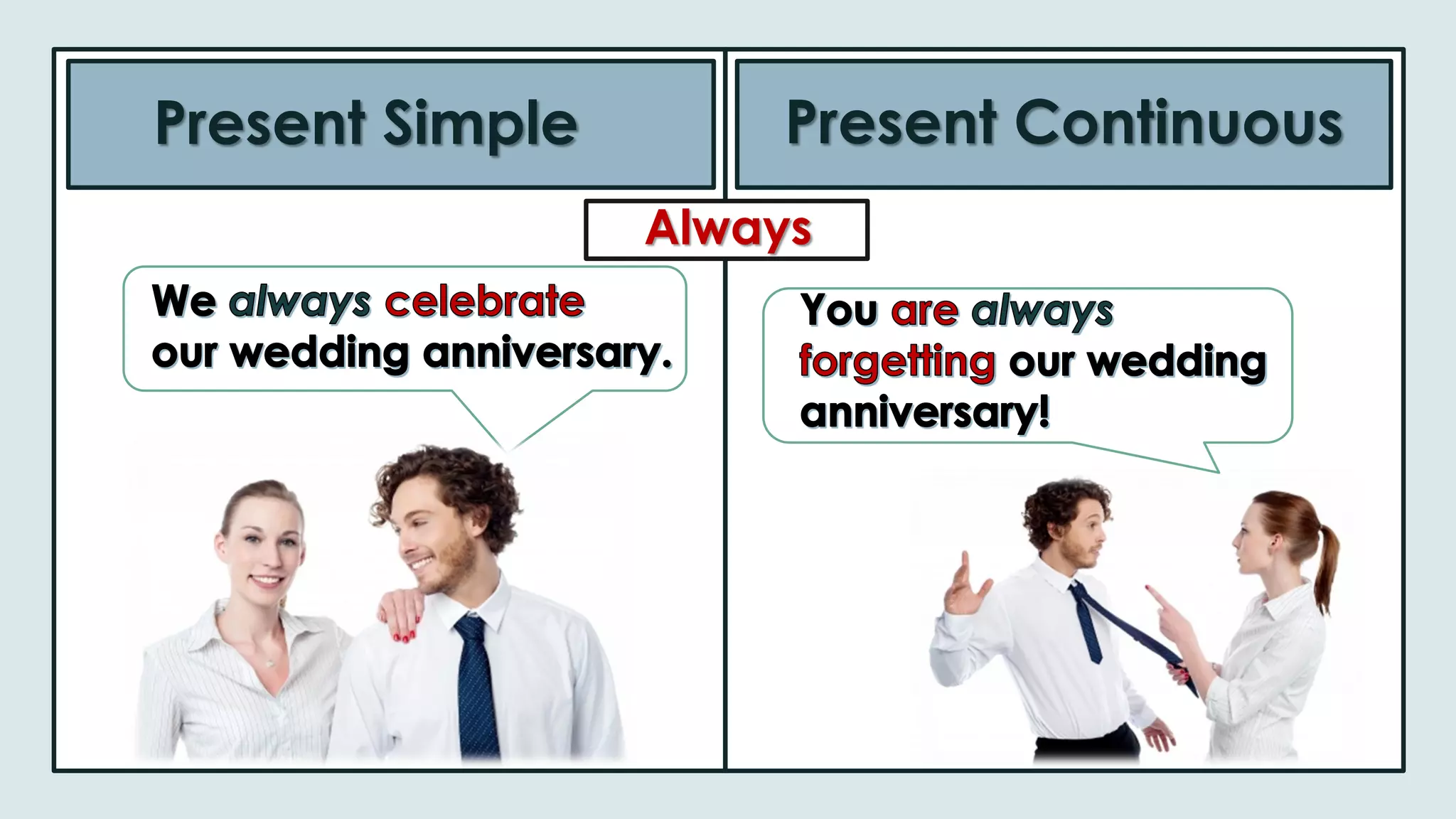
Always
Present Simple Present Continuous
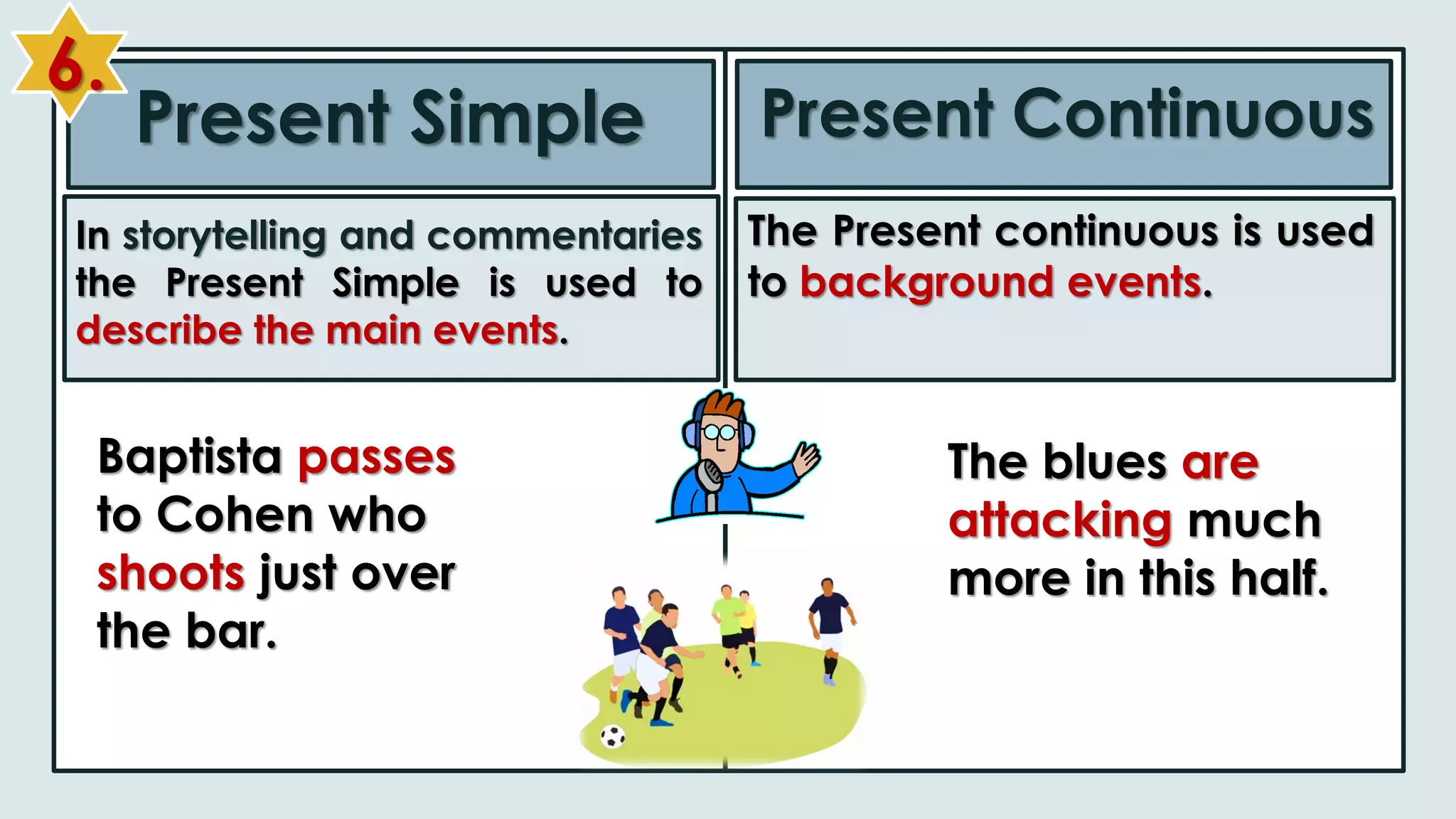
In storytelling and commentaries
the Present Simple is used to
describe the main events.
The Present continuous is used
to background events.
Baptista passes
to Cohen who
shoots just over
the bar.
The blues are
attacking much
more in this half.
6.
Present Simple Present Continuous
Future
meanings
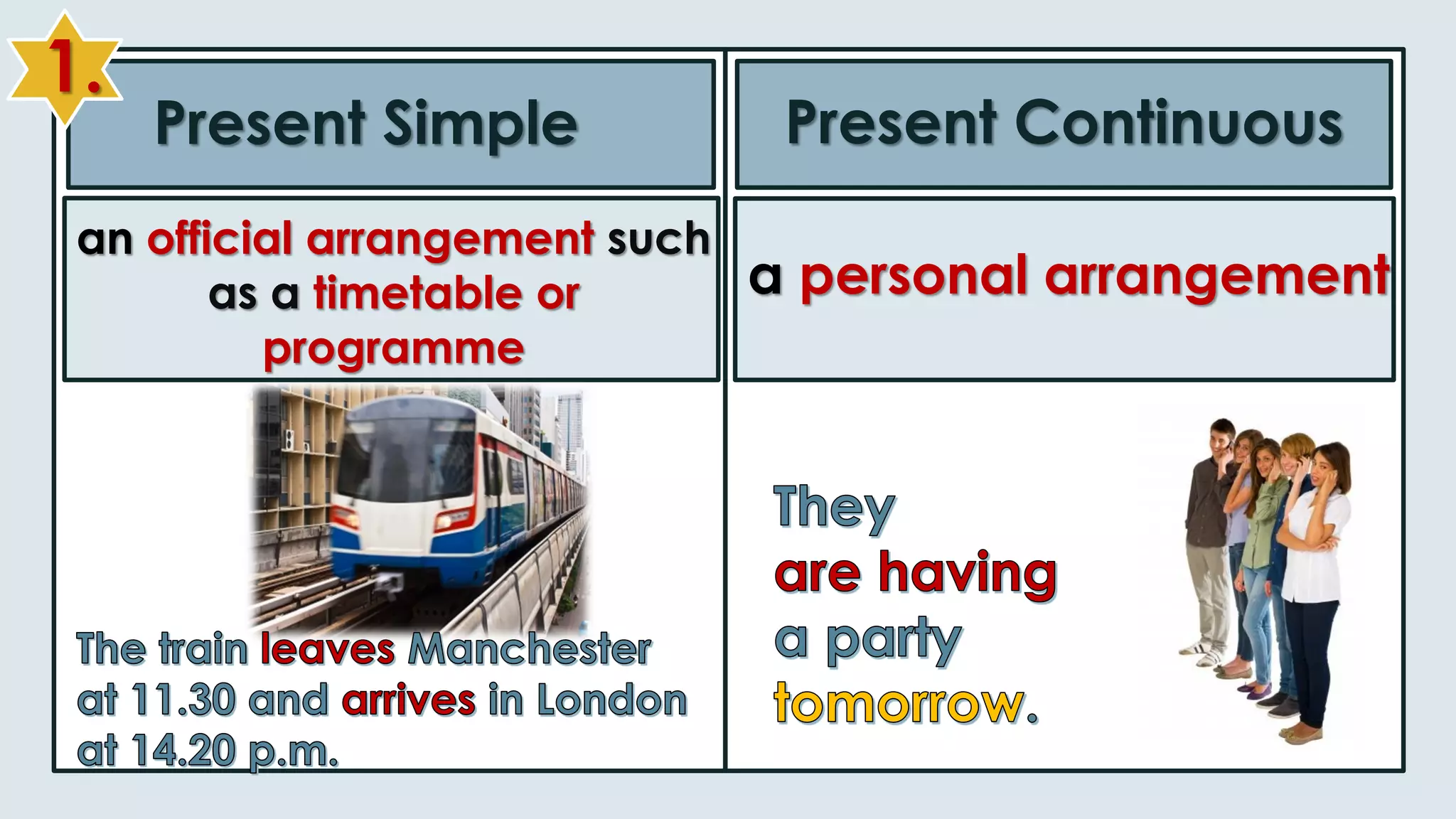
1.
Present Simple Present Continuous
an official arrangement such
as a timetable or
programme
a personal arrangement
Present Simple Present Continuous
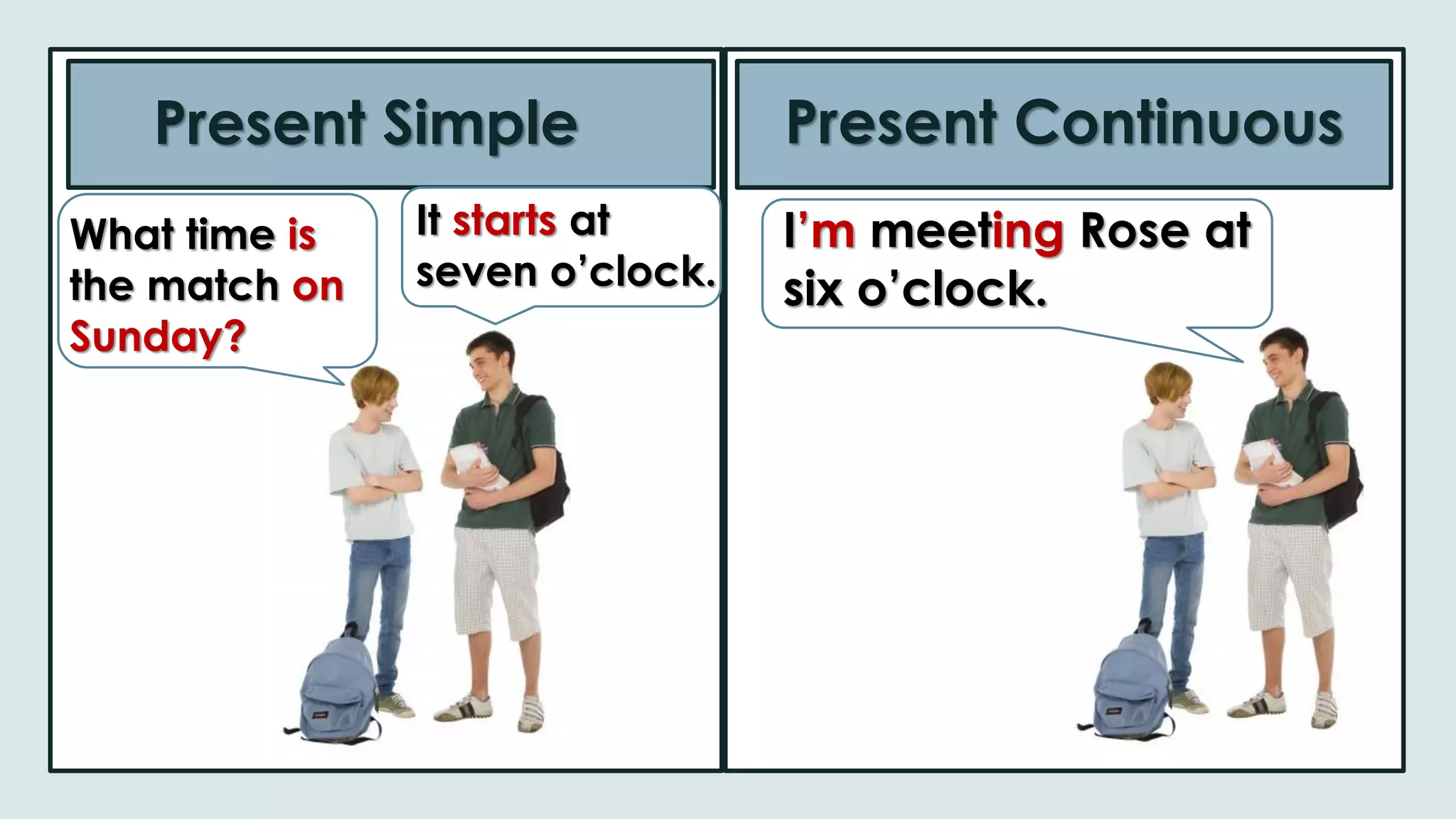
I’m meeting Rose at
six o’clock.
What time is
the match on
Sunday?
It starts at
seven o’clock.
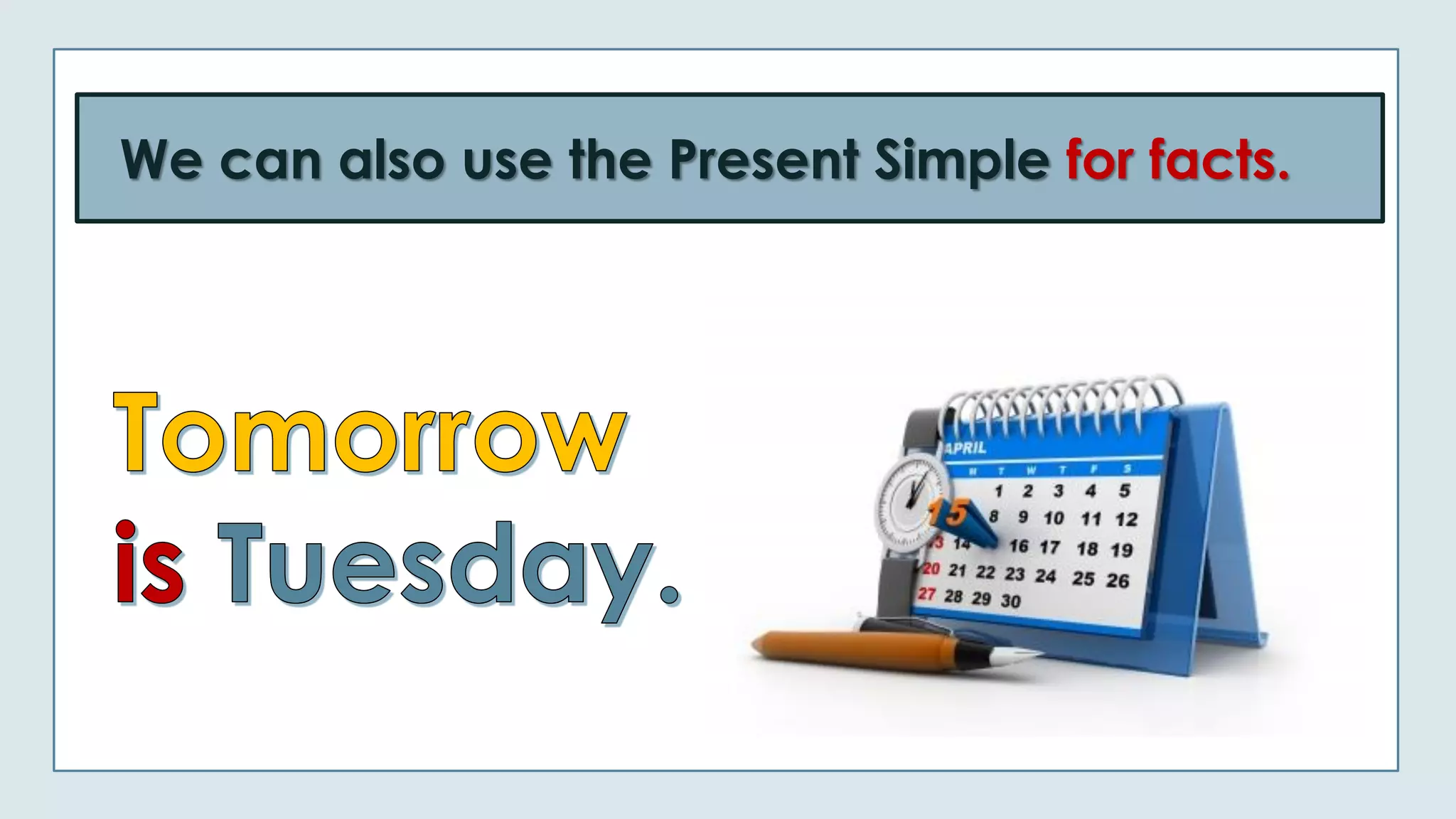
We can also use the Present Simple for facts.
Freedigitalphotos.net

Present Simple vs Present Continuous - English Language

  • 1.
  • 2.
    Present Simple PresentContinuous Clue words Clue words At present Currently Usually Often Never NowadaysSometimes Now Always At the moment
  • 3.
    Present Simple PresentContinuous Subject + verb (present form) Subject + am, is, are + verb + ing Affirmative
  • 4.
    Present Simple PresentContinuous Subject + do, does + not + verb Subject + am, is, are + not verb + ing Negative
  • 5.
    Present Simple PresentContinuous do, does + subject + verb am, is, are + subject + verb + ing Interrogative
  • 6.
    Present Simple PresentContinuous past now past nowfuture future I’m doingI do repeated actions (habits, routines). something happening at the time of speaking. The action is not finished. 1.
  • 7.
    Present Simple PresentContinuous He is a chef. He cooks delicious food. Now, he is cooking a new recipe.
  • 8.
    Present Simple PresentContinuous At the moment, I’m building a new house. I’m a builder. I build houses.
  • 9.
    Present Simple PresentContinuous She works very hard most of the time. At the moment, she is chatting in the workplace.
  • 10.
    Present Simple PresentContinuous a permanent situation. a temporary situation. 2. I’m a doctor. I treat people. Currently, I’m not working. I’m ill.
  • 11.
    Present Simple PresentContinuous She is French. She lives in Paris. At present, she is living in London. She is learning English.
  • 12.
    Present Simple PresentContinuous They always go to school by car. This week, they are going to school on foot. Their car is broken.
  • 13.
    to say thatsomething is true or untrue in general. 3. Present Simple Present Continuous to talk about changes, developments and trends. The earth turns 360º every day. The earth is changing due to global warming.
  • 14.
    Present Simple PresentContinuous Polar bears live in the north pole. Climate change is affecting polar bears.
  • 15.
    Present Simple PresentContinuous like – love - hate – want - be prefer - know – suppose – mean believe – understand- seem,… These verbs are not normally used in continuous/ progressive tenses. I don’t believe! Is that really true? The Present Simple is normally used to talk about thoughts, feelings and states. The Present Continuous is mainly used for actions and happenings. It’s not usually used for states. 4.
  • 16.
    Present Simple PresentContinuous The Present Continuous is mainly used for actions and happenings. It’s not usually used for states. She doesn’t seem very happy at the moment. like – love - hate – want - need prefer - know – suppose – mean believe – understand- seem,… These verbs are not normally used in continuous/ progressive tenses. The Present Simple is normally used to talk about thoughts, feelings and states.
  • 17.
    Present Simple PresentContinuous like – love - hate – want - be prefer - know – suppose – mean believe – understand- seem,… These verbs are not normally used in continuous/ progressive tenses. It tastes good. The Present Simple is normally used to talk about thoughts, feelings and states. The Present Continuous is mainly used for actions and happenings. It’s not usually used for states.
  • 18.
    Always with thePresent Continuous means “too often”. Present Simple Present Continuous Always with the Present Simple means “every time”. Always 5.
  • 19.
    Present Simple PresentContinuous Always
  • 20.
    Present Simple PresentContinuous In storytelling and commentaries the Present Simple is used to describe the main events. The Present continuous is used to background events. Baptista passes to Cohen who shoots just over the bar. The blues are attacking much more in this half. 6.
  • 21.
    Present Simple PresentContinuous Future meanings
  • 22.
    1. Present Simple PresentContinuous an official arrangement such as a timetable or programme a personal arrangement
  • 23.
    Present Simple PresentContinuous I’m meeting Rose at six o’clock. What time is the match on Sunday? It starts at seven o’clock.
  • 24.
    We can alsouse the Present Simple for facts.
  • 25.