
Top 20 Reasons Why Startups Fail
Our Relationship to Failure
• As entrepreneurs, our relationship to failure is
redefined
• Any new enterprise is a groping forward from one
failure to the next
• Failure is another word for learning what doesn’t work
• Split testing
• Pivot
• Iterate
• Course correct
• Feedback
If at first you don’t succeed
“I have not failed. I've just found 10,000
ways that won't work.” Thomas Edison
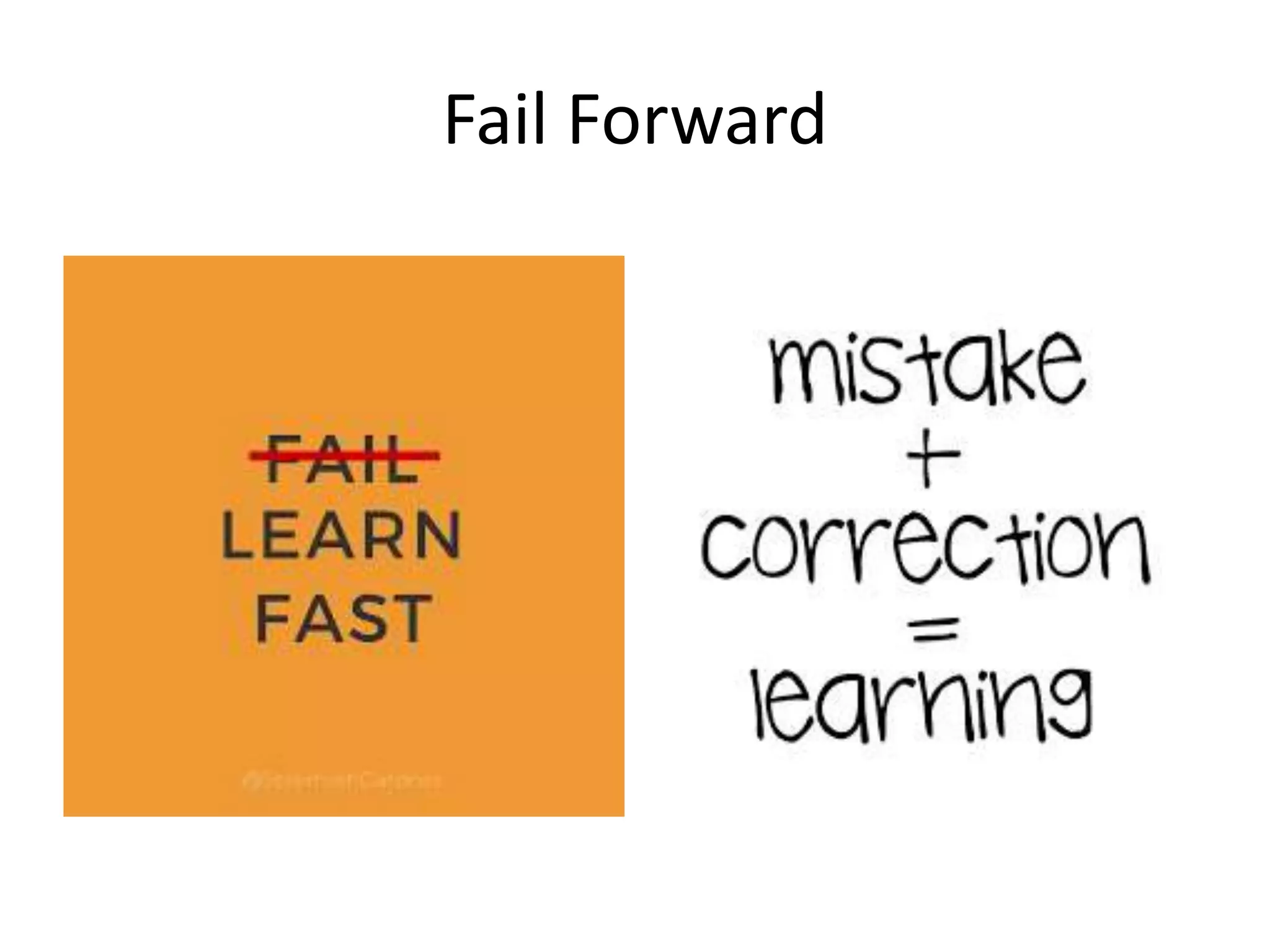
Fail Forward
iterarate
Course Correct
Fail fast and cheap
manage risk and limit downside
A Day in the Life
The Dip
Own Your Failures
• Take responsibility
• No blaming others
• Recognize quickly when something isn’t working
• Professionalism: emotionally detach from your
ideas
• Listen and embrace feedback and criticism
• Don’t defend as the default reactionary response
• Learn, course correct, pivot, rinse and repeat
On the other hand…
Never underestimate the power of getting it
right the first time.
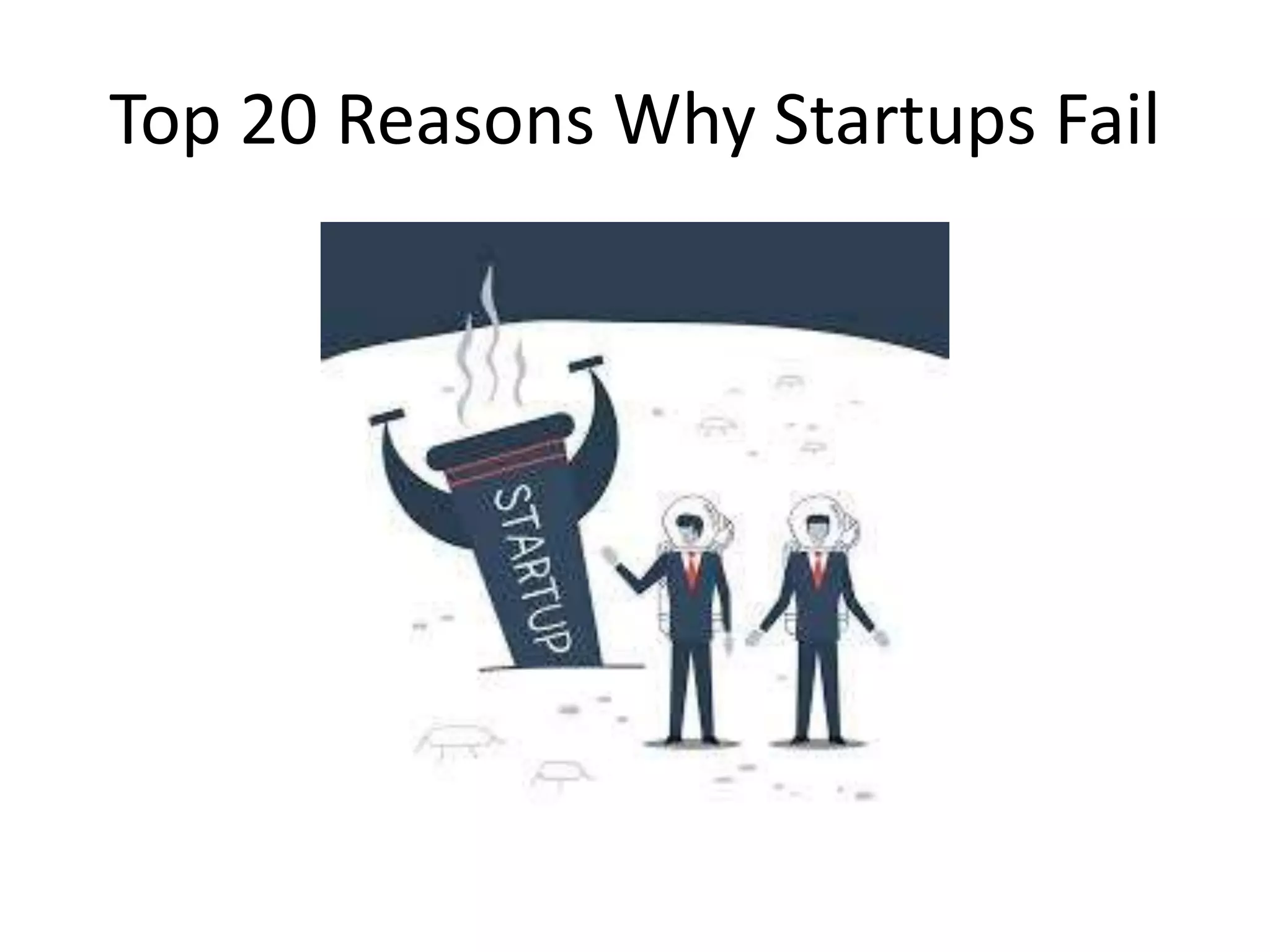
Top 20 Reasons Why Startups Fail
After Action Reports
Post Mortem
Top 20 reasons for startup failure
• This list was compiled by CB Insights by
analyzing 101 startup failure post-mortems.
• They analyzed these to figure out the main
reasons startups fail.
• Startups, corporations, investors, economic
development folks, academics, and journalists
all want some insight into the question:
• “What are the reasons startups fail?”
Startup post-mortems
After reading through the
101 postmortems, they
learned there is rarely
one reason for a single
startup’s failure. However,
they began to see a
pattern to these stories.
Anna Karenina Principle
"Happy families are all alike; every
unhappy family is unhappy in its own way.”
• Leo Tolstoy
• It’s the first sentence in the classic 800+ page
novel
The Anna Karenina principle states that a deficiency
in any one of a number of factors dooms an
endeavor to failure. Consequently, a successful
endeavor (subject to this principle) is one where
every possible deficiency has been avoided.
• Each failure overcome is
exorcising a deficiency
and bringing us closer
to our goal
• Pain is weakness leaving
the body
• The obstacle is the way
The Obstacle is the Way
#20 Failure to Pivot
Not pivoting away or quickly enough from a bad
product, a bad hire, or a bad decision was cited
as a reason for failure in 7% of the post
mortems. Dwelling or being married to a bad
idea can sap resources and money as well as
leave employees frustrated by a lack of progress.
#19 Burnout
Work-life balance is not something that startup
founders often get and so the risk of burning out
is high. Burn out was given as a reason for
failure 8% of the time The ability to cut your
losses where necessary and re-direct your
efforts when you see a dead end was deemed
important to succeeding and avoiding burnout,
as was having a solid, diverse, and driven team
so that responsibilities can be shared.
#18 Didn’t Use Network
Get your investors involved. Your investors are
there to help you. Get them involved from the
start, and don’t be afraid to ask for help. I think
we made the mistake early on of trying to do
(and know) everything ourselves, perhaps out of
insecurity over being so new to the business
world. This is a mistake.
# 17 Legal Challenges
Sometimes a startup can
evolve from a simple idea
to a world of legal
complexities that can
prove to be a core cause
of shutting down.
#16 No Financing/Investor Interest
Tying to the more
common reason of
running out of cash, a
number of startup
founders explicitly cited a
lack of investor interest
either at the seed follow-
on stage (the Series A
Crunch) or at all.
Runway
#15 Failed Geographical Expansion
• Location was an issue in a couple of different
ways. The first was that there has to be
congruence between your startup’s concept and
location.
• Location also played a role in failure for remote
teams. The key being that if your team is working
remotely, make sure you find effective
communication methods, otherwise lack of
teamwork and planning could lead to failure.
#14 Lack of Passion
• There are many good ideas out there in the
world, but 9% of startup post-mortem founders
found that a lack of passion for a domain and a
lack of knowledge of a domain were key reasons
for failure no matter how good an idea is.
• The work you do while you procrastinate is
probably the work you should be doing for the
rest of your life.
– Jessica Hische
#13 Pivot Gone Bad
Pivots like Burbn to Instagram or ThePoint to
Groupon can go extraordinarily well. Or they can
start you down the wrong road.
As Flowtab’s post-mortem explains,
• “Pivoting for pivoting’s sake is worthless. It
should be a calculated affair, where changes to
the business model are made, hypotheses are
tested, and results are measured. Otherwise,
you can’t learn anything.”
#12 Disharmony among
team/investors
• Discord with a
cofounder is a fatal
issue for startup post-
mortem companies.
• Acrimony isn’t limited
to the founding team,
and when things go bad
with an investor, it can
get ugly pretty quickly.
#11 Lose Focus
Getting sidetracked by
distracting projects,
personal issues, and/or
general loss of focus was
mentioned in 13% of
stories as a contributor to
failure.
#10 Product Mistimed
• If you release your product too early, users
may write it off as not good enough and
getting them back may be difficult if their first
impression of you is negative. And if you
release your product too late, you may have
missed your window of opportunity in the
market.
• Being right too soon
Timing is Everything
On the other hand…
If you are not embarrassed by the first version of
your product, you've launched too late.
– Reid Hoffman
– PayPal, LinkedIn, Masters of Scale podcast
– Book: The Startup of You
#9 Ignore Customers
• Ignoring users is a tried and true way to
fail. Tunnel vision and not gathering user
feedback are fatal flaws for most startups.
On the other hand…
“If I had asked people what they wanted, they
would have said faster horses.”
– Henry Ford
An innovator should have understanding of one’s
customers and their problems via empirical,
observational, anecdotal methods or even intuition.
They should also feel free to ignore customers’
inputs. Ford’s adherence to his vision of the mass-
market car and how to materialize that vision was
instrumental in his early success.
#8 Poor Marketing
• Knowing your target audience and knowing
how to get their attention and convert them
to leads and ultimately customers is one of
the most important skills of a successful
business. But an inability to market was a
common failure especially among founders
who liked to code or build product but who
didn’t relish the idea of promoting the
product.
#7 Product without a Business Model
• Failed founders seem to agree that a business
model is important – staying wedded to a
single channel or failing to find ways to make
money at scale left investors hesitant and
founders unable to capitalize on any traction
gained.
#6 User un-friendly product
• Bad things happen when you ignore what
users want and need, whether consciously or
accidentally.
#5 Pricing/Cost Issues
• Pricing is a dark art when it comes to startup
success, and startup post-mortems highlight
the difficulty in pricing a product high enough
to eventually cover costs but low enough to
bring in customers.
• A16z podcast on pricing
• https://a16z.com/2016/08/13/pricing/
#4 Get Outcompeted
• Despite the platitudes that startups shouldn’t
pay attention to the competition, the reality is
that once an idea gets hot or gets market
validation, there may be many entrants in a
space. And while obsessing over the
competition is not healthy, ignoring them was
also a recipe for failure in 19% of the startup
failures.
#3 Not the Right Team
A diverse team with different skill sets was often
cited as being critical to the success of a
company. Failure post-mortems often lamented
that “I wish we had a CTO from the start,” or
wished that the startup had “a founder that
loved the business aspect of things.”
#2 Ran Out of Cash
Money and time are finite and need to be
allocated judiciously. The question of how
should you spend your money was a frequent
conundrum and reason for failure cited by
startups (29%).
• Budgets
• Discipline
#1 No Market Need
• Tackling problems that are interesting to solve rather
than those that serve a market need was cited as the
No. 1 reason for failure, noted in 42% of cases.
• “Startups fail when they are not solving a market
problem. We were not solving a large enough problem
that we could universally serve with a scalable solution.
We had great technology, great data on shopping
behavior, great reputation as a thought leader, great
expertise, great advisors, etc, but what we didn’t have
was technology or business model that solved a pain
point in a scalable way.”
On the other hand….
In his book Zero To One, PayPal and Palantir entrepreneur
and venture capitalist (first outside investor in
Facebook) Peter Thiel claims that in business the opposite
of the Anna Karenina principle applies:
• Tolstoy opens Anna Karenina by observing: “All happy
families are alike; each unhappy family is unhappy in its
own way.” Business is the opposite. All happy
companies are different: each one earns a monopoly
by solving a unique problem. All failed companies are
the same: they failed to escape competition.
Stay in Touch
• Follow me on twitter @jjcousins http://bit.ly/2gQlamx
• Subscribe to my podcast MBA ASAP http://bit.ly/2fCWs8s
• Subscribe to my YouTube learning channel MBA ASAP http://bit.ly/2erywED
• Check out my blog at MBA-ASAP.com http://bit.ly/2nwYFl8
• Check out the MBA ASAP library at MBA-ASAP.com http://bit.ly/2uQbQjH
• Kindle, paperback, audio books at Amazon http://bit.ly/2uQbQjH
• audio books at Audible http://adbl.co/2xA7JJZ http://adbl.co/2w0CCHd
• Check my online courses at Udemy http://bit.ly/2xAjxRn http://bit.ly/2xK10hY
• and Teachable
• Connect with me on LinkedIn http://bit.ly/2sR1eQr
• Get the free eBook Understanding Financial Statements http://bit.ly/2kl6ADV
• Sign up for my email list at MBA-ASAP.com
• Check out my program at UNM Continuing Ed http://bit.ly/2A5Ah0w
• Check out my Patreon site http://bit.ly/2k1ebsb
•
• Subscribe via: YouTube, Podcast, Facebook, Twitter, iTunes
Top 20 Reasons Why Startups Fail

Top 20 Reasons Why Startups Fail

  • 1.
    Top 20 ReasonsWhy Startups Fail
  • 2.
    Our Relationship toFailure • As entrepreneurs, our relationship to failure is redefined • Any new enterprise is a groping forward from one failure to the next • Failure is another word for learning what doesn’t work • Split testing • Pivot • Iterate • Course correct • Feedback
  • 3.
    If at firstyou don’t succeed
  • 4.
    “I have notfailed. I've just found 10,000 ways that won't work.” Thomas Edison
  • 5.
  • 6.
  • 7.
  • 8.
    Fail fast andcheap manage risk and limit downside
  • 9.
    A Day inthe Life
  • 10.
  • 11.
    Own Your Failures •Take responsibility • No blaming others • Recognize quickly when something isn’t working • Professionalism: emotionally detach from your ideas • Listen and embrace feedback and criticism • Don’t defend as the default reactionary response • Learn, course correct, pivot, rinse and repeat
  • 15.
    On the otherhand… Never underestimate the power of getting it right the first time.
  • 16.
    Top 20 ReasonsWhy Startups Fail
  • 17.
  • 18.
    Top 20 reasonsfor startup failure • This list was compiled by CB Insights by analyzing 101 startup failure post-mortems. • They analyzed these to figure out the main reasons startups fail. • Startups, corporations, investors, economic development folks, academics, and journalists all want some insight into the question: • “What are the reasons startups fail?”
  • 19.
    Startup post-mortems After readingthrough the 101 postmortems, they learned there is rarely one reason for a single startup’s failure. However, they began to see a pattern to these stories.
  • 20.
    Anna Karenina Principle "Happyfamilies are all alike; every unhappy family is unhappy in its own way.” • Leo Tolstoy • It’s the first sentence in the classic 800+ page novel The Anna Karenina principle states that a deficiency in any one of a number of factors dooms an endeavor to failure. Consequently, a successful endeavor (subject to this principle) is one where every possible deficiency has been avoided.
  • 21.
    • Each failureovercome is exorcising a deficiency and bringing us closer to our goal • Pain is weakness leaving the body • The obstacle is the way
  • 23.
  • 24.
    #20 Failure toPivot Not pivoting away or quickly enough from a bad product, a bad hire, or a bad decision was cited as a reason for failure in 7% of the post mortems. Dwelling or being married to a bad idea can sap resources and money as well as leave employees frustrated by a lack of progress.
  • 25.
    #19 Burnout Work-life balanceis not something that startup founders often get and so the risk of burning out is high. Burn out was given as a reason for failure 8% of the time The ability to cut your losses where necessary and re-direct your efforts when you see a dead end was deemed important to succeeding and avoiding burnout, as was having a solid, diverse, and driven team so that responsibilities can be shared.
  • 26.
    #18 Didn’t UseNetwork Get your investors involved. Your investors are there to help you. Get them involved from the start, and don’t be afraid to ask for help. I think we made the mistake early on of trying to do (and know) everything ourselves, perhaps out of insecurity over being so new to the business world. This is a mistake.
  • 27.
    # 17 LegalChallenges Sometimes a startup can evolve from a simple idea to a world of legal complexities that can prove to be a core cause of shutting down.
  • 28.
    #16 No Financing/InvestorInterest Tying to the more common reason of running out of cash, a number of startup founders explicitly cited a lack of investor interest either at the seed follow- on stage (the Series A Crunch) or at all. Runway
  • 29.
    #15 Failed GeographicalExpansion • Location was an issue in a couple of different ways. The first was that there has to be congruence between your startup’s concept and location. • Location also played a role in failure for remote teams. The key being that if your team is working remotely, make sure you find effective communication methods, otherwise lack of teamwork and planning could lead to failure.
  • 30.
    #14 Lack ofPassion • There are many good ideas out there in the world, but 9% of startup post-mortem founders found that a lack of passion for a domain and a lack of knowledge of a domain were key reasons for failure no matter how good an idea is. • The work you do while you procrastinate is probably the work you should be doing for the rest of your life. – Jessica Hische
  • 31.
    #13 Pivot GoneBad Pivots like Burbn to Instagram or ThePoint to Groupon can go extraordinarily well. Or they can start you down the wrong road. As Flowtab’s post-mortem explains, • “Pivoting for pivoting’s sake is worthless. It should be a calculated affair, where changes to the business model are made, hypotheses are tested, and results are measured. Otherwise, you can’t learn anything.”
  • 32.
    #12 Disharmony among team/investors •Discord with a cofounder is a fatal issue for startup post- mortem companies. • Acrimony isn’t limited to the founding team, and when things go bad with an investor, it can get ugly pretty quickly.
  • 33.
    #11 Lose Focus Gettingsidetracked by distracting projects, personal issues, and/or general loss of focus was mentioned in 13% of stories as a contributor to failure.
  • 34.
    #10 Product Mistimed •If you release your product too early, users may write it off as not good enough and getting them back may be difficult if their first impression of you is negative. And if you release your product too late, you may have missed your window of opportunity in the market. • Being right too soon
  • 35.
  • 36.
    On the otherhand… If you are not embarrassed by the first version of your product, you've launched too late. – Reid Hoffman – PayPal, LinkedIn, Masters of Scale podcast – Book: The Startup of You
  • 37.
    #9 Ignore Customers •Ignoring users is a tried and true way to fail. Tunnel vision and not gathering user feedback are fatal flaws for most startups.
  • 38.
    On the otherhand… “If I had asked people what they wanted, they would have said faster horses.” – Henry Ford An innovator should have understanding of one’s customers and their problems via empirical, observational, anecdotal methods or even intuition. They should also feel free to ignore customers’ inputs. Ford’s adherence to his vision of the mass- market car and how to materialize that vision was instrumental in his early success.
  • 39.
    #8 Poor Marketing •Knowing your target audience and knowing how to get their attention and convert them to leads and ultimately customers is one of the most important skills of a successful business. But an inability to market was a common failure especially among founders who liked to code or build product but who didn’t relish the idea of promoting the product.
  • 40.
    #7 Product withouta Business Model • Failed founders seem to agree that a business model is important – staying wedded to a single channel or failing to find ways to make money at scale left investors hesitant and founders unable to capitalize on any traction gained.
  • 41.
    #6 User un-friendlyproduct • Bad things happen when you ignore what users want and need, whether consciously or accidentally.
  • 42.
    #5 Pricing/Cost Issues •Pricing is a dark art when it comes to startup success, and startup post-mortems highlight the difficulty in pricing a product high enough to eventually cover costs but low enough to bring in customers. • A16z podcast on pricing • https://a16z.com/2016/08/13/pricing/
  • 43.
    #4 Get Outcompeted •Despite the platitudes that startups shouldn’t pay attention to the competition, the reality is that once an idea gets hot or gets market validation, there may be many entrants in a space. And while obsessing over the competition is not healthy, ignoring them was also a recipe for failure in 19% of the startup failures.
  • 44.
    #3 Not theRight Team A diverse team with different skill sets was often cited as being critical to the success of a company. Failure post-mortems often lamented that “I wish we had a CTO from the start,” or wished that the startup had “a founder that loved the business aspect of things.”
  • 45.
    #2 Ran Outof Cash Money and time are finite and need to be allocated judiciously. The question of how should you spend your money was a frequent conundrum and reason for failure cited by startups (29%). • Budgets • Discipline
  • 46.
    #1 No MarketNeed • Tackling problems that are interesting to solve rather than those that serve a market need was cited as the No. 1 reason for failure, noted in 42% of cases. • “Startups fail when they are not solving a market problem. We were not solving a large enough problem that we could universally serve with a scalable solution. We had great technology, great data on shopping behavior, great reputation as a thought leader, great expertise, great advisors, etc, but what we didn’t have was technology or business model that solved a pain point in a scalable way.”
  • 47.
    On the otherhand…. In his book Zero To One, PayPal and Palantir entrepreneur and venture capitalist (first outside investor in Facebook) Peter Thiel claims that in business the opposite of the Anna Karenina principle applies: • Tolstoy opens Anna Karenina by observing: “All happy families are alike; each unhappy family is unhappy in its own way.” Business is the opposite. All happy companies are different: each one earns a monopoly by solving a unique problem. All failed companies are the same: they failed to escape competition.
  • 48.
    Stay in Touch •Follow me on twitter @jjcousins http://bit.ly/2gQlamx • Subscribe to my podcast MBA ASAP http://bit.ly/2fCWs8s • Subscribe to my YouTube learning channel MBA ASAP http://bit.ly/2erywED • Check out my blog at MBA-ASAP.com http://bit.ly/2nwYFl8 • Check out the MBA ASAP library at MBA-ASAP.com http://bit.ly/2uQbQjH • Kindle, paperback, audio books at Amazon http://bit.ly/2uQbQjH • audio books at Audible http://adbl.co/2xA7JJZ http://adbl.co/2w0CCHd • Check my online courses at Udemy http://bit.ly/2xAjxRn http://bit.ly/2xK10hY • and Teachable • Connect with me on LinkedIn http://bit.ly/2sR1eQr • Get the free eBook Understanding Financial Statements http://bit.ly/2kl6ADV • Sign up for my email list at MBA-ASAP.com • Check out my program at UNM Continuing Ed http://bit.ly/2A5Ah0w • Check out my Patreon site http://bit.ly/2k1ebsb • • Subscribe via: YouTube, Podcast, Facebook, Twitter, iTunes