What is animal testing?
• Animal testing is the use of
  animals in research and
  development projects. To test
  the safety of substances such
  as foods or drugs

• Right now it is estimated that
  50 to 100 million vertebrate
  animals are used annually but
  many more invertebrates.
•    Information taken from http://dictionary.reference.com/browse/animal+testing and
    http://en.wikipedia.org/wiki/Animal_testing
What animals are used in testing?
• 90% of the animals used are rats
  and mice. They are used to test
  drug treatments for diseases and
  various kinds of cancer.
• Dogs, cats, and primates
  combined account for less than
  1% of all the animals used in
  research.
• We live a healthier life because of
  animal testing (this is an opinion)
•   Information taken from http://www.the-
    aps.org/pa/animals/quest4.html
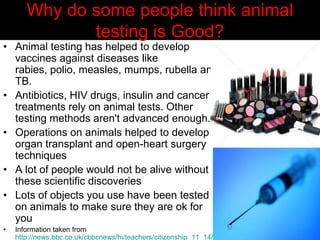
Why do some people think animal
              testing is Good?
• Animal testing has helped to develop
  vaccines against diseases like
  rabies, polio, measles, mumps, rubella and
  TB.
• Antibiotics, HIV drugs, insulin and cancer
  treatments rely on animal tests. Other
  testing methods aren't advanced enough.
• Operations on animals helped to develop
  organ transplant and open-heart surgery
  techniques
• A lot of people would not be alive without
  these scientific discoveries
• Lots of objects you use have been tested
  on animals to make sure they are ok for
  you
•   Information taken from
    http://news.bbc.co.uk/cbbcnews/hi/teachers/citizenship_11_14/s
Why do some people think animal
             testing is bad?
• It's cruel, unnecessary, and expensive. They
  believe that more accurate testing can be
  carried out with computers (opinion).
• 2.73 million animals were used in tests in
  2002. That was an increase of 110,000.
• 100 million animals are used in testing
  worldwide. Between 10 -11 million were used
  in the European Union
• Animals are bred for research but
  subsequently killed as "surplus" - of which
  campaigners claim there are millions but are
  not included in statistics.
• Household products are still tested on animals
  in Britain today. In the Draize Eye
  Test, irritants are dripped into the eyes of
  Rabbits.
• Information from
  http://www.bbc.co.uk/schools/studentlife/debate/2008/44_shouldanimalsb
Where can I get more information?
• http://vivisection-
  absurd.org.uk/x33.html
• http://news.bbc.co.uk/cbbcnews/hi/t
  eachers/citizenship_11_14/subject
  _areas/human_rights/newsid_3430
  000/3430169.stm
• http://www.gurl.com/findout/fastfact
  s/pages/0,,622679,00.html
• http://www.homeoffice.gov.uk/scien
  ce-research/animal-testing/
• http://www.bbc.co.uk/schools/stude
  ntlife/debate/2008/44_shouldanimal
  sbetestedon.shtml
Thank you

What do you think?

Animal testing

  • 2.
    What is animaltesting? • Animal testing is the use of animals in research and development projects. To test the safety of substances such as foods or drugs • Right now it is estimated that 50 to 100 million vertebrate animals are used annually but many more invertebrates. • Information taken from http://dictionary.reference.com/browse/animal+testing and http://en.wikipedia.org/wiki/Animal_testing
  • 3.
    What animals areused in testing? • 90% of the animals used are rats and mice. They are used to test drug treatments for diseases and various kinds of cancer. • Dogs, cats, and primates combined account for less than 1% of all the animals used in research. • We live a healthier life because of animal testing (this is an opinion) • Information taken from http://www.the- aps.org/pa/animals/quest4.html
  • 4.
    Why do somepeople think animal testing is Good? • Animal testing has helped to develop vaccines against diseases like rabies, polio, measles, mumps, rubella and TB. • Antibiotics, HIV drugs, insulin and cancer treatments rely on animal tests. Other testing methods aren't advanced enough. • Operations on animals helped to develop organ transplant and open-heart surgery techniques • A lot of people would not be alive without these scientific discoveries • Lots of objects you use have been tested on animals to make sure they are ok for you • Information taken from http://news.bbc.co.uk/cbbcnews/hi/teachers/citizenship_11_14/s
  • 5.
    Why do somepeople think animal testing is bad? • It's cruel, unnecessary, and expensive. They believe that more accurate testing can be carried out with computers (opinion). • 2.73 million animals were used in tests in 2002. That was an increase of 110,000. • 100 million animals are used in testing worldwide. Between 10 -11 million were used in the European Union • Animals are bred for research but subsequently killed as "surplus" - of which campaigners claim there are millions but are not included in statistics. • Household products are still tested on animals in Britain today. In the Draize Eye Test, irritants are dripped into the eyes of Rabbits. • Information from http://www.bbc.co.uk/schools/studentlife/debate/2008/44_shouldanimalsb
  • 6.
    Where can Iget more information? • http://vivisection- absurd.org.uk/x33.html • http://news.bbc.co.uk/cbbcnews/hi/t eachers/citizenship_11_14/subject _areas/human_rights/newsid_3430 000/3430169.stm • http://www.gurl.com/findout/fastfact s/pages/0,,622679,00.html • http://www.homeoffice.gov.uk/scien ce-research/animal-testing/ • http://www.bbc.co.uk/schools/stude ntlife/debate/2008/44_shouldanimal sbetestedon.shtml
  • 7.