The   Painful   Truth   about   Animal   Testing
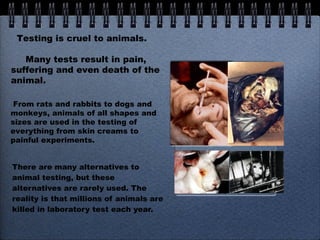
There are many alternatives to animal testing, but these alternatives are rarely used. The reality is that millions of animals are killed in laboratory test each year. Testing is cruel to animals. Many tests result in pain, suffering and even death of the animal. From rats and rabbits to dogs and monkeys, animals of all shapes and sizes are used in the testing of everything from skin creams to painful experiments.
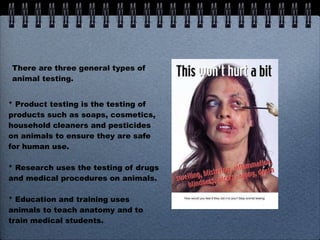
There are three general types of animal testing.  * Product testing is the testing of products such as soaps, cosmetics, household cleaners and pesticides on animals to ensure they are safe for human use.  * Research uses the testing of drugs and medical procedures on animals.  * Education and training uses animals to teach anatomy and to train medical students.
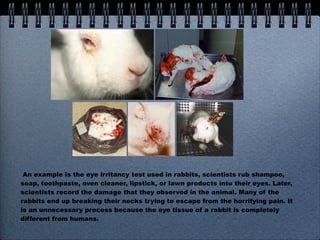
An example is the eye irritancy test used in rabbits, scientists rub shampoo, soap, toothpaste, oven cleaner, lipstick, or lawn products into their eyes. Later, scientists record the damage that they observed in the animal. Many of the rabbits end up breaking their necks trying to escape from the horrifying pain. It is an unnecessary process because the eye tissue of a rabbit is completely different from humans.
What’s the point of testing when: * Animal experiments can be misleading considering an animal’s response to a drug can be different to human’s. * Rats are only 37% effective in determining what causes cancer in humans. * The stress that animals endure in labs can effect experiments, making the results meaningless. *   Animal testing is not useful if the drugs have different effect in  humans and animals.
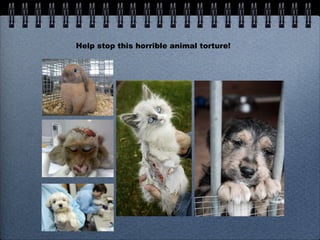
Help stop this horrible animal torture!
Approximately 17- 32 million animals are used in research each year * 65,000 Dogs  * 20,000 Cats * 30,000 Sheep  * 245,000 Rabbits * Over a million Rats & Mice  * 175,000 Hamsters  * 57,000 Primates * 58,000 Pigs
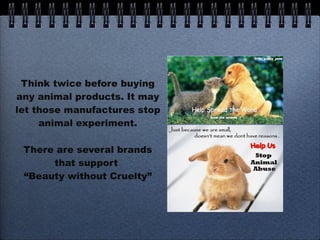
Think twice before buying any animal products. It may let those manufactures stop animal experiment. There are several brands that support  “ Beauty without Cruelty”

Animal testing

  • 1.
    The Painful Truth about Animal Testing
  • 2.
    There are manyalternatives to animal testing, but these alternatives are rarely used. The reality is that millions of animals are killed in laboratory test each year. Testing is cruel to animals. Many tests result in pain, suffering and even death of the animal. From rats and rabbits to dogs and monkeys, animals of all shapes and sizes are used in the testing of everything from skin creams to painful experiments.
  • 3.
    There are threegeneral types of animal testing. * Product testing is the testing of products such as soaps, cosmetics, household cleaners and pesticides on animals to ensure they are safe for human use. * Research uses the testing of drugs and medical procedures on animals. * Education and training uses animals to teach anatomy and to train medical students.
  • 4.
    An example isthe eye irritancy test used in rabbits, scientists rub shampoo, soap, toothpaste, oven cleaner, lipstick, or lawn products into their eyes. Later, scientists record the damage that they observed in the animal. Many of the rabbits end up breaking their necks trying to escape from the horrifying pain. It is an unnecessary process because the eye tissue of a rabbit is completely different from humans.
  • 5.
    What’s the pointof testing when: * Animal experiments can be misleading considering an animal’s response to a drug can be different to human’s. * Rats are only 37% effective in determining what causes cancer in humans. * The stress that animals endure in labs can effect experiments, making the results meaningless. * Animal testing is not useful if the drugs have different effect in humans and animals.
  • 6.
    Help stop thishorrible animal torture!
  • 7.
    Approximately 17- 32million animals are used in research each year * 65,000 Dogs * 20,000 Cats * 30,000 Sheep * 245,000 Rabbits * Over a million Rats & Mice * 175,000 Hamsters * 57,000 Primates * 58,000 Pigs
  • 8.
    Think twice beforebuying any animal products. It may let those manufactures stop animal experiment. There are several brands that support “ Beauty without Cruelty”