SCREENING MODELS ON DIABETES
Presented by :- Kundlik Rathod
M.S.Pharm (Semister-II )
Reg.No.:-PC/2017-X/173
5/18/2018
1
CONTENTS
INTRODUCTION
IN-VIVO MODEL
IN-VITRO MODEL
REFERENCES
5/18/2018
1
What is diabetes?
 Diabetes is a group of diseases in which the body either doesn’t
produce enough or any insulin, does not properly use the insulin that
is produced, or a combination of both.
 When any of these things happens, the body is unable to get sugar
from the blood into the cells. that leads to high blood sugar levels.
 Glucose, the form of sugar found in your blood, is one of your chief
energy sources.
Lack of insulin or resistance to insulin causes sugar to build up in
your blood.
 This can lead to many health problems. 5/18/2018
2
ANIMAL MODELS FOR TYPE-1 & TYPE-2 DIABETES( IN-Vivo
Model)
1.Chemically induced diabetes
 Alloxan
 Streptozotocin:- Neonatal Streptozotocin induced diabetes rat model.
Nicotinamide-Streptozotocin induced diabetic model.
Sucrose-challenged STZ-induced diabetic rat model .
Low dose STZ with high fat diet-fed rat model.
2. Insulin antibody induced diabetes
3. Hormones Induced Diabetes.
4. Virus induced diabetic animal model
5. Spontaneously or genetically derived animals
6.Zebrafish Model
5/18/2018
3
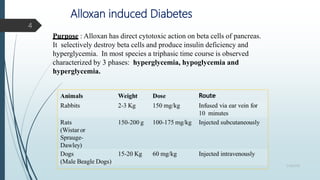
Alloxan induced Diabetes
Purpose : Alloxan has direct cytotoxic action on beta cells of pancreas.
It selectively destroy beta cells and produce insulin deficiency and
hyperglycemia. In most species a triphasic time course is observed
characterized by 3 phases: hyperglycemia, hypoglycemia and
hyperglycemia.
5/18/2018
4
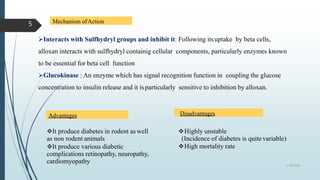
Mechanism ofAction
Interacts with Sulfhydryl groups and inhibit it: Following itsuptake by beta cells,
alloxan interacts with sulfhydryl containig cellular components, particularly enzymes known
to be essential for beta cell function
Glucokinase : An enzyme which has signal recognition function in coupling the glucose
concentration to insulin release and it isparticularly sensitive to inhibition by alloxan.
Advantages Disadvantages
It produce diabetes in rodent as well
as non rodent animals
It produce various diabetic
complications retinopathy, neuropathy,
cardiomyopathy
Highly unstable
(Incidence of diabetes is quite variable)
High mortality rate
5/18/2018
5
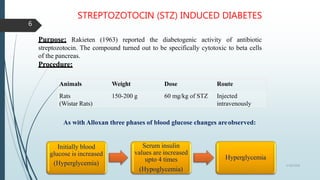
Purpose: Rakieten (1963) reported the diabetogenic activity of antibiotic
streptozotocin. The compound turned out to be specifically cytotoxic to beta cells
of the pancreas.
Procedure:
Animals Weight Dose Route
Rats
(Wistar Rats)
150-200 g 60 mg/kg of STZ Injected
intravenously
As with Alloxan three phases of blood glucose changes areobserved:
Initially blood
glucose is increased
(Hyperglycemia)
Serum insulin
values are increased
upto 4 times
(Hypoglycemia)
Hyperglycemia
STREPTOZOTOCIN (STZ) INDUCED DIABETES
5/18/2018
6
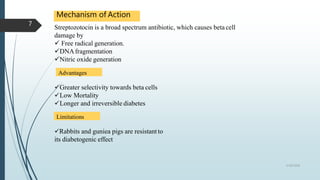
Mechanism of Action
Streptozotocin is a broad spectrum antibiotic, which causes beta cell
damage by
 Free radical generation.
DNAfragmentation
Nitric oxide generation
Advantages
Greater selectivity towards beta cells
Low Mortality
Longer and irreversible diabetes
Limitations
Rabbits and guniea pigs are resistantto
its diabetogenic effect
5/18/2018
7
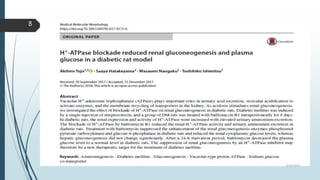
5/18/2018
8
Insulin antibody induced diabetes
 Principle: - A transient diabetic syndrome can be Induced by injecting guinea pigs with anti insulin serum.
Preparation of antibody:-
Procedure:-
Bovine insulin, dissolved in
acidified water [ph 3.0] at a
dose of 1mg /ml
Injected into
guinea pigs
Anti insulin sera is
collected after two
weeks of antigenic
challenge
Adult albino rats are
injected
with 0.25-1.0 ml of guinea
pig
anti- insulin serum.
Blood glucose level 300
mg/ dl.
The drug sample to be
screened is given and
blood glucose level is
analyzed to determine
the activity.
5/18/2018
9
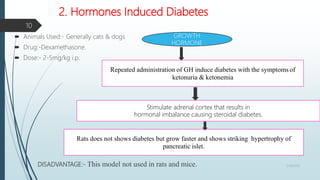
2. Hormones Induced Diabetes
 Animals Used:- Generally cats & dogs
 Drug:-Dexamethasone.
 Dose:- 2-5mg/kg i.p.
DISADVANTAGE:- This model not used in rats and mice.
GROWTH
HORMONE
Repeated administration of GH induce diabetes with the symptoms of
ketonuria & ketonemia
Rats does not shows diabetes but grow faster and shows striking hypertrophy of
pancreatic islet.
Stimulate adrenal cortex that results in
hormonal imbalance causing steroidal diabetes.
5/18/2018
10
VIRUS INDUCED DIABETES
 PURPOSE:- Infecting and destroying B-cells in pancreas.
Viruses producing systemic effects, not directly affecting B-cells.
 Viruses inducing diabetes include:
a) RNA picornoviruses
b) Coxsackie-B4
c) Encephalomyocarditis virus
Procedure:-
Limitation:- 5/18/2018
11
Old mice are 6-8 week injected with D- variant of encephalomyocarditis [EMC] i.p.
pretreatment is given with the cyclosporine A
Drug to be screened is administered orally for a period of 6 weeks.
Spontaneously or genetically derived animals
 Spontaneously diabetic animals of type 2 diabetes may be obtained from the animals with one or
several genetic mutations transmitted from generation to generation (e.g., ob/ob, db/db mice) or
by selected from non-diabetic outbred animals by repeated breeding over several generation
[e.g., (GK) rat, Tsumara Suzuki Obese Diabetes (TSOD) mouse].
 These animals generally inherit diabetes either as single or multigene defects as seen in KK mouse,
db/db mouse, or Zucker fatty rat.
Other Rats & Mice
RATS MICE
1. BB rat
2. WBN/KOB rat
3. GOTO/KAKIZAKI
4. ZUKKAR fatty rat
5. WDF/ TA-FArat
6. BHE rat
1. KK mice
2. KK-Ay mice
3. NOD mice
4. Obese hyperglycemic mice
5. New Zealand obese mice
6. Transgenic mice
5/18/2018
12
BB RATS
• Bio Breeding Rat.
• Insulin deficiency & insulitis due to
beta-cells destruction.
KK-Mice
• Nakamura (1962), reported on a
diabetic strain of the KK mouse.
• It is obese animale & showed
polyphagia and polyuria.
• Mice at the age of seven months
or older showed glucosuria and
blood sugar levels up to
320mg%. 5/18/2018
13
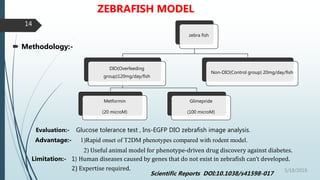
ZEBRAFISH MODEL
 Methodology:-
Evaluation:- Glucose tolerance test , Ins-EGFP DIO zebrafish image analysis.
Advantage:- 1)Rapid onset of T2DM phenotypes compared with rodent model.
2) Useful animal model for phenotype-driven drug discovery against diabetes.
Limitation:- 1) Human diseases caused by genes that do not exist in zebrafish can’t developed.
2) Expertise required.
zebra fish
DIO(Overfeeding
group)120mg/day/fish
Metformin
(20 microM)
Glimepride
(100 microM)
Non-DIO(Control group) 20mg/day/fish
5/18/2018
14
Scientific Reports DOI:10.1038/s41598-017
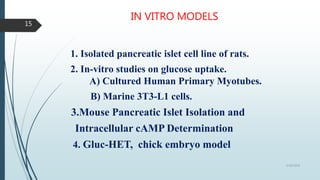
IN VITRO MODELS
1. Isolated pancreatic islet cell line of rats.
2. In-vitro studies on glucose uptake.
A) Cultured Human Primary Myotubes.
B) Marine 3T3-L1 cells.
3.Mouse Pancreatic Islet Isolation and
Intracellular cAMP Determination
4. Gluc-HET, chick embryo model
5/18/2018
15
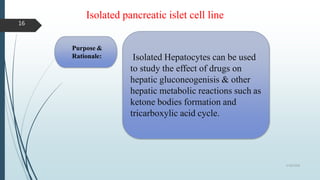
Isolated pancreatic islet cell line
Purpose &
Rationale: Isolated Hepatocytes can be used
to study the effect of drugs on
hepatic gluconeogenisis & other
hepatic metabolic reactions such as
ketone bodies formation and
tricarboxylic acid cycle.
5/18/2018
16
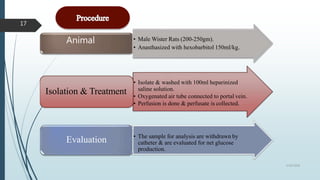
• Male Wister Rats (200-250gm).
• Anasthasized with hexobarbitol 150ml/kg.
Animal
• Isolate & washed with 100ml heparinized
saline solution.
• Oxygenated air tube connected to portal vein.
• Perfusion is done & perfusate is collected.
Isolation & Treatment
• The sample for analysis are withdrawn by
catheter & are evaluated for net glucose
production.
Evaluation
5/18/2018
17
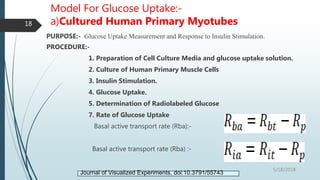
Model For Glucose Uptake:-
a)Cultured Human Primary Myotubes
PURPOSE:- Glucose Uptake Measurement and Response to Insulin Stimulation.
PROCEDURE:-
1. Preparation of Cell Culture Media and glucose uptake solution.
2. Culture of Human Primary Muscle Cells
3. Insulin Stimulation.
4. Glucose Uptake.
5. Determination of Radiolabeled Glucose
7. Rate of Glucose Uptake
Basal active transport rate (Rba):-
Basal active transport rate (Rba) :-
5/18/2018
18
Journal of Visualized Experiments, doi:10.3791/55743
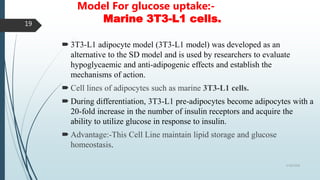
Model For glucose uptake:-
Marine 3T3-L1 cells.
 3T3-L1 adipocyte model (3T3-L1 model) was developed as an
alternative to the SD model and is used by researchers to evaluate
hypoglycaemic and anti-adipogenic effects and establish the
mechanisms of action.
 Cell lines of adipocytes such as marine 3T3-L1 cells.
 During differentiation, 3T3-L1 pre-adipocytes become adipocytes with a
20-fold increase in the number of insulin receptors and acquire the
ability to utilize glucose in response to insulin.
 Advantage:-This Cell Line maintain lipid storage and glucose
homeostasis.
5/18/2018
19
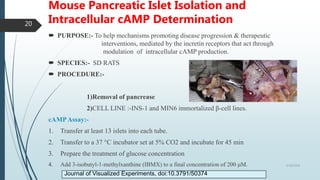
Mouse Pancreatic Islet Isolation and
Intracellular cAMP Determination
 PURPOSE:- To help mechanisms promoting disease progression & therapeutic
interventions, mediated by the incretin receptors that act through
modulation of intracellular cAMP production.
 SPECIES:- SD RATS
 PROCEDURE:-
1)Removal of pancrease
2)CELL LINE :-INS-1 and MIN6 immortalized β-cell lines.
cAMPAssay:-
1. Transfer at least 13 islets into each tube.
2. Transfer to a 37 °C incubator set at 5% CO2 and incubate for 45 min
3. Prepare the treatment of glucose concentration
4. Add 3-isobutyl-1-methylxanthine (IBMX) to a final concentration of 200 μM. 5/18/2018
20
Journal of Visualized Experiments, doi:10.3791/50374
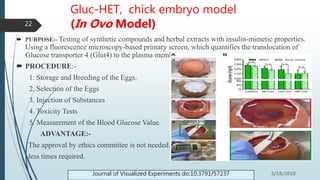
Gluc-HET, chick embryo model
(In Ovo Model)
 PURPOSE:- Testing of synthetic compounds and herbal extracts with insulin-mimetic properties.
Using a fluorescence microscopy-based primary screen, which quantifies the translocation of
Glucose transporter 4 (Glut4) to the plasma membrane.
 PROCEDURE:-
1. Storage and Breeding of the Eggs.
2. Selection of the Eggs
3. Injection of Substances
4. Toxicity Tests
5. Measurement of the Blood Glucose Value.
ADVANTAGE:-
The approval by ethics committee is not needed.
less times required.
5/18/2018
22
Journal of Visualized Experiments do:10.3791/57237
Refercences
 Haselgrübler Renate, Stübl Flora, Stadlbauer Verena, Lanzerstorfer Peter, Weghuber
Julian; An In Ovo Model for Testing Insulin-mimetic Compounds; 4/23/2018; Journal of
Visualized Experiments; Issue 134; DOI:10.3791/57237.
 Zang Liqing, Shimada Yasuhito &Nishimura Norihiro; Development of a Novel
Zebrafish:Model for Type 2 Diabetes Mellitus; 03 May 2017; Nature/Scientific Reports.
 Joshua C. Neuman, Nathan A. Truchan, Jamie W. Joseph, Michelle E. Kimple; A Method
for Mouse Pancreatic Islet Isolation and Intracellular cAMP Determination; 6/25/2014;
Journal of Visualized Experiments; DOI:10.3791/50374.
 Stephanie Chanon1, Christine Durand1, Aurelie Vieille-Marchiset1, Maud Robert2,
Charna Dibner3, Chantal Simon1, Etienne Lefai1Glucose Uptake Measurement and
Response to Insulin Stimulation in In Vitro Cultured Human Primary Myotubes
6/25/2017 doi:10.3791/55743.
 Heydemann Ahlke; An Overview of Murine High Fat Diet as a Model for Type 2 Diabetes
Mellitus; 27 June 2016; Journal of Diabetes Research; Volume 2016.
 Goud Busineni Jayasimha, Dwarakanath.V, Swamy B.K.Chikka; Streptozotocin - A
Diabetogenic Agent in Animal Models; April 2015; IJPPR; Vol.:3, Issue:1.
5/18/2018
23
5/18/2018
24

screening model for diabetes

  • 1.
    SCREENING MODELS ONDIABETES Presented by :- Kundlik Rathod M.S.Pharm (Semister-II ) Reg.No.:-PC/2017-X/173 5/18/2018 1
  • 2.
  • 3.
    What is diabetes? Diabetes is a group of diseases in which the body either doesn’t produce enough or any insulin, does not properly use the insulin that is produced, or a combination of both.  When any of these things happens, the body is unable to get sugar from the blood into the cells. that leads to high blood sugar levels.  Glucose, the form of sugar found in your blood, is one of your chief energy sources. Lack of insulin or resistance to insulin causes sugar to build up in your blood.  This can lead to many health problems. 5/18/2018 2
  • 4.
    ANIMAL MODELS FORTYPE-1 & TYPE-2 DIABETES( IN-Vivo Model) 1.Chemically induced diabetes  Alloxan  Streptozotocin:- Neonatal Streptozotocin induced diabetes rat model. Nicotinamide-Streptozotocin induced diabetic model. Sucrose-challenged STZ-induced diabetic rat model . Low dose STZ with high fat diet-fed rat model. 2. Insulin antibody induced diabetes 3. Hormones Induced Diabetes. 4. Virus induced diabetic animal model 5. Spontaneously or genetically derived animals 6.Zebrafish Model 5/18/2018 3
  • 5.
    Alloxan induced Diabetes Purpose: Alloxan has direct cytotoxic action on beta cells of pancreas. It selectively destroy beta cells and produce insulin deficiency and hyperglycemia. In most species a triphasic time course is observed characterized by 3 phases: hyperglycemia, hypoglycemia and hyperglycemia. 5/18/2018 4
  • 6.
    Mechanism ofAction Interacts withSulfhydryl groups and inhibit it: Following itsuptake by beta cells, alloxan interacts with sulfhydryl containig cellular components, particularly enzymes known to be essential for beta cell function Glucokinase : An enzyme which has signal recognition function in coupling the glucose concentration to insulin release and it isparticularly sensitive to inhibition by alloxan. Advantages Disadvantages It produce diabetes in rodent as well as non rodent animals It produce various diabetic complications retinopathy, neuropathy, cardiomyopathy Highly unstable (Incidence of diabetes is quite variable) High mortality rate 5/18/2018 5
  • 7.
    Purpose: Rakieten (1963)reported the diabetogenic activity of antibiotic streptozotocin. The compound turned out to be specifically cytotoxic to beta cells of the pancreas. Procedure: Animals Weight Dose Route Rats (Wistar Rats) 150-200 g 60 mg/kg of STZ Injected intravenously As with Alloxan three phases of blood glucose changes areobserved: Initially blood glucose is increased (Hyperglycemia) Serum insulin values are increased upto 4 times (Hypoglycemia) Hyperglycemia STREPTOZOTOCIN (STZ) INDUCED DIABETES 5/18/2018 6
  • 8.
    Mechanism of Action Streptozotocinis a broad spectrum antibiotic, which causes beta cell damage by  Free radical generation. DNAfragmentation Nitric oxide generation Advantages Greater selectivity towards beta cells Low Mortality Longer and irreversible diabetes Limitations Rabbits and guniea pigs are resistantto its diabetogenic effect 5/18/2018 7
  • 9.
  • 10.
    Insulin antibody induceddiabetes  Principle: - A transient diabetic syndrome can be Induced by injecting guinea pigs with anti insulin serum. Preparation of antibody:- Procedure:- Bovine insulin, dissolved in acidified water [ph 3.0] at a dose of 1mg /ml Injected into guinea pigs Anti insulin sera is collected after two weeks of antigenic challenge Adult albino rats are injected with 0.25-1.0 ml of guinea pig anti- insulin serum. Blood glucose level 300 mg/ dl. The drug sample to be screened is given and blood glucose level is analyzed to determine the activity. 5/18/2018 9
  • 11.
    2. Hormones InducedDiabetes  Animals Used:- Generally cats & dogs  Drug:-Dexamethasone.  Dose:- 2-5mg/kg i.p. DISADVANTAGE:- This model not used in rats and mice. GROWTH HORMONE Repeated administration of GH induce diabetes with the symptoms of ketonuria & ketonemia Rats does not shows diabetes but grow faster and shows striking hypertrophy of pancreatic islet. Stimulate adrenal cortex that results in hormonal imbalance causing steroidal diabetes. 5/18/2018 10
  • 12.
    VIRUS INDUCED DIABETES PURPOSE:- Infecting and destroying B-cells in pancreas. Viruses producing systemic effects, not directly affecting B-cells.  Viruses inducing diabetes include: a) RNA picornoviruses b) Coxsackie-B4 c) Encephalomyocarditis virus Procedure:- Limitation:- 5/18/2018 11 Old mice are 6-8 week injected with D- variant of encephalomyocarditis [EMC] i.p. pretreatment is given with the cyclosporine A Drug to be screened is administered orally for a period of 6 weeks.
  • 13.
    Spontaneously or geneticallyderived animals  Spontaneously diabetic animals of type 2 diabetes may be obtained from the animals with one or several genetic mutations transmitted from generation to generation (e.g., ob/ob, db/db mice) or by selected from non-diabetic outbred animals by repeated breeding over several generation [e.g., (GK) rat, Tsumara Suzuki Obese Diabetes (TSOD) mouse].  These animals generally inherit diabetes either as single or multigene defects as seen in KK mouse, db/db mouse, or Zucker fatty rat. Other Rats & Mice RATS MICE 1. BB rat 2. WBN/KOB rat 3. GOTO/KAKIZAKI 4. ZUKKAR fatty rat 5. WDF/ TA-FArat 6. BHE rat 1. KK mice 2. KK-Ay mice 3. NOD mice 4. Obese hyperglycemic mice 5. New Zealand obese mice 6. Transgenic mice 5/18/2018 12
  • 14.
    BB RATS • BioBreeding Rat. • Insulin deficiency & insulitis due to beta-cells destruction. KK-Mice • Nakamura (1962), reported on a diabetic strain of the KK mouse. • It is obese animale & showed polyphagia and polyuria. • Mice at the age of seven months or older showed glucosuria and blood sugar levels up to 320mg%. 5/18/2018 13
  • 15.
    ZEBRAFISH MODEL  Methodology:- Evaluation:-Glucose tolerance test , Ins-EGFP DIO zebrafish image analysis. Advantage:- 1)Rapid onset of T2DM phenotypes compared with rodent model. 2) Useful animal model for phenotype-driven drug discovery against diabetes. Limitation:- 1) Human diseases caused by genes that do not exist in zebrafish can’t developed. 2) Expertise required. zebra fish DIO(Overfeeding group)120mg/day/fish Metformin (20 microM) Glimepride (100 microM) Non-DIO(Control group) 20mg/day/fish 5/18/2018 14 Scientific Reports DOI:10.1038/s41598-017
  • 16.
    IN VITRO MODELS 1.Isolated pancreatic islet cell line of rats. 2. In-vitro studies on glucose uptake. A) Cultured Human Primary Myotubes. B) Marine 3T3-L1 cells. 3.Mouse Pancreatic Islet Isolation and Intracellular cAMP Determination 4. Gluc-HET, chick embryo model 5/18/2018 15
  • 17.
    Isolated pancreatic isletcell line Purpose & Rationale: Isolated Hepatocytes can be used to study the effect of drugs on hepatic gluconeogenisis & other hepatic metabolic reactions such as ketone bodies formation and tricarboxylic acid cycle. 5/18/2018 16
  • 18.
    • Male WisterRats (200-250gm). • Anasthasized with hexobarbitol 150ml/kg. Animal • Isolate & washed with 100ml heparinized saline solution. • Oxygenated air tube connected to portal vein. • Perfusion is done & perfusate is collected. Isolation & Treatment • The sample for analysis are withdrawn by catheter & are evaluated for net glucose production. Evaluation 5/18/2018 17
  • 19.
    Model For GlucoseUptake:- a)Cultured Human Primary Myotubes PURPOSE:- Glucose Uptake Measurement and Response to Insulin Stimulation. PROCEDURE:- 1. Preparation of Cell Culture Media and glucose uptake solution. 2. Culture of Human Primary Muscle Cells 3. Insulin Stimulation. 4. Glucose Uptake. 5. Determination of Radiolabeled Glucose 7. Rate of Glucose Uptake Basal active transport rate (Rba):- Basal active transport rate (Rba) :- 5/18/2018 18 Journal of Visualized Experiments, doi:10.3791/55743
  • 20.
    Model For glucoseuptake:- Marine 3T3-L1 cells.  3T3-L1 adipocyte model (3T3-L1 model) was developed as an alternative to the SD model and is used by researchers to evaluate hypoglycaemic and anti-adipogenic effects and establish the mechanisms of action.  Cell lines of adipocytes such as marine 3T3-L1 cells.  During differentiation, 3T3-L1 pre-adipocytes become adipocytes with a 20-fold increase in the number of insulin receptors and acquire the ability to utilize glucose in response to insulin.  Advantage:-This Cell Line maintain lipid storage and glucose homeostasis. 5/18/2018 19
  • 21.
    Mouse Pancreatic IsletIsolation and Intracellular cAMP Determination  PURPOSE:- To help mechanisms promoting disease progression & therapeutic interventions, mediated by the incretin receptors that act through modulation of intracellular cAMP production.  SPECIES:- SD RATS  PROCEDURE:- 1)Removal of pancrease 2)CELL LINE :-INS-1 and MIN6 immortalized β-cell lines. cAMPAssay:- 1. Transfer at least 13 islets into each tube. 2. Transfer to a 37 °C incubator set at 5% CO2 and incubate for 45 min 3. Prepare the treatment of glucose concentration 4. Add 3-isobutyl-1-methylxanthine (IBMX) to a final concentration of 200 μM. 5/18/2018 20 Journal of Visualized Experiments, doi:10.3791/50374
  • 22.
    Gluc-HET, chick embryomodel (In Ovo Model)  PURPOSE:- Testing of synthetic compounds and herbal extracts with insulin-mimetic properties. Using a fluorescence microscopy-based primary screen, which quantifies the translocation of Glucose transporter 4 (Glut4) to the plasma membrane.  PROCEDURE:- 1. Storage and Breeding of the Eggs. 2. Selection of the Eggs 3. Injection of Substances 4. Toxicity Tests 5. Measurement of the Blood Glucose Value. ADVANTAGE:- The approval by ethics committee is not needed. less times required. 5/18/2018 22 Journal of Visualized Experiments do:10.3791/57237
  • 23.
    Refercences  Haselgrübler Renate,Stübl Flora, Stadlbauer Verena, Lanzerstorfer Peter, Weghuber Julian; An In Ovo Model for Testing Insulin-mimetic Compounds; 4/23/2018; Journal of Visualized Experiments; Issue 134; DOI:10.3791/57237.  Zang Liqing, Shimada Yasuhito &Nishimura Norihiro; Development of a Novel Zebrafish:Model for Type 2 Diabetes Mellitus; 03 May 2017; Nature/Scientific Reports.  Joshua C. Neuman, Nathan A. Truchan, Jamie W. Joseph, Michelle E. Kimple; A Method for Mouse Pancreatic Islet Isolation and Intracellular cAMP Determination; 6/25/2014; Journal of Visualized Experiments; DOI:10.3791/50374.  Stephanie Chanon1, Christine Durand1, Aurelie Vieille-Marchiset1, Maud Robert2, Charna Dibner3, Chantal Simon1, Etienne Lefai1Glucose Uptake Measurement and Response to Insulin Stimulation in In Vitro Cultured Human Primary Myotubes 6/25/2017 doi:10.3791/55743.  Heydemann Ahlke; An Overview of Murine High Fat Diet as a Model for Type 2 Diabetes Mellitus; 27 June 2016; Journal of Diabetes Research; Volume 2016.  Goud Busineni Jayasimha, Dwarakanath.V, Swamy B.K.Chikka; Streptozotocin - A Diabetogenic Agent in Animal Models; April 2015; IJPPR; Vol.:3, Issue:1. 5/18/2018 23
  • 24.