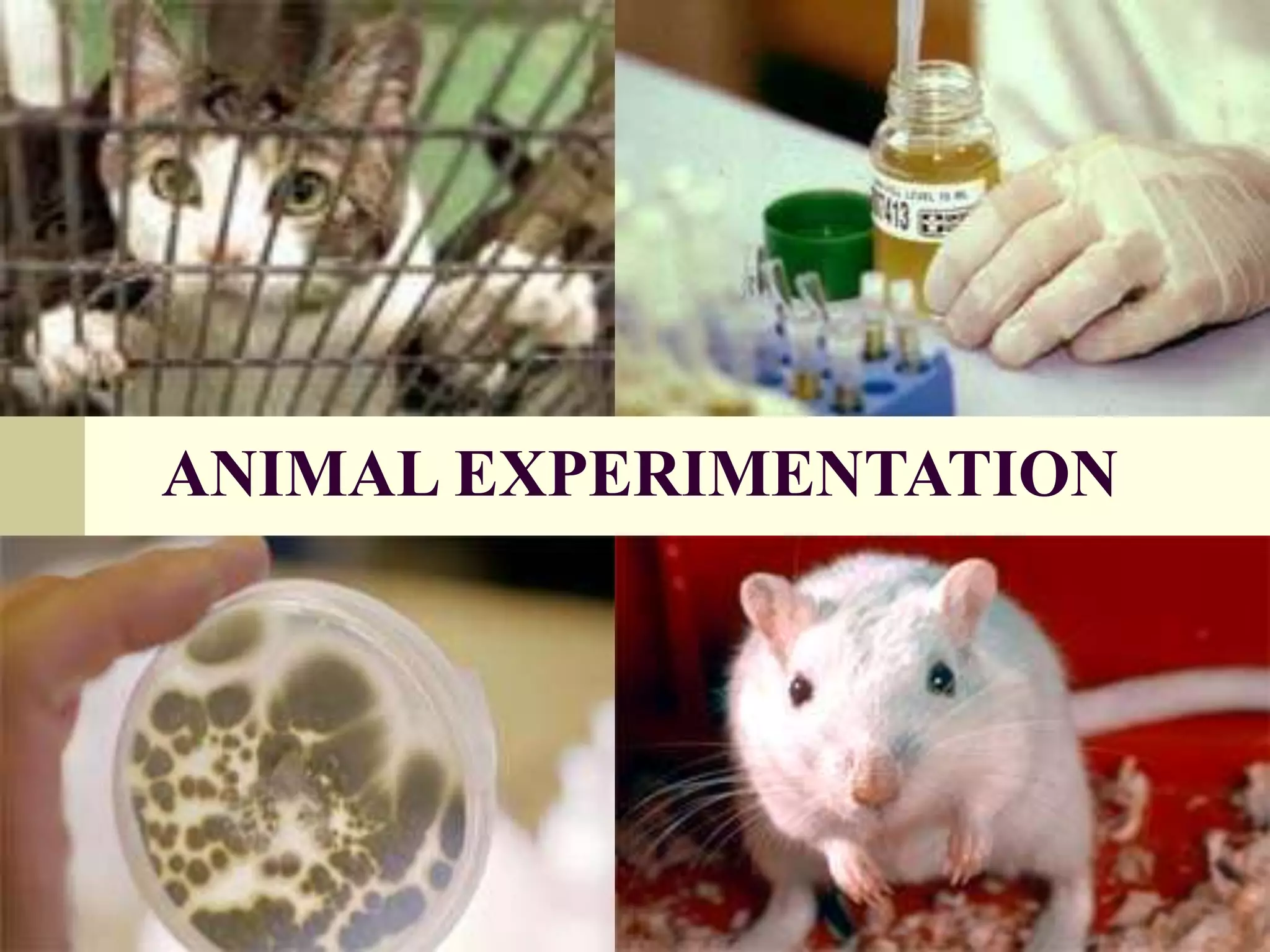
ANIMAL EXPERIMENTATION
Key Points
More than 2.7 million live animal experiments were authorized in
Great Britain in 2002. This number has halved in the last 30 years.
Around the world, animals are used to test products ranging from
shampoo to new cancer drugs
British law requires that any new drug must be tested on at least
two different species of live mammal. One must be a large non-
rodent.
UK regulations are considered some of the most rigorous in the
world - the Animals Act of 1986 insists that no animal experiments
be conducted if there is a realistic alternative.
Almost every medical treatment you use has been tested on
animals. Animals were also used to develop anesthetics to prevent
human pain and suffering during surgery.
Does animal testing work?
YES NO
Animal testing has helped to
develop vaccines against diseases
like rabies, polio, measles,
mumps, rubella and TB
Antibiotics, HIV drugs, insulin and
cancer treatments rely on animal
tests. Other testing methods
aren't advanced enough
Scientists claim there are no
differences in lab animals and
humans that cannot be factored
into tests
Operations on animals helped to
develop organ transplant and
open-heart surgery techniques
Animal experiments can be
misleading. An animal's response
to a drug can be different to a
human's
Successful alternatives include
test tube studies on human tissue
cultures, statistics and computer
models
The stress that animals endure in
labs can affect experiments,
making the results meaningless
Animals are still used to test items
like cleaning products, which
benefit mankind less than
medicines or surgery
Is animal testing morally right?
YES NO
Human life has greater intrinsic value
than animal life.
Legislation protects all lab animals
from cruelty or mistreatment
Millions of animals are killed for food
every year - if anything, medical
research is a more worthy death
Few animals feel any pain as they
are killed before they have the
chance to suffer
Animals have as much right to life
as human beings
Strict controls have not revented
researchers from abusing animals
– although such instances are rare
Deaths through research are
absolutely unnecessary and are
morally no different from murder
When locked up they suffer
tremendous stress. Can we know
they don't feel pain?
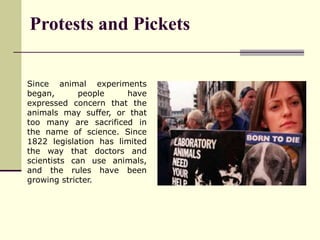
Protests and Pickets
Since animal experiments
began, people have
expressed concern that the
animals may suffer, or that
too many are sacrificed in
the name of science. Since
1822 legislation has limited
the way that doctors and
scientists can use animals,
and the rules have been
growing stricter.
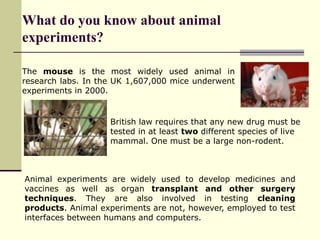
What do you know about animal
experiments?
The mouse is the most widely used animal in
research labs. In the UK 1,607,000 mice underwent
experiments in 2000.
British law requires that any new drug must be
tested in at least two different species of live
mammal. One must be a large non-rodent.
Animal experiments are widely used to develop medicines and
vaccines as well as organ transplant and other surgery
techniques. They are also involved in testing cleaning
products. Animal experiments are not, however, employed to test
interfaces between humans and computers.
 Replacement – attempt to use alternative methods
 Reduction – attempt to use statistics to reduce the number of
animals necessary for each experiment
 Refinement – attempt to improve the experiment to reduce
animal suffering
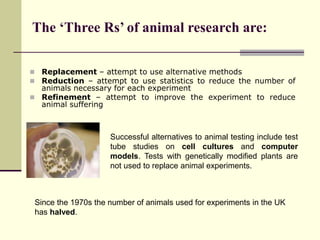
Successful alternatives to animal testing include test
tube studies on cell cultures and computer
models. Tests with genetically modified plants are
not used to replace animal experiments.
Since the 1970s the number of animals used for experiments in the UK
has halved.
The ‘Three Rs’ of animal research are:

Animal experimentation

  • 1.
  • 2.
    Key Points More than2.7 million live animal experiments were authorized in Great Britain in 2002. This number has halved in the last 30 years. Around the world, animals are used to test products ranging from shampoo to new cancer drugs British law requires that any new drug must be tested on at least two different species of live mammal. One must be a large non- rodent. UK regulations are considered some of the most rigorous in the world - the Animals Act of 1986 insists that no animal experiments be conducted if there is a realistic alternative. Almost every medical treatment you use has been tested on animals. Animals were also used to develop anesthetics to prevent human pain and suffering during surgery.
  • 3.
    Does animal testingwork? YES NO Animal testing has helped to develop vaccines against diseases like rabies, polio, measles, mumps, rubella and TB Antibiotics, HIV drugs, insulin and cancer treatments rely on animal tests. Other testing methods aren't advanced enough Scientists claim there are no differences in lab animals and humans that cannot be factored into tests Operations on animals helped to develop organ transplant and open-heart surgery techniques Animal experiments can be misleading. An animal's response to a drug can be different to a human's Successful alternatives include test tube studies on human tissue cultures, statistics and computer models The stress that animals endure in labs can affect experiments, making the results meaningless Animals are still used to test items like cleaning products, which benefit mankind less than medicines or surgery
  • 4.
    Is animal testingmorally right? YES NO Human life has greater intrinsic value than animal life. Legislation protects all lab animals from cruelty or mistreatment Millions of animals are killed for food every year - if anything, medical research is a more worthy death Few animals feel any pain as they are killed before they have the chance to suffer Animals have as much right to life as human beings Strict controls have not revented researchers from abusing animals – although such instances are rare Deaths through research are absolutely unnecessary and are morally no different from murder When locked up they suffer tremendous stress. Can we know they don't feel pain?
  • 5.
    Protests and Pickets Sinceanimal experiments began, people have expressed concern that the animals may suffer, or that too many are sacrificed in the name of science. Since 1822 legislation has limited the way that doctors and scientists can use animals, and the rules have been growing stricter.
  • 6.
    What do youknow about animal experiments? The mouse is the most widely used animal in research labs. In the UK 1,607,000 mice underwent experiments in 2000. British law requires that any new drug must be tested in at least two different species of live mammal. One must be a large non-rodent. Animal experiments are widely used to develop medicines and vaccines as well as organ transplant and other surgery techniques. They are also involved in testing cleaning products. Animal experiments are not, however, employed to test interfaces between humans and computers.
  • 7.
     Replacement –attempt to use alternative methods  Reduction – attempt to use statistics to reduce the number of animals necessary for each experiment  Refinement – attempt to improve the experiment to reduce animal suffering Successful alternatives to animal testing include test tube studies on cell cultures and computer models. Tests with genetically modified plants are not used to replace animal experiments. Since the 1970s the number of animals used for experiments in the UK has halved. The ‘Three Rs’ of animal research are: