Introduction To EMV
electronic Cards
Presented By -
Anil
Chaurasiya(15MCMC17)
University of Hyderabad
EMV
Standards for Electonic Cards
Presented By -
Anil Chaurasiya
University of
Hyderabad
EMV Technology?
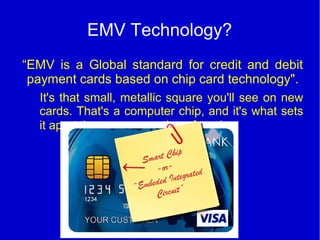
“EMV is a Global standard for credit and debit
payment cards based on chip card technology".
It's that small, metallic square you'll see on new
cards. That's a computer chip, and it's what sets
it apart the new generation of cards.
How EMV gets it’s name?
Europay
MasterCard
Visa
About EMVCo
EMVCo is jointly owned by
American Express
Discover
JCB
MasterCard
UnionPay and Visa.
EMVCo facilitates worldwide interoperability and acceptance
of secure payment transactions.
What is in chip card?
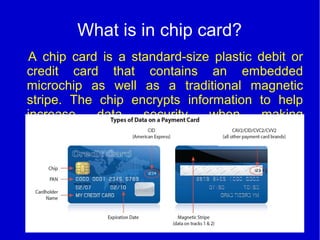
A chip card is a standard-size plastic debit or
credit card that contains an embedded
microchip as well as a traditional magnetic
stripe. The chip encrypts information to help
increase data security when making
transactions at terminals or ATMs that are chip-
enabled.
Chip and PIN
These transactions are often referred to as "Chip
and PIN" because PIN entry is required to verify
the customer is the genuine cardholder. This is a
simplification since the EMV specifications include
other cardholder verification methods as well.
EMV vs. Magnetic Stripe
Transactions
Unlike magnetic stripe transactions, where typically
only the card's track to data containing the card
number and expiry date is processed, every chip card
transaction contain dozens of pieces of information to
be exchanged between the card, the terminal and the
acquiring bank or processors host.
EMV vs. Magnetic Stripe
Transactions
This requires the terminal to perform many stages of
complex processing, including cryptographic
authentication, to successfully complete a
transaction. This means that adding support for EMV
to existing payment applications can be a daunting
task.
EMV Challenges ?
Despite its advantages, however, EMV is not a
perfect solution. First of all, converting the entire
country to EMV technology will be a logistical
nightmare. Not only will tech implementation require
considerable time and investment, but consumers
accustomed to swipe-and-sign will also need time to
adjust to the new method, slowing down checkout
lines in the interim.
EMV Challenges ?
Perhaps the biggest issue with EMV is that, as
secure as it is, it still cannot protect merchants or
their customers from all possible threats.
EMV Challenges ?
For example, it has no impact at all on the security of
online transactions. For these “card-not-present”
purchases, fraudsters need only steal the card
number, expiration data and CVV in order to start a
shopping spree. Sophisticated hackers have
discovered other vulnerabilities of the system as well;
they are much more complicated than the simple
hacks we are seeing today, but they do exist.
EMV cards more secure than
traditional cards?
The magnetic stripes on traditional credit and debit
cards store contain unchanging data. Whoever
accesses that data gains the sensitive card and
cardholder information necessary to make purchases.
That makes traditional cards prime targets for
counterfeiters, who convert stolen card data to cash.
EMV cards more secure than
traditional cards?
Unlike magnetic-stripe cards, every time an EMV
card is used for payment, the card chip creates a
unique transaction code that cannot be used again.
EMV cards more secure than
traditional cards?
Unlike magnetic-stripe cards, every time an EMV
card is used for payment, the card chip creates a
unique transaction code that cannot be used again.
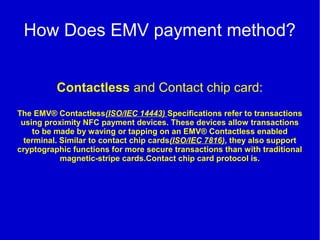
How Does EMV payment method?
Contactless and Contact chip card:
The EMV® Contactless(ISO/IEC 14443) Specifications refer to transactions
using proximity NFC payment devices. These devices allow transactions
to be made by waving or tapping on an EMV® Contactless enabled
terminal. Similar to contact chip cards(ISO/IEC 7816), they also support
cryptographic functions for more secure transactions than with traditional
magnetic-stripe cards.Contact chip card protocol is.
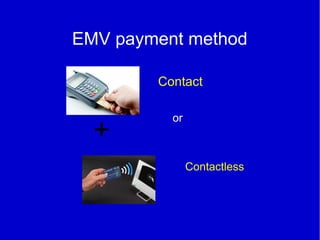
EMV payment method
Contact
or
Contactless
+
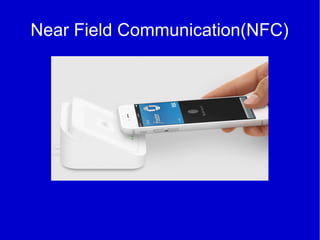
Near Field Communication(NFC)
How Does EMV payment method?
EMV payment methods
Contact
ISO/IEC 7816
Or
Contactless
ISO/IEC 14443
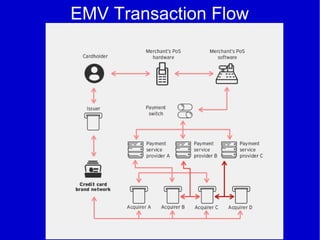
EMV Transaction Flow
Cardholder Verification Method
(CVM)
Although EMV is often referred to as “Chip and PIN”, in
fact EMV supports several different methods of
verifying the identity of the cardholder, known as
Cardholder Verification Methods (CVM). Every card
contains a list of the CVM that it supports, and when
they need to be applied (e.g. Use online PIN if the
transaction is an ATM cash withdrawal, else use
signature).
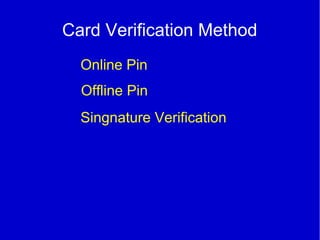
Card Verification Method
Online Pin
Offline Pin
Singnature Verification
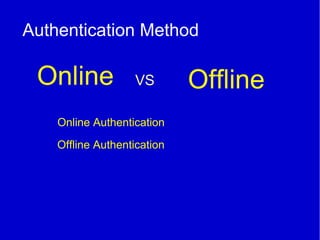
Authentication Method
Online OfflineVS
Online Authentication
Offline Authentication
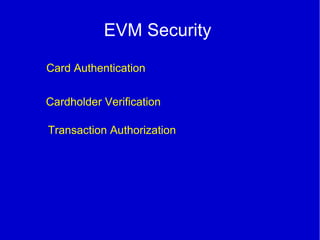
EVM Security
Cardholder Verification
Transaction Authorization
Card Authentication
End of Presentation
Thank You!

Introduction to emv

  • 1.
    Introduction To EMV electronicCards Presented By - Anil Chaurasiya(15MCMC17) University of Hyderabad
  • 2.
    EMV Standards for ElectonicCards Presented By - Anil Chaurasiya University of Hyderabad
  • 3.
    EMV Technology? “EMV isa Global standard for credit and debit payment cards based on chip card technology". It's that small, metallic square you'll see on new cards. That's a computer chip, and it's what sets it apart the new generation of cards.
  • 4.
    How EMV getsit’s name? Europay MasterCard Visa
  • 5.
    About EMVCo EMVCo isjointly owned by American Express Discover JCB MasterCard UnionPay and Visa. EMVCo facilitates worldwide interoperability and acceptance of secure payment transactions.
  • 6.
    What is inchip card? A chip card is a standard-size plastic debit or credit card that contains an embedded microchip as well as a traditional magnetic stripe. The chip encrypts information to help increase data security when making transactions at terminals or ATMs that are chip- enabled.
  • 7.
    Chip and PIN Thesetransactions are often referred to as "Chip and PIN" because PIN entry is required to verify the customer is the genuine cardholder. This is a simplification since the EMV specifications include other cardholder verification methods as well.
  • 8.
    EMV vs. MagneticStripe Transactions Unlike magnetic stripe transactions, where typically only the card's track to data containing the card number and expiry date is processed, every chip card transaction contain dozens of pieces of information to be exchanged between the card, the terminal and the acquiring bank or processors host.
  • 9.
    EMV vs. MagneticStripe Transactions This requires the terminal to perform many stages of complex processing, including cryptographic authentication, to successfully complete a transaction. This means that adding support for EMV to existing payment applications can be a daunting task.
  • 10.
    EMV Challenges ? Despiteits advantages, however, EMV is not a perfect solution. First of all, converting the entire country to EMV technology will be a logistical nightmare. Not only will tech implementation require considerable time and investment, but consumers accustomed to swipe-and-sign will also need time to adjust to the new method, slowing down checkout lines in the interim.
  • 11.
    EMV Challenges ? Perhapsthe biggest issue with EMV is that, as secure as it is, it still cannot protect merchants or their customers from all possible threats.
  • 12.
    EMV Challenges ? Forexample, it has no impact at all on the security of online transactions. For these “card-not-present” purchases, fraudsters need only steal the card number, expiration data and CVV in order to start a shopping spree. Sophisticated hackers have discovered other vulnerabilities of the system as well; they are much more complicated than the simple hacks we are seeing today, but they do exist.
  • 13.
    EMV cards moresecure than traditional cards? The magnetic stripes on traditional credit and debit cards store contain unchanging data. Whoever accesses that data gains the sensitive card and cardholder information necessary to make purchases. That makes traditional cards prime targets for counterfeiters, who convert stolen card data to cash.
  • 14.
    EMV cards moresecure than traditional cards? Unlike magnetic-stripe cards, every time an EMV card is used for payment, the card chip creates a unique transaction code that cannot be used again.
  • 15.
    EMV cards moresecure than traditional cards? Unlike magnetic-stripe cards, every time an EMV card is used for payment, the card chip creates a unique transaction code that cannot be used again.
  • 16.
    How Does EMVpayment method? Contactless and Contact chip card: The EMV® Contactless(ISO/IEC 14443) Specifications refer to transactions using proximity NFC payment devices. These devices allow transactions to be made by waving or tapping on an EMV® Contactless enabled terminal. Similar to contact chip cards(ISO/IEC 7816), they also support cryptographic functions for more secure transactions than with traditional magnetic-stripe cards.Contact chip card protocol is.
  • 17.
  • 18.
  • 19.
    How Does EMVpayment method? EMV payment methods Contact ISO/IEC 7816 Or Contactless ISO/IEC 14443
  • 20.
  • 21.
    Cardholder Verification Method (CVM) AlthoughEMV is often referred to as “Chip and PIN”, in fact EMV supports several different methods of verifying the identity of the cardholder, known as Cardholder Verification Methods (CVM). Every card contains a list of the CVM that it supports, and when they need to be applied (e.g. Use online PIN if the transaction is an ATM cash withdrawal, else use signature).
  • 22.
    Card Verification Method OnlinePin Offline Pin Singnature Verification
  • 23.
    Authentication Method Online OfflineVS OnlineAuthentication Offline Authentication
  • 24.
    EVM Security Cardholder Verification TransactionAuthorization Card Authentication
  • 25.