1
 Software Quality Assurance
Slide Set to accompany
Software Engineering: A Practitioner’s Approach, 7/e
by Roger S. Pressman
Slides copyright © 1996, 2001, 2005, 2009 by Roger S. Pressman
For non-profit educational use only
May be reproduced ONLY for student use at the university level when used in conjunction
with Software Engineering: A Practitioner's Approach, 7/e. Any other reproduction or use is
prohibited without the express written permission of the author.
All copyright information MUST appear if these slides are posted on a website for student
use.
2
Comment on Quality
 Phil Crosby once said:
 The problem of quality management is not what people
don't know about it. The problem is what they think they
do know . . .
 Today every company has a mechanism to ensure
quality in its products
 Software Quality is not maintained by software
developers
 Typically a group for software quality assurance (SQA) is
established within the company
3
Elements of SQA
 Standards – International
 Reviews and Audits – within the company
 Testing – testing of the code
 Error/defect collection and analysis - team
 Change management – change to specifications
 Education - developers, leaders, stakeholders
 Vendor management – purchasing parts of software
 Security management - cybersecurity
 Safety - failures
 Risk management – backup plans
4
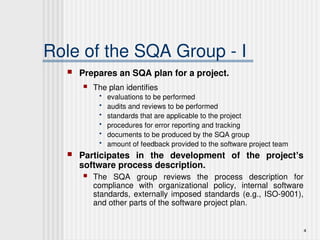
Role of the SQA Group - I
 Prepares an SQA plan for a project.
 The plan identifies
• evaluations to be performed
• audits and reviews to be performed
• standards that are applicable to the project
• procedures for error reporting and tracking
• documents to be produced by the SQA group
• amount of feedback provided to the software project team
 Participates in the development of the project’s
software process description.
 The SQA group reviews the process description for
compliance with organizational policy, internal software
standards, externally imposed standards (e.g., ISO-9001),
and other parts of the software project plan.
5
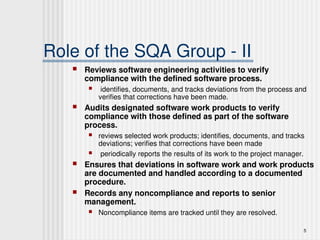
Role of the SQA Group - II
 Reviews software engineering activities to verify
compliance with the defined software process.
 identifies, documents, and tracks deviations from the process and
verifies that corrections have been made.
 Audits designated software work products to verify
compliance with those defined as part of the software
process.
 reviews selected work products; identifies, documents, and tracks
deviations; verifies that corrections have been made
 periodically reports the results of its work to the project manager.
 Ensures that deviations in software work and work products
are documented and handled according to a documented
procedure.
 Records any noncompliance and reports to senior
management.
 Noncompliance items are tracked until they are resolved.
6
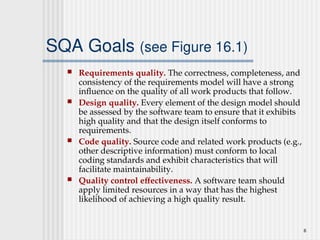
SQA Goals (see Figure 16.1)
 Requirements quality. The correctness, completeness, and
consistency of the requirements model will have a strong
influence on the quality of all work products that follow.
 Design quality. Every element of the design model should
be assessed by the software team to ensure that it exhibits
high quality and that the design itself conforms to
requirements.
 Code quality. Source code and related work products (e.g.,
other descriptive information) must conform to local
coding standards and exhibit characteristics that will
facilitate maintainability.
 Quality control effectiveness. A software team should
apply limited resources in a way that has the highest
likelihood of achieving a high quality result.
7
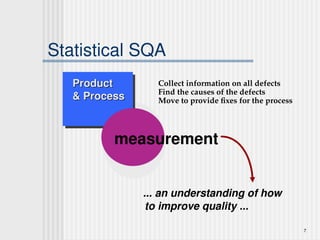
Statistical SQA
Product
Product
& Process
& Process
measurement
... an understanding of how
to improve quality ...
Collect information on all defects
Find the causes of the defects
Move to provide fixes for the process
8
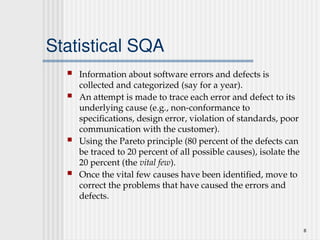
Statistical SQA
 Information about software errors and defects is
collected and categorized (say for a year).
 An attempt is made to trace each error and defect to its
underlying cause (e.g., non-conformance to
specifications, design error, violation of standards, poor
communication with the customer).
 Using the Pareto principle (80 percent of the defects can
be traced to 20 percent of all possible causes), isolate the
20 percent (the vital few).
 Once the vital few causes have been identified, move to
correct the problems that have caused the errors and
defects.
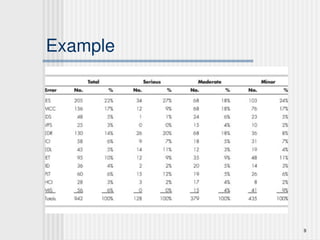
Example
9
10
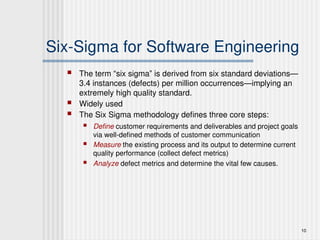
Six-Sigma for Software Engineering
 The term “six sigma” is derived from six standard deviations—
3.4 instances (defects) per million occurrences—implying an
extremely high quality standard.
 Widely used
 The Six Sigma methodology defines three core steps:
 Define customer requirements and deliverables and project goals
via well-defined methods of customer communication
 Measure the existing process and its output to determine current
quality performance (collect defect metrics)
 Analyze defect metrics and determine the vital few causes.
11
Software Reliability
 A simple measure of reliability is mean-time-
between-failure (MTBF), where
MTBF = MTTF + MTTR
 The acronyms MTTF and MTTR are mean-
time-to-failure and mean-time-to-repair,
respectively.
 Software availability is the probability that a
program is operating according to requirements
at a given point in time and is defined as
Availability = [MTTF/(MTTF + MTTR)] x 100%
12
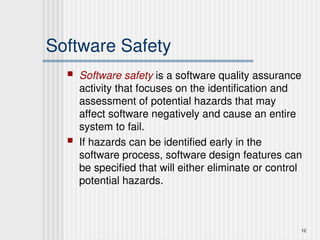
Software Safety
 Software safety is a software quality assurance
activity that focuses on the identification and
assessment of potential hazards that may
affect software negatively and cause an entire
system to fail.
 If hazards can be identified early in the
software process, software design features can
be specified that will either eliminate or control
potential hazards.
13
ISO 9001:2000 Standard
 ISO 9001:2000 is the quality assurance standard that
applies to software engineering.
 The standard contains 20 requirements that must be
present for an effective quality assurance system.
 The requirements delineated by ISO 9001:2000 address
topics such as
 management responsibility, quality system, contract
review, design control, document and data control, product
identification and traceability, process control, inspection
and testing, corrective and preventive action, control of
quality records, internal quality audits, training, servicing,
and statistical techniques.

Software Quality Assurance SQA lecture.ppt

  • 1.
    1  Software QualityAssurance Slide Set to accompany Software Engineering: A Practitioner’s Approach, 7/e by Roger S. Pressman Slides copyright © 1996, 2001, 2005, 2009 by Roger S. Pressman For non-profit educational use only May be reproduced ONLY for student use at the university level when used in conjunction with Software Engineering: A Practitioner's Approach, 7/e. Any other reproduction or use is prohibited without the express written permission of the author. All copyright information MUST appear if these slides are posted on a website for student use.
  • 2.
    2 Comment on Quality Phil Crosby once said:  The problem of quality management is not what people don't know about it. The problem is what they think they do know . . .  Today every company has a mechanism to ensure quality in its products  Software Quality is not maintained by software developers  Typically a group for software quality assurance (SQA) is established within the company
  • 3.
    3 Elements of SQA Standards – International  Reviews and Audits – within the company  Testing – testing of the code  Error/defect collection and analysis - team  Change management – change to specifications  Education - developers, leaders, stakeholders  Vendor management – purchasing parts of software  Security management - cybersecurity  Safety - failures  Risk management – backup plans
  • 4.
    4 Role of theSQA Group - I  Prepares an SQA plan for a project.  The plan identifies • evaluations to be performed • audits and reviews to be performed • standards that are applicable to the project • procedures for error reporting and tracking • documents to be produced by the SQA group • amount of feedback provided to the software project team  Participates in the development of the project’s software process description.  The SQA group reviews the process description for compliance with organizational policy, internal software standards, externally imposed standards (e.g., ISO-9001), and other parts of the software project plan.
  • 5.
    5 Role of theSQA Group - II  Reviews software engineering activities to verify compliance with the defined software process.  identifies, documents, and tracks deviations from the process and verifies that corrections have been made.  Audits designated software work products to verify compliance with those defined as part of the software process.  reviews selected work products; identifies, documents, and tracks deviations; verifies that corrections have been made  periodically reports the results of its work to the project manager.  Ensures that deviations in software work and work products are documented and handled according to a documented procedure.  Records any noncompliance and reports to senior management.  Noncompliance items are tracked until they are resolved.
  • 6.
    6 SQA Goals (seeFigure 16.1)  Requirements quality. The correctness, completeness, and consistency of the requirements model will have a strong influence on the quality of all work products that follow.  Design quality. Every element of the design model should be assessed by the software team to ensure that it exhibits high quality and that the design itself conforms to requirements.  Code quality. Source code and related work products (e.g., other descriptive information) must conform to local coding standards and exhibit characteristics that will facilitate maintainability.  Quality control effectiveness. A software team should apply limited resources in a way that has the highest likelihood of achieving a high quality result.
  • 7.
    7 Statistical SQA Product Product & Process &Process measurement ... an understanding of how to improve quality ... Collect information on all defects Find the causes of the defects Move to provide fixes for the process
  • 8.
    8 Statistical SQA  Informationabout software errors and defects is collected and categorized (say for a year).  An attempt is made to trace each error and defect to its underlying cause (e.g., non-conformance to specifications, design error, violation of standards, poor communication with the customer).  Using the Pareto principle (80 percent of the defects can be traced to 20 percent of all possible causes), isolate the 20 percent (the vital few).  Once the vital few causes have been identified, move to correct the problems that have caused the errors and defects.
  • 9.
  • 10.
    10 Six-Sigma for SoftwareEngineering  The term “six sigma” is derived from six standard deviations— 3.4 instances (defects) per million occurrences—implying an extremely high quality standard.  Widely used  The Six Sigma methodology defines three core steps:  Define customer requirements and deliverables and project goals via well-defined methods of customer communication  Measure the existing process and its output to determine current quality performance (collect defect metrics)  Analyze defect metrics and determine the vital few causes.
  • 11.
    11 Software Reliability  Asimple measure of reliability is mean-time- between-failure (MTBF), where MTBF = MTTF + MTTR  The acronyms MTTF and MTTR are mean- time-to-failure and mean-time-to-repair, respectively.  Software availability is the probability that a program is operating according to requirements at a given point in time and is defined as Availability = [MTTF/(MTTF + MTTR)] x 100%
  • 12.
    12 Software Safety  Softwaresafety is a software quality assurance activity that focuses on the identification and assessment of potential hazards that may affect software negatively and cause an entire system to fail.  If hazards can be identified early in the software process, software design features can be specified that will either eliminate or control potential hazards.
  • 13.
    13 ISO 9001:2000 Standard ISO 9001:2000 is the quality assurance standard that applies to software engineering.  The standard contains 20 requirements that must be present for an effective quality assurance system.  The requirements delineated by ISO 9001:2000 address topics such as  management responsibility, quality system, contract review, design control, document and data control, product identification and traceability, process control, inspection and testing, corrective and preventive action, control of quality records, internal quality audits, training, servicing, and statistical techniques.