Software Quality Assurance
Quality Concepts
“For a software application to achieve high quality levels,
it is necessary to begin upstream and ensure that intermediate
deliverables and work products are also of high quality levels.
This means that the entire process of software development must itself
be focused on quality”
Capers Jones
User satisfaction = compliant product + good quality +
delivery within budget and schedule
Quality Control
 Quality control involves the series of inspections,
reviews, and tests used throughout the software
process.
 Quality control includes a feedback loop to the process.
 A key concept of quality control is that all work products
have
 defined,
 measurable
Specifications to which we may compare the output of each
process.
 If the data provided through quality assurance identify
problems,
 it is management’s responsibility to address the problems
 and apply the necessary resources to resolve quality issues.
Cost of Quality
 The cost of quality includes all costs incurred in
the pursuit of quality or in performing quality-
related activities.
 Quality costs may be divided 3 mode of cost:
 Prevention
 Appraisal
 Failure.
 Prevention costs include
1. Quality planning
2. Formal technical reviews
3. Training
 Appraisal costs include activities to gain insight
into product
1. In-process and Inter-process inspection
2. Equipment calibration and maintenance
3. Testing
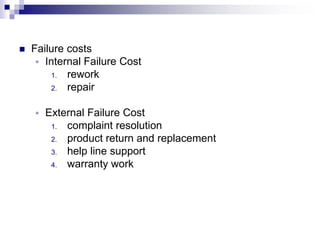
 Failure costs
 Internal Failure Cost
1. rework
2. repair
 External Failure Cost
1. complaint resolution
2. product return and replacement
3. help line support
4. warranty work
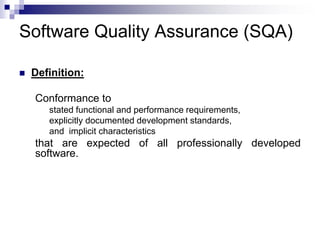
Software Quality Assurance (SQA)
 Definition:
Conformance to
stated functional and performance requirements,
explicitly documented development standards,
and implicit characteristics
that are expected of all professionally developed
software.
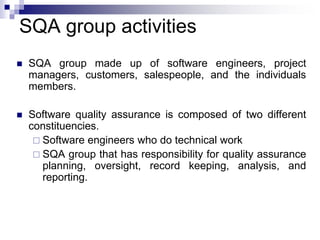
SQA group activities
 SQA group made up of software engineers, project
managers, customers, salespeople, and the individuals
members.
 Software quality assurance is composed of two different
constituencies.
 Software engineers who do technical work
 SQA group that has responsibility for quality assurance
planning, oversight, record keeping, analysis, and
reporting.
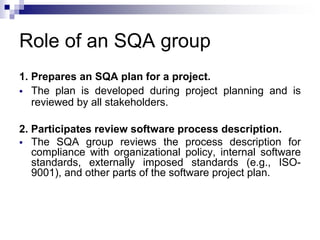
Role of an SQA group
1. Prepares an SQA plan for a project.
 The plan is developed during project planning and is
reviewed by all stakeholders.
2. Participates review software process description.
 The SQA group reviews the process description for
compliance with organizational policy, internal software
standards, externally imposed standards (e.g., ISO-
9001), and other parts of the software project plan.
3. Reviews software engineering activities to verify
compliance with the defined software process.
 The SQA group identifies, documents, and tracks
deviations from the process and verifies that corrections
have been made.
4. Audits designated software work products to verify
compliance with those defined as part of the
software process.
 The SQA group reviews selected work products;
identifies, documents, and tracks deviations; verifies that
corrections have been made; and periodically reports the
results of its work to the project manager.
5. Ensures that deviations in software work and work
products are documented and handled according to
a documented procedure.
 Deviations may be encountered in the project plan,
process description, applicable standards, or technical
work products.
Software Review
 Software reviews are a "filter" for the software
engineering process.
 That is, reviews are applied at various points during
software development and serve to uncover errors and
defects that can then be removed.
Software Review
 Types of Review
 Informal Review
 Meeting around the coffee machine and discussing
technical problems.
 Formal Review
 Formal presentation of software design to an
audience of customers, management, and
technical staff
Cost Impact of Software Defects
 The primary objective of formal technical reviews is to find errors
during the process so that they do not become defects after release
of the software.
 Direct benefit is early discovery of error, do not propagate to the
next step.
 However, FTR have been shown to be up to 75 percent effective in
uncovering flaws.
Contd.
 Assume that an error uncovered during design
will cost 1.0 monetary unit to correct.
 Relative to this cost, the same error uncovered
just before testing commences will cost 6.5
units; during testing, 15 units; and after release,
between 60 and 100 units.
TECHNICAL REVIEWS
 It is a software quality assurance activity performed by
software engineers
 The Technical Review is actually a class of reviews that
includes walkthroughs, inspections, round-robin reviews
and other small group technical assessments of
software.
FTR- Review meeting
 Every review meeting should abide by the following
constraints:
1. Between three and five people (typically) should be
involved in the review.
2. Advance preparation should occur but should require no
more than two hours of work for each person.
3. The duration of the review meeting should be less than
two hours.
4. FTR focuses on a specific (and small) part of the overall
software.
5. e.g. rather than attempting to review an entire design,
are conducted for each component or small group of
components.
Review Reporting and Record Keeping
 During the FTR, a reviewer (the recorder) actively
records all issues that have been raised.
 These are summarized at the end of the review
meeting and a review issues list is produced.
 A review summary report answers three questions:
1. What was reviewed?
2. Who reviewed it?
3. What were the findings and conclusions?
 Review summary report becomes part of the project
historical record and may be distributed to the project
leader and other interested parties.
 It is important to establish a follow-up procedure
to ensure that items on the issues list have been
properly corrected.
SOFTWARE RELIABILITY
 Software reliability is defined in statistical terms as "the
probability of failure-free operation of a computer
program in a specified environment for a specified time“.
 What is meant by the term failure?
 In the context of any discussion of software quality and reliability,
failure is nonconformance to software requirements.
 Correction of one failure may in fact result in the introduction of
other errors that ultimately result in other failures.
 Software reliability can be measured directed and
estimated using historical and developmental data.

Software Quality Assurance in software engineering

  • 1.
  • 2.
    Quality Concepts “For asoftware application to achieve high quality levels, it is necessary to begin upstream and ensure that intermediate deliverables and work products are also of high quality levels. This means that the entire process of software development must itself be focused on quality” Capers Jones User satisfaction = compliant product + good quality + delivery within budget and schedule
  • 3.
    Quality Control  Qualitycontrol involves the series of inspections, reviews, and tests used throughout the software process.  Quality control includes a feedback loop to the process.  A key concept of quality control is that all work products have  defined,  measurable Specifications to which we may compare the output of each process.
  • 4.
     If thedata provided through quality assurance identify problems,  it is management’s responsibility to address the problems  and apply the necessary resources to resolve quality issues.
  • 5.
    Cost of Quality The cost of quality includes all costs incurred in the pursuit of quality or in performing quality- related activities.  Quality costs may be divided 3 mode of cost:  Prevention  Appraisal  Failure.
  • 6.
     Prevention costsinclude 1. Quality planning 2. Formal technical reviews 3. Training
  • 7.
     Appraisal costsinclude activities to gain insight into product 1. In-process and Inter-process inspection 2. Equipment calibration and maintenance 3. Testing
  • 8.
     Failure costs Internal Failure Cost 1. rework 2. repair  External Failure Cost 1. complaint resolution 2. product return and replacement 3. help line support 4. warranty work
  • 9.
    Software Quality Assurance(SQA)  Definition: Conformance to stated functional and performance requirements, explicitly documented development standards, and implicit characteristics that are expected of all professionally developed software.
  • 10.
    SQA group activities SQA group made up of software engineers, project managers, customers, salespeople, and the individuals members.  Software quality assurance is composed of two different constituencies.  Software engineers who do technical work  SQA group that has responsibility for quality assurance planning, oversight, record keeping, analysis, and reporting.
  • 11.
    Role of anSQA group 1. Prepares an SQA plan for a project.  The plan is developed during project planning and is reviewed by all stakeholders. 2. Participates review software process description.  The SQA group reviews the process description for compliance with organizational policy, internal software standards, externally imposed standards (e.g., ISO- 9001), and other parts of the software project plan.
  • 12.
    3. Reviews softwareengineering activities to verify compliance with the defined software process.  The SQA group identifies, documents, and tracks deviations from the process and verifies that corrections have been made. 4. Audits designated software work products to verify compliance with those defined as part of the software process.  The SQA group reviews selected work products; identifies, documents, and tracks deviations; verifies that corrections have been made; and periodically reports the results of its work to the project manager.
  • 13.
    5. Ensures thatdeviations in software work and work products are documented and handled according to a documented procedure.  Deviations may be encountered in the project plan, process description, applicable standards, or technical work products.
  • 14.
    Software Review  Softwarereviews are a "filter" for the software engineering process.  That is, reviews are applied at various points during software development and serve to uncover errors and defects that can then be removed.
  • 15.
    Software Review  Typesof Review  Informal Review  Meeting around the coffee machine and discussing technical problems.  Formal Review  Formal presentation of software design to an audience of customers, management, and technical staff
  • 16.
    Cost Impact ofSoftware Defects  The primary objective of formal technical reviews is to find errors during the process so that they do not become defects after release of the software.  Direct benefit is early discovery of error, do not propagate to the next step.  However, FTR have been shown to be up to 75 percent effective in uncovering flaws.
  • 17.
    Contd.  Assume thatan error uncovered during design will cost 1.0 monetary unit to correct.  Relative to this cost, the same error uncovered just before testing commences will cost 6.5 units; during testing, 15 units; and after release, between 60 and 100 units.
  • 18.
    TECHNICAL REVIEWS  Itis a software quality assurance activity performed by software engineers  The Technical Review is actually a class of reviews that includes walkthroughs, inspections, round-robin reviews and other small group technical assessments of software.
  • 19.
    FTR- Review meeting Every review meeting should abide by the following constraints: 1. Between three and five people (typically) should be involved in the review. 2. Advance preparation should occur but should require no more than two hours of work for each person. 3. The duration of the review meeting should be less than two hours. 4. FTR focuses on a specific (and small) part of the overall software. 5. e.g. rather than attempting to review an entire design, are conducted for each component or small group of components.
  • 20.
    Review Reporting andRecord Keeping  During the FTR, a reviewer (the recorder) actively records all issues that have been raised.  These are summarized at the end of the review meeting and a review issues list is produced.  A review summary report answers three questions: 1. What was reviewed? 2. Who reviewed it? 3. What were the findings and conclusions?  Review summary report becomes part of the project historical record and may be distributed to the project leader and other interested parties.
  • 21.
     It isimportant to establish a follow-up procedure to ensure that items on the issues list have been properly corrected.
  • 22.
    SOFTWARE RELIABILITY  Softwarereliability is defined in statistical terms as "the probability of failure-free operation of a computer program in a specified environment for a specified time“.  What is meant by the term failure?  In the context of any discussion of software quality and reliability, failure is nonconformance to software requirements.  Correction of one failure may in fact result in the introduction of other errors that ultimately result in other failures.  Software reliability can be measured directed and estimated using historical and developmental data.