Topics2
Chapter 4
Medication Orders and
Labeling
2012 Paradigm Publishing
Topics3
Learning Objectives
 Gain an awareness of the historical roots of prescriptions, the Rx symbol,
and the signa.
 Recognize the influence of early Greek and Roman healthcare
practitioners on current medical terminology and abbreviations.
 Understand the difference between a prescription and a medication
order.
 Understand common medical and pharmacy terminology, abbreviations,
acronyms, and symbols.
 Identify pharmacy directions written in signa language.
 Recognize physician instructions and other pertinent information on a
medication order.
 Identify the various components of a compounded sterile preparation
label.
2012 Paradigm Publishing
Topics4
Topics
 Learning Objectives
 Introduction
 Medical Root Words, Prefixes, and Suffixes
 Medical Abbreviations, Acronyms, and Symbols
 Signa Interpretation
 Medication Orders
 Types of Medication Orders
 Medication Order Contents and Processing
 CSP Labeling
 Sterile Compound Label Components
 Sterile Compound Label Verification and Application
 Chapter Summary
2012 Paradigm Publishing
In Slide Show view, click
the desired topic to the
left to link directly to the
related slide. To return
to this slide at any point
in the presentation, click
the Topics button below.
Topics55
Introduction
 The origin of medical terminology is as old as
medicine itself
approximately 75% of medical terminology has its roots in
the Greek language
the remainder can be traced to Latin
2012 Paradigm Publishing
Topics66
Medical Root Words, Prefixes, and
Suffixes
 Most medical terminology is based on a combination
of medical morphemes, or root words, prefixes, and
suffixes
 A word’s meaning is derived from the root word
 A combining vowel is sometimes added to the end
of the root word
when a root word contains this combining vowel, the word
is said to be in its combined form
2012 Paradigm Publishing
Topics77
Medical Root Words, Prefixes, and
Suffixes…/2
 A prefix is a word element attached to the beginning
of a root word
a prefix often indicates time, location, direction, or
number
 A suffix is a word element attached to the end of a
root word
the addition of a suffix further defines the meaning of a
root word
2012 Paradigm Publishing
Topics88
Medical Abbreviations, Acronyms,
and Symbols
 Approximately 35,000 abbreviations, acronyms, and
symbols are used in medicine and pharmacy
 Collectively, they are referred to as medical
abbreviations, or simply abbreviations
most abbreviations are developed to shorten the length of
words and word combinations related to health, medicine,
laboratory procedures or tests, and pharmacy
2012 Paradigm Publishing
Topics99
Medical Abbreviations, Acronyms,
and Symbols…/2
Common Medical Abbreviations
 Indicate specific patient care facilities, units, or
departments or the titles of individual team
members
 Refer to specific medical diagnoses and conditions,
procedures, treatments, patient directives/activities,
equipment/supplies, and tests
2012 Paradigm Publishing
Topics1010
Medical Abbreviations, Acronyms,
and Symbols…/3
Common Pharmacy Abbreviations
 Typically seen on medication orders or other written
communications between providers and pharmacies
provide important information
might also include abbreviations to communicate specific
compounding directives
common for indicating the route of administration and the
dosing intervals for prescribed medications
2012 Paradigm Publishing
Topics1111
Medical Abbreviations, Acronyms,
and Symbols…/4
Common Pharmacy Symbols
 In addition to knowing pharmacy abbreviations, you
need to recognize and understand a number of
symbols specific to pharmacy practice
symbols such as ↑ and ↓ are frequently placed on
medication orders to indicate “increase” and “decrease,”
respectively
another common symbol is the Greek delta symbol (Δ),
which is used to indicate a desired change
2012 Paradigm Publishing
Topics1212
Medical Abbreviations, Acronyms,
and Symbols…/5
The Official “Do Not Use” List of Abbreviations
 In 2004, the Joint Commission was driven to create
The Official “Do Not Use” List of Abbreviations in
response to a number of sentinel events that had
been noted across the United States
list integrated into the Performance Standards for
Healthcare Accreditation
the nonstandard and potentially dangerous abbreviations
should not be used in any healthcare application
2012 Paradigm Publishing
Topics1313
Signa Interpretation
 The signa component is a specialized language that
physicians or other prescribers place on a medication
order
provides the pharmacy with specific directions for
administering the medication order
may include dosage information, the route of
administration, the amount to be dispensed, the time
schedule or dosing interval, and any special instructions
2012 Paradigm Publishing
Topics1414
Signa Interpretation…/2
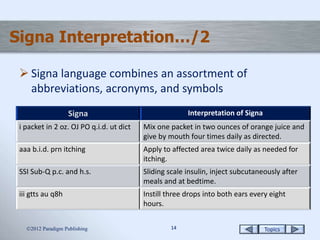
 Signa language combines an assortment of
abbreviations, acronyms, and symbols
2012 Paradigm Publishing
Signa Interpretation of Signa
i packet in 2 oz. OJ PO q.i.d. ut dict Mix one packet in two ounces of orange juice and
give by mouth four times daily as directed.
aaa b.i.d. prn itching Apply to affected area twice daily as needed for
itching.
SSI Sub-Q p.c. and h.s. Sliding scale insulin, inject subcutaneously after
meals and at bedtime.
iii gtts au q8h Instill three drops into both ears every eight
hours.
Topics1515
Signa Interpretation…/3
 Transcribing or interpreting a signa requires you to
seek the portions of the directive that address the
following questions:
What is the route of administration of the medication?
How much of the medication is the patient supposed to
take and how often?
What special instructions need to be followed when taking
the medication?
2012 Paradigm Publishing
Topics1616
Medication Orders
 Medication orders are similar to prescriptions
exclusive to the institutional or hospital setting
 Medication orders entered directly into a computer
by the physician are often called eMARs (electronic
medication administration records)
 Just like other types of prescriptions, medication
orders are legal documents that must be filed,
usually based on the date the order was written, and
kept on hand for up to two years
2012 Paradigm Publishing
Topics1717
Medication Orders…/2
 Upon receipt of the medication order, the pharmacy
determines what medications and dosages have
been ordered and then interprets the signa
directions
it is then transcribed, or interpreted, and then entered into
the pharmacy’s computer system through a process called
order entry
the pharmacist usually performs order entry, but specially
trained pharmacy technicians may also complete this task
 A label is then prepared for each of the medications
2012 Paradigm Publishing
Topics18
Your Turn
2012 Paradigm Publishing
1) Approximately how many abbreviations, acronyms, and symbols are
used in medicine and pharmacy?
a. 350
b. 3,500
c. 35,000
d. 350,000
2) This component is a specialized language that physicians or other
prescribers place on a medication order.
a. delta
b. signa
c. alpha
d. omega
In Slide Show view,
click here to see
the answer to
Question 1. Then
click again to
advance to
Question 2.
In Slide Show view,
click here to see
the answer to
Question 2.
Topics1919
 During hospital treatment, a physician examines a
patient and then writes the first medication order on
the patient’s medical chart
the medical chart is commonly called the medication
administration record, the patient’s chart or, simply, the
chart
2012 Paradigm Publishing
Types of Medication Orders
Topics2020
 The physician’s initial
order is called the
admission order and is
often written while the
patient is in the
emergency department
or has just been
admitted to a hospital
room
2012 Paradigm Publishing
Types of Medication Orders…/2
Topics2121
 If applicable, the admission order includes a list of
the medications, including dosages and dosing
intervals, that the patient has been taking at home
 These medications are commonly referred to as
home medications or home meds
in many instances, the physician orders the pharmacy to
continue home meds so that the patient will receive these
same medications while he or she is hospitalized
2012 Paradigm Publishing
Types of Medication Orders…/3
Topics2222
 Every time a physician
examines a patient,
new orders, or changes
to existing medication
orders, are written
may be referred to as
daily orders
2012 Paradigm Publishing
Types of Medication Orders…/4
Topics2323
 Some physicians whose
specialties involve
commonly prescribed
medical treatments take
advantage of preprinted
order forms called
standing orders, or
routine orders
2012 Paradigm Publishing
Types of Medication Orders…/5
Topics2424
 The medical chart contains both patient
identification information and copies of all treatment
orders prescribed during the patient’s stay
 Standard patient identification information is either
handwritten on the order, provided on a computer-
generated patient ID label affixed to the order, or
preprinted at the top of each medication order by
using an addressograph
2012 Paradigm Publishing
Medication Order Contents and
Processing
Topics2525
 Access to protected health information (PHI), such
as that found on a medication order or in a patient
chart, is restricted and the information may be
viewed only by those departments that must see the
data in order to correctly treat the patient
pharmacy
laboratory
nursing
2012 Paradigm Publishing
Medication Order Contents and
Processing…/2
Topics2626
 The treatment orders kept in the medical chart are
carbon copies of all medication, diagnostic,
laboratory, dietary, and other orders prescribed
the original copy remains in the chart, while the other
carbon copies are hand-delivered, faxed, scanned
electronically, or sent via pneumatic tube system to the
pharmacy or other relevant hospital departments
may be kept at the nursing station or maintained on a
computer record
2012 Paradigm Publishing
Medication Order Contents and
Processing…/3
Topics2727
 Orders are most often written by hand, using a
combination of medical terminology and signa
instructions, but they may also be entered directly
into a hospital computer
facilities that depend on an eMAR system provide
computer terminals at the nursing station or near the
patient’s room
physicians use these terminals for direct order entry,
commonly referred to as computerized physician order
entry (CPOE)
2012 Paradigm Publishing
Medication Order Contents and
Processing…/4
Topics2828
 A pharmacist or technician based in either the
central pharmacy or a satellite pharmacy enters the
order into the pharmacy’s computer system
specialized pharmacy software assists with the
identification of patient medication allergies and cross-
sensitivities, drug–drug or drug–food interactions,
appropriate medication dosage, duplicate therapy,
contraindications, and other information
if an issue or potential problem arises, a flashing caution or
warning screen (sometimes called a warning flag) appears
2012 Paradigm Publishing
Medication Order Contents and
Processing…/5
Topics2929
CSP Labeling
 Upon completion of sterile compounding and
checking procedures, personnel must appropriately
label the sterile compound in its final container
 Labels will most often be affixed by the IV technician
but may also be affixed by the pharmacist
 Federal laws require that pharmacy labels accurately
identify the ingredients and the amount of each
ingredient in the final sterile compound
2012 Paradigm Publishing
Topics3030
Sterile Compound Label
Components
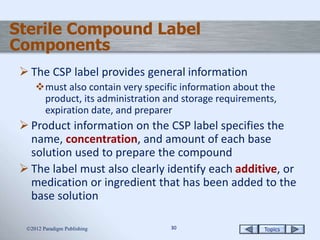
 The CSP label provides general information
must also contain very specific information about the
product, its administration and storage requirements,
expiration date, and preparer
 Product information on the CSP label specifies the
name, concentration, and amount of each base
solution used to prepare the compound
 The label must also clearly identify each additive, or
medication or ingredient that has been added to the
base solution
2012 Paradigm Publishing
Topics3131
Sterile Compound Label
Components…/2
 In general, only IV
push and IVPB
medications require
an administration
time, which is the
length of time over
which the drug is to
be given
2012 Paradigm Publishing
Topics3232
Sterile Compound Label
Components…/3
 If the medication’s administration is not ordered by
the physician and the package insert is unavailable,
the pharmacist may find this information by
consulting one of the pharmacy reference manuals,
such as the Handbook on Injectable Drugs, or a
computerized pharmacy reference source, such as
Micromedex
2012 Paradigm Publishing
Topics3333
Sterile Compound Label
Components…/4
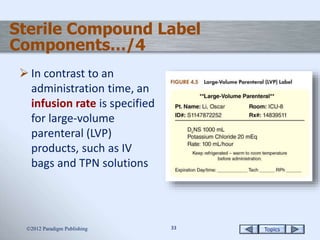
 In contrast to an
administration time, an
infusion rate is specified
for large-volume
parenteral (LVP)
products, such as IV
bags and TPN solutions
2012 Paradigm Publishing
Topics3434
Sterile Compound Label
Components…/5
 The CSP label must
also provide the
physician’s directions
for the medication’s
dosing interval
2012 Paradigm Publishing
Topics3535
Sterile Compound Label
Components…/6
 Personnel also add
auxiliary labels to clarify
special instructions or
highlight physician
directions for the nursing
staff
2012 Paradigm Publishing
Topics3636
Sterile Compound Label
Components…/7
 Another required component
on the CSP label is the
expiration date of the sterile
compound, sometimes
referred to as the beyond-use
date (BUD)
2012 Paradigm Publishing
Topics3737
Sterile Compound Label
Components…/8
 Several factors determine the expiration date,
including the stability of the drug in its
compounded form
storage requirements must also be included on the label
 Every CSP label must also identify the pharmacy
personnel who prepared the compound
2012 Paradigm Publishing
Topics3838
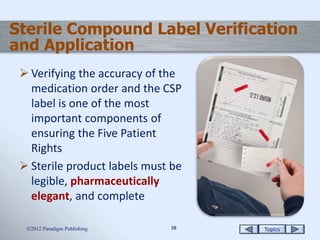
 Verifying the accuracy of the
medication order and the CSP
label is one of the most
important components of
ensuring the Five Patient
Rights
 Sterile product labels must be
legible, pharmaceutically
elegant, and complete
2012 Paradigm Publishing
Sterile Compound Label Verification
and Application
Topics39
Your Turn
2012 Paradigm Publishing
3) The physician’s initial order is called this.
a. start order
b. begin order
c. check-in order
d. admission order
4) The CSP label provides all of the following information except
a. storage requirements of medication
b. administration rate of medication
c. patient diagnosis
d. patient identification number
In Slide Show view,
click here to see
the answer to
Question 3. Then
click again to
advance to
Question 4.
In Slide Show view,
click here to see
the answer to
Question 4.

Medication Orders and Labeling

  • 2.
    Topics2 Chapter 4 Medication Ordersand Labeling 2012 Paradigm Publishing
  • 3.
    Topics3 Learning Objectives  Gainan awareness of the historical roots of prescriptions, the Rx symbol, and the signa.  Recognize the influence of early Greek and Roman healthcare practitioners on current medical terminology and abbreviations.  Understand the difference between a prescription and a medication order.  Understand common medical and pharmacy terminology, abbreviations, acronyms, and symbols.  Identify pharmacy directions written in signa language.  Recognize physician instructions and other pertinent information on a medication order.  Identify the various components of a compounded sterile preparation label. 2012 Paradigm Publishing
  • 4.
    Topics4 Topics  Learning Objectives Introduction  Medical Root Words, Prefixes, and Suffixes  Medical Abbreviations, Acronyms, and Symbols  Signa Interpretation  Medication Orders  Types of Medication Orders  Medication Order Contents and Processing  CSP Labeling  Sterile Compound Label Components  Sterile Compound Label Verification and Application  Chapter Summary 2012 Paradigm Publishing In Slide Show view, click the desired topic to the left to link directly to the related slide. To return to this slide at any point in the presentation, click the Topics button below.
  • 5.
    Topics55 Introduction  The originof medical terminology is as old as medicine itself approximately 75% of medical terminology has its roots in the Greek language the remainder can be traced to Latin 2012 Paradigm Publishing
  • 6.
    Topics66 Medical Root Words,Prefixes, and Suffixes  Most medical terminology is based on a combination of medical morphemes, or root words, prefixes, and suffixes  A word’s meaning is derived from the root word  A combining vowel is sometimes added to the end of the root word when a root word contains this combining vowel, the word is said to be in its combined form 2012 Paradigm Publishing
  • 7.
    Topics77 Medical Root Words,Prefixes, and Suffixes…/2  A prefix is a word element attached to the beginning of a root word a prefix often indicates time, location, direction, or number  A suffix is a word element attached to the end of a root word the addition of a suffix further defines the meaning of a root word 2012 Paradigm Publishing
  • 8.
    Topics88 Medical Abbreviations, Acronyms, andSymbols  Approximately 35,000 abbreviations, acronyms, and symbols are used in medicine and pharmacy  Collectively, they are referred to as medical abbreviations, or simply abbreviations most abbreviations are developed to shorten the length of words and word combinations related to health, medicine, laboratory procedures or tests, and pharmacy 2012 Paradigm Publishing
  • 9.
    Topics99 Medical Abbreviations, Acronyms, andSymbols…/2 Common Medical Abbreviations  Indicate specific patient care facilities, units, or departments or the titles of individual team members  Refer to specific medical diagnoses and conditions, procedures, treatments, patient directives/activities, equipment/supplies, and tests 2012 Paradigm Publishing
  • 10.
    Topics1010 Medical Abbreviations, Acronyms, andSymbols…/3 Common Pharmacy Abbreviations  Typically seen on medication orders or other written communications between providers and pharmacies provide important information might also include abbreviations to communicate specific compounding directives common for indicating the route of administration and the dosing intervals for prescribed medications 2012 Paradigm Publishing
  • 11.
    Topics1111 Medical Abbreviations, Acronyms, andSymbols…/4 Common Pharmacy Symbols  In addition to knowing pharmacy abbreviations, you need to recognize and understand a number of symbols specific to pharmacy practice symbols such as ↑ and ↓ are frequently placed on medication orders to indicate “increase” and “decrease,” respectively another common symbol is the Greek delta symbol (Δ), which is used to indicate a desired change 2012 Paradigm Publishing
  • 12.
    Topics1212 Medical Abbreviations, Acronyms, andSymbols…/5 The Official “Do Not Use” List of Abbreviations  In 2004, the Joint Commission was driven to create The Official “Do Not Use” List of Abbreviations in response to a number of sentinel events that had been noted across the United States list integrated into the Performance Standards for Healthcare Accreditation the nonstandard and potentially dangerous abbreviations should not be used in any healthcare application 2012 Paradigm Publishing
  • 13.
    Topics1313 Signa Interpretation  Thesigna component is a specialized language that physicians or other prescribers place on a medication order provides the pharmacy with specific directions for administering the medication order may include dosage information, the route of administration, the amount to be dispensed, the time schedule or dosing interval, and any special instructions 2012 Paradigm Publishing
  • 14.
    Topics1414 Signa Interpretation…/2  Signalanguage combines an assortment of abbreviations, acronyms, and symbols 2012 Paradigm Publishing Signa Interpretation of Signa i packet in 2 oz. OJ PO q.i.d. ut dict Mix one packet in two ounces of orange juice and give by mouth four times daily as directed. aaa b.i.d. prn itching Apply to affected area twice daily as needed for itching. SSI Sub-Q p.c. and h.s. Sliding scale insulin, inject subcutaneously after meals and at bedtime. iii gtts au q8h Instill three drops into both ears every eight hours.
  • 15.
    Topics1515 Signa Interpretation…/3  Transcribingor interpreting a signa requires you to seek the portions of the directive that address the following questions: What is the route of administration of the medication? How much of the medication is the patient supposed to take and how often? What special instructions need to be followed when taking the medication? 2012 Paradigm Publishing
  • 16.
    Topics1616 Medication Orders  Medicationorders are similar to prescriptions exclusive to the institutional or hospital setting  Medication orders entered directly into a computer by the physician are often called eMARs (electronic medication administration records)  Just like other types of prescriptions, medication orders are legal documents that must be filed, usually based on the date the order was written, and kept on hand for up to two years 2012 Paradigm Publishing
  • 17.
    Topics1717 Medication Orders…/2  Uponreceipt of the medication order, the pharmacy determines what medications and dosages have been ordered and then interprets the signa directions it is then transcribed, or interpreted, and then entered into the pharmacy’s computer system through a process called order entry the pharmacist usually performs order entry, but specially trained pharmacy technicians may also complete this task  A label is then prepared for each of the medications 2012 Paradigm Publishing
  • 18.
    Topics18 Your Turn 2012 ParadigmPublishing 1) Approximately how many abbreviations, acronyms, and symbols are used in medicine and pharmacy? a. 350 b. 3,500 c. 35,000 d. 350,000 2) This component is a specialized language that physicians or other prescribers place on a medication order. a. delta b. signa c. alpha d. omega In Slide Show view, click here to see the answer to Question 1. Then click again to advance to Question 2. In Slide Show view, click here to see the answer to Question 2.
  • 19.
    Topics1919  During hospitaltreatment, a physician examines a patient and then writes the first medication order on the patient’s medical chart the medical chart is commonly called the medication administration record, the patient’s chart or, simply, the chart 2012 Paradigm Publishing Types of Medication Orders
  • 20.
    Topics2020  The physician’sinitial order is called the admission order and is often written while the patient is in the emergency department or has just been admitted to a hospital room 2012 Paradigm Publishing Types of Medication Orders…/2
  • 21.
    Topics2121  If applicable,the admission order includes a list of the medications, including dosages and dosing intervals, that the patient has been taking at home  These medications are commonly referred to as home medications or home meds in many instances, the physician orders the pharmacy to continue home meds so that the patient will receive these same medications while he or she is hospitalized 2012 Paradigm Publishing Types of Medication Orders…/3
  • 22.
    Topics2222  Every timea physician examines a patient, new orders, or changes to existing medication orders, are written may be referred to as daily orders 2012 Paradigm Publishing Types of Medication Orders…/4
  • 23.
    Topics2323  Some physicianswhose specialties involve commonly prescribed medical treatments take advantage of preprinted order forms called standing orders, or routine orders 2012 Paradigm Publishing Types of Medication Orders…/5
  • 24.
    Topics2424  The medicalchart contains both patient identification information and copies of all treatment orders prescribed during the patient’s stay  Standard patient identification information is either handwritten on the order, provided on a computer- generated patient ID label affixed to the order, or preprinted at the top of each medication order by using an addressograph 2012 Paradigm Publishing Medication Order Contents and Processing
  • 25.
    Topics2525  Access toprotected health information (PHI), such as that found on a medication order or in a patient chart, is restricted and the information may be viewed only by those departments that must see the data in order to correctly treat the patient pharmacy laboratory nursing 2012 Paradigm Publishing Medication Order Contents and Processing…/2
  • 26.
    Topics2626  The treatmentorders kept in the medical chart are carbon copies of all medication, diagnostic, laboratory, dietary, and other orders prescribed the original copy remains in the chart, while the other carbon copies are hand-delivered, faxed, scanned electronically, or sent via pneumatic tube system to the pharmacy or other relevant hospital departments may be kept at the nursing station or maintained on a computer record 2012 Paradigm Publishing Medication Order Contents and Processing…/3
  • 27.
    Topics2727  Orders aremost often written by hand, using a combination of medical terminology and signa instructions, but they may also be entered directly into a hospital computer facilities that depend on an eMAR system provide computer terminals at the nursing station or near the patient’s room physicians use these terminals for direct order entry, commonly referred to as computerized physician order entry (CPOE) 2012 Paradigm Publishing Medication Order Contents and Processing…/4
  • 28.
    Topics2828  A pharmacistor technician based in either the central pharmacy or a satellite pharmacy enters the order into the pharmacy’s computer system specialized pharmacy software assists with the identification of patient medication allergies and cross- sensitivities, drug–drug or drug–food interactions, appropriate medication dosage, duplicate therapy, contraindications, and other information if an issue or potential problem arises, a flashing caution or warning screen (sometimes called a warning flag) appears 2012 Paradigm Publishing Medication Order Contents and Processing…/5
  • 29.
    Topics2929 CSP Labeling  Uponcompletion of sterile compounding and checking procedures, personnel must appropriately label the sterile compound in its final container  Labels will most often be affixed by the IV technician but may also be affixed by the pharmacist  Federal laws require that pharmacy labels accurately identify the ingredients and the amount of each ingredient in the final sterile compound 2012 Paradigm Publishing
  • 30.
    Topics3030 Sterile Compound Label Components The CSP label provides general information must also contain very specific information about the product, its administration and storage requirements, expiration date, and preparer  Product information on the CSP label specifies the name, concentration, and amount of each base solution used to prepare the compound  The label must also clearly identify each additive, or medication or ingredient that has been added to the base solution 2012 Paradigm Publishing
  • 31.
    Topics3131 Sterile Compound Label Components…/2 In general, only IV push and IVPB medications require an administration time, which is the length of time over which the drug is to be given 2012 Paradigm Publishing
  • 32.
    Topics3232 Sterile Compound Label Components…/3 If the medication’s administration is not ordered by the physician and the package insert is unavailable, the pharmacist may find this information by consulting one of the pharmacy reference manuals, such as the Handbook on Injectable Drugs, or a computerized pharmacy reference source, such as Micromedex 2012 Paradigm Publishing
  • 33.
    Topics3333 Sterile Compound Label Components…/4 In contrast to an administration time, an infusion rate is specified for large-volume parenteral (LVP) products, such as IV bags and TPN solutions 2012 Paradigm Publishing
  • 34.
    Topics3434 Sterile Compound Label Components…/5 The CSP label must also provide the physician’s directions for the medication’s dosing interval 2012 Paradigm Publishing
  • 35.
    Topics3535 Sterile Compound Label Components…/6 Personnel also add auxiliary labels to clarify special instructions or highlight physician directions for the nursing staff 2012 Paradigm Publishing
  • 36.
    Topics3636 Sterile Compound Label Components…/7 Another required component on the CSP label is the expiration date of the sterile compound, sometimes referred to as the beyond-use date (BUD) 2012 Paradigm Publishing
  • 37.
    Topics3737 Sterile Compound Label Components…/8 Several factors determine the expiration date, including the stability of the drug in its compounded form storage requirements must also be included on the label  Every CSP label must also identify the pharmacy personnel who prepared the compound 2012 Paradigm Publishing
  • 38.
    Topics3838  Verifying theaccuracy of the medication order and the CSP label is one of the most important components of ensuring the Five Patient Rights  Sterile product labels must be legible, pharmaceutically elegant, and complete 2012 Paradigm Publishing Sterile Compound Label Verification and Application
  • 39.
    Topics39 Your Turn 2012 ParadigmPublishing 3) The physician’s initial order is called this. a. start order b. begin order c. check-in order d. admission order 4) The CSP label provides all of the following information except a. storage requirements of medication b. administration rate of medication c. patient diagnosis d. patient identification number In Slide Show view, click here to see the answer to Question 3. Then click again to advance to Question 4. In Slide Show view, click here to see the answer to Question 4.