ADMINISTRATION OF MEDICINE
BELLO C. B.
INTRODUCTION
• One of the strategies that are used to maintain or
restore health of patients with acute or chronic health
problems is medication. In hospital care, medicine and
drugs are used interchangeably; drug is any substance
that is capable of affecting a person’s state of health or
ability to function. A medicine is any substance that
improves a person’s state of health or ability to
function. Medicines are administered for the purpose
of diagnosis, cure, treatment, relief or prevention of
health problem. A medicine has a therapeutic (helpful)
effect whereas a drug may not e.g. aspirin is a
medicine, alcohol is a drug.
• Errors in medication delivery are the longest single
cause of medical error in hospitals (Institute of
Medicine Report, 2000). Medication delivery is
highly complex, multifaceted operation involving
many people and numerous steps. The medication
delivery process consists of five basic stages of
prescribing/ordering, order transcription,
dispensing, administering and monitoring. Within
each of these stages there are multiple actions,
each presenting potential for error. Medication
administration is the last step in the medication use
process and the nurse administering that
medication provides the final line of defense for the
patient.
CLASSIFICATION OF MEDICINES
• Medicines are classified according to their specific
therapeutic actions on the body system on which
they act. Medicine may be identified by their
generic, chemical or trade name; some medications
have as many as three different names.
CLASSIFICATION CONTD
• Chemical name: provides information about its
composition and molecular structure e.g. N-acetyl-
para-aminophenol, which is commonly known as
Tylenol.
• Generic name: this is the name the manufacturer
who first the medication gives the drug, e.g.
Acetaminophen is the generic name of Tylenol.
• Trade name: also called brand or proprietary name
is the name under which a manufacturer markets a
medication. The trade name has this symbol (TM) at
the upper right of the name, e.g. Tylenol, Panadol
ROUTES OF DRUG ADMINISTRATION
• Oral Route:- Drug is swallowed maybe in liquid, tablet or
capsule form. It is also called enteral route, easiest and most
economical route. Note that absorption is influenced by the
presence or absence of food in the stomach and the amount
of stomach and intestinal activity and whether or not the
drugs composition is altered by gastric secretions.
• Buccal Route:- Drug is placed against mucous membrane of
inner surface of the cheek, it is absorbed across membrane of
mouth.
• Sublingual:- Drug is placed under tongue to be dissolved. It is
absorbed across membrane of mouth.
• Inhalation:- Drug applied to respiratory membrane.
• Rectal:- Drug applied into the rectum and absorption is by the
mucosa.
• Vaginally:- Drugs are applied into the vagina.
Topical:- Application to the part being treated. This is
the poorest route; substances are absorbed very
slowly and incompletely by this route e.g. skin, eye,
nose, ears etc.
• Inunctions:- Applied with rubbing to create friction,
liniments are applied this way.
• Instillation:- Drug in solution is place into the body
cavity for absorption across a membrane e.g. eye
drops, ear drops.
• Irrigation:- Mucous membrane or skin is flushed
with drug in solution, useful for local effect.
• Insufflations:- Administering of drug inform of
powder into the body cavity.
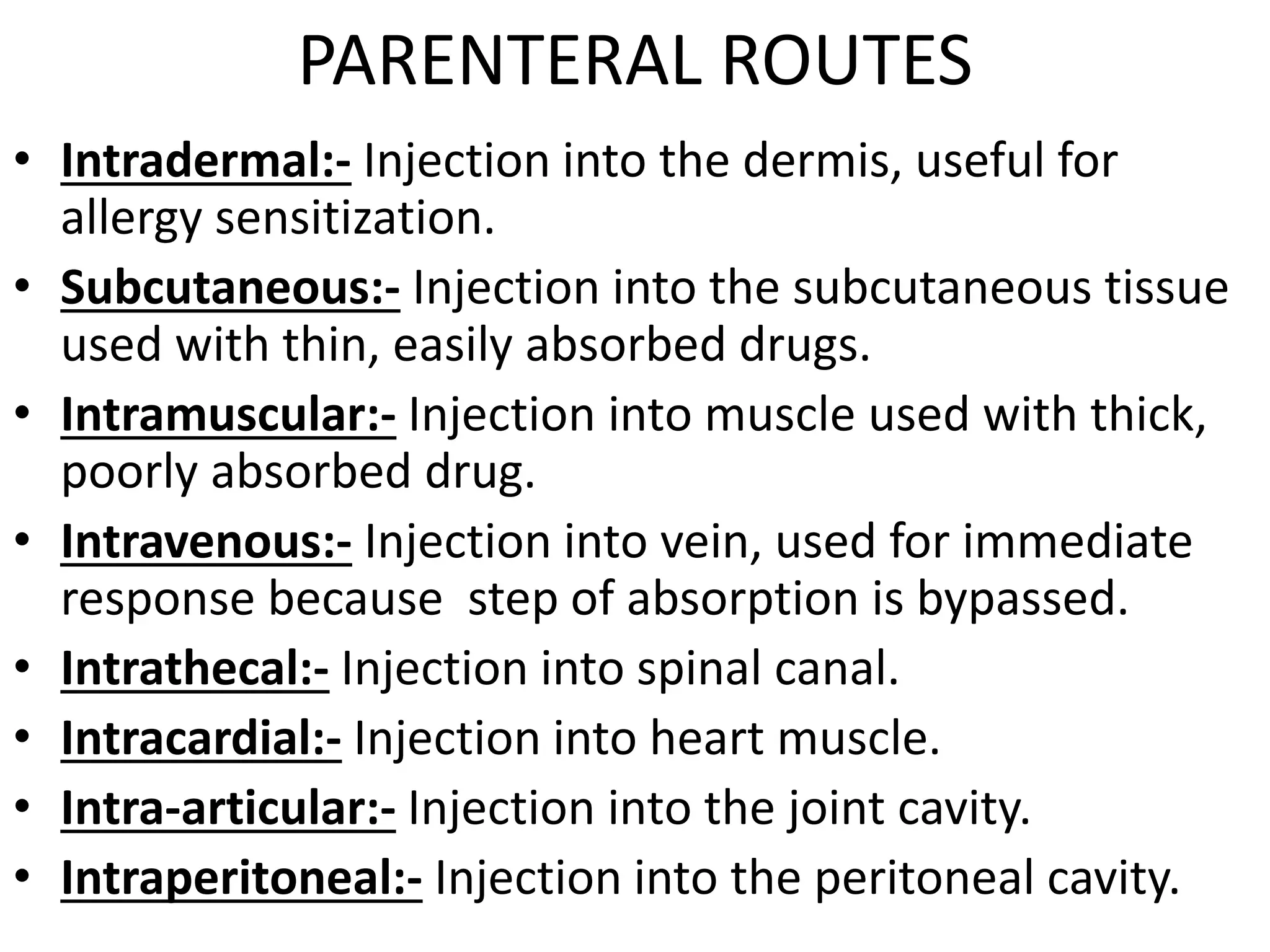
PARENTERAL ROUTES
• Intradermal:- Injection into the dermis, useful for
allergy sensitization.
• Subcutaneous:- Injection into the subcutaneous tissue
used with thin, easily absorbed drugs.
• Intramuscular:- Injection into muscle used with thick,
poorly absorbed drug.
• Intravenous:- Injection into vein, used for immediate
response because step of absorption is bypassed.
• Intrathecal:- Injection into spinal canal.
• Intracardial:- Injection into heart muscle.
• Intra-articular:- Injection into the joint cavity.
• Intraperitoneal:- Injection into the peritoneal cavity.
ADMINISTRATION OF DRUGS
• Administration of drug includes proper preparation of, client
identification and the actual administration. The nurse must pay
full attention to the procedure and try not to do other tasks
simultaneously; accuracy is greatest when the nurse observes the
ten (10) rights of drug administration.
• The right medication
• The right dose
• The right client
• The right route
• The right time
• The right documentation
• The right assessment
• The right client education
• The right to refuse
• The right evaluation
RIGHTS 1
• RIGHT MEDICATION:-A medication order is
required for any drug to be administered by a nurse,
an order must include clients full name, ward, bed
number, date the order is written, date the drug
order will expire, drug name, dose and frequency
and route of administration.
• If a medication order is incorrect or inappropriate,
the nurse should consult the prescriber. The nurse
who gives the wrong medication or an incorrect
dosage is legally responsible for the error.
RIGHTS 2
• RIGHT DOSE:- unit dose system is designed to minimize
error, when a medication must be prepared from a
dose other than what is ordered, the chance of error
increases. After calculating the dose, the nurse must
have another nurse to cross check the calculation. After
calculating the dose, appropriate measuring devices
must be used e.g. medicine cup in mls are used for
liquid preparation, or pediatrics scaled dropper. Note as
follows:-
• -Drugs poured into medication cups are done at eye
level.
• -Pour liquid medication away from label, so that labels
are not soiled which makes it difficult to read.
• -Expel air in syringes to ensure accurate measurement
of doses
RIGHTS 3
• RIGHT CLIENT:- Once a nurse is prepared to
administer a drug, the clients case note is checked
for name and patient should be called by name to
confirm that he/she is the right client, a client may
be asked to state his/her full name when necessary
to prevent error. Identity bracelets are checked in
an unconscious and unidentified client.
RIGHT4
• RIGHT TIME:- Agency and hospital have routine
schedules for medications ordered at standard
intervals, e.g. tid, etc. all routinely ordered
medications should be given within 30mins before
or after the scheduled time. Some medications
require the nurse’s clinical judgment in
determining the right time of administration e.g.
Prn order of analgesic, the nurse needs to assess
the characteristics and severity of the pain. To
determine when to administer an order of a stool
softener Prn, will need the nurse to assess the
characteristics of a clients stool daily.
Rights 5 & 6
• RIGHT ROUTE:- The prescribers order must designate a
route of administration. If the route of administration is
missing or if the special route is not the recommended
route, the nurse must consult the prescriber
immediately.
• RIGHT DOCUMENTATION:- Many medication error
result from inappropriate documentation, nurses and
other care givers must use accurate documentation to
communicate with one another. The nurse must verify
any inaccurate documentation before giving
medications and document medication accurately at
the time of administration.
RIGHT 7
• RIGHT ASSESSMENT:- Some medication
require some assessment before
administration such as antihypertensive drugs
or the prescriber may give instruction such as
“do not give if apical pulse is lower than
60beats /min” e. g Digitalis
RIGHTS 8 9 10
• RIGHT CLIENT EDUCATION:- The client must be
properly educated on the necessary information about
the drug before it is served, such information should
include, the purpose for the medication, what to
expect, any precaution and what to report.
• RIGHT TO REFUSE:- adult clients have the right to
refuse their medication, but it is the responsibility of
the nurse to inform the client of the consequences of
such action. This should be properly documented and
the prescriber must be informed.
• RIGHT EVALUATION:- the nurse must monitor client by
keeping watch over them in order to promptly discover
side effects or adverse reaction
TYPES OF ORDER
• Written order:- All medication order must be
written except in circumstances that this is not
possible due to certain reasons, the nurse
must note that there is more danger of an
order being spoken incorrectly than of its
being miswritten. An order is likely to be
misunderstood when heard than when read.
TYPES OF ORDER
• Verbal order:- In emergencies, medication order may
be given verbally as there is no time for writing such,
verbal orders are only accepted only if it is truly
emergency. When accepting a verbal order, always
repeat the name of the medications, dosage, route of
administration and the name of the client, so that the
physician can ensure you heard correctly and to have a
choice to rethink the order if need be.
• For documentation, the nurse should write same
information on the physicians order sheet and indicates
as ‘per verbal’ order of Dr (name) followed by the nurse
signature and title. The nurse must ensure that the
physician counter signs the order at earliest
convenience to confirm prescription.
TYPES OF ORDER
• Telephone order:- It is a type of verbal order,
procedure is the same as verbal order and the nurse
should state or record “telephone order” and are
counter signed at the physicians earliest
opportunity.
• STAT Orders:- The word “stat” is an abbreviation of
a Latin word “statim” (immediately). A stat order
therefore is to be carried out immediately i.e. as
soon as possible, the nurse must record the time
the medication was administered.
TYPES OF ORDER
• Standing order:- Its applicable to all clients who are
administered to a particular nursing care unit or
meet certain criteria for home care. For example, a
physician might write a standing order requiring
that all clients admitted to a labor and delivering
service should have a certain medication for
discomfort as soon as uterine dilation reaches a
certain point. When following standing orders, be
certain that all the requirements for administration
are noted and that the client does not have
individual contradiction such as allergy that would
make the medication or dose inappropriate.
TYPES OF ORDER
• STAT Orders:- The word “stat” is an
abbreviation of a Latin word “statum”
(immediately). A stat order therefore is to be
carried out immediately i.e. as soon as
possible, the nurse must record the time the
medication was administered.
TYPES OF ORDER
• Prn orders:- It is a Latin word “Pro re nate” (as
needed). It is given only when the clients need it,
these include analgesics, hypnotics and laxatives.
Serving of this order is based on nursing judgment
and consultation with another nurse or the client to
confirm the need e.g. Acetylsalicylic acid 500mg
every 4hours for pain Prn. With this order, a client
would have 500mg of aspirin as frequently as every
4hours as necessary i.e. while in pain.
A MEDICATION ORDER
• A medication order is required for every medication
that you administer to a patient/client
• A medication order must include the following:
• Name of client
• Date and time when order was written
• Name of medication to be given
• Dosage of medication
• Route
• Time and frequency of administration
• Signature of person writing the order.
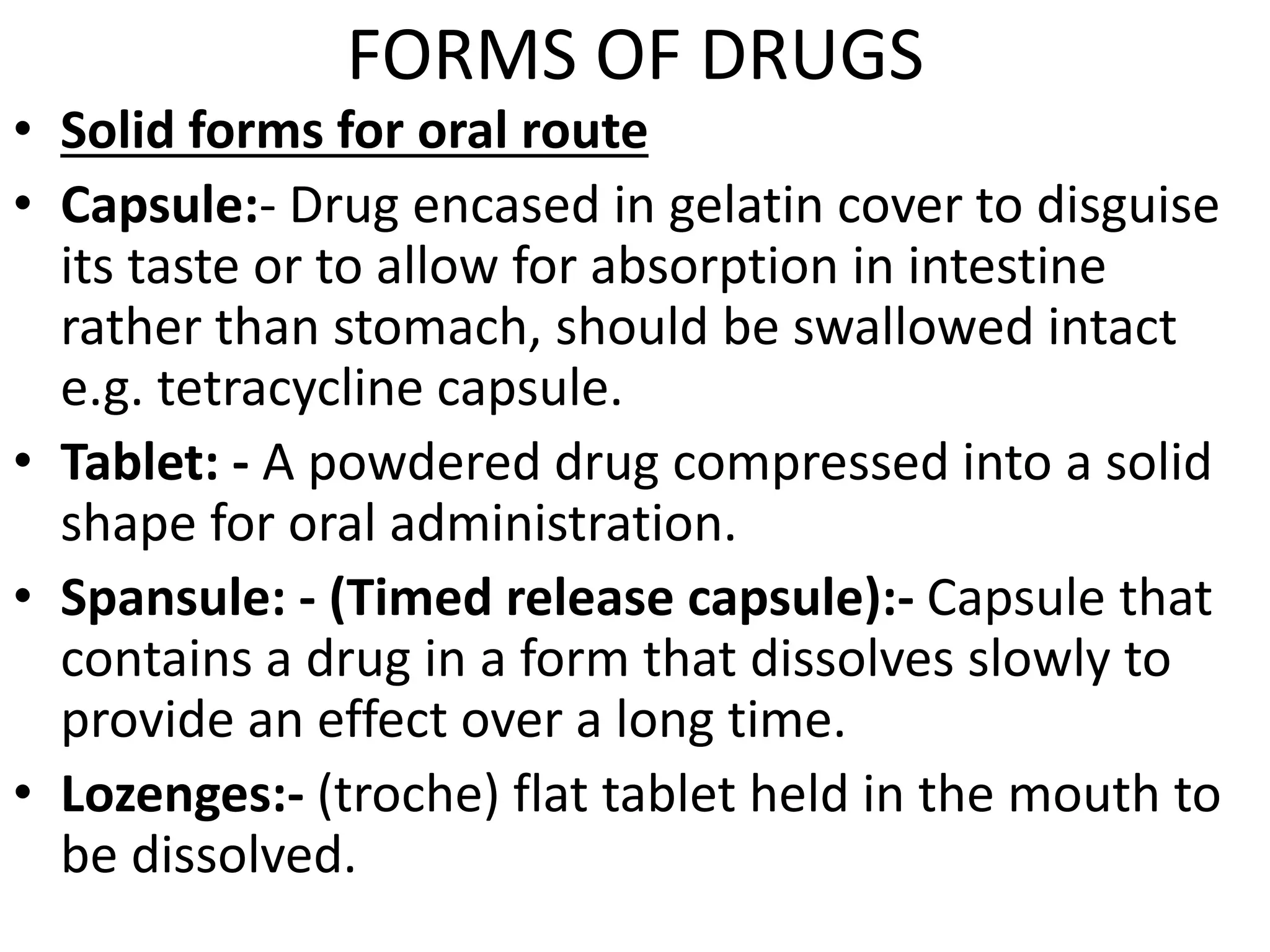
FORMS OF DRUGS
• Solid forms for oral route
• Capsule:- Drug encased in gelatin cover to disguise
its taste or to allow for absorption in intestine
rather than stomach, should be swallowed intact
e.g. tetracycline capsule.
• Tablet: - A powdered drug compressed into a solid
shape for oral administration.
• Spansule: - (Timed release capsule):- Capsule that
contains a drug in a form that dissolves slowly to
provide an effect over a long time.
• Lozenges:- (troche) flat tablet held in the mouth to
be dissolved.
FORMS OF DRUG CONTD
• Enteric coated tablet:- A tablet with a coating that
causes it to dissolve in the small intestine not the
stomach, this delay absorption until the medication
reaches the small intestine. Pls note that these
medications must not be crushed.
• Scored tablets contain an indented marking to
make breakage for partial dosages possible so that
it can be divided in halves and quarters
FORMS OF DRUGS CONTD
• Liquid forms for oral route
• Syrup:- Medicine dissolved in sugar and water (used to
give a soothing, pleasant taste).
• Aqueous solution:- Medicine dissolved in a water base.
• Elixir:- Aromatic and potent alcohol preparation e.g.
cough elixir.
• Powder Effervescent:- Some powder foam as it is
mixed with liquid, the foaming action disguises the
taste of drug e.g. Andrew liver salt.
• Magma:- (milk); soluble suspension with a water base
to be shaken before serving e.g. milk of magnesia.
FORMS OF DRUG CONTD
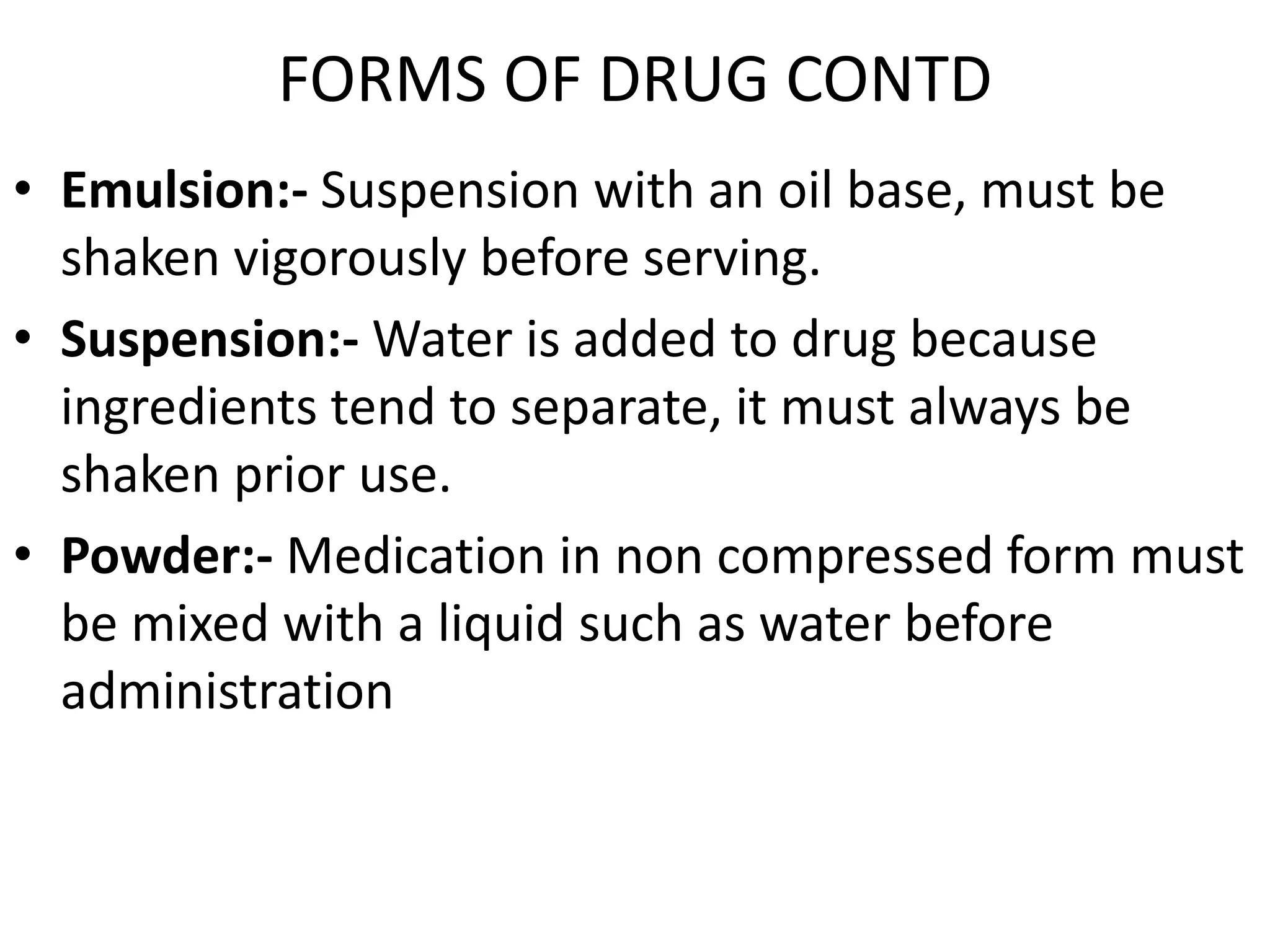
• Emulsion:- Suspension with an oil base, must be
shaken vigorously before serving.
• Suspension:- Water is added to drug because
ingredients tend to separate, it must always be
shaken prior use.
• Powder:- Medication in non compressed form must
be mixed with a liquid such as water before
administration
FORMS OF DRUGS CONTD
• Medications prepared for topical use
• Lotion:- Drug combined with water base to be used for
external application also to be shaken vigorously before
use e.g. calamine lotion.
• Ointment:- Drug combined with oil base to be used for
external application.
• Powder:- Medication in non compressed form must be
mixed with a liquid such as water before
administration.
• Tincture: - Potent solution with an alcohol base. Usual
dosage will be small.
• Paste:-Thick ointment absorbed through skin more
than ointment, often used for skin protection.
FORMS OF DRUG CONTD
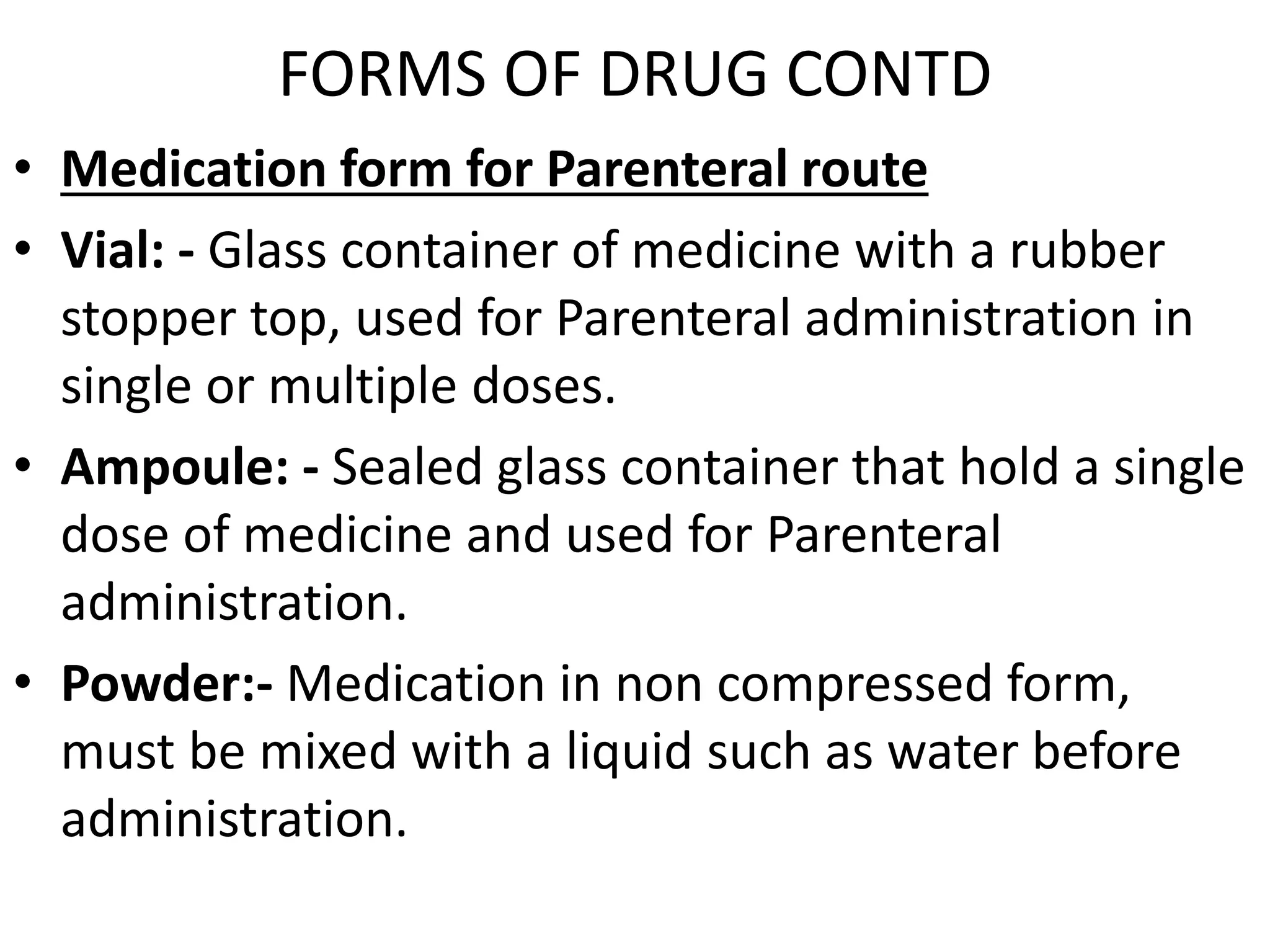
• Medication form for Parenteral route
• Vial: - Glass container of medicine with a rubber
stopper top, used for Parenteral administration in
single or multiple doses.
• Ampoule: - Sealed glass container that hold a single
dose of medicine and used for Parenteral
administration.
• Powder:- Medication in non compressed form,
must be mixed with a liquid such as water before
administration.
FORMS OF DRUG CONTD
• Medication form for body cavities.
• Suppository:- Drug combined with a glycerin or
cocoa butter base for rectal or vaginal insertion, the
base melts at body temperature and releases the
drug e.g. Anusol suppository.
• Pessary: - Drug compressed in a slim oblong form
for easy insertion into the vagina e.g. canesten
Pessary
• Ovules: - In suppository form but specifically for
vaginal insertions.
ADMINISTRATION OF ORAL MEDICATIONS
• It requires a clean, not sterile technique.
• -Give oral medications one hour before or after meals
for optimal absorption.
• -Except drug that irritate the stomach or cause gastro-
intestinal upset which are given with meals, milk or
prescribed antacid e.g. ASA.
• -A nurse must wash her hands thoroughly and prepare
her medicine trolley ready.
• -Ensure prompt identification of patient by calling her
name and compare with case note.
• -Read the prescription sheet and check for the name of
the drug, dose, route of administration and how often
and observe the five rights.
ADMINISTRATION OF ORAL MEDICATIONS CONTD
• Remove tablets or capsule by pouring into a bottle lid and drop
patient’s dose in a serving spoon.
• Ensure that excess do not drop into spoon as it will contaminate
others if returned back.
• Excess tablet or capsule in the bottle lid can be returned.
• Never pour tablet or capsule into hand.
• Tablets can be crushed with a mortar and pestle if patient cannot
tolerate it.
• Do not open capsules, spansules and do not crush enteric coated
tablets.
• A scored tablet may be broken in half, hold tablet between two
thumbs while you place a clean piece of gauze or paper towel
between the tablet and the hand.
• Do not attempt to break an un-scored tablet as they are difficult
and may not be accurate.
• All drugs are placed in the serving spoon.
ADMINISTRATION OF ORAL MEDICATION CONTD
• Check the prescription as above, before giving it to patient.
• Any agent that requires a special assessment before serving
must be done before serving e.g. Digoxin require the check of
pulse before serving and it is usually withheld when pulse
rate is less than 60 beats/minute.
• provide a drinking water for the patient and allow the patient
to swallow all medication given; ensure adequate fluid is
consumed alongside.
• Provide a glass of iced liquid or fruit juice for drug that leaves
bitter after taste.
• Observe patient for any abnormal reaction.
• Cross check again the Dr’s prescription sheet to ensure that
no error has been made.
• Chart drug given stating name of drug, dose, route with date
and time and your signature and cadre written clearly.
ADMINISTERING LIQUID MEDICATION
• Hold bottle with labels against the palm of your hand so that
you pour away from label.
• Ensure measuring cup is at eye level. Use the lower meniscus
to align with container scale.
• Never use a medication if the label has been obscured by
medicine previously dripping on it.
• Never re-label such a bottle either but return it to the
pharmacy to be re-labeled.
• For an infant or toddler, medication may be served in a
syringe without needle and ensure that the sweetest drug is
given first.
• Never interchange a medicine dropper that is supplied with
one medicine with that from another as their drop size may
differ.
• Do not mix oral liquid medications together because
incompatible precipitates could occur.
GENERAL RULES OF SAFE MEDICATION
• 1. Be certain that you have a clear written order for each medication
administered unless a true emergency exists (then use an oral order).
• 2. Concentrate on the act of preparing and administering medicine,
do not let yourself be distracted during this potentially dangerous
time.
• 3. Never take a medicine from an unlabelled or illegibly labeled
container.
• 4. Check a medicine kardex or card with the physician’s original order
the first time a medicine is to be administered to be certain that a
transcription error did not occur.
• 5. Follow the ten rights of medicine administration.
• 6. Do not leave medicine by a bed side if it is not taken immediately;
return it to the medication area.
• 7. Never return an unused portion of medicine to a stock
medicine bottle because of the potential danger of
returning it to the wrong bottle and contaminating the
bottle.
• 8. Do not administer medication prepared by someone
else; if an error was made in preparation, you would be
equally responsible for the error.
• 9. Do not prepare medication for another person to
administer.
• 10. Question any physician order that you think will cause
client harm or not safe or recommended. As a nurse you
must know usual dosages, routes and reasons for
administering drugs.
• 11. Refuse to administer any medication that
in your opinion would cause harm to a client.
• 12. Chart all medicine administered as soon as
administration has been completed so a dose
will not be repeated accidentally by another
care giver.
CONTROLLED DRUGS ACTS (CDA)
• CD are basically narcotics and narcotic analgesics;
the nurse is responsible for following legal
provisions when administering controlled
substances such as opiods, which are carefully
controlled through federal and state guidelines.
Violations of the controlled drug act are
punishable by fines, imprisonment and loss of
nurse licensure. Hospitals and other health care
agencies have policies for the proper storage and
distribution of controlled drugs.
Guidelines for Administration of controlled drugs
• Store all controlled drugs in a locked, secure cabinet or container.
• Frequently count controlled drugs with the opening of controlled
drug drawers and/or at shift change.
• Report discrepancies in controlled drug counts immediately
• Use a special inventory record each time a controlled dug is
dispensed, ensure an accurate ongoing record of controlled drugs
used, wasted and remaining
• Document patients name, date, time of medication, dose, and
signature of the nurse dispensing the medication.
• A second nurse witnesses disposal of the unused portion if a nurse
gives only part of a controlled substance, if paper records are kept,
both nurses sign their names on the form
• Do not place wasted portions of medications in sharp containers,
• Student nurses can only watch the drug being given.
• Follow institutional policy for controlled drug use
TYPES OF MEDICATION ACTION.
• This includes:-
• Therapeutic effect: this is the expected or predicted
response that a medication causes
• Side effects : this are predictable, often
unavoidable secondary effects produced at the
• normal therapeutic dose. e.g anti hypertensive
causing impotence
• Toxic effects: this develop after a prolong intake of
a medication, excess amount of a medication may
lead to a toxic effect; antidotes are available for
some toxicity.
TYPES OF MEDICATION ACTION CONTD
• Idiosyncratic reactions: this is an unpredictable
effect, in which a patient overreacts or under reacts
to a medication or has a reaction different from
normal. E.g. after taking Phenergan, an
antihistamine, a child become overactive or
agitated instead of being drowsy.
• Allergic reactions: this are unpredictable responses
due to immunologic sensitivity to the drug, the drug
has antigen that is triggering the release of
antibodies in the body leading antigen-antibody
reaction. Reaction may be inform of urticaria rash
TYPES OF MEDICATION ACTION CONTD
• Anaphylactic reaction: this is a more severe allergic
reaction, it is life threatening characterized by
sudden constriction of bronchiolar muscles, edema
of the pharynx and larynx with severe wheezing and
shortness of breath. Immediate medical attention is
required. History of known allergy is required, and
such patients should be strictly exempted from such
drug. e.g Penicillin. Patients should advised to wear
medical alerts.
TYPES OF MEDICATION ACTION CONTD
• Adverse effect: they are unintended,
undesirable and often unpredictable severe
response to medication, adverse effect may be
immediate, may take weeks or month to
occur. early recognition is important,
medication must be discontinued when
noticed and proper report and documentation
done

ADMINISTRATION OF MEDICINE(Nursing).pptx

  • 1.
  • 2.
    INTRODUCTION • One ofthe strategies that are used to maintain or restore health of patients with acute or chronic health problems is medication. In hospital care, medicine and drugs are used interchangeably; drug is any substance that is capable of affecting a person’s state of health or ability to function. A medicine is any substance that improves a person’s state of health or ability to function. Medicines are administered for the purpose of diagnosis, cure, treatment, relief or prevention of health problem. A medicine has a therapeutic (helpful) effect whereas a drug may not e.g. aspirin is a medicine, alcohol is a drug.
  • 3.
    • Errors inmedication delivery are the longest single cause of medical error in hospitals (Institute of Medicine Report, 2000). Medication delivery is highly complex, multifaceted operation involving many people and numerous steps. The medication delivery process consists of five basic stages of prescribing/ordering, order transcription, dispensing, administering and monitoring. Within each of these stages there are multiple actions, each presenting potential for error. Medication administration is the last step in the medication use process and the nurse administering that medication provides the final line of defense for the patient.
  • 4.
    CLASSIFICATION OF MEDICINES •Medicines are classified according to their specific therapeutic actions on the body system on which they act. Medicine may be identified by their generic, chemical or trade name; some medications have as many as three different names.
  • 5.
    CLASSIFICATION CONTD • Chemicalname: provides information about its composition and molecular structure e.g. N-acetyl- para-aminophenol, which is commonly known as Tylenol. • Generic name: this is the name the manufacturer who first the medication gives the drug, e.g. Acetaminophen is the generic name of Tylenol. • Trade name: also called brand or proprietary name is the name under which a manufacturer markets a medication. The trade name has this symbol (TM) at the upper right of the name, e.g. Tylenol, Panadol
  • 6.
    ROUTES OF DRUGADMINISTRATION • Oral Route:- Drug is swallowed maybe in liquid, tablet or capsule form. It is also called enteral route, easiest and most economical route. Note that absorption is influenced by the presence or absence of food in the stomach and the amount of stomach and intestinal activity and whether or not the drugs composition is altered by gastric secretions. • Buccal Route:- Drug is placed against mucous membrane of inner surface of the cheek, it is absorbed across membrane of mouth. • Sublingual:- Drug is placed under tongue to be dissolved. It is absorbed across membrane of mouth. • Inhalation:- Drug applied to respiratory membrane. • Rectal:- Drug applied into the rectum and absorption is by the mucosa.
  • 7.
    • Vaginally:- Drugsare applied into the vagina. Topical:- Application to the part being treated. This is the poorest route; substances are absorbed very slowly and incompletely by this route e.g. skin, eye, nose, ears etc. • Inunctions:- Applied with rubbing to create friction, liniments are applied this way. • Instillation:- Drug in solution is place into the body cavity for absorption across a membrane e.g. eye drops, ear drops. • Irrigation:- Mucous membrane or skin is flushed with drug in solution, useful for local effect. • Insufflations:- Administering of drug inform of powder into the body cavity.
  • 8.
    PARENTERAL ROUTES • Intradermal:-Injection into the dermis, useful for allergy sensitization. • Subcutaneous:- Injection into the subcutaneous tissue used with thin, easily absorbed drugs. • Intramuscular:- Injection into muscle used with thick, poorly absorbed drug. • Intravenous:- Injection into vein, used for immediate response because step of absorption is bypassed. • Intrathecal:- Injection into spinal canal. • Intracardial:- Injection into heart muscle. • Intra-articular:- Injection into the joint cavity. • Intraperitoneal:- Injection into the peritoneal cavity.
  • 9.
    ADMINISTRATION OF DRUGS •Administration of drug includes proper preparation of, client identification and the actual administration. The nurse must pay full attention to the procedure and try not to do other tasks simultaneously; accuracy is greatest when the nurse observes the ten (10) rights of drug administration. • The right medication • The right dose • The right client • The right route • The right time • The right documentation • The right assessment • The right client education • The right to refuse • The right evaluation
  • 10.
    RIGHTS 1 • RIGHTMEDICATION:-A medication order is required for any drug to be administered by a nurse, an order must include clients full name, ward, bed number, date the order is written, date the drug order will expire, drug name, dose and frequency and route of administration. • If a medication order is incorrect or inappropriate, the nurse should consult the prescriber. The nurse who gives the wrong medication or an incorrect dosage is legally responsible for the error.
  • 11.
    RIGHTS 2 • RIGHTDOSE:- unit dose system is designed to minimize error, when a medication must be prepared from a dose other than what is ordered, the chance of error increases. After calculating the dose, the nurse must have another nurse to cross check the calculation. After calculating the dose, appropriate measuring devices must be used e.g. medicine cup in mls are used for liquid preparation, or pediatrics scaled dropper. Note as follows:- • -Drugs poured into medication cups are done at eye level. • -Pour liquid medication away from label, so that labels are not soiled which makes it difficult to read. • -Expel air in syringes to ensure accurate measurement of doses
  • 12.
    RIGHTS 3 • RIGHTCLIENT:- Once a nurse is prepared to administer a drug, the clients case note is checked for name and patient should be called by name to confirm that he/she is the right client, a client may be asked to state his/her full name when necessary to prevent error. Identity bracelets are checked in an unconscious and unidentified client.
  • 13.
    RIGHT4 • RIGHT TIME:-Agency and hospital have routine schedules for medications ordered at standard intervals, e.g. tid, etc. all routinely ordered medications should be given within 30mins before or after the scheduled time. Some medications require the nurse’s clinical judgment in determining the right time of administration e.g. Prn order of analgesic, the nurse needs to assess the characteristics and severity of the pain. To determine when to administer an order of a stool softener Prn, will need the nurse to assess the characteristics of a clients stool daily.
  • 14.
    Rights 5 &6 • RIGHT ROUTE:- The prescribers order must designate a route of administration. If the route of administration is missing or if the special route is not the recommended route, the nurse must consult the prescriber immediately. • RIGHT DOCUMENTATION:- Many medication error result from inappropriate documentation, nurses and other care givers must use accurate documentation to communicate with one another. The nurse must verify any inaccurate documentation before giving medications and document medication accurately at the time of administration.
  • 15.
    RIGHT 7 • RIGHTASSESSMENT:- Some medication require some assessment before administration such as antihypertensive drugs or the prescriber may give instruction such as “do not give if apical pulse is lower than 60beats /min” e. g Digitalis
  • 16.
    RIGHTS 8 910 • RIGHT CLIENT EDUCATION:- The client must be properly educated on the necessary information about the drug before it is served, such information should include, the purpose for the medication, what to expect, any precaution and what to report. • RIGHT TO REFUSE:- adult clients have the right to refuse their medication, but it is the responsibility of the nurse to inform the client of the consequences of such action. This should be properly documented and the prescriber must be informed. • RIGHT EVALUATION:- the nurse must monitor client by keeping watch over them in order to promptly discover side effects or adverse reaction
  • 17.
    TYPES OF ORDER •Written order:- All medication order must be written except in circumstances that this is not possible due to certain reasons, the nurse must note that there is more danger of an order being spoken incorrectly than of its being miswritten. An order is likely to be misunderstood when heard than when read.
  • 18.
    TYPES OF ORDER •Verbal order:- In emergencies, medication order may be given verbally as there is no time for writing such, verbal orders are only accepted only if it is truly emergency. When accepting a verbal order, always repeat the name of the medications, dosage, route of administration and the name of the client, so that the physician can ensure you heard correctly and to have a choice to rethink the order if need be. • For documentation, the nurse should write same information on the physicians order sheet and indicates as ‘per verbal’ order of Dr (name) followed by the nurse signature and title. The nurse must ensure that the physician counter signs the order at earliest convenience to confirm prescription.
  • 19.
    TYPES OF ORDER •Telephone order:- It is a type of verbal order, procedure is the same as verbal order and the nurse should state or record “telephone order” and are counter signed at the physicians earliest opportunity. • STAT Orders:- The word “stat” is an abbreviation of a Latin word “statim” (immediately). A stat order therefore is to be carried out immediately i.e. as soon as possible, the nurse must record the time the medication was administered.
  • 20.
    TYPES OF ORDER •Standing order:- Its applicable to all clients who are administered to a particular nursing care unit or meet certain criteria for home care. For example, a physician might write a standing order requiring that all clients admitted to a labor and delivering service should have a certain medication for discomfort as soon as uterine dilation reaches a certain point. When following standing orders, be certain that all the requirements for administration are noted and that the client does not have individual contradiction such as allergy that would make the medication or dose inappropriate.
  • 21.
    TYPES OF ORDER •STAT Orders:- The word “stat” is an abbreviation of a Latin word “statum” (immediately). A stat order therefore is to be carried out immediately i.e. as soon as possible, the nurse must record the time the medication was administered.
  • 22.
    TYPES OF ORDER •Prn orders:- It is a Latin word “Pro re nate” (as needed). It is given only when the clients need it, these include analgesics, hypnotics and laxatives. Serving of this order is based on nursing judgment and consultation with another nurse or the client to confirm the need e.g. Acetylsalicylic acid 500mg every 4hours for pain Prn. With this order, a client would have 500mg of aspirin as frequently as every 4hours as necessary i.e. while in pain.
  • 23.
    A MEDICATION ORDER •A medication order is required for every medication that you administer to a patient/client • A medication order must include the following: • Name of client • Date and time when order was written • Name of medication to be given • Dosage of medication • Route • Time and frequency of administration • Signature of person writing the order.
  • 24.
    FORMS OF DRUGS •Solid forms for oral route • Capsule:- Drug encased in gelatin cover to disguise its taste or to allow for absorption in intestine rather than stomach, should be swallowed intact e.g. tetracycline capsule. • Tablet: - A powdered drug compressed into a solid shape for oral administration. • Spansule: - (Timed release capsule):- Capsule that contains a drug in a form that dissolves slowly to provide an effect over a long time. • Lozenges:- (troche) flat tablet held in the mouth to be dissolved.
  • 25.
    FORMS OF DRUGCONTD • Enteric coated tablet:- A tablet with a coating that causes it to dissolve in the small intestine not the stomach, this delay absorption until the medication reaches the small intestine. Pls note that these medications must not be crushed. • Scored tablets contain an indented marking to make breakage for partial dosages possible so that it can be divided in halves and quarters
  • 26.
    FORMS OF DRUGSCONTD • Liquid forms for oral route • Syrup:- Medicine dissolved in sugar and water (used to give a soothing, pleasant taste). • Aqueous solution:- Medicine dissolved in a water base. • Elixir:- Aromatic and potent alcohol preparation e.g. cough elixir. • Powder Effervescent:- Some powder foam as it is mixed with liquid, the foaming action disguises the taste of drug e.g. Andrew liver salt. • Magma:- (milk); soluble suspension with a water base to be shaken before serving e.g. milk of magnesia.
  • 27.
    FORMS OF DRUGCONTD • Emulsion:- Suspension with an oil base, must be shaken vigorously before serving. • Suspension:- Water is added to drug because ingredients tend to separate, it must always be shaken prior use. • Powder:- Medication in non compressed form must be mixed with a liquid such as water before administration
  • 28.
    FORMS OF DRUGSCONTD • Medications prepared for topical use • Lotion:- Drug combined with water base to be used for external application also to be shaken vigorously before use e.g. calamine lotion. • Ointment:- Drug combined with oil base to be used for external application. • Powder:- Medication in non compressed form must be mixed with a liquid such as water before administration. • Tincture: - Potent solution with an alcohol base. Usual dosage will be small. • Paste:-Thick ointment absorbed through skin more than ointment, often used for skin protection.
  • 29.
    FORMS OF DRUGCONTD • Medication form for Parenteral route • Vial: - Glass container of medicine with a rubber stopper top, used for Parenteral administration in single or multiple doses. • Ampoule: - Sealed glass container that hold a single dose of medicine and used for Parenteral administration. • Powder:- Medication in non compressed form, must be mixed with a liquid such as water before administration.
  • 30.
    FORMS OF DRUGCONTD • Medication form for body cavities. • Suppository:- Drug combined with a glycerin or cocoa butter base for rectal or vaginal insertion, the base melts at body temperature and releases the drug e.g. Anusol suppository. • Pessary: - Drug compressed in a slim oblong form for easy insertion into the vagina e.g. canesten Pessary • Ovules: - In suppository form but specifically for vaginal insertions.
  • 31.
    ADMINISTRATION OF ORALMEDICATIONS • It requires a clean, not sterile technique. • -Give oral medications one hour before or after meals for optimal absorption. • -Except drug that irritate the stomach or cause gastro- intestinal upset which are given with meals, milk or prescribed antacid e.g. ASA. • -A nurse must wash her hands thoroughly and prepare her medicine trolley ready. • -Ensure prompt identification of patient by calling her name and compare with case note. • -Read the prescription sheet and check for the name of the drug, dose, route of administration and how often and observe the five rights.
  • 32.
    ADMINISTRATION OF ORALMEDICATIONS CONTD • Remove tablets or capsule by pouring into a bottle lid and drop patient’s dose in a serving spoon. • Ensure that excess do not drop into spoon as it will contaminate others if returned back. • Excess tablet or capsule in the bottle lid can be returned. • Never pour tablet or capsule into hand. • Tablets can be crushed with a mortar and pestle if patient cannot tolerate it. • Do not open capsules, spansules and do not crush enteric coated tablets. • A scored tablet may be broken in half, hold tablet between two thumbs while you place a clean piece of gauze or paper towel between the tablet and the hand. • Do not attempt to break an un-scored tablet as they are difficult and may not be accurate. • All drugs are placed in the serving spoon.
  • 33.
    ADMINISTRATION OF ORALMEDICATION CONTD • Check the prescription as above, before giving it to patient. • Any agent that requires a special assessment before serving must be done before serving e.g. Digoxin require the check of pulse before serving and it is usually withheld when pulse rate is less than 60 beats/minute. • provide a drinking water for the patient and allow the patient to swallow all medication given; ensure adequate fluid is consumed alongside. • Provide a glass of iced liquid or fruit juice for drug that leaves bitter after taste. • Observe patient for any abnormal reaction. • Cross check again the Dr’s prescription sheet to ensure that no error has been made. • Chart drug given stating name of drug, dose, route with date and time and your signature and cadre written clearly.
  • 34.
    ADMINISTERING LIQUID MEDICATION •Hold bottle with labels against the palm of your hand so that you pour away from label. • Ensure measuring cup is at eye level. Use the lower meniscus to align with container scale. • Never use a medication if the label has been obscured by medicine previously dripping on it. • Never re-label such a bottle either but return it to the pharmacy to be re-labeled. • For an infant or toddler, medication may be served in a syringe without needle and ensure that the sweetest drug is given first. • Never interchange a medicine dropper that is supplied with one medicine with that from another as their drop size may differ. • Do not mix oral liquid medications together because incompatible precipitates could occur.
  • 35.
    GENERAL RULES OFSAFE MEDICATION • 1. Be certain that you have a clear written order for each medication administered unless a true emergency exists (then use an oral order). • 2. Concentrate on the act of preparing and administering medicine, do not let yourself be distracted during this potentially dangerous time. • 3. Never take a medicine from an unlabelled or illegibly labeled container. • 4. Check a medicine kardex or card with the physician’s original order the first time a medicine is to be administered to be certain that a transcription error did not occur. • 5. Follow the ten rights of medicine administration. • 6. Do not leave medicine by a bed side if it is not taken immediately; return it to the medication area.
  • 36.
    • 7. Neverreturn an unused portion of medicine to a stock medicine bottle because of the potential danger of returning it to the wrong bottle and contaminating the bottle. • 8. Do not administer medication prepared by someone else; if an error was made in preparation, you would be equally responsible for the error. • 9. Do not prepare medication for another person to administer. • 10. Question any physician order that you think will cause client harm or not safe or recommended. As a nurse you must know usual dosages, routes and reasons for administering drugs.
  • 37.
    • 11. Refuseto administer any medication that in your opinion would cause harm to a client. • 12. Chart all medicine administered as soon as administration has been completed so a dose will not be repeated accidentally by another care giver.
  • 38.
    CONTROLLED DRUGS ACTS(CDA) • CD are basically narcotics and narcotic analgesics; the nurse is responsible for following legal provisions when administering controlled substances such as opiods, which are carefully controlled through federal and state guidelines. Violations of the controlled drug act are punishable by fines, imprisonment and loss of nurse licensure. Hospitals and other health care agencies have policies for the proper storage and distribution of controlled drugs.
  • 39.
    Guidelines for Administrationof controlled drugs • Store all controlled drugs in a locked, secure cabinet or container. • Frequently count controlled drugs with the opening of controlled drug drawers and/or at shift change. • Report discrepancies in controlled drug counts immediately • Use a special inventory record each time a controlled dug is dispensed, ensure an accurate ongoing record of controlled drugs used, wasted and remaining • Document patients name, date, time of medication, dose, and signature of the nurse dispensing the medication. • A second nurse witnesses disposal of the unused portion if a nurse gives only part of a controlled substance, if paper records are kept, both nurses sign their names on the form • Do not place wasted portions of medications in sharp containers, • Student nurses can only watch the drug being given. • Follow institutional policy for controlled drug use
  • 40.
    TYPES OF MEDICATIONACTION. • This includes:- • Therapeutic effect: this is the expected or predicted response that a medication causes • Side effects : this are predictable, often unavoidable secondary effects produced at the • normal therapeutic dose. e.g anti hypertensive causing impotence • Toxic effects: this develop after a prolong intake of a medication, excess amount of a medication may lead to a toxic effect; antidotes are available for some toxicity.
  • 41.
    TYPES OF MEDICATIONACTION CONTD • Idiosyncratic reactions: this is an unpredictable effect, in which a patient overreacts or under reacts to a medication or has a reaction different from normal. E.g. after taking Phenergan, an antihistamine, a child become overactive or agitated instead of being drowsy. • Allergic reactions: this are unpredictable responses due to immunologic sensitivity to the drug, the drug has antigen that is triggering the release of antibodies in the body leading antigen-antibody reaction. Reaction may be inform of urticaria rash
  • 42.
    TYPES OF MEDICATIONACTION CONTD • Anaphylactic reaction: this is a more severe allergic reaction, it is life threatening characterized by sudden constriction of bronchiolar muscles, edema of the pharynx and larynx with severe wheezing and shortness of breath. Immediate medical attention is required. History of known allergy is required, and such patients should be strictly exempted from such drug. e.g Penicillin. Patients should advised to wear medical alerts.
  • 43.
    TYPES OF MEDICATIONACTION CONTD • Adverse effect: they are unintended, undesirable and often unpredictable severe response to medication, adverse effect may be immediate, may take weeks or month to occur. early recognition is important, medication must be discontinued when noticed and proper report and documentation done