Topics2
Chapter 5
Calculations for Sterile
Compounding
2012 Paradigm Publishing
Topics3
Learning Objectives
 Explore the evolution of mathematical formulas used in sterile
compounding.
 Understand the principles of pharmacy dosage calculations.
 Practice several types of pharmaceutical calculations using a
basic formula, ratio and proportion, dimensional analysis,
intravenous flow rates, intravenous drip rates, and alligations.
 Determine the best method of solving pharmaceutical dosage
questions based on the medication labeling and sterile
compounding procedure required.
2012 Paradigm Publishing
Topics4
Topics
 Learning Objectives
 Introduction
 Calculations as Part of the Anteroom Protocol
 Dosage Calculations
 Special Considerations
 Common Pharmacy Equivalents and Conversions
 Basic Formula Calculations
 Ratio and Proportion Calculations
 Dimensional Analysis Calculations
 IV Flow Rate Calculations
 IV Drip Rate Calculations
 Alligation Calculations
 Calculation Skills in the Sterile Compounding Environment
 Chapter Summary
2012 Paradigm Publishing
In Slide Show view, click
the desired topic to the
left to link directly to the
related slide. To return
to this slide at any point
in the presentation, click
the Topics button below.
Topics55
Introduction
 The majority of the CSPs assembled will require the
application of one or more pharmacy calculation
methods to determine the volume of the medication,
additive, or solution component needed to prepare a
CSP or to resolve the number of CSPs necessary for a
24-hour supply
numerous other calculation methods are used by
pharmacy personnel to determine information such as
day’s supply, quantity to be dispensed, and average
wholesale price (AWP)
2012 Paradigm Publishing
Topics66
Calculations as Part of the
Anteroom Protocol
 The prescriber includes the names of the desired
medications, the desired doses, and the dosing
intervals as part of the CSP order
the prescriber also determines the desired base solution
and infusion rate for large-volume parenterals (LVPs)
most small-volume parenterals (SVPs), however, are
prepared using standard base solutions and volumes and
are administered using standard administration times
2012 Paradigm Publishing
Topics77
Calculations as Part of the
Anteroom Protocol…/2
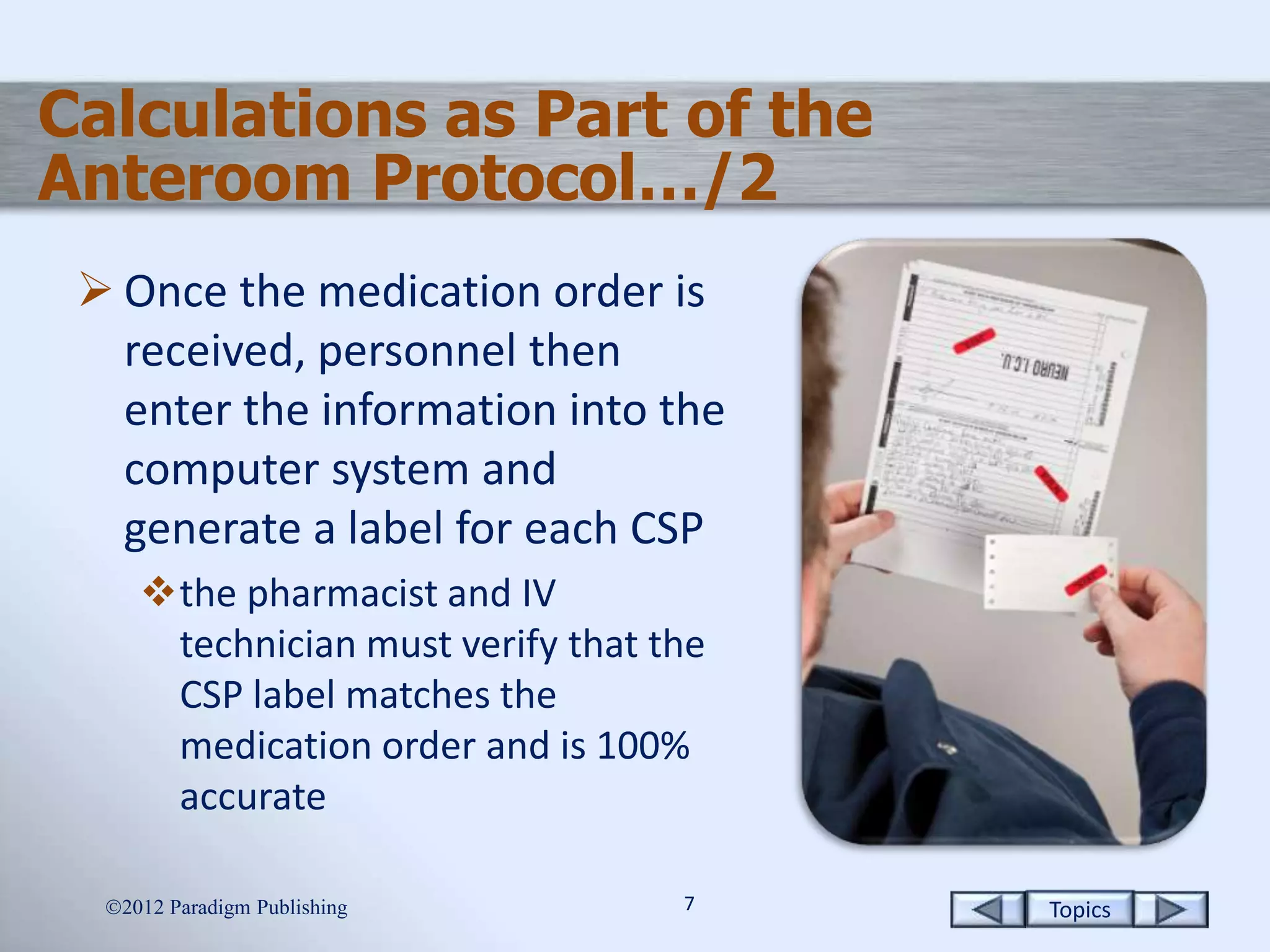
 Once the medication order is
received, personnel then
enter the information into the
computer system and
generate a label for each CSP
the pharmacist and IV
technician must verify that the
CSP label matches the
medication order and is 100%
accurate
2012 Paradigm Publishing
Topics88
Calculations as Part of the
Anteroom Protocol…/3
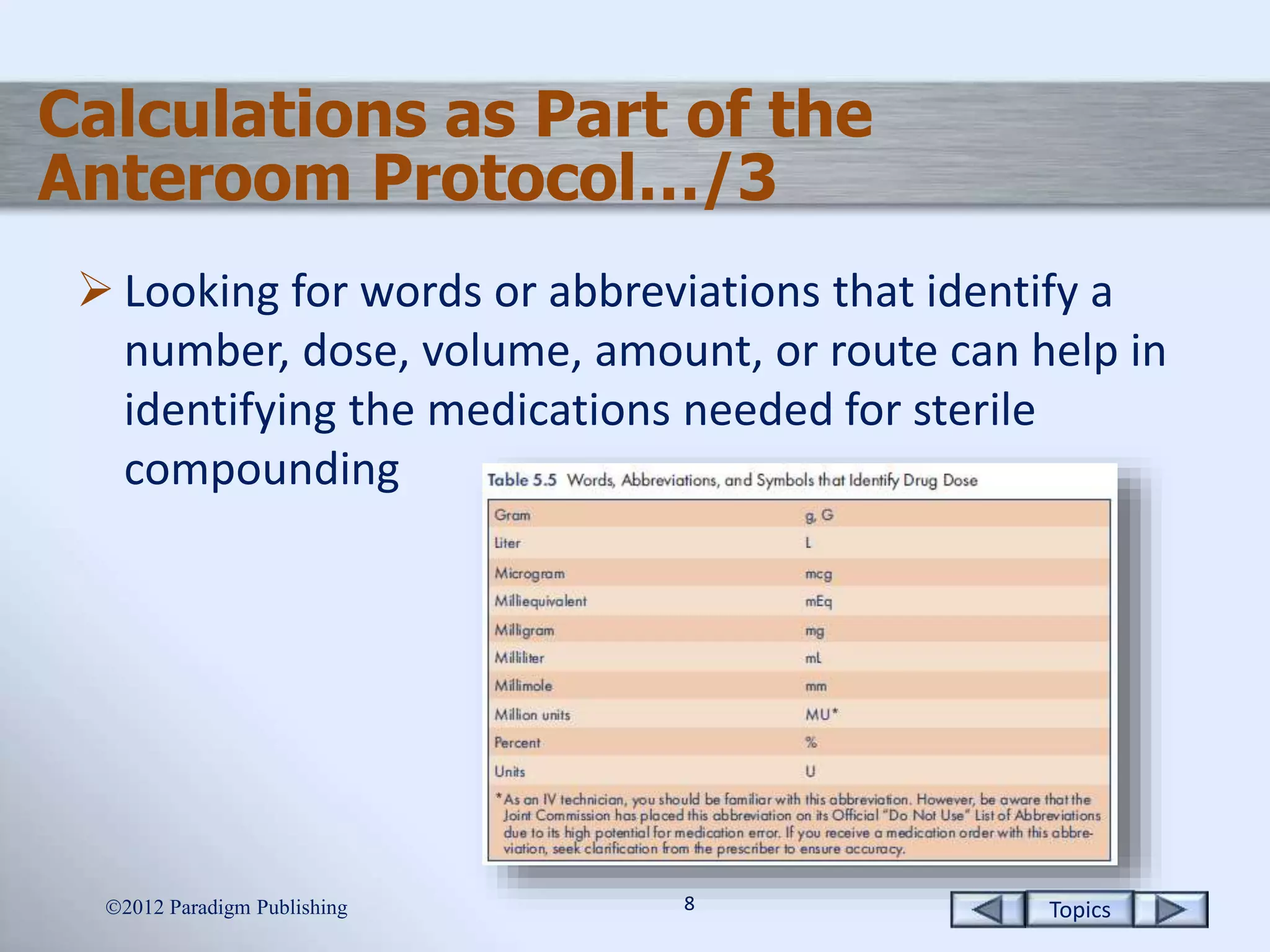
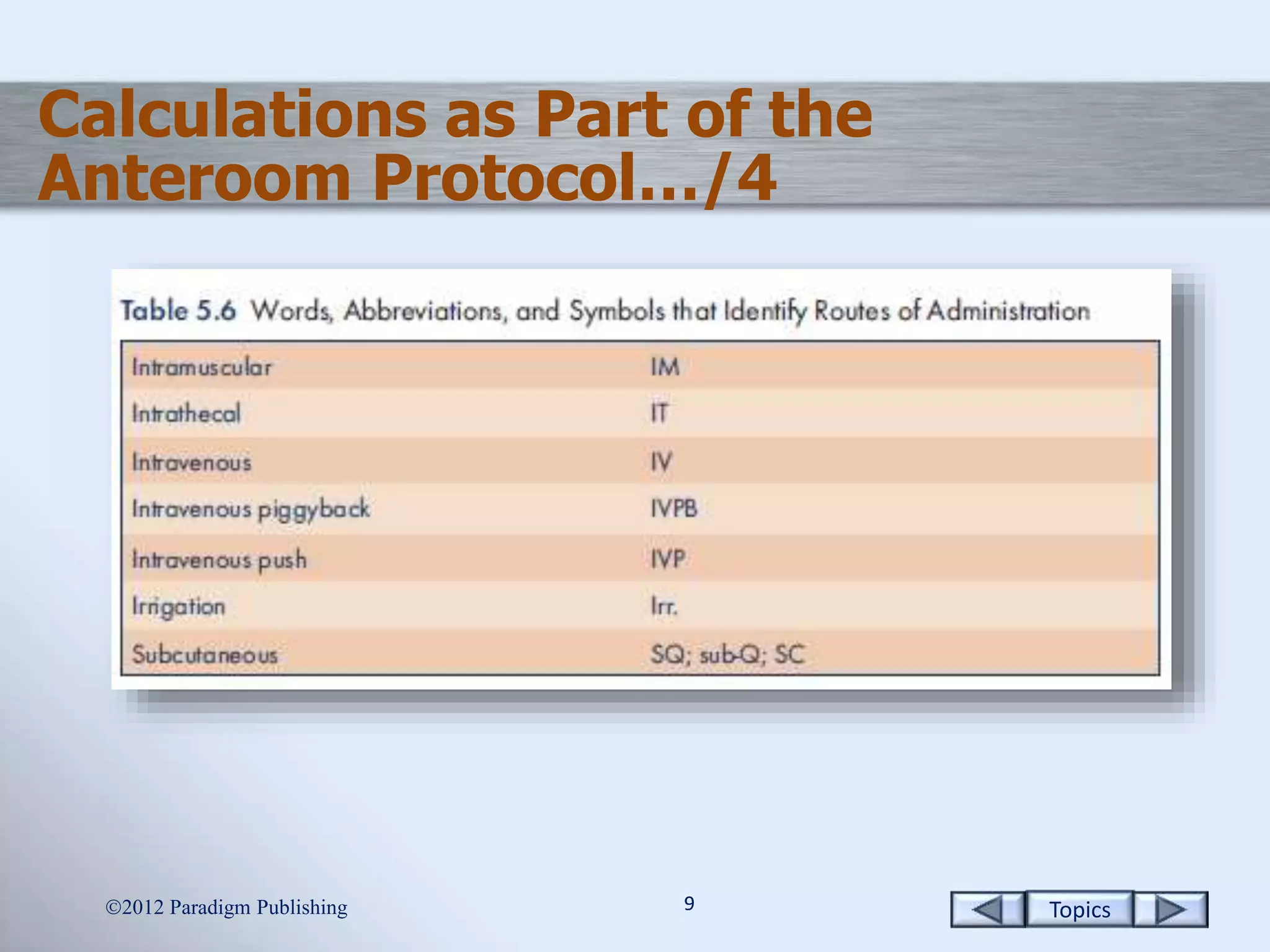
 Looking for words or abbreviations that identify a
number, dose, volume, amount, or route can help in
identifying the medications needed for sterile
compounding
2012 Paradigm Publishing
Topics99
Calculations as Part of the
Anteroom Protocol…/4
2012 Paradigm Publishing
Topics1010
Dosage Calculations
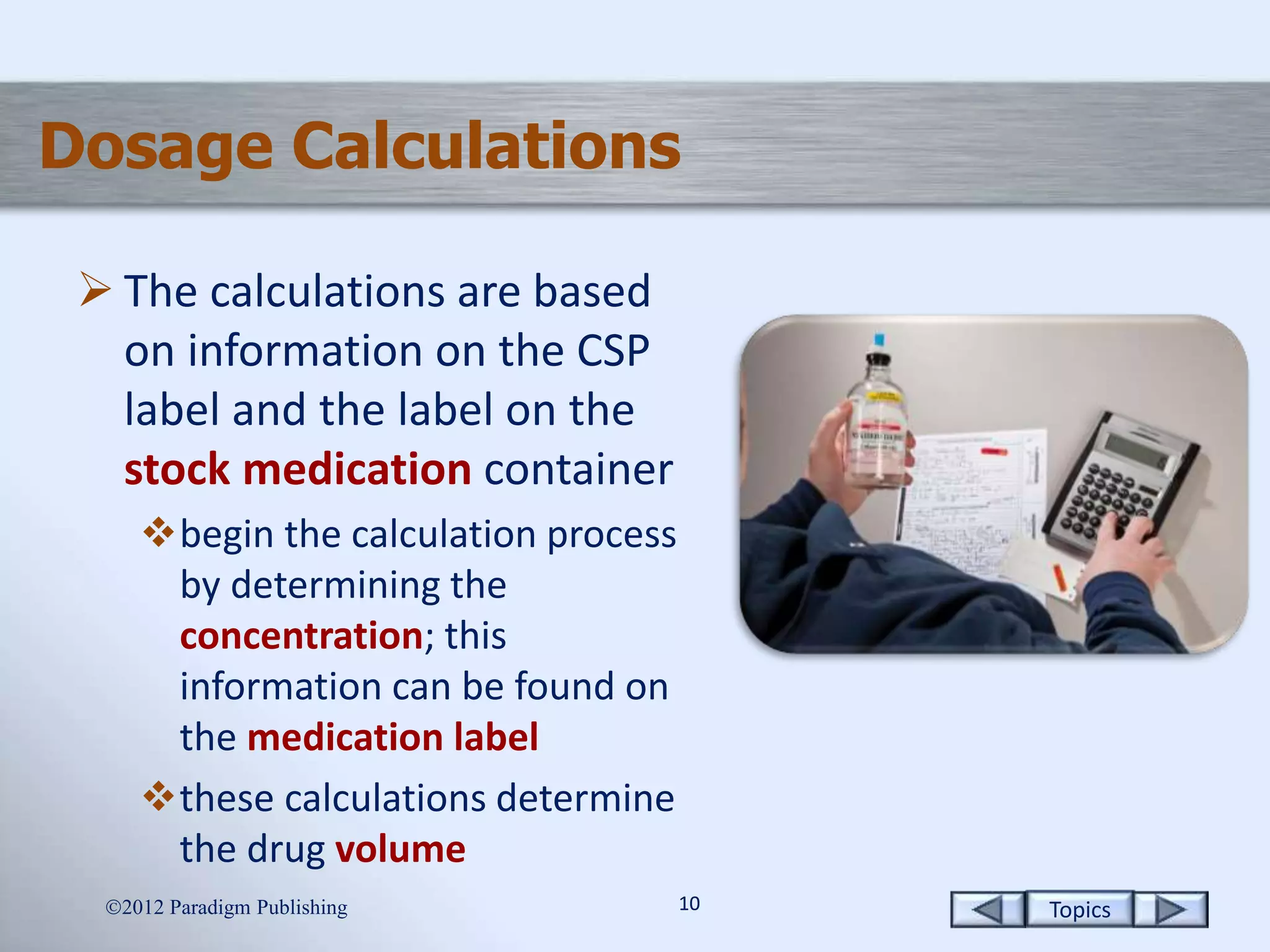
 The calculations are based
on information on the CSP
label and the label on the
stock medication container
begin the calculation process
by determining the
concentration; this
information can be found on
the medication label
these calculations determine
the drug volume
2012 Paradigm Publishing
Topics1111
Dosage Calculations…/2
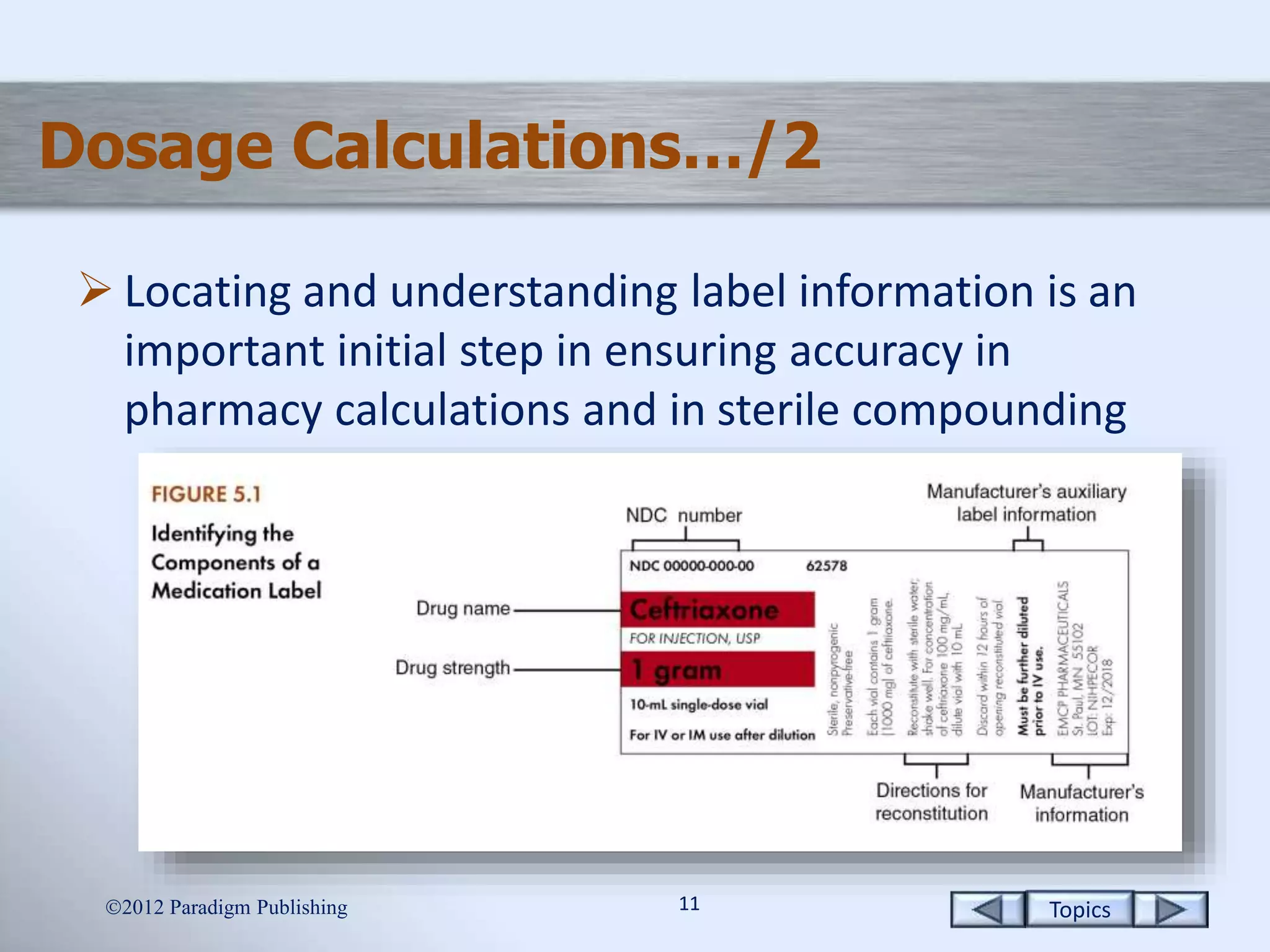
 Locating and understanding label information is an
important initial step in ensuring accuracy in
pharmacy calculations and in sterile compounding
2012 Paradigm Publishing
Topics1212
Special Considerations
 One consideration is that the volume (in milliliters [mL]
or liters [L]) and strength (in percent [%]) of the base
solution are not to be included in any equation in which
personnel are asked to determine the amount or volume
of drug that is to be drawn up for a desired dose
 Another consideration when performing pharmacy
calculations is that an IV technician chooses a method or
formula based on the type of CSP being prepared as well
as a personal calculation preference
2012 Paradigm Publishing
Topics1313
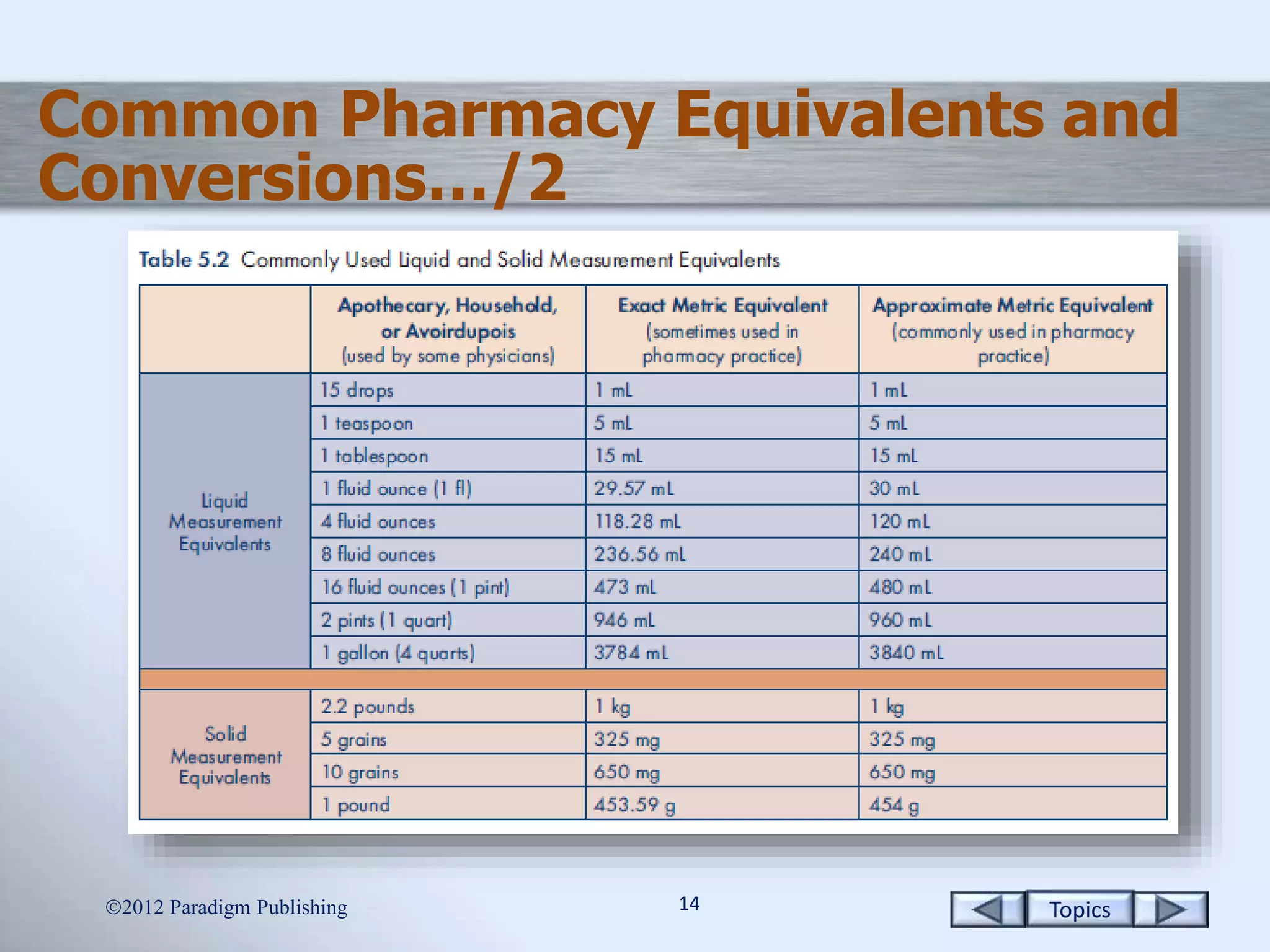
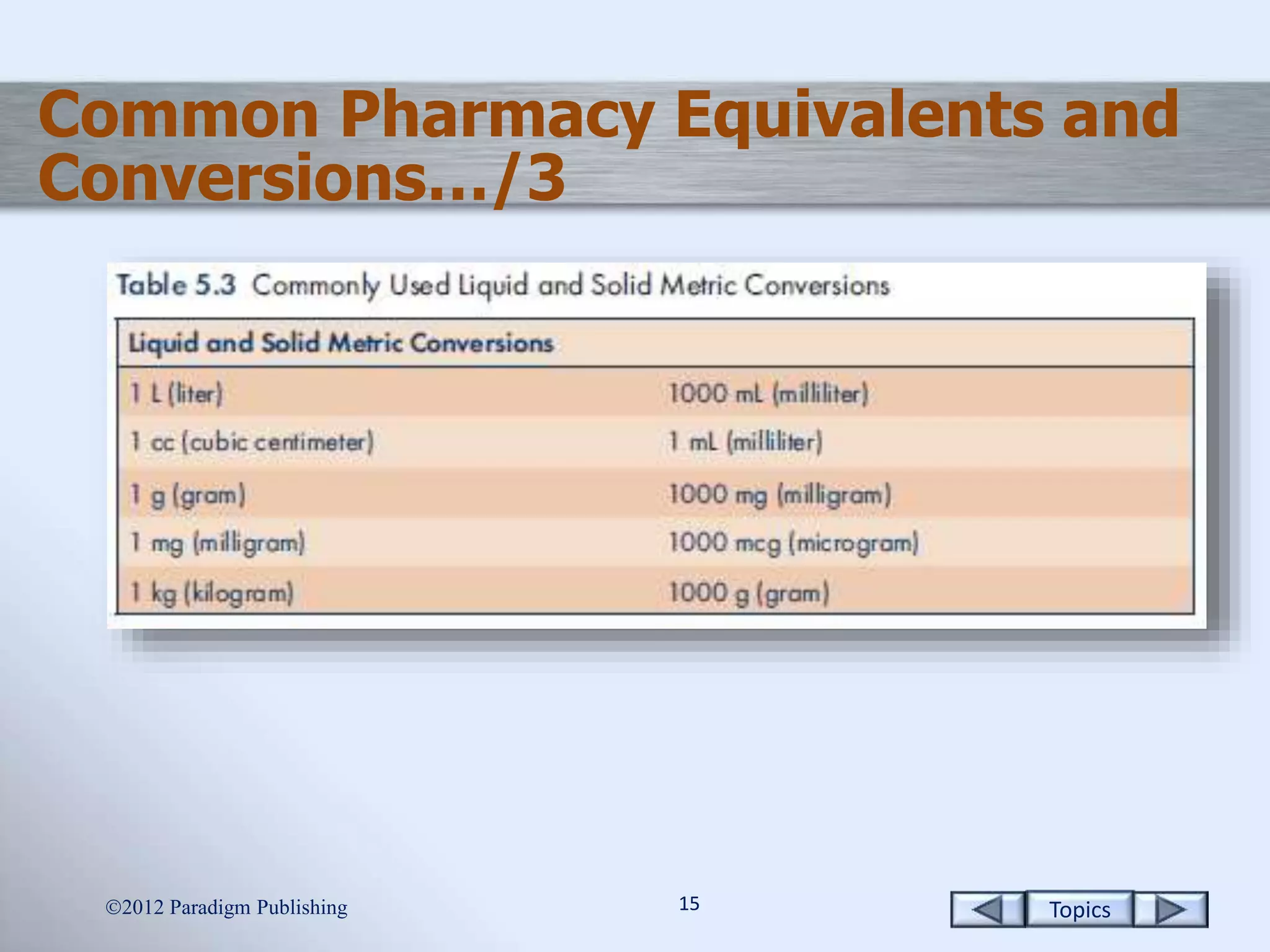
 In addition to understanding basic math principles,
the IV technician must memorize the most
commonly used equivalents and metric conversions
2012 Paradigm Publishing
Common Pharmacy Equivalents and
Conversions
Topics1414
Common Pharmacy Equivalents and
Conversions…/2
2012 Paradigm Publishing
Topics1515
Common Pharmacy Equivalents and
Conversions…/3
2012 Paradigm Publishing
Topics1616
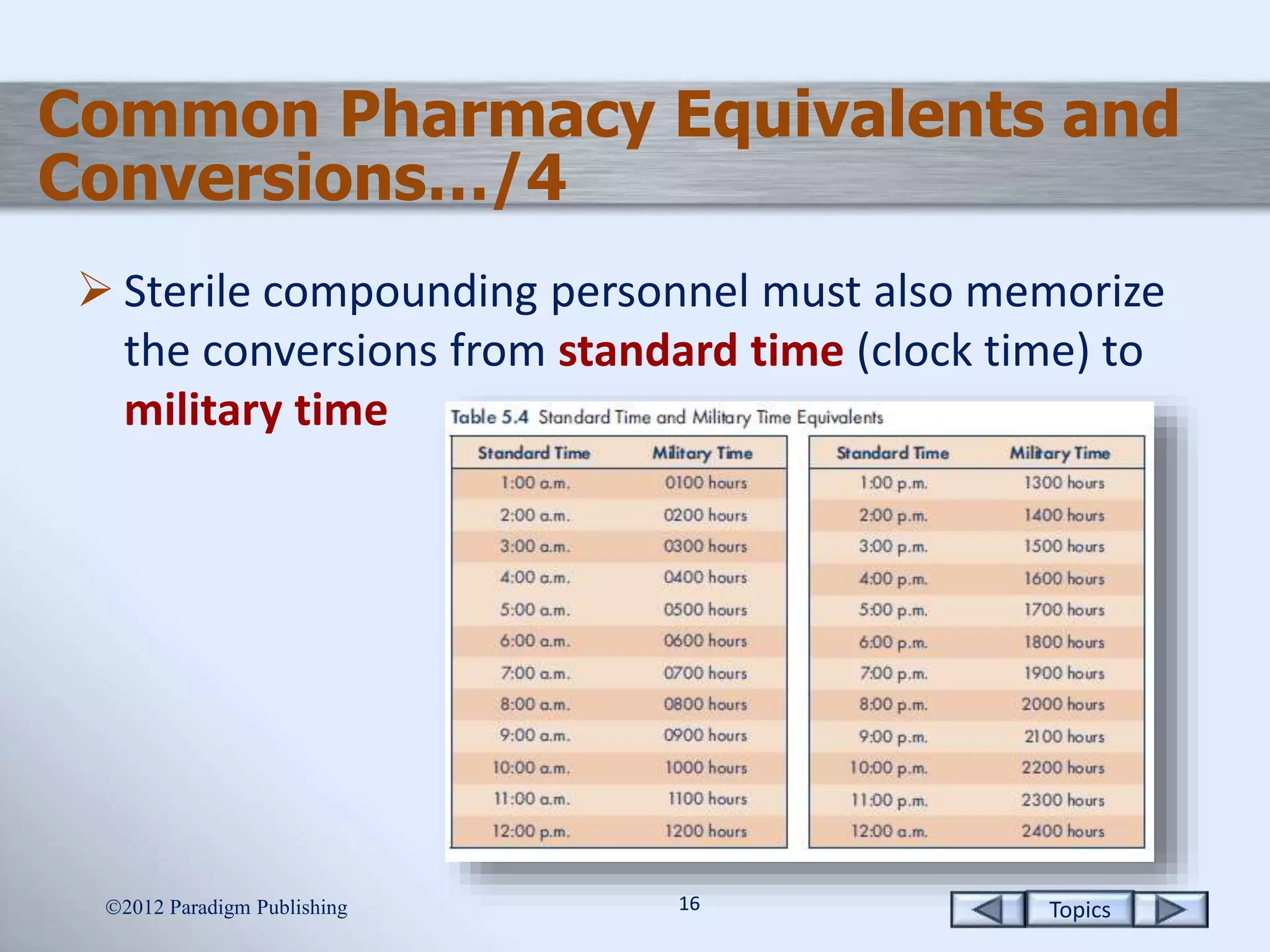
Common Pharmacy Equivalents and
Conversions…/4
 Sterile compounding personnel must also memorize
the conversions from standard time (clock time) to
military time
2012 Paradigm Publishing
Topics17
Your Turn
2012 Paradigm Publishing
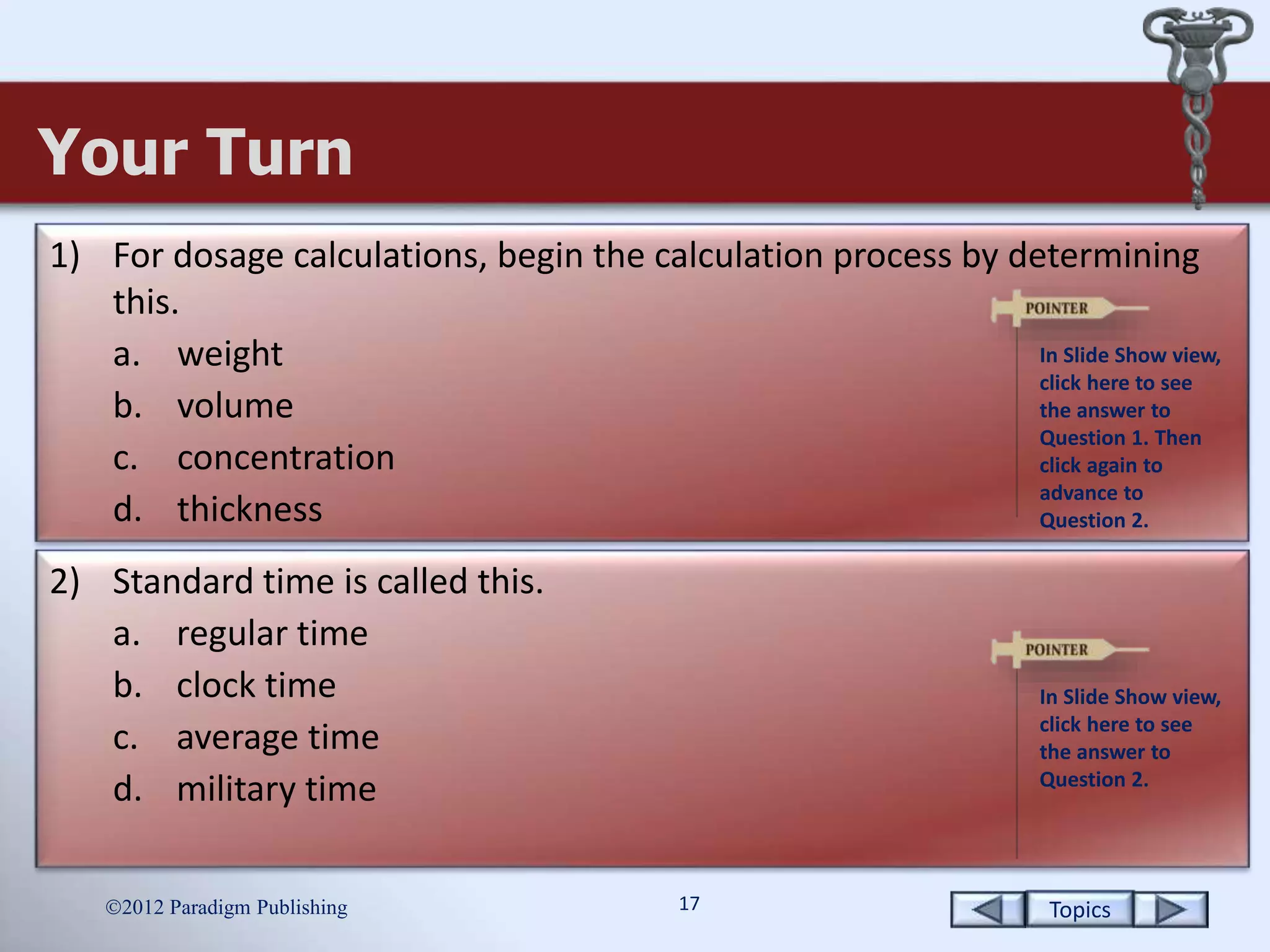
1) For dosage calculations, begin the calculation process by determining
this.
a. weight
b. volume
c. concentration
d. thickness
2) Standard time is called this.
a. regular time
b. clock time
c. average time
d. military time
In Slide Show view,
click here to see
the answer to
Question 1. Then
click again to
advance to
Question 2.
In Slide Show view,
click here to see
the answer to
Question 2.
Topics1818
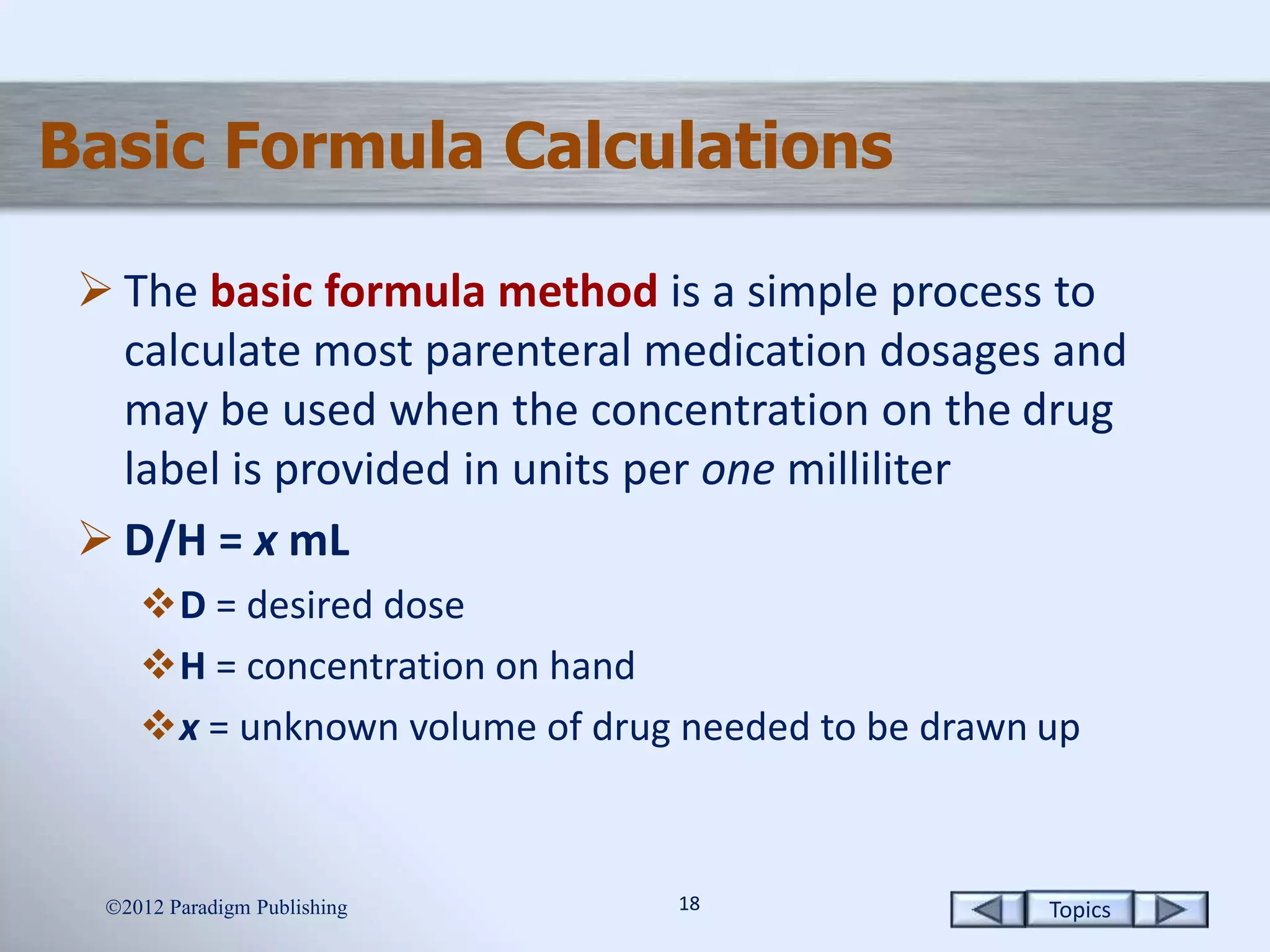
Basic Formula Calculations
 The basic formula method is a simple process to
calculate most parenteral medication dosages and
may be used when the concentration on the drug
label is provided in units per one milliliter
 D/H = x mL
D = desired dose
H = concentration on hand
x = unknown volume of drug needed to be drawn up
2012 Paradigm Publishing
Topics1919
Basic Formula Calculations…/2
 The basic formula method is best used in sterile
compounding scenarios that meet the following
criteria:
the prescriber has ordered a CSP with a single medication
additive
the drug is in an injectable form
the medication label provides you with the concentration
of the drug in the form of number of units per one milliliter
2012 Paradigm Publishing
Topics2020
Basic Formula Calculations…/3
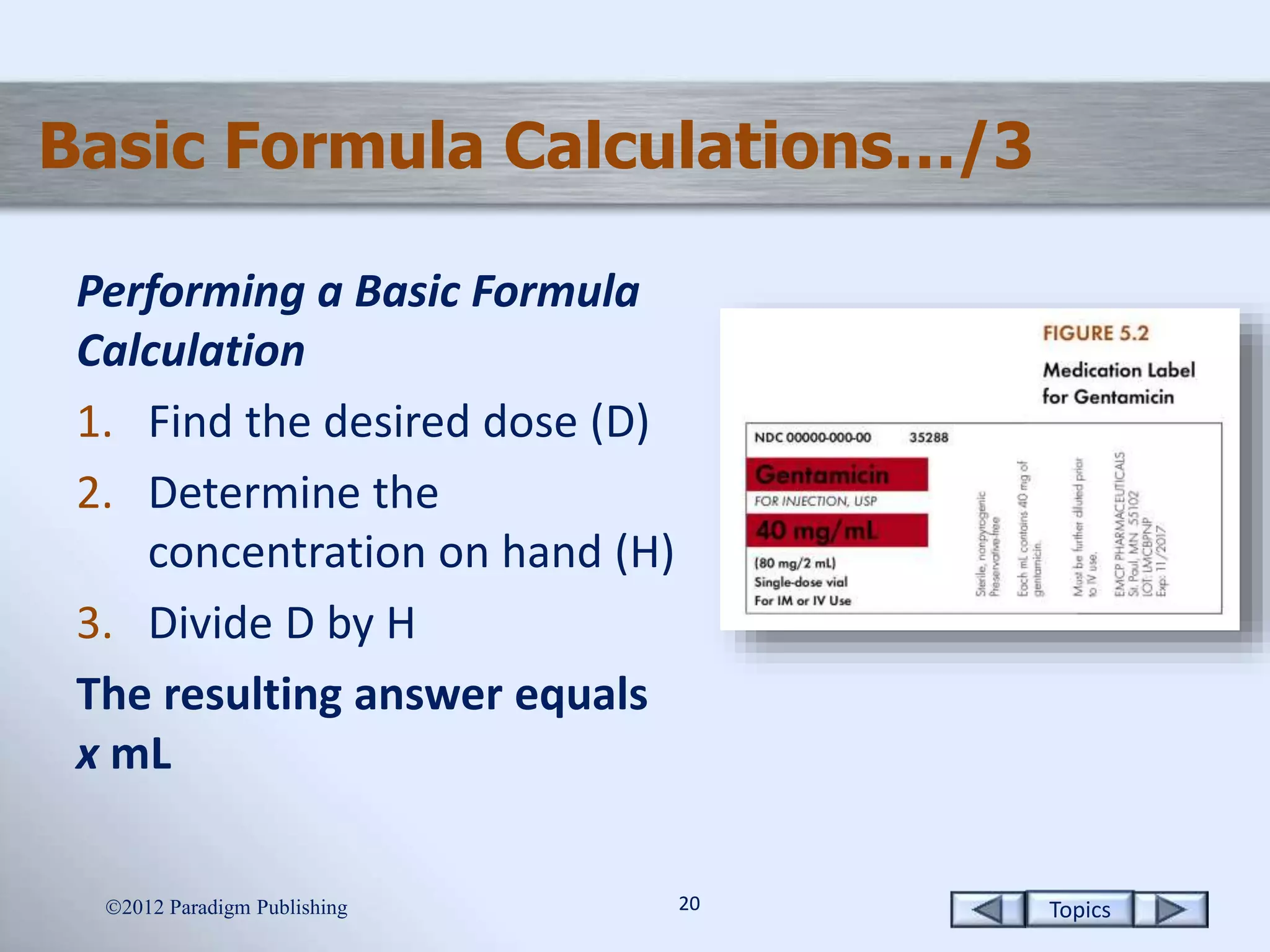
Performing a Basic Formula
Calculation
1. Find the desired dose (D)
2. Determine the
concentration on hand (H)
3. Divide D by H
The resulting answer equals
x mL
2012 Paradigm Publishing
Topics2121
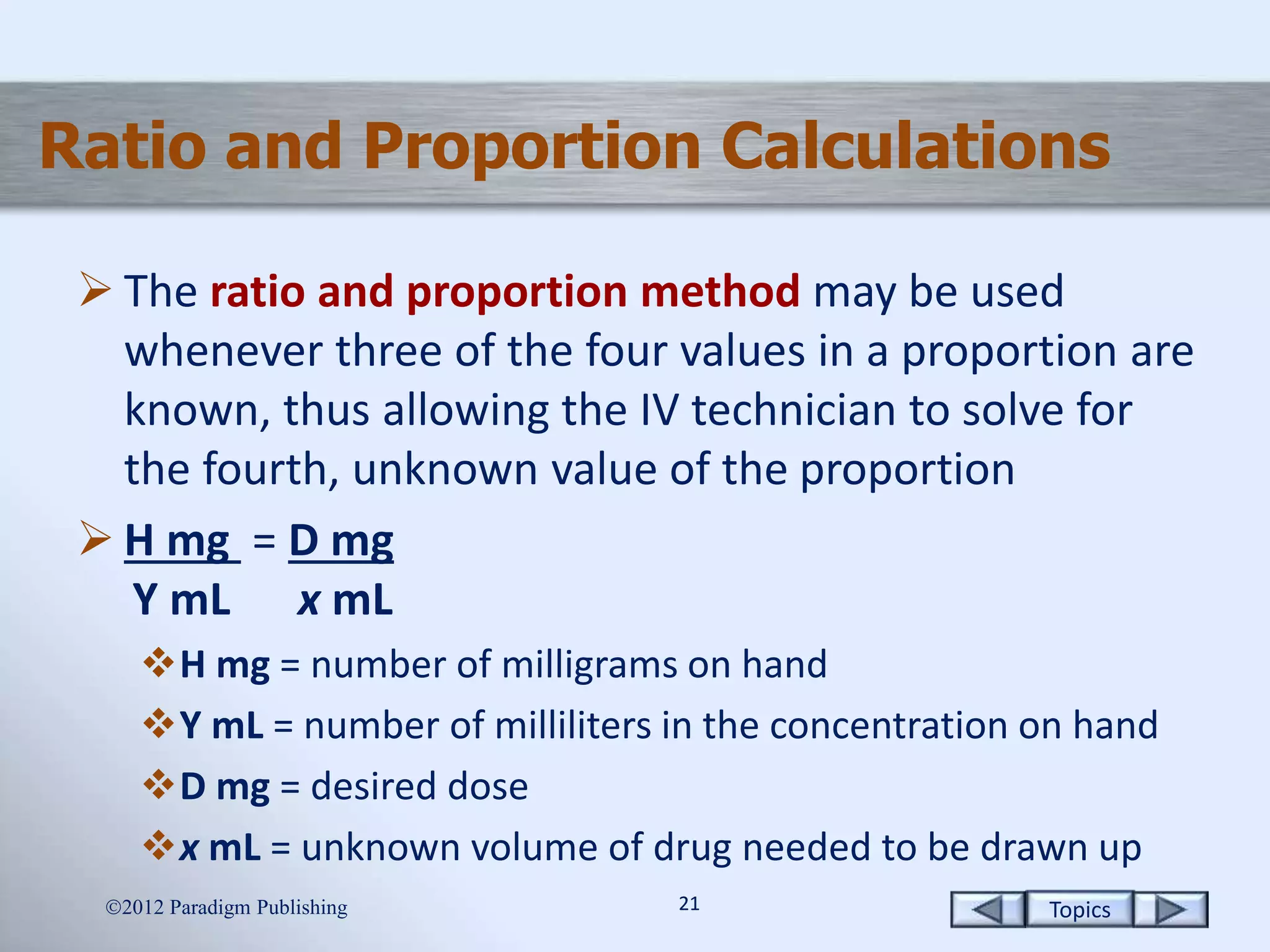
Ratio and Proportion Calculations
 The ratio and proportion method may be used
whenever three of the four values in a proportion are
known, thus allowing the IV technician to solve for
the fourth, unknown value of the proportion
 H mg = D mg
Y mL x mL
H mg = number of milligrams on hand
Y mL = number of milliliters in the concentration on hand
D mg = desired dose
x mL = unknown volume of drug needed to be drawn up
2012 Paradigm Publishing
Topics2222
Ratio and Proportion
Calculations…/2
 The ratio and proportion method is best used in
sterile compounding scenarios that meet the
following criteria:
the stock drug is already in a liquid, injectable form (does
not need to be reconstituted; the medication label
identifies the concentration of the drug in a form other
than the form milligrams per one milliliter
the stock drug is in a powdered form and requires
reconstitution prior to drawing it up for injection
either a liquid or powdered drug requires the completion
of several additional steps to solve the problem
2012 Paradigm Publishing
Topics2323
Ratio and Proportion
Calculations…/3
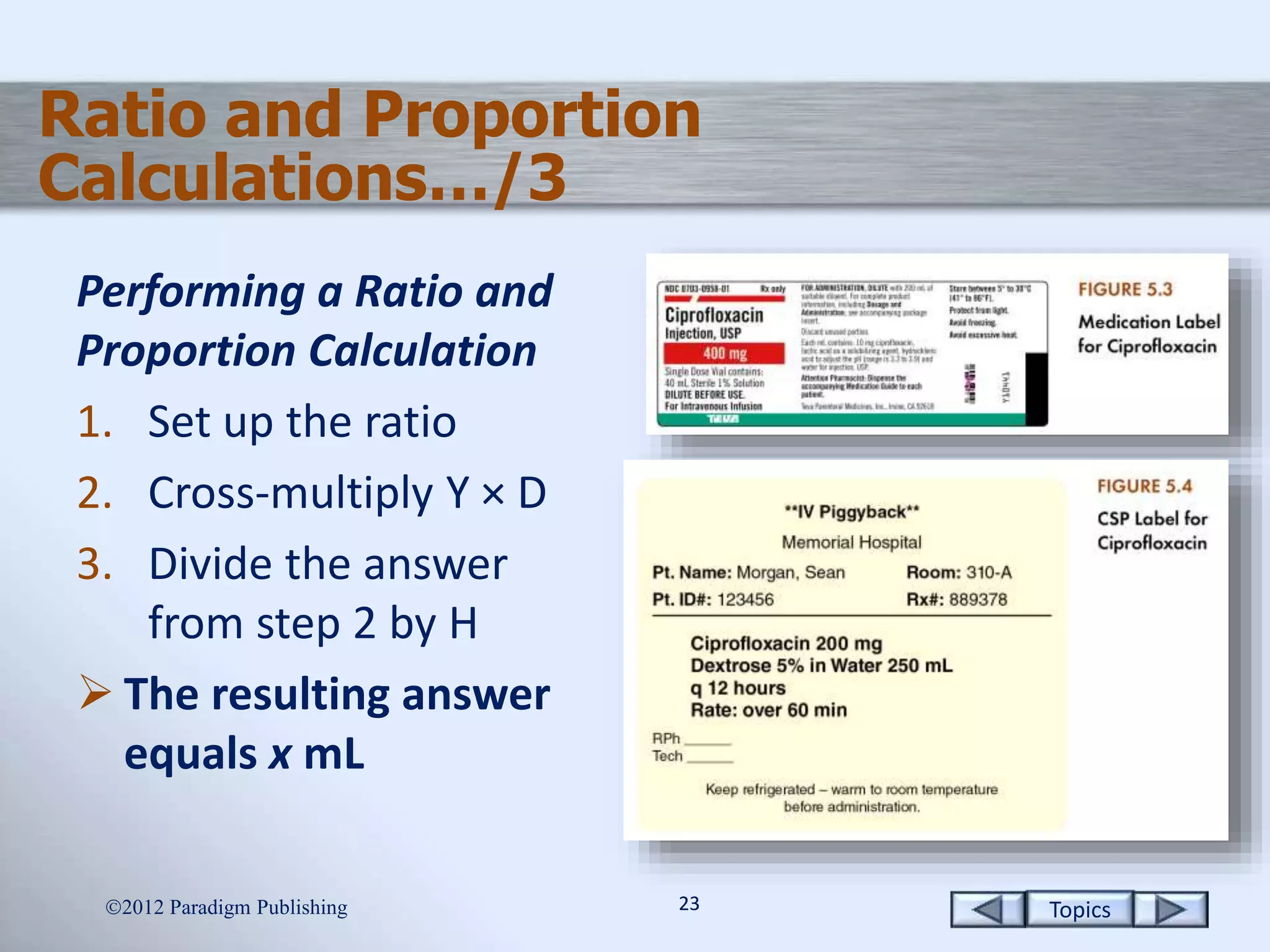
Performing a Ratio and
Proportion Calculation
1. Set up the ratio
2. Cross-multiply Y × D
3. Divide the answer
from step 2 by H
 The resulting answer
equals x mL
2012 Paradigm Publishing
Topics2424
Dimensional Analysis Calculations
 The dimensional analysis method, also known as
“calculation by cancellation,” is another approach
that some IV technicians prefer to use when a
dosage calculation involves multiple steps
based on the principle that any number can be multiplied
by one without changing its value
first determine the answer that is needed, and then use
the values provided to perform a series of calculations
2012 Paradigm Publishing
Topics2525
Dimensional Analysis
Calculations…/2
 The dimensional analysis method for solving
pharmacy dosage calculations is best used in sterile
compounding scenarios that meet either of the
following criteria:
to determine the volume of drug needed to prepare the
CSP, the IV technician must answer several questions by
performing multiple calculations
the IV technician must make one or more conversions
between various units of measure
2012 Paradigm Publishing
Topics2626
Dimensional Analysis
Calculations…/3
 Performing a Dimensional Analysis Calculation
put the unknown quantity (the x you want to define) on its
own on the left side of the equation, followed by an equal
sign
on the right side, record a series of ratios, using both
standard equivalents and information provided by the
medication label and the CSP label
then multiply the ratios together to provide the answer to
the problem
2012 Paradigm Publishing
Topics2727
Dimensional Analysis
Calculations…/4
 The unit of measure in the numerator of the first
ratio must be the same as the unit of measure you
are solving, and the unit of measure in each
successive numerator must match the unit of
measure in the preceding denominator
as a result of this setup, the units of measure in each
alternate numerator–denominator will cancel out, such
that the only unit of measure remaining is the one you
must solve
2012 Paradigm Publishing
Topics2828
IV Flow Rate Calculations
 A daily IV run, or the batch typically requires a 24-hour
supply of CSPs
 Several types of IV flow rate calculations will determine the
answer to one or more of the following:
How long will this bag last?
What time will the next bag be needed?
How many bags will be needed for the patient for a 24-hour
period?
 These may all be solved using IV flow rate calculations that
employ simple addition, division, and/or multiplication
2012 Paradigm Publishing
Topics2929
IV Flow Rate Calculations…/2
 The three methods for solving IV flow rate questions
are best used in sterile compounding scenarios that
meet the following criteria:
the infusion rate in mL/hour is provided on the medication
order or CSP label
the total volume is provided on the medication order or
CSP label
the current time is known or may be easily determined
2012 Paradigm Publishing
Topics3030
IV Flow Rate Calculations…/3
Performing an IV Flow Rate Calculation
 The answers to the three questions can be
determined by setting up a division or multiplication
problem
when calculating IV flow rates, you must know the total
volume of the LVP and either 1) the infusion rate in
milliliters per hour (mL/hr) or 2) the number of hours over
which the LVP is to be infused
this information can be found on the medication order or
the CSP label
2012 Paradigm Publishing
Topics3131
IV Drip Rate Calculations
 The drop factor method relies on the specific drop
factor (gtts/mL), or the number of drops per
milliliter, that a certain type of IV tubing delivers
 Each of the different types of IV tubing delivers a
different drop factor
macrodrip IV tubing may deliver either 10 gtts/mL or 20
gtts/mL
microdrip IV tubing delivers 60 gtts/mL
 An equation using drop factor is sometimes called an
IV drip rate calculation
2012 Paradigm Publishing
Topics3232
IV Drip Rate Calculations…/2
 The drop factor method is best used in situations
that meet the following criteria:
the total volume to be infused is known
the total infusion time is known
the drop factor of the IV tubing is known
the desired answer is to be provided in drops per minute
(gtts/min)
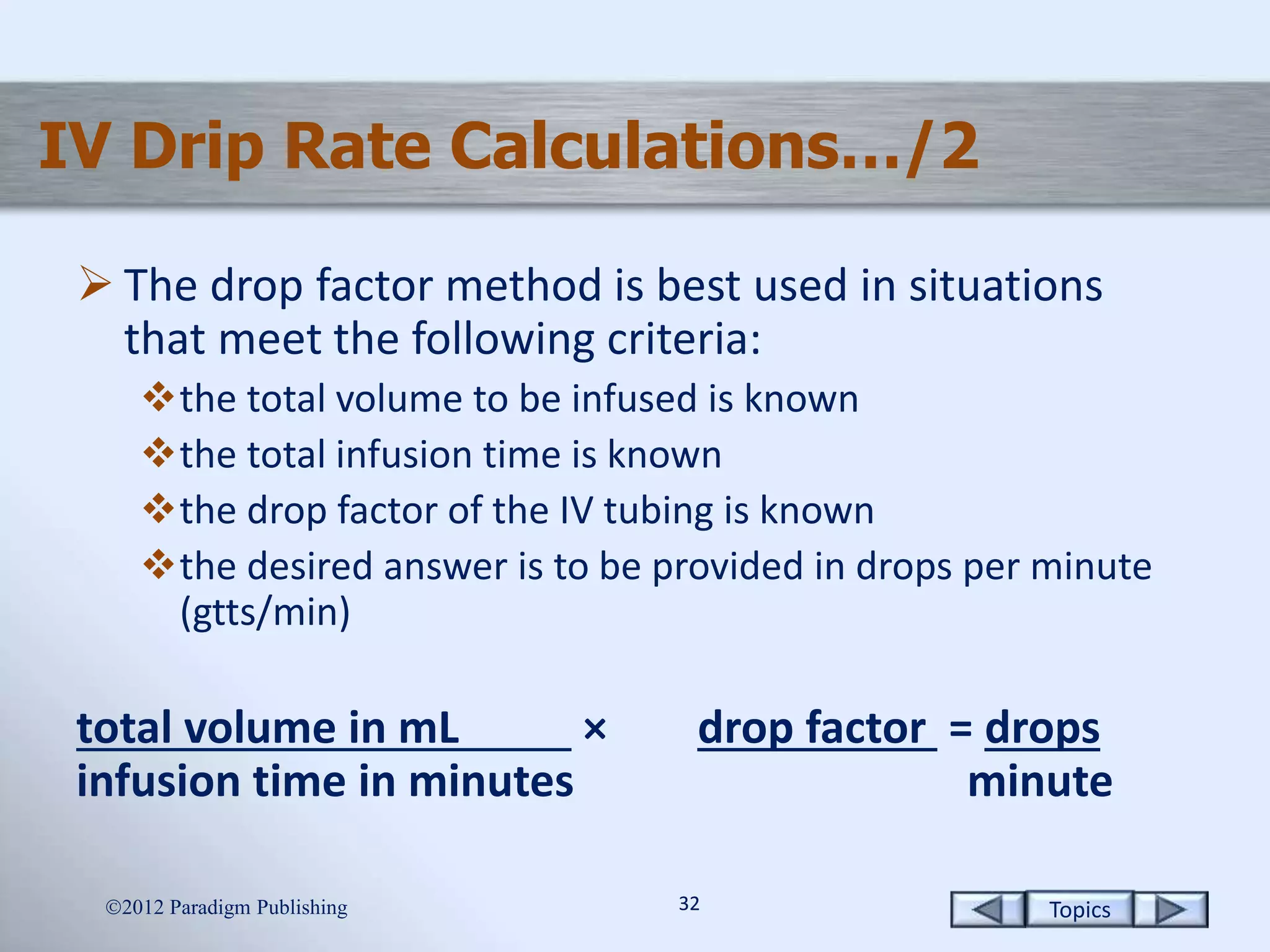
total volume in mL × drop factor = drops
infusion time in minutes minute
2012 Paradigm Publishing
Topics3333
Alligation Calculations
 The pharmacy may be required to mix two different
strengths of the same active ingredient of a drug or
solution to make the desired strength
a higher-percent strength of a drug or solution is mixed
with a lower-percent strength of a drug or solution in
order to make the desired strength
 This scenario requires you to employ a calculation
called the alligation method, or simply alligation
rarely performed by IV technicians
2012 Paradigm Publishing
Topics3434
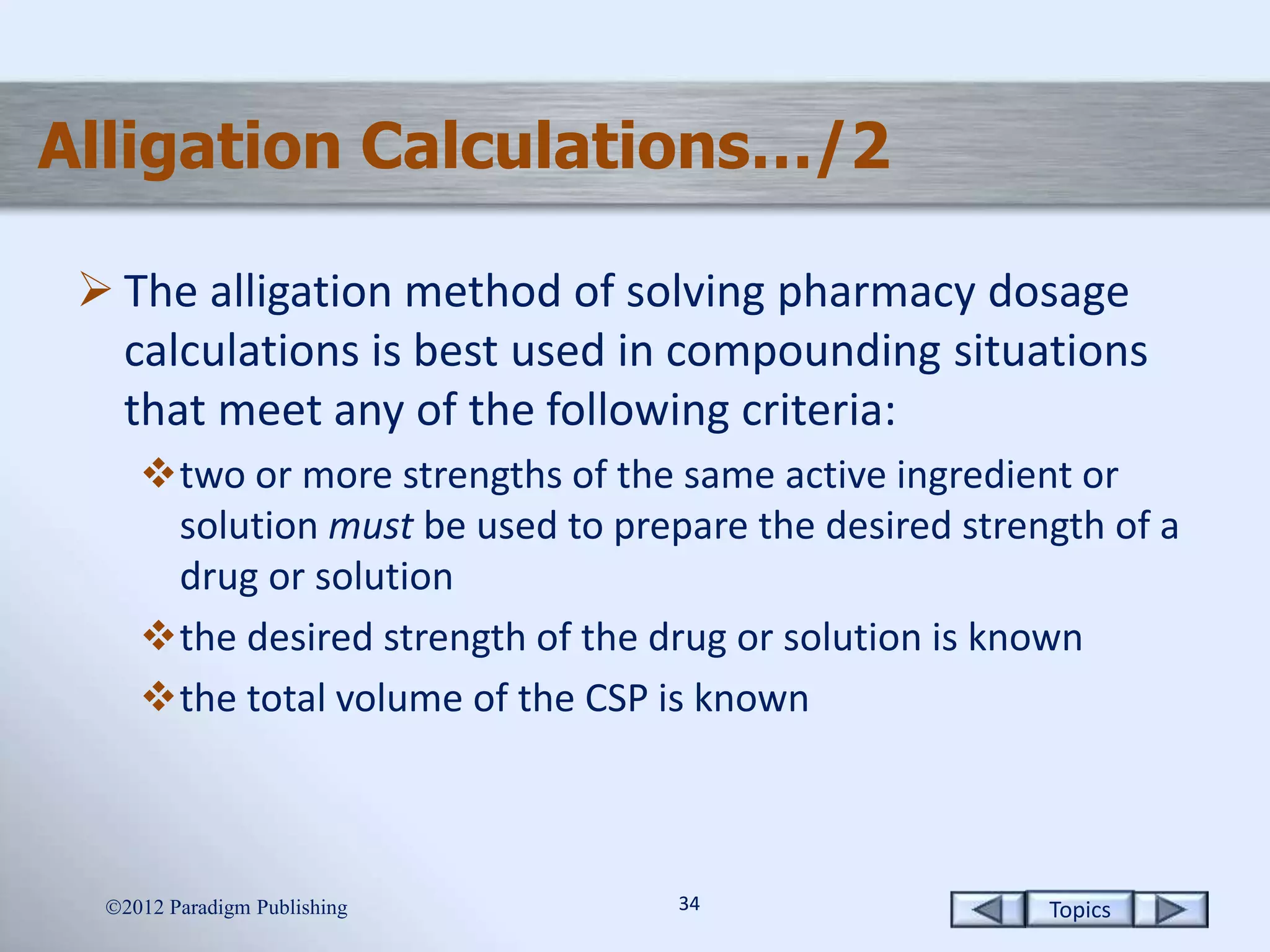
Alligation Calculations…/2
 The alligation method of solving pharmacy dosage
calculations is best used in compounding situations
that meet any of the following criteria:
two or more strengths of the same active ingredient or
solution must be used to prepare the desired strength of a
drug or solution
the desired strength of the drug or solution is known
the total volume of the CSP is known
2012 Paradigm Publishing
Topics3535
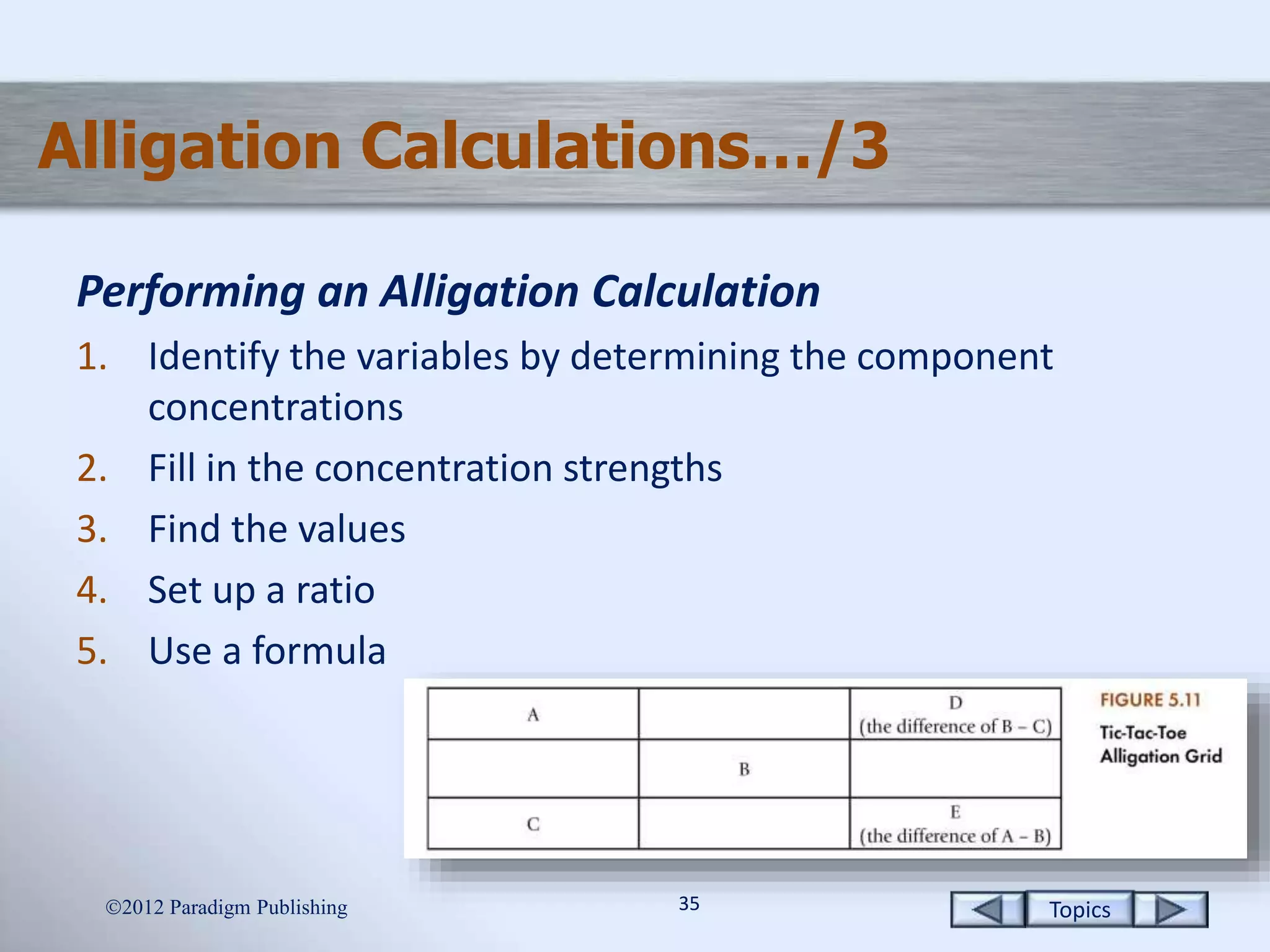
Alligation Calculations…/3
Performing an Alligation Calculation
1. Identify the variables by determining the component
concentrations
2. Fill in the concentration strengths
3. Find the values
4. Set up a ratio
5. Use a formula
2012 Paradigm Publishing
Topics3636
Calculation Skills in the
Sterile Compounding Environment
 Accurate calculation and measurement of the
components or ingredients of the formulation are
critical
the pharmacy technician must have an understanding of
historical practices and a working knowledge of current
systems of measurement and pharmacy calculations
in order to perform accurate calculations, you must write
down the equation and verify that you have the correct
information in the correct place within the formula
2012 Paradigm Publishing
Topics37
Your Turn
2012 Paradigm Publishing
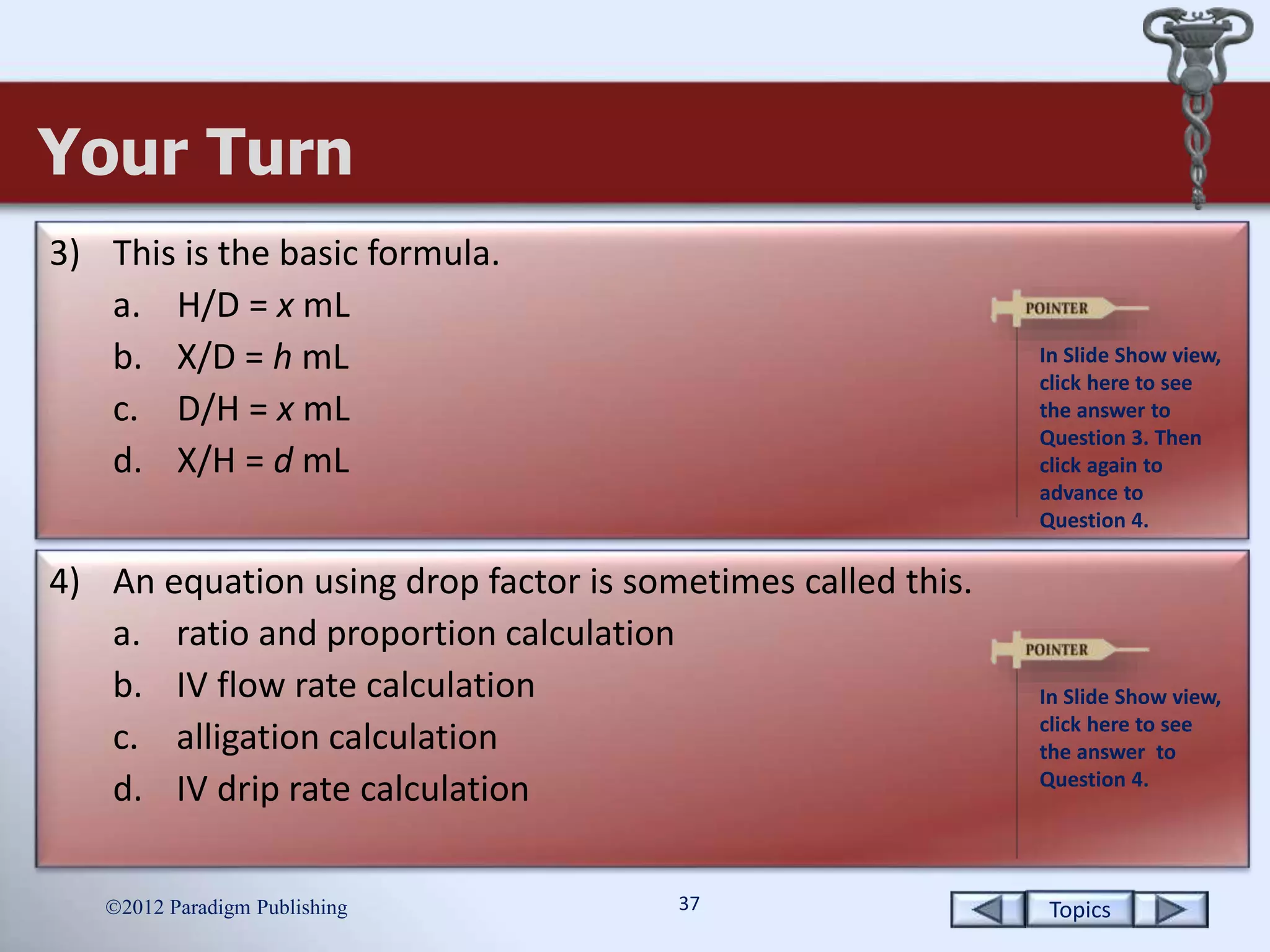
3) This is the basic formula.
a. H/D = x mL
b. X/D = h mL
c. D/H = x mL
d. X/H = d mL
4) An equation using drop factor is sometimes called this.
a. ratio and proportion calculation
b. IV flow rate calculation
c. alligation calculation
d. IV drip rate calculation
In Slide Show view,
click here to see
the answer to
Question 3. Then
click again to
advance to
Question 4.
In Slide Show view,
click here to see
the answer to
Question 4.

Calculations for Sterile Compounding

  • 2.
    Topics2 Chapter 5 Calculations forSterile Compounding 2012 Paradigm Publishing
  • 3.
    Topics3 Learning Objectives  Explorethe evolution of mathematical formulas used in sterile compounding.  Understand the principles of pharmacy dosage calculations.  Practice several types of pharmaceutical calculations using a basic formula, ratio and proportion, dimensional analysis, intravenous flow rates, intravenous drip rates, and alligations.  Determine the best method of solving pharmaceutical dosage questions based on the medication labeling and sterile compounding procedure required. 2012 Paradigm Publishing
  • 4.
    Topics4 Topics  Learning Objectives Introduction  Calculations as Part of the Anteroom Protocol  Dosage Calculations  Special Considerations  Common Pharmacy Equivalents and Conversions  Basic Formula Calculations  Ratio and Proportion Calculations  Dimensional Analysis Calculations  IV Flow Rate Calculations  IV Drip Rate Calculations  Alligation Calculations  Calculation Skills in the Sterile Compounding Environment  Chapter Summary 2012 Paradigm Publishing In Slide Show view, click the desired topic to the left to link directly to the related slide. To return to this slide at any point in the presentation, click the Topics button below.
  • 5.
    Topics55 Introduction  The majorityof the CSPs assembled will require the application of one or more pharmacy calculation methods to determine the volume of the medication, additive, or solution component needed to prepare a CSP or to resolve the number of CSPs necessary for a 24-hour supply numerous other calculation methods are used by pharmacy personnel to determine information such as day’s supply, quantity to be dispensed, and average wholesale price (AWP) 2012 Paradigm Publishing
  • 6.
    Topics66 Calculations as Partof the Anteroom Protocol  The prescriber includes the names of the desired medications, the desired doses, and the dosing intervals as part of the CSP order the prescriber also determines the desired base solution and infusion rate for large-volume parenterals (LVPs) most small-volume parenterals (SVPs), however, are prepared using standard base solutions and volumes and are administered using standard administration times 2012 Paradigm Publishing
  • 7.
    Topics77 Calculations as Partof the Anteroom Protocol…/2  Once the medication order is received, personnel then enter the information into the computer system and generate a label for each CSP the pharmacist and IV technician must verify that the CSP label matches the medication order and is 100% accurate 2012 Paradigm Publishing
  • 8.
    Topics88 Calculations as Partof the Anteroom Protocol…/3  Looking for words or abbreviations that identify a number, dose, volume, amount, or route can help in identifying the medications needed for sterile compounding 2012 Paradigm Publishing
  • 9.
    Topics99 Calculations as Partof the Anteroom Protocol…/4 2012 Paradigm Publishing
  • 10.
    Topics1010 Dosage Calculations  Thecalculations are based on information on the CSP label and the label on the stock medication container begin the calculation process by determining the concentration; this information can be found on the medication label these calculations determine the drug volume 2012 Paradigm Publishing
  • 11.
    Topics1111 Dosage Calculations…/2  Locatingand understanding label information is an important initial step in ensuring accuracy in pharmacy calculations and in sterile compounding 2012 Paradigm Publishing
  • 12.
    Topics1212 Special Considerations  Oneconsideration is that the volume (in milliliters [mL] or liters [L]) and strength (in percent [%]) of the base solution are not to be included in any equation in which personnel are asked to determine the amount or volume of drug that is to be drawn up for a desired dose  Another consideration when performing pharmacy calculations is that an IV technician chooses a method or formula based on the type of CSP being prepared as well as a personal calculation preference 2012 Paradigm Publishing
  • 13.
    Topics1313  In additionto understanding basic math principles, the IV technician must memorize the most commonly used equivalents and metric conversions 2012 Paradigm Publishing Common Pharmacy Equivalents and Conversions
  • 14.
    Topics1414 Common Pharmacy Equivalentsand Conversions…/2 2012 Paradigm Publishing
  • 15.
    Topics1515 Common Pharmacy Equivalentsand Conversions…/3 2012 Paradigm Publishing
  • 16.
    Topics1616 Common Pharmacy Equivalentsand Conversions…/4  Sterile compounding personnel must also memorize the conversions from standard time (clock time) to military time 2012 Paradigm Publishing
  • 17.
    Topics17 Your Turn 2012 ParadigmPublishing 1) For dosage calculations, begin the calculation process by determining this. a. weight b. volume c. concentration d. thickness 2) Standard time is called this. a. regular time b. clock time c. average time d. military time In Slide Show view, click here to see the answer to Question 1. Then click again to advance to Question 2. In Slide Show view, click here to see the answer to Question 2.
  • 18.
    Topics1818 Basic Formula Calculations The basic formula method is a simple process to calculate most parenteral medication dosages and may be used when the concentration on the drug label is provided in units per one milliliter  D/H = x mL D = desired dose H = concentration on hand x = unknown volume of drug needed to be drawn up 2012 Paradigm Publishing
  • 19.
    Topics1919 Basic Formula Calculations…/2 The basic formula method is best used in sterile compounding scenarios that meet the following criteria: the prescriber has ordered a CSP with a single medication additive the drug is in an injectable form the medication label provides you with the concentration of the drug in the form of number of units per one milliliter 2012 Paradigm Publishing
  • 20.
    Topics2020 Basic Formula Calculations…/3 Performinga Basic Formula Calculation 1. Find the desired dose (D) 2. Determine the concentration on hand (H) 3. Divide D by H The resulting answer equals x mL 2012 Paradigm Publishing
  • 21.
    Topics2121 Ratio and ProportionCalculations  The ratio and proportion method may be used whenever three of the four values in a proportion are known, thus allowing the IV technician to solve for the fourth, unknown value of the proportion  H mg = D mg Y mL x mL H mg = number of milligrams on hand Y mL = number of milliliters in the concentration on hand D mg = desired dose x mL = unknown volume of drug needed to be drawn up 2012 Paradigm Publishing
  • 22.
    Topics2222 Ratio and Proportion Calculations…/2 The ratio and proportion method is best used in sterile compounding scenarios that meet the following criteria: the stock drug is already in a liquid, injectable form (does not need to be reconstituted; the medication label identifies the concentration of the drug in a form other than the form milligrams per one milliliter the stock drug is in a powdered form and requires reconstitution prior to drawing it up for injection either a liquid or powdered drug requires the completion of several additional steps to solve the problem 2012 Paradigm Publishing
  • 23.
    Topics2323 Ratio and Proportion Calculations…/3 Performinga Ratio and Proportion Calculation 1. Set up the ratio 2. Cross-multiply Y × D 3. Divide the answer from step 2 by H  The resulting answer equals x mL 2012 Paradigm Publishing
  • 24.
    Topics2424 Dimensional Analysis Calculations The dimensional analysis method, also known as “calculation by cancellation,” is another approach that some IV technicians prefer to use when a dosage calculation involves multiple steps based on the principle that any number can be multiplied by one without changing its value first determine the answer that is needed, and then use the values provided to perform a series of calculations 2012 Paradigm Publishing
  • 25.
    Topics2525 Dimensional Analysis Calculations…/2  Thedimensional analysis method for solving pharmacy dosage calculations is best used in sterile compounding scenarios that meet either of the following criteria: to determine the volume of drug needed to prepare the CSP, the IV technician must answer several questions by performing multiple calculations the IV technician must make one or more conversions between various units of measure 2012 Paradigm Publishing
  • 26.
    Topics2626 Dimensional Analysis Calculations…/3  Performinga Dimensional Analysis Calculation put the unknown quantity (the x you want to define) on its own on the left side of the equation, followed by an equal sign on the right side, record a series of ratios, using both standard equivalents and information provided by the medication label and the CSP label then multiply the ratios together to provide the answer to the problem 2012 Paradigm Publishing
  • 27.
    Topics2727 Dimensional Analysis Calculations…/4  Theunit of measure in the numerator of the first ratio must be the same as the unit of measure you are solving, and the unit of measure in each successive numerator must match the unit of measure in the preceding denominator as a result of this setup, the units of measure in each alternate numerator–denominator will cancel out, such that the only unit of measure remaining is the one you must solve 2012 Paradigm Publishing
  • 28.
    Topics2828 IV Flow RateCalculations  A daily IV run, or the batch typically requires a 24-hour supply of CSPs  Several types of IV flow rate calculations will determine the answer to one or more of the following: How long will this bag last? What time will the next bag be needed? How many bags will be needed for the patient for a 24-hour period?  These may all be solved using IV flow rate calculations that employ simple addition, division, and/or multiplication 2012 Paradigm Publishing
  • 29.
    Topics2929 IV Flow RateCalculations…/2  The three methods for solving IV flow rate questions are best used in sterile compounding scenarios that meet the following criteria: the infusion rate in mL/hour is provided on the medication order or CSP label the total volume is provided on the medication order or CSP label the current time is known or may be easily determined 2012 Paradigm Publishing
  • 30.
    Topics3030 IV Flow RateCalculations…/3 Performing an IV Flow Rate Calculation  The answers to the three questions can be determined by setting up a division or multiplication problem when calculating IV flow rates, you must know the total volume of the LVP and either 1) the infusion rate in milliliters per hour (mL/hr) or 2) the number of hours over which the LVP is to be infused this information can be found on the medication order or the CSP label 2012 Paradigm Publishing
  • 31.
    Topics3131 IV Drip RateCalculations  The drop factor method relies on the specific drop factor (gtts/mL), or the number of drops per milliliter, that a certain type of IV tubing delivers  Each of the different types of IV tubing delivers a different drop factor macrodrip IV tubing may deliver either 10 gtts/mL or 20 gtts/mL microdrip IV tubing delivers 60 gtts/mL  An equation using drop factor is sometimes called an IV drip rate calculation 2012 Paradigm Publishing
  • 32.
    Topics3232 IV Drip RateCalculations…/2  The drop factor method is best used in situations that meet the following criteria: the total volume to be infused is known the total infusion time is known the drop factor of the IV tubing is known the desired answer is to be provided in drops per minute (gtts/min) total volume in mL × drop factor = drops infusion time in minutes minute 2012 Paradigm Publishing
  • 33.
    Topics3333 Alligation Calculations  Thepharmacy may be required to mix two different strengths of the same active ingredient of a drug or solution to make the desired strength a higher-percent strength of a drug or solution is mixed with a lower-percent strength of a drug or solution in order to make the desired strength  This scenario requires you to employ a calculation called the alligation method, or simply alligation rarely performed by IV technicians 2012 Paradigm Publishing
  • 34.
    Topics3434 Alligation Calculations…/2  Thealligation method of solving pharmacy dosage calculations is best used in compounding situations that meet any of the following criteria: two or more strengths of the same active ingredient or solution must be used to prepare the desired strength of a drug or solution the desired strength of the drug or solution is known the total volume of the CSP is known 2012 Paradigm Publishing
  • 35.
    Topics3535 Alligation Calculations…/3 Performing anAlligation Calculation 1. Identify the variables by determining the component concentrations 2. Fill in the concentration strengths 3. Find the values 4. Set up a ratio 5. Use a formula 2012 Paradigm Publishing
  • 36.
    Topics3636 Calculation Skills inthe Sterile Compounding Environment  Accurate calculation and measurement of the components or ingredients of the formulation are critical the pharmacy technician must have an understanding of historical practices and a working knowledge of current systems of measurement and pharmacy calculations in order to perform accurate calculations, you must write down the equation and verify that you have the correct information in the correct place within the formula 2012 Paradigm Publishing
  • 37.
    Topics37 Your Turn 2012 ParadigmPublishing 3) This is the basic formula. a. H/D = x mL b. X/D = h mL c. D/H = x mL d. X/H = d mL 4) An equation using drop factor is sometimes called this. a. ratio and proportion calculation b. IV flow rate calculation c. alligation calculation d. IV drip rate calculation In Slide Show view, click here to see the answer to Question 3. Then click again to advance to Question 4. In Slide Show view, click here to see the answer to Question 4.