Dr. M. Yusuf
 To establish guidelines and the responsibilities
for various disciplines who depend on the
medical record as the primary tool for
communicating information to patient care.
 To provide standards for uniform documentation
practice by all physicians.
 To ensure competent records toward fulfillment
of medico-legal responsibility of physicians.
Patient Care Orders are: the
physician prescriptions, or
authorization for the diagnostic or
treatment service to a patient.
 Most Important Communication piece
Culmination of all skills (Assessment, Analysis,
Plan)
 Initiates all care
 Historical record; Sequence of events
 Communication to all caregivers
 Communication to lawyers
 Entries may be made into the medical record by:
Physicians, Nurses, Pharmacists, RT, Dietician,
Care Coordinator, Special Ed Teachers, Dentists,
Midwives, Paramedic, Social Worker, Recreation
Specialist, Radiology tech.
 Your entries communicate to all of these
professionals
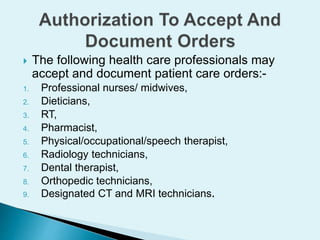
 The following health care professionals may
accept and document patient care orders:-
1. Professional nurses/ midwives,
2. Dieticians,
3. RT,
4. Pharmacist,
5. Physical/occupational/speech therapist,
6. Radiology technicians,
7. Dental therapist,
8. Orthopedic technicians,
9. Designated CT and MRI technicians.
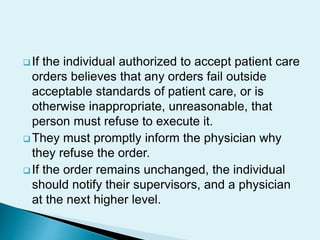
 If the individual authorized to accept patient care
orders believes that any orders fail outside
acceptable standards of patient care, or is
otherwise inappropriate, unreasonable, that
person must refuse to execute it.
 They must promptly inform the physician why
they refuse the order.
 If the order remains unchanged, the individual
should notify their supervisors, and a physician
at the next higher level.
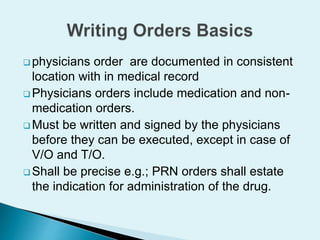
 physicians order are documented in consistent
location with in medical record
 Physicians orders include medication and non-
medication orders.
 Must be written and signed by the physicians
before they can be executed, except in case of
V/O and T/O.
 Shall be precise e.g.; PRN orders shall estate
the indication for administration of the drug.
 Only forms approved by the Medical Records
Committee shall be used in the record
 All entries must be legible with author clearly
labeled, with date(date-month-year sequence)
and time(24-hours clock system).
 Every page shall contain patient’s name and
medical record number.
 Who is responsible for this? YOU, and anyone
writing on the page.
 Continuous; lines/space, if skipped, should be
marked through.
 Made in black or dark blue ink.
 Only approved abbreviations and symbols may
be used.
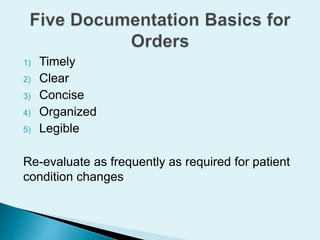
1) Timely
2) Clear
3) Concise
4) Organized
5) Legible
Re-evaluate as frequently as required for patient
condition changes
 A physician shall not change the orders or plan
of management of another physician, unless:-
1. Specifically requested or authorized by the
attending physician.
2. The chief of service deems it necessary,
urgent and in the patients best interest to do
so.
 When an error occurs, a line should be drawn
through it and the word error written on the line
next to it. This is followed by name, title, date
and time.
 Then, re-write proper information.
 No correction fluid is to be used.
 Don't use eraser
 Use of identification stamp is encouraged.
 When stamp is used, a signature must still be
present above the stamp.
 Diagnostic and therapeutic orders.
 Admitting And Preoperative Orders.
 Postoperative Orders.
 Verbal Orders.
 Telephone Orders.
 Routine orders.
 Discharge Orders.
 The procedure:
1. Listen to the order,
2. Repeat the patient’s name, file number, room
number, diagnosis and complete order back to
the physician to ensure accuracy.
3. Record the order,
4. Record the date and time,
 Sign your name and badge number, before the
end of the next calendar day after the order was
given.
 V/O are appropriate in the following situations:-
1. Emergency.
2. If practitioner placing the order is physically
unavailable and order has urgency.
3. If physician is performing a procedure.
 Must be signed, dated and timed within 48 hours
(except Med orders and restraint orders which
are 24)
 Cannot be used for:
1) Chemo,
2) DNR/Code Status;
3) Post OP,
4) PCA;
5) Hyper- alimentation;
6) Withdrawal of life support;
7) Heparin;
8) Initial parenteral orders of narcotics
 Admit to : Ward, ICU, or preoperative room.
 Diagnosis: Primary Diagnosis, Other Diagnoses
 Indication and Intended operation.
 Condition: Stable
 Nursing Vital Signs:
 Frequency of vital signs;
 Input and output recording;
 Neurological or vascular checks.
 Notify physician if blood pressure <90/60,
>160/110; pulse >110; pulse <60; temperature
>38.5; urine output <35 cc/h for >2 hours;
respiratory rate >30.
 Activity level (precautions, bed rest, elevation of
bed, weight bearing restrictions, rotation bed,
bathroom privileges )
 Allergies: No known allergies
 Diet: NPO
 Medications:
 Antibiotics to be initiated immediately
preoperatively; Additional dose during operation
and 1 dose of antibiotic postoperatively.
 Must be on Doctors order form or other
approved form (Heparin, Lovenox and Protonix)
 Include all Drug; Strength; Route; Frequency
 All strengths and volume in metric system
 Parameters required for PRN (fever, pain)
 only one range of dose per statement,( eg;
Morphine xx - xx every 4 hours for pain)
 All medication orders must be individually
reordered following surgery. “Resume” orders
are not acceptable
 “Resume Home Meds” cannot be used.
 Any ambiguous or illegible order will be required
to be re-written prior to filling the medication
 All home medications brought into the hospital
to be utilized by inpatients will be verified first by
pharmacy as the proper medication prior to
administration.
 Labs and Special X-Rays:
 Electrolytes, BUN, creatinine, INR/PTT, CBC,
platelet count, UA, ABG, pulmonary function
tests.
 Chest x-ray (if >35 yrs old),
 ECG (if older then 35 yrs old or if cardiovascular
disease).
 Type and cross for an appropriate number of
units of blood.
 Transfer:
From recovery room to surgical ward when
stable.
 Vital Signs: q4h, I&O q4h x 24h.
 Activity:
Bed rest; ambulate in 6-8 hours if
appropriate.
Incentive spirometer q1h while awake.
 IV Fluids:
IV D5 LR or D5 1/2 NS at 125 cc/h
 Diet:
NPO x 8h then sips of water.
Advance from clear liquids to regular diet as
tolerated.
 Medications:
1. Cefazolin 1 gm IV q8h x 3 doses;
2. Meperidine 50 mg IV/IM q3-4h prn pain
 Laboratory Evaluation: CBC, Chest x-ray in AM
if indicated.
 Post-operative, pre-admission, pre-
procedures orders are valid for 30
days in the event the surgery,
admission, procedure is delayed, and
as long as patient’s conditions
unchanged.
 Are preprinted sets of instructions for the patient
care which can be initiated by a nurse in the
absence of physician order.
 Amendment may be made to the pre-printed
orders by a physician in writing, verbally or over
the telephone.
 Must be signed by the attending physician within
the next calendar day.
1) Its not so easy. Slow down. Re-read what you
wrote. Ask for help.
2) Watch unapproved abbreviations
3) 5 Basics (Pt, drug, dose, route, time)
4) PRN need a rationale
5) Don’t use two ranges in same order (20-40 mg
q 4-6 hours)
6) Legibility
Doctors order sheet
Doctors order sheet
Doctors order sheet

Doctors order sheet

  • 1.
  • 2.
     To establishguidelines and the responsibilities for various disciplines who depend on the medical record as the primary tool for communicating information to patient care.  To provide standards for uniform documentation practice by all physicians.  To ensure competent records toward fulfillment of medico-legal responsibility of physicians.
  • 4.
    Patient Care Ordersare: the physician prescriptions, or authorization for the diagnostic or treatment service to a patient.
  • 5.
     Most ImportantCommunication piece Culmination of all skills (Assessment, Analysis, Plan)  Initiates all care  Historical record; Sequence of events  Communication to all caregivers  Communication to lawyers
  • 6.
     Entries maybe made into the medical record by: Physicians, Nurses, Pharmacists, RT, Dietician, Care Coordinator, Special Ed Teachers, Dentists, Midwives, Paramedic, Social Worker, Recreation Specialist, Radiology tech.  Your entries communicate to all of these professionals
  • 7.
     The followinghealth care professionals may accept and document patient care orders:- 1. Professional nurses/ midwives, 2. Dieticians, 3. RT, 4. Pharmacist, 5. Physical/occupational/speech therapist, 6. Radiology technicians, 7. Dental therapist, 8. Orthopedic technicians, 9. Designated CT and MRI technicians.
  • 8.
     If theindividual authorized to accept patient care orders believes that any orders fail outside acceptable standards of patient care, or is otherwise inappropriate, unreasonable, that person must refuse to execute it.  They must promptly inform the physician why they refuse the order.  If the order remains unchanged, the individual should notify their supervisors, and a physician at the next higher level.
  • 10.
     physicians orderare documented in consistent location with in medical record  Physicians orders include medication and non- medication orders.  Must be written and signed by the physicians before they can be executed, except in case of V/O and T/O.  Shall be precise e.g.; PRN orders shall estate the indication for administration of the drug.
  • 11.
     Only formsapproved by the Medical Records Committee shall be used in the record  All entries must be legible with author clearly labeled, with date(date-month-year sequence) and time(24-hours clock system).  Every page shall contain patient’s name and medical record number.  Who is responsible for this? YOU, and anyone writing on the page.
  • 12.
     Continuous; lines/space,if skipped, should be marked through.  Made in black or dark blue ink.  Only approved abbreviations and symbols may be used.
  • 13.
    1) Timely 2) Clear 3)Concise 4) Organized 5) Legible Re-evaluate as frequently as required for patient condition changes
  • 14.
     A physicianshall not change the orders or plan of management of another physician, unless:- 1. Specifically requested or authorized by the attending physician. 2. The chief of service deems it necessary, urgent and in the patients best interest to do so.
  • 15.
     When anerror occurs, a line should be drawn through it and the word error written on the line next to it. This is followed by name, title, date and time.  Then, re-write proper information.  No correction fluid is to be used.  Don't use eraser
  • 16.
     Use ofidentification stamp is encouraged.  When stamp is used, a signature must still be present above the stamp.
  • 18.
     Diagnostic andtherapeutic orders.  Admitting And Preoperative Orders.  Postoperative Orders.  Verbal Orders.  Telephone Orders.  Routine orders.  Discharge Orders.
  • 19.
     The procedure: 1.Listen to the order, 2. Repeat the patient’s name, file number, room number, diagnosis and complete order back to the physician to ensure accuracy. 3. Record the order, 4. Record the date and time,  Sign your name and badge number, before the end of the next calendar day after the order was given.
  • 20.
     V/O areappropriate in the following situations:- 1. Emergency. 2. If practitioner placing the order is physically unavailable and order has urgency. 3. If physician is performing a procedure.  Must be signed, dated and timed within 48 hours (except Med orders and restraint orders which are 24)
  • 21.
     Cannot beused for: 1) Chemo, 2) DNR/Code Status; 3) Post OP, 4) PCA; 5) Hyper- alimentation; 6) Withdrawal of life support; 7) Heparin; 8) Initial parenteral orders of narcotics
  • 22.
     Admit to: Ward, ICU, or preoperative room.  Diagnosis: Primary Diagnosis, Other Diagnoses  Indication and Intended operation.  Condition: Stable  Nursing Vital Signs:  Frequency of vital signs;  Input and output recording;  Neurological or vascular checks.
  • 23.
     Notify physicianif blood pressure <90/60, >160/110; pulse >110; pulse <60; temperature >38.5; urine output <35 cc/h for >2 hours; respiratory rate >30.  Activity level (precautions, bed rest, elevation of bed, weight bearing restrictions, rotation bed, bathroom privileges )  Allergies: No known allergies  Diet: NPO
  • 24.
     Medications:  Antibioticsto be initiated immediately preoperatively; Additional dose during operation and 1 dose of antibiotic postoperatively.  Must be on Doctors order form or other approved form (Heparin, Lovenox and Protonix)  Include all Drug; Strength; Route; Frequency  All strengths and volume in metric system
  • 25.
     Parameters requiredfor PRN (fever, pain)  only one range of dose per statement,( eg; Morphine xx - xx every 4 hours for pain)  All medication orders must be individually reordered following surgery. “Resume” orders are not acceptable  “Resume Home Meds” cannot be used.  Any ambiguous or illegible order will be required to be re-written prior to filling the medication
  • 26.
     All homemedications brought into the hospital to be utilized by inpatients will be verified first by pharmacy as the proper medication prior to administration.
  • 27.
     Labs andSpecial X-Rays:  Electrolytes, BUN, creatinine, INR/PTT, CBC, platelet count, UA, ABG, pulmonary function tests.  Chest x-ray (if >35 yrs old),  ECG (if older then 35 yrs old or if cardiovascular disease).  Type and cross for an appropriate number of units of blood.
  • 29.
     Transfer: From recoveryroom to surgical ward when stable.  Vital Signs: q4h, I&O q4h x 24h.  Activity: Bed rest; ambulate in 6-8 hours if appropriate. Incentive spirometer q1h while awake.  IV Fluids: IV D5 LR or D5 1/2 NS at 125 cc/h
  • 30.
     Diet: NPO x8h then sips of water. Advance from clear liquids to regular diet as tolerated.  Medications: 1. Cefazolin 1 gm IV q8h x 3 doses; 2. Meperidine 50 mg IV/IM q3-4h prn pain  Laboratory Evaluation: CBC, Chest x-ray in AM if indicated.
  • 31.
     Post-operative, pre-admission,pre- procedures orders are valid for 30 days in the event the surgery, admission, procedure is delayed, and as long as patient’s conditions unchanged.
  • 32.
     Are preprintedsets of instructions for the patient care which can be initiated by a nurse in the absence of physician order.  Amendment may be made to the pre-printed orders by a physician in writing, verbally or over the telephone.  Must be signed by the attending physician within the next calendar day.
  • 34.
    1) Its notso easy. Slow down. Re-read what you wrote. Ask for help. 2) Watch unapproved abbreviations 3) 5 Basics (Pt, drug, dose, route, time) 4) PRN need a rationale 5) Don’t use two ranges in same order (20-40 mg q 4-6 hours) 6) Legibility