@Physiocouk #manchesterphysio facebook.com/physiocouk
* 2
Welcome
Trigger point therapy & soft tissue release for sports and
massage therapists
With Louise Rigby and Zoe Killian
@Physiocouk #manchesterphysio facebook.com/physiocouk
3
@Physiocouk #manchesterphysio facebook.com/physiocouk
Who are we?
Louise’s LinkedIn: www.linkedin.com/louise-rigby
Twitter: @LouPhysiocouk
Zoe’s LinkedIn: www.linkedin.com/in/zoe-killian
Twitter: @ZoePhysiocouk
4
@Physiocouk #manchesterphysio facebook.com/physiocouk
Let’s connect
Website: www.physio.co.uk / Massage.physio.co.uk
Twitter: @physiocouk
Facebook: www.facebook.com/physiocouk
Aims of today
@Physiocouk #manchesterphysio facebook.com/physiocouk
✓ Learn the theory of a trigger point
✓ Learn the theory of trigger point therapy
✓ Practice the trigger point technique to muscle groups
✓ Use other soft tissue release techniques along side TP release
Itinerary
@Physiocouk #manchesterphysio facebook.com/physiocouk
10.00 - 10.30 - Induction / Arrival
10.30 - 10.50 - Quiz – What do you know about trigger point therapy
10.50 -11.30 - Theory: Trigger point therapy
11.30 -12.00 - Indications/ outcome measures
12.00 - 12.30 - Lunch
12.30 - 13.00 - Theory: Trigger pointing technique
13.00 - 14.00 - Practical: Muscle groups
14.00 - 14.30 – Practical: Tools & other STR techniques
14.30 - 15.00 - Case Studies/Quiz answers
Quiz…What do you know about trigger point therapy?
@Physiocouk #manchesterphysio facebook.com/physiocouk
Question 1
@Physiocouk #manchesterphysio facebook.com/physiocouk
What is a trigger point?
Question 2
@Physiocouk #manchesterphysio facebook.com/physiocouk
How would patients describe Trigger Point
pain?
Question 3
@Physiocouk #manchesterphysio facebook.com/physiocouk
Name some indications for Trigger Point
Therapy?
Question 4
@Physiocouk #manchesterphysio facebook.com/physiocouk
Name 3 benefits of Trigger Point Therapy
Question 5
@Physiocouk #manchesterphysio facebook.com/physiocouk
Name some contraindications for Trigger
Point Therapy
Question 6
@Physiocouk #manchesterphysio facebook.com/physiocouk
Where is the Trapezius muscle found?
Question 7
@Physiocouk #manchesterphysio facebook.com/physiocouk
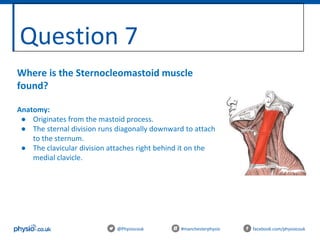
Where is the Sternocleidomastoid muscle
found?
Question 8
@Physiocouk #manchesterphysio facebook.com/physiocouk
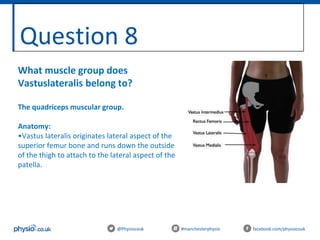
What muscle group does Vastus Lateralis
belong to?
Theory:
Trigger Point Therapy
@Physiocouk #manchesterphysio facebook.com/physiocouk
What are trigger points?
@Physiocouk #manchesterphysio facebook.com/physiocouk
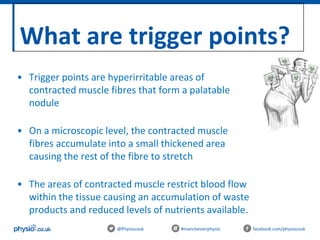
• Trigger points are hyperirritable areas of
contracted muscle fibres that form a palatable
nodule
• On a microscopic level, the contracted muscle
fibres accumulate into a small thickened area
causing the rest of the fibre to stretch
• The areas of contracted muscle restrict blood flow
within the tissue causing an accumulation of waste
products and reduced levels of nutrients available.
Brief History
@Physiocouk #manchesterphysio facebook.com/physiocouk
• 1930s -Dr Hans Lange used sclerometer to prove that tender areas in muscles are
50% harder than surrounding areas.
• 1940s- Janet Travell developed trigger point injection therapy and termed the
“tender areas” described by Dr Hans “Trigger points”.
• Travell's therapy called for the injection of saline (a salt solution) and procaine (also
known as Novocaine, an anesthetic) into the trigger point.
• Travell mapped what she termed the body's trigger points and the manner in which
pain radiates to the rest of the body.
• Travell's work came to national attention when she treated President John F.
Kennedy for his back pain.
• Travell co-authored several books with David Simons which are considered the
definitive reference for trigger point therapy.
• Travell & Simons' Myofascial Pain and Dysfunction: Upper half of body
• Travell & Simons' Myofascial Pain and Dysfunction: The Trigger Point Manual
• Myofascial Pain and Dysfunction: The Trigger Point Manual, Volume 2
Brief History
@Physiocouk #manchesterphysio facebook.com/physiocouk
• 1976- Bonnie Prudden, a physical fitness and exercise therapist
developed Travells trigger point therapy. She found that applying
sustained pressure to a trigger point using thumbs, knuckles and
elbows produced superior results to those treated with injections
when followed by corrective movements and stretching. Prudden
later went on to author two books:
• Myotherapy: Bonnie Prudden’s Complete Guide to Pain Free Living
• Pain Erasure the Bonnie Prudden Way
Different types of trigger points
@Physiocouk #manchesterphysio facebook.com/physiocouk
• Trigger points are described according to location, tenderness and
chronicity.
• The main types of trigger points are:
• Central/ primary trigger points
• Satellite/ secondary trigger points
• Active trigger points
• Latent trigger points
Central/ primary trigger points
@Physiocouk #manchesterphysio facebook.com/physiocouk
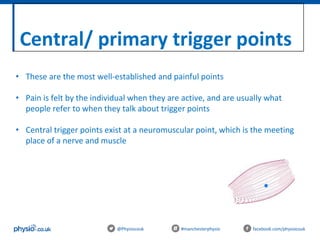
• These are the most well-established and painful points
• Pain is felt by the individual when they are active, and are usually what
people refer to when they talk about trigger points
• Central trigger points exist at a neuromuscular point, which is the meeting
place of a nerve and muscle
Satellite/ secondary trigger points
@Physiocouk #manchesterphysio facebook.com/physiocouk
• These trigger points are “created” as a response to the central trigger
point in neighbouring muscles that lie within the referred pain zone.
• The primary trigger point is still the key to trigger pointing intervention:
the satellite trigger points often resolve once the primary point has been
effectively rendered inactive.
• Satellite points may also prove unresponsive to treatment until the
primary central focus is weakened. This is often the case in the
paraspinal and/or abdominal muscles.
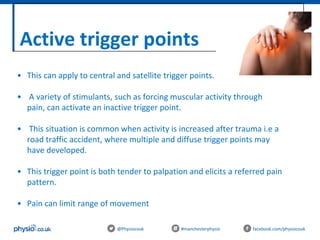
Active trigger points
@Physiocouk #manchesterphysio facebook.com/physiocouk
• This can apply to central and satellite trigger points.
• A variety of stimulants, such as forcing muscular activity through
pain, can activate an inactive trigger point.
• This situation is common when activity is increased after trauma i.e a
road traffic accident, where multiple and diffuse trigger points may
have developed.
• This trigger point is both tender to palpation and elicits a referred pain
pattern.
• Pain can limit range of movement
Latent/Inactive trigger points
@Physiocouk #manchesterphysio facebook.com/physiocouk
• This applies to lumps and nodules that feel like trigger points. These can
develop anywhere in the body and are often secondary.
• These trigger points are not painful, and do not elicit a referred pain pathway.
• The presence of inactive trigger points within muscles may lead to increased
muscular stiffness and tension. They can build up for years.
• It has been suggested that these points are more common in those who live a
sedentary lifestyle (Starlanyl & Copeland 2001)
• These points are “potential” trigger points and may reactivate if the central or
primary trigger point is (re)stimulated
• Reactivation may occur following trauma and injury
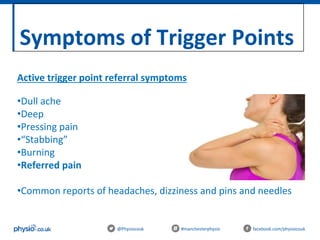
Symptoms of Trigger Points
@Physiocouk #manchesterphysio facebook.com/physiocouk
Active trigger point referral symptoms
•Dull ache
•Deep
•Pressing pain
•“Stabbing”
•Burning
•Referred pain
•Common reports of headaches, dizziness and pins and needles
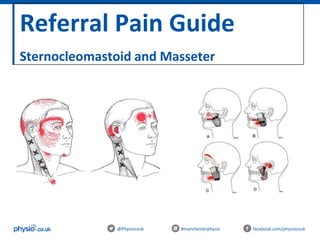
Referral Pain Guide
Sternocleomastoid and Masseter
@Physiocouk #manchesterphysio facebook.com/physiocouk
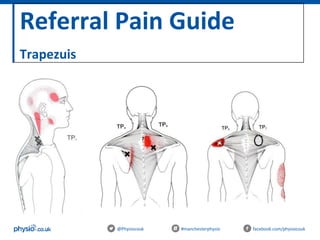
Referral Pain Guide
Trapezuis
@Physiocouk #manchesterphysio facebook.com/physiocouk
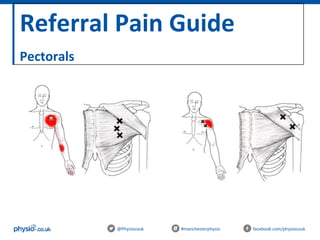
Referral Pain Guide
Pectorals
@Physiocouk #manchesterphysio facebook.com/physiocouk
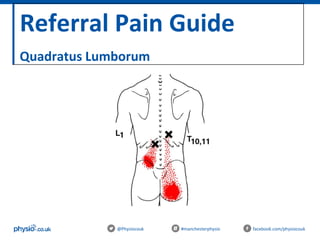
Referral Pain Guide
Quadratus Lumborum
@Physiocouk #manchesterphysio facebook.com/physiocouk
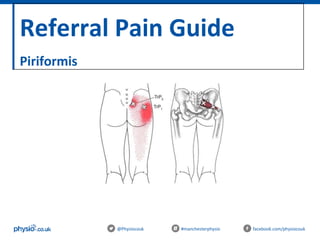
Referral Pain Guide
Piriformis
@Physiocouk #manchesterphysio facebook.com/physiocouk
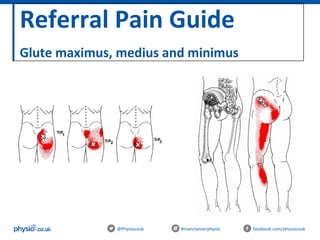
Referral Pain Guide
Glute maximus, medius and minimus
@Physiocouk #manchesterphysio facebook.com/physiocouk
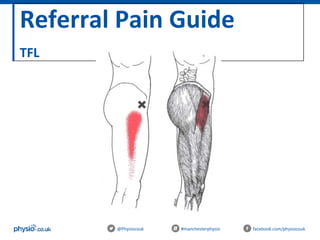
Referral Pain Guide
TFL
@Physiocouk #manchesterphysio facebook.com/physiocouk
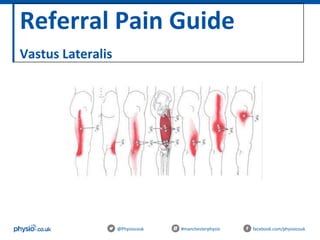
Referral Pain Guide
Vastus Lateralis
@Physiocouk #manchesterphysio facebook.com/physiocouk
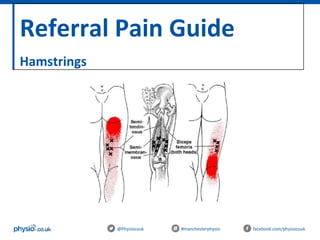
Referral Pain Guide
Hamstrings
@Physiocouk #manchesterphysio facebook.com/physiocouk
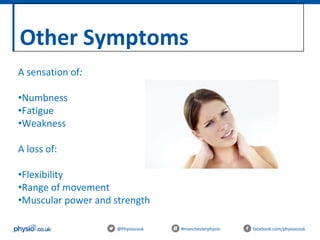
Other Symptoms
@Physiocouk #manchesterphysio facebook.com/physiocouk
A sensation of:
•Numbness
•Fatigue
•Weakness
A loss of:
•Flexibility
•Range of movement
•Muscular power and strength
Why are they present?
@Physiocouk #manchesterphysio facebook.com/physiocouk
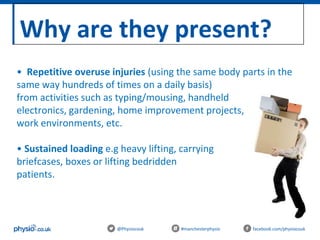
• Repetitive overuse injuries (using the same body parts in the
same way hundreds of times on a daily basis)
from activities such as typing/mousing, handheld
electronics, gardening, home improvement projects,
work environments, etc.
• Sustained loading e.g heavy lifting, carrying babies,
briefcases, boxes or lifting bedridden
patients.
Why are they present?
@Physiocouk #manchesterphysio facebook.com/physiocouk
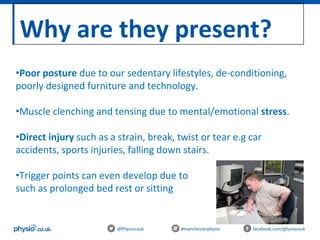
•Poor posture due to our sedentary lifestyles, de-conditioning,
poorly designed furniture and technology.
•Muscle clenching and tensing due to mental/emotional stress.
•Direct injury such as a strain, break, twist or tear e.g car
accidents, sports injuries, falling down stairs.
•Trigger points can even develop due to inactivity
such as prolonged bed rest or sitting .
Formation of a Trigger
point
@Physiocouk #manchesterphysio facebook.com/physiocouk
• Deep within muscles are spiral shaped nerve fibres called muscle spindles.
• When muscles are excessively stretched muscle spindles activate and send
signals to the brain to promote a protective muscular contraction- stretch
reflex arc.
Formation of a Trigger
point
@Physiocouk #manchesterphysio facebook.com/physiocouk
• The problem occurs when the muscle spindle becomes
sensitised.
• Injury or overuse can over stimulate muscle spindles which can
cause contraction within the muscle and subsequently forming
localised muscular spasm…. A Trigger point.
Formation of a Trigger
point
@Physiocouk #manchesterphysio facebook.com/physiocouk
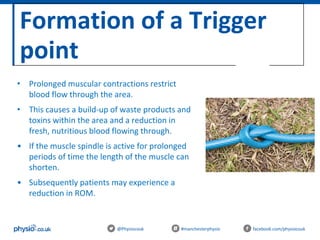
• Prolonged muscular contractions restrict
blood flow through the area.
• This causes a build-up of waste products and
toxins within the area and a reduction in
fresh, nutritious blood flowing through.
• If the muscle spindle is active for prolonged
periods of time the length of the muscle can
shorten.
• Subsequently patients may experience a
reduction in ROM.
Where are they formed?
@Physiocouk #manchesterphysio facebook.com/physiocouk
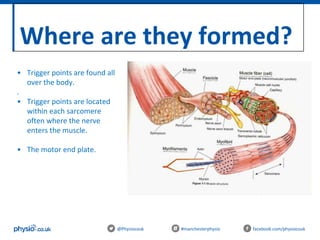
• Trigger points are found all
over the body.
.
• Trigger points are located
within each sarcomere
often where the nerve
enters the muscle.
• The motor end plate.
Trigger point pain
@Physiocouk #manchesterphysio facebook.com/physiocouk
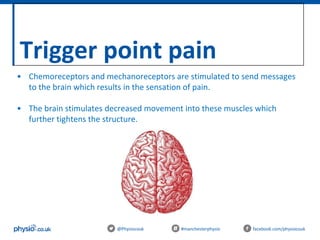
• Chemoreceptors and mechanoreceptors are stimulated to send messages
to the brain which results in the sensation of pain.
• The brain stimulates decreased movement into these muscles which
further tightens the structure.
Indications and Outcome
Measures
@Physiocouk #manchesterphysio facebook.com/physiocouk
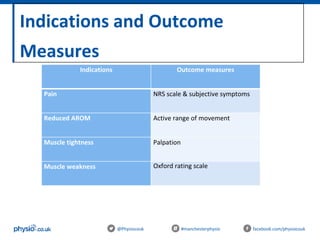
Indications Outcome measures
Pain NRS scale & subjective symptoms
Reduced AROM Active range of movement
Muscle tightness Palpation
Muscle weakness Oxford rating scale
44@Physiocouk #manchesterphysio facebook.com/physiocouk
Outcome measure:
Numerical rating scale
• Simple and easy
• Before, during and after massage
• Record change
• Use with patient to see reduction in pain over
the progression of treatments
45@Physiocouk #manchesterphysio facebook.com/physiocouk
Outcome measure:
Range of movement
• Pre and post measurements
• Goniometer or visual
• Standardise to produce reliable results
• Review each session
• Used to distinguish areas to treat and
techniques types
• Valuable in the success of treatment
46@Physiocouk #manchesterphysio facebook.com/physiocouk
Outcome measure:
Muscle testing
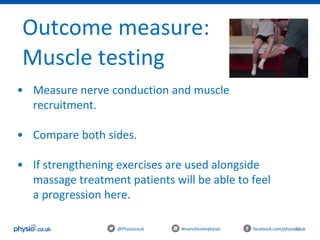
• Measure nerve conduction and muscle
recruitment.
• Compare both sides.
• If strengthening exercises are used alongside
massage treatment patients will be able to feel
a progression here.
47@Physiocouk #manchesterphysio facebook.com/physiocouk
Outcome measure:
Palpation
Use palpation as a measure using “the four T’s”
• Temperature
Is the tissue hot? This could indicate presence of inflammation.
● Texture
Swelling (acute-hard, chronic – “boggy”, congested)
healthy tissues should have an even texture
Adhesions feel like tissues are “stuck” and less mobile
“audible crunching”.
48@Physiocouk #manchesterphysio facebook.com/physiocouk
Outcome measure:
Palpation
● Tenderness
Pain can be indicated through response. NRS can be
used here.
● Tone
Tissues may be tense, always compare to other side to
see what is normal for the patient.
Lunch
@Physiocouk #manchesterphysio facebook.com/physiocouk
Theory:
Trigger Pointing Therapy
@Physiocouk #manchesterphysio facebook.com/physiocouk
How to treat a Trigger Point
@Physiocouk #manchesterphysio facebook.com/physiocouk
Assessment
•Find the most painful TP using patient response and Numeric Rating Scale.
•Treat the highest rated point and radiate out from this point
•Once the points are found – a good amount of pressure is applied (perform with
precaution - keep communication with patient)
•Initial pain is stimulated and you hold the pressure until the pain has eased completely
or in some cases reduced slightly
•Re-apply pressure onto the same point until the pain eases off quicker or it isn’t felt
anymore (roughly 3 times)
•Thumbs/elbows or tools can be used
How to treat a Trigger Point
@Physiocouk #manchesterphysio facebook.com/physiocouk
Guidelines
Application of direct pressure onto the trigger points for around 30 seconds
or until the patient’s pain has decreased to at least 3/10 NRS score.
The applied pressure help to break-up the adhesive fibre connections within
the trigger points and push out blood containing waste products and toxins.
After 30 seconds, the pressure is released allowing a rush of fresh blood
containing nutrients to circulate the trigger point.
Repeat 3 times in conjunction with deep massage strokes.
This can vary on the severity of pain/ how deep or superficial the TP is –
subjective and variable to each patient
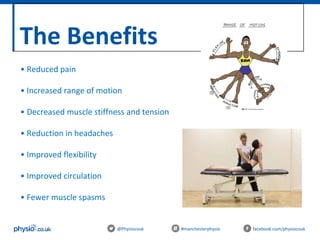
The Benefits
@Physiocouk #manchesterphysio facebook.com/physiocouk
• Reduced pain
• Increased range of motion
• Decreased muscle stiffness and tension
• Reduction in headaches
• Improved flexibility
• Improved circulation
• Fewer muscle spasms
Precautions
@Physiocouk #manchesterphysio facebook.com/physiocouk
• High pain scales
• Patient Anxiety
• Acute/ Inflammatory stage of healing
• Hypersensitivity
• Pregnancy
• Epilepsy
• Asthma
• Hypertension
• Prescribed medication
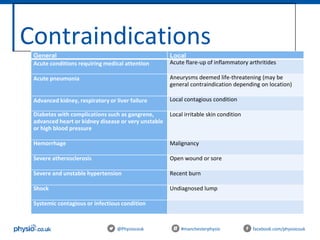
Contraindications
@Physiocouk #manchesterphysio facebook.com/physiocouk
General Local
Acute conditions requiring medical attention Acute flare-up of inflammatory arthritides
Acute pneumonia Aneurysms deemed life-threatening (may be
general contraindication depending on location)
Advanced kidney, respiratory or liver failure Local contagious condition
Diabetes with complications such as gangrene,
advanced heart or kidney disease or very unstable
or high blood pressure
Local irritable skin condition
Hemorrhage Malignancy
Severe atherosclerosis Open wound or sore
Severe and unstable hypertension Recent burn
Shock Undiagnosed lump
Systemic contagious or infectious condition
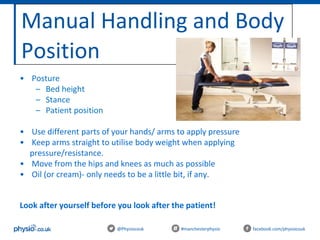
Manual Handling and Body
Position
@Physiocouk #manchesterphysio facebook.com/physiocouk
• Posture
– Bed height
– Stance
– Patient position
• Use different parts of your hands/ arms to apply pressure
• Keep arms straight to utilise body weight when applying
pressure/resistance.
• Move from the hips and knees as much as possible
• Oil (or cream)- only needs to be a little bit, if any.
Look after yourself before you look after the patient!
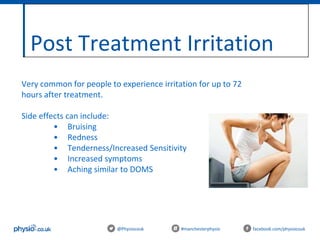
Post Treatment Irritation
@Physiocouk #manchesterphysio facebook.com/physiocouk
Very common for people to experience irritation for up to 72
hours after treatment.
Side effects can include:
• Bruising
• Redness
• Tenderness/Increased Sensitivity
• Increased symptoms
• Aching similar to DOMS
Post Treatment Irritation
@Physiocouk #manchesterphysio facebook.com/physiocouk
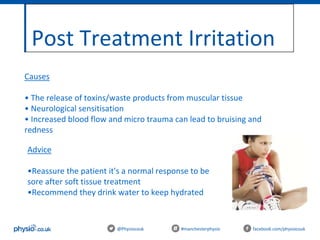
Causes
• The release of toxins/waste products from muscular tissue
• Neurological sensitisation
• Increased blood flow and micro trauma can lead to bruising and
redness
Advice
•Reassure the patient it's a normal response to be
sore after soft tissue treatment
•Recommend they drink water to keep hydrated
Practical:
Trigger pointing muscles
@Physiocouk #manchesterphysio facebook.com/physiocouk
• UFT
• Sternocleomastoid
• Rhomboids
• QL
• TFL
• Vastus Lateralis
• Gastrocnemius
Trapezius
@Physiocouk #manchesterphysio facebook.com/physiocouk
The trapezius can be separated into three
muscles:
•The upper trapezius
•The middle trapezius
•The lower trapezius
Anatomy: All three trapezius muscles originate
along the spine to T12 and extend laterally to
attach to the shoulder girdle.
Function: Each muscle has a different direction
of pull. Movements facilitated include scapula
elevation, depression, retraction, upwards and
downward rotation.
Trapezius
@Physiocouk #manchesterphysio facebook.com/physiocouk
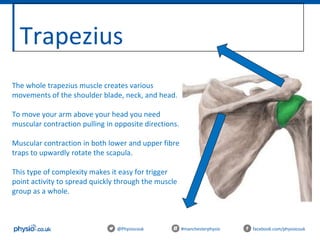
The whole trapezius muscle creates various
movements of the shoulder blade, neck, and head.
To move your arm above your head you need
muscular contraction pulling in opposite directions.
Muscular contraction in both lower and upper fibre
traps to upwardly rotate the scapula.
This type of complexity makes it easy for trigger
point activity to spread quickly through the muscle
group as a whole.
Trapezius Trigger Points
@Physiocouk #manchesterphysio facebook.com/physiocouk
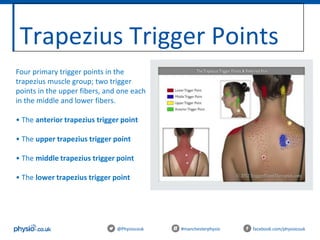
Four primary trigger points in the
trapezius muscle group; two trigger
points in the upper fibers, and one each
in the middle and lower fibers.
• The anterior trapezius trigger point
• The upper trapezius trigger point
• The middle trapezius trigger point
• The lower trapezius trigger point
Trapezius Pain
@Physiocouk #manchesterphysio facebook.com/physiocouk
Causes
● Poor posture- shoulders, neck and back
● Stress
● Carrying heavy handbags/ laptop bags on one side
● Dysfunction/ pathology within the shoulder complex
Symptoms
● Ache and tightness in shoulders and neck
● Tension headaches
● Upper cross syndrome
● Struggle to look over shoulder
RX: UFT
@Physiocouk #manchesterphysio facebook.com/physiocouk
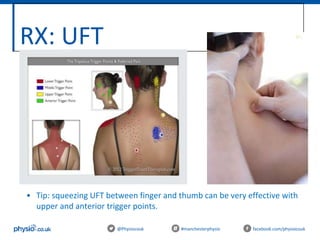
• Tip: squeezing UFT between finger and thumb can be very effective with
upper and anterior trigger points.
Sternocleomastoid
@Physiocouk #manchesterphysio facebook.com/physiocouk
Anatomy:
● Originates from the mastoid process.
● The sternal division runs diagonally downward to attach to the
sternum.
● The clavicular division attaches right behind it on the medial
clavicle.
Function:
● Turn head towards opposite side and bilaterally side flex the neck.
● Control and monitor the head’s position in space. Proprioceptive
feedback from the SCM is essential to being able to maintain one’s
balance.
Sternocleomastoid Trigger Points
@Physiocouk #manchesterphysio facebook.com/physiocouk
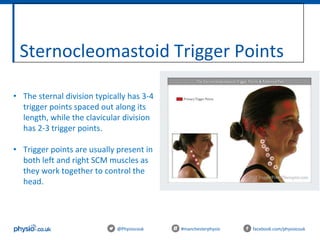
• The sternal division typically has 3-4
trigger points spaced out along its
length, while the clavicular division
has 2-3 trigger points.
• Trigger points are usually present in
both left and right SCM muscles as
they work together to control the
head.
Sternocleomastoid Pain
@Physiocouk #manchesterphysio facebook.com/physiocouk
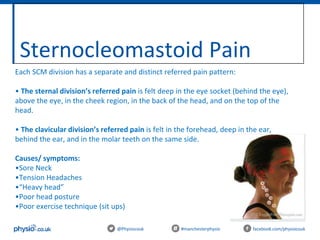
Each SCM division has a separate and distinct referred pain pattern:
• The sternal division’s referred pain is felt deep in the eye socket (behind the eye),
above the eye, in the cheek region, in the back of the head, and on the top of the
head.
• The clavicular division’s referred pain is felt in the forehead, deep in the ear,
behind the ear, and in the molar teeth on the same side.
Causes/ symptoms:
•Sore Neck
•Tension Headaches
•“Heavy head”
•Poor head posture
•Poor exercise technique (sit ups)
RX: Sternocleomastoid
@Physiocouk #manchesterphysio facebook.com/physiocouk
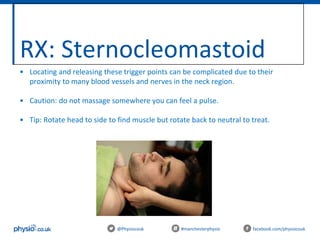
• Locating and releasing these trigger points can be complicated due to their
proximity to many blood vessels and nerves in the neck region.
• Caution: do not massage somewhere you can feel a pulse.
• Tip: Rotate head to side to find muscle but rotate back to neutral to treat.
Rhomboids
@Physiocouk #manchesterphysio facebook.com/physiocouk
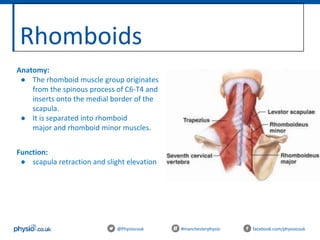
Anatomy:
● The rhomboid muscle group originates
from the spinous process of C6-T4 and
inserts onto the medial border of the
scapula.
● It is separated into rhomboid
major and rhomboid minor muscles.
Function:
● scapula retraction and slight elevation
Rhomboid Trigger Points
@Physiocouk #manchesterphysio facebook.com/physiocouk
3 primary trigger points
• The rhomboid minor trigger point lies just medial to the inside edge of the scapula,
level with the scapular spine.
• The rhomboid major trigger points lie one above the other, along the lower part of the
scapular border.
•Referred Pain: The pain concentrates in
the region between the spine and the
shoulder blade.
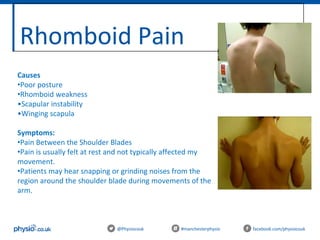
Rhomboid Pain
@Physiocouk #manchesterphysio facebook.com/physiocouk
Causes
•Poor posture
•Rhomboid weakness
•Scapular instability
•Winging scapula
Symptoms:
•Pain Between the Shoulder Blades
•Pain is usually felt at rest and not typically affected my
movement.
•Patients may hear snapping or grinding noises from the
region around the shoulder blade during movements of the
arm.
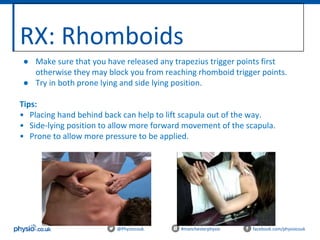
RX: Rhomboids
@Physiocouk #manchesterphysio facebook.com/physiocouk
● Make sure that you have released any trapezius trigger points first
otherwise they may block you from reaching rhomboid trigger points.
● Try in both prone lying and side lying position.
Tips:
• Placing hand behind back can help to lift scapula out of the way.
• Side-lying position to allow more forward movement of the scapula.
• Prone to allow more pressure to be applied.
Have a go!
@Physiocouk #manchesterphysio facebook.com/physiocouk
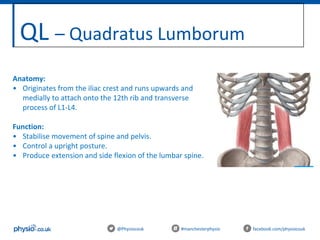
QL – Quadratus Lumborum
@Physiocouk #manchesterphysio facebook.com/physiocouk
Anatomy:
• Originates from the iliac crest and runs upwards and
medially to attach onto the 12th rib and transverse
process of L1-L4.
Function:
• Stabilise movement of spine and pelvis.
• Control a upright posture.
• Produce extension and side flexion of the lumbar spine.
QL Trigger points
@Physiocouk #manchesterphysio facebook.com/physiocouk
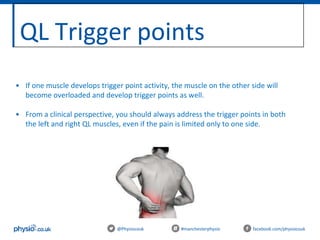
• If one muscle develops trigger point activity, the muscle on the other side will
become overloaded and develop trigger points as well.
• From a clinical perspective, you should always address the trigger points in both
the left and right QL muscles, even if the pain is limited only to one side.
QL Trigger points
@Physiocouk #manchesterphysio facebook.com/physiocouk
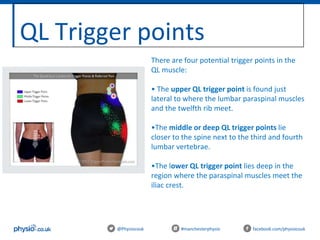
There are four potential trigger points in the
QL muscle:
• The upper QL trigger point is found just
lateral to where the lumbar paraspinal muscles
and the twelfth rib meet.
•The middle or deep QL trigger points lie
closer to the spine next to the third and fourth
lumbar vertebrae.
•The lower QL trigger point lies deep in the
region where the paraspinal muscles meet the
iliac crest.
QL Pain
@Physiocouk #manchesterphysio facebook.com/physiocouk
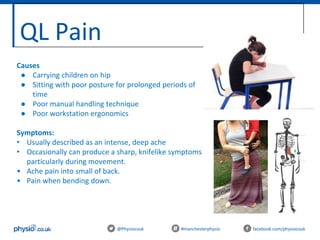
Causes
● Carrying children on hip
● Sitting with poor posture for prolonged periods of
time
● Poor manual handling technique
● Poor workstation ergonomics
Symptoms:
• Usually described as an intense, deep ache
• Occasionally can produce a sharp, knifelike symptoms
particularly during movement.
• Ache pain into small of back.
• Pain when bending down.
RX: QL
@Physiocouk #manchesterphysio facebook.com/physiocouk
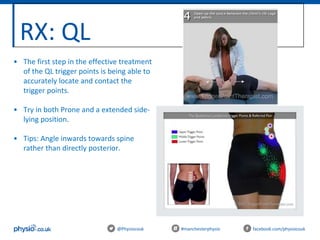
• The first step in the effective treatment
of the QL trigger points is being able to
accurately locate and contact the
trigger points.
• Try in both Prone and a extended side-
lying position.
• Tips: Angle inwards towards spine
rather than directly posterior.
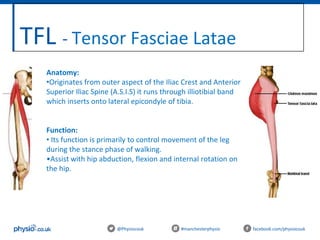
TFL - Tensor Fasciae Latae
@Physiocouk #manchesterphysio facebook.com/physiocouk
Anatomy:
•Originates from outer aspect of the Iliac Crest and Anterior
Superior Iliac Spine (A.S.I.S) it runs through illiotibial band
which inserts onto lateral epicondyle of tibia.
Function:
• Its function is primarily to control movement of the leg
during the stance phase of walking.
•Assist with hip abduction, flexion and internal rotation on
the hip.
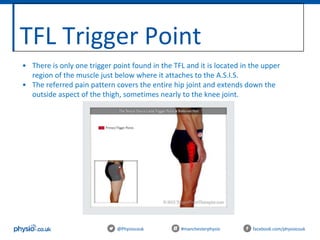
TFL Trigger Point
@Physiocouk #manchesterphysio facebook.com/physiocouk
• There is only one trigger point found in the TFL and it is located in the upper
region of the muscle just below where it attaches to the A.S.I.S.
• The referred pain pattern covers the entire hip joint and extends down the
outside aspect of the thigh, sometimes nearly to the knee joint.
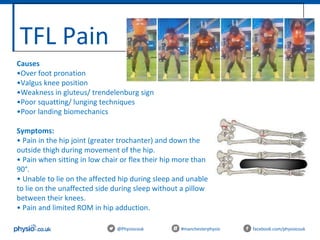
TFL Pain
@Physiocouk #manchesterphysio facebook.com/physiocouk
Causes
•Over foot pronation
•Valgus knee position
•Weakness in gluteus/ trendelenburg sign
•Poor squatting/ lunging techniques
•Poor landing biomechanics
Symptoms:
• Pain in the hip joint (greater trochanter) and down the
outside thigh during movement of the hip.
• Pain when sitting in low chair or flex their hip more than
90°.
• Unable to lie on the affected hip during sleep and unable
to lie on the unaffected side during sleep without a pillow
between their knees.
• Pain and limited ROM in hip adduction.
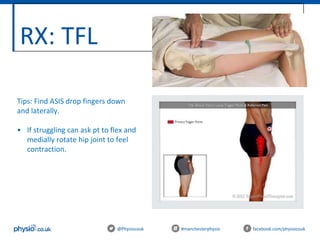
RX: TFL
@Physiocouk #manchesterphysio facebook.com/physiocouk
Tips: Find ASIS drop fingers down
and laterally.
• If struggling can ask pt to flex and
medially rotate hip joint to feel
contraction.
Vastus Lateralis
@Physiocouk #manchesterphysio facebook.com/physiocouk
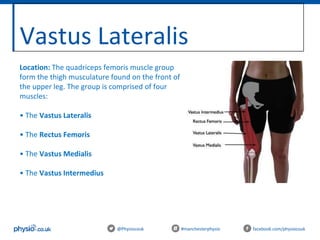
Location: The quadriceps femoris muscle group
form the thigh musculature found on the front of
the upper leg. The group is comprised of four
muscles:
• The Vastus Lateralis
• The Rectus Femoris
• The Vastus Medialis
• The Vastus Intermedius
Vastus Lateralis
@Physiocouk #manchesterphysio facebook.com/physiocouk
Anatomy:
•Vastus lateralis originates lateral aspect of the superior
femur bone and runs down the outside of the thigh to
attach to the lateral aspect of the patella.
Function:
•The vastus lateralis is the largest muscle in the group.
•Contraction of this muscle produces extension of the
lower leg at the knee.
•Helps to stabilise the patella in patellofemoral groove.
Vastus Lateralis Trigger Points
@Physiocouk #manchesterphysio facebook.com/physiocouk
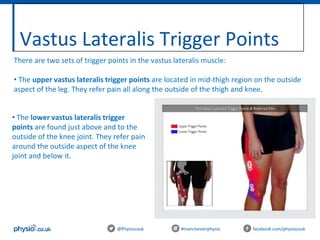
There are two sets of trigger points in the vastus lateralis muscle:
• The upper vastus lateralis trigger points are located in mid-thigh region on the outside
aspect of the leg. They refer pain all along the outside of the thigh and knee.
• The lower vastus lateralis trigger
points are found just above and to the
outside of the knee joint. They refer pain
around the outside aspect of the knee
joint and below it.
Vastus Lateralis Pain
@Physiocouk #manchesterphysio facebook.com/physiocouk
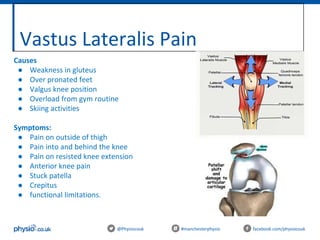
Causes
● Weakness in gluteus
● Over pronated feet
● Valgus knee position
● Overload from gym routine
● Skiing activities
Symptoms:
● Pain on outside of thigh
● Pain into and behind the knee
● Pain on resisted knee extension
● Anterior knee pain
● Stuck patella
● Crepitus
● functional limitations.
RX: Vastus Lateralis
@Physiocouk #manchesterphysio facebook.com/physiocouk
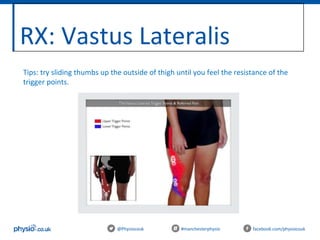
Tips: try sliding thumbs up the outside of thigh until you feel the resistance of the
trigger points.
Gastrocnemius
@Physiocouk #manchesterphysio facebook.com/physiocouk
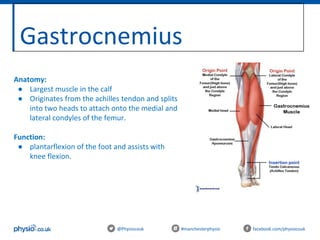
Anatomy:
● Largest muscle in the calf
● Originates from the achilles tendon and splits
into two heads to attach onto the medial and
lateral condyles of the femur.
Function:
● plantarflexion of the foot and assists with
knee flexion.
Gastrocnemius trigger
points
@Physiocouk #manchesterphysio facebook.com/physiocouk
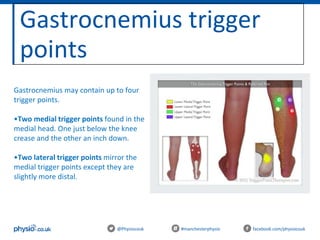
Gastrocnemius may contain up to four
trigger points.
•Two medial trigger points found in the
medial head. One just below the knee
crease and the other an inch down.
•Two lateral trigger points mirror the
medial trigger points except they are
slightly more distal.
Gastrocnemius Pain
@Physiocouk #manchesterphysio facebook.com/physiocouk
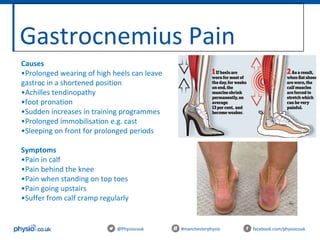
Causes
•Prolonged wearing of high heels can leave
gastroc in a shortened position
•Achilles tendinopathy
•foot pronation
•Sudden increases in training programmes
•Prolonged immobilisation e.g. cast
•Sleeping on front for prolonged periods
Symptoms
•Pain in calf
•Pain behind the knee
•Pain when standing on top toes
•Pain going upstairs
•Suffer from calf cramp regularly
RX: Gastrocnemius
@Physiocouk #manchesterphysio facebook.com/physiocouk
• Tip: try using your elbow to trigger point.
Have a go!
@Physiocouk #manchesterphysio facebook.com/physiocouk
Supporting Evidence
@Physiocouk #manchesterphysio facebook.com/physiocouk
Effectiveness of Myofascial Trigger Point Manual Therapy Combined With a Self-
Stretching Protocol for the Management of Plantar Heel Pain: A Randomized
Controlled Trial
@Physiocouk #manchesterphysio facebook.com/physiocouk
Renan-Ordine et al, (2011)
•Aim: to assess the effect of trigger point therapy and stretching or stretching alone in the
treatment for plantar heel pain.
•Method: 60 patients with plantar heel pain were divided into 2 groups a)self-stretching b) self-
stretching and trigger point therapy.
•Outcome measures: assessed at baseline and at a 1-month follow up.
– Physical function and pain assessed using a quality of life questionnaire.
– pressure pain thresholds were assessed over affected gastroc, soleus muscles and over the
calcaneus using a mechanical pressure algometer.
•Results: trigger point therapy and self-stretching is superior to stretching alone in the treatment of
patients with plantar heel pain.
•Link: http://www.jospt.org/doi/full/10.2519/jospt.2011.3504
Comparative study on effects of manipulation treatment and transcutaneous
electrical nerve stimulation on patients with cervicogenic headache
@Physiocouk #manchesterphysio facebook.com/physiocouk
Li et al, (2007)
•Aim: To compare the effects of trigger pointing and transcutaneous electrical nerve stimulation
(TENS) on patients with cervicogenic headache.
•Method: 70 patients with cervicoigenic headaches were randomly allocated to receive trigger
pointing or TENS every other day for 40 days.
•Outcome measures: Taken 2 weeks pre-treatment and 4 weeks post-treatment.
– headache degree, frequency and lasting time using a numeric rating scale
– ROM of cervical spine.
•Results: Trigger pointing was superior to TENS in headache frequency, lasting time and ROM
scores. Response rate of trigger pointing treatment was 94.5%, significantly higher than 64.5% of
TENS treatment.
•Link: http://europepmc.org/abstract/med/17631795
Immediate effect of activator trigger point therapy and myofascial band therapy on
non-specific neck pain in patients with upper trapezius trigger points compared to
sham ultrasound: A randomised controlled trial
@Physiocouk #manchesterphysio facebook.com/physiocouk
Blikstad and Gemmell, (2007)
•Aim: To determine the immediate effect of activator trigger point therapy and myofascial band
therapy compared to sham ultrasound on non-specific neck pain
•Method: 45 patients with non-specific neck pain of at least 4 on an 11-point numerical rating scale
and upper trap trigger points, decreased cervical lateral flexion away from the active trigger points
participated. Participants were assigned to one of three treatment groups; trigger point therapy,
myofascial band therapy or sham ultrasound.
•Outcome measures: assessed before and 5 min after treatment
– pain levels assessed using numerical scale
– cervical ROM using goniometer
– pain perceived thresholds using pain pressure algometer.
•Results: For the primary outcome measure of pain reduction the odds of a patient improving with
activator trigger point therapy was 7 times higher than a patient treated with myofascial band
therapy or sham ultrasound.
•Link: http://www.sciencedirect.com/science/article/pii/S1479235407001083
The use of other STR
@Physiocouk #manchesterphysio facebook.com/physiocouk
•Helps warm up an area
•Removes waste products
•Increases oxygenation
•Increases new blood flow
•Further breaks down collagen
•Helps sooth an area after deep pressure has been applied
•Nice, relaxing end to a treatment
98@Physiocouk #manchesterphysio facebook.com/physiocouk
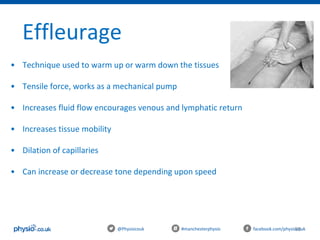
Effleurage
• Technique used to warm up or warm down the tissues
• Tensile force, works as a mechanical pump
• Increases fluid flow encourages venous and lymphatic return
• Increases tissue mobility
• Dilation of capillaries
• Can increase or decrease tone depending upon speed
99@Physiocouk #manchesterphysio facebook.com/physiocouk
Petrissage
• Examples of petrissage- Kneading, wringing & skin rolling
• A group of deep style techniques that are applied with
pressure and compress the underlying muscles
• Movements should be slow and repetitive with pressure in
order to loosen the muscles and increase blood flow to the
area
• Promotes relaxation
• Increases fluid flow
• Increases mobility of fibrous tissue
• Decreases tone
100@Physiocouk #manchesterphysio facebook.com/physiocouk
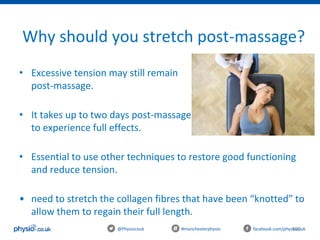
Why should you stretch post-massage?
• Excessive tension may still remain
post-massage.
• It takes up to two days post-massage
to experience full effects.
• Essential to use other techniques to restore good functioning
and reduce tension.
• need to stretch the collagen fibres that have been “knotted” to
allow them to regain their full length.
101@Physiocouk #manchesterphysio facebook.com/physiocouk
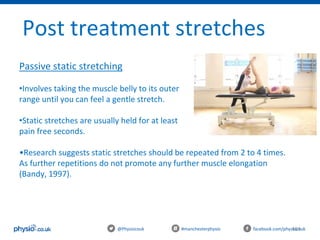
Post treatment stretches
Passive static stretching
•Involves taking the muscle belly to its outer
range until you can feel a gentle stretch.
•Static stretches are usually held for at least 30
pain free seconds.
•Research suggests static stretches should be repeated from 2 to 4 times.
As further repetitions do not promote any further muscle elongation
(Bandy, 1997).
Practical:
Tool and other STR techniques
@Physiocouk #manchesterphysio facebook.com/physiocouk
Supporting Evidence:
Other STR techniques
@Physiocouk #manchesterphysio facebook.com/physiocouk
Therapeutic evaluation of lumbar tender point deep massage
for chronic non-specific low back pain
@Physiocouk #manchesterphysio facebook.com/physiocouk
Zheng et al, 2012
•Aim: To investigate the effects of lumber traction along and in combination with deep
tissue massage in patients with chronic low back pain.
•Method: 64 patients with LBP were divided to two groups A) lumber traction and deep
tissue massage or B) lumber traction who both received treatment twice a week for 3
weeks.
•Outcome measures: tissue hardness meter/algometer and VAS pain scores.
•Results: Patients receiving deep tissue massage and traction experienced significant
decreases in muscle hardness and pain intensity when compared to those who received
lumber traction alone.
•Link: http://www.sciencedirect.com/science/article/pii/S0254627213600667
Massage therapy as an effective treatment for carpal tunnel
syndrome
@Physiocouk #manchesterphysio facebook.com/physiocouk
Elliott and Burkett, 2013
•Aim: To investigate the effects of massage therapy as the
treatment for carpal tunnel syndrome.
•Method: 21 participants received 30 min of massage including
trigger point therapy twice a week for 6 weeks.
•Outcome measures: Carpel tunnel questionnaires, Phalen and
Tinel test assessment.
•Results: Participants experienced a significant reduction in
symptom severity and improvements in physical function.
•Link:
http://www.sciencedirect.com/science/article/pii/S1360859212002434
Case Studies
@Physiocouk #manchesterphysio facebook.com/physiocouk
Case Study: Shoulder
pain
@Physiocouk #manchesterphysio facebook.com/physiocouk
PC/HPC -21 year old female with an gradual onset of ache pain in shoulders over
past 1/12 rating 4/10 on VAS scale. The pain is aggravated by sitting at a desk for
long hours and eased with the application of heat.
SH- final year art student with a sudden increase in workload as final project is
due in 2/12. Carry heavy art portfolio to and from university. Attends a LBP class
at the gym 1 x a month.
PMH- nil to note
DH- paracetamol when needed
Case Study: Shoulder
pain
@Physiocouk #manchesterphysio facebook.com/physiocouk
Objective signs
• Increased UFT tone
• Reduced cervical lateral flexion due to UFT tightness
• TOP of L and R UFT and Rhomboids
• Active Trigger points in R and L Rhomboids
• No neurological symptoms
Case Study: Shoulder
pain
@Physiocouk #manchesterphysio facebook.com/physiocouk
Case Study: Lower back pain
@Physiocouk #manchesterphysio facebook.com/physiocouk
PC/HPC – 39 year old male 8/10 sharp pain in R lower back. Pain began suddenly
when after lifting heavy box up which sent shooting pains down R leg. Aggravated
by bending down and putting shoes on and eased by lying down flat.
SH- full time receptionist, doesn’t perform regular exercise.
PMH- history of lower back pain
DH- analgesics
Case Study: Lower back pain
@Physiocouk #manchesterphysio facebook.com/physiocouk
Objective signs
•Limited Lumber range of movement
•Increase in pain during flexion and L lateral flexion
•Pain eased during extension.
•PALP – pain on palp of QL and L3 spinous process
Case Study: Lower back pain
@Physiocouk #manchesterphysio facebook.com/physiocouk
Case Study: Calf pain
@Physiocouk #manchesterphysio facebook.com/physiocouk
PC/HPC – 35 year old male runner. Felt a 6/10 sharp pain in R calf towards
the end of a 5K run 2/52 ago. Had to stop running. No swelling or bruising
was present. Pain reduced since 3/10 ache pain, tried running again but still
feels painful.
SH- work in a warehouse, on feet all day up and down ladders.
PMH- prev R lateral ankle sprain 12/12 ago
DH-nil to note
Case Study: Calf pain
@Physiocouk #manchesterphysio facebook.com/physiocouk
Objective signs
•Increased calf bulk L side
•Thickening of R Achilles tendon
•Reduced dorsiflexion of R ankle
•Reduce muscular strength in R resisted plantarflexion
•Reduced R calf length
•PALP- pain on palp of medial gastroc
•-ve Thomas test
Case Study: Calf pain
@Physiocouk #manchesterphysio facebook.com/physiocouk
Case Study: Buttock pain
@Physiocouk #manchesterphysio facebook.com/physiocouk
PC/HPC- 25 year old male 5/10 pain in L buttock. 1/12 ago increased pain
following legs gym session, gradually worsening since. Aggravated by
climbing multiple flights of stairs at work. Eased by resting.
SH- Started going to the gym 1/12 ago after a 5 year break. Doesn’t do any
stretching because he doesn’t know how to. Works on the 8th floor of a
office building.
PMH- over pronate both feet, especially bad in L side.
DH- nil to note
Case Study: Buttock pain
@Physiocouk #manchesterphysio facebook.com/physiocouk
Objective signs
•Over pronation in L > R foot
•Valgus position of knees
•Poor hamstring flexibility on 90/90 test in L>R legs
•No neurological symptoms during SLR
•PALP: tension L>R hamstring, glutes and piriformis
•Very tender on PALP of piriformis
Case Study: Buttock pain
@Physiocouk #manchesterphysio facebook.com/physiocouk
Diagnosis?
How would treat this?
Quiz…
Answers
@Physiocouk #manchesterphysio facebook.com/physiocouk
Question 1
@Physiocouk #manchesterphysio facebook.com/physiocouk
What is a trigger point?
• Trigger points are hyperirritable areas of contracted muscle
fibres that form a palatable nodule
• On a microscopic level, the contracted muscle fibres accumulate
into a small thickened area causing the rest of the fibre to
stretch
• The areas of contracted muscle restrict blood flow within the
tissue causing an accumulation of waste products and reduced
levels of nutrients available.
Question 2
@Physiocouk #manchesterphysio facebook.com/physiocouk
How would a patient describe trigger point pain?
• Dull ache
• Deep
• Sharp
• Pressing pain
• Stabbing
• Burning
• Travelling pain
• Head pain
Question 3
@Physiocouk #manchesterphysio facebook.com/physiocouk
Name some indications for Trigger point therapy
• Pain
• Reduced AROM
• High muscle tension or tone
• Muscle tightness
Question 4
@Physiocouk #manchesterphysio facebook.com/physiocouk
Name some benefits of Trigger point therapy
•Reduced pain
• Increased range of motion
• Decreased muscle stiffness and tension
• Reduction in headaches
• Improved flexibility
• Improved circulation
• Fewer muscle spasms
Question 5
@Physiocouk #manchesterphysio facebook.com/physiocouk
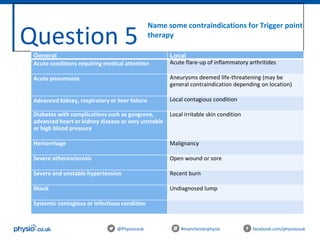
Name some contraindications for Trigger point
therapy
General Local
Acute conditions requiring medical attention Acute flare-up of inflammatory arthritides
Acute pneumonia Aneurysms deemed life-threatening (may be
general contraindication depending on location)
Advanced kidney, respiratory or liver failure Local contagious condition
Diabetes with complications such as gangrene,
advanced heart or kidney disease or very unstable
or high blood pressure
Local irritable skin condition
Hemorrhage Malignancy
Severe atherosclerosis Open wound or sore
Severe and unstable hypertension Recent burn
Shock Undiagnosed lump
Systemic contagious or infectious condition
Question 6
@Physiocouk #manchesterphysio facebook.com/physiocouk
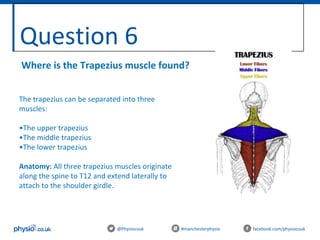
Where is the Trapezius muscle found?
The trapezius can be separated into three
muscles:
•The upper trapezius
•The middle trapezius
•The lower trapezius
Anatomy: All three trapezius muscles originate
along the spine to T12 and extend laterally to
attach to the shoulder girdle.
Question 7
@Physiocouk #manchesterphysio facebook.com/physiocouk
Where is the Sternocleomastoid muscle
found?
Anatomy:
● Originates from the mastoid process.
● The sternal division runs diagonally downward to attach
to the sternum.
● The clavicular division attaches right behind it on the
medial clavicle.
Question 8
@Physiocouk #manchesterphysio facebook.com/physiocouk
What muscle group does
Vastuslateralis belong to?
The quadriceps muscular group.
Anatomy:
•Vastus lateralis originates lateral aspect of the
superior femur bone and runs down the outside
of the thigh to attach to the lateral aspect of the
patella.
128
Thanks for coming!
Don’t forget to follow us on Twitter: @physiocouk
@Physiocouk #manchesterphysio facebook.com/physiocouk

Trigger point presentation workshop 01.04.17

  • 1.
  • 2.
    * 2 Welcome Trigger pointtherapy & soft tissue release for sports and massage therapists With Louise Rigby and Zoe Killian @Physiocouk #manchesterphysio facebook.com/physiocouk
  • 3.
    3 @Physiocouk #manchesterphysio facebook.com/physiocouk Whoare we? Louise’s LinkedIn: www.linkedin.com/louise-rigby Twitter: @LouPhysiocouk Zoe’s LinkedIn: www.linkedin.com/in/zoe-killian Twitter: @ZoePhysiocouk
  • 4.
    4 @Physiocouk #manchesterphysio facebook.com/physiocouk Let’sconnect Website: www.physio.co.uk / Massage.physio.co.uk Twitter: @physiocouk Facebook: www.facebook.com/physiocouk
  • 5.
    Aims of today @Physiocouk#manchesterphysio facebook.com/physiocouk ✓ Learn the theory of a trigger point ✓ Learn the theory of trigger point therapy ✓ Practice the trigger point technique to muscle groups ✓ Use other soft tissue release techniques along side TP release
  • 6.
    Itinerary @Physiocouk #manchesterphysio facebook.com/physiocouk 10.00- 10.30 - Induction / Arrival 10.30 - 10.50 - Quiz – What do you know about trigger point therapy 10.50 -11.30 - Theory: Trigger point therapy 11.30 -12.00 - Indications/ outcome measures 12.00 - 12.30 - Lunch 12.30 - 13.00 - Theory: Trigger pointing technique 13.00 - 14.00 - Practical: Muscle groups 14.00 - 14.30 – Practical: Tools & other STR techniques 14.30 - 15.00 - Case Studies/Quiz answers
  • 7.
    Quiz…What do youknow about trigger point therapy? @Physiocouk #manchesterphysio facebook.com/physiocouk
  • 8.
    Question 1 @Physiocouk #manchesterphysiofacebook.com/physiocouk What is a trigger point?
  • 9.
    Question 2 @Physiocouk #manchesterphysiofacebook.com/physiocouk How would patients describe Trigger Point pain?
  • 10.
    Question 3 @Physiocouk #manchesterphysiofacebook.com/physiocouk Name some indications for Trigger Point Therapy?
  • 11.
    Question 4 @Physiocouk #manchesterphysiofacebook.com/physiocouk Name 3 benefits of Trigger Point Therapy
  • 12.
    Question 5 @Physiocouk #manchesterphysiofacebook.com/physiocouk Name some contraindications for Trigger Point Therapy
  • 13.
    Question 6 @Physiocouk #manchesterphysiofacebook.com/physiocouk Where is the Trapezius muscle found?
  • 14.
    Question 7 @Physiocouk #manchesterphysiofacebook.com/physiocouk Where is the Sternocleidomastoid muscle found?
  • 15.
    Question 8 @Physiocouk #manchesterphysiofacebook.com/physiocouk What muscle group does Vastus Lateralis belong to?
  • 16.
    Theory: Trigger Point Therapy @Physiocouk#manchesterphysio facebook.com/physiocouk
  • 17.
    What are triggerpoints? @Physiocouk #manchesterphysio facebook.com/physiocouk • Trigger points are hyperirritable areas of contracted muscle fibres that form a palatable nodule • On a microscopic level, the contracted muscle fibres accumulate into a small thickened area causing the rest of the fibre to stretch • The areas of contracted muscle restrict blood flow within the tissue causing an accumulation of waste products and reduced levels of nutrients available.
  • 18.
    Brief History @Physiocouk #manchesterphysiofacebook.com/physiocouk • 1930s -Dr Hans Lange used sclerometer to prove that tender areas in muscles are 50% harder than surrounding areas. • 1940s- Janet Travell developed trigger point injection therapy and termed the “tender areas” described by Dr Hans “Trigger points”. • Travell's therapy called for the injection of saline (a salt solution) and procaine (also known as Novocaine, an anesthetic) into the trigger point. • Travell mapped what she termed the body's trigger points and the manner in which pain radiates to the rest of the body. • Travell's work came to national attention when she treated President John F. Kennedy for his back pain. • Travell co-authored several books with David Simons which are considered the definitive reference for trigger point therapy. • Travell & Simons' Myofascial Pain and Dysfunction: Upper half of body • Travell & Simons' Myofascial Pain and Dysfunction: The Trigger Point Manual • Myofascial Pain and Dysfunction: The Trigger Point Manual, Volume 2
  • 19.
    Brief History @Physiocouk #manchesterphysiofacebook.com/physiocouk • 1976- Bonnie Prudden, a physical fitness and exercise therapist developed Travells trigger point therapy. She found that applying sustained pressure to a trigger point using thumbs, knuckles and elbows produced superior results to those treated with injections when followed by corrective movements and stretching. Prudden later went on to author two books: • Myotherapy: Bonnie Prudden’s Complete Guide to Pain Free Living • Pain Erasure the Bonnie Prudden Way
  • 20.
    Different types oftrigger points @Physiocouk #manchesterphysio facebook.com/physiocouk • Trigger points are described according to location, tenderness and chronicity. • The main types of trigger points are: • Central/ primary trigger points • Satellite/ secondary trigger points • Active trigger points • Latent trigger points
  • 21.
    Central/ primary triggerpoints @Physiocouk #manchesterphysio facebook.com/physiocouk • These are the most well-established and painful points • Pain is felt by the individual when they are active, and are usually what people refer to when they talk about trigger points • Central trigger points exist at a neuromuscular point, which is the meeting place of a nerve and muscle
  • 22.
    Satellite/ secondary triggerpoints @Physiocouk #manchesterphysio facebook.com/physiocouk • These trigger points are “created” as a response to the central trigger point in neighbouring muscles that lie within the referred pain zone. • The primary trigger point is still the key to trigger pointing intervention: the satellite trigger points often resolve once the primary point has been effectively rendered inactive. • Satellite points may also prove unresponsive to treatment until the primary central focus is weakened. This is often the case in the paraspinal and/or abdominal muscles.
  • 23.
    Active trigger points @Physiocouk#manchesterphysio facebook.com/physiocouk • This can apply to central and satellite trigger points. • A variety of stimulants, such as forcing muscular activity through pain, can activate an inactive trigger point. • This situation is common when activity is increased after trauma i.e a road traffic accident, where multiple and diffuse trigger points may have developed. • This trigger point is both tender to palpation and elicits a referred pain pattern. • Pain can limit range of movement
  • 24.
    Latent/Inactive trigger points @Physiocouk#manchesterphysio facebook.com/physiocouk • This applies to lumps and nodules that feel like trigger points. These can develop anywhere in the body and are often secondary. • These trigger points are not painful, and do not elicit a referred pain pathway. • The presence of inactive trigger points within muscles may lead to increased muscular stiffness and tension. They can build up for years. • It has been suggested that these points are more common in those who live a sedentary lifestyle (Starlanyl & Copeland 2001) • These points are “potential” trigger points and may reactivate if the central or primary trigger point is (re)stimulated • Reactivation may occur following trauma and injury
  • 25.
    Symptoms of TriggerPoints @Physiocouk #manchesterphysio facebook.com/physiocouk Active trigger point referral symptoms •Dull ache •Deep •Pressing pain •“Stabbing” •Burning •Referred pain •Common reports of headaches, dizziness and pins and needles
  • 26.
    Referral Pain Guide Sternocleomastoidand Masseter @Physiocouk #manchesterphysio facebook.com/physiocouk
  • 27.
    Referral Pain Guide Trapezuis @Physiocouk#manchesterphysio facebook.com/physiocouk
  • 28.
    Referral Pain Guide Pectorals @Physiocouk#manchesterphysio facebook.com/physiocouk
  • 29.
    Referral Pain Guide QuadratusLumborum @Physiocouk #manchesterphysio facebook.com/physiocouk
  • 30.
    Referral Pain Guide Piriformis @Physiocouk#manchesterphysio facebook.com/physiocouk
  • 31.
    Referral Pain Guide Glutemaximus, medius and minimus @Physiocouk #manchesterphysio facebook.com/physiocouk
  • 32.
    Referral Pain Guide TFL @Physiocouk#manchesterphysio facebook.com/physiocouk
  • 33.
    Referral Pain Guide VastusLateralis @Physiocouk #manchesterphysio facebook.com/physiocouk
  • 34.
    Referral Pain Guide Hamstrings @Physiocouk#manchesterphysio facebook.com/physiocouk
  • 35.
    Other Symptoms @Physiocouk #manchesterphysiofacebook.com/physiocouk A sensation of: •Numbness •Fatigue •Weakness A loss of: •Flexibility •Range of movement •Muscular power and strength
  • 36.
    Why are theypresent? @Physiocouk #manchesterphysio facebook.com/physiocouk • Repetitive overuse injuries (using the same body parts in the same way hundreds of times on a daily basis) from activities such as typing/mousing, handheld electronics, gardening, home improvement projects, work environments, etc. • Sustained loading e.g heavy lifting, carrying babies, briefcases, boxes or lifting bedridden patients.
  • 37.
    Why are theypresent? @Physiocouk #manchesterphysio facebook.com/physiocouk •Poor posture due to our sedentary lifestyles, de-conditioning, poorly designed furniture and technology. •Muscle clenching and tensing due to mental/emotional stress. •Direct injury such as a strain, break, twist or tear e.g car accidents, sports injuries, falling down stairs. •Trigger points can even develop due to inactivity such as prolonged bed rest or sitting .
  • 38.
    Formation of aTrigger point @Physiocouk #manchesterphysio facebook.com/physiocouk • Deep within muscles are spiral shaped nerve fibres called muscle spindles. • When muscles are excessively stretched muscle spindles activate and send signals to the brain to promote a protective muscular contraction- stretch reflex arc.
  • 39.
    Formation of aTrigger point @Physiocouk #manchesterphysio facebook.com/physiocouk • The problem occurs when the muscle spindle becomes sensitised. • Injury or overuse can over stimulate muscle spindles which can cause contraction within the muscle and subsequently forming localised muscular spasm…. A Trigger point.
  • 40.
    Formation of aTrigger point @Physiocouk #manchesterphysio facebook.com/physiocouk • Prolonged muscular contractions restrict blood flow through the area. • This causes a build-up of waste products and toxins within the area and a reduction in fresh, nutritious blood flowing through. • If the muscle spindle is active for prolonged periods of time the length of the muscle can shorten. • Subsequently patients may experience a reduction in ROM.
  • 41.
    Where are theyformed? @Physiocouk #manchesterphysio facebook.com/physiocouk • Trigger points are found all over the body. . • Trigger points are located within each sarcomere often where the nerve enters the muscle. • The motor end plate.
  • 42.
    Trigger point pain @Physiocouk#manchesterphysio facebook.com/physiocouk • Chemoreceptors and mechanoreceptors are stimulated to send messages to the brain which results in the sensation of pain. • The brain stimulates decreased movement into these muscles which further tightens the structure.
  • 43.
    Indications and Outcome Measures @Physiocouk#manchesterphysio facebook.com/physiocouk Indications Outcome measures Pain NRS scale & subjective symptoms Reduced AROM Active range of movement Muscle tightness Palpation Muscle weakness Oxford rating scale
  • 44.
    44@Physiocouk #manchesterphysio facebook.com/physiocouk Outcomemeasure: Numerical rating scale • Simple and easy • Before, during and after massage • Record change • Use with patient to see reduction in pain over the progression of treatments
  • 45.
    45@Physiocouk #manchesterphysio facebook.com/physiocouk Outcomemeasure: Range of movement • Pre and post measurements • Goniometer or visual • Standardise to produce reliable results • Review each session • Used to distinguish areas to treat and techniques types • Valuable in the success of treatment
  • 46.
    46@Physiocouk #manchesterphysio facebook.com/physiocouk Outcomemeasure: Muscle testing • Measure nerve conduction and muscle recruitment. • Compare both sides. • If strengthening exercises are used alongside massage treatment patients will be able to feel a progression here.
  • 47.
    47@Physiocouk #manchesterphysio facebook.com/physiocouk Outcomemeasure: Palpation Use palpation as a measure using “the four T’s” • Temperature Is the tissue hot? This could indicate presence of inflammation. ● Texture Swelling (acute-hard, chronic – “boggy”, congested) healthy tissues should have an even texture Adhesions feel like tissues are “stuck” and less mobile “audible crunching”.
  • 48.
    48@Physiocouk #manchesterphysio facebook.com/physiocouk Outcomemeasure: Palpation ● Tenderness Pain can be indicated through response. NRS can be used here. ● Tone Tissues may be tense, always compare to other side to see what is normal for the patient.
  • 49.
  • 50.
    Theory: Trigger Pointing Therapy @Physiocouk#manchesterphysio facebook.com/physiocouk
  • 51.
    How to treata Trigger Point @Physiocouk #manchesterphysio facebook.com/physiocouk Assessment •Find the most painful TP using patient response and Numeric Rating Scale. •Treat the highest rated point and radiate out from this point •Once the points are found – a good amount of pressure is applied (perform with precaution - keep communication with patient) •Initial pain is stimulated and you hold the pressure until the pain has eased completely or in some cases reduced slightly •Re-apply pressure onto the same point until the pain eases off quicker or it isn’t felt anymore (roughly 3 times) •Thumbs/elbows or tools can be used
  • 52.
    How to treata Trigger Point @Physiocouk #manchesterphysio facebook.com/physiocouk Guidelines Application of direct pressure onto the trigger points for around 30 seconds or until the patient’s pain has decreased to at least 3/10 NRS score. The applied pressure help to break-up the adhesive fibre connections within the trigger points and push out blood containing waste products and toxins. After 30 seconds, the pressure is released allowing a rush of fresh blood containing nutrients to circulate the trigger point. Repeat 3 times in conjunction with deep massage strokes. This can vary on the severity of pain/ how deep or superficial the TP is – subjective and variable to each patient
  • 53.
    The Benefits @Physiocouk #manchesterphysiofacebook.com/physiocouk • Reduced pain • Increased range of motion • Decreased muscle stiffness and tension • Reduction in headaches • Improved flexibility • Improved circulation • Fewer muscle spasms
  • 54.
    Precautions @Physiocouk #manchesterphysio facebook.com/physiocouk •High pain scales • Patient Anxiety • Acute/ Inflammatory stage of healing • Hypersensitivity • Pregnancy • Epilepsy • Asthma • Hypertension • Prescribed medication
  • 55.
    Contraindications @Physiocouk #manchesterphysio facebook.com/physiocouk GeneralLocal Acute conditions requiring medical attention Acute flare-up of inflammatory arthritides Acute pneumonia Aneurysms deemed life-threatening (may be general contraindication depending on location) Advanced kidney, respiratory or liver failure Local contagious condition Diabetes with complications such as gangrene, advanced heart or kidney disease or very unstable or high blood pressure Local irritable skin condition Hemorrhage Malignancy Severe atherosclerosis Open wound or sore Severe and unstable hypertension Recent burn Shock Undiagnosed lump Systemic contagious or infectious condition
  • 56.
    Manual Handling andBody Position @Physiocouk #manchesterphysio facebook.com/physiocouk • Posture – Bed height – Stance – Patient position • Use different parts of your hands/ arms to apply pressure • Keep arms straight to utilise body weight when applying pressure/resistance. • Move from the hips and knees as much as possible • Oil (or cream)- only needs to be a little bit, if any. Look after yourself before you look after the patient!
  • 57.
    Post Treatment Irritation @Physiocouk#manchesterphysio facebook.com/physiocouk Very common for people to experience irritation for up to 72 hours after treatment. Side effects can include: • Bruising • Redness • Tenderness/Increased Sensitivity • Increased symptoms • Aching similar to DOMS
  • 58.
    Post Treatment Irritation @Physiocouk#manchesterphysio facebook.com/physiocouk Causes • The release of toxins/waste products from muscular tissue • Neurological sensitisation • Increased blood flow and micro trauma can lead to bruising and redness Advice •Reassure the patient it's a normal response to be sore after soft tissue treatment •Recommend they drink water to keep hydrated
  • 59.
    Practical: Trigger pointing muscles @Physiocouk#manchesterphysio facebook.com/physiocouk • UFT • Sternocleomastoid • Rhomboids • QL • TFL • Vastus Lateralis • Gastrocnemius
  • 60.
    Trapezius @Physiocouk #manchesterphysio facebook.com/physiocouk Thetrapezius can be separated into three muscles: •The upper trapezius •The middle trapezius •The lower trapezius Anatomy: All three trapezius muscles originate along the spine to T12 and extend laterally to attach to the shoulder girdle. Function: Each muscle has a different direction of pull. Movements facilitated include scapula elevation, depression, retraction, upwards and downward rotation.
  • 61.
    Trapezius @Physiocouk #manchesterphysio facebook.com/physiocouk Thewhole trapezius muscle creates various movements of the shoulder blade, neck, and head. To move your arm above your head you need muscular contraction pulling in opposite directions. Muscular contraction in both lower and upper fibre traps to upwardly rotate the scapula. This type of complexity makes it easy for trigger point activity to spread quickly through the muscle group as a whole.
  • 62.
    Trapezius Trigger Points @Physiocouk#manchesterphysio facebook.com/physiocouk Four primary trigger points in the trapezius muscle group; two trigger points in the upper fibers, and one each in the middle and lower fibers. • The anterior trapezius trigger point • The upper trapezius trigger point • The middle trapezius trigger point • The lower trapezius trigger point
  • 63.
    Trapezius Pain @Physiocouk #manchesterphysiofacebook.com/physiocouk Causes ● Poor posture- shoulders, neck and back ● Stress ● Carrying heavy handbags/ laptop bags on one side ● Dysfunction/ pathology within the shoulder complex Symptoms ● Ache and tightness in shoulders and neck ● Tension headaches ● Upper cross syndrome ● Struggle to look over shoulder
  • 64.
    RX: UFT @Physiocouk #manchesterphysiofacebook.com/physiocouk • Tip: squeezing UFT between finger and thumb can be very effective with upper and anterior trigger points.
  • 65.
    Sternocleomastoid @Physiocouk #manchesterphysio facebook.com/physiocouk Anatomy: ●Originates from the mastoid process. ● The sternal division runs diagonally downward to attach to the sternum. ● The clavicular division attaches right behind it on the medial clavicle. Function: ● Turn head towards opposite side and bilaterally side flex the neck. ● Control and monitor the head’s position in space. Proprioceptive feedback from the SCM is essential to being able to maintain one’s balance.
  • 66.
    Sternocleomastoid Trigger Points @Physiocouk#manchesterphysio facebook.com/physiocouk • The sternal division typically has 3-4 trigger points spaced out along its length, while the clavicular division has 2-3 trigger points. • Trigger points are usually present in both left and right SCM muscles as they work together to control the head.
  • 67.
    Sternocleomastoid Pain @Physiocouk #manchesterphysiofacebook.com/physiocouk Each SCM division has a separate and distinct referred pain pattern: • The sternal division’s referred pain is felt deep in the eye socket (behind the eye), above the eye, in the cheek region, in the back of the head, and on the top of the head. • The clavicular division’s referred pain is felt in the forehead, deep in the ear, behind the ear, and in the molar teeth on the same side. Causes/ symptoms: •Sore Neck •Tension Headaches •“Heavy head” •Poor head posture •Poor exercise technique (sit ups)
  • 68.
    RX: Sternocleomastoid @Physiocouk #manchesterphysiofacebook.com/physiocouk • Locating and releasing these trigger points can be complicated due to their proximity to many blood vessels and nerves in the neck region. • Caution: do not massage somewhere you can feel a pulse. • Tip: Rotate head to side to find muscle but rotate back to neutral to treat.
  • 69.
    Rhomboids @Physiocouk #manchesterphysio facebook.com/physiocouk Anatomy: ●The rhomboid muscle group originates from the spinous process of C6-T4 and inserts onto the medial border of the scapula. ● It is separated into rhomboid major and rhomboid minor muscles. Function: ● scapula retraction and slight elevation
  • 70.
    Rhomboid Trigger Points @Physiocouk#manchesterphysio facebook.com/physiocouk 3 primary trigger points • The rhomboid minor trigger point lies just medial to the inside edge of the scapula, level with the scapular spine. • The rhomboid major trigger points lie one above the other, along the lower part of the scapular border. •Referred Pain: The pain concentrates in the region between the spine and the shoulder blade.
  • 71.
    Rhomboid Pain @Physiocouk #manchesterphysiofacebook.com/physiocouk Causes •Poor posture •Rhomboid weakness •Scapular instability •Winging scapula Symptoms: •Pain Between the Shoulder Blades •Pain is usually felt at rest and not typically affected my movement. •Patients may hear snapping or grinding noises from the region around the shoulder blade during movements of the arm.
  • 72.
    RX: Rhomboids @Physiocouk #manchesterphysiofacebook.com/physiocouk ● Make sure that you have released any trapezius trigger points first otherwise they may block you from reaching rhomboid trigger points. ● Try in both prone lying and side lying position. Tips: • Placing hand behind back can help to lift scapula out of the way. • Side-lying position to allow more forward movement of the scapula. • Prone to allow more pressure to be applied.
  • 73.
    Have a go! @Physiocouk#manchesterphysio facebook.com/physiocouk
  • 74.
    QL – QuadratusLumborum @Physiocouk #manchesterphysio facebook.com/physiocouk Anatomy: • Originates from the iliac crest and runs upwards and medially to attach onto the 12th rib and transverse process of L1-L4. Function: • Stabilise movement of spine and pelvis. • Control a upright posture. • Produce extension and side flexion of the lumbar spine.
  • 75.
    QL Trigger points @Physiocouk#manchesterphysio facebook.com/physiocouk • If one muscle develops trigger point activity, the muscle on the other side will become overloaded and develop trigger points as well. • From a clinical perspective, you should always address the trigger points in both the left and right QL muscles, even if the pain is limited only to one side.
  • 76.
    QL Trigger points @Physiocouk#manchesterphysio facebook.com/physiocouk There are four potential trigger points in the QL muscle: • The upper QL trigger point is found just lateral to where the lumbar paraspinal muscles and the twelfth rib meet. •The middle or deep QL trigger points lie closer to the spine next to the third and fourth lumbar vertebrae. •The lower QL trigger point lies deep in the region where the paraspinal muscles meet the iliac crest.
  • 77.
    QL Pain @Physiocouk #manchesterphysiofacebook.com/physiocouk Causes ● Carrying children on hip ● Sitting with poor posture for prolonged periods of time ● Poor manual handling technique ● Poor workstation ergonomics Symptoms: • Usually described as an intense, deep ache • Occasionally can produce a sharp, knifelike symptoms particularly during movement. • Ache pain into small of back. • Pain when bending down.
  • 78.
    RX: QL @Physiocouk #manchesterphysiofacebook.com/physiocouk • The first step in the effective treatment of the QL trigger points is being able to accurately locate and contact the trigger points. • Try in both Prone and a extended side- lying position. • Tips: Angle inwards towards spine rather than directly posterior.
  • 79.
    TFL - TensorFasciae Latae @Physiocouk #manchesterphysio facebook.com/physiocouk Anatomy: •Originates from outer aspect of the Iliac Crest and Anterior Superior Iliac Spine (A.S.I.S) it runs through illiotibial band which inserts onto lateral epicondyle of tibia. Function: • Its function is primarily to control movement of the leg during the stance phase of walking. •Assist with hip abduction, flexion and internal rotation on the hip.
  • 80.
    TFL Trigger Point @Physiocouk#manchesterphysio facebook.com/physiocouk • There is only one trigger point found in the TFL and it is located in the upper region of the muscle just below where it attaches to the A.S.I.S. • The referred pain pattern covers the entire hip joint and extends down the outside aspect of the thigh, sometimes nearly to the knee joint.
  • 81.
    TFL Pain @Physiocouk #manchesterphysiofacebook.com/physiocouk Causes •Over foot pronation •Valgus knee position •Weakness in gluteus/ trendelenburg sign •Poor squatting/ lunging techniques •Poor landing biomechanics Symptoms: • Pain in the hip joint (greater trochanter) and down the outside thigh during movement of the hip. • Pain when sitting in low chair or flex their hip more than 90°. • Unable to lie on the affected hip during sleep and unable to lie on the unaffected side during sleep without a pillow between their knees. • Pain and limited ROM in hip adduction.
  • 82.
    RX: TFL @Physiocouk #manchesterphysiofacebook.com/physiocouk Tips: Find ASIS drop fingers down and laterally. • If struggling can ask pt to flex and medially rotate hip joint to feel contraction.
  • 83.
    Vastus Lateralis @Physiocouk #manchesterphysiofacebook.com/physiocouk Location: The quadriceps femoris muscle group form the thigh musculature found on the front of the upper leg. The group is comprised of four muscles: • The Vastus Lateralis • The Rectus Femoris • The Vastus Medialis • The Vastus Intermedius
  • 84.
    Vastus Lateralis @Physiocouk #manchesterphysiofacebook.com/physiocouk Anatomy: •Vastus lateralis originates lateral aspect of the superior femur bone and runs down the outside of the thigh to attach to the lateral aspect of the patella. Function: •The vastus lateralis is the largest muscle in the group. •Contraction of this muscle produces extension of the lower leg at the knee. •Helps to stabilise the patella in patellofemoral groove.
  • 85.
    Vastus Lateralis TriggerPoints @Physiocouk #manchesterphysio facebook.com/physiocouk There are two sets of trigger points in the vastus lateralis muscle: • The upper vastus lateralis trigger points are located in mid-thigh region on the outside aspect of the leg. They refer pain all along the outside of the thigh and knee. • The lower vastus lateralis trigger points are found just above and to the outside of the knee joint. They refer pain around the outside aspect of the knee joint and below it.
  • 86.
    Vastus Lateralis Pain @Physiocouk#manchesterphysio facebook.com/physiocouk Causes ● Weakness in gluteus ● Over pronated feet ● Valgus knee position ● Overload from gym routine ● Skiing activities Symptoms: ● Pain on outside of thigh ● Pain into and behind the knee ● Pain on resisted knee extension ● Anterior knee pain ● Stuck patella ● Crepitus ● functional limitations.
  • 87.
    RX: Vastus Lateralis @Physiocouk#manchesterphysio facebook.com/physiocouk Tips: try sliding thumbs up the outside of thigh until you feel the resistance of the trigger points.
  • 88.
    Gastrocnemius @Physiocouk #manchesterphysio facebook.com/physiocouk Anatomy: ●Largest muscle in the calf ● Originates from the achilles tendon and splits into two heads to attach onto the medial and lateral condyles of the femur. Function: ● plantarflexion of the foot and assists with knee flexion.
  • 89.
    Gastrocnemius trigger points @Physiocouk #manchesterphysiofacebook.com/physiocouk Gastrocnemius may contain up to four trigger points. •Two medial trigger points found in the medial head. One just below the knee crease and the other an inch down. •Two lateral trigger points mirror the medial trigger points except they are slightly more distal.
  • 90.
    Gastrocnemius Pain @Physiocouk #manchesterphysiofacebook.com/physiocouk Causes •Prolonged wearing of high heels can leave gastroc in a shortened position •Achilles tendinopathy •foot pronation •Sudden increases in training programmes •Prolonged immobilisation e.g. cast •Sleeping on front for prolonged periods Symptoms •Pain in calf •Pain behind the knee •Pain when standing on top toes •Pain going upstairs •Suffer from calf cramp regularly
  • 91.
    RX: Gastrocnemius @Physiocouk #manchesterphysiofacebook.com/physiocouk • Tip: try using your elbow to trigger point.
  • 92.
    Have a go! @Physiocouk#manchesterphysio facebook.com/physiocouk
  • 93.
  • 94.
    Effectiveness of MyofascialTrigger Point Manual Therapy Combined With a Self- Stretching Protocol for the Management of Plantar Heel Pain: A Randomized Controlled Trial @Physiocouk #manchesterphysio facebook.com/physiocouk Renan-Ordine et al, (2011) •Aim: to assess the effect of trigger point therapy and stretching or stretching alone in the treatment for plantar heel pain. •Method: 60 patients with plantar heel pain were divided into 2 groups a)self-stretching b) self- stretching and trigger point therapy. •Outcome measures: assessed at baseline and at a 1-month follow up. – Physical function and pain assessed using a quality of life questionnaire. – pressure pain thresholds were assessed over affected gastroc, soleus muscles and over the calcaneus using a mechanical pressure algometer. •Results: trigger point therapy and self-stretching is superior to stretching alone in the treatment of patients with plantar heel pain. •Link: http://www.jospt.org/doi/full/10.2519/jospt.2011.3504
  • 95.
    Comparative study oneffects of manipulation treatment and transcutaneous electrical nerve stimulation on patients with cervicogenic headache @Physiocouk #manchesterphysio facebook.com/physiocouk Li et al, (2007) •Aim: To compare the effects of trigger pointing and transcutaneous electrical nerve stimulation (TENS) on patients with cervicogenic headache. •Method: 70 patients with cervicoigenic headaches were randomly allocated to receive trigger pointing or TENS every other day for 40 days. •Outcome measures: Taken 2 weeks pre-treatment and 4 weeks post-treatment. – headache degree, frequency and lasting time using a numeric rating scale – ROM of cervical spine. •Results: Trigger pointing was superior to TENS in headache frequency, lasting time and ROM scores. Response rate of trigger pointing treatment was 94.5%, significantly higher than 64.5% of TENS treatment. •Link: http://europepmc.org/abstract/med/17631795
  • 96.
    Immediate effect ofactivator trigger point therapy and myofascial band therapy on non-specific neck pain in patients with upper trapezius trigger points compared to sham ultrasound: A randomised controlled trial @Physiocouk #manchesterphysio facebook.com/physiocouk Blikstad and Gemmell, (2007) •Aim: To determine the immediate effect of activator trigger point therapy and myofascial band therapy compared to sham ultrasound on non-specific neck pain •Method: 45 patients with non-specific neck pain of at least 4 on an 11-point numerical rating scale and upper trap trigger points, decreased cervical lateral flexion away from the active trigger points participated. Participants were assigned to one of three treatment groups; trigger point therapy, myofascial band therapy or sham ultrasound. •Outcome measures: assessed before and 5 min after treatment – pain levels assessed using numerical scale – cervical ROM using goniometer – pain perceived thresholds using pain pressure algometer. •Results: For the primary outcome measure of pain reduction the odds of a patient improving with activator trigger point therapy was 7 times higher than a patient treated with myofascial band therapy or sham ultrasound. •Link: http://www.sciencedirect.com/science/article/pii/S1479235407001083
  • 97.
    The use ofother STR @Physiocouk #manchesterphysio facebook.com/physiocouk •Helps warm up an area •Removes waste products •Increases oxygenation •Increases new blood flow •Further breaks down collagen •Helps sooth an area after deep pressure has been applied •Nice, relaxing end to a treatment
  • 98.
    98@Physiocouk #manchesterphysio facebook.com/physiocouk Effleurage •Technique used to warm up or warm down the tissues • Tensile force, works as a mechanical pump • Increases fluid flow encourages venous and lymphatic return • Increases tissue mobility • Dilation of capillaries • Can increase or decrease tone depending upon speed
  • 99.
    99@Physiocouk #manchesterphysio facebook.com/physiocouk Petrissage •Examples of petrissage- Kneading, wringing & skin rolling • A group of deep style techniques that are applied with pressure and compress the underlying muscles • Movements should be slow and repetitive with pressure in order to loosen the muscles and increase blood flow to the area • Promotes relaxation • Increases fluid flow • Increases mobility of fibrous tissue • Decreases tone
  • 100.
    100@Physiocouk #manchesterphysio facebook.com/physiocouk Whyshould you stretch post-massage? • Excessive tension may still remain post-massage. • It takes up to two days post-massage to experience full effects. • Essential to use other techniques to restore good functioning and reduce tension. • need to stretch the collagen fibres that have been “knotted” to allow them to regain their full length.
  • 101.
    101@Physiocouk #manchesterphysio facebook.com/physiocouk Posttreatment stretches Passive static stretching •Involves taking the muscle belly to its outer range until you can feel a gentle stretch. •Static stretches are usually held for at least 30 pain free seconds. •Research suggests static stretches should be repeated from 2 to 4 times. As further repetitions do not promote any further muscle elongation (Bandy, 1997).
  • 102.
    Practical: Tool and otherSTR techniques @Physiocouk #manchesterphysio facebook.com/physiocouk
  • 103.
    Supporting Evidence: Other STRtechniques @Physiocouk #manchesterphysio facebook.com/physiocouk
  • 104.
    Therapeutic evaluation oflumbar tender point deep massage for chronic non-specific low back pain @Physiocouk #manchesterphysio facebook.com/physiocouk Zheng et al, 2012 •Aim: To investigate the effects of lumber traction along and in combination with deep tissue massage in patients with chronic low back pain. •Method: 64 patients with LBP were divided to two groups A) lumber traction and deep tissue massage or B) lumber traction who both received treatment twice a week for 3 weeks. •Outcome measures: tissue hardness meter/algometer and VAS pain scores. •Results: Patients receiving deep tissue massage and traction experienced significant decreases in muscle hardness and pain intensity when compared to those who received lumber traction alone. •Link: http://www.sciencedirect.com/science/article/pii/S0254627213600667
  • 105.
    Massage therapy asan effective treatment for carpal tunnel syndrome @Physiocouk #manchesterphysio facebook.com/physiocouk Elliott and Burkett, 2013 •Aim: To investigate the effects of massage therapy as the treatment for carpal tunnel syndrome. •Method: 21 participants received 30 min of massage including trigger point therapy twice a week for 6 weeks. •Outcome measures: Carpel tunnel questionnaires, Phalen and Tinel test assessment. •Results: Participants experienced a significant reduction in symptom severity and improvements in physical function. •Link: http://www.sciencedirect.com/science/article/pii/S1360859212002434
  • 106.
  • 107.
    Case Study: Shoulder pain @Physiocouk#manchesterphysio facebook.com/physiocouk PC/HPC -21 year old female with an gradual onset of ache pain in shoulders over past 1/12 rating 4/10 on VAS scale. The pain is aggravated by sitting at a desk for long hours and eased with the application of heat. SH- final year art student with a sudden increase in workload as final project is due in 2/12. Carry heavy art portfolio to and from university. Attends a LBP class at the gym 1 x a month. PMH- nil to note DH- paracetamol when needed
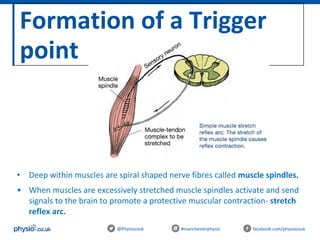
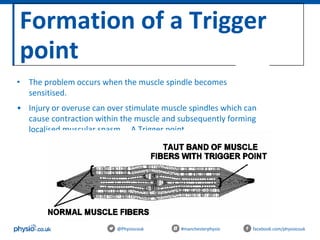
  • 108.
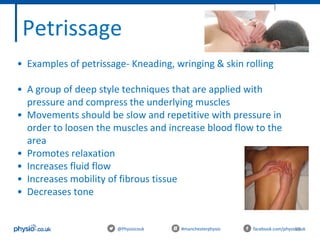
    Case Study: Shoulder pain @Physiocouk#manchesterphysio facebook.com/physiocouk Objective signs • Increased UFT tone • Reduced cervical lateral flexion due to UFT tightness • TOP of L and R UFT and Rhomboids • Active Trigger points in R and L Rhomboids • No neurological symptoms
  • 109.
    Case Study: Shoulder pain @Physiocouk#manchesterphysio facebook.com/physiocouk
  • 110.
    Case Study: Lowerback pain @Physiocouk #manchesterphysio facebook.com/physiocouk PC/HPC – 39 year old male 8/10 sharp pain in R lower back. Pain began suddenly when after lifting heavy box up which sent shooting pains down R leg. Aggravated by bending down and putting shoes on and eased by lying down flat. SH- full time receptionist, doesn’t perform regular exercise. PMH- history of lower back pain DH- analgesics
  • 111.
    Case Study: Lowerback pain @Physiocouk #manchesterphysio facebook.com/physiocouk Objective signs •Limited Lumber range of movement •Increase in pain during flexion and L lateral flexion •Pain eased during extension. •PALP – pain on palp of QL and L3 spinous process
  • 112.
    Case Study: Lowerback pain @Physiocouk #manchesterphysio facebook.com/physiocouk
  • 113.
    Case Study: Calfpain @Physiocouk #manchesterphysio facebook.com/physiocouk PC/HPC – 35 year old male runner. Felt a 6/10 sharp pain in R calf towards the end of a 5K run 2/52 ago. Had to stop running. No swelling or bruising was present. Pain reduced since 3/10 ache pain, tried running again but still feels painful. SH- work in a warehouse, on feet all day up and down ladders. PMH- prev R lateral ankle sprain 12/12 ago DH-nil to note
  • 114.
    Case Study: Calfpain @Physiocouk #manchesterphysio facebook.com/physiocouk Objective signs •Increased calf bulk L side •Thickening of R Achilles tendon •Reduced dorsiflexion of R ankle •Reduce muscular strength in R resisted plantarflexion •Reduced R calf length •PALP- pain on palp of medial gastroc •-ve Thomas test
  • 115.
    Case Study: Calfpain @Physiocouk #manchesterphysio facebook.com/physiocouk
  • 116.
    Case Study: Buttockpain @Physiocouk #manchesterphysio facebook.com/physiocouk PC/HPC- 25 year old male 5/10 pain in L buttock. 1/12 ago increased pain following legs gym session, gradually worsening since. Aggravated by climbing multiple flights of stairs at work. Eased by resting. SH- Started going to the gym 1/12 ago after a 5 year break. Doesn’t do any stretching because he doesn’t know how to. Works on the 8th floor of a office building. PMH- over pronate both feet, especially bad in L side. DH- nil to note
  • 117.
    Case Study: Buttockpain @Physiocouk #manchesterphysio facebook.com/physiocouk Objective signs •Over pronation in L > R foot •Valgus position of knees •Poor hamstring flexibility on 90/90 test in L>R legs •No neurological symptoms during SLR •PALP: tension L>R hamstring, glutes and piriformis •Very tender on PALP of piriformis
  • 118.
    Case Study: Buttockpain @Physiocouk #manchesterphysio facebook.com/physiocouk Diagnosis? How would treat this?
  • 119.
  • 120.
    Question 1 @Physiocouk #manchesterphysiofacebook.com/physiocouk What is a trigger point? • Trigger points are hyperirritable areas of contracted muscle fibres that form a palatable nodule • On a microscopic level, the contracted muscle fibres accumulate into a small thickened area causing the rest of the fibre to stretch • The areas of contracted muscle restrict blood flow within the tissue causing an accumulation of waste products and reduced levels of nutrients available.
  • 121.
    Question 2 @Physiocouk #manchesterphysiofacebook.com/physiocouk How would a patient describe trigger point pain? • Dull ache • Deep • Sharp • Pressing pain • Stabbing • Burning • Travelling pain • Head pain
  • 122.
    Question 3 @Physiocouk #manchesterphysiofacebook.com/physiocouk Name some indications for Trigger point therapy • Pain • Reduced AROM • High muscle tension or tone • Muscle tightness
  • 123.
    Question 4 @Physiocouk #manchesterphysiofacebook.com/physiocouk Name some benefits of Trigger point therapy •Reduced pain • Increased range of motion • Decreased muscle stiffness and tension • Reduction in headaches • Improved flexibility • Improved circulation • Fewer muscle spasms
  • 124.
    Question 5 @Physiocouk #manchesterphysiofacebook.com/physiocouk Name some contraindications for Trigger point therapy General Local Acute conditions requiring medical attention Acute flare-up of inflammatory arthritides Acute pneumonia Aneurysms deemed life-threatening (may be general contraindication depending on location) Advanced kidney, respiratory or liver failure Local contagious condition Diabetes with complications such as gangrene, advanced heart or kidney disease or very unstable or high blood pressure Local irritable skin condition Hemorrhage Malignancy Severe atherosclerosis Open wound or sore Severe and unstable hypertension Recent burn Shock Undiagnosed lump Systemic contagious or infectious condition
  • 125.
    Question 6 @Physiocouk #manchesterphysiofacebook.com/physiocouk Where is the Trapezius muscle found? The trapezius can be separated into three muscles: •The upper trapezius •The middle trapezius •The lower trapezius Anatomy: All three trapezius muscles originate along the spine to T12 and extend laterally to attach to the shoulder girdle.
  • 126.
    Question 7 @Physiocouk #manchesterphysiofacebook.com/physiocouk Where is the Sternocleomastoid muscle found? Anatomy: ● Originates from the mastoid process. ● The sternal division runs diagonally downward to attach to the sternum. ● The clavicular division attaches right behind it on the medial clavicle.
  • 127.
    Question 8 @Physiocouk #manchesterphysiofacebook.com/physiocouk What muscle group does Vastuslateralis belong to? The quadriceps muscular group. Anatomy: •Vastus lateralis originates lateral aspect of the superior femur bone and runs down the outside of the thigh to attach to the lateral aspect of the patella.
  • 128.
    128 Thanks for coming! Don’tforget to follow us on Twitter: @physiocouk @Physiocouk #manchesterphysio facebook.com/physiocouk