


What do we know
about sexual abuse?
Kateryna Kolnogorova
Paulina Grzelak
SWPS, University of Social Sciences and Humanities in Warsaw
Contents
• Statistics on sexual violence
• Characteristics of sexual abusers
• Study: What people know about rapists and rape
Sexual violence (WHO) — any sexual act,
attempt to obtain a sexual act, unwanted sexual
comments or advances, or acts to traffic, or
otherwise directed, against a person’s sexuality
using coercion, by any person regardless of their
relationship to the victim, in any setting, including
but not limited to home and work.
(Krug, Dahlberg, Mercy, Zwi, & Lozano, 2002)
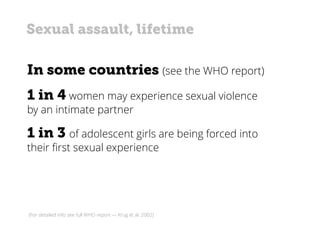
In some countries (see the WHO report)
1 in 4 women may experience sexual violence
by an intimate partner
1 in 3 of adolescent girls are being forced into
their first sexual experience
(For detailed info see full WHO report — Krug et al. 2002)
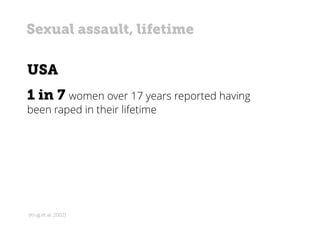
Sexual assault, lifetime
USA
1 in 7 women over 17 years reported having
been raped in their lifetime
(Krug et al. 2002)
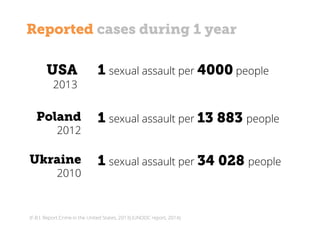
(F.B.I. Report.Crime in the United States, 2013) (UNODC report, 2014)
Ukraine
2010
Poland
2012
Reported cases during 1 year
1 sexual assault per 4000 peopleUSA
2013
1 sexual assault per 13 883 people
1 sexual assault per 34 028 people
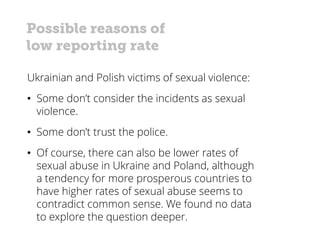
Possible reasons of
low reporting rate
Ukrainian and Polish victims of sexual violence:
• Some don’t consider the incidents as sexual
violence.
• Some don’t trust the police.
• Of course, there can also be lower rates of
sexual abuse in Ukraine and Poland, although
a tendency for more prosperous countries to
have higher rates of sexual abuse seems to
contradict common sense. We found no data
to explore the question deeper.
Characteristics
of sexual abusers
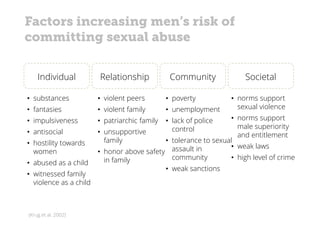
Factors increasing men’s risk of
committing sexual abuse
• substances
• fantasies
• impulsiveness
• antisocial
• hostility towards
women
• abused as a child
• witnessed family
violence as a child
Individual Relationship Community Societal
• violent peers
• violent family
• patriarchic family
• unsupportive
family
• honor above safety
in family
• poverty
• unemployment
• lack of police
control
• tolerance to sexual
assault in
community
• weak sanctions
• norms support
sexual violence
• norms support
male superiority
and entitlement
• weak laws
• high level of crime
(Krug et al. 2002)
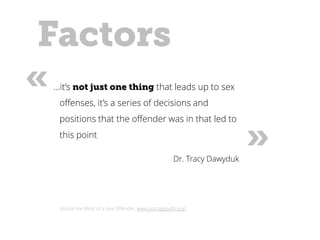
…it’s not just one thing that leads up to sex
offenses, it’s a series of decisions and
positions that the offender was in that led to
this point
«
»
Factors
Dr. Tracy Dawyduk
(Inside the Mind of a Sex Offender, www.portagepath.org)
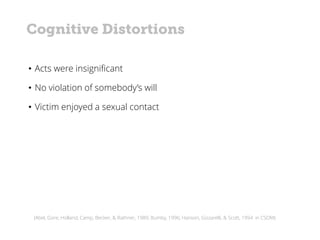
(Abel, Gore, Holland, Camp, Becker, & Rathner, 1989; Bumby, 1996; Hanson, Gizzarelli, & Scott, 1994 in CSOM)
• Acts were insignificant
• No violation of somebody’s will
• Victim enjoyed a sexual contact
Cognitive Distortions
1 (Bumby, 2000; Marshall, 1989; Seidman, Marshall, Hudson, & Robertson,1994; Ward, Hudson, Marshall, & Seigert, 1995 in CSOM)
• Communication problems
• Socially isolated
• Have problems in establishing and maintaining any
love relationships1
Or
• Most rape offenders are married or have a partner2
Social and interpersonal skills
2 (State of California Department of Justice, Megan's Law)
(Vachon, Lynam, Johnson, 2014)
• Deficit in empathy to the victim
• But may be empathic in general
Empathy
(Marshall, 1996 in CSOM)
• May be a factor
• Promoted by movies
• Doesn’t cause sexual offending in most people
History of maltreatment
(Elsegood and Duff (2010)
For child molesters:
• Bad at recognizing emotions of adults
• Recognize children’s emotions on the level of other people
=> adults = danger
Emotional incongruence
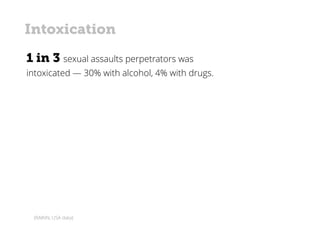
Intoxication
1 in 3 sexual assaults perpetrators was
intoxicated — 30% with alcohol, 4% with drugs.
(RAINN, USA data)
Study
To explore how realistic the ideas
of people about rapists are
Aim
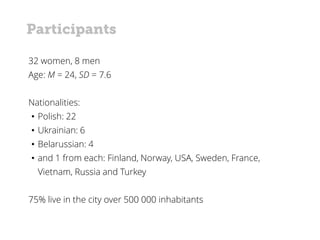
32 women, 8 men
Age: M = 24, SD = 7.6
Nationalities:
• Polish: 22
• Ukrainian: 6
• Belarussian: 4
• and 1 from each: Finland, Norway, USA, Sweden, France,
Vietnam, Russia and Turkey
75% live in the city over 500 000 inhabitants
Participants
We asked questions and compared the answers
to statistics from scientific and official sources.
The questionnaire: http://bit.ly/1L2QFwn
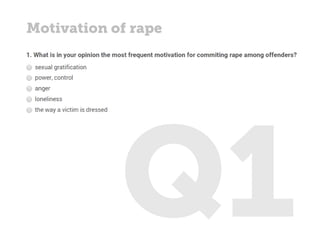
Motivation of rape
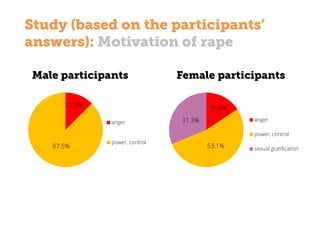
Study (based on the participants’
answers): Motivation of rape
12.5%
87.5%
anger
power, control
Male participants
15.6%
53.1%
31.3% anger
power, control
sexual gratification
Female participants
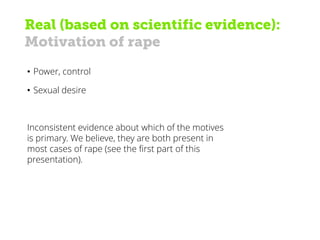
Real (based on scientific evidence):
Motivation of rape
• Power, control
• Sexual desire
Inconsistent evidence about which of the motives
is primary. We believe, they are both present in
most cases of rape (see the first part of this
presentation).
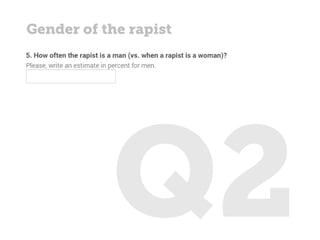
Gender of the rapist
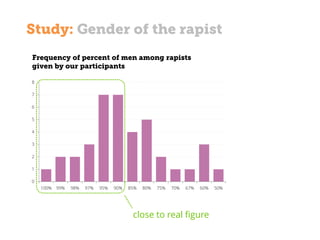
Study: Gender of the rapist
Frequency of percent of men among rapists
given by our participants
0
1
2
3
4
5
6
7
8
100% 99% 98% 97% 95% 90% 85% 80% 75% 70% 67% 60% 50%
close to real figure
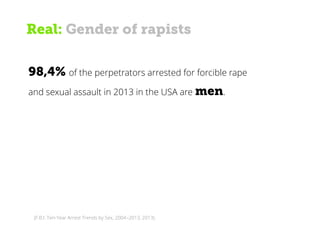
(F.B.I. Ten-Year Arrest Trends by Sex, 2004–2013, 2013)
98,4% of the perpetrators arrested for forcible rape
and sexual assault in 2013 in the USA are men.
Real: Gender of rapists
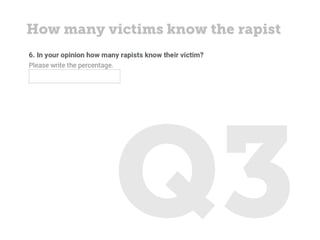
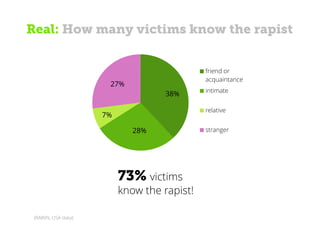
How many victims know the rapist
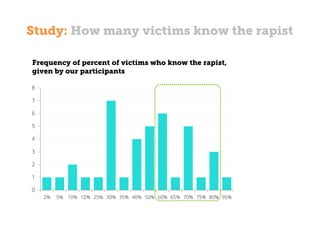
Study: How many victims know the rapist
Frequency of percent of victims who know the rapist,
given by our participants
0
1
2
3
4
5
6
7
8
2% 5% 10% 12% 25% 30% 35% 40% 50% 60% 65% 70% 75% 80% 95%
(RAINN, USA data)
Real: How many victims know the rapist
73% victims
know the rapist!
38%
28%
7%
27%
friend or
acquaintance
intimate
relative
stranger
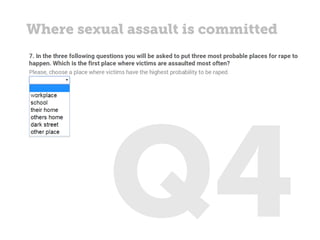
Where sexual assault is committed
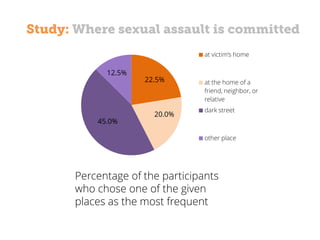
Study: Where sexual assault is committed
22.5%
20.0%
45.0%
12.5%
at victim’s home
at the home of a
friend, neighbor, or
relative
dark street
other place
Percentage of the participants
who chose one of the given
places as the most frequent
(RAINN, USA data)
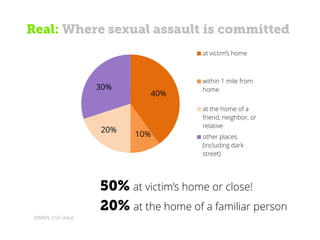
Real: Where sexual assault is committed
50% at victim’s home or close!
20% at the home of a familiar person
40%
10%
20%
30%
at victim’s home
within 1 mile from
home
at the home of a
friend, neighbor, or
relative
other places
(including dark
street)
Victim’s responsibility
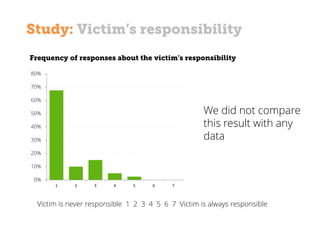
Study: Victim’s responsibility
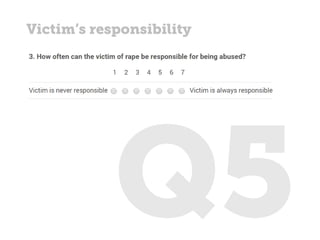
Victim is never responsible 1 2 3 4 5 6 7 Victim is always responsible
0%
10%
20%
30%
40%
50%
60%
70%
80%
1 2 3 4 5 6 7
Frequency of responses about the victim’s responsibility
We did not compare
this result with any
data
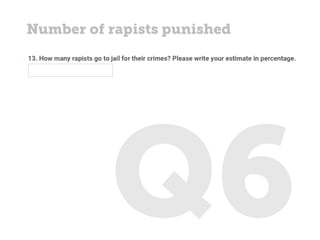
Number of rapists punished
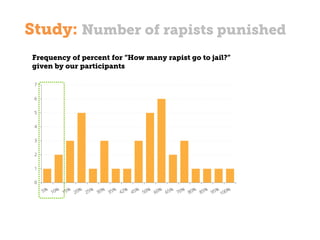
Study: Number of rapists punished
0
1
2
3
4
5
6
7
Frequency of percent for “How many rapist go to jail?”
given by our participants
(RAINN, USA data—on the website a source for every figure is described in more detail)
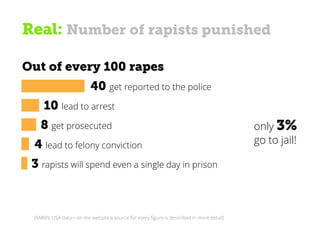
Real: Number of rapists punished
only 3%
go to jail!
Out of every 100 rapes
40 get reported to the police
10 lead to arrest
8 get prosecuted
4 lead to felony conviction
3 rapists will spend even a single day in prison
Please share this
presentation
Kateryna Kolnogorova
kolnogorova@gmail.com
Paulina Grzelak
pgrzelak@st.swps.edu.pl
Feel free to contact us
References
Elsegood, K. J., & Duff, S. C. (2010). Theory of mind in men who have sexually offended against children: A U.K.
comparison study between child sex offenders and nonoffender controls. Sexual Abuse: A Journal of Research and
Treatment, 22, 112–131. doi:10.1177/1079063209359926
F.B.I. Report.Crime in the United States (2013). Retrieved January 20, 2015, from http://www.fbi.gov/about-
us/cjis/ucr/crime-in-the-u.s/2013/crime-in-the-u.s.-2013/violent-crime/rape
F.B.I. Ten-Year Arrest Trends by Sex, 2004–2013 (2013). Retrieved January 20, 2015, from http://www.fbi.gov/about-
us/cjis/ucr/crime-in-the-u.s/2013/crime-in-the-u.s.-2013/tables/table-
33/table_33_ten_year_arrest_trends_by_sex_2013.xls
Inside the Mind of a Sex Offender, retrieved on the 01.11.14 from
http://www.portagepath.org/shlibbu/community/CommunityPwaysSummer05SexOffender.pdf
Krug, E.G., Dahlberg, L.L., Mercy, J.A., Zwi, A.B., & Lozano, R. (eds.). (2002). World report on violence and health. Geneva:
WHO.
Rape, Abuse & Incest National Network (RAINN), retrieved on the 30.10.14 from https://rainn.org/get-
information/statistics/sexual-assault-offenders
State of California Department of Justice, “Megan's Law”, retrieved on the 02.11.2014
from http://meganslaw.ca.gov/facts.htm
The Center for Sex Offender Management (CSOM). “Section 3: Common Characteristics of Sex Offenders”, retrieved
on the 02.11.2014 from http://www.csom.org/train/etiology/3/3_1.htm#backtrack5)
Vachon, D. D., Lynam, D. R., & Johnson, J. A. (2014). The (Non)Relation Between Empathy and Aggression: Surprising
Results From a Meta-Analysis. Psychological Bulletin, 140(3), 751–773.
United Nations Office on Drugs and Crime (UNDOC), retrieved on the 02.11.2014 from
http://www.unodc.org/unodc/en/data-and-analysis/statistics/crime.html

What do we_know_about_sexual_abuse

  • 1.
    What do weknow about sexual abuse? Kateryna Kolnogorova Paulina Grzelak SWPS, University of Social Sciences and Humanities in Warsaw
  • 2.
    Contents • Statistics onsexual violence • Characteristics of sexual abusers • Study: What people know about rapists and rape
  • 3.
    Sexual violence (WHO)— any sexual act, attempt to obtain a sexual act, unwanted sexual comments or advances, or acts to traffic, or otherwise directed, against a person’s sexuality using coercion, by any person regardless of their relationship to the victim, in any setting, including but not limited to home and work. (Krug, Dahlberg, Mercy, Zwi, & Lozano, 2002)
  • 4.
    In some countries(see the WHO report) 1 in 4 women may experience sexual violence by an intimate partner 1 in 3 of adolescent girls are being forced into their first sexual experience (For detailed info see full WHO report — Krug et al. 2002) Sexual assault, lifetime
  • 5.
    Sexual assault, lifetime USA 1in 7 women over 17 years reported having been raped in their lifetime (Krug et al. 2002)
  • 6.
    (F.B.I. Report.Crime inthe United States, 2013) (UNODC report, 2014) Ukraine 2010 Poland 2012 Reported cases during 1 year 1 sexual assault per 4000 peopleUSA 2013 1 sexual assault per 13 883 people 1 sexual assault per 34 028 people
  • 7.
    Possible reasons of lowreporting rate Ukrainian and Polish victims of sexual violence: • Some don’t consider the incidents as sexual violence. • Some don’t trust the police. • Of course, there can also be lower rates of sexual abuse in Ukraine and Poland, although a tendency for more prosperous countries to have higher rates of sexual abuse seems to contradict common sense. We found no data to explore the question deeper.
  • 8.
  • 9.
    Factors increasing men’srisk of committing sexual abuse • substances • fantasies • impulsiveness • antisocial • hostility towards women • abused as a child • witnessed family violence as a child Individual Relationship Community Societal • violent peers • violent family • patriarchic family • unsupportive family • honor above safety in family • poverty • unemployment • lack of police control • tolerance to sexual assault in community • weak sanctions • norms support sexual violence • norms support male superiority and entitlement • weak laws • high level of crime (Krug et al. 2002)
  • 10.
    …it’s not justone thing that leads up to sex offenses, it’s a series of decisions and positions that the offender was in that led to this point « » Factors Dr. Tracy Dawyduk (Inside the Mind of a Sex Offender, www.portagepath.org)
  • 11.
    (Abel, Gore, Holland,Camp, Becker, & Rathner, 1989; Bumby, 1996; Hanson, Gizzarelli, & Scott, 1994 in CSOM) • Acts were insignificant • No violation of somebody’s will • Victim enjoyed a sexual contact Cognitive Distortions
  • 12.
    1 (Bumby, 2000;Marshall, 1989; Seidman, Marshall, Hudson, & Robertson,1994; Ward, Hudson, Marshall, & Seigert, 1995 in CSOM) • Communication problems • Socially isolated • Have problems in establishing and maintaining any love relationships1 Or • Most rape offenders are married or have a partner2 Social and interpersonal skills 2 (State of California Department of Justice, Megan's Law)
  • 13.
    (Vachon, Lynam, Johnson,2014) • Deficit in empathy to the victim • But may be empathic in general Empathy
  • 14.
    (Marshall, 1996 inCSOM) • May be a factor • Promoted by movies • Doesn’t cause sexual offending in most people History of maltreatment
  • 15.
    (Elsegood and Duff(2010) For child molesters: • Bad at recognizing emotions of adults • Recognize children’s emotions on the level of other people => adults = danger Emotional incongruence
  • 16.
    Intoxication 1 in 3sexual assaults perpetrators was intoxicated — 30% with alcohol, 4% with drugs. (RAINN, USA data)
  • 17.
  • 18.
    To explore howrealistic the ideas of people about rapists are Aim
  • 19.
    32 women, 8men Age: M = 24, SD = 7.6 Nationalities: • Polish: 22 • Ukrainian: 6 • Belarussian: 4 • and 1 from each: Finland, Norway, USA, Sweden, France, Vietnam, Russia and Turkey 75% live in the city over 500 000 inhabitants Participants
  • 20.
    We asked questionsand compared the answers to statistics from scientific and official sources. The questionnaire: http://bit.ly/1L2QFwn
  • 21.
  • 22.
    Study (based onthe participants’ answers): Motivation of rape 12.5% 87.5% anger power, control Male participants 15.6% 53.1% 31.3% anger power, control sexual gratification Female participants
  • 23.
    Real (based onscientific evidence): Motivation of rape • Power, control • Sexual desire Inconsistent evidence about which of the motives is primary. We believe, they are both present in most cases of rape (see the first part of this presentation).
  • 24.
  • 25.
    Study: Gender ofthe rapist Frequency of percent of men among rapists given by our participants 0 1 2 3 4 5 6 7 8 100% 99% 98% 97% 95% 90% 85% 80% 75% 70% 67% 60% 50% close to real figure
  • 26.
    (F.B.I. Ten-Year ArrestTrends by Sex, 2004–2013, 2013) 98,4% of the perpetrators arrested for forcible rape and sexual assault in 2013 in the USA are men. Real: Gender of rapists
  • 27.
    How many victimsknow the rapist
  • 28.
    Study: How manyvictims know the rapist Frequency of percent of victims who know the rapist, given by our participants 0 1 2 3 4 5 6 7 8 2% 5% 10% 12% 25% 30% 35% 40% 50% 60% 65% 70% 75% 80% 95%
  • 29.
    (RAINN, USA data) Real:How many victims know the rapist 73% victims know the rapist! 38% 28% 7% 27% friend or acquaintance intimate relative stranger
  • 30.
  • 31.
    Study: Where sexualassault is committed 22.5% 20.0% 45.0% 12.5% at victim’s home at the home of a friend, neighbor, or relative dark street other place Percentage of the participants who chose one of the given places as the most frequent
  • 32.
    (RAINN, USA data) Real:Where sexual assault is committed 50% at victim’s home or close! 20% at the home of a familiar person 40% 10% 20% 30% at victim’s home within 1 mile from home at the home of a friend, neighbor, or relative other places (including dark street)
  • 33.
  • 34.
    Study: Victim’s responsibility Victimis never responsible 1 2 3 4 5 6 7 Victim is always responsible 0% 10% 20% 30% 40% 50% 60% 70% 80% 1 2 3 4 5 6 7 Frequency of responses about the victim’s responsibility We did not compare this result with any data
  • 35.
  • 36.
    Study: Number ofrapists punished 0 1 2 3 4 5 6 7 Frequency of percent for “How many rapist go to jail?” given by our participants
  • 37.
    (RAINN, USA data—onthe website a source for every figure is described in more detail) Real: Number of rapists punished only 3% go to jail! Out of every 100 rapes 40 get reported to the police 10 lead to arrest 8 get prosecuted 4 lead to felony conviction 3 rapists will spend even a single day in prison
  • 38.
  • 39.
  • 40.
    References Elsegood, K. J.,& Duff, S. C. (2010). Theory of mind in men who have sexually offended against children: A U.K. comparison study between child sex offenders and nonoffender controls. Sexual Abuse: A Journal of Research and Treatment, 22, 112–131. doi:10.1177/1079063209359926 F.B.I. Report.Crime in the United States (2013). Retrieved January 20, 2015, from http://www.fbi.gov/about- us/cjis/ucr/crime-in-the-u.s/2013/crime-in-the-u.s.-2013/violent-crime/rape F.B.I. Ten-Year Arrest Trends by Sex, 2004–2013 (2013). Retrieved January 20, 2015, from http://www.fbi.gov/about- us/cjis/ucr/crime-in-the-u.s/2013/crime-in-the-u.s.-2013/tables/table- 33/table_33_ten_year_arrest_trends_by_sex_2013.xls Inside the Mind of a Sex Offender, retrieved on the 01.11.14 from http://www.portagepath.org/shlibbu/community/CommunityPwaysSummer05SexOffender.pdf Krug, E.G., Dahlberg, L.L., Mercy, J.A., Zwi, A.B., & Lozano, R. (eds.). (2002). World report on violence and health. Geneva: WHO. Rape, Abuse & Incest National Network (RAINN), retrieved on the 30.10.14 from https://rainn.org/get- information/statistics/sexual-assault-offenders State of California Department of Justice, “Megan's Law”, retrieved on the 02.11.2014 from http://meganslaw.ca.gov/facts.htm The Center for Sex Offender Management (CSOM). “Section 3: Common Characteristics of Sex Offenders”, retrieved on the 02.11.2014 from http://www.csom.org/train/etiology/3/3_1.htm#backtrack5) Vachon, D. D., Lynam, D. R., & Johnson, J. A. (2014). The (Non)Relation Between Empathy and Aggression: Surprising Results From a Meta-Analysis. Psychological Bulletin, 140(3), 751–773. United Nations Office on Drugs and Crime (UNDOC), retrieved on the 02.11.2014 from http://www.unodc.org/unodc/en/data-and-analysis/statistics/crime.html