Welcome to Discrete Mathematics
PRESENTATION
Topics: Graph Theory
Submited by:
Md: Aliul Kadir akib
Daffodil International University
Mail:aliulkadir@gmail.com
Introduction
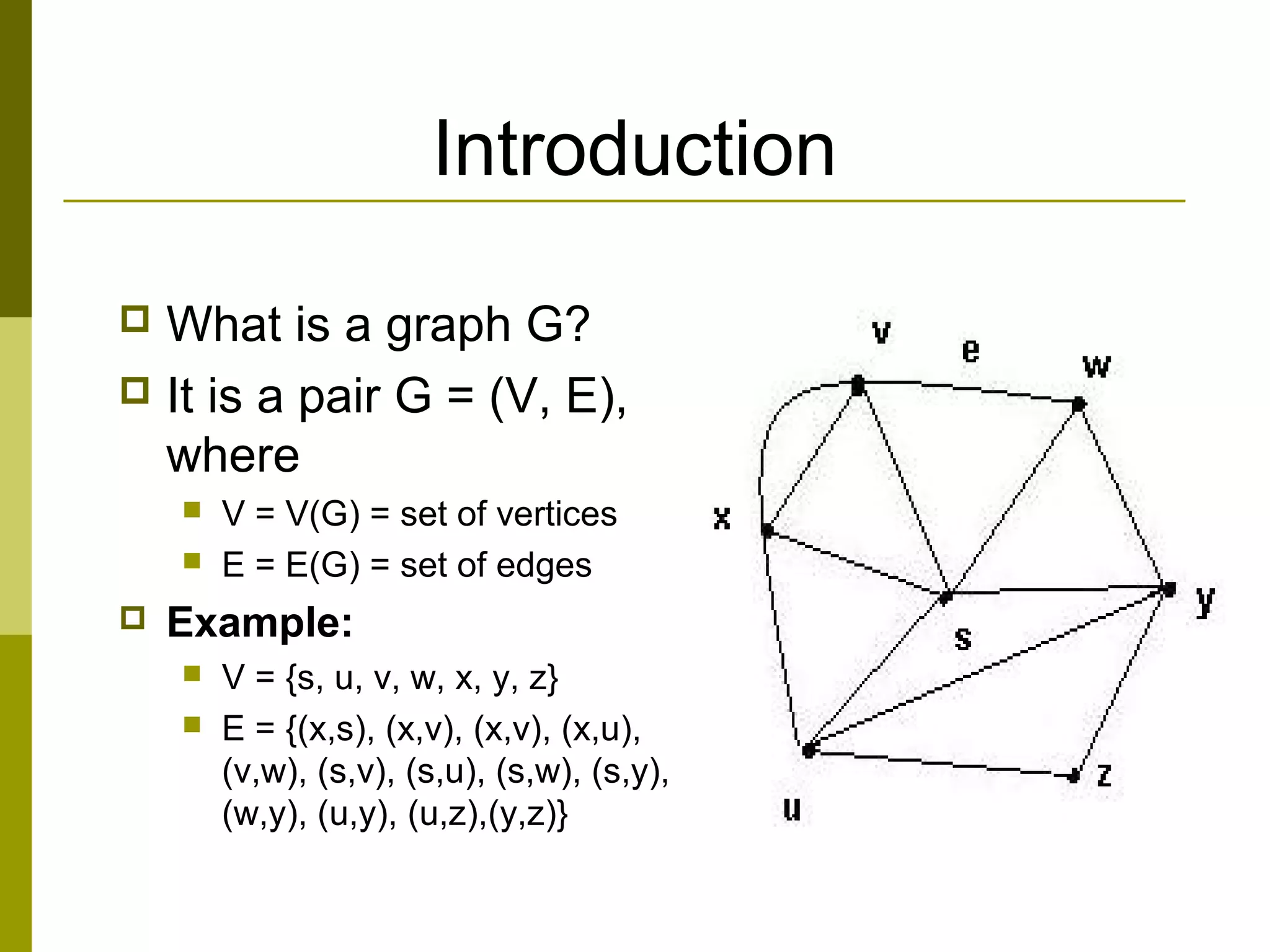
 What is a graph G?
 It is a pair G = (V, E),
where
 V = V(G) = set of vertices
 E = E(G) = set of edges
 Example:
 V = {s, u, v, w, x, y, z}
 E = {(x,s), (x,v), (x,v), (x,u),
(v,w), (s,v), (s,u), (s,w), (s,y),
(w,y), (u,y), (u,z),(y,z)}
Special edges
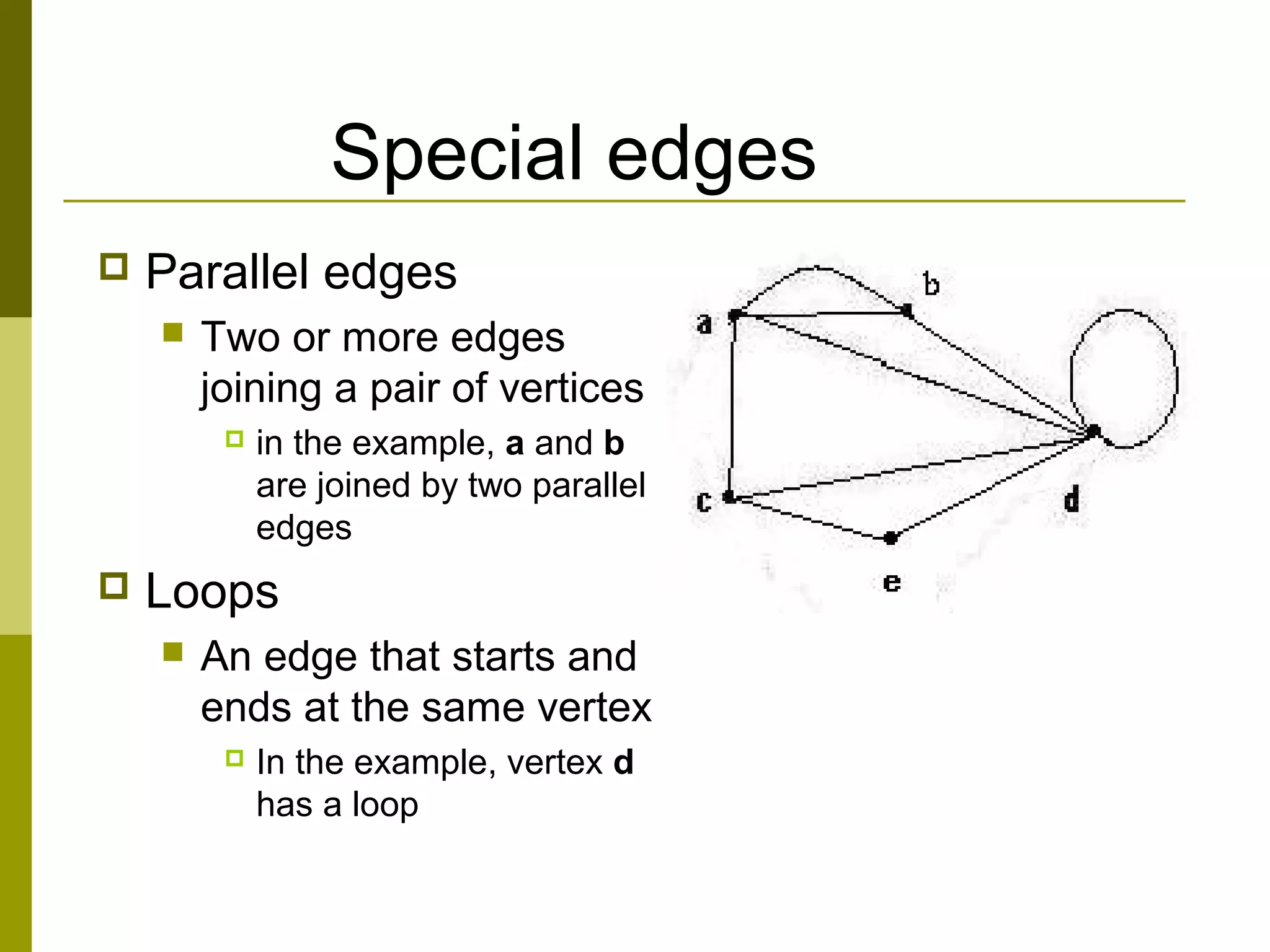
 Parallel edges
 Two or more edges
joining a pair of vertices
 in the example, a and b
are joined by two parallel
edges
 Loops
 An edge that starts and
ends at the same vertex
 In the example, vertex d
has a loop
Special graphs
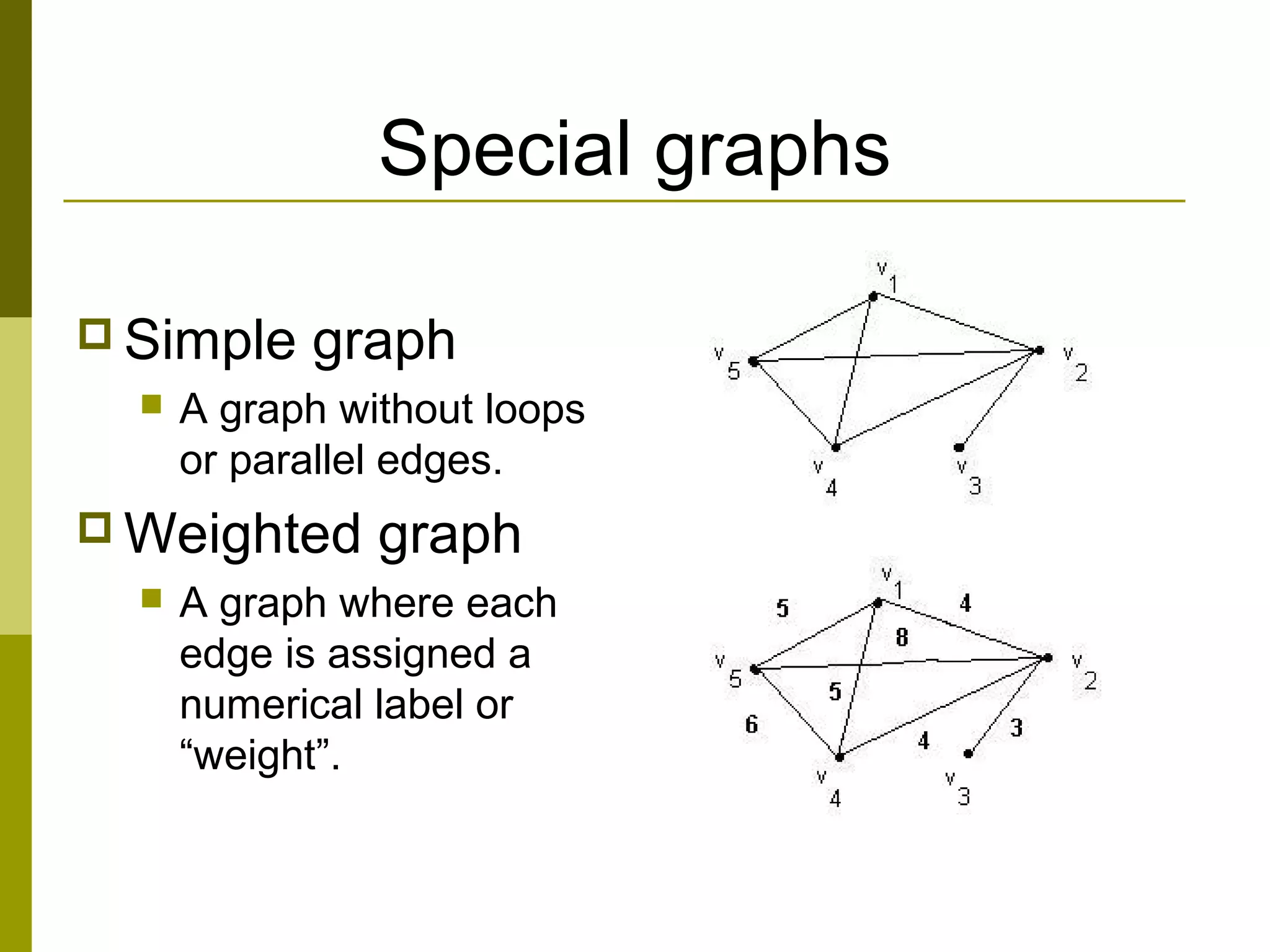
 Simple graph
 A graph without loops
or parallel edges.
 Weighted graph
 A graph where each
edge is assigned a
numerical label or
“weight”.
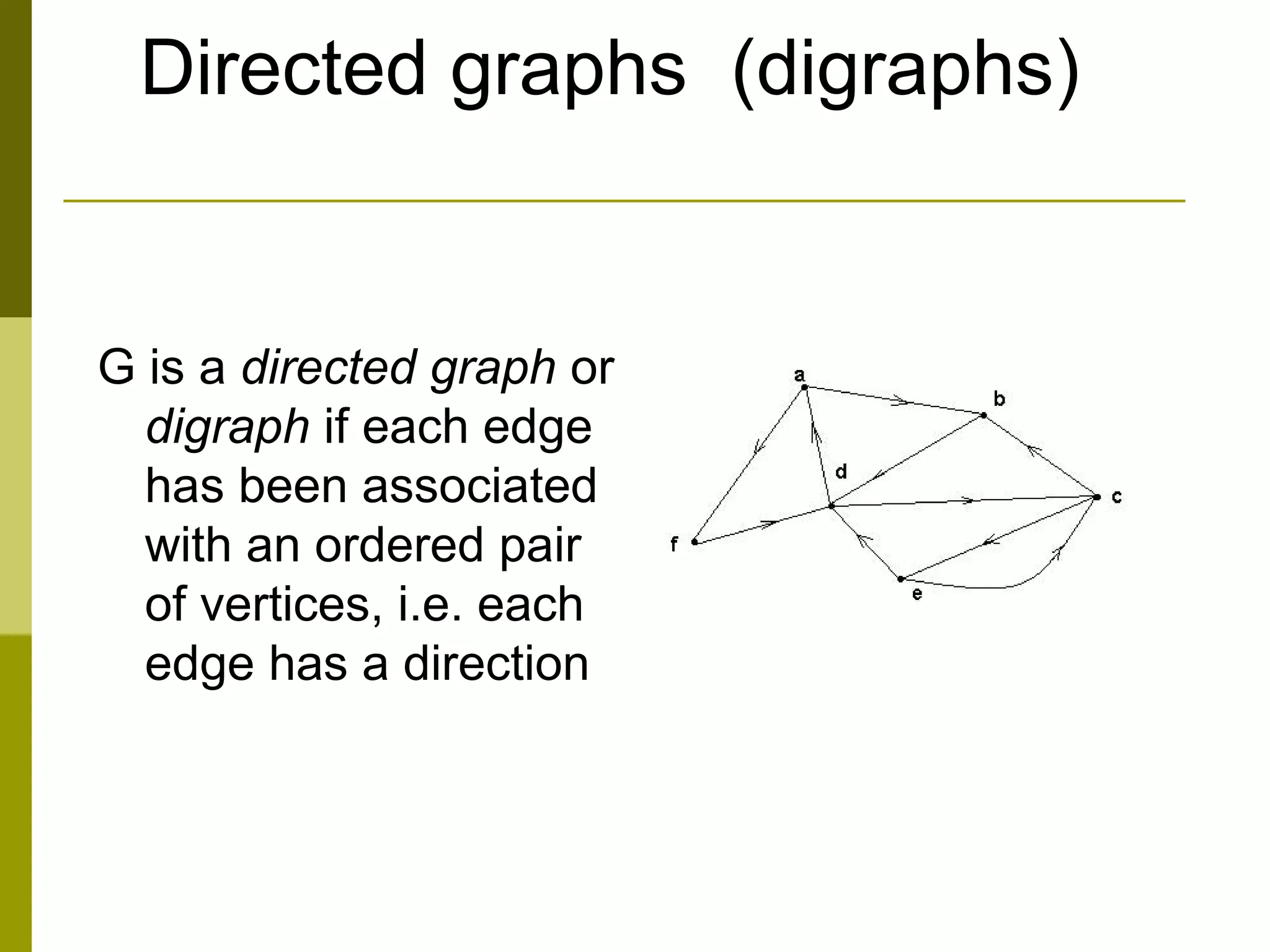
Directed graphs (digraphs)
G is a directed graph or
digraph if each edge
has been associated
with an ordered pair
of vertices, i.e. each
edge has a direction
Terminology – Undirected graphs
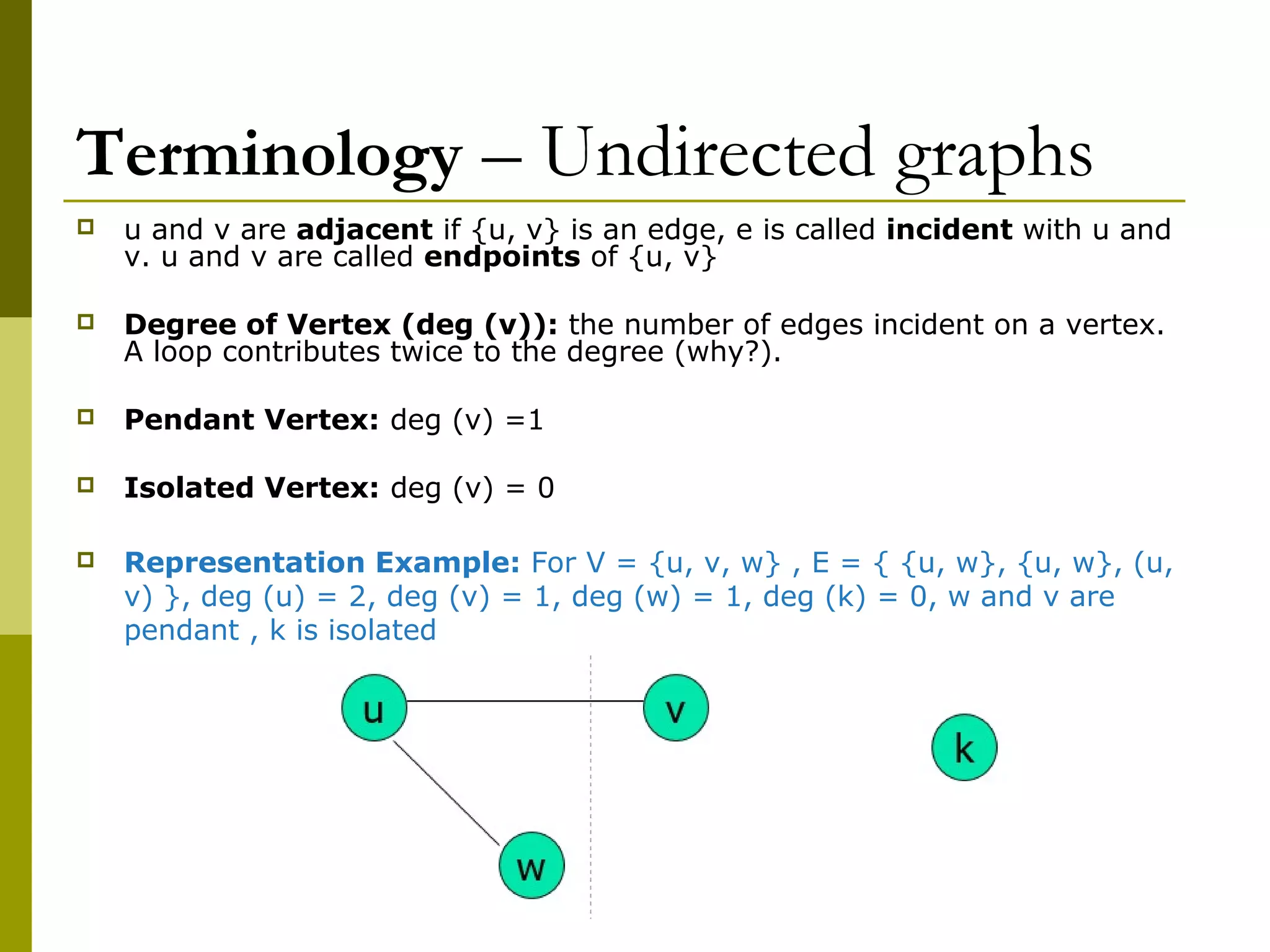
 u and v are adjacent if {u, v} is an edge, e is called incident with u and
v. u and v are called endpoints of {u, v}
 Degree of Vertex (deg (v)): the number of edges incident on a vertex.
A loop contributes twice to the degree (why?).
 Pendant Vertex: deg (v) =1
 Isolated Vertex: deg (v) = 0
 Representation Example: For V = {u, v, w} , E = { {u, w}, {u, w}, (u,
v) }, deg (u) = 2, deg (v) = 1, deg (w) = 1, deg (k) = 0, w and v are
pendant , k is isolated
Terminology – Directed graphs
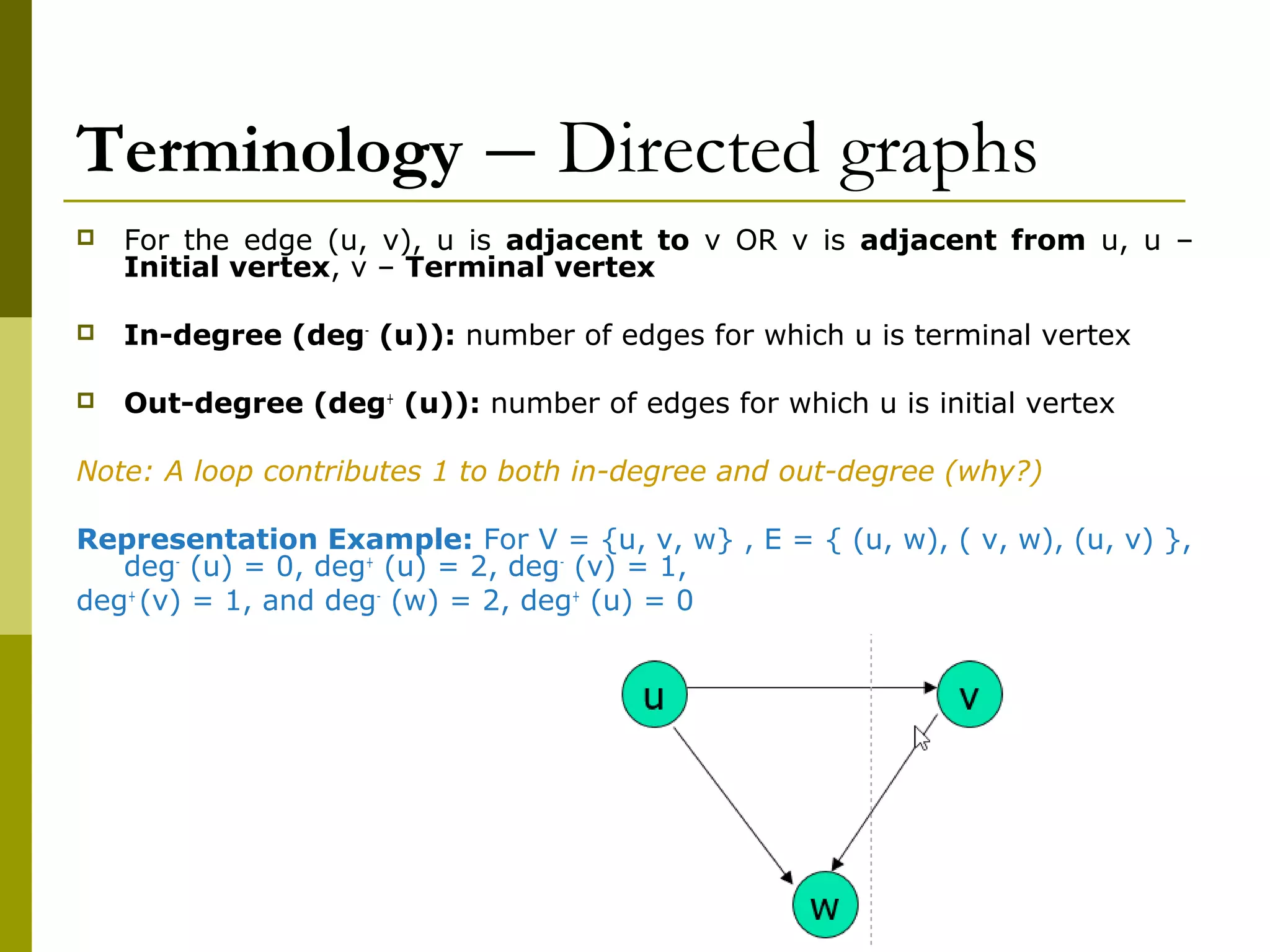
 For the edge (u, v), u is adjacent to v OR v is adjacent from u, u –
Initial vertex, v – Terminal vertex
 In-degree (deg-
(u)): number of edges for which u is terminal vertex
 Out-degree (deg+
(u)): number of edges for which u is initial vertex
Note: A loop contributes 1 to both in-degree and out-degree (why?)
Representation Example: For V = {u, v, w} , E = { (u, w), ( v, w), (u, v) },
deg-
(u) = 0, deg+
(u) = 2, deg-
(v) = 1,
deg+
(v) = 1, and deg-
(w) = 2, deg+
(u) = 0
Theorems: Undirected Graphs
Theorem 1
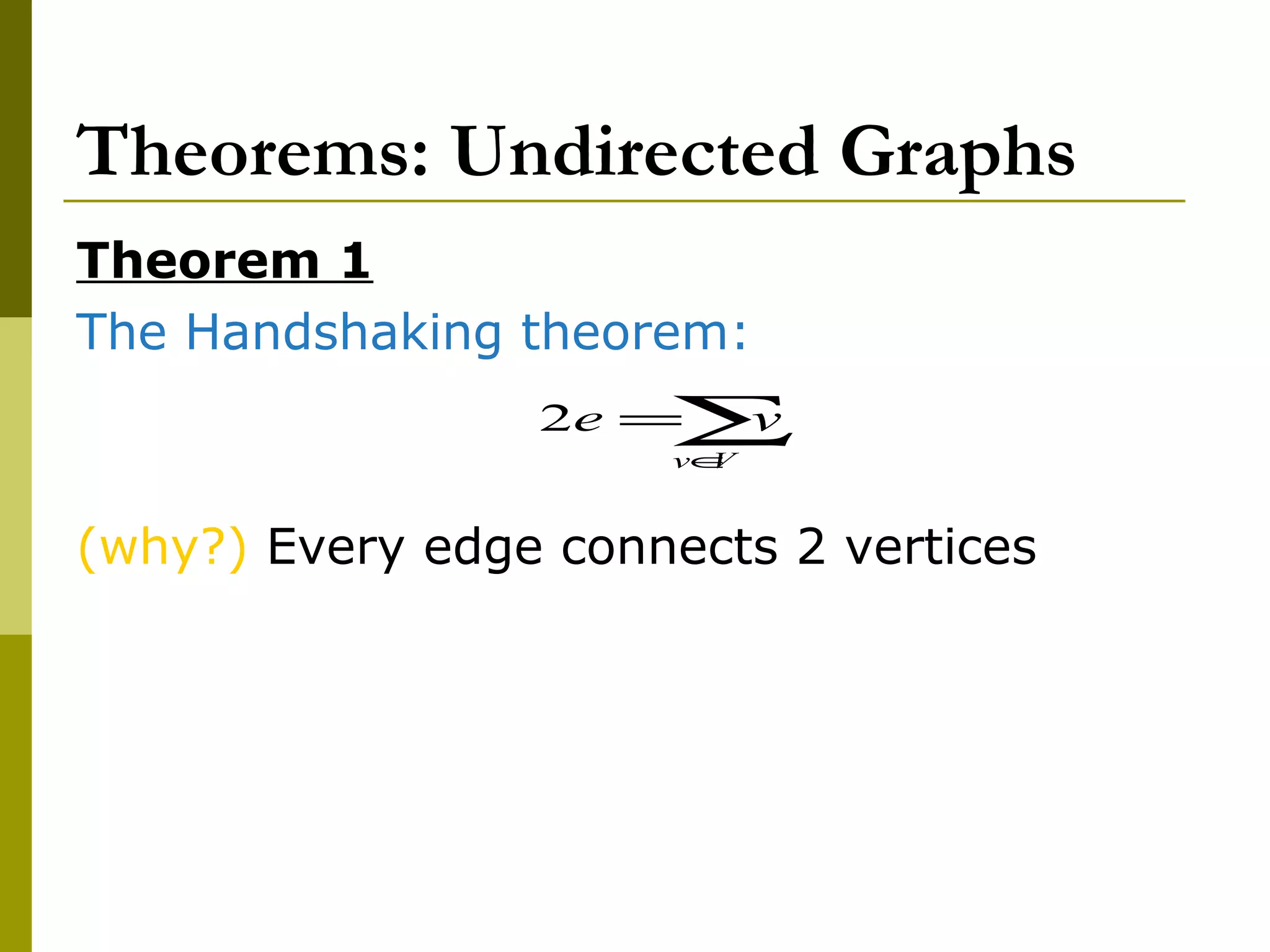
The Handshaking theorem:
(why?) Every edge connects 2 vertices
∑∈
=
Vv
ve2
Theorems: Undirected Graphs
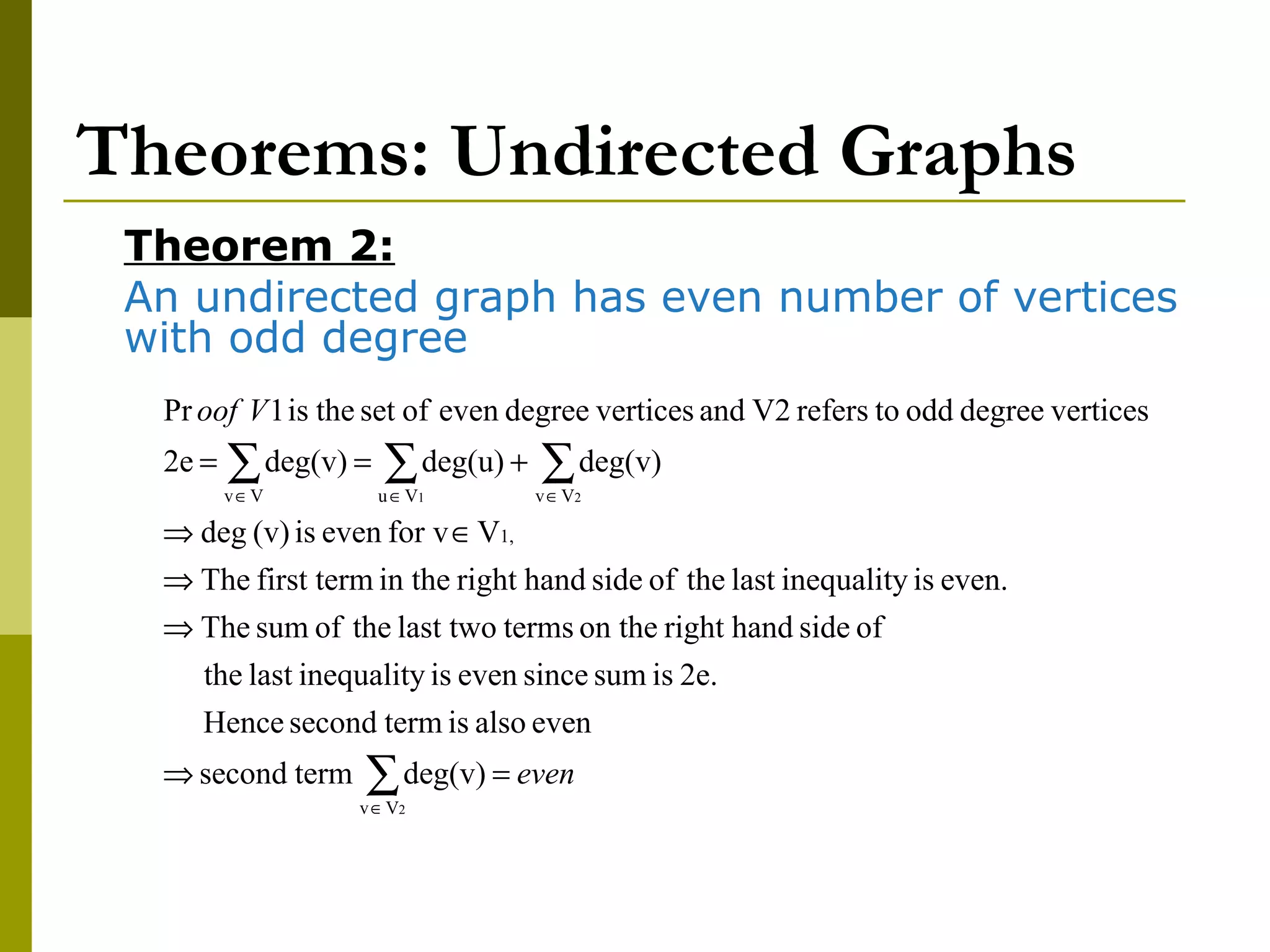
Theorem 2:
An undirected graph has even number of vertices
with odd degree
even
Voof
=⇒
⇒
⇒
∈⇒
+==
∑
∑∑∑
∈
∈∈∈
2
21
Vv
1,
VvVuVv
deg(v)termsecond
evenalsoistermsecondHence
2e.issumsinceevenisinequalitylastthe
ofsidehandrighton thetermslast twotheofsumThe
even.isinequalitylasttheofsidehandrightin thefirst termThe
Vfor vevenis(v)deg
deg(v)deg(u)deg(v)2e
verticesdegreeoddtorefersV2andverticesdegreeevenofsettheis1Pr
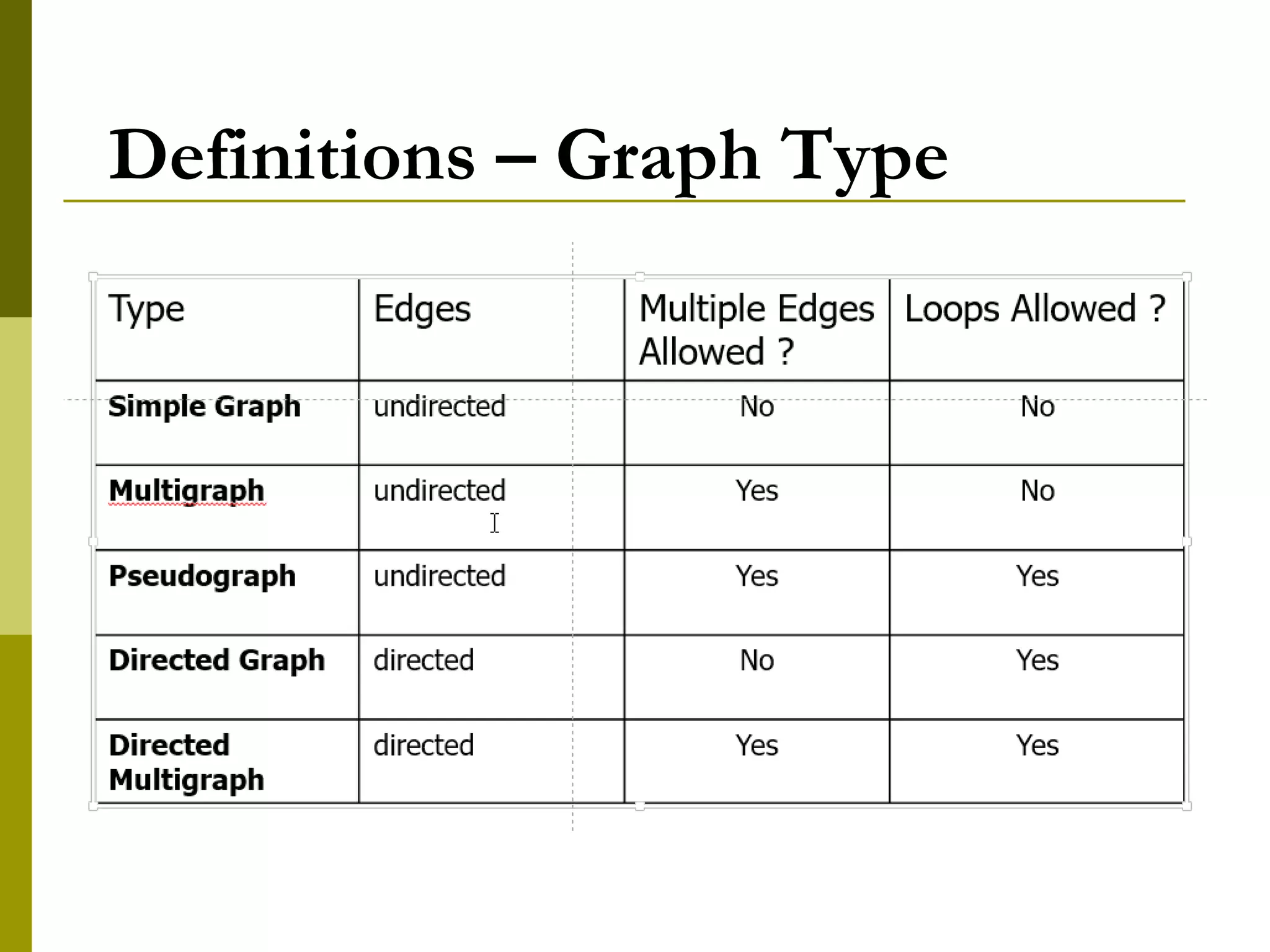
Definitions – Graph Type
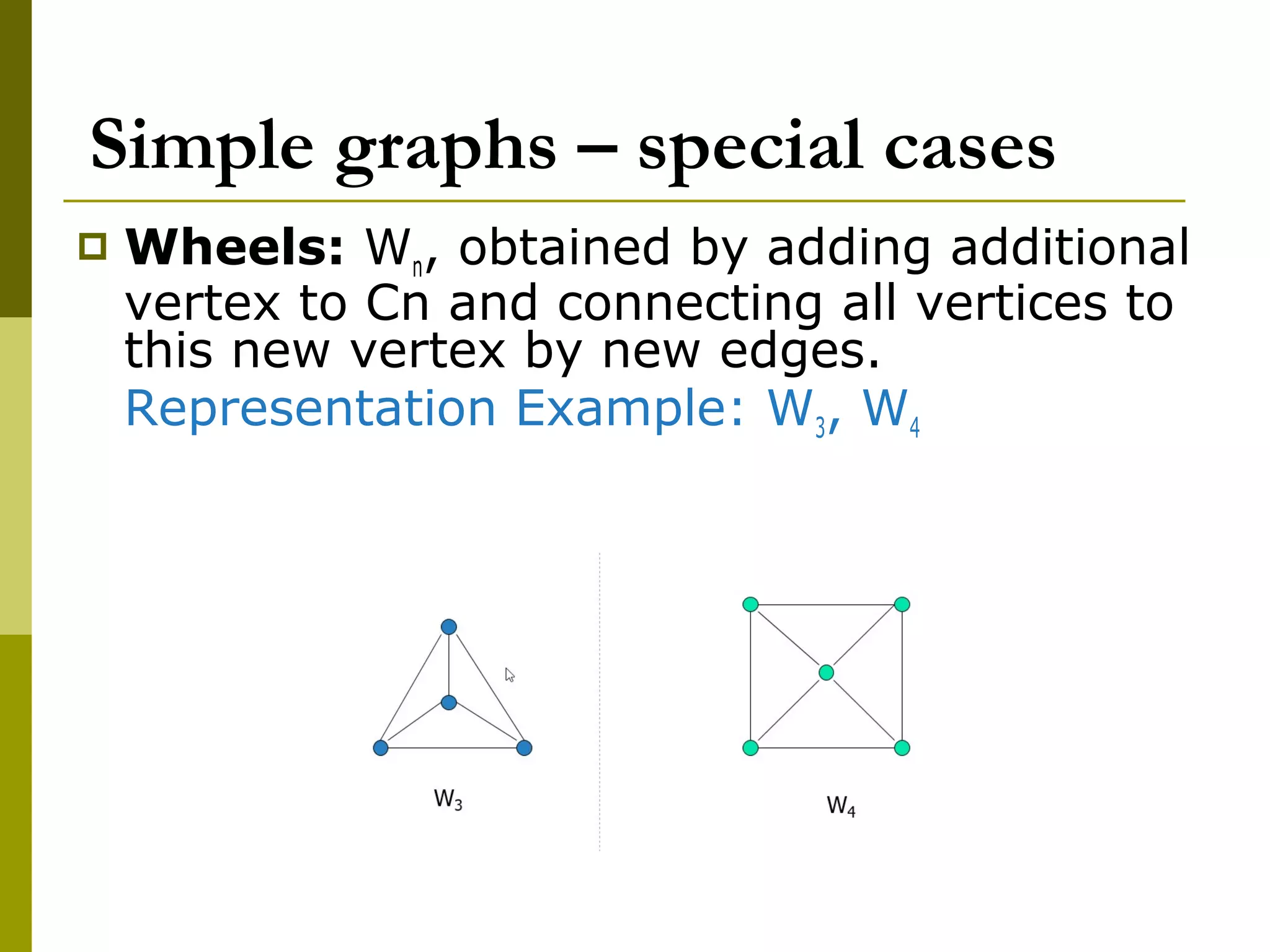
Simple graphs – special cases
 Wheels: Wn, obtained by adding additional
vertex to Cn and connecting all vertices to
this new vertex by new edges.
Representation Example: W3, W4
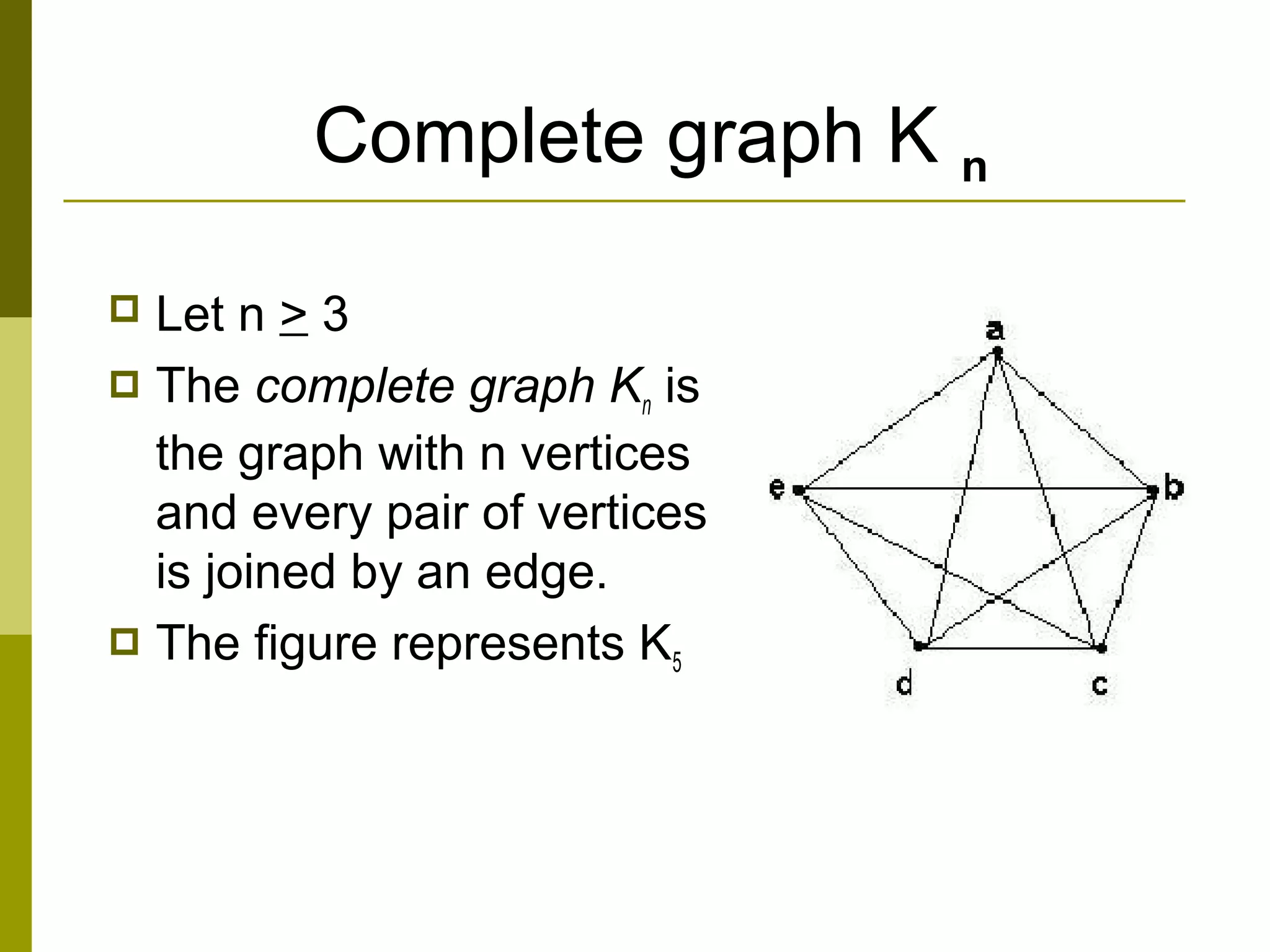
Complete graph K n
 Let n > 3
 The complete graph Kn is
the graph with n vertices
and every pair of vertices
is joined by an edge.
 The figure represents K5
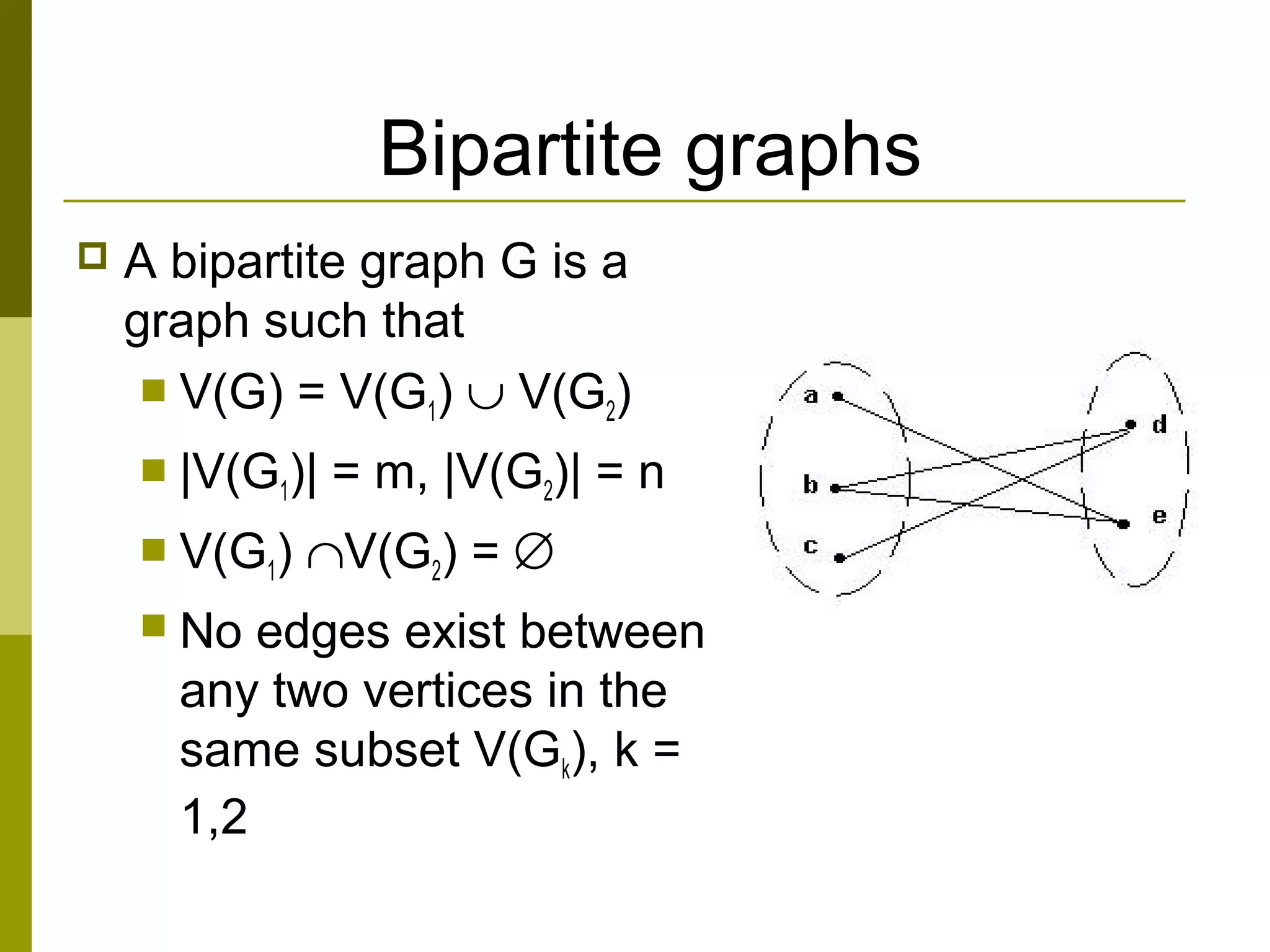
Bipartite graphs
 A bipartite graph G is a
graph such that
 V(G) = V(G1) ∪ V(G2)
 |V(G1)| = m, |V(G2)| = n
 V(G1) ∩V(G2) = ∅
 No edges exist between
any two vertices in the
same subset V(Gk), k =
1,2
Complete bipartite graph Km,n
 A bipartite graph is the
complete bipartite graph Km,n if
every vertex in V(G1) is joined
to a vertex in V(G2) and
conversely,
 |V(G1)| = m
 |V(G2)| = n
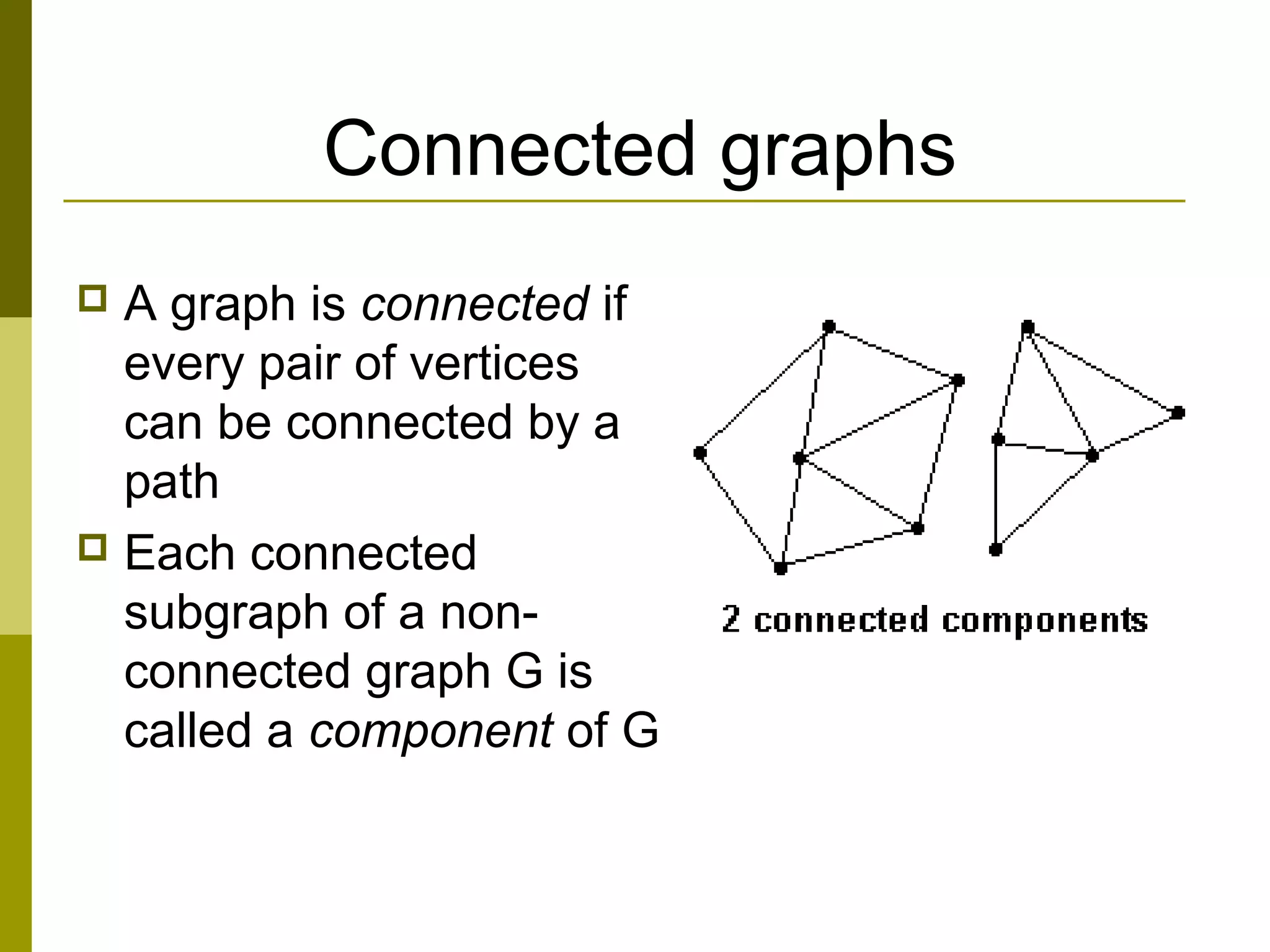
Connected graphs
 A graph is connected if
every pair of vertices
can be connected by a
path
 Each connected
subgraph of a non-
connected graph G is
called a component of G
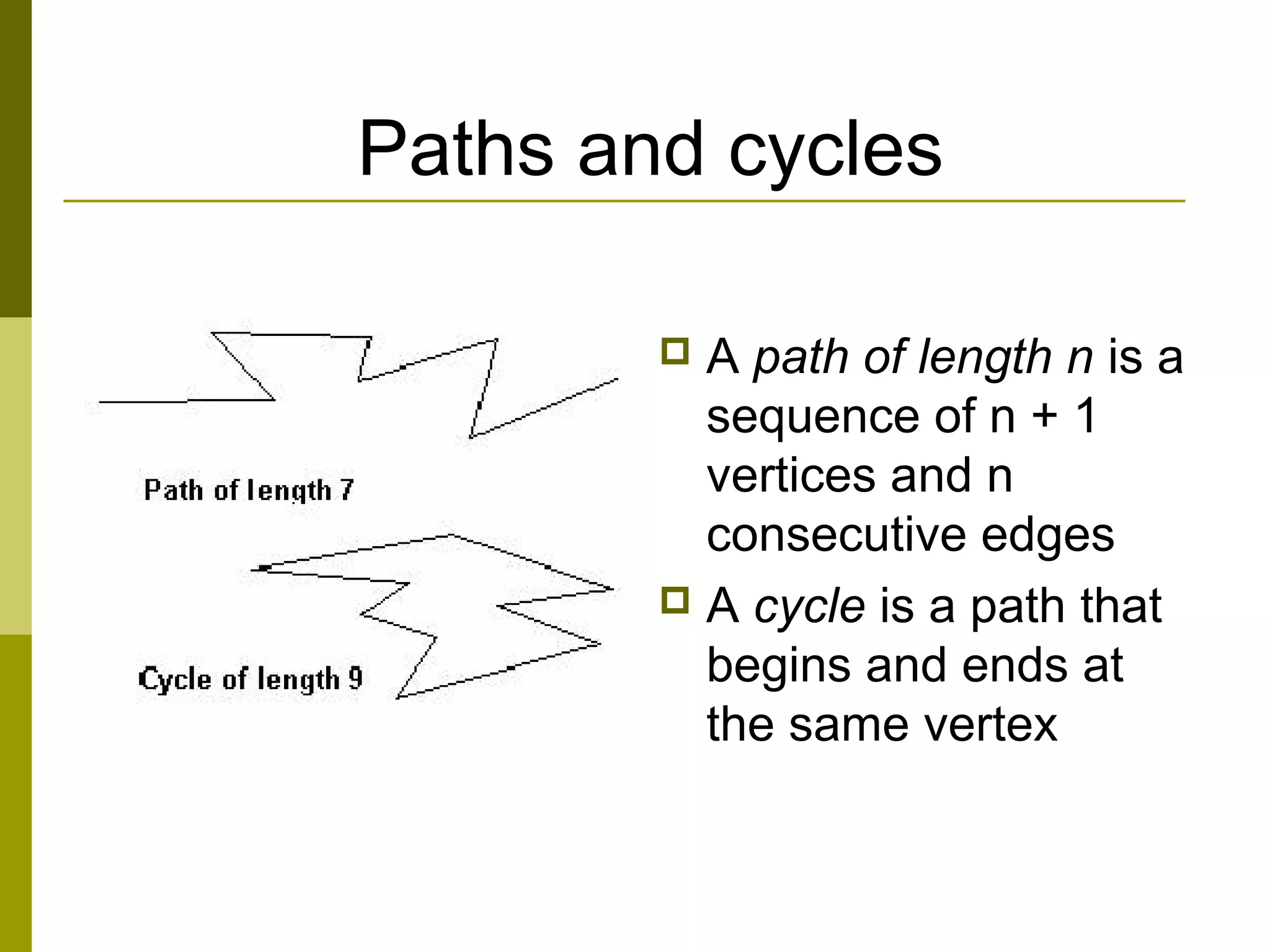
Paths and cycles
 A path of length n is a
sequence of n + 1
vertices and n
consecutive edges
 A cycle is a path that
begins and ends at
the same vertex
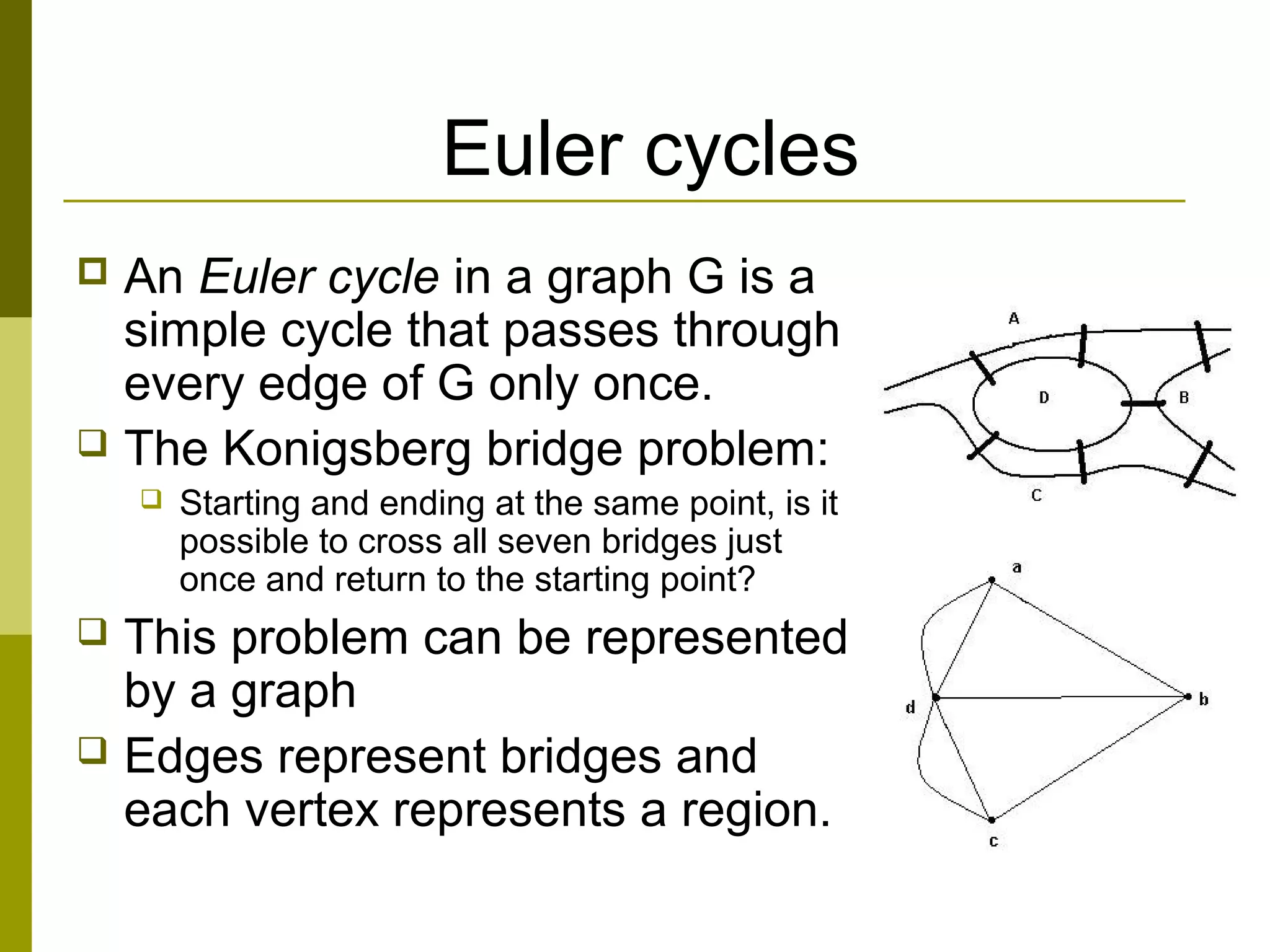
Euler cycles
 An Euler cycle in a graph G is a
simple cycle that passes through
every edge of G only once.
 The Konigsberg bridge problem:
 Starting and ending at the same point, is it
possible to cross all seven bridges just
once and return to the starting point?
 This problem can be represented
by a graph
 Edges represent bridges and
each vertex represents a region.
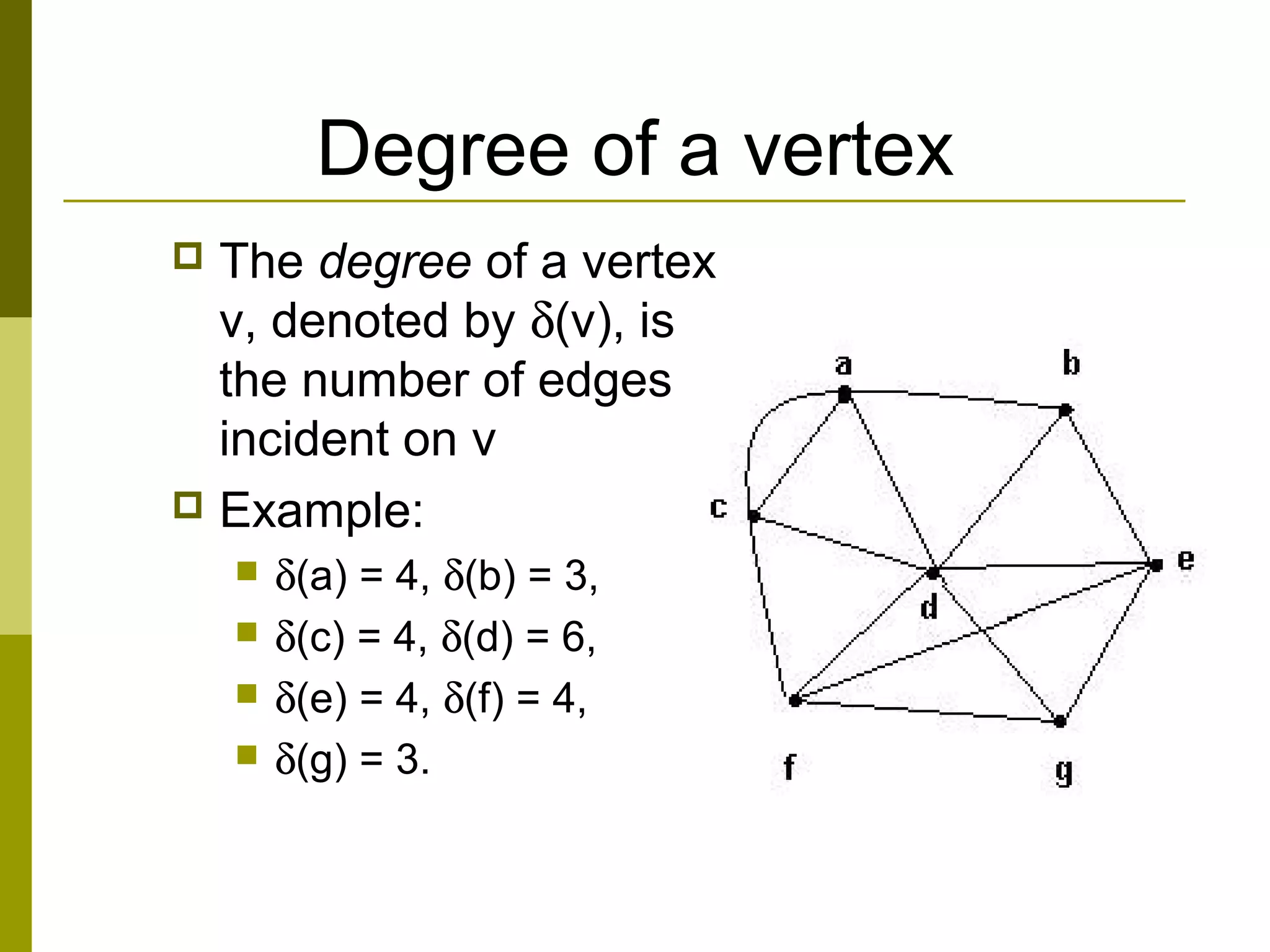
Degree of a vertex
 The degree of a vertex
v, denoted by δ(v), is
the number of edges
incident on v
 Example:
 δ(a) = 4, δ(b) = 3,
 δ(c) = 4, δ(d) = 6,
 δ(e) = 4, δ(f) = 4,
 δ(g) = 3.
Sum of the degrees of a graph
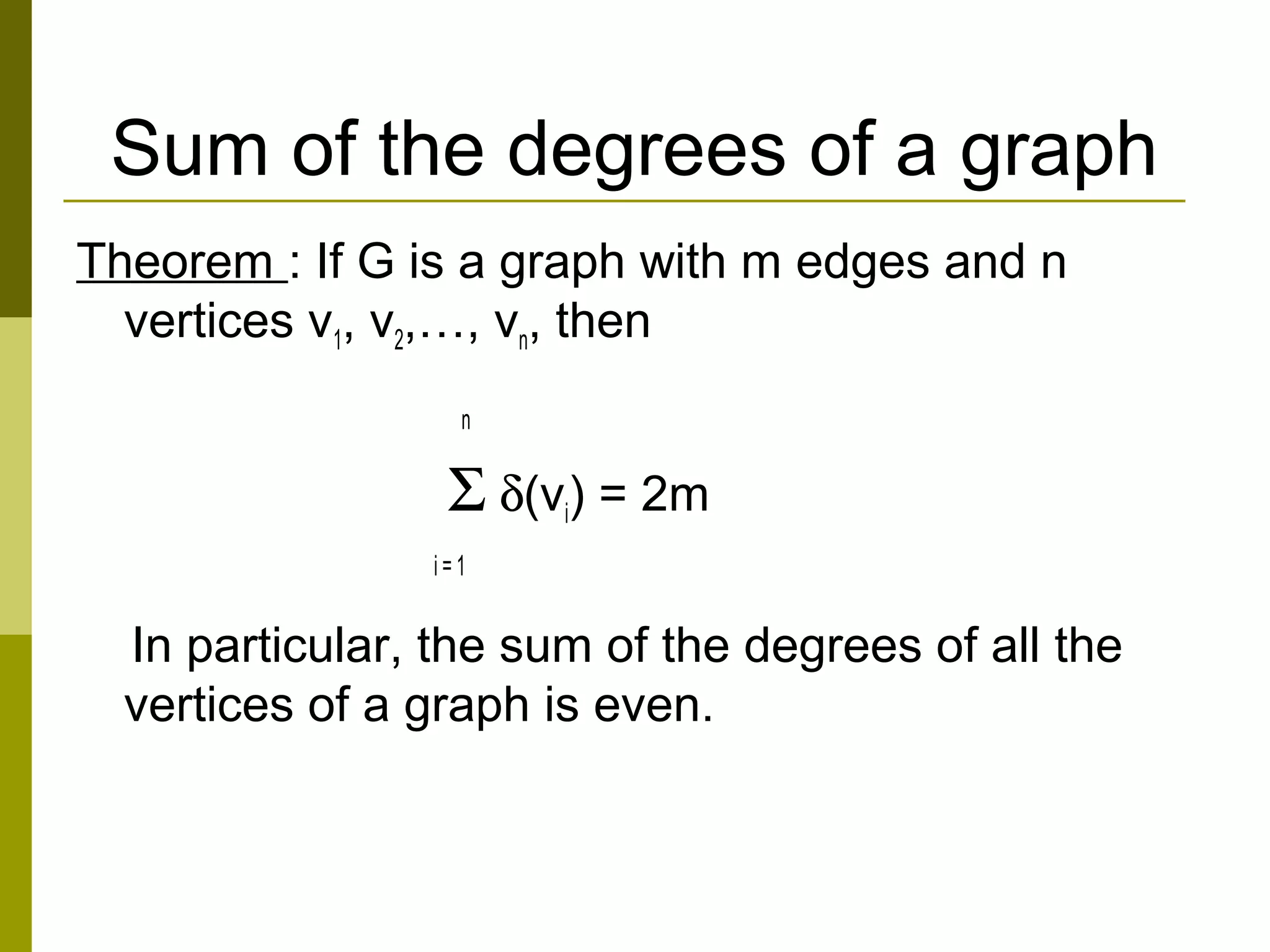
Theorem : If G is a graph with m edges and n
vertices v1, v2,…, vn, then
n
Σ δ(vi) = 2m
i = 1
In particular, the sum of the degrees of all the
vertices of a graph is even.
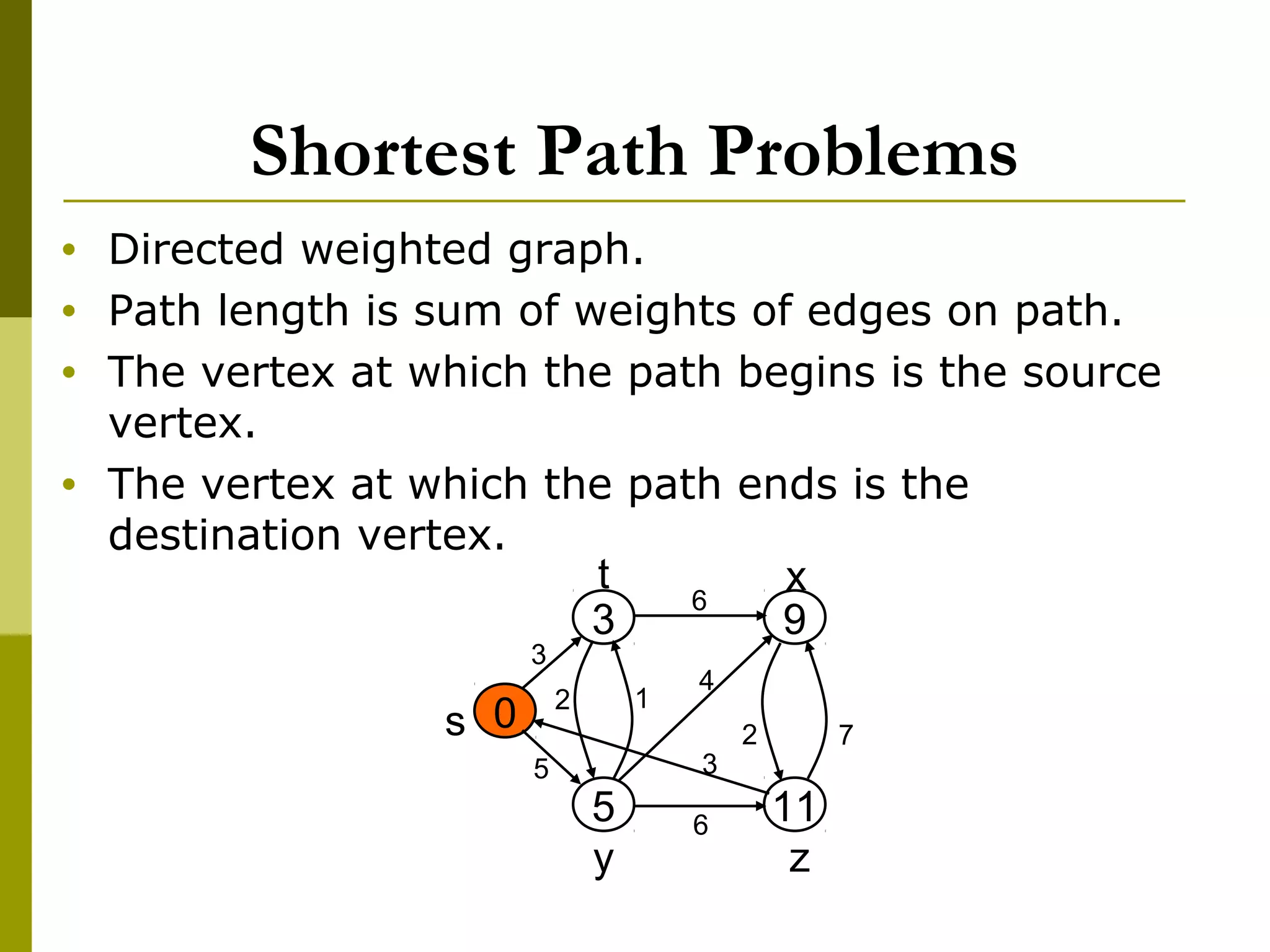
Shortest Path Problems
• Directed weighted graph.
• Path length is sum of weights of edges on path.
• The vertex at which the path begins is the source
vertex.
• The vertex at which the path ends is the
destination vertex.
0
3 9
5 11
3
6
5
7
6
s
t x
y z
2
2 1
4
3
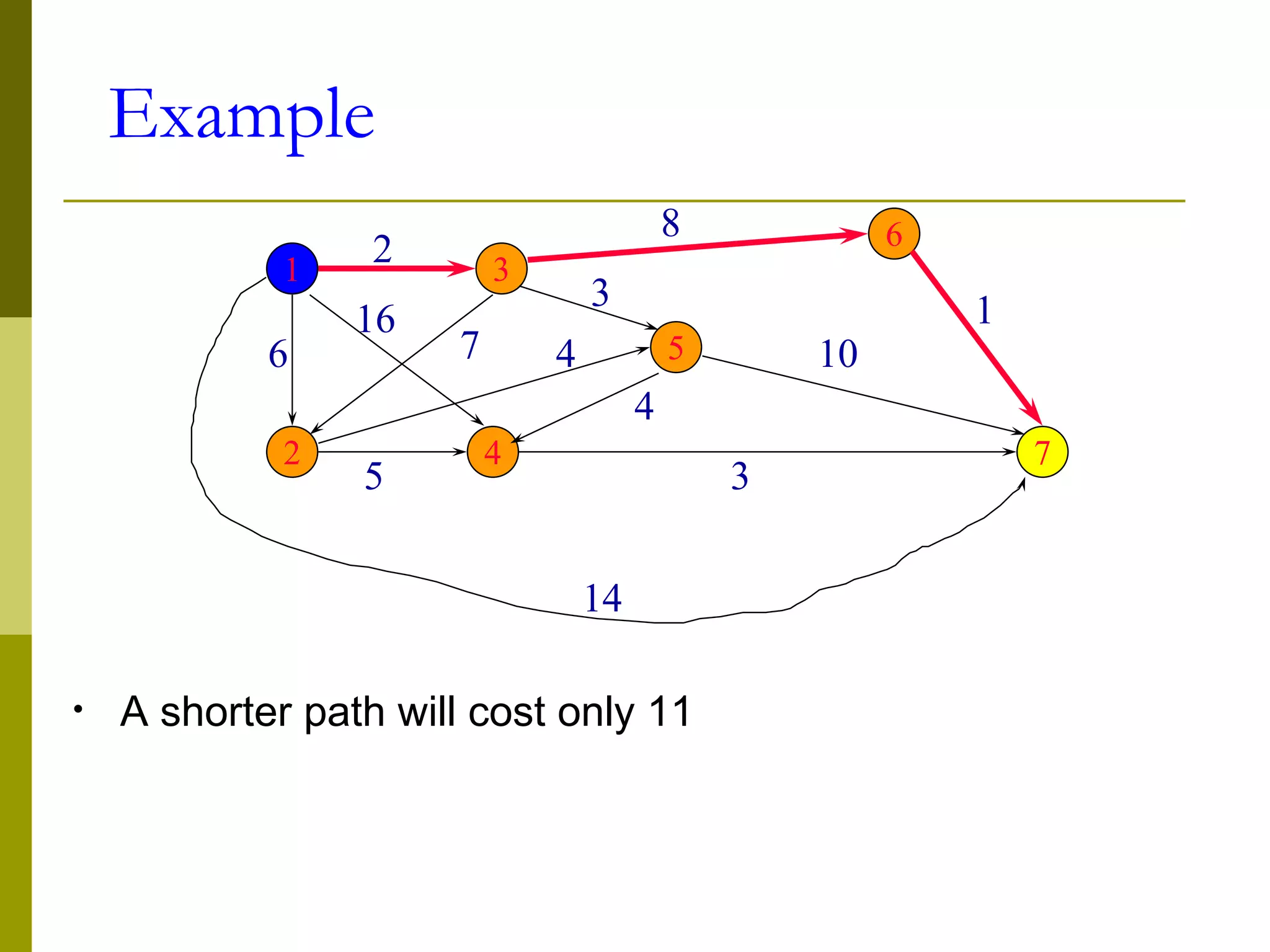
Example
1
2
3
4
5
6
7
2
6
16
7
8
10
3
14
4
4
5 3
1
• A shorter path will cost only 11
Representations of graphs
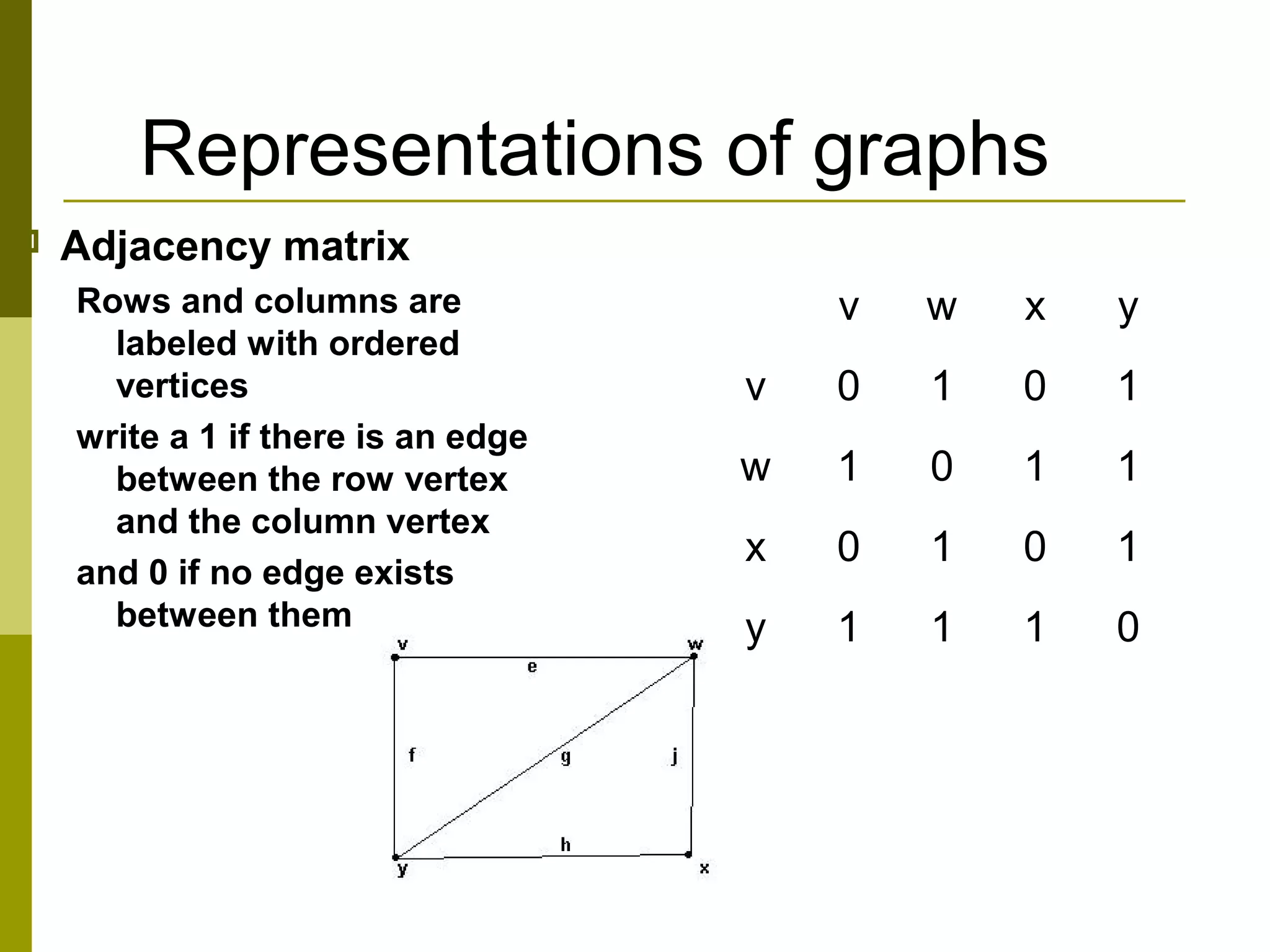
 Adjacency matrix
Rows and columns are
labeled with ordered
vertices
write a 1 if there is an edge
between the row vertex
and the column vertex
and 0 if no edge exists
between them
v w x y
v 0 1 0 1
w 1 0 1 1
x 0 1 0 1
y 1 1 1 0
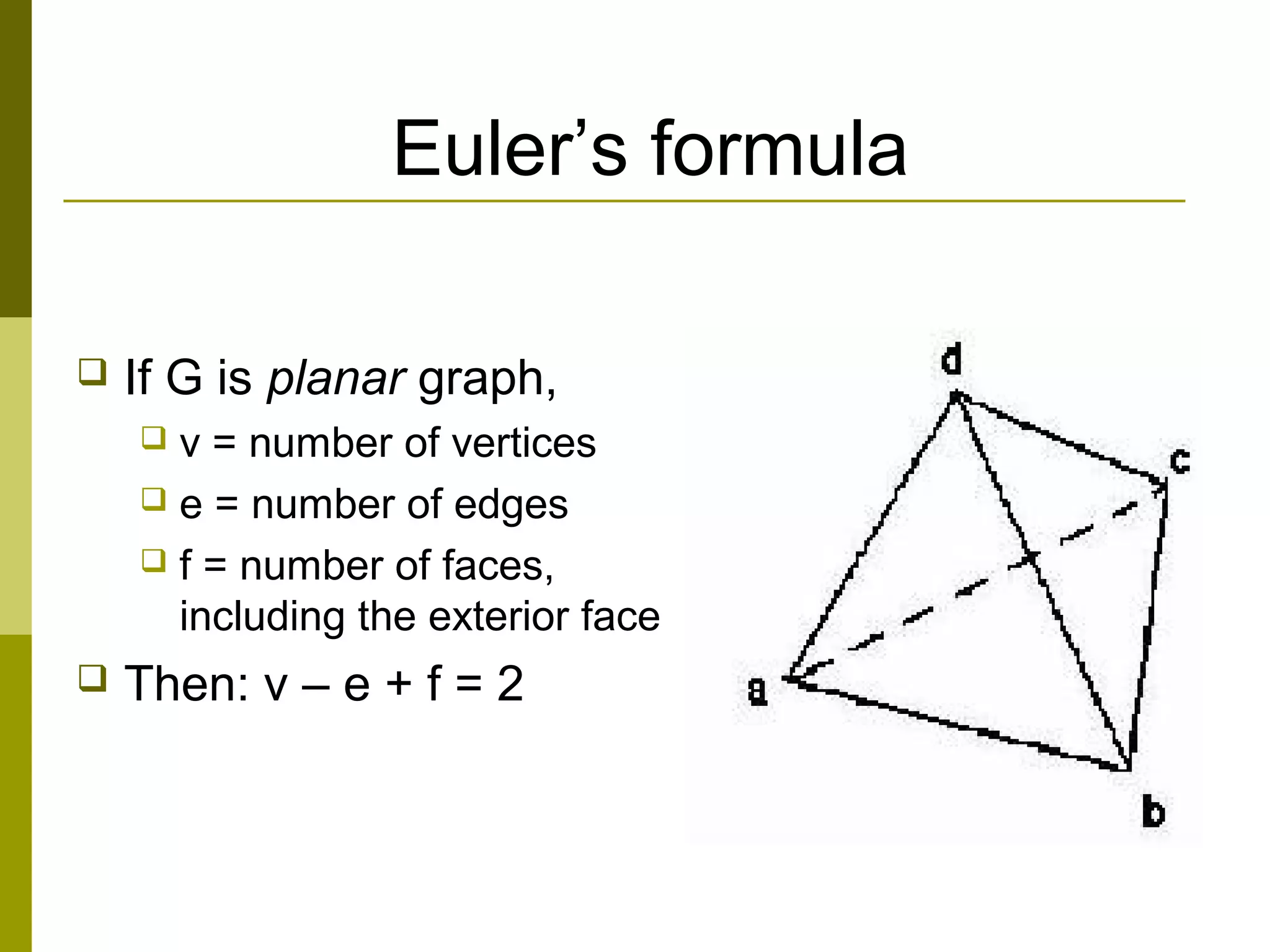
Euler’s formula
 If G is planar graph,
 v = number of vertices
 e = number of edges
 f = number of faces,
including the exterior face
 Then: v – e + f = 2
Graph theory presentation

Graph theory presentation

  • 1.
    Welcome to DiscreteMathematics PRESENTATION Topics: Graph Theory Submited by: Md: Aliul Kadir akib Daffodil International University Mail:aliulkadir@gmail.com
  • 2.
    Introduction  What isa graph G?  It is a pair G = (V, E), where  V = V(G) = set of vertices  E = E(G) = set of edges  Example:  V = {s, u, v, w, x, y, z}  E = {(x,s), (x,v), (x,v), (x,u), (v,w), (s,v), (s,u), (s,w), (s,y), (w,y), (u,y), (u,z),(y,z)}
  • 3.
    Special edges  Paralleledges  Two or more edges joining a pair of vertices  in the example, a and b are joined by two parallel edges  Loops  An edge that starts and ends at the same vertex  In the example, vertex d has a loop
  • 4.
    Special graphs  Simplegraph  A graph without loops or parallel edges.  Weighted graph  A graph where each edge is assigned a numerical label or “weight”.
  • 5.
    Directed graphs (digraphs) Gis a directed graph or digraph if each edge has been associated with an ordered pair of vertices, i.e. each edge has a direction
  • 6.
    Terminology – Undirectedgraphs  u and v are adjacent if {u, v} is an edge, e is called incident with u and v. u and v are called endpoints of {u, v}  Degree of Vertex (deg (v)): the number of edges incident on a vertex. A loop contributes twice to the degree (why?).  Pendant Vertex: deg (v) =1  Isolated Vertex: deg (v) = 0  Representation Example: For V = {u, v, w} , E = { {u, w}, {u, w}, (u, v) }, deg (u) = 2, deg (v) = 1, deg (w) = 1, deg (k) = 0, w and v are pendant , k is isolated
  • 7.
    Terminology – Directedgraphs  For the edge (u, v), u is adjacent to v OR v is adjacent from u, u – Initial vertex, v – Terminal vertex  In-degree (deg- (u)): number of edges for which u is terminal vertex  Out-degree (deg+ (u)): number of edges for which u is initial vertex Note: A loop contributes 1 to both in-degree and out-degree (why?) Representation Example: For V = {u, v, w} , E = { (u, w), ( v, w), (u, v) }, deg- (u) = 0, deg+ (u) = 2, deg- (v) = 1, deg+ (v) = 1, and deg- (w) = 2, deg+ (u) = 0
  • 8.
    Theorems: Undirected Graphs Theorem1 The Handshaking theorem: (why?) Every edge connects 2 vertices ∑∈ = Vv ve2
  • 9.
    Theorems: Undirected Graphs Theorem2: An undirected graph has even number of vertices with odd degree even Voof =⇒ ⇒ ⇒ ∈⇒ +== ∑ ∑∑∑ ∈ ∈∈∈ 2 21 Vv 1, VvVuVv deg(v)termsecond evenalsoistermsecondHence 2e.issumsinceevenisinequalitylastthe ofsidehandrighton thetermslast twotheofsumThe even.isinequalitylasttheofsidehandrightin thefirst termThe Vfor vevenis(v)deg deg(v)deg(u)deg(v)2e verticesdegreeoddtorefersV2andverticesdegreeevenofsettheis1Pr
  • 10.
  • 11.
    Simple graphs –special cases  Wheels: Wn, obtained by adding additional vertex to Cn and connecting all vertices to this new vertex by new edges. Representation Example: W3, W4
  • 12.
    Complete graph Kn  Let n > 3  The complete graph Kn is the graph with n vertices and every pair of vertices is joined by an edge.  The figure represents K5
  • 13.
    Bipartite graphs  Abipartite graph G is a graph such that  V(G) = V(G1) ∪ V(G2)  |V(G1)| = m, |V(G2)| = n  V(G1) ∩V(G2) = ∅  No edges exist between any two vertices in the same subset V(Gk), k = 1,2
  • 14.
    Complete bipartite graphKm,n  A bipartite graph is the complete bipartite graph Km,n if every vertex in V(G1) is joined to a vertex in V(G2) and conversely,  |V(G1)| = m  |V(G2)| = n
  • 15.
    Connected graphs  Agraph is connected if every pair of vertices can be connected by a path  Each connected subgraph of a non- connected graph G is called a component of G
  • 16.
    Paths and cycles A path of length n is a sequence of n + 1 vertices and n consecutive edges  A cycle is a path that begins and ends at the same vertex
  • 17.
    Euler cycles  AnEuler cycle in a graph G is a simple cycle that passes through every edge of G only once.  The Konigsberg bridge problem:  Starting and ending at the same point, is it possible to cross all seven bridges just once and return to the starting point?  This problem can be represented by a graph  Edges represent bridges and each vertex represents a region.
  • 18.
    Degree of avertex  The degree of a vertex v, denoted by δ(v), is the number of edges incident on v  Example:  δ(a) = 4, δ(b) = 3,  δ(c) = 4, δ(d) = 6,  δ(e) = 4, δ(f) = 4,  δ(g) = 3.
  • 19.
    Sum of thedegrees of a graph Theorem : If G is a graph with m edges and n vertices v1, v2,…, vn, then n Σ δ(vi) = 2m i = 1 In particular, the sum of the degrees of all the vertices of a graph is even.
  • 20.
    Shortest Path Problems •Directed weighted graph. • Path length is sum of weights of edges on path. • The vertex at which the path begins is the source vertex. • The vertex at which the path ends is the destination vertex. 0 3 9 5 11 3 6 5 7 6 s t x y z 2 2 1 4 3
  • 21.
  • 22.
    Representations of graphs Adjacency matrix Rows and columns are labeled with ordered vertices write a 1 if there is an edge between the row vertex and the column vertex and 0 if no edge exists between them v w x y v 0 1 0 1 w 1 0 1 1 x 0 1 0 1 y 1 1 1 0
  • 23.
    Euler’s formula  IfG is planar graph,  v = number of vertices  e = number of edges  f = number of faces, including the exterior face  Then: v – e + f = 2