Discrete Matthematics
Course no. CSE 1203
Prepared by: Nikhat Rejoana Sadia
Graph by NikhatREjoanaSadia
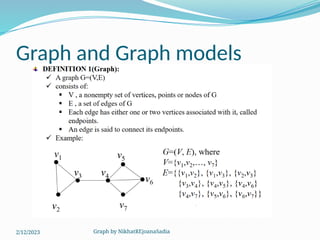
Graph and Graph models
2/12/2023
Graph by NikhatREjoanaSadia
Graph and Graph models
 The set of vertices V of a graph G may be infinite. A
graph with an infinite vertex set is called an infinite
graph.
 A graph with a finite vertex set is called a finite
graph.
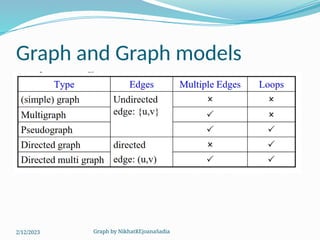
 Simple graph: Graph in which each edge connects
two different vertices and no two edges connect the
same pair of vertices.
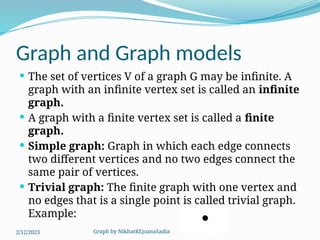
 Trivial graph: The finite graph with one vertex and
no edges that is a single point is called trivial graph.
Example:
2/12/2023
Graph by NikhatREjoanaSadia
Graph and Graph models
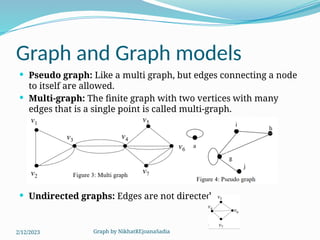
 Pseudo graph: Like a multi graph, but edges connecting a node
to itself are allowed.
 Multi-graph: The finite graph with two vertices with many
edges that is a single point is called multi-graph.
 Undirected graphs: Edges are not directed.
2/12/2023
Graph by NikhatREjoanaSadia
Graph and Graph models
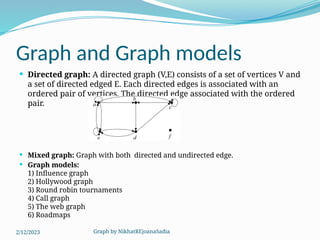
 Directed graph: A directed graph (V,E) consists of a set of vertices V and
a set of directed edged E. Each directed edges is associated with an
ordered pair of vertices. The directed edge associated with the ordered
pair.
 Mixed graph: Graph with both directed and undirected edge.
 Graph models:
1) Influence graph
2) Hollywood graph
3) Round robin tournaments
4) Call graph
5) The web graph
6) Roadmaps
2/12/2023
Graph by NikhatREjoanaSadia
Graph and Graph models
2/12/2023
Graph by NikhatREjoanaSadia
Graph Terminology
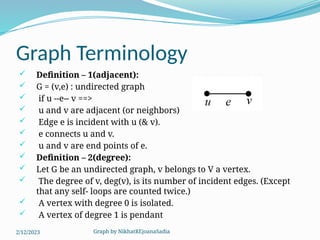
 Definition – 1(adjacent):
 G = (v,e) : undirected graph
 if u --e-- v ==>
 u and v are adjacent (or neighbors)
 Edge e is incident with u (& v).
 e connects u and v.
 u and v are end points of e.
 Definition – 2(degree):
 Let G be an undirected graph, v belongs to V a vertex.
 The degree of v, deg(v), is its number of incident edges. (Except
that any self- loops are counted twice.)
 A vertex with degree 0 is isolated.
 A vertex of degree 1 is pendant
2/12/2023
Graph by NikhatREjoanaSadia
Graph Terminology
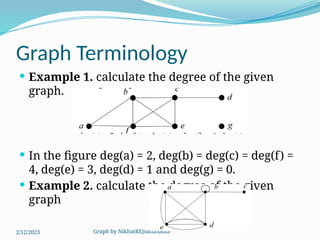
 Example 1. calculate the degree of the given
graph.
 In the figure deg(a) = 2, deg(b) = deg(c) = deg(f) =
4, deg(e) = 3, deg(d) = 1 and deg(g) = 0.
 Example 2. calculate the degree of the given
graph
2/12/2023
Graph by NikhatREjoanaSadia
Graph Terminology
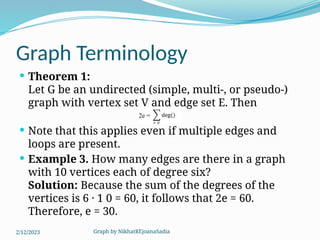
 Theorem 1:
Let G be an undirected (simple, multi-, or pseudo-)
graph with vertex set V and edge set E. Then
 Note that this applies even if multiple edges and
loops are present.
 Example 3. How many edges are there in a graph
with 10 vertices each of degree six?
Solution: Because the sum of the degrees of the
vertices is 6 · 1 0 = 60, it follows that 2e = 60.
Therefore, e = 30.
2/12/2023
Graph by NikhatREjoanaSadia
Graph Terminology
 Definition-4: Let G be a directed graph, v a vertex of G.
 The in-degree of v, deg-(v), is the number of edges going to v or the number
of edges with as their terminal vertex.
 The out-degree of v, deg+(v) , is the number of edges coming from v or the
number of edges with as their initial vertex.
 The degree of v, deg(v) = deg-(v) + deg+(v) , is the sum of v’s in-degree and
out-degree.
 Example 4: Find the in-degree and out-degree of each vertex in the graph
G with directed edges.
deg-(a)=2, deg+(a)=4
deg-(b)=2, deg+(b)=1
deg-(c)=3, deg+(c)=2
deg-(d)=2, deg+(d)=2
deg-(e)=3, deg+(e)=3
deg-(f )=0, deg+(f )=0
2/12/2023
Graph by NikhatREjoanaSadia
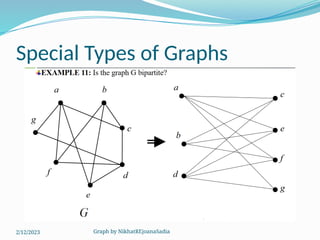
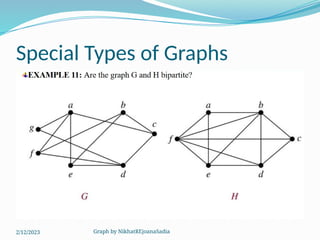
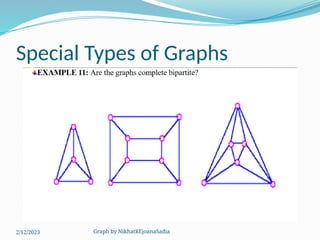
Special Types of Graphs
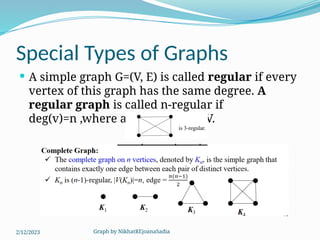
 A simple graph G=(V, E) is called regular if every
vertex of this graph has the same degree. A
regular graph is called n-regular if
deg(v)=n ,where all v belongs to V.
2/12/2023
Graph by NikhatREjoanaSadia
Special Types of Graphs
2/12/2023
Graph by NikhatREjoanaSadia
Special Types of Graphs
2/12/2023
Graph by NikhatREjoanaSadia
Special Types of Graphs
2/12/2023
Graph by NikhatREjoanaSadia
Special Types of Graphs
2/12/2023
Graph by NikhatREjoanaSadia
Special Types of Graphs
2/12/2023
Graph by NikhatREjoanaSadia
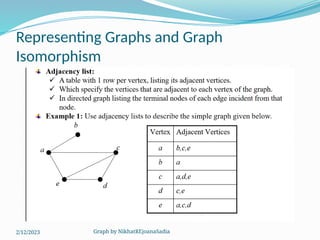
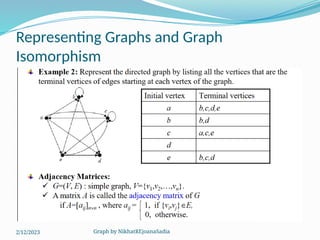
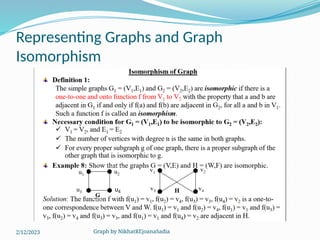
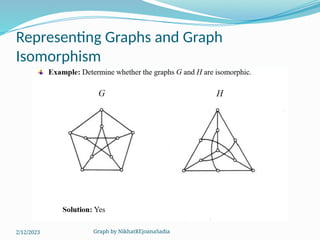
Representing Graphs and Graph
Isomorphism
2/12/2023
Graph by NikhatREjoanaSadia
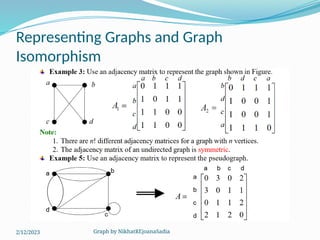
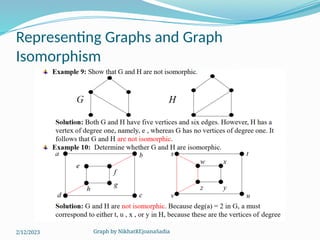
Representing Graphs and Graph
Isomorphism
2/12/2023
Graph by NikhatREjoanaSadia
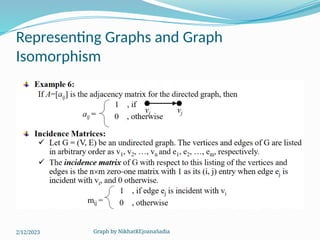
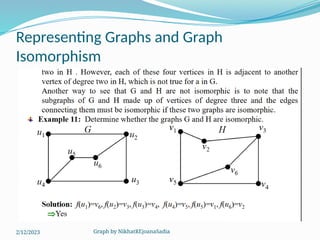
Representing Graphs and Graph
Isomorphism
2/12/2023
Graph by NikhatREjoanaSadia
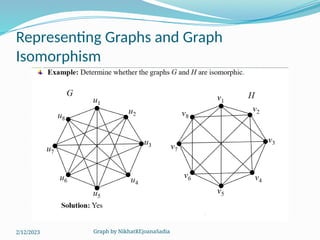
Representing Graphs and Graph
Isomorphism
2/12/2023
Graph by NikhatREjoanaSadia
Representing Graphs and Graph
Isomorphism
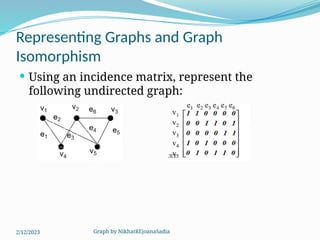
 Using an incidence matrix, represent the
following undirected graph:
2/12/2023
Graph by NikhatREjoanaSadia
Representing Graphs and Graph
Isomorphism
2/12/2023
Graph by NikhatREjoanaSadia
Representing Graphs and Graph
Isomorphism
2/12/2023
Graph by NikhatREjoanaSadia
Representing Graphs and Graph
Isomorphism
2/12/2023
Graph by NikhatREjoanaSadia
Representing Graphs and Graph
Isomorphism
2/12/2023
Graph by NikhatREjoanaSadia
Representing Graphs and Graph
Isomorphism
2/12/2023
Graph by NikhatREjoanaSadia
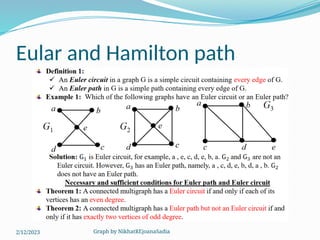
Eular and Hamilton path
2/12/2023
Graph by NikhatREjoanaSadia
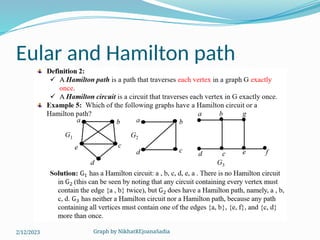
Eular and Hamilton path
2/12/2023
Graph by NikhatREjoanaSadia
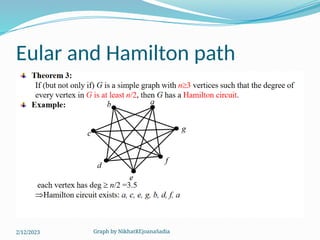
Eular and Hamilton path
2/12/2023
Graph by NikhatREjoanaSadia
Eular and Hamilton path
2/12/2023
Graph by NikhatREjoanaSadia
Shortest path algorithm
2/12/2023
Graph by NikhatREjoanaSadia
Shortest path algorithm
2/12/2023
Graph by NikhatREjoanaSadia
Shortest path algorithm
2/12/2023
Graph by NikhatREjoanaSadia
Shortest path algorithm
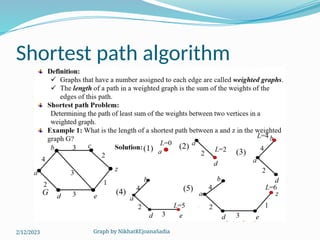
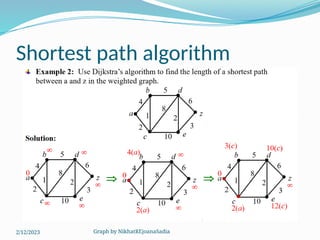
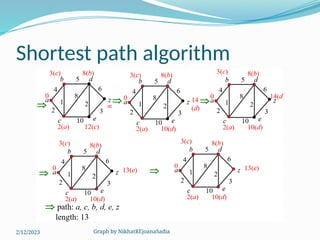
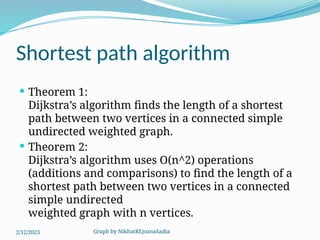
 Theorem 1:
Dijkstra’s algorithm finds the length of a shortest
path between two vertices in a connected simple
undirected weighted graph.
 Theorem 2:
Dijkstra’s algorithm uses O(n^2) operations
(additions and comparisons) to find the length of a
shortest path between two vertices in a connected
simple undirected
weighted graph with n vertices.
2/12/2023
Graph by NikhatREjoanaSadia
Graph coloring
2/12/2023
Graph by NikhatREjoanaSadia
Graph coloring
2/12/2023
Graph by NikhatREjoanaSadia
Graph coloring
2/12/2023
Graph by NikhatREjoanaSadia
Graph coloring
2/12/2023
Graph by NikhatREjoanaSadia
Graph coloring
2/12/2023

Discrete mathematics 4 on Computer science and engineering.pptx