Thoracotomy
By kajal sansoya
What is Thoracotomy ?
o It is process of making an incision into the
chest wall.
o Performed by a surgeon , to gain access to the
thoracic organs, most commonly heart, lungs
and esophagus or thoracic aorta & sometimes
to access the tumors in spine.
Purpose
o Thoracotomy allows to study the conditions
of the lungs such as removal of lung or part of
lung or removal of rib.
o Thoracotomy also provide access to heart ,
diaphragm and portions of aorta which passes
through the chest cavity.
o Lung cancer is most common cancer requiring
a thoracotomy. Tumors growth can be
removed through the incision.
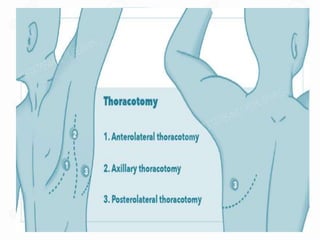
Approaches to Thoractomy
• There are 3 main subtypes of thoracotomy
incisions
Posterolateral incision
Anterolateral incision
Axillary incision
Posterolateral
• It is a gold standard for access to the thorax. It
provides access to all thoracic viscera, & is
mainly used for pulmonary resections.
• It is very common approach for operations on
lungs. When performed on 5th intercostal
space , it allows optimal access to pulmonary
hilum( pulmonary artery and pulmonary vein)
• Incision of choice for pulmonary resections i.e
pneumonectomy & lobectomy.
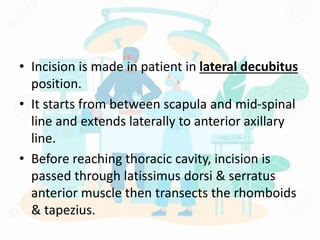
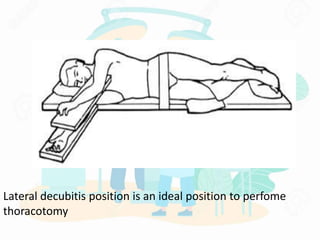
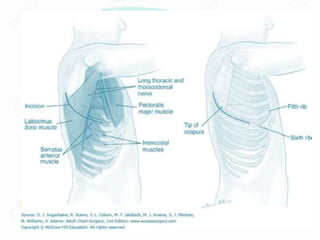
• Incision is made in patient in lateral decubitus
position.
• It starts from between scapula and mid-spinal
line and extends laterally to anterior axillary
line.
• Before reaching thoracic cavity, incision is
passed through latissimus dorsi & serratus
anterior muscle then transects the rhomboids
& tapezius.
Lateral decubitis position is an ideal position to perfome
thoracotomy
Anterolateral
• Incision is made under breast. Incision can be
used in a variety of operations for cardiac,
pulmonary and oesophageal pathology.
• Left anterolateral thoracotomy is incision of
choice for open massage.
• Incision runs from lateral border of sternum to
the mid-axillary line at 4th or 5th intercostal
space, dividing through the pectoralis major &
serratus anterior in it approach.
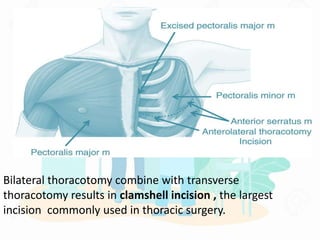
Bilateral thoracotomy combine with transverse
thoracotomy results in clamshell incision , the largest
incision commonly used in thoracic surgery.
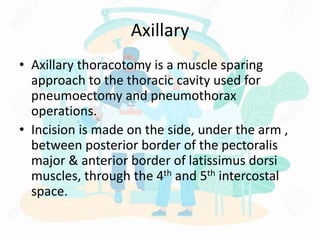
Axillary
• Axillary thoracotomy is a muscle sparing
approach to the thoracic cavity used for
pneumoectomy and pneumothorax
operations.
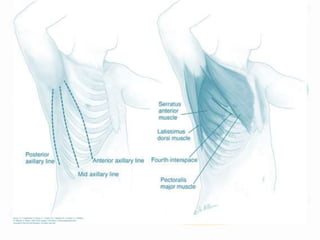
• Incision is made on the side, under the arm ,
between posterior border of the pectoralis
major & anterior border of latissimus dorsi
muscles, through the 4th and 5th intercostal
space.
• Incision reduces muscle damage and has good
cosmetic outcomes.
• Gave exposure to thoracic viscera.
• It is choice of incision in majority of PDA
conditon and pulmonary resections
conditions.
Thank you
Happy reading

Thoracotomy

  • 1.
  • 2.
    What is Thoracotomy? o It is process of making an incision into the chest wall. o Performed by a surgeon , to gain access to the thoracic organs, most commonly heart, lungs and esophagus or thoracic aorta & sometimes to access the tumors in spine.
  • 3.
    Purpose o Thoracotomy allowsto study the conditions of the lungs such as removal of lung or part of lung or removal of rib. o Thoracotomy also provide access to heart , diaphragm and portions of aorta which passes through the chest cavity. o Lung cancer is most common cancer requiring a thoracotomy. Tumors growth can be removed through the incision.
  • 4.
    Approaches to Thoractomy •There are 3 main subtypes of thoracotomy incisions Posterolateral incision Anterolateral incision Axillary incision
  • 5.
    Posterolateral • It isa gold standard for access to the thorax. It provides access to all thoracic viscera, & is mainly used for pulmonary resections. • It is very common approach for operations on lungs. When performed on 5th intercostal space , it allows optimal access to pulmonary hilum( pulmonary artery and pulmonary vein) • Incision of choice for pulmonary resections i.e pneumonectomy & lobectomy.
  • 6.
    • Incision ismade in patient in lateral decubitus position. • It starts from between scapula and mid-spinal line and extends laterally to anterior axillary line. • Before reaching thoracic cavity, incision is passed through latissimus dorsi & serratus anterior muscle then transects the rhomboids & tapezius.
  • 7.
    Lateral decubitis positionis an ideal position to perfome thoracotomy
  • 9.
    Anterolateral • Incision ismade under breast. Incision can be used in a variety of operations for cardiac, pulmonary and oesophageal pathology. • Left anterolateral thoracotomy is incision of choice for open massage. • Incision runs from lateral border of sternum to the mid-axillary line at 4th or 5th intercostal space, dividing through the pectoralis major & serratus anterior in it approach.
  • 10.
    Bilateral thoracotomy combinewith transverse thoracotomy results in clamshell incision , the largest incision commonly used in thoracic surgery.
  • 11.
    Axillary • Axillary thoracotomyis a muscle sparing approach to the thoracic cavity used for pneumoectomy and pneumothorax operations. • Incision is made on the side, under the arm , between posterior border of the pectoralis major & anterior border of latissimus dorsi muscles, through the 4th and 5th intercostal space.
  • 12.
    • Incision reducesmuscle damage and has good cosmetic outcomes. • Gave exposure to thoracic viscera. • It is choice of incision in majority of PDA conditon and pulmonary resections conditions.
  • 15.