THE COMPLEMENT SYSTEM
OF TELEOST
S.J.Abisha
MFT 16085
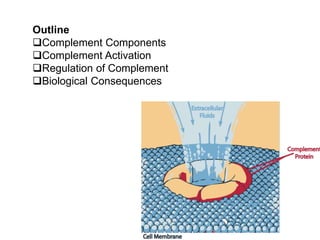
Outline
Complement Components
Complement Activation
Regulation of Complement
Biological Consequences
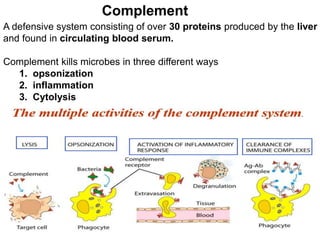
A defensive system consisting of over 30 proteins produced by the liver
and found in circulating blood serum.
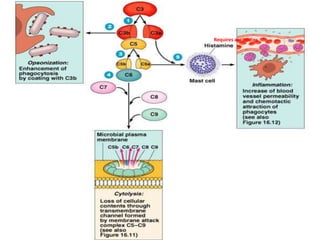
Complement kills microbes in three different ways
1. opsonization
2. inflammation
3. Cytolysis
Complement
COMPLEMENT
COMPONENTS
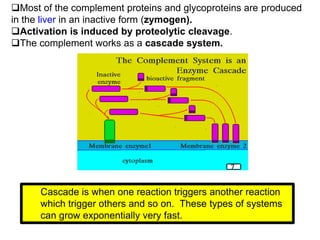
Most of the complement proteins and glycoproteins are produced
in the liver in an inactive form (zymogen).
Activation is induced by proteolytic cleavage.
The complement works as a cascade system.
Cascade is when one reaction triggers another reaction
which trigger others and so on. These types of systems
can grow exponentially very fast.
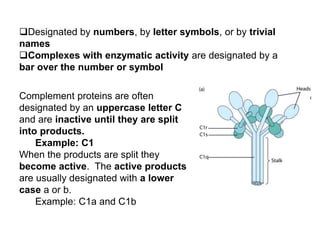
Complement proteins are often
designated by an uppercase letter C
and are inactive until they are split
into products.
Example: C1
When the products are split they
become active. The active products
are usually designated with a lower
case a or b.
Example: C1a and C1b
Designated by numbers, by letter symbols, or by trivial
names
Complexes with enzymatic activity are designated by a
bar over the number or symbol
The larger fragments binds to the target near the site of
the activation and the smaller fragments diffuse from the
site and can initiate localized inflammatory response by
binding to specific receptors.
The complement fragments interact one another to form
functional complexes.
Those complexes having enzymatic activity are written by a
bar over the symbol or number (eg- C4b2a3b)
The complement components isolated in teleost are
C1q,C1r,C1s,MBL,MASP,Bf,C2,C3,C4,C5,C6,C7,C8,C9
and Factor D
In fish more than 4 C3 isoforms and 2 C4 isoforms
have been identified.
In cyclostomes , cytolytic activity of the complent is
absent in serum and has only the alternative pathway of C3
activation.
The complement system of shark or cartilaginous fish
contain the classical and alternate pathway.
Like mammals fish also has CCP and ACP.
Complement system
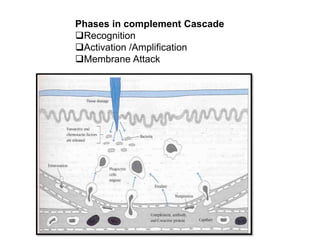
Phases in complement Cascade
Recognition
Activation /Amplification
Membrane Attack
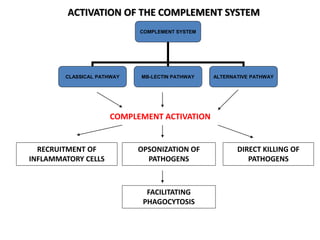
ACTIVATION OF THE COMPLEMENT SYSTEM
COMPLEMENT SYSTEM
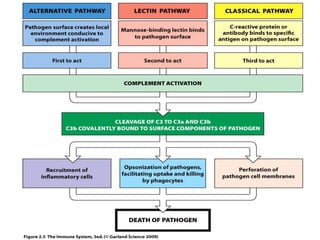
CLASSICAL PATHWAY MB-LECTIN PATHWAY ALTERNATIVE PATHWAY
COMPLEMENT ACTIVATION
RECRUITMENT OF
INFLAMMATORY CELLS
OPSONIZATION OF
PATHOGENS
DIRECT KILLING OF
PATHOGENS
FACILITATING
PHAGOCYTOSIS
ACTIVATION VIA THE CLASSICAL
PATHWAY
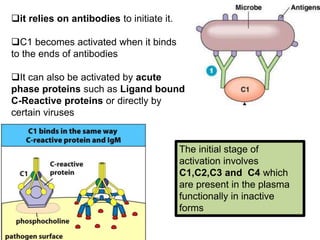
it relies on antibodies to initiate it.
C1 becomes activated when it binds
to the ends of antibodies
It can also be activated by acute
phase proteins such as Ligand bound
C-Reactive proteins or directly by
certain viruses
The initial stage of
activation involves
C1,C2,C3 and C4 which
are present in the plasma
functionally in inactive
forms
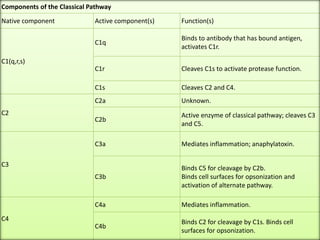
Components of the Classical Pathway
Native component Active component(s) Function(s)
C1(q,r,s)
C1q
Binds to antibody that has bound antigen,
activates C1r.
C1r Cleaves C1s to activate protease function.
C1s Cleaves C2 and C4.
C2
C2a Unknown.
C2b
Active enzyme of classical pathway; cleaves C3
and C5.
C3
C3a Mediates inflammation; anaphylatoxin.
C3b
Binds C5 for cleavage by C2b.
Binds cell surfaces for opsonization and
activation of alternate pathway.
C4
C4a Mediates inflammation.
C4b
Binds C2 for cleavage by C1s. Binds cell
surfaces for opsonization.
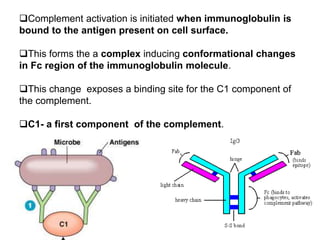
Complement activation is initiated when immunoglobulin is
bound to the antigen present on cell surface.
This forms the a complex inducing conformational changes
in Fc region of the immunoglobulin molecule.
This change exposes a binding site for the C1 component of
the complement.
C1- a first component of the complement.
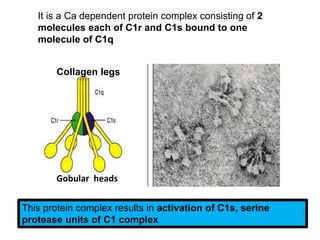
Gobular heads
Collagen legs
It is a Ca dependent protein complex consisting of 2
molecules each of C1r and C1s bound to one
molecule of C1q
This protein complex results in activation of C1s, serine
protease units of C1 complex
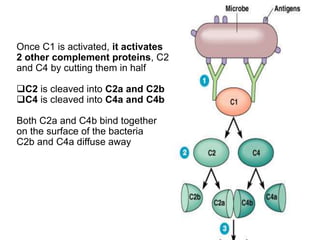
Once C1 is activated, it activates
2 other complement proteins, C2
and C4 by cutting them in half
C2 is cleaved into C2a and C2b
C4 is cleaved into C4a and C4b
Both C2a and C4b bind together
on the surface of the bacteria
C2b and C4a diffuse away
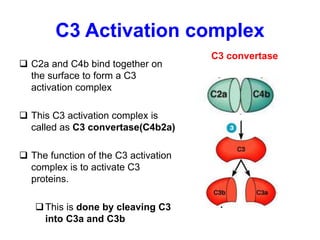
C3 Activation complex
 C2a and C4b bind together on
the surface to form a C3
activation complex
 This C3 activation complex is
called as C3 convertase(C4b2a)
 The function of the C3 activation
complex is to activate C3
proteins.
This is done by cleaving C3
into C3a and C3b
C3 convertase
C3 is the one of the most abundant proteins in the serum and
plays important role or central role in complement activation.
The native C3 component consists of 2 polypeptide chains-
α and β
Hydrolyses of C3a of the α chain by the C3 convertase
generates C3b.
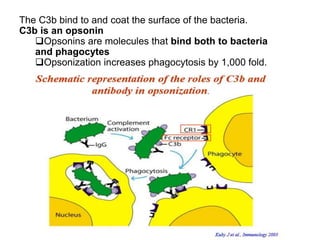
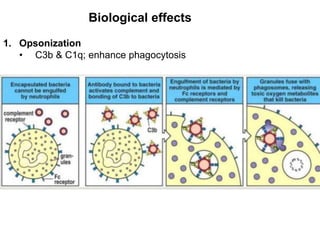
The C3b bind to and coat the surface of the bacteria.
C3b is an opsonin
Opsonins are molecules that bind both to bacteria
and phagocytes
Opsonization increases phagocytosis by 1,000 fold.
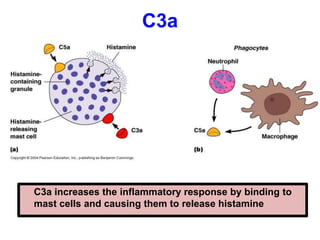
C3a
C3a increases the inflammatory response by binding to
mast cells and causing them to release histamine
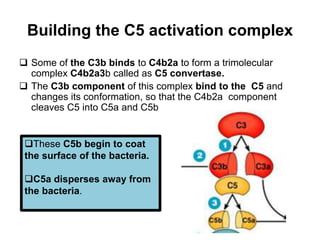
Building the C5 activation complex
 Some of the C3b binds to C4b2a to form a trimolecular
complex C4b2a3b called as C5 convertase.
 The C3b component of this complex bind to the C5 and
changes its conformation, so that the C4b2a component
cleaves C5 into C5a and C5b
These C5b begin to coat
the surface of the bacteria.
C5a disperses away from
the bacteria.
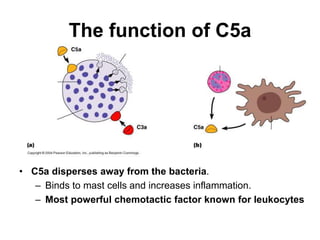
The function of C5a
• C5a disperses away from the bacteria.
– Binds to mast cells and increases inflammation.
– Most powerful chemotactic factor known for leukocytes
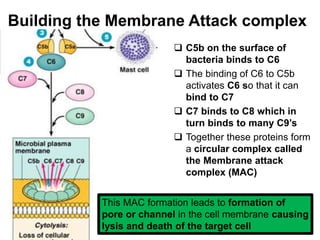
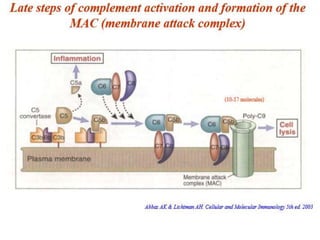
Building the Membrane Attack complex
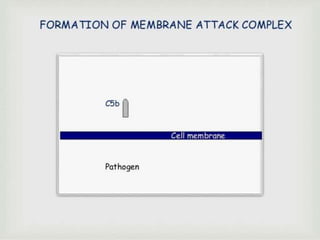
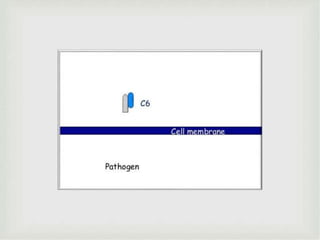
 C5b on the surface of
bacteria binds to C6
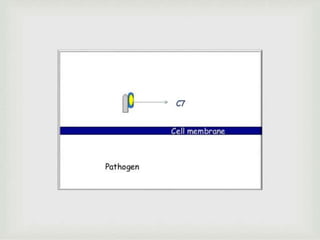
 The binding of C6 to C5b
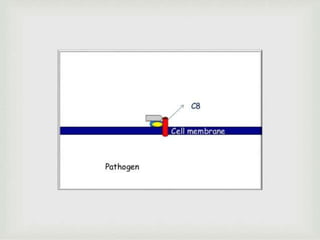
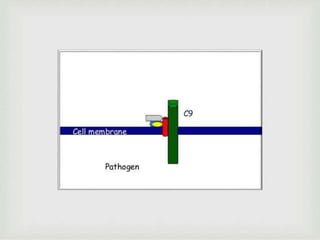
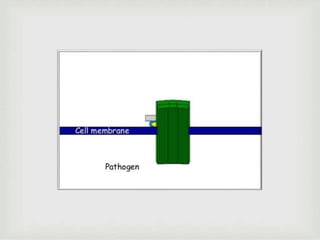
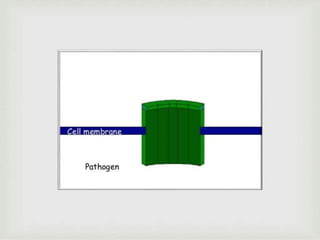
activates C6 so that it can
bind to C7
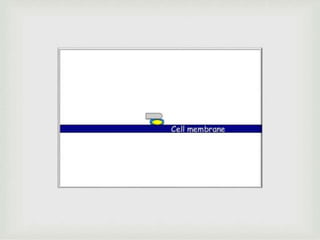
 C7 binds to C8 which in
turn binds to many C9’s
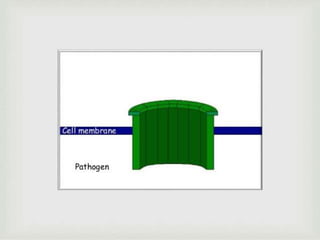
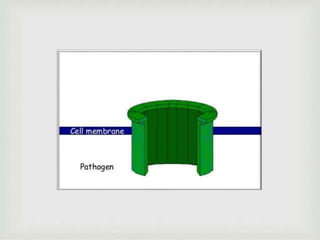
 Together these proteins form
a circular complex called
the Membrane attack
complex (MAC)
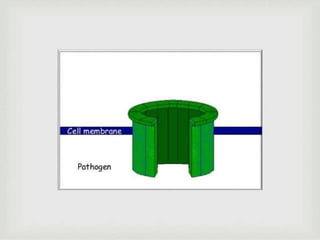
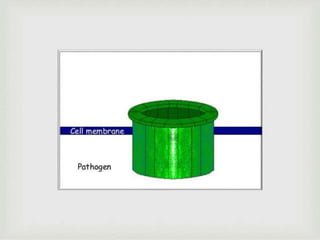
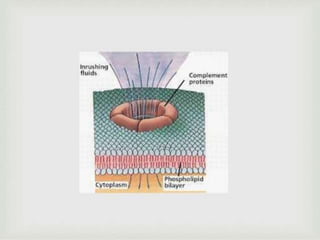
This MAC formation leads to formation of
pore or channel in the cell membrane causing
lysis and death of the target cell
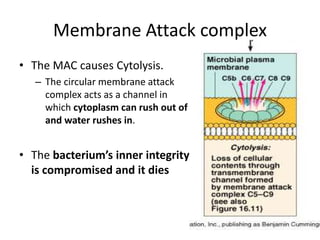
Membrane Attack complex
• The MAC causes Cytolysis.
– The circular membrane attack
complex acts as a channel in
which cytoplasm can rush out of
and water rushes in.
• The bacterium’s inner integrity
is compromised and it dies
Requires antibodies
ACTIVATION VIA THE
ALTERNATIVE PATHWAY
The alternative pathway
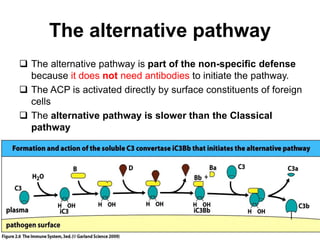
 The alternative pathway is part of the non-specific defense
because it does not need antibodies to initiate the pathway.
 The ACP is activated directly by surface constituents of foreign
cells
 The alternative pathway is slower than the Classical
pathway
Components of the Alternate Pathway
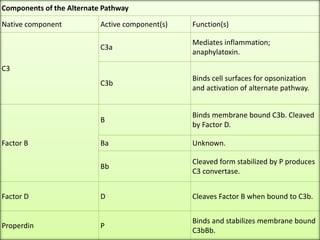
Native component Active component(s) Function(s)
C3
C3a
Mediates inflammation;
anaphylatoxin.
C3b
Binds cell surfaces for opsonization
and activation of alternate pathway.
Factor B
B
Binds membrane bound C3b. Cleaved
by Factor D.
Ba Unknown.
Bb
Cleaved form stabilized by P produces
C3 convertase.
Factor D D Cleaves Factor B when bound to C3b.
Properdin P
Binds and stabilizes membrane bound
C3bBb.
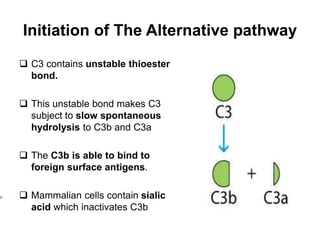
Initiation of The Alternative pathway
 C3 contains unstable thioester
bond.
 This unstable bond makes C3
subject to slow spontaneous
hydrolysis to C3b and C3a
 The C3b is able to bind to
foreign surface antigens.
 Mammalian cells contain sialic
acid which inactivates C3b
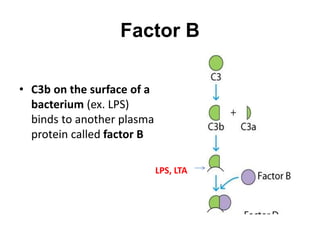
Factor B
• C3b on the surface of a
bacterium (ex. LPS)
binds to another plasma
protein called factor B
LPS, LTA
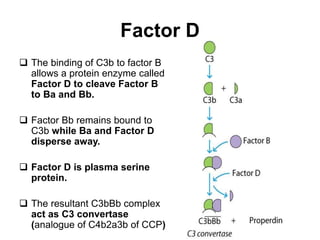
Factor D
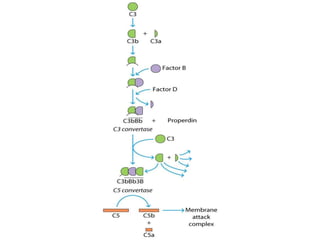
 The binding of C3b to factor B
allows a protein enzyme called
Factor D to cleave Factor B
to Ba and Bb.
 Factor Bb remains bound to
C3b while Ba and Factor D
disperse away.
 Factor D is plasma serine
protein.
 The resultant C3bBb complex
act as C3 convertase
(analogue of C4b2a3b of CCP)
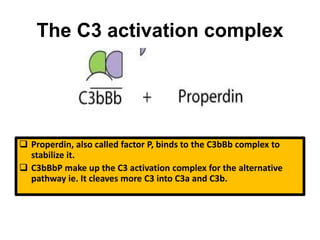
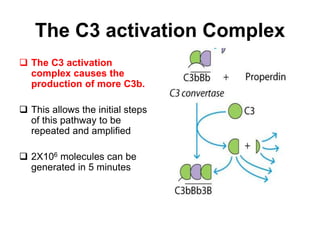
The C3 activation complex
 Properdin, also called factor P, binds to the C3bBb complex to
stabilize it.
 C3bBbP make up the C3 activation complex for the alternative
pathway ie. It cleaves more C3 into C3a and C3b.
The C3 activation Complex
 The C3 activation
complex causes the
production of more C3b.
 This allows the initial steps
of this pathway to be
repeated and amplified
 2X10⁶ molecules can be
generated in 5 minutes
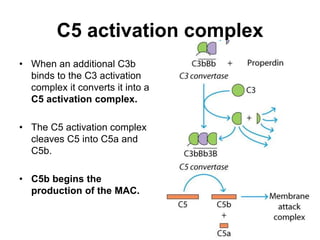
C5 activation complex
• When an additional C3b
binds to the C3 activation
complex it converts it into a
C5 activation complex.
• The C5 activation complex
cleaves C5 into C5a and
C5b.
• C5b begins the
production of the MAC.
ACTIVATION VIA THE MANNAN-
BINDING LECTIN PATHWAY
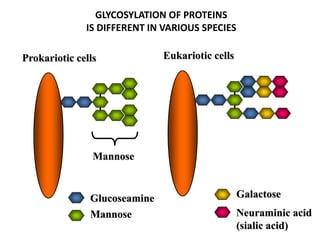
Mannose
Eukariotic cells
Glucoseamine
Mannose
Galactose
Neuraminic acid
(sialic acid)
GLYCOSYLATION OF PROTEINS
IS DIFFERENT IN VARIOUS SPECIES
Prokariotic cells
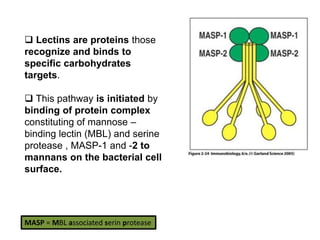
 Lectins are proteins those
recognize and binds to
specific carbohydrates
targets.
 This pathway is initiated by
binding of protein complex
constituting of mannose –
binding lectin (MBL) and serine
protease , MASP-1 and -2 to
mannans on the bacterial cell
surface.
MASP = MBL associated serin protease
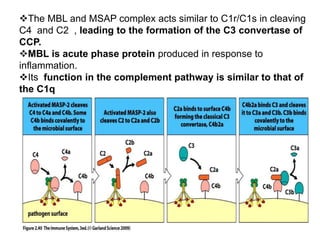
The MBL and MSAP complex acts similar to C1r/C1s in cleaving
C4 and C2 , leading to the formation of the C3 convertase of
CCP.
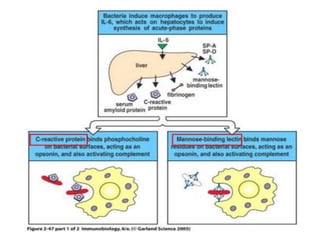
MBL is acute phase protein produced in response to
inflammation.
Its function in the complement pathway is similar to that of
the C1q
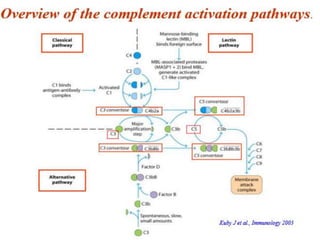
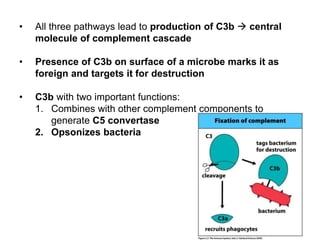
• All three pathways lead to production of C3b  central
molecule of complement cascade
• Presence of C3b on surface of a microbe marks it as
foreign and targets it for destruction
• C3b with two important functions:
1. Combines with other complement components to
generate C5 convertase
2. Opsonizes bacteria
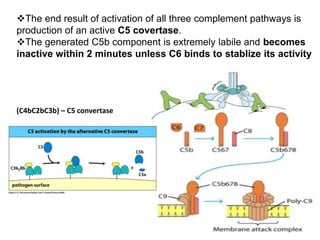
The end result of activation of all three complement pathways is
production of an active C5 covertase.
The generated C5b component is extremely labile and becomes
inactive within 2 minutes unless C6 binds to stablize its activity
(C4bC2bC3b) – C5 convertase
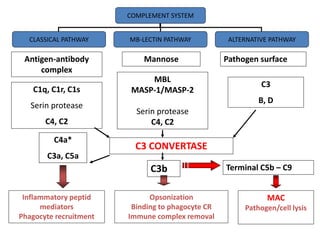
COMPLEMENT ACTIVATION
SUMMARY
Antigen-antibody
complex
Mannose Pathogen surface
C1q, C1r, C1s
Serin protease
C4, C2
MBL
MASP-1/MASP-2
Serin protease
C4, C2
C3
B, D
COMPLEMENT SYSTEM
CLASSICAL PATHWAY MB-LECTIN PATHWAY ALTERNATIVE PATHWAY
C3 CONVERTASE
C4a*
C3a, C5a
Inflammatory peptid
mediators
Phagocyte recruitment
C3b
Opsonization
Binding to phagocyte CR
Immune complex removal
Terminal C5b – C9
MAC
Pathogen/cell lysis
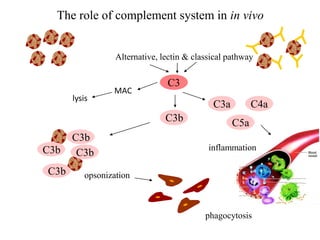
inflammation
The role of complement system in in vivo
Alternative, lectin & classical pathway
C3
C3b
opsonization
phagocytosis
C3b
C3bC3b
C3b
C5a
C4aC3a
MAC
lysis
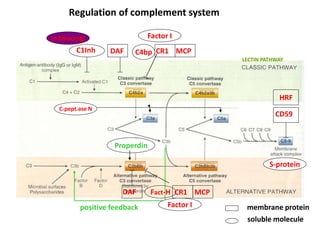
REGULATION OF THE
COMPLEMENT SYSTEM
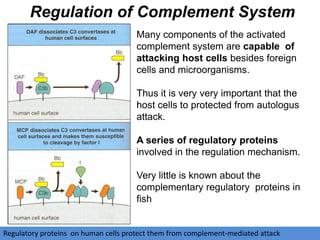
Many components of the activated
complement system are capable of
attacking host cells besides foreign
cells and microorganisms.
Thus it is very very important that the
host cells to protected from autologus
attack.
A series of regulatory proteins
involved in the regulation mechanism.
Very little is known about the
complementary regulatory proteins in
fish
Regulation of Complement System
Regulatory proteins on human cells protect them from complement-mediated attack
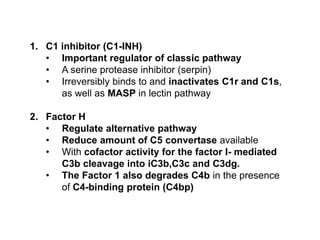
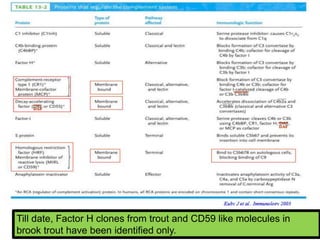
1. C1 inhibitor (C1-INH)
• Important regulator of classic pathway
• A serine protease inhibitor (serpin)
• Irreversibly binds to and inactivates C1r and C1s,
as well as MASP in lectin pathway
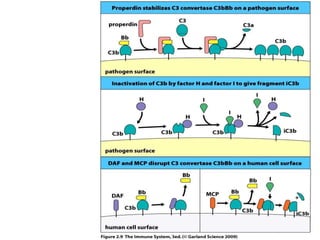
2. Factor H
• Regulate alternative pathway
• Reduce amount of C5 convertase available
• With cofactor activity for the factor I- mediated
C3b cleavage into iC3b,C3c and C3dg.
• The Factor 1 also degrades C4b in the presence
of C4-binding protein (C4bp)
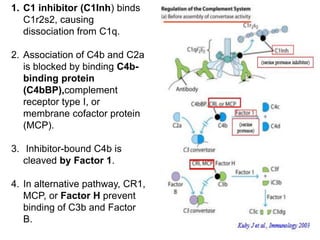
1. C1 inhibitor (C1Inh) binds
C1r2s2, causing
dissociation from C1q.
2. Association of C4b and C2a
is blocked by binding C4b-
binding protein
(C4bBP),complement
receptor type I, or
membrane cofactor protein
(MCP).
3. Inhibitor-bound C4b is
cleaved by Factor 1.
4. In alternative pathway, CR1,
MCP, or Factor H prevent
binding of C3b and Factor
B.
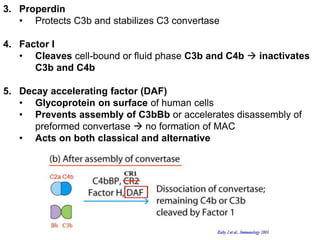
3. Properdin
• Protects C3b and stabilizes C3 convertase
4. Factor I
• Cleaves cell-bound or fluid phase C3b and C4b  inactivates
C3b and C4b
5. Decay accelerating factor (DAF)
• Glycoprotein on surface of human cells
• Prevents assembly of C3bBb or accelerates disassembly of
preformed convertase  no formation of MAC
• Acts on both classical and alternative
6. C4b-binding protein (C4BP)
• Inhibits the action of C4b in classical pathway
• Splits C4 convertase and is a cofactor for factor I
7. Complement Receptor 1 (CR-1)
• Co-factor for factor I, together with CD46
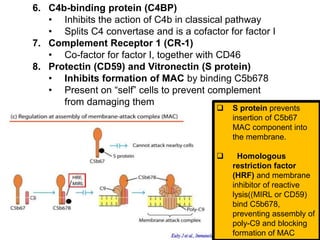
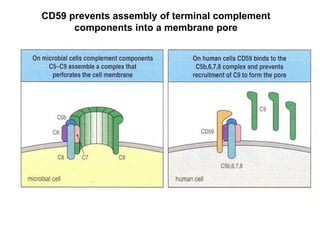
8. Protectin (CD59) and Vitronectin (S protein)
• Inhibits formation of MAC by binding C5b678
• Present on “self” cells to prevent complement
from damaging them
 S protein prevents
insertion of C5b67
MAC component into
the membrane.
 Homologous
restriction factor
(HRF) and membrane
inhibitor of reactive
lysis((MIRL or CD59)
bind C5b678,
preventing assembly of
poly-C9 and blocking
formation of MAC
Till date, Factor H clones from trout and CD59 like molecules in
brook trout have been identified only.
CD59 prevents assembly of terminal complement
components into a membrane pore
DAFC1Inh
Properdin
positive feedback
Factor I
CR1 MCPC4bp
Factor I
Fact-H CR1 MCPDAF
CD59
HRF
S-protein
a-2macrogl
LECTIN PATHWAY
Regulation of complement system
membrane protein
soluble molecule
C-pept.ase N
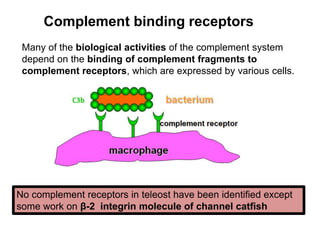
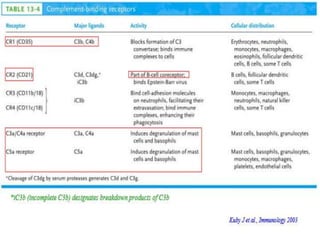
Complement binding receptors
Many of the biological activities of the complement system
depend on the binding of complement fragments to
complement receptors, which are expressed by various cells.
No complement receptors in teleost have been identified except
some work on β-2 integrin molecule of channel catfish
1. Opsonization
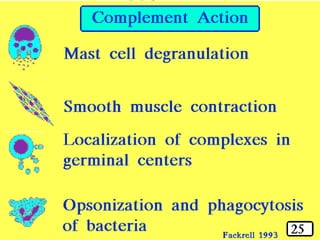
• C3b & C1q; enhance phagocytosis
Biological effects
Complement mediated inflammation
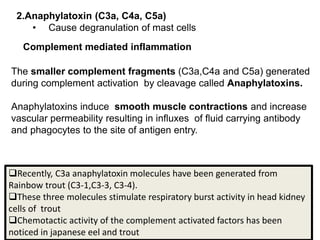
The smaller complement fragments (C3a,C4a and C5a) generated
during complement activation by cleavage called Anaphylatoxins.
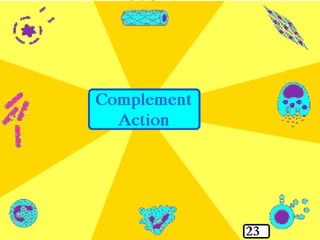
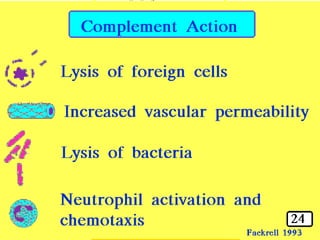
Anaphylatoxins induce smooth muscle contractions and increase
vascular permeability resulting in influxes of fluid carrying antibody
and phagocytes to the site of antigen entry.
Recently, C3a anaphylatoxin molecules have been generated from
Rainbow trout (C3-1,C3-3, C3-4).
These three molecules stimulate respiratory burst activity in head kidney
cells of trout
Chemotactic activity of the complement activated factors has been
noticed in japanese eel and trout
2.Anaphylatoxin (C3a, C4a, C5a)
• Cause degranulation of mast cells
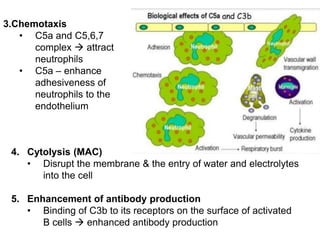
3.Chemotaxis
• C5a and C5,6,7
complex  attract
neutrophils
• C5a – enhance
adhesiveness of
neutrophils to the
endothelium
4. Cytolysis (MAC)
• Disrupt the membrane & the entry of water and electrolytes
into the cell
5. Enhancement of antibody production
• Binding of C3b to its receptors on the surface of activated
B cells  enhanced antibody production
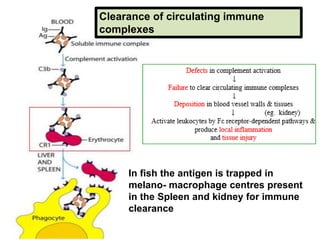
Clearance of circulating immune
complexes
In fish the antigen is trapped in
melano- macrophage centres present
in the Spleen and kidney for immune
clearance
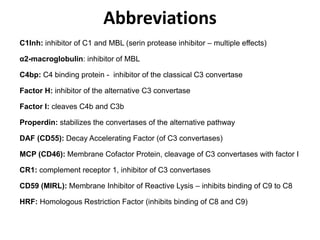
C1Inh: inhibitor of C1 and MBL (serin protease inhibitor – multiple effects)
α2-macroglobulin: inhibitor of MBL
C4bp: C4 binding protein - inhibitor of the classical C3 convertase
Factor H: inhibitor of the alternative C3 convertase
Factor I: cleaves C4b and C3b
Properdin: stabilizes the convertases of the alternative pathway
DAF (CD55): Decay Accelerating Factor (of C3 convertases)
MCP (CD46): Membrane Cofactor Protein, cleavage of C3 convertases with factor I
CR1: complement receptor 1, inhibitor of C3 convertases
CD59 (MIRL): Membrane Inhibitor of Reactive Lysis – inhibits binding of C9 to C8
HRF: Homologous Restriction Factor (inhibits binding of C8 and C9)
Abbreviations
References
 The complement by Hugh B. Fackrell & Maria Sawicki
THE MULTIPLE ROLES OF COMPLEMENT –
Dr Andrew Guirguis
Haematology Registrar
The Alfred Hospital
Scientific Meeting – 22nd May, 2008
 Kuby immunology 7th edition
Immunology – 4th edition-
[Richard_A._Goldsby,_Thomas_J._Kindt,_Barbara_A._O(B
ookZZ.org)
https;//www.ncbi.nlm.nih.gov
https;//www.immunology.org
https;//www.boundless.com

Complement system

  • 1.
    THE COMPLEMENT SYSTEM OFTELEOST S.J.Abisha MFT 16085
  • 2.
  • 3.
    A defensive systemconsisting of over 30 proteins produced by the liver and found in circulating blood serum. Complement kills microbes in three different ways 1. opsonization 2. inflammation 3. Cytolysis Complement
  • 4.
  • 5.
    Most of thecomplement proteins and glycoproteins are produced in the liver in an inactive form (zymogen). Activation is induced by proteolytic cleavage. The complement works as a cascade system. Cascade is when one reaction triggers another reaction which trigger others and so on. These types of systems can grow exponentially very fast.
  • 6.
    Complement proteins areoften designated by an uppercase letter C and are inactive until they are split into products. Example: C1 When the products are split they become active. The active products are usually designated with a lower case a or b. Example: C1a and C1b Designated by numbers, by letter symbols, or by trivial names Complexes with enzymatic activity are designated by a bar over the number or symbol
  • 7.
    The larger fragmentsbinds to the target near the site of the activation and the smaller fragments diffuse from the site and can initiate localized inflammatory response by binding to specific receptors. The complement fragments interact one another to form functional complexes. Those complexes having enzymatic activity are written by a bar over the symbol or number (eg- C4b2a3b)
  • 8.
    The complement componentsisolated in teleost are C1q,C1r,C1s,MBL,MASP,Bf,C2,C3,C4,C5,C6,C7,C8,C9 and Factor D In fish more than 4 C3 isoforms and 2 C4 isoforms have been identified. In cyclostomes , cytolytic activity of the complent is absent in serum and has only the alternative pathway of C3 activation. The complement system of shark or cartilaginous fish contain the classical and alternate pathway. Like mammals fish also has CCP and ACP.
  • 12.
  • 13.
    Phases in complementCascade Recognition Activation /Amplification Membrane Attack
  • 14.
    ACTIVATION OF THECOMPLEMENT SYSTEM COMPLEMENT SYSTEM CLASSICAL PATHWAY MB-LECTIN PATHWAY ALTERNATIVE PATHWAY COMPLEMENT ACTIVATION RECRUITMENT OF INFLAMMATORY CELLS OPSONIZATION OF PATHOGENS DIRECT KILLING OF PATHOGENS FACILITATING PHAGOCYTOSIS
  • 16.
    ACTIVATION VIA THECLASSICAL PATHWAY
  • 17.
    it relies onantibodies to initiate it. C1 becomes activated when it binds to the ends of antibodies It can also be activated by acute phase proteins such as Ligand bound C-Reactive proteins or directly by certain viruses The initial stage of activation involves C1,C2,C3 and C4 which are present in the plasma functionally in inactive forms
  • 18.
    Components of theClassical Pathway Native component Active component(s) Function(s) C1(q,r,s) C1q Binds to antibody that has bound antigen, activates C1r. C1r Cleaves C1s to activate protease function. C1s Cleaves C2 and C4. C2 C2a Unknown. C2b Active enzyme of classical pathway; cleaves C3 and C5. C3 C3a Mediates inflammation; anaphylatoxin. C3b Binds C5 for cleavage by C2b. Binds cell surfaces for opsonization and activation of alternate pathway. C4 C4a Mediates inflammation. C4b Binds C2 for cleavage by C1s. Binds cell surfaces for opsonization.
  • 19.
    Complement activation isinitiated when immunoglobulin is bound to the antigen present on cell surface. This forms the a complex inducing conformational changes in Fc region of the immunoglobulin molecule. This change exposes a binding site for the C1 component of the complement. C1- a first component of the complement.
  • 20.
    Gobular heads Collagen legs Itis a Ca dependent protein complex consisting of 2 molecules each of C1r and C1s bound to one molecule of C1q This protein complex results in activation of C1s, serine protease units of C1 complex
  • 21.
    Once C1 isactivated, it activates 2 other complement proteins, C2 and C4 by cutting them in half C2 is cleaved into C2a and C2b C4 is cleaved into C4a and C4b Both C2a and C4b bind together on the surface of the bacteria C2b and C4a diffuse away
  • 22.
    C3 Activation complex C2a and C4b bind together on the surface to form a C3 activation complex  This C3 activation complex is called as C3 convertase(C4b2a)  The function of the C3 activation complex is to activate C3 proteins. This is done by cleaving C3 into C3a and C3b C3 convertase
  • 23.
    C3 is theone of the most abundant proteins in the serum and plays important role or central role in complement activation. The native C3 component consists of 2 polypeptide chains- α and β Hydrolyses of C3a of the α chain by the C3 convertase generates C3b.
  • 24.
    The C3b bindto and coat the surface of the bacteria. C3b is an opsonin Opsonins are molecules that bind both to bacteria and phagocytes Opsonization increases phagocytosis by 1,000 fold.
  • 25.
    C3a C3a increases theinflammatory response by binding to mast cells and causing them to release histamine
  • 26.
    Building the C5activation complex  Some of the C3b binds to C4b2a to form a trimolecular complex C4b2a3b called as C5 convertase.  The C3b component of this complex bind to the C5 and changes its conformation, so that the C4b2a component cleaves C5 into C5a and C5b These C5b begin to coat the surface of the bacteria. C5a disperses away from the bacteria.
  • 27.
    The function ofC5a • C5a disperses away from the bacteria. – Binds to mast cells and increases inflammation. – Most powerful chemotactic factor known for leukocytes
  • 28.
    Building the MembraneAttack complex  C5b on the surface of bacteria binds to C6  The binding of C6 to C5b activates C6 so that it can bind to C7  C7 binds to C8 which in turn binds to many C9’s  Together these proteins form a circular complex called the Membrane attack complex (MAC) This MAC formation leads to formation of pore or channel in the cell membrane causing lysis and death of the target cell
  • 42.
    Membrane Attack complex •The MAC causes Cytolysis. – The circular membrane attack complex acts as a channel in which cytoplasm can rush out of and water rushes in. • The bacterium’s inner integrity is compromised and it dies
  • 43.
  • 44.
  • 45.
    The alternative pathway The alternative pathway is part of the non-specific defense because it does not need antibodies to initiate the pathway.  The ACP is activated directly by surface constituents of foreign cells  The alternative pathway is slower than the Classical pathway
  • 46.
    Components of theAlternate Pathway Native component Active component(s) Function(s) C3 C3a Mediates inflammation; anaphylatoxin. C3b Binds cell surfaces for opsonization and activation of alternate pathway. Factor B B Binds membrane bound C3b. Cleaved by Factor D. Ba Unknown. Bb Cleaved form stabilized by P produces C3 convertase. Factor D D Cleaves Factor B when bound to C3b. Properdin P Binds and stabilizes membrane bound C3bBb.
  • 47.
    Initiation of TheAlternative pathway  C3 contains unstable thioester bond.  This unstable bond makes C3 subject to slow spontaneous hydrolysis to C3b and C3a  The C3b is able to bind to foreign surface antigens.  Mammalian cells contain sialic acid which inactivates C3b
  • 48.
    Factor B • C3bon the surface of a bacterium (ex. LPS) binds to another plasma protein called factor B LPS, LTA
  • 49.
    Factor D  Thebinding of C3b to factor B allows a protein enzyme called Factor D to cleave Factor B to Ba and Bb.  Factor Bb remains bound to C3b while Ba and Factor D disperse away.  Factor D is plasma serine protein.  The resultant C3bBb complex act as C3 convertase (analogue of C4b2a3b of CCP)
  • 50.
    The C3 activationcomplex  Properdin, also called factor P, binds to the C3bBb complex to stabilize it.  C3bBbP make up the C3 activation complex for the alternative pathway ie. It cleaves more C3 into C3a and C3b.
  • 51.
    The C3 activationComplex  The C3 activation complex causes the production of more C3b.  This allows the initial steps of this pathway to be repeated and amplified  2X10⁶ molecules can be generated in 5 minutes
  • 52.
    C5 activation complex •When an additional C3b binds to the C3 activation complex it converts it into a C5 activation complex. • The C5 activation complex cleaves C5 into C5a and C5b. • C5b begins the production of the MAC.
  • 54.
    ACTIVATION VIA THEMANNAN- BINDING LECTIN PATHWAY
  • 55.
    Mannose Eukariotic cells Glucoseamine Mannose Galactose Neuraminic acid (sialicacid) GLYCOSYLATION OF PROTEINS IS DIFFERENT IN VARIOUS SPECIES Prokariotic cells
  • 56.
     Lectins areproteins those recognize and binds to specific carbohydrates targets.  This pathway is initiated by binding of protein complex constituting of mannose – binding lectin (MBL) and serine protease , MASP-1 and -2 to mannans on the bacterial cell surface. MASP = MBL associated serin protease
  • 57.
    The MBL andMSAP complex acts similar to C1r/C1s in cleaving C4 and C2 , leading to the formation of the C3 convertase of CCP. MBL is acute phase protein produced in response to inflammation. Its function in the complement pathway is similar to that of the C1q
  • 58.
    • All threepathways lead to production of C3b  central molecule of complement cascade • Presence of C3b on surface of a microbe marks it as foreign and targets it for destruction • C3b with two important functions: 1. Combines with other complement components to generate C5 convertase 2. Opsonizes bacteria
  • 61.
    The end resultof activation of all three complement pathways is production of an active C5 covertase. The generated C5b component is extremely labile and becomes inactive within 2 minutes unless C6 binds to stablize its activity (C4bC2bC3b) – C5 convertase
  • 63.
  • 64.
    Antigen-antibody complex Mannose Pathogen surface C1q,C1r, C1s Serin protease C4, C2 MBL MASP-1/MASP-2 Serin protease C4, C2 C3 B, D COMPLEMENT SYSTEM CLASSICAL PATHWAY MB-LECTIN PATHWAY ALTERNATIVE PATHWAY C3 CONVERTASE C4a* C3a, C5a Inflammatory peptid mediators Phagocyte recruitment C3b Opsonization Binding to phagocyte CR Immune complex removal Terminal C5b – C9 MAC Pathogen/cell lysis
  • 65.
    inflammation The role ofcomplement system in in vivo Alternative, lectin & classical pathway C3 C3b opsonization phagocytosis C3b C3bC3b C3b C5a C4aC3a MAC lysis
  • 66.
  • 67.
    Many components ofthe activated complement system are capable of attacking host cells besides foreign cells and microorganisms. Thus it is very very important that the host cells to protected from autologus attack. A series of regulatory proteins involved in the regulation mechanism. Very little is known about the complementary regulatory proteins in fish Regulation of Complement System Regulatory proteins on human cells protect them from complement-mediated attack
  • 68.
    1. C1 inhibitor(C1-INH) • Important regulator of classic pathway • A serine protease inhibitor (serpin) • Irreversibly binds to and inactivates C1r and C1s, as well as MASP in lectin pathway 2. Factor H • Regulate alternative pathway • Reduce amount of C5 convertase available • With cofactor activity for the factor I- mediated C3b cleavage into iC3b,C3c and C3dg. • The Factor 1 also degrades C4b in the presence of C4-binding protein (C4bp)
  • 69.
    1. C1 inhibitor(C1Inh) binds C1r2s2, causing dissociation from C1q. 2. Association of C4b and C2a is blocked by binding C4b- binding protein (C4bBP),complement receptor type I, or membrane cofactor protein (MCP). 3. Inhibitor-bound C4b is cleaved by Factor 1. 4. In alternative pathway, CR1, MCP, or Factor H prevent binding of C3b and Factor B.
  • 70.
    3. Properdin • ProtectsC3b and stabilizes C3 convertase 4. Factor I • Cleaves cell-bound or fluid phase C3b and C4b  inactivates C3b and C4b 5. Decay accelerating factor (DAF) • Glycoprotein on surface of human cells • Prevents assembly of C3bBb or accelerates disassembly of preformed convertase  no formation of MAC • Acts on both classical and alternative
  • 72.
    6. C4b-binding protein(C4BP) • Inhibits the action of C4b in classical pathway • Splits C4 convertase and is a cofactor for factor I 7. Complement Receptor 1 (CR-1) • Co-factor for factor I, together with CD46 8. Protectin (CD59) and Vitronectin (S protein) • Inhibits formation of MAC by binding C5b678 • Present on “self” cells to prevent complement from damaging them  S protein prevents insertion of C5b67 MAC component into the membrane.  Homologous restriction factor (HRF) and membrane inhibitor of reactive lysis((MIRL or CD59) bind C5b678, preventing assembly of poly-C9 and blocking formation of MAC
  • 73.
    Till date, FactorH clones from trout and CD59 like molecules in brook trout have been identified only.
  • 74.
    CD59 prevents assemblyof terminal complement components into a membrane pore
  • 75.
    DAFC1Inh Properdin positive feedback Factor I CR1MCPC4bp Factor I Fact-H CR1 MCPDAF CD59 HRF S-protein a-2macrogl LECTIN PATHWAY Regulation of complement system membrane protein soluble molecule C-pept.ase N
  • 76.
    Complement binding receptors Manyof the biological activities of the complement system depend on the binding of complement fragments to complement receptors, which are expressed by various cells. No complement receptors in teleost have been identified except some work on β-2 integrin molecule of channel catfish
  • 78.
    1. Opsonization • C3b& C1q; enhance phagocytosis Biological effects
  • 79.
    Complement mediated inflammation Thesmaller complement fragments (C3a,C4a and C5a) generated during complement activation by cleavage called Anaphylatoxins. Anaphylatoxins induce smooth muscle contractions and increase vascular permeability resulting in influxes of fluid carrying antibody and phagocytes to the site of antigen entry. Recently, C3a anaphylatoxin molecules have been generated from Rainbow trout (C3-1,C3-3, C3-4). These three molecules stimulate respiratory burst activity in head kidney cells of trout Chemotactic activity of the complement activated factors has been noticed in japanese eel and trout 2.Anaphylatoxin (C3a, C4a, C5a) • Cause degranulation of mast cells
  • 80.
    3.Chemotaxis • C5a andC5,6,7 complex  attract neutrophils • C5a – enhance adhesiveness of neutrophils to the endothelium 4. Cytolysis (MAC) • Disrupt the membrane & the entry of water and electrolytes into the cell 5. Enhancement of antibody production • Binding of C3b to its receptors on the surface of activated B cells  enhanced antibody production
  • 81.
    Clearance of circulatingimmune complexes In fish the antigen is trapped in melano- macrophage centres present in the Spleen and kidney for immune clearance
  • 82.
    C1Inh: inhibitor ofC1 and MBL (serin protease inhibitor – multiple effects) α2-macroglobulin: inhibitor of MBL C4bp: C4 binding protein - inhibitor of the classical C3 convertase Factor H: inhibitor of the alternative C3 convertase Factor I: cleaves C4b and C3b Properdin: stabilizes the convertases of the alternative pathway DAF (CD55): Decay Accelerating Factor (of C3 convertases) MCP (CD46): Membrane Cofactor Protein, cleavage of C3 convertases with factor I CR1: complement receptor 1, inhibitor of C3 convertases CD59 (MIRL): Membrane Inhibitor of Reactive Lysis – inhibits binding of C9 to C8 HRF: Homologous Restriction Factor (inhibits binding of C8 and C9) Abbreviations
  • 83.
    References  The complementby Hugh B. Fackrell & Maria Sawicki THE MULTIPLE ROLES OF COMPLEMENT – Dr Andrew Guirguis Haematology Registrar The Alfred Hospital Scientific Meeting – 22nd May, 2008  Kuby immunology 7th edition Immunology – 4th edition- [Richard_A._Goldsby,_Thomas_J._Kindt,_Barbara_A._O(B ookZZ.org) https;//www.ncbi.nlm.nih.gov https;//www.immunology.org https;//www.boundless.com