ECOLOGICAL PYRAMID
Presented by-
Vandana Singh
Msc 1st sem
Contents
1. Definition of Pyramids
2. Types of Pyramid
a) Pyramids of numbers
b) Pyramids of biomass
c) Pyramids of energy
3. Importance of Pyramids
4. Limitations of Pyramids
5. References
DEFENITION OF PYRAMID
• An ecological pyramid is a graphical
representation designed to show the biomass or
bio-productivity at each trophic level in a given
ecosystem.
• Charles Elton (1927) developed the idea of
ecological pyramids. Therefore these are also
termed as Eltonian pyramids.
TYPES OF PYRAMID
1) Pyramid of number
2) Pyramid of biomass
3) Pyramid of energy
PYRAMID OF NUMBER
Definition– the number of organisms in a food
chain can be represented graphically in a
pyramid. Each bar represents the number of
individuals at each trophic level in the food
chain.
It can be upright and inverted.
Upright pyramid Inverted pyramid
PYRAMID OF BIOMASS
• Definition– The pyramid of biomass is a
graphical representation that depicts the
biomass existent in per unit area in all the
different trophic level of the ecological system.
• It can be upright and inverted.
Upright pyramid Inverted pyramid
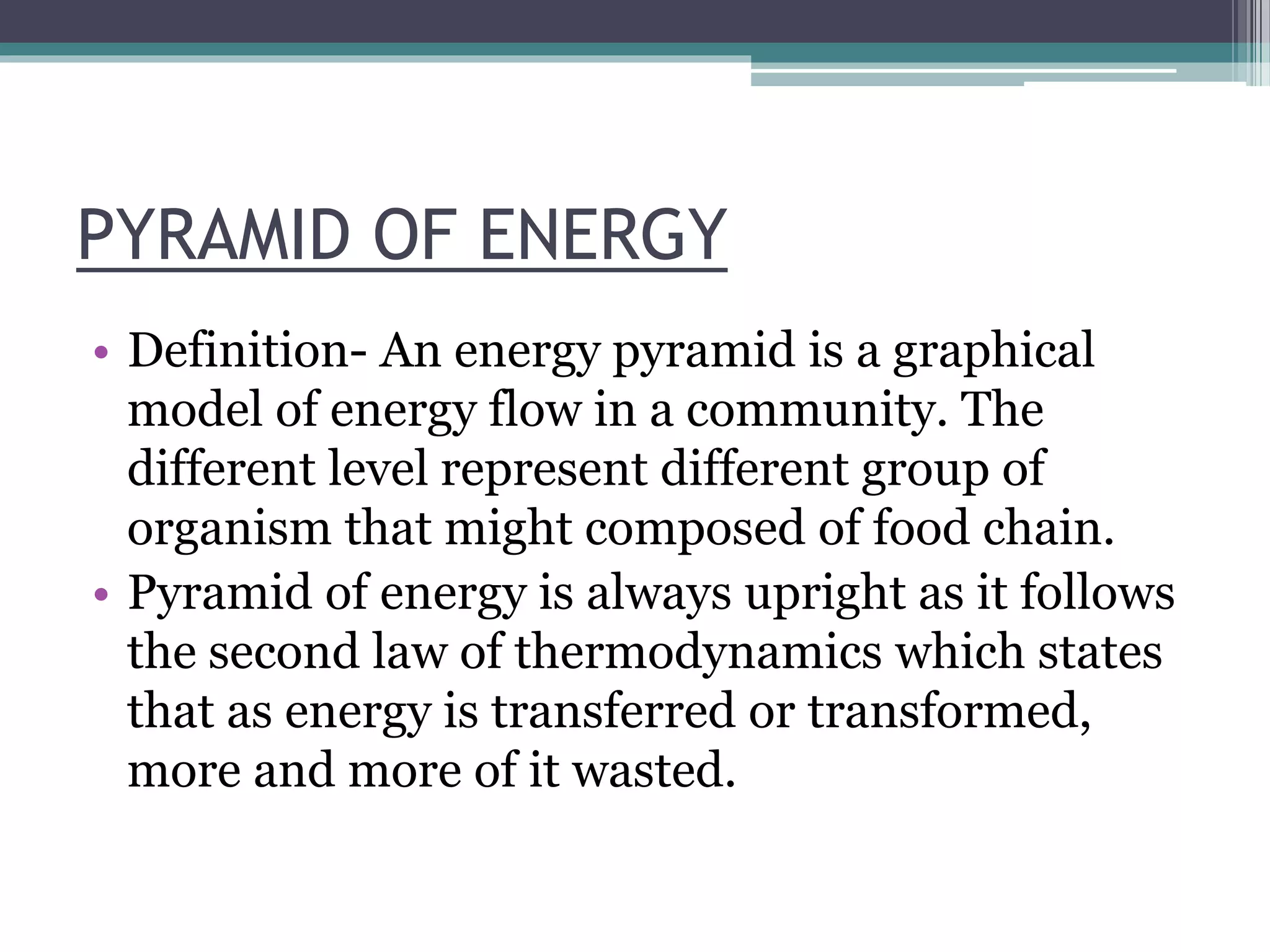
PYRAMID OF ENERGY
• Definition- An energy pyramid is a graphical
model of energy flow in a community. The
different level represent different group of
organism that might composed of food chain.
• Pyramid of energy is always upright as it follows
the second law of thermodynamics which states
that as energy is transferred or transformed,
more and more of it wasted.
Upright model of pyramid of energy
IMPORTANCE OF ECOLOGICAL
PYRAMIDS
1. Easy to understand.
2. It gives overall picture of transfer of energy
from one trophic level to the next.
LIMITATIONS OF ECOLOGICAL
PYRAMIDS
1. It assumes a simple food chain, something that
almost never exist in nature. It does not
consider a food web.
2. It does not take into account the same species
belonging to two or more trophic level.
REFERENCES
• P.S. Dhami, G. Chopra, H.N. Srivastava, A Text
Book Of Biology
• S.K. Agarwal, Fundamentals Of Ecology
• www.wikipedia.com
THANK YOU

Ecological pyramid

  • 1.
  • 2.
    Contents 1. Definition ofPyramids 2. Types of Pyramid a) Pyramids of numbers b) Pyramids of biomass c) Pyramids of energy 3. Importance of Pyramids 4. Limitations of Pyramids 5. References
  • 3.
    DEFENITION OF PYRAMID •An ecological pyramid is a graphical representation designed to show the biomass or bio-productivity at each trophic level in a given ecosystem. • Charles Elton (1927) developed the idea of ecological pyramids. Therefore these are also termed as Eltonian pyramids.
  • 4.
    TYPES OF PYRAMID 1)Pyramid of number 2) Pyramid of biomass 3) Pyramid of energy
  • 5.
    PYRAMID OF NUMBER Definition–the number of organisms in a food chain can be represented graphically in a pyramid. Each bar represents the number of individuals at each trophic level in the food chain. It can be upright and inverted.
  • 6.
  • 7.
    PYRAMID OF BIOMASS •Definition– The pyramid of biomass is a graphical representation that depicts the biomass existent in per unit area in all the different trophic level of the ecological system. • It can be upright and inverted.
  • 8.
  • 9.
    PYRAMID OF ENERGY •Definition- An energy pyramid is a graphical model of energy flow in a community. The different level represent different group of organism that might composed of food chain. • Pyramid of energy is always upright as it follows the second law of thermodynamics which states that as energy is transferred or transformed, more and more of it wasted.
  • 10.
    Upright model ofpyramid of energy
  • 11.
    IMPORTANCE OF ECOLOGICAL PYRAMIDS 1.Easy to understand. 2. It gives overall picture of transfer of energy from one trophic level to the next.
  • 12.
    LIMITATIONS OF ECOLOGICAL PYRAMIDS 1.It assumes a simple food chain, something that almost never exist in nature. It does not consider a food web. 2. It does not take into account the same species belonging to two or more trophic level.
  • 13.
    REFERENCES • P.S. Dhami,G. Chopra, H.N. Srivastava, A Text Book Of Biology • S.K. Agarwal, Fundamentals Of Ecology • www.wikipedia.com
  • 14.