WHAT ARE ECOLOGICAL PYRAMIDS ?
An ecological pyramid is a graphical representation
designed to show biomass or bio-productivity at each
trophic level in a given ecosystem.
Trophic levels are feeding positions in a food chain such
as primary producers, herbivores, primary carnivores etc.
Charles Elton(1925) developed the idea of ecological
pyramids. Therefore, they are also termed as Eltonian
pyramids.
TYPES OF ECOLOGICAL
PYRAMIDS
Three types of ecological pyramids
can usually be distinguished namely:
Pyramid of numbers
Pyramid of biomass
Pyramid of productivity(energy)
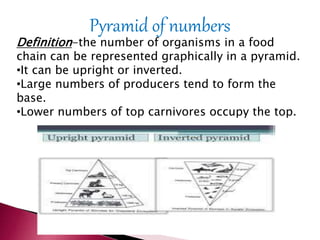
Pyramid of numbers
Definition-the number of organisms in a food
chain can be represented graphically in a pyramid.
•It can be upright or inverted.
•Large numbers of producers tend to form the
base.
•Lower numbers of top carnivores occupy the top.
Advantages:
Simple easy method or giving an overview.
Good for comparing changes to the ecosystem at
different times of year e.g. between seasons.
Disadvantages:
They do not take the organism’s size into account
so may not always resemble a pyramid.
Does not take into account juveniles or immature
forms.
Numbers of a specific species can be too great to
measure accurately.
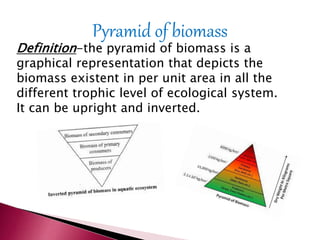
Pyramid of biomass
Definition-the pyramid of biomass is a
graphical representation that depicts the
biomass existent in per unit area in all the
different trophic level of ecological system.
It can be upright and inverted.
Advantages:
It is more accurate as the organism’s size is taken into
account. For example, a bar representing 1 tree will be
largest as it has more mass than primary consumers.
Overcomes the problem of pyramids of numbers.
Disadvantages:
Biomass data is difficult to obtain as the organism needs
to be killed and heated in an oven to remove any water, until
a constant dry mass is obtained.
Only uses samples from populations, so its important to
measure biomass exactly.
The time of the year that biomass is measured affects the
result(the shape of the pyramid would depend on the
season).
Pyramid of energy
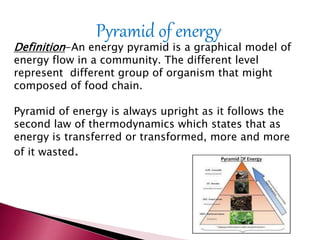
Definition-An energy pyramid is a graphical model of
energy flow in a community. The different level
represent different group of organism that might
composed of food chain.
Pyramid of energy is always upright as it follows the
second law of thermodynamics which states that as
energy is transferred or transformed, more and more
of it wasted.
Advantages:
It takes account of the rate of production over a period of time.
Two species of comparable biomass may have very different life
spans. Thus a direct comparison of their total biomasses is
misleading, but their productivity is directly comparable.
The relative energy chain within an ecosystem can be compared
using pyramids of energy; also different ecosystems can be
compared.
There are no inverted pyramids.
The input of solar energy can be added.
Disadvantages:
The rate of biomass production of an organism is required, which
involves measuring growth and reproduction through time.
There is still the difficulty of assigning the organisms to a specific
trophic level. As well as the organisms in the food chains there is
the problem of assigning the decomposers and detritivores to a
particular trophic level.
Importance of Ecological Pyramids
The importance of ecological pyramid can be
explained in the following points:
They show the feeding of different
organisms in different ecosystems.
It shows the efficiency of energy transfer.
The condition of the ecosystem can be
monitored and any further damage can be
prevented.
Limitations of Ecological Pyramids
(i) It never takes into account the same
species belonging to two or more trophic
levels.
(ii) It assumes a simple food chain,
something that almost never exists in
nature.
(iii) It does not accommodate a food web.
Ecological pyramid

Ecological pyramid

  • 2.
    WHAT ARE ECOLOGICALPYRAMIDS ? An ecological pyramid is a graphical representation designed to show biomass or bio-productivity at each trophic level in a given ecosystem. Trophic levels are feeding positions in a food chain such as primary producers, herbivores, primary carnivores etc. Charles Elton(1925) developed the idea of ecological pyramids. Therefore, they are also termed as Eltonian pyramids.
  • 3.
    TYPES OF ECOLOGICAL PYRAMIDS Threetypes of ecological pyramids can usually be distinguished namely: Pyramid of numbers Pyramid of biomass Pyramid of productivity(energy)
  • 4.
    Pyramid of numbers Definition-thenumber of organisms in a food chain can be represented graphically in a pyramid. •It can be upright or inverted. •Large numbers of producers tend to form the base. •Lower numbers of top carnivores occupy the top.
  • 5.
    Advantages: Simple easy methodor giving an overview. Good for comparing changes to the ecosystem at different times of year e.g. between seasons. Disadvantages: They do not take the organism’s size into account so may not always resemble a pyramid. Does not take into account juveniles or immature forms. Numbers of a specific species can be too great to measure accurately.
  • 6.
    Pyramid of biomass Definition-thepyramid of biomass is a graphical representation that depicts the biomass existent in per unit area in all the different trophic level of ecological system. It can be upright and inverted.
  • 7.
    Advantages: It is moreaccurate as the organism’s size is taken into account. For example, a bar representing 1 tree will be largest as it has more mass than primary consumers. Overcomes the problem of pyramids of numbers. Disadvantages: Biomass data is difficult to obtain as the organism needs to be killed and heated in an oven to remove any water, until a constant dry mass is obtained. Only uses samples from populations, so its important to measure biomass exactly. The time of the year that biomass is measured affects the result(the shape of the pyramid would depend on the season).
  • 8.
    Pyramid of energy Definition-Anenergy pyramid is a graphical model of energy flow in a community. The different level represent different group of organism that might composed of food chain. Pyramid of energy is always upright as it follows the second law of thermodynamics which states that as energy is transferred or transformed, more and more of it wasted.
  • 9.
    Advantages: It takes accountof the rate of production over a period of time. Two species of comparable biomass may have very different life spans. Thus a direct comparison of their total biomasses is misleading, but their productivity is directly comparable. The relative energy chain within an ecosystem can be compared using pyramids of energy; also different ecosystems can be compared. There are no inverted pyramids. The input of solar energy can be added. Disadvantages: The rate of biomass production of an organism is required, which involves measuring growth and reproduction through time. There is still the difficulty of assigning the organisms to a specific trophic level. As well as the organisms in the food chains there is the problem of assigning the decomposers and detritivores to a particular trophic level.
  • 10.
    Importance of EcologicalPyramids The importance of ecological pyramid can be explained in the following points: They show the feeding of different organisms in different ecosystems. It shows the efficiency of energy transfer. The condition of the ecosystem can be monitored and any further damage can be prevented.
  • 11.
    Limitations of EcologicalPyramids (i) It never takes into account the same species belonging to two or more trophic levels. (ii) It assumes a simple food chain, something that almost never exists in nature. (iii) It does not accommodate a food web.