Reading in the Social SciencesOne Set of Cognitive and Sociocultural Interpretations
First, take a minute and jot down some notesPick your preferred theoretical frameworkHow might it examine reading a paper for this course?
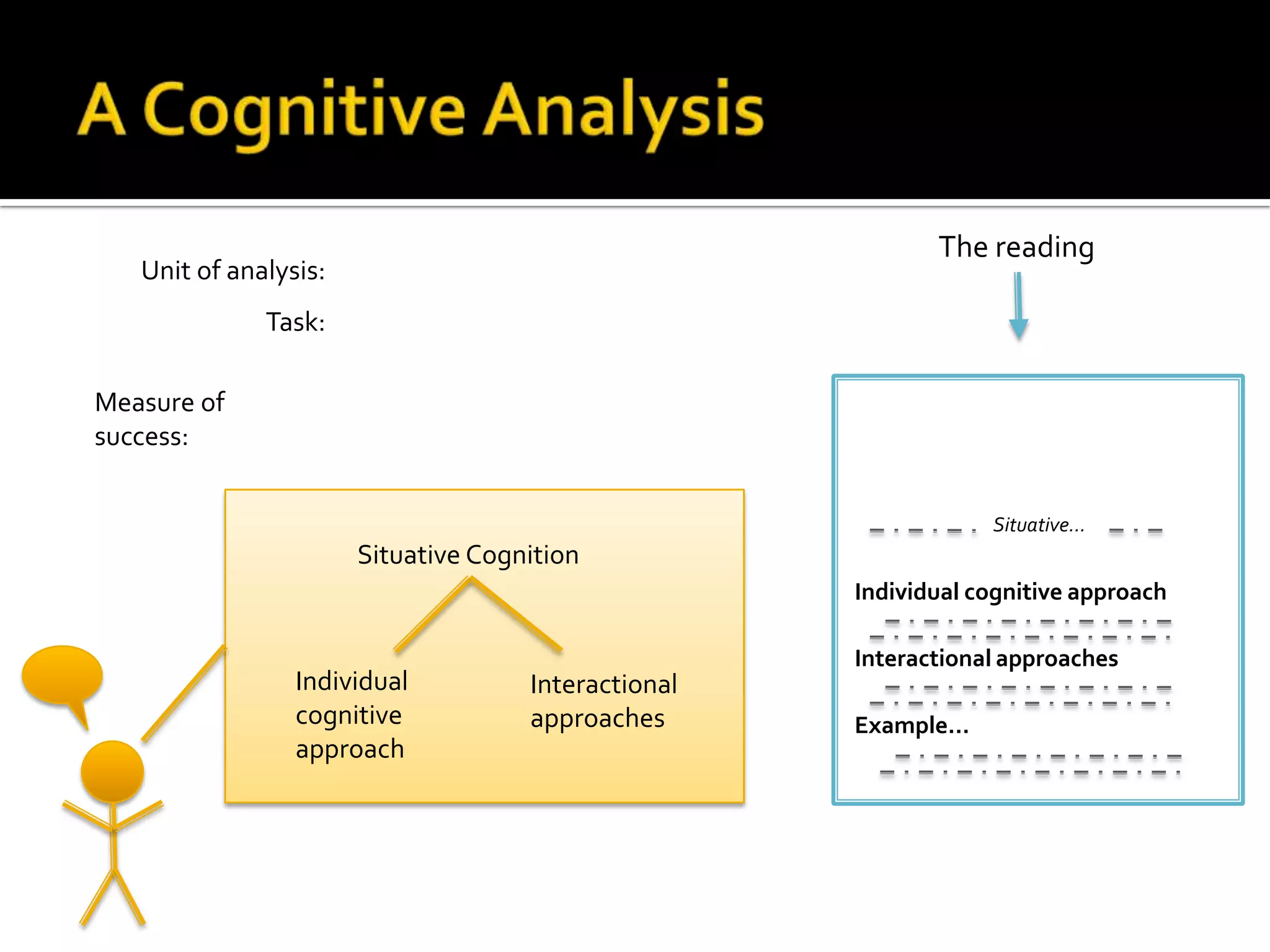
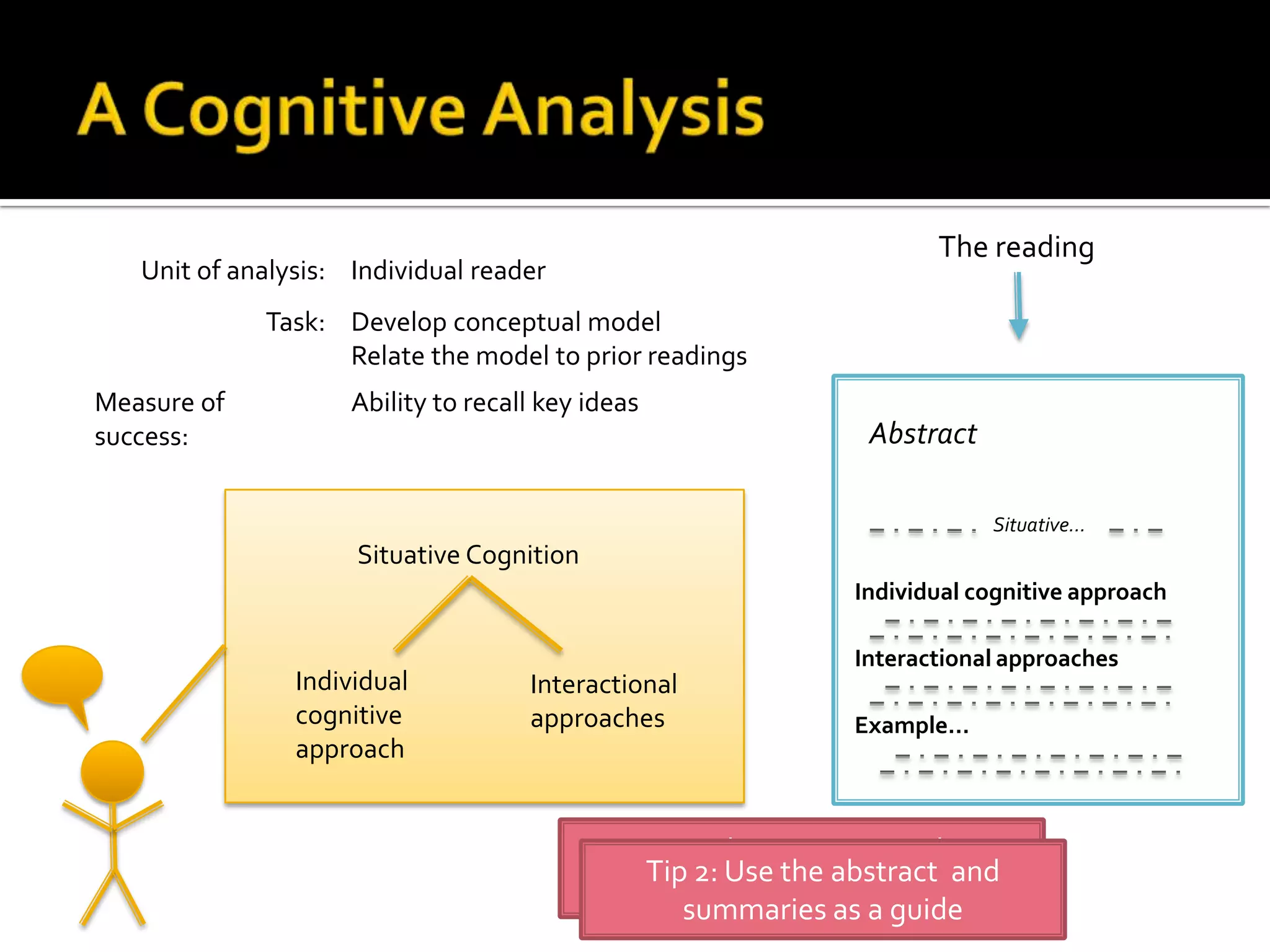
A Cognitive AnalysisThe readingSituative…Situative CognitionIndividual cognitive approachInteractional approachesIndividual cognitive approachInteractional approachesExample…
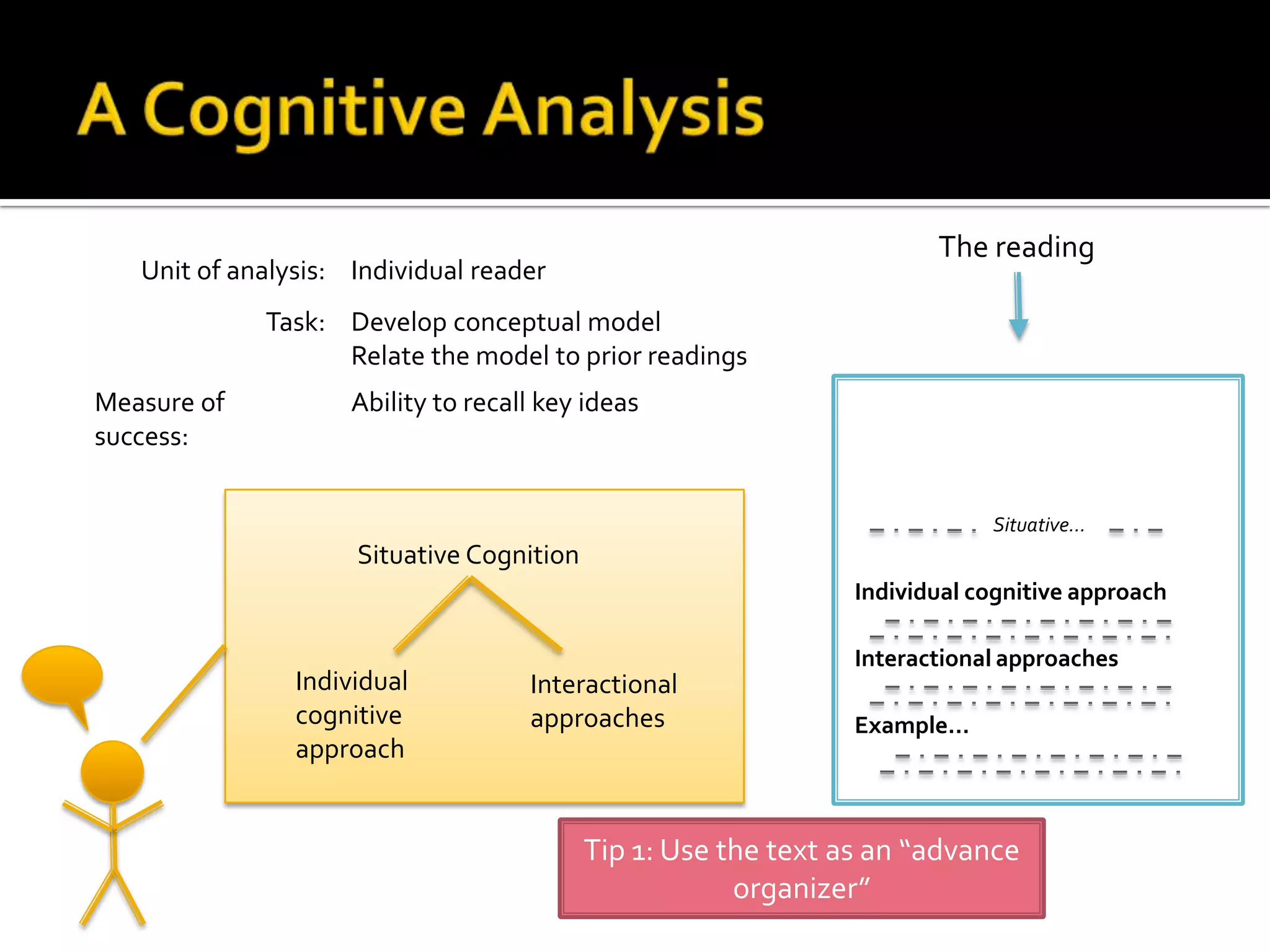
A Cognitive AnalysisThe readingSituative…Situative CognitionIndividual cognitive approachInteractional approachesIndividual cognitive approachInteractional approachesExample…Tip 1: Use the text as an “advance organizer”
A Cognitive AnalysisThe readingAbstractSituative…Situative CognitionIndividual cognitive approachInteractional approachesIndividual cognitive approachInteractional approachesExample…Tip 1: Use the text as an “advance organizer”Tip 2: Use the abstract  and summaries as a guide
A Cognitive Analysis ContinuedSome other key ideas:The task isn’t just recall
Distributed cognition
Prior knowledge
Metacognition
Problem solving
Assimilation and AccomodationTip 3: Remember the task and timeframe (develop understanding over the entire semester)Situative…Individual cognitive approachInteractional approachesExample…
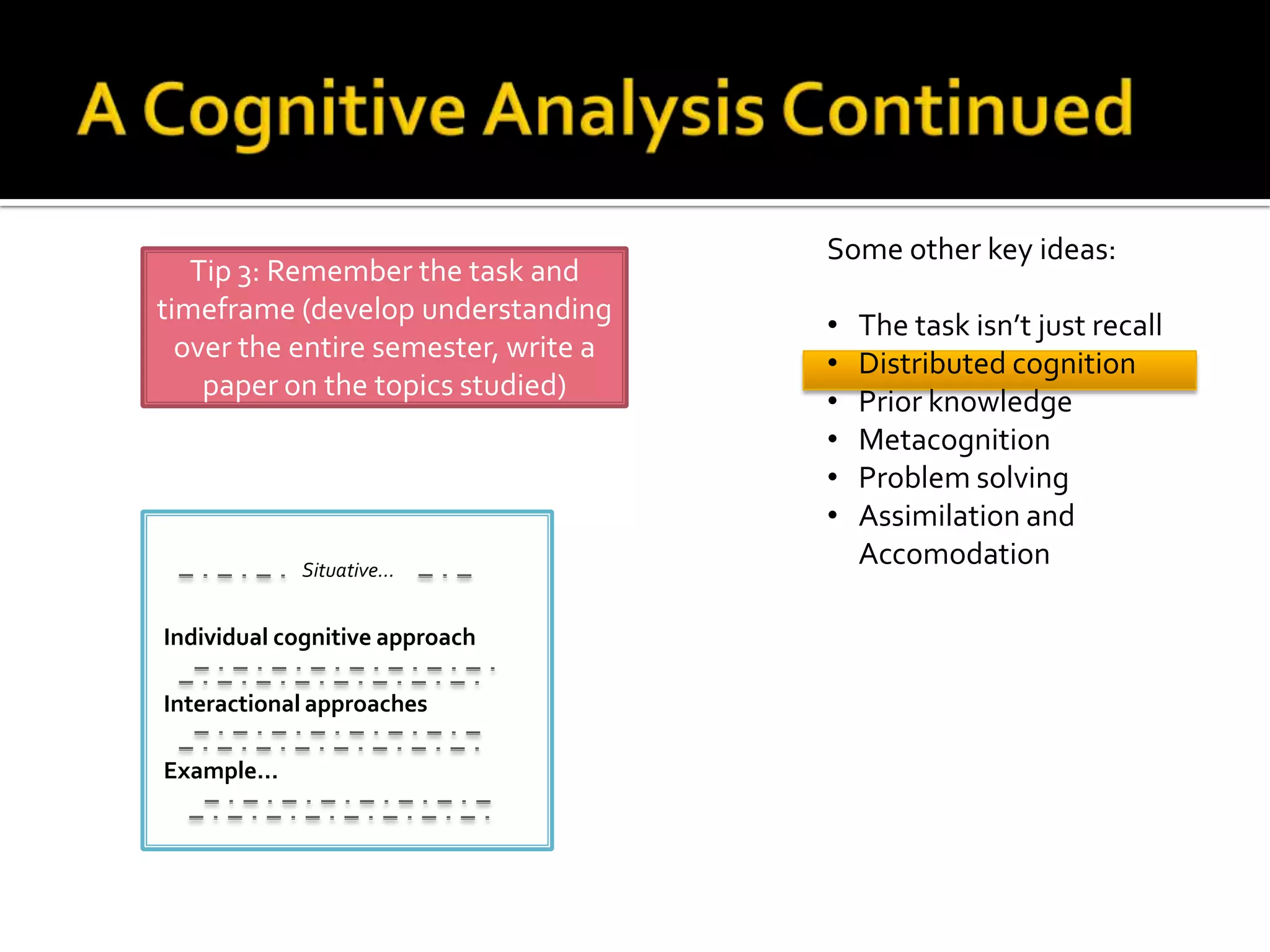
A Cognitive Analysis ContinuedSome other key ideas:The task isn’t just recall
Distributed cognition
Prior knowledge
Metacognition
Problem solving
Assimilation and AccomodationTip 3: Remember the task and timeframe (develop understanding over the entire semester, write a paper on the topics studied)Situative…Individual cognitive approachInteractional approachesExample…
A Cognitive Analysis ContinuedSome other key ideas:The task isn’t just recall
Distributed cognition
Prior knowledge
Metacognition
Problem solving
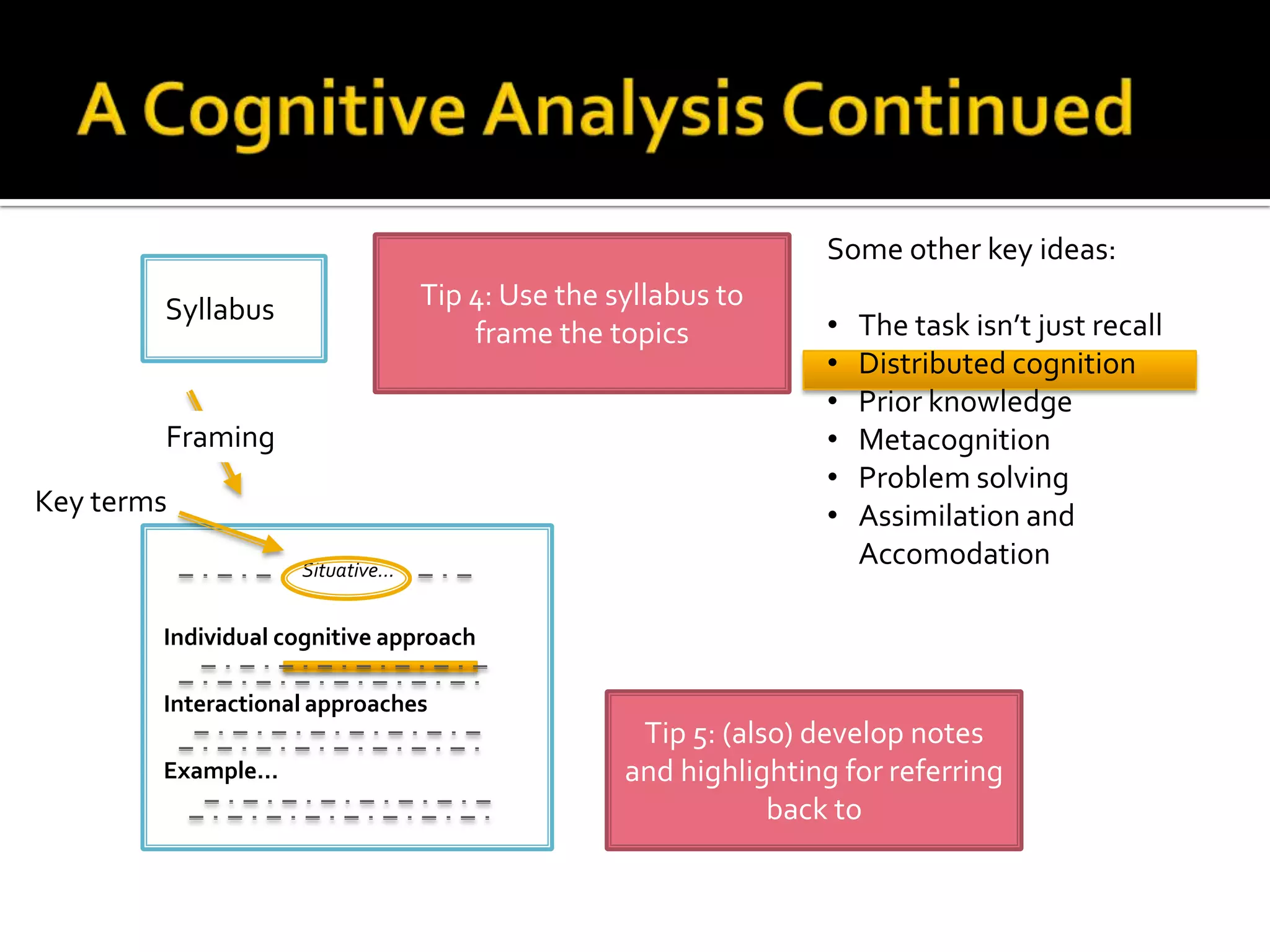
Assimilation and AccomodationTip 4: Use the syllabus to frame the topicsSyllabusFramingKey termsSituative…Individual cognitive approachInteractional approachesTip 5: (also) develop notes and highlighting for referring back toExample…
A Cognitive Analysis ContinuedSome other key ideas:The task isn’t just recall
Distributed cognition
Prior knowledge

Reading academic texts

  • 1.
    Reading in theSocial SciencesOne Set of Cognitive and Sociocultural Interpretations
  • 2.
    First, take aminute and jot down some notesPick your preferred theoretical frameworkHow might it examine reading a paper for this course?
  • 3.
    A Cognitive AnalysisThereadingSituative…Situative CognitionIndividual cognitive approachInteractional approachesIndividual cognitive approachInteractional approachesExample…
  • 4.
    A Cognitive AnalysisThereadingSituative…Situative CognitionIndividual cognitive approachInteractional approachesIndividual cognitive approachInteractional approachesExample…Tip 1: Use the text as an “advance organizer”
  • 5.
    A Cognitive AnalysisThereadingAbstractSituative…Situative CognitionIndividual cognitive approachInteractional approachesIndividual cognitive approachInteractional approachesExample…Tip 1: Use the text as an “advance organizer”Tip 2: Use the abstract and summaries as a guide
  • 6.
    A Cognitive AnalysisContinuedSome other key ideas:The task isn’t just recall
  • 7.
  • 8.
  • 9.
  • 10.
  • 11.
    Assimilation and AccomodationTip3: Remember the task and timeframe (develop understanding over the entire semester)Situative…Individual cognitive approachInteractional approachesExample…
  • 12.
    A Cognitive AnalysisContinuedSome other key ideas:The task isn’t just recall
  • 13.
  • 14.
  • 15.
  • 16.
  • 17.
    Assimilation and AccomodationTip3: Remember the task and timeframe (develop understanding over the entire semester, write a paper on the topics studied)Situative…Individual cognitive approachInteractional approachesExample…
  • 18.
    A Cognitive AnalysisContinuedSome other key ideas:The task isn’t just recall
  • 19.
  • 20.
  • 21.
  • 22.
  • 23.
    Assimilation and AccomodationTip4: Use the syllabus to frame the topicsSyllabusFramingKey termsSituative…Individual cognitive approachInteractional approachesTip 5: (also) develop notes and highlighting for referring back toExample…
  • 24.
    A Cognitive AnalysisContinuedSome other key ideas:The task isn’t just recall
  • 25.
  • 26.
  • 27.
  • 28.
  • 29.
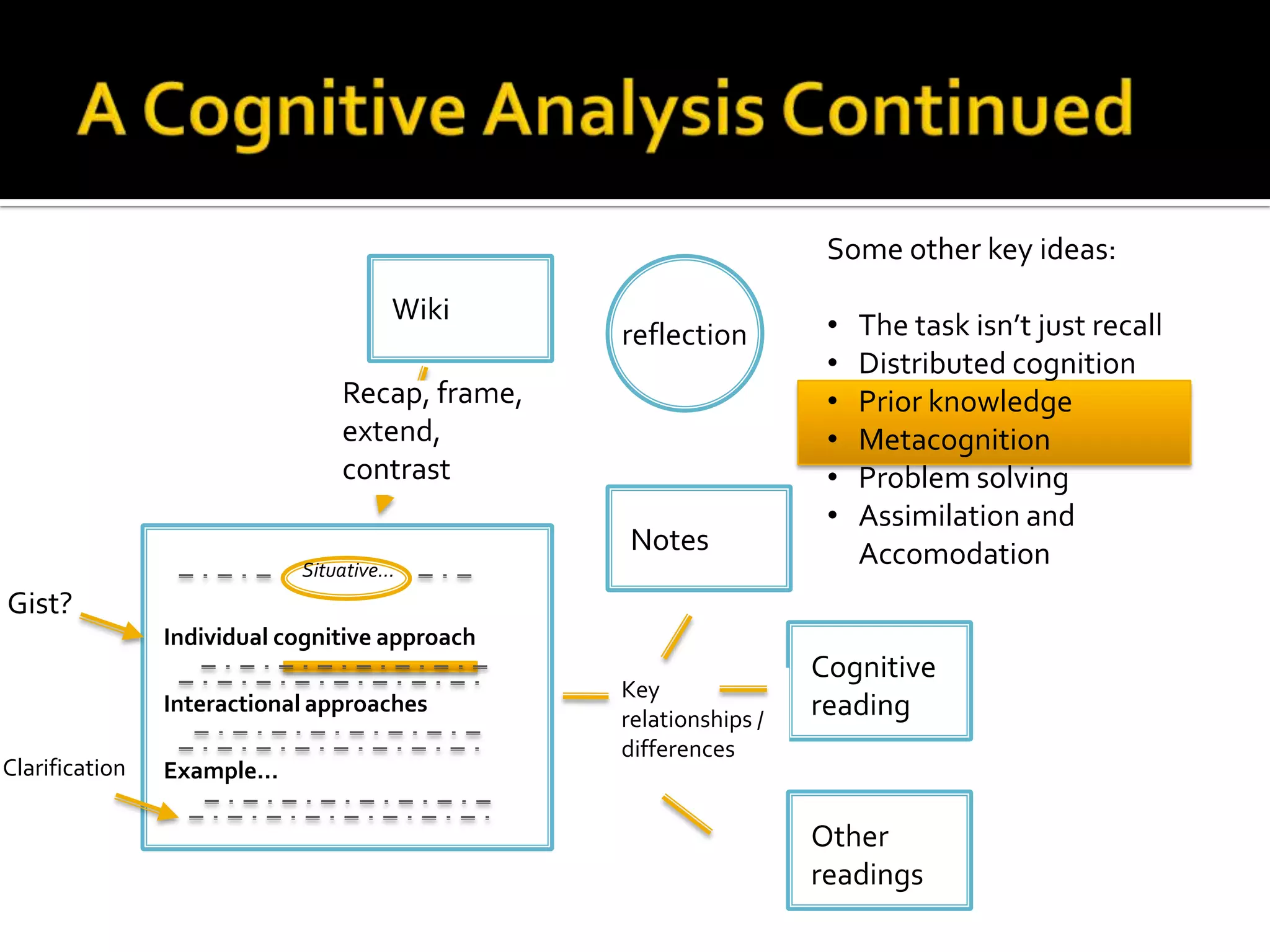
    Assimilation and AccomodationWikireflectionRecap,frame, extend, contrast NotesSituative…Gist?Individual cognitive approachCognitive readingKey relationships / differencesInteractional approachesClarificationExample…Other readings
  • 30.
    A Cognitive AnalysisContinuedSome other key ideas:The task isn’t just recall
  • 31.
  • 32.
  • 33.
  • 34.
  • 35.
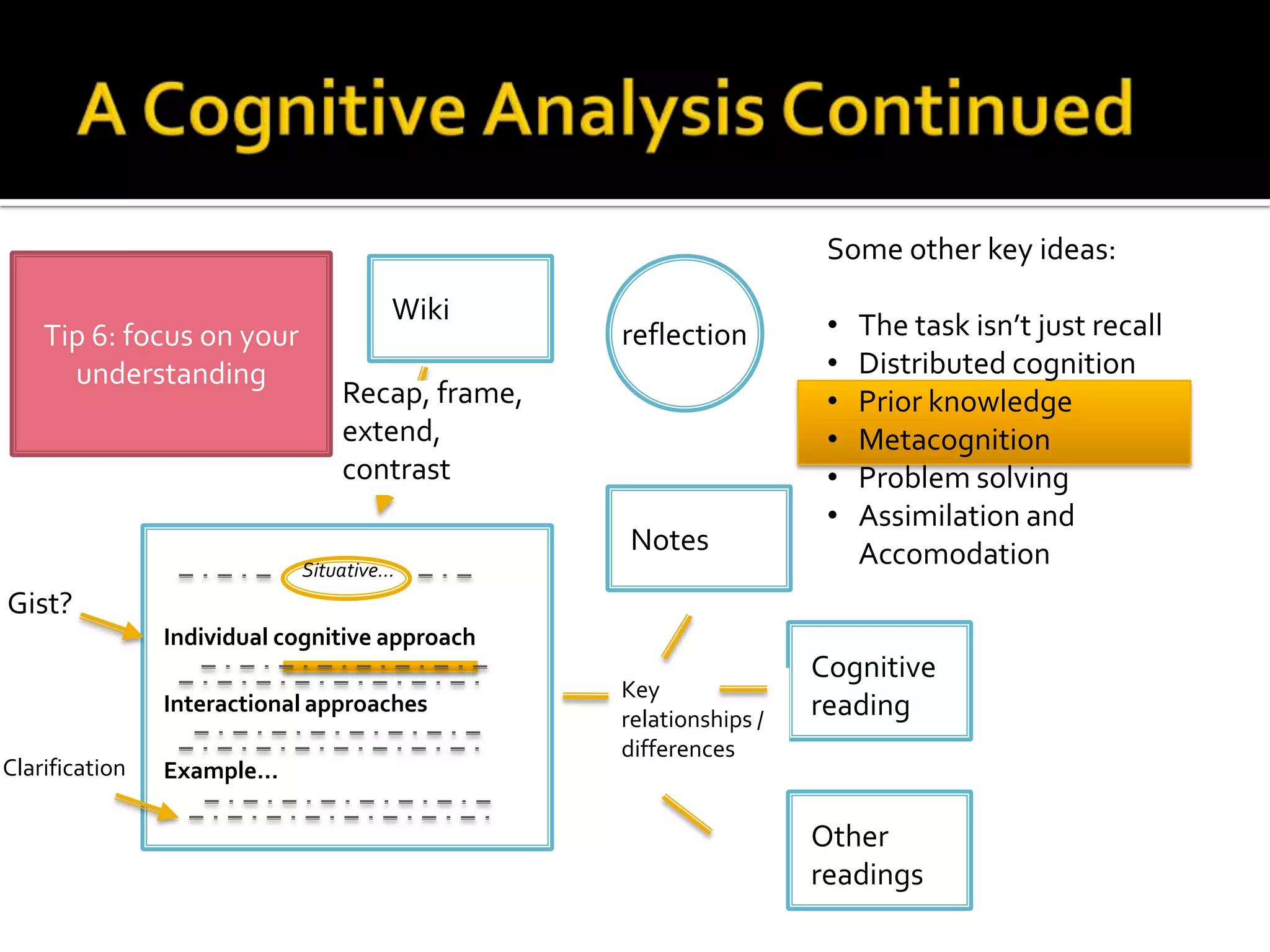
    Assimilation and AccomodationTip6: focus on your understandingWikireflectionRecap, frame, extend, contrast NotesSituative…Gist?Individual cognitive approachCognitive readingKey relationships / differencesInteractional approachesClarificationExample…Other readings
  • 36.
    A Cognitive AnalysisContinuedSome other key ideas:The task isn’t just recall
  • 37.
  • 38.
  • 39.
  • 40.
  • 41.
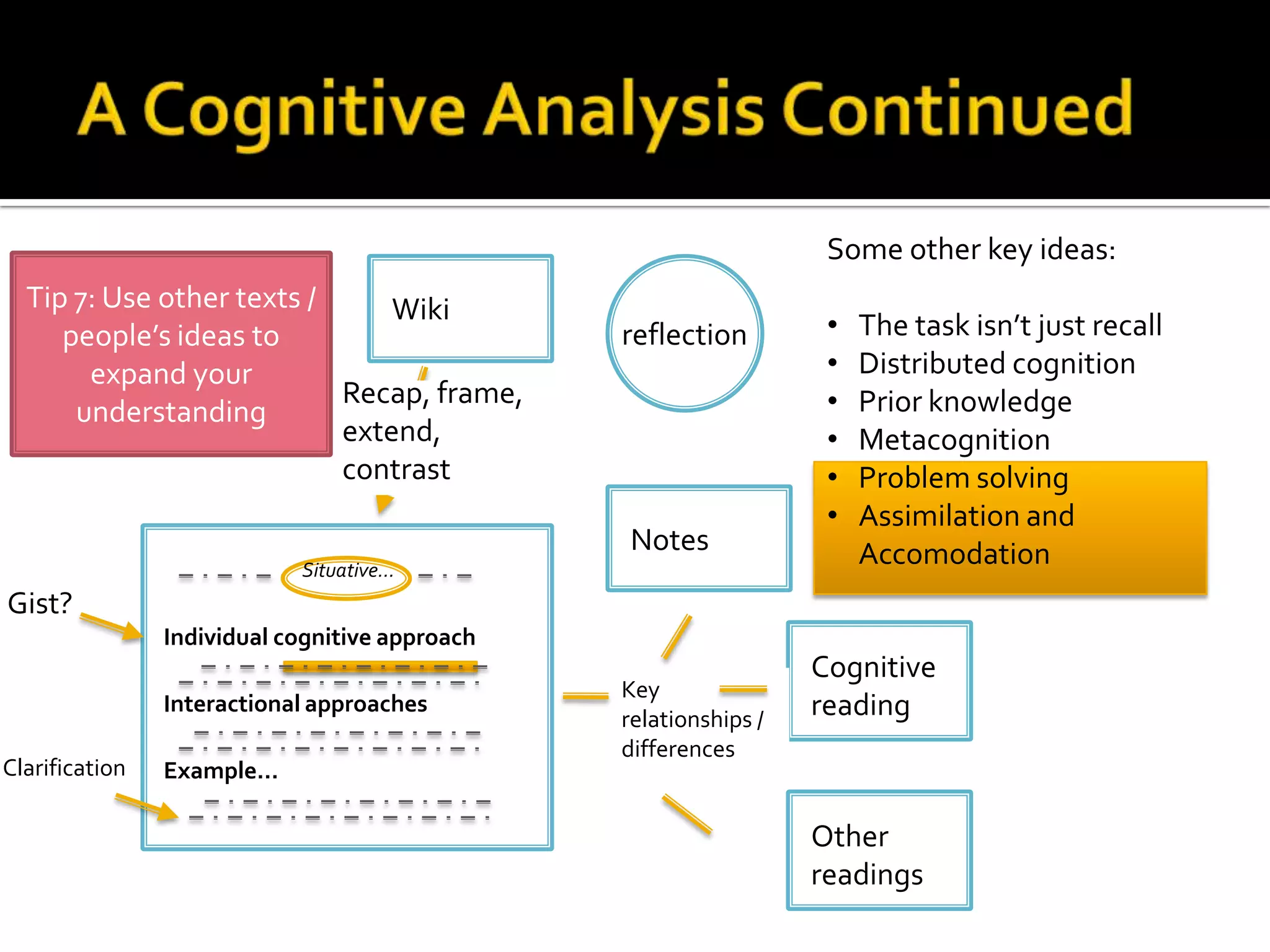
    Assimilation and AccomodationTip7: Use other texts / people’s ideas to expand your understandingWikireflectionRecap, frame, extend, contrast NotesSituative…Gist?Individual cognitive approachCognitive readingKey relationships / differencesInteractional approachesClarificationExample…Other readings
  • 42.
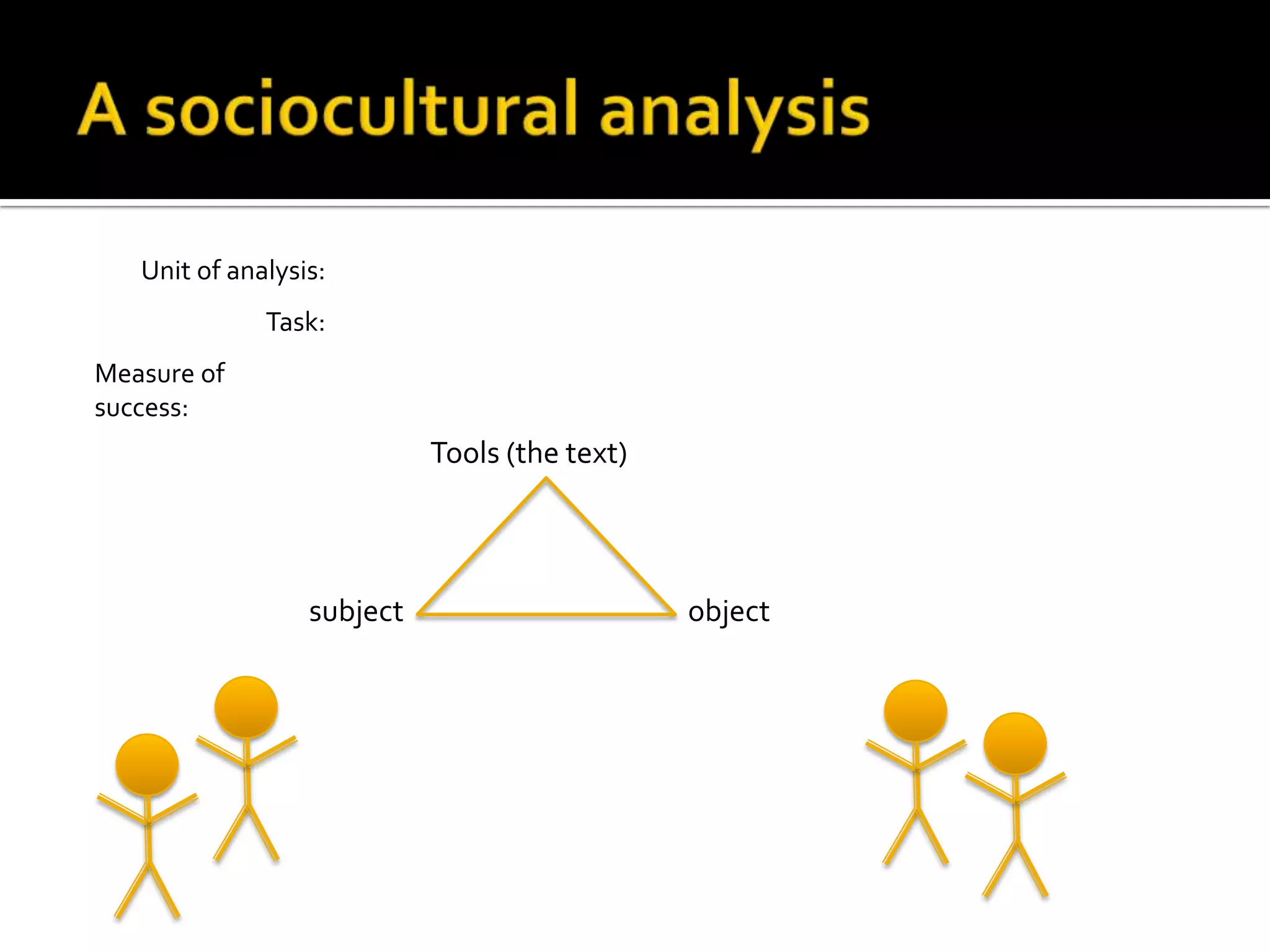
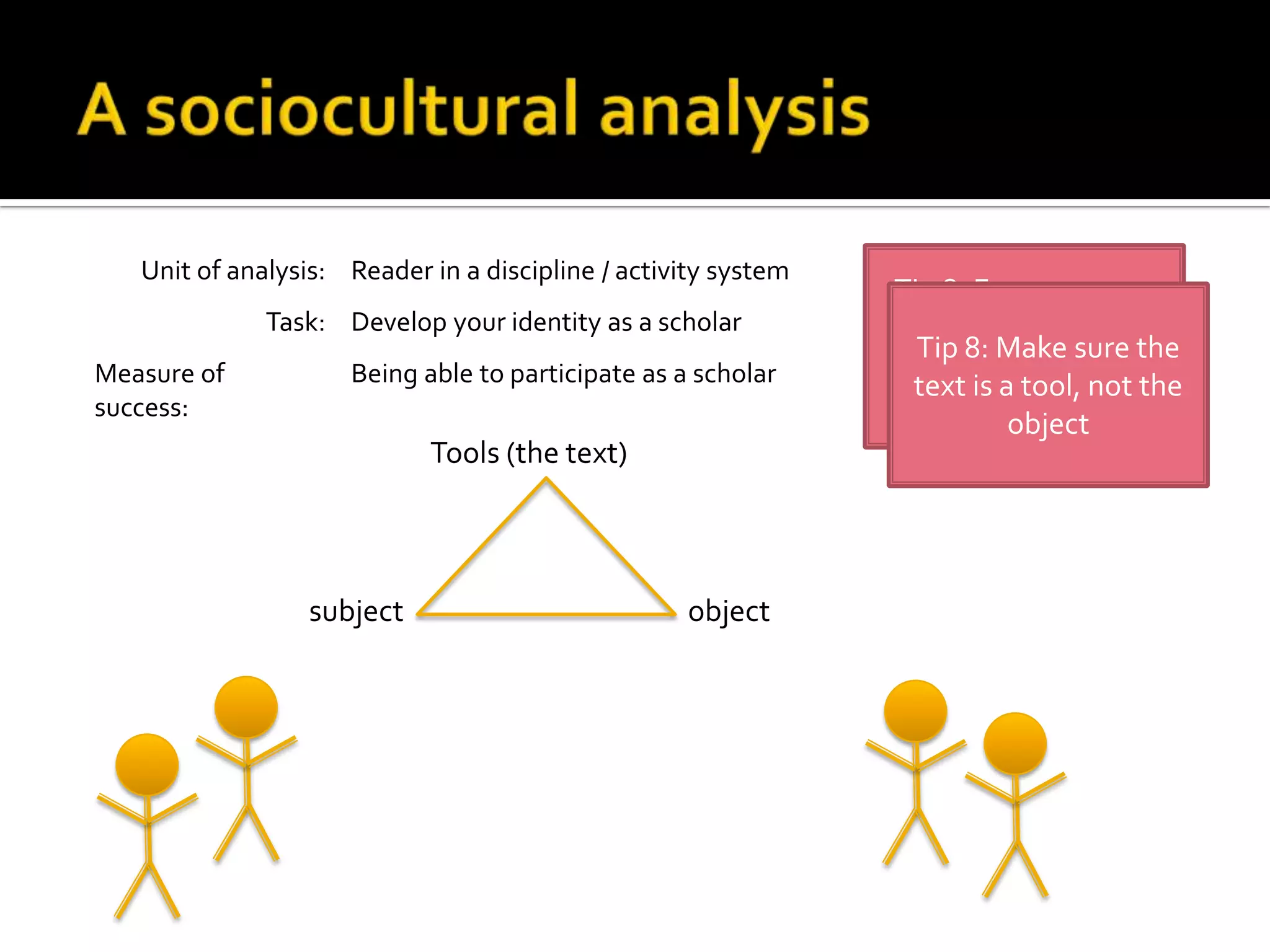
    A sociocultural analysisTools(the text)subjectobject
  • 43.
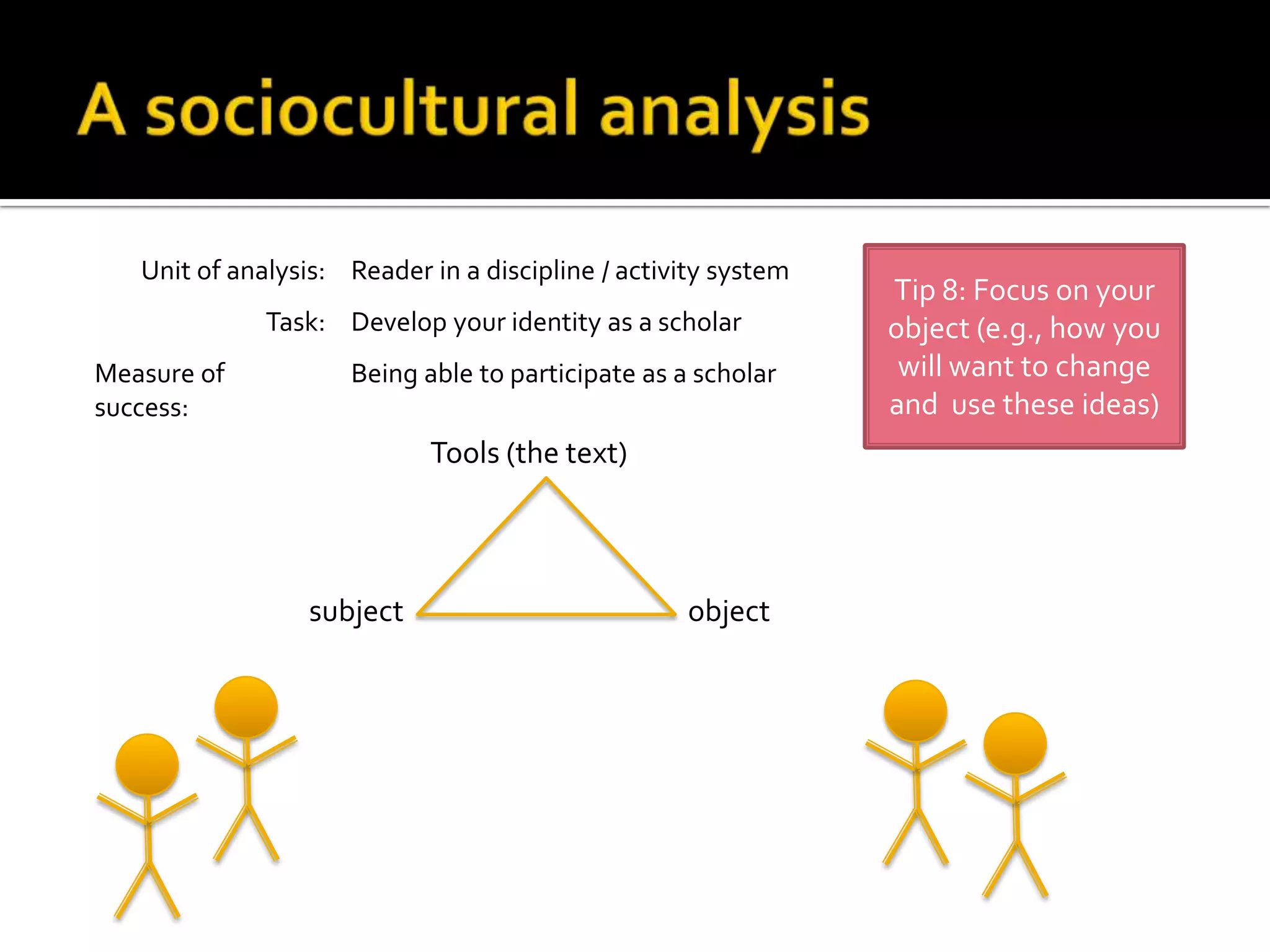
    A sociocultural analysisTip8: Focus on your object (e.g., how you will want to change and use these ideas)Tools (the text)subjectobject
  • 44.
    A sociocultural analysisTip8: Focus on your object (e.g., how you will want to change and use these ideas)Tip 8: Make sure the text is a tool, not the objectTools (the text)subjectobject
  • 45.
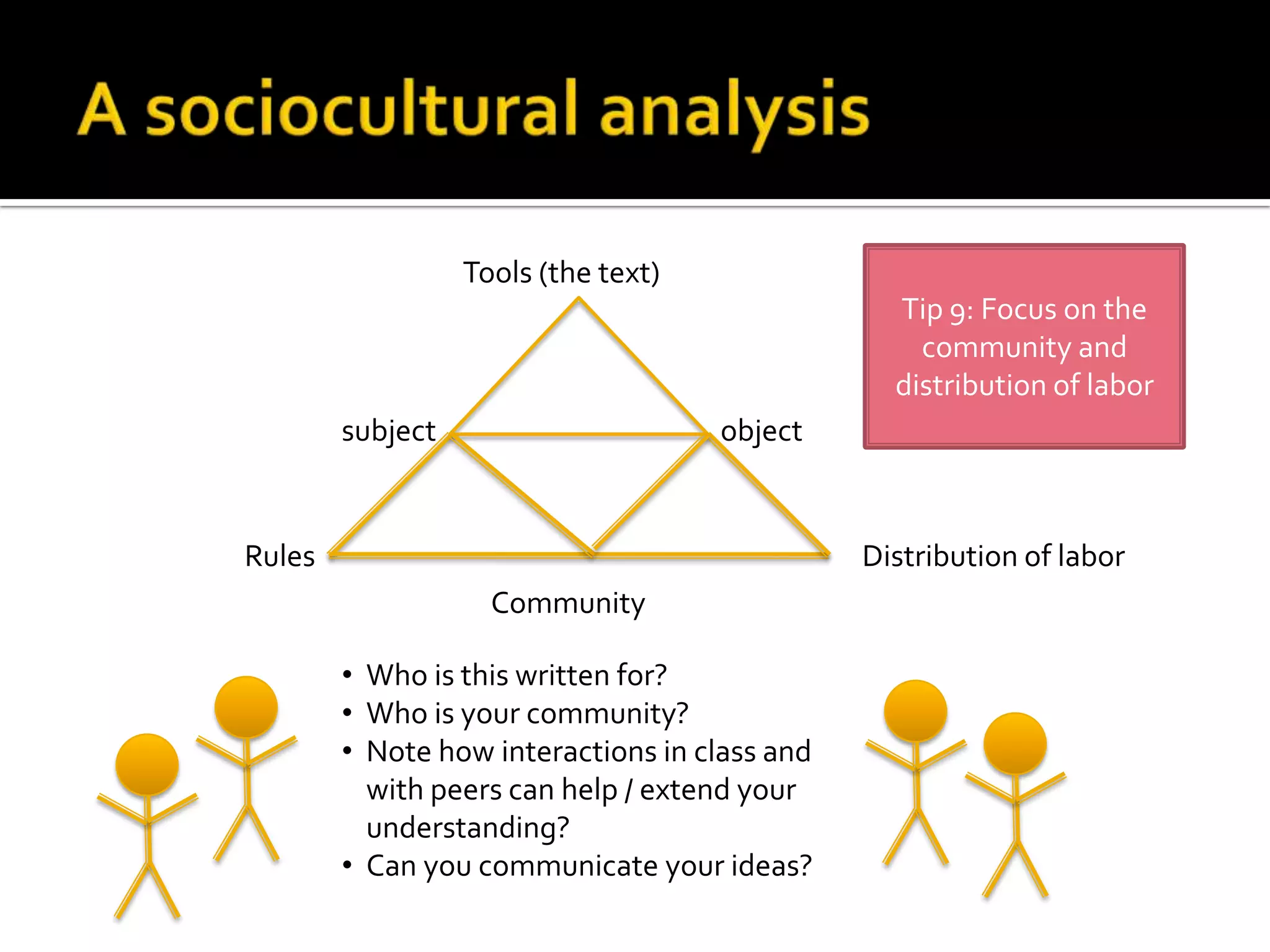
    A sociocultural analysisTip9: Focus on the community and distribution of laborTools (the text)subjectobjectRulesDistribution of laborCommunityWho is this written for?
  • 46.
    Who is yourcommunity?
  • 47.
    Note how interactionsin class and with peers can help / extend your understanding?
  • 48.
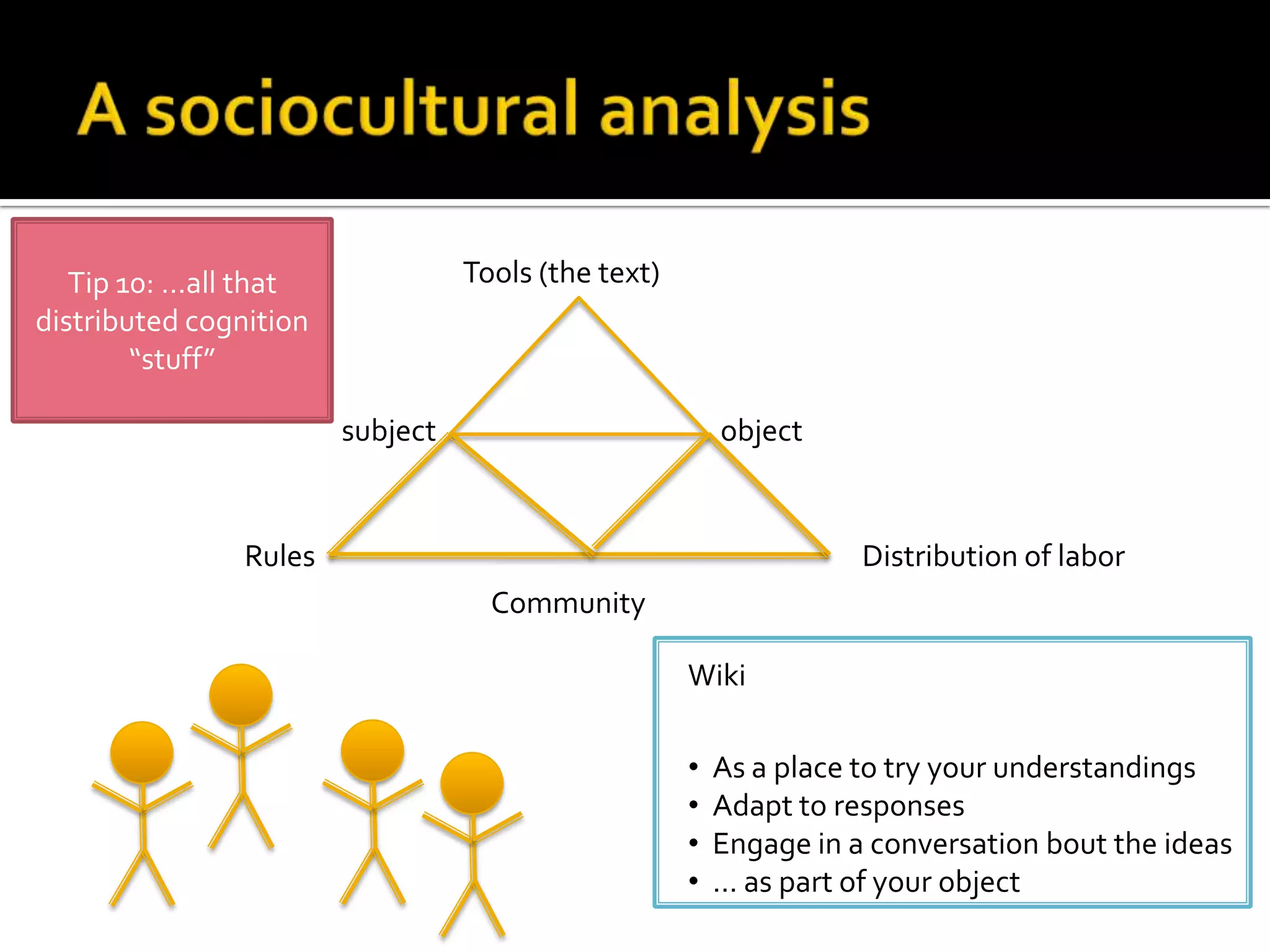
    Can you communicateyour ideas?A sociocultural analysisTip 10: …all that distributed cognition “stuff”Tools (the text)subjectobjectRulesDistribution of laborCommunityWikiAs a place to try your understandings
  • 49.
  • 50.
    Engage in aconversation bout the ideas
  • 51.
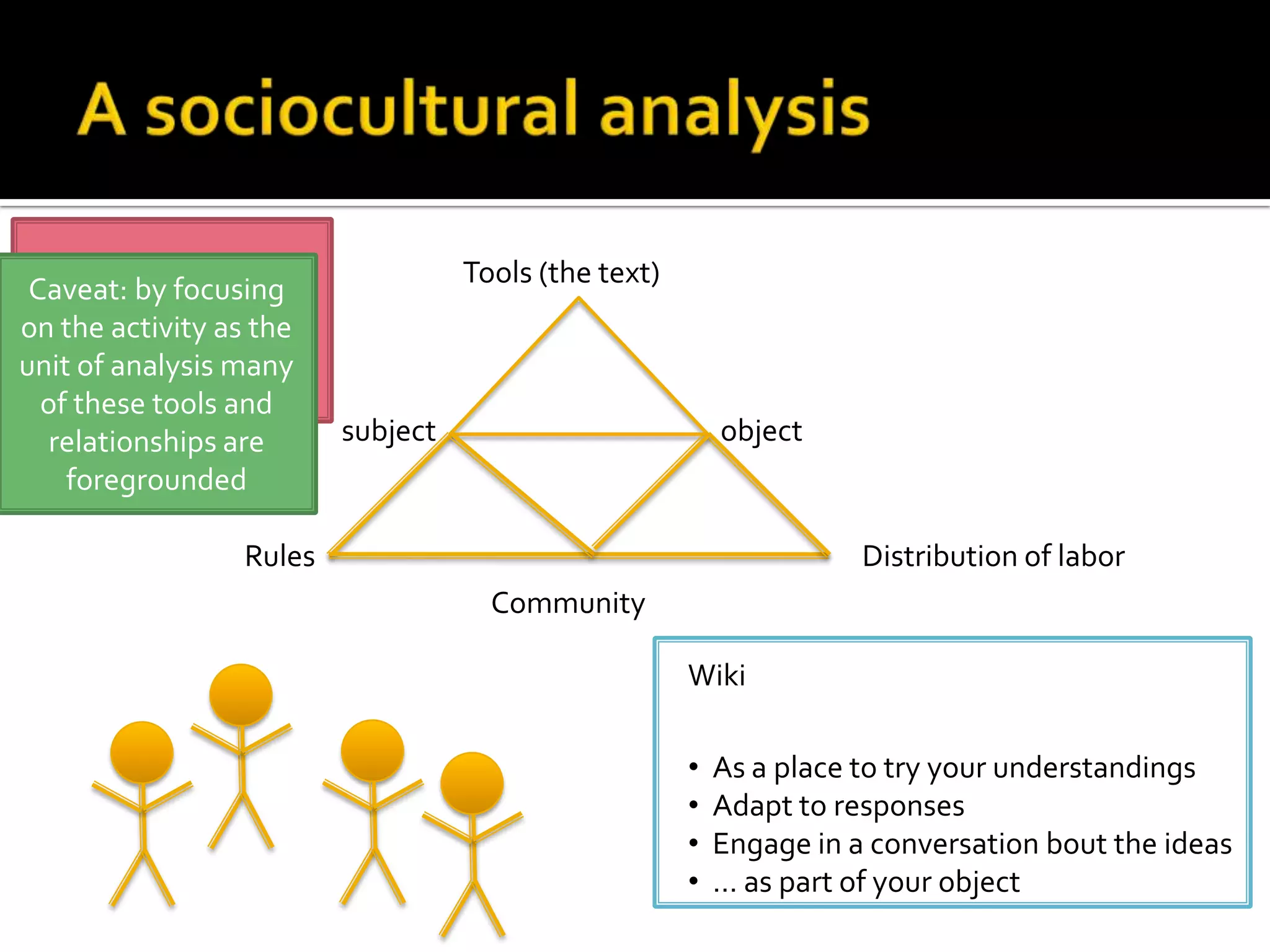
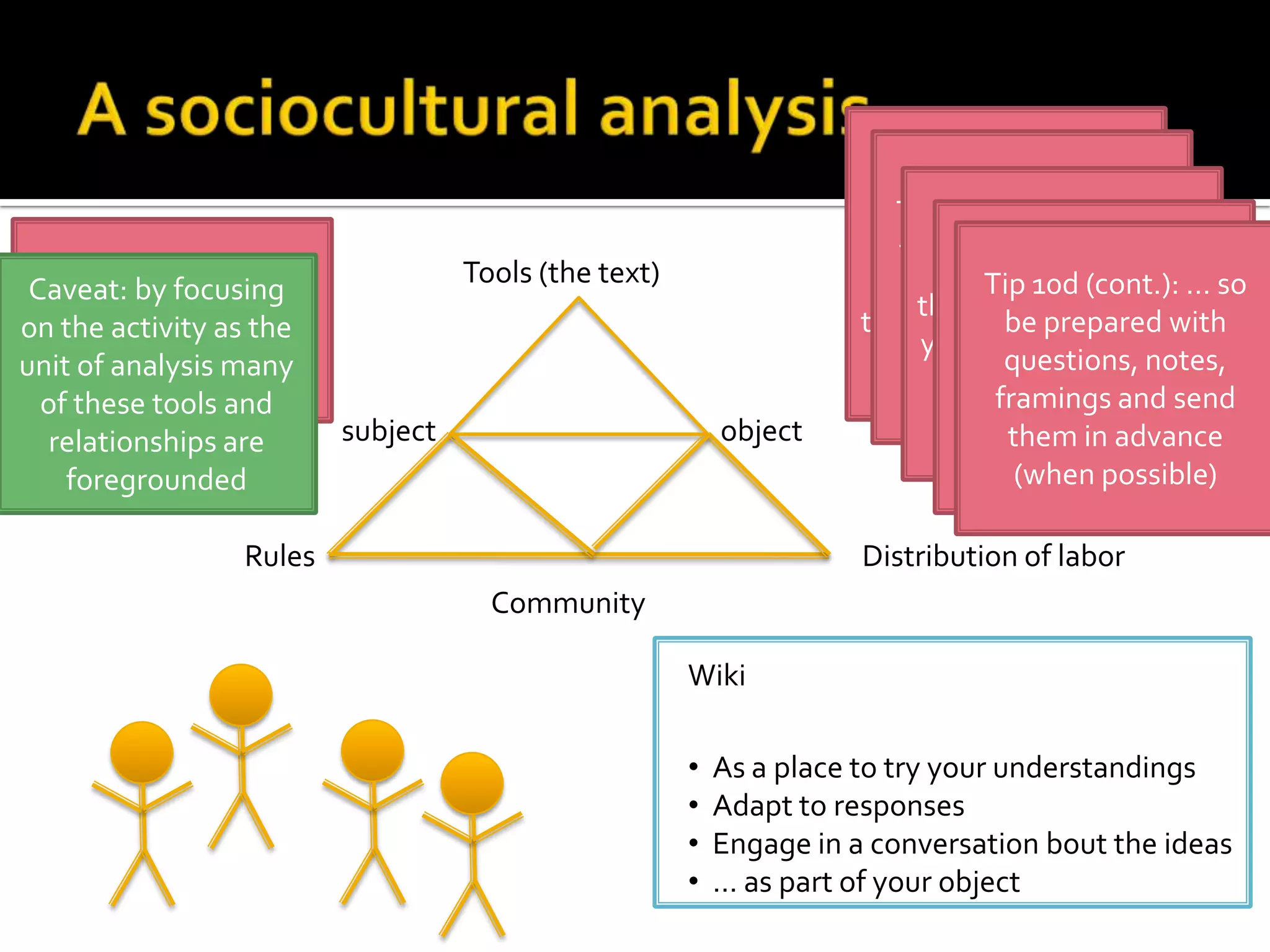
    … as partof your object A sociocultural analysisTip 10: …all that distributed cognition “stuff”Tools (the text)Caveat: by focusing on the activity as the unit of analysis many of these tools and relationships are foregroundedsubjectobjectRulesDistribution of laborCommunityWikiAs a place to try your understandings
  • 52.
  • 53.
    Engage in aconversation bout the ideas
  • 54.
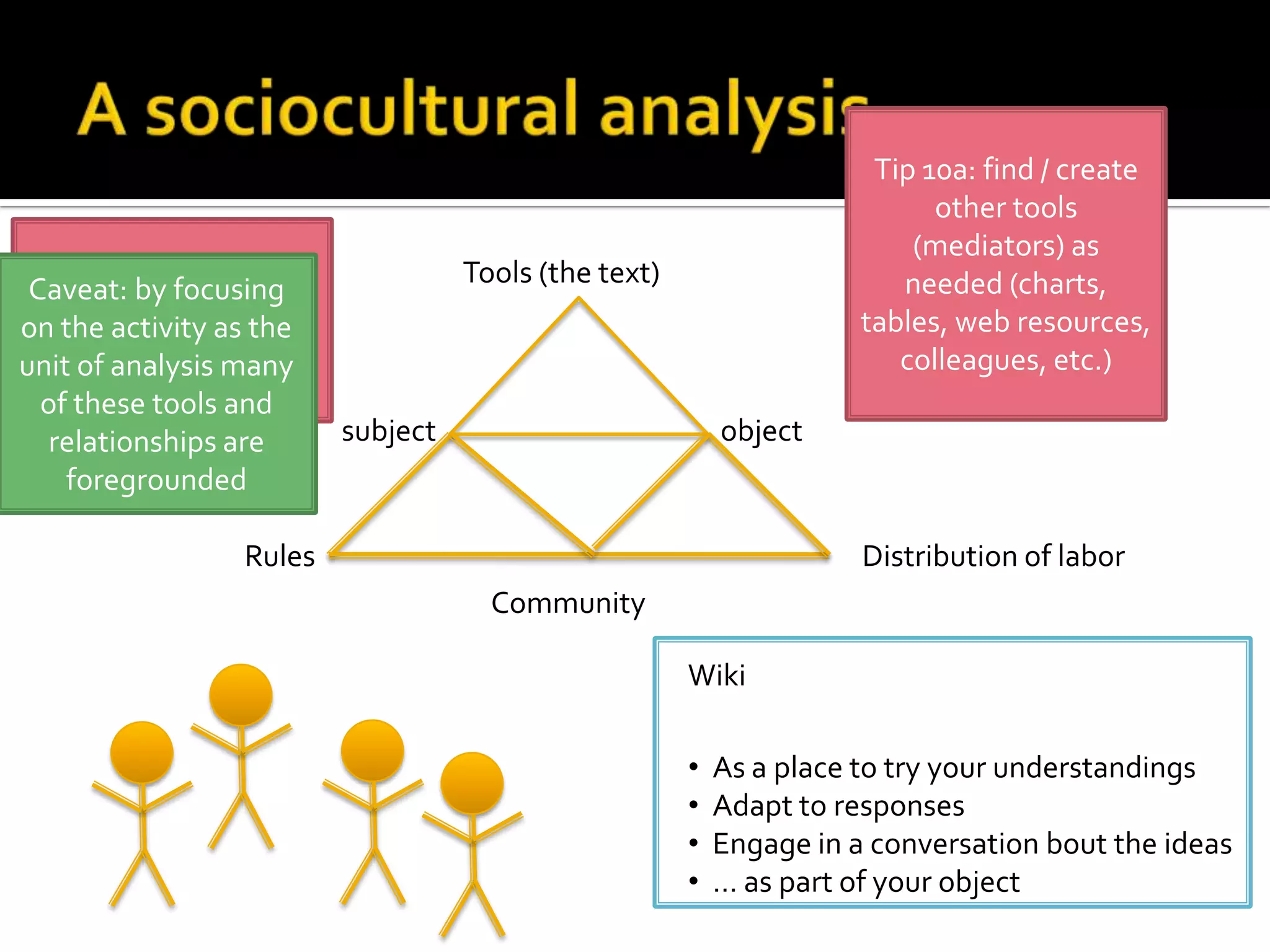
    … as partof your object A sociocultural analysisTip 10a: find / create other tools (mediators) as needed (charts, tables, web resources, colleagues, etc.)Tip 10: …all that distributed cognition “stuff”Tools (the text)Caveat: by focusing on the activity as the unit of analysis many of these tools and relationships are foregroundedsubjectobjectRulesDistribution of laborCommunityWikiAs a place to try your understandings
  • 55.
  • 56.
    Engage in aconversation bout the ideas
  • 57.
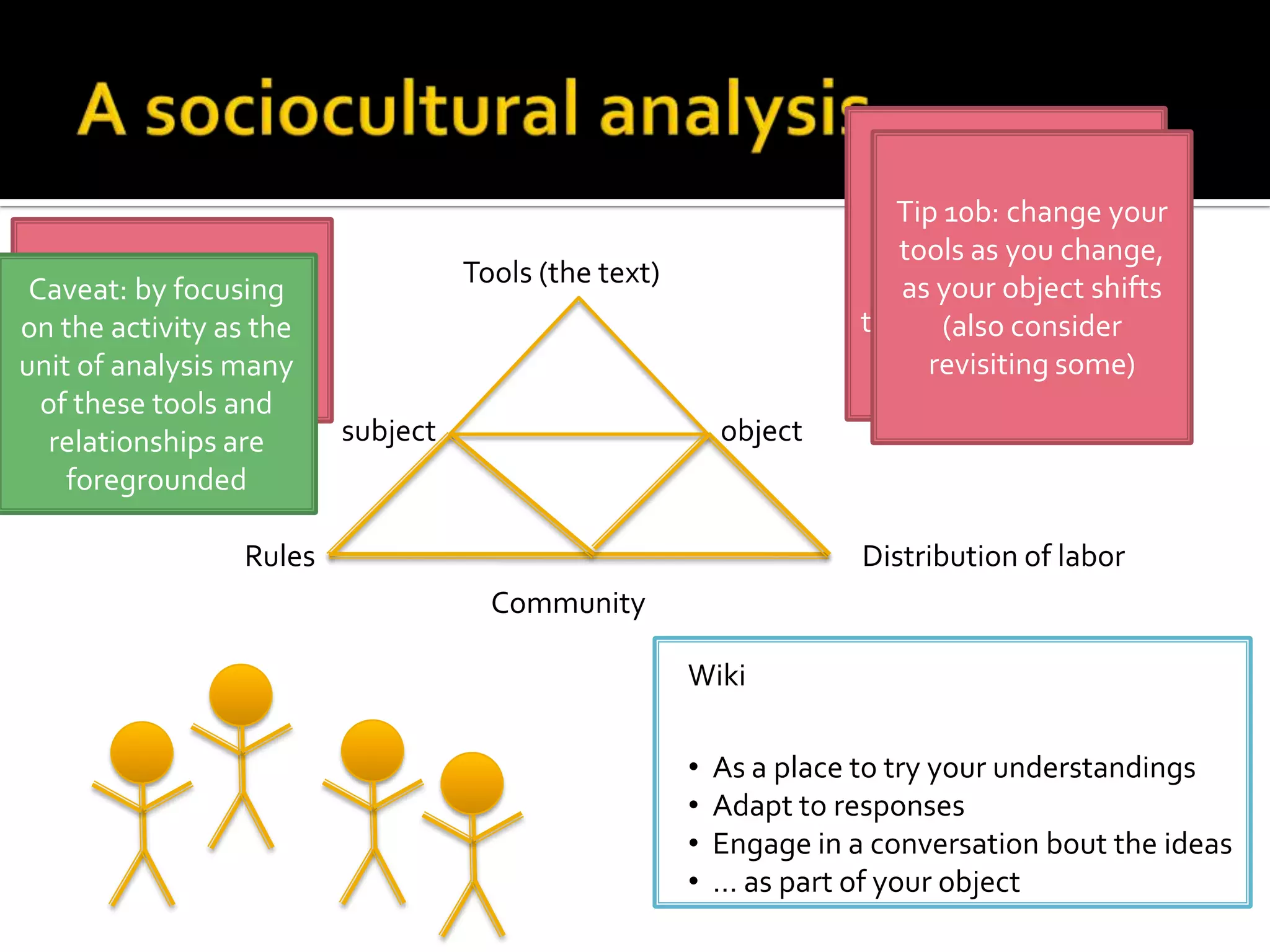
    … as partof your object A sociocultural analysisTip 10a: find / create other tools (mediators) as needed (charts, tables, web resources, colleagues, etc.)Tip 10b: change your tools as you change, as your object shifts (also consider revisiting some)Tip 10: …all that distributed cognition “stuff”Tools (the text)Caveat: by focusing on the activity as the unit of analysis many of these tools and relationships are foregroundedsubjectobjectRulesDistribution of laborCommunityWikiAs a place to try your understandings
  • 58.
  • 59.
    Engage in aconversation bout the ideas
  • 60.
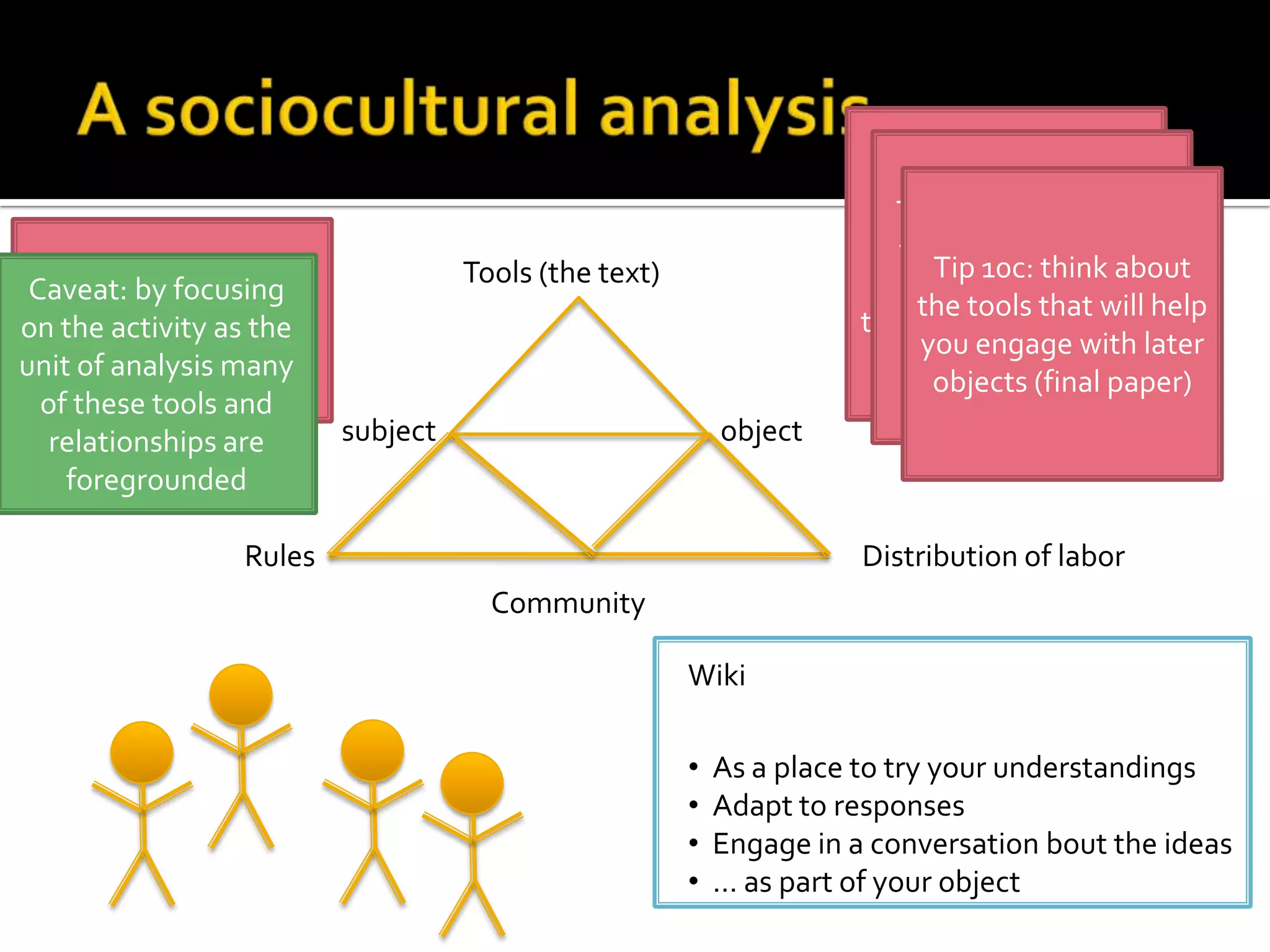
    … as partof your object A sociocultural analysisTip 10a: find / create other tools (mediators) as needed (charts, tables, web resources, colleagues, etc.)Tip 10b: change your tools as you change, as your object shifts (also consider revisiting some)Tip 10c: think about the tools that will help you engage with later objects (final paper)Tip 10: …all that distributed cognition “stuff”Tools (the text)Caveat: by focusing on the activity as the unit of analysis many of these tools and relationships are foregroundedsubjectobjectRulesDistribution of laborCommunityWikiAs a place to try your understandings
  • 61.
  • 62.
    Engage in aconversation bout the ideas
  • 63.
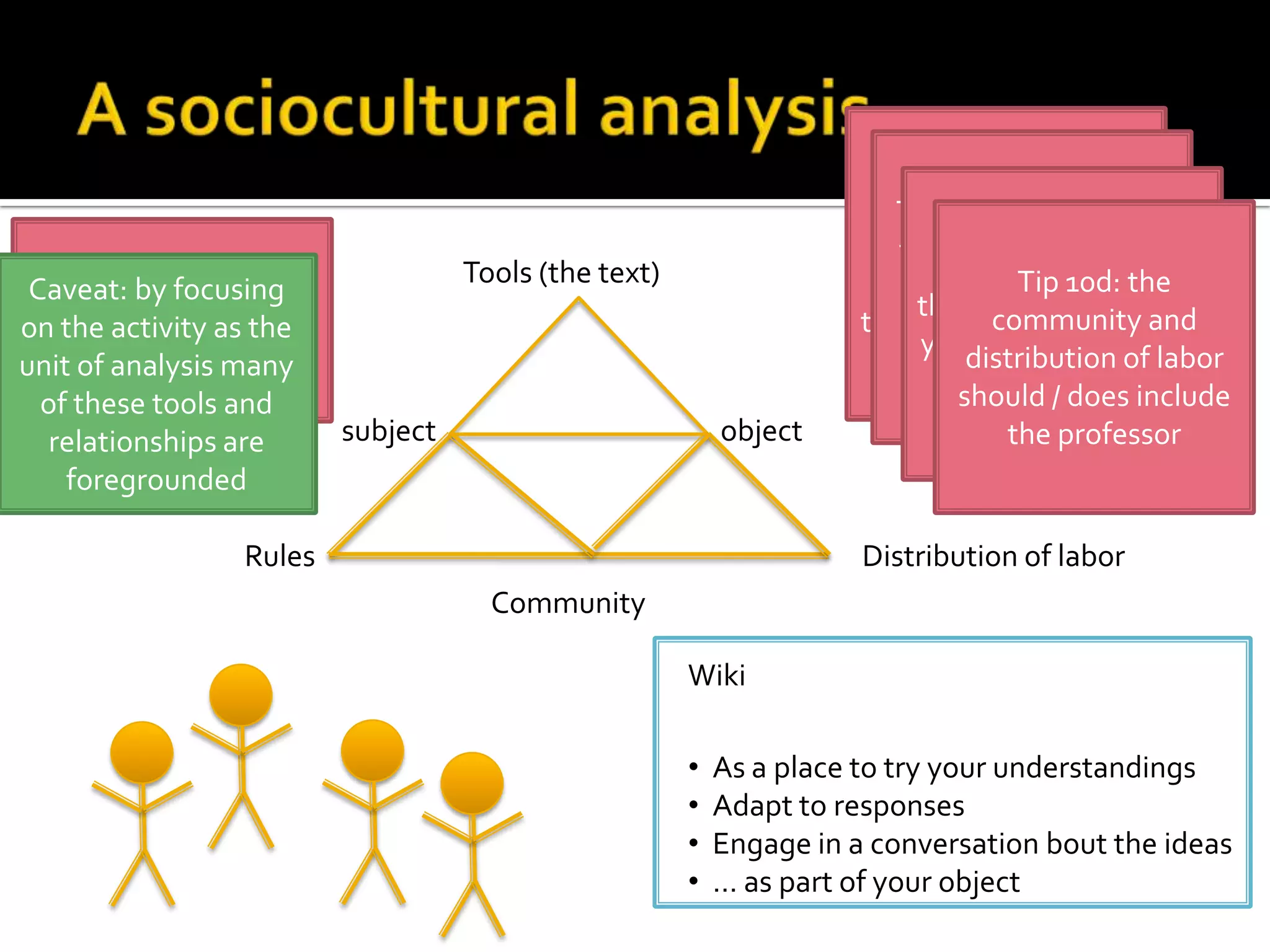
    … as partof your object A sociocultural analysisTip 10a: find / create other tools (mediators) as needed (charts, tables, web resources, colleagues, etc.)Tip 10b: change your tools as you change, as your object shifts (also consider revisiting some)Tip 10c: think about the tools that will help you engage with later objects (final paper)Tip 10d: the community and distribution of labor should / does include the professorTip 10: …all that distributed cognition “stuff”Tools (the text)Caveat: by focusing on the activity as the unit of analysis many of these tools and relationships are foregroundedsubjectobjectRulesDistribution of laborCommunityWikiAs a place to try your understandings
  • 64.
  • 65.
    Engage in aconversation bout the ideas
  • 66.
    … as partof your object A sociocultural analysisTip 10a: find / create other tools (mediators) as needed (charts, tables, web resources, colleagues, etc.)Tip 10b: change your tools as you change, as your object shifts (also consider revisiting some)Tip 10c: think about the tools that will help you engage with later objects (final paper)Tip 10d: the community and distribution of labor should / does include the professorTip 10: …all that distributed cognition “stuff”Tip 10d (cont.): … so be prepared with questions, notes, framings and send them in advance (when possible)Tools (the text)Caveat: by focusing on the activity as the unit of analysis many of these tools and relationships are foregroundedsubjectobjectRulesDistribution of laborCommunityWikiAs a place to try your understandings
  • 67.
  • 68.
    Engage in aconversation bout the ideas
  • 69.
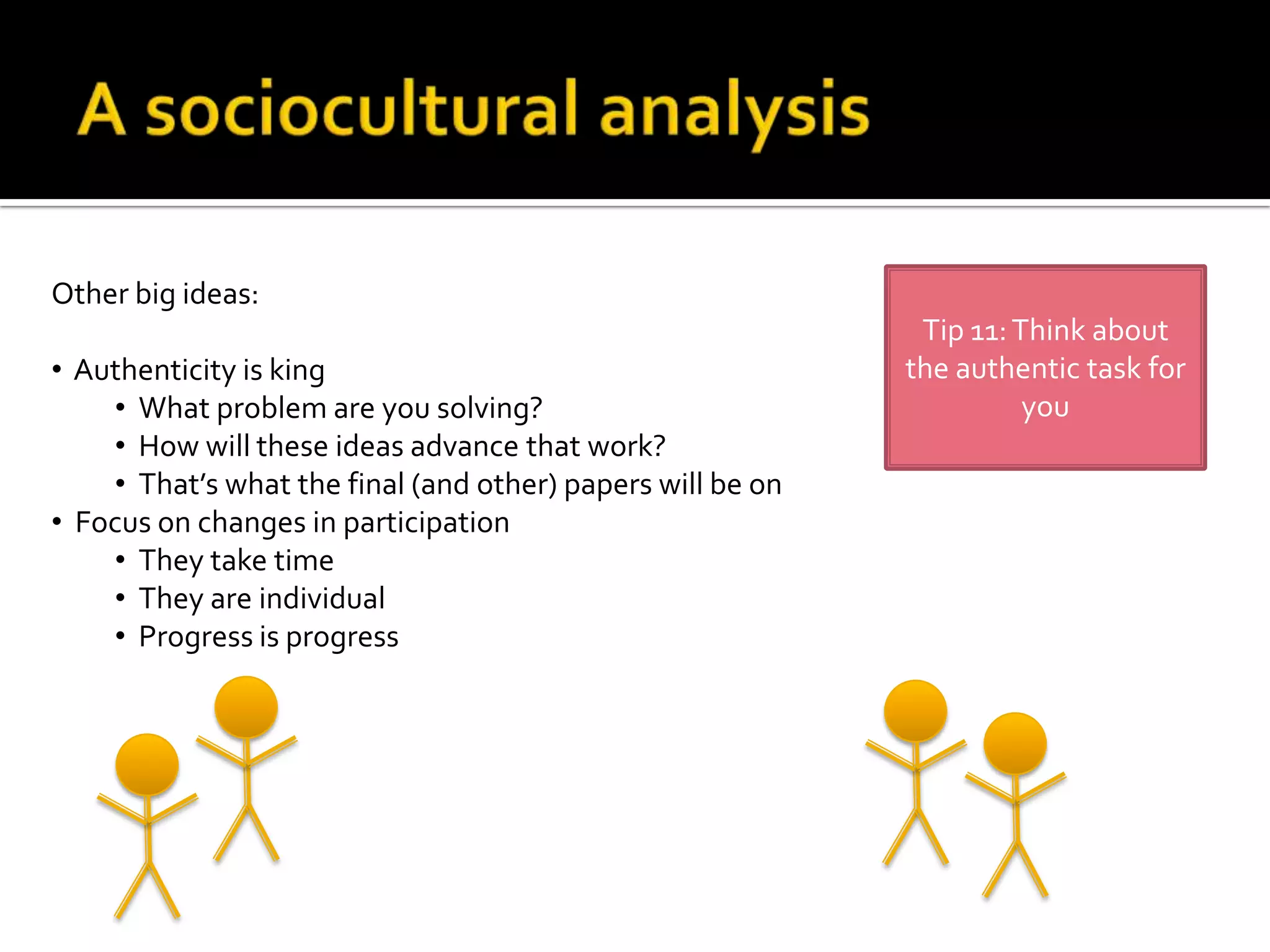
    … as partof your object A sociocultural analysisTip 11: Think about the authentic task for youOther big ideas: Authenticity is king
  • 70.
    What problem areyou solving?
  • 71.
    How will theseideas advance that work?
  • 72.
    That’s what thefinal (and other) papers will be on
  • 73.
    Focus on changesin participation
  • 74.
  • 75.
  • 76.
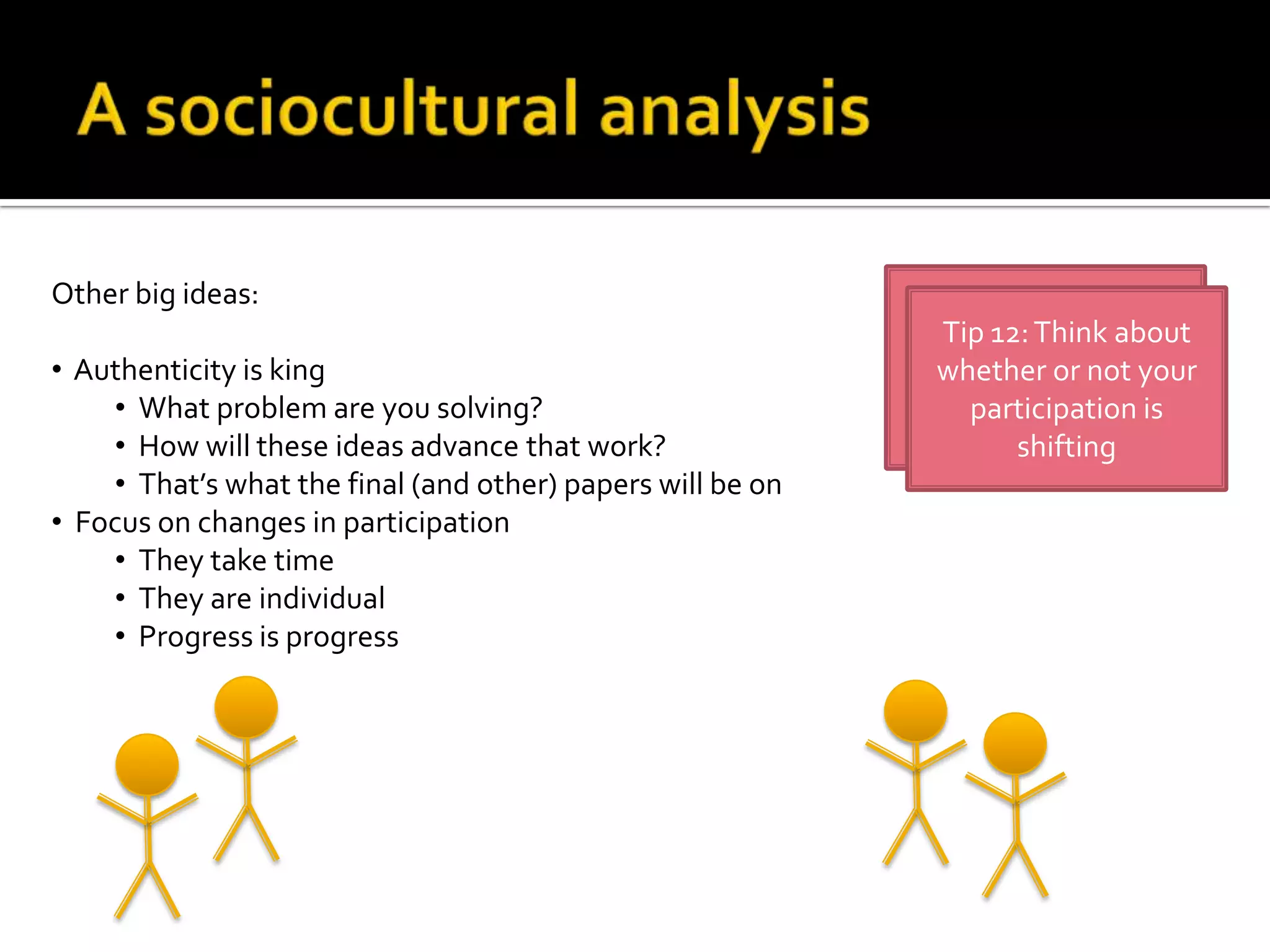
    Progress is progressAsociocultural analysisTip 11: Think about the authentic task for youOther big ideas: Authenticity is king
  • 77.
    What problem areyou solving?
  • 78.
    How will theseideas advance that work?
  • 79.
    That’s what thefinal (and other) papers will be on
  • 80.
    Focus on changesin participation
  • 81.
  • 82.
  • 83.
    Progress is progressTip12: Think about whether or not your participation is shifting
  • 84.
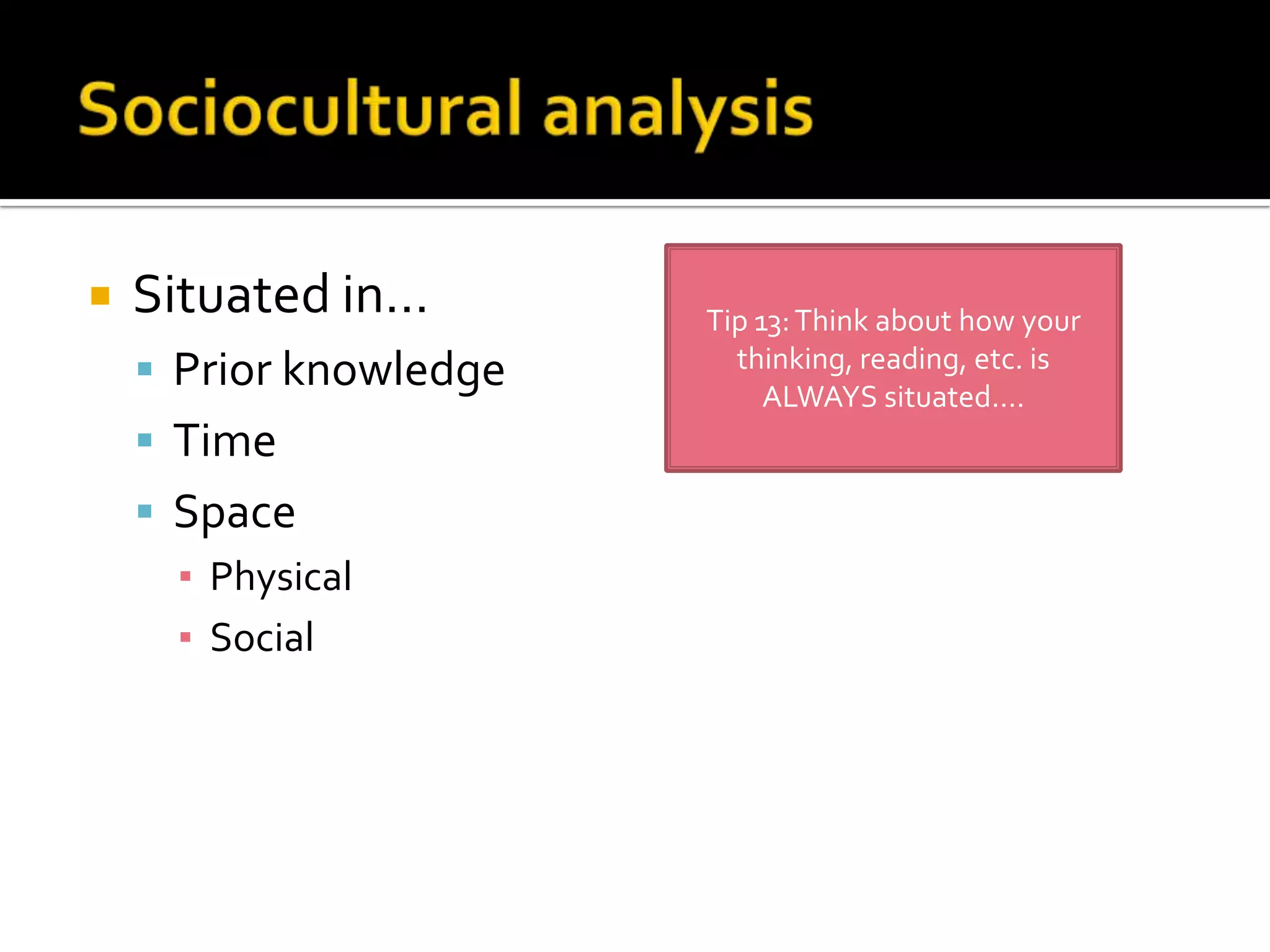
    Sociocultural analysisSituated in…PriorknowledgeTimeSpacePhysicalSocialTip 13: Think about how your thinking, reading, etc. is ALWAYS situated….
  • 85.
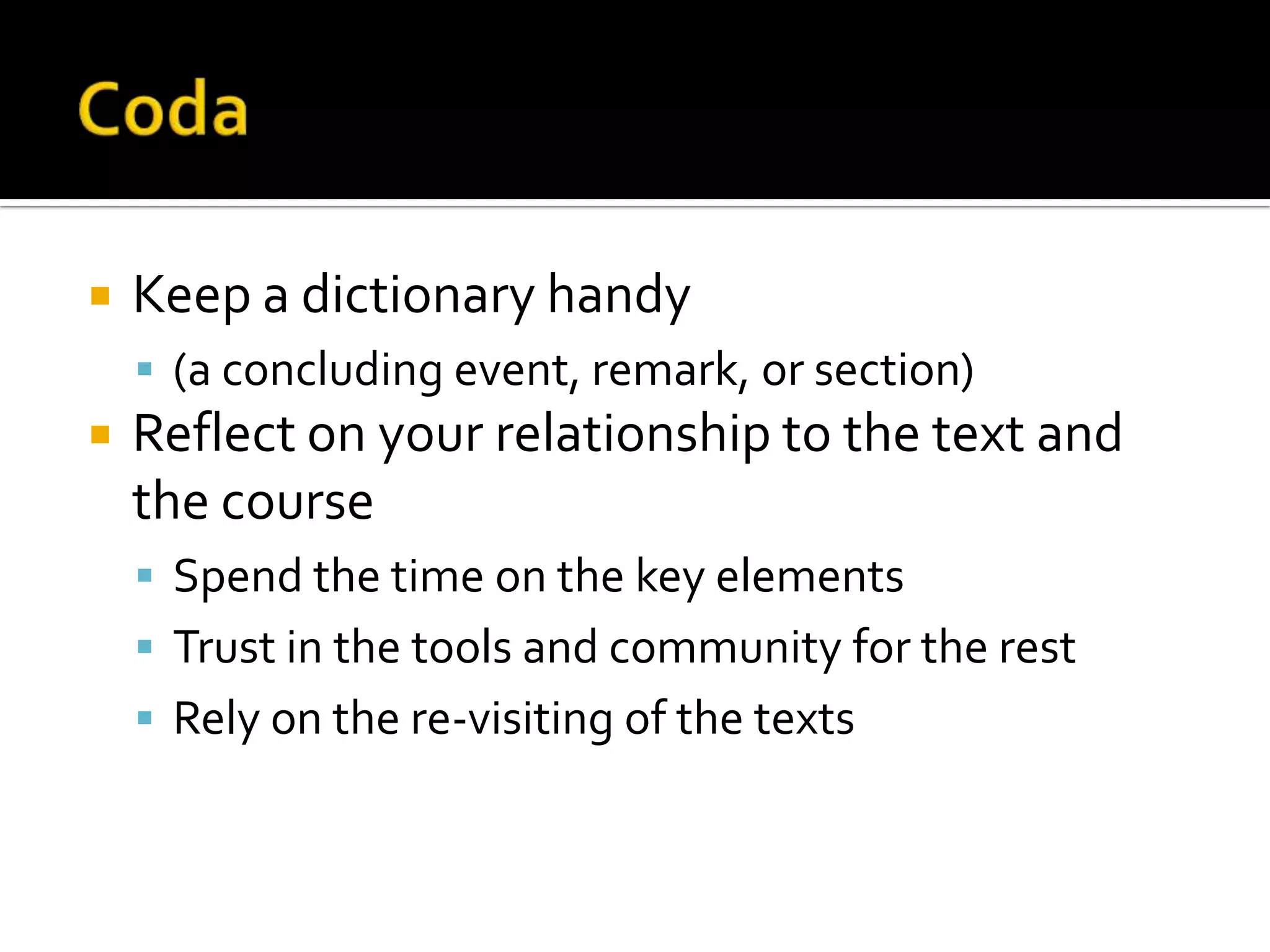
    Coda Keep adictionary handy(a concluding event, remark, or section)Reflect on your relationship to the text and the courseSpend the time on the key elementsTrust in the tools and community for the restRely on the re-visiting of the texts