Prepared by: Jessy Chong
URL: chongsk818.blogspot.com
 Use to forecast the production time and labour
costs in circumstances where a work force
makes a new product and improves its efficiency
with experience and learning.
 The learning effect is that as the work force
learns from experience how to make the new
product, there is a big reduction in the time to
make additional units.
 The learning rate is expressed as a percentage
value, such as 80% learning curve.
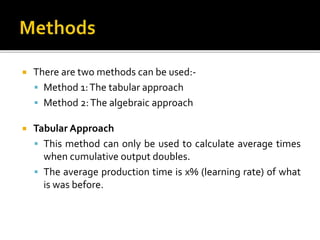
 There are two methods can be used:-
 Method 1:The tabular approach
 Method 2:The algebraic approach
 Tabular Approach
 This method can only be used to calculate average times
when cumulative output doubles.
 The average production time is x% (learning rate) of what
is was before.
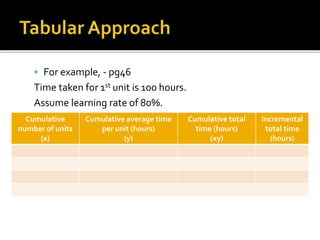
 For example, - pg46
Time taken for 1st unit is 100 hours.
Assume learning rate of 80%.
Cumulative
number of units
(x)
Cumulative average time
per unit (hours)
(y)
Cumulative total
time (hours)
(xy)
Incremental
total time
(hours)
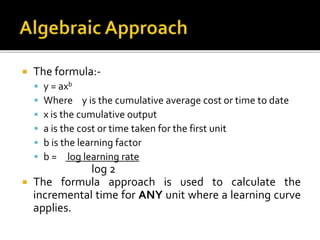
 The formula:-
 y = axb
 Where y is the cumulative average cost or time to date
 x is the cumulative output
 a is the cost or time taken for the first unit
 b is the learning factor
 b = log learning rate
log 2
 The formula approach is used to calculate the
incremental time for ANY unit where a learning curve
applies.
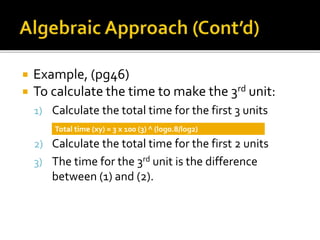
 Example, (pg46)
 To calculate the time to make the 3rd unit:
1) Calculate the total time for the first 3 units
2) Calculate the total time for the first 2 units
3) The time for the 3rd unit is the difference
between (1) and (2).
Total time (xy) = 3 x 100 (3) ^ (log0.8/log2)
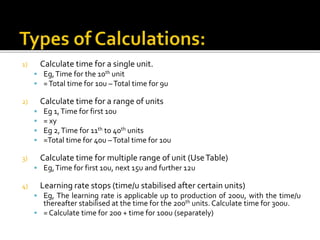
1) Calculate time for a single unit.
 Eg,Time for the 10th unit
 =Total time for 10u –Total time for 9u
2) Calculate time for a range of units
 Eg 1,Time for first 10u
 = xy
 Eg 2,Time for 11th to 40th units
 =Total time for 40u –Total time for 10u
3) Calculate time for multiple range of unit (UseTable)
 Eg,Time for first 10u, next 15u and further 12u
4) Learning rate stops (time/u stabilised after certain units)
 Eg, The learning rate is applicable up to production of 200u, with the time/u
thereafter stabilised at the time for the 200th units. Calculate time for 300u.
 = Calculate time for 200 + time for 100u (separately)

Learning curve

  • 1.
    Prepared by: JessyChong URL: chongsk818.blogspot.com
  • 2.
     Use toforecast the production time and labour costs in circumstances where a work force makes a new product and improves its efficiency with experience and learning.  The learning effect is that as the work force learns from experience how to make the new product, there is a big reduction in the time to make additional units.  The learning rate is expressed as a percentage value, such as 80% learning curve.
  • 3.
     There aretwo methods can be used:-  Method 1:The tabular approach  Method 2:The algebraic approach  Tabular Approach  This method can only be used to calculate average times when cumulative output doubles.  The average production time is x% (learning rate) of what is was before.
  • 4.
     For example,- pg46 Time taken for 1st unit is 100 hours. Assume learning rate of 80%. Cumulative number of units (x) Cumulative average time per unit (hours) (y) Cumulative total time (hours) (xy) Incremental total time (hours)
  • 5.
     The formula:- y = axb  Where y is the cumulative average cost or time to date  x is the cumulative output  a is the cost or time taken for the first unit  b is the learning factor  b = log learning rate log 2  The formula approach is used to calculate the incremental time for ANY unit where a learning curve applies.
  • 6.
     Example, (pg46) To calculate the time to make the 3rd unit: 1) Calculate the total time for the first 3 units 2) Calculate the total time for the first 2 units 3) The time for the 3rd unit is the difference between (1) and (2). Total time (xy) = 3 x 100 (3) ^ (log0.8/log2)
  • 7.
    1) Calculate timefor a single unit.  Eg,Time for the 10th unit  =Total time for 10u –Total time for 9u 2) Calculate time for a range of units  Eg 1,Time for first 10u  = xy  Eg 2,Time for 11th to 40th units  =Total time for 40u –Total time for 10u 3) Calculate time for multiple range of unit (UseTable)  Eg,Time for first 10u, next 15u and further 12u 4) Learning rate stops (time/u stabilised after certain units)  Eg, The learning rate is applicable up to production of 200u, with the time/u thereafter stabilised at the time for the 200th units. Calculate time for 300u.  = Calculate time for 200 + time for 100u (separately)