Operations
             Management
               Module E –
               Learning Curves

                             PowerPoint presentation to accompany
                             Heizer/Render
                             Principles of Operations Management, 7e
                             Operations Management, 9e
© 2008 Prentice Hall, Inc.                                             E–1
Outline
             Learning Curves in Services and
              Manufacturing
             Applying the Learning Curve
                              Arithmetic Approach
                              Logarithmic Approach
                              Learning-Curve Coefficient Approach
             Strategic Implications of Learning
              Curves
             Limitations of Learning Curves
© 2008 Prentice Hall, Inc.                                           E–2
Learning Objectives
               When you complete this module you
               should be able to:
                    1. Define a learning curve
                    2. Use the arithmetic concept to
                       estimate times
                    3. Compute learning curve effects with
                       the logarithmic and learning-curve
                       coefficient approaches
                    4. Describe the strategic implications of
                       learning curves
© 2008 Prentice Hall, Inc.                                      E–3
Learning Curves
                  Based on the premise that people and
                   organizations become better at their
                   tasks as the tasks are repeated
                  Time to produce a unit decreases as
                   more units are produced
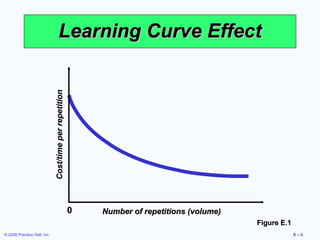
                  Learning curves typically follow a
                   negative exponential distribution
                  The rate of improvement decreases
                   over time

© 2008 Prentice Hall, Inc.                                E–4
Learning Curve Effect
                             Cost/time per repetition


                                                        0   Number of repetitions (volume)
                                                                                             Figure E.1
© 2008 Prentice Hall, Inc.                                                                                E–5
Learning Curves
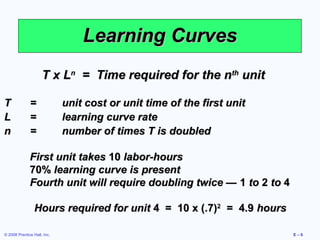
                     T x Ln = Time required for the nth unit

T             =              unit cost or unit time of the first unit
L             =              learning curve rate
n             =              number of times T is doubled

              First unit takes 10 labor-hours
              70% learning curve is present
              Fourth unit will require doubling twice — 1 to 2 to 4

                 Hours required for unit 4 = 10 x (.7)2 = 4.9 hours

© 2008 Prentice Hall, Inc.                                              E–6
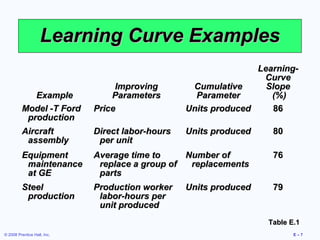
Learning Curve Examples
                                                                 Learning-
                                                                  Curve
                                  Improving        Cumulative      Slope
             Example             Parameters         Parameter       (%)
          Model -T Ford      Price                Units produced     86
           production
          Aircraft           Direct labor-hours   Units produced    80
           assembly           per unit
          Equipment          Average time to     Number of          76
           maintenance        replace a group of  replacements
           at GE              parts
          Steel              Production worker    Units produced    79
           production         labor-hours per
                              unit produced
                                                                   Table E.1
© 2008 Prentice Hall, Inc.                                                E–7
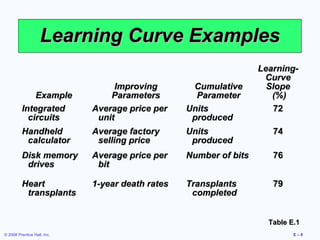
Learning Curve Examples
                                                                   Learning-
                                                                    Curve
                                  Improving        Cumulative        Slope
              Example            Parameters         Parameter         (%)
          Integrated         Average price per    Units                72
            circuits          unit                 produced
          Handheld           Average factory      Units               74
           calculator         selling price        produced
          Disk memory        Average price per    Number of bits      76
           drives             bit

          Heart              1-year death rates   Transplants         79
           transplants                             completed


                                                                     Table E.1
© 2008 Prentice Hall, Inc.                                                  E–8
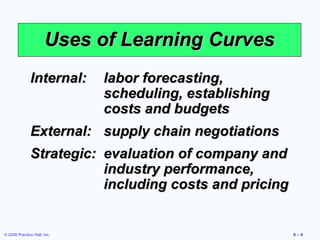
Uses of Learning Curves
              Internal:      labor forecasting,
                             scheduling, establishing
                             costs and budgets
              External: supply chain negotiations
              Strategic: evaluation of company and
                         industry performance,
                         including costs and pricing


© 2008 Prentice Hall, Inc.                              E–9
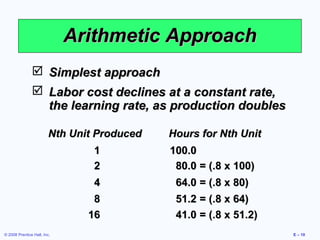
Arithmetic Approach
                Simplest approach
                Labor cost declines at a constant rate,
                 the learning rate, as production doubles

                        Nth Unit Produced   Hours for Nth Unit
                                1           100.0
                                2            80.0 = (.8 x 100)
                                4            64.0 = (.8 x 80)
                                8            51.2 = (.8 x 64)
                               16            41.0 = (.8 x 51.2)
© 2008 Prentice Hall, Inc.                                        E – 10
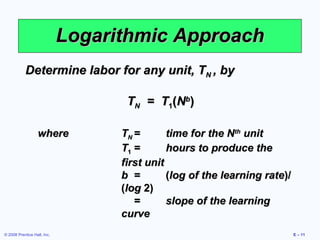
Logarithmic Approach
           Determine labor for any unit, TN , by

                                    TN = T1(Nb)

                   where           TN =       time for the Nth unit
                                   T1 =       hours to produce the
                                   first unit
                                   b =        (log of the learning rate)/
                                   (log 2)
                                      =       slope of the learning
                                   curve
© 2008 Prentice Hall, Inc.                                                  E – 11
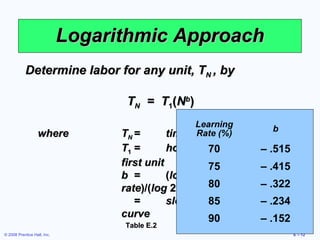
Logarithmic Approach
           Determine labor for any unit, TN , by

                                    TN = T1(Nb)
                                                     Learning        b
                   where           TN =        time for the Nth unit
                                                     Rate (%)
                                   T1 =       hours to70 produce the
                                                                  – .515
                                   first unit           75        – .415
                                   b =        (log of the learning
                                   rate)/(log 2)        80        – .322
                                      =       slope of 85 learning.234
                                                        the       –
                                   curve                90        – .152
                                   Table E.2
© 2008 Prentice Hall, Inc.                                                 E – 12
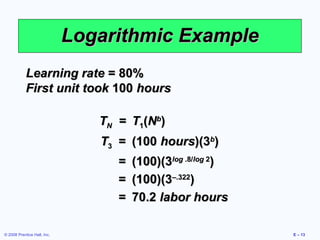
Logarithmic Example
            Learning rate = 80%
            First unit took 100 hours

                                TN = T1(Nb)
                                T3 = (100 hours)(3b)
                                   = (100)(3log .8/log 2)
                                   = (100)(3–.322)
                                   = 70.2 labor hours

© 2008 Prentice Hall, Inc.                                  E – 13
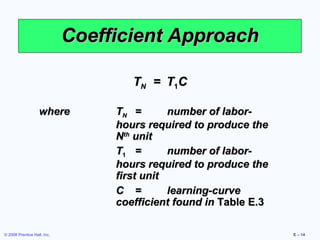
Coefficient Approach

                                     TN = T1C

                   where          TN =       number of labor-
                                  hours required to produce the
                                  Nth unit
                                  T1 =       number of labor-
                                  hours required to produce the
                                  first unit
                                  C =        learning-curve
                                  coefficient found in Table E.3

© 2008 Prentice Hall, Inc.                                         E – 14
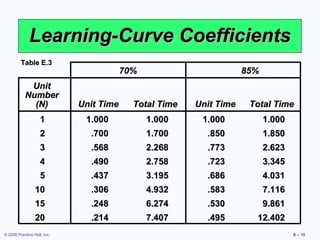
Learning-Curve Coefficients
         Table E.3
                                         70%                        85%
            Unit
           Number
             (N)             Unit Time     Total Time   Unit Time    Total Time
                    1         1.000            1.000     1.000            1.000
                    2          .700            1.700      .850            1.850
                    3          .568            2.268      .773            2.623
                    4          .490            2.758      .723            3.345
                    5          .437            3.195      .686            4.031
                 10            .306            4.932      .583            7.116
                 15            .248            6.274      .530            9.861
                 20            .214            7.407      .495        12.402
© 2008 Prentice Hall, Inc.                                                        E – 15
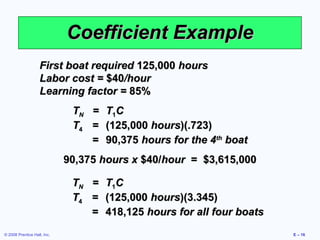
Coefficient Example
                    First boat required 125,000 hours
                    Labor cost = $40/hour
                    Learning factor = 85%
                              TN = T1C
                              T4 = (125,000 hours)(.723)
                                 = 90,375 hours for the 4th boat
                             90,375 hours x $40/hour = $3,615,000

                              TN   =   T1C
                              T4   =   (125,000 hours)(3.345)
                                   =   418,125 hours for all four boats
© 2008 Prentice Hall, Inc.                                                E – 16
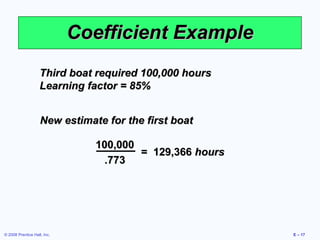
Coefficient Example
                    Third boat required 100,000 hours
                    Learning factor = 85%


                    New estimate for the first boat

                               100,000
                                       = 129,366 hours
                                 .773


© 2008 Prentice Hall, Inc.                               E – 17
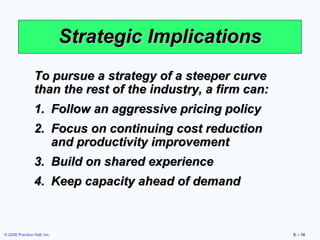
Strategic Implications
                 To pursue a strategy of a steeper curve
                 than the rest of the industry, a firm can:
                 1. Follow an aggressive pricing policy
                 2. Focus on continuing cost reduction
                    and productivity improvement
                 3. Build on shared experience
                 4. Keep capacity ahead of demand


© 2008 Prentice Hall, Inc.                                    E – 18
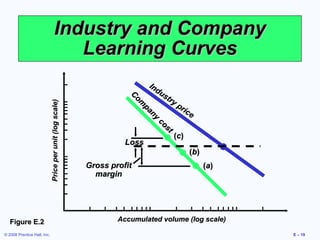
Industry and Company
                                          Learning Curves
                                                                           In
                                                                     C       du
                                                                      om        st
                                                                                   ry
                             Price per unit (log scale)


                                                                         pa           pr
                                                                            ny          ice
                                                                               co
                                                                                 st
                                                                                     (c)
                                                                    Loss
                                                                                          (b )
                                                          Gross profit                           (a)
                                                            margin


   Figure E.2                                                     Accumulated volume (log scale)

© 2008 Prentice Hall, Inc.                                                                             E – 19
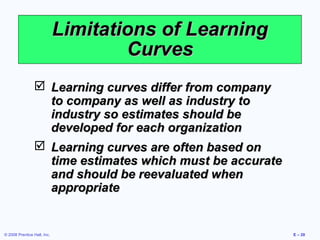
Limitations of Learning
                                     Curves
                  Learning curves differ from company
                   to company as well as industry to
                   industry so estimates should be
                   developed for each organization
                  Learning curves are often based on
                   time estimates which must be accurate
                   and should be reevaluated when
                   appropriate


© 2008 Prentice Hall, Inc.                                 E – 20
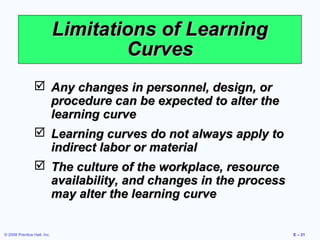
Limitations of Learning
                                     Curves
                  Any changes in personnel, design, or
                   procedure can be expected to alter the
                   learning curve
                  Learning curves do not always apply to
                   indirect labor or material
                  The culture of the workplace, resource
                   availability, and changes in the process
                   may alter the learning curve


© 2008 Prentice Hall, Inc.                                    E – 21

Heizer mod e

  • 1.
    Operations Management Module E – Learning Curves PowerPoint presentation to accompany Heizer/Render Principles of Operations Management, 7e Operations Management, 9e © 2008 Prentice Hall, Inc. E–1
  • 2.
    Outline  Learning Curves in Services and Manufacturing  Applying the Learning Curve  Arithmetic Approach  Logarithmic Approach  Learning-Curve Coefficient Approach  Strategic Implications of Learning Curves  Limitations of Learning Curves © 2008 Prentice Hall, Inc. E–2
  • 3.
    Learning Objectives When you complete this module you should be able to: 1. Define a learning curve 2. Use the arithmetic concept to estimate times 3. Compute learning curve effects with the logarithmic and learning-curve coefficient approaches 4. Describe the strategic implications of learning curves © 2008 Prentice Hall, Inc. E–3
  • 4.
    Learning Curves  Based on the premise that people and organizations become better at their tasks as the tasks are repeated  Time to produce a unit decreases as more units are produced  Learning curves typically follow a negative exponential distribution  The rate of improvement decreases over time © 2008 Prentice Hall, Inc. E–4
  • 5.
    Learning Curve Effect Cost/time per repetition 0 Number of repetitions (volume) Figure E.1 © 2008 Prentice Hall, Inc. E–5
  • 6.
    Learning Curves T x Ln = Time required for the nth unit T = unit cost or unit time of the first unit L = learning curve rate n = number of times T is doubled First unit takes 10 labor-hours 70% learning curve is present Fourth unit will require doubling twice — 1 to 2 to 4 Hours required for unit 4 = 10 x (.7)2 = 4.9 hours © 2008 Prentice Hall, Inc. E–6
  • 7.
    Learning Curve Examples Learning- Curve Improving Cumulative Slope Example Parameters Parameter (%) Model -T Ford Price Units produced 86 production Aircraft Direct labor-hours Units produced 80 assembly per unit Equipment Average time to Number of 76 maintenance replace a group of replacements at GE parts Steel Production worker Units produced 79 production labor-hours per unit produced Table E.1 © 2008 Prentice Hall, Inc. E–7
  • 8.
    Learning Curve Examples Learning- Curve Improving Cumulative Slope Example Parameters Parameter (%) Integrated Average price per Units 72 circuits unit produced Handheld Average factory Units 74 calculator selling price produced Disk memory Average price per Number of bits 76 drives bit Heart 1-year death rates Transplants 79 transplants completed Table E.1 © 2008 Prentice Hall, Inc. E–8
  • 9.
    Uses of LearningCurves Internal: labor forecasting, scheduling, establishing costs and budgets External: supply chain negotiations Strategic: evaluation of company and industry performance, including costs and pricing © 2008 Prentice Hall, Inc. E–9
  • 10.
    Arithmetic Approach  Simplest approach  Labor cost declines at a constant rate, the learning rate, as production doubles Nth Unit Produced Hours for Nth Unit 1 100.0 2 80.0 = (.8 x 100) 4 64.0 = (.8 x 80) 8 51.2 = (.8 x 64) 16 41.0 = (.8 x 51.2) © 2008 Prentice Hall, Inc. E – 10
  • 11.
    Logarithmic Approach Determine labor for any unit, TN , by TN = T1(Nb) where TN = time for the Nth unit T1 = hours to produce the first unit b = (log of the learning rate)/ (log 2) = slope of the learning curve © 2008 Prentice Hall, Inc. E – 11
  • 12.
    Logarithmic Approach Determine labor for any unit, TN , by TN = T1(Nb) Learning b where TN = time for the Nth unit Rate (%) T1 = hours to70 produce the – .515 first unit 75 – .415 b = (log of the learning rate)/(log 2) 80 – .322 = slope of 85 learning.234 the – curve 90 – .152 Table E.2 © 2008 Prentice Hall, Inc. E – 12
  • 13.
    Logarithmic Example Learning rate = 80% First unit took 100 hours TN = T1(Nb) T3 = (100 hours)(3b) = (100)(3log .8/log 2) = (100)(3–.322) = 70.2 labor hours © 2008 Prentice Hall, Inc. E – 13
  • 14.
    Coefficient Approach TN = T1C where TN = number of labor- hours required to produce the Nth unit T1 = number of labor- hours required to produce the first unit C = learning-curve coefficient found in Table E.3 © 2008 Prentice Hall, Inc. E – 14
  • 15.
    Learning-Curve Coefficients Table E.3 70% 85% Unit Number (N) Unit Time Total Time Unit Time Total Time 1 1.000 1.000 1.000 1.000 2 .700 1.700 .850 1.850 3 .568 2.268 .773 2.623 4 .490 2.758 .723 3.345 5 .437 3.195 .686 4.031 10 .306 4.932 .583 7.116 15 .248 6.274 .530 9.861 20 .214 7.407 .495 12.402 © 2008 Prentice Hall, Inc. E – 15
  • 16.
    Coefficient Example First boat required 125,000 hours Labor cost = $40/hour Learning factor = 85% TN = T1C T4 = (125,000 hours)(.723) = 90,375 hours for the 4th boat 90,375 hours x $40/hour = $3,615,000 TN = T1C T4 = (125,000 hours)(3.345) = 418,125 hours for all four boats © 2008 Prentice Hall, Inc. E – 16
  • 17.
    Coefficient Example Third boat required 100,000 hours Learning factor = 85% New estimate for the first boat 100,000 = 129,366 hours .773 © 2008 Prentice Hall, Inc. E – 17
  • 18.
    Strategic Implications To pursue a strategy of a steeper curve than the rest of the industry, a firm can: 1. Follow an aggressive pricing policy 2. Focus on continuing cost reduction and productivity improvement 3. Build on shared experience 4. Keep capacity ahead of demand © 2008 Prentice Hall, Inc. E – 18
  • 19.
    Industry and Company Learning Curves In C du om st ry Price per unit (log scale) pa pr ny ice co st (c) Loss (b ) Gross profit (a) margin Figure E.2 Accumulated volume (log scale) © 2008 Prentice Hall, Inc. E – 19
  • 20.
    Limitations of Learning Curves  Learning curves differ from company to company as well as industry to industry so estimates should be developed for each organization  Learning curves are often based on time estimates which must be accurate and should be reevaluated when appropriate © 2008 Prentice Hall, Inc. E – 20
  • 21.
    Limitations of Learning Curves  Any changes in personnel, design, or procedure can be expected to alter the learning curve  Learning curves do not always apply to indirect labor or material  The culture of the workplace, resource availability, and changes in the process may alter the learning curve © 2008 Prentice Hall, Inc. E – 21

Editor's Notes

  • #5 This slide provides some reasons that capacity is an issue. The following slides guide a discussion of capacity.
  • #6 This slide provides some reasons that capacity is an issue. The following slides guide a discussion of capacity.
  • #7 This slide can be used to frame a discussion of capacity. Points to be made might include: - capacity definition and measurement is necessary if we are to develop a production schedule - while a process may have “maximum” capacity, many factors prevent us from achieving that capacity on a continuous basis. Students should be asked to suggest factors which might prevent one from achieving maximum capacity.
  • #8 This slide can be used to frame a discussion of capacity. Points to be made might include: - capacity definition and measurement is necessary if we are to develop a production schedule - while a process may have “maximum” capacity, many factors prevent us from achieving that capacity on a continuous basis. Students should be asked to suggest factors which might prevent one from achieving maximum capacity.
  • #9 This slide can be used to frame a discussion of capacity. Points to be made might include: - capacity definition and measurement is necessary if we are to develop a production schedule - while a process may have “maximum” capacity, many factors prevent us from achieving that capacity on a continuous basis. Students should be asked to suggest factors which might prevent one from achieving maximum capacity.
  • #10 This slide can be used to frame a discussion of capacity. Points to be made might include: - capacity definition and measurement is necessary if we are to develop a production schedule - while a process may have “maximum” capacity, many factors prevent us from achieving that capacity on a continuous basis. Students should be asked to suggest factors which might prevent one from achieving maximum capacity.
  • #11 This slide can be used to frame a discussion of capacity. Points to be made might include: - capacity definition and measurement is necessary if we are to develop a production schedule - while a process may have “maximum” capacity, many factors prevent us from achieving that capacity on a continuous basis. Students should be asked to suggest factors which might prevent one from achieving maximum capacity.
  • #12 This slide can be used to frame a discussion of capacity. Points to be made might include: - capacity definition and measurement is necessary if we are to develop a production schedule - while a process may have “maximum” capacity, many factors prevent us from achieving that capacity on a continuous basis. Students should be asked to suggest factors which might prevent one from achieving maximum capacity.
  • #13 This slide can be used to frame a discussion of capacity. Points to be made might include: - capacity definition and measurement is necessary if we are to develop a production schedule - while a process may have “maximum” capacity, many factors prevent us from achieving that capacity on a continuous basis. Students should be asked to suggest factors which might prevent one from achieving maximum capacity.
  • #14 This slide can be used to frame a discussion of capacity. Points to be made might include: - capacity definition and measurement is necessary if we are to develop a production schedule - while a process may have “maximum” capacity, many factors prevent us from achieving that capacity on a continuous basis. Students should be asked to suggest factors which might prevent one from achieving maximum capacity.
  • #15 This slide can be used to frame a discussion of capacity. Points to be made might include: - capacity definition and measurement is necessary if we are to develop a production schedule - while a process may have “maximum” capacity, many factors prevent us from achieving that capacity on a continuous basis. Students should be asked to suggest factors which might prevent one from achieving maximum capacity.
  • #16 This slide can be used to frame a discussion of capacity. Points to be made might include: - capacity definition and measurement is necessary if we are to develop a production schedule - while a process may have “maximum” capacity, many factors prevent us from achieving that capacity on a continuous basis. Students should be asked to suggest factors which might prevent one from achieving maximum capacity.
  • #17 This slide can be used to frame a discussion of capacity. Points to be made might include: - capacity definition and measurement is necessary if we are to develop a production schedule - while a process may have “maximum” capacity, many factors prevent us from achieving that capacity on a continuous basis. Students should be asked to suggest factors which might prevent one from achieving maximum capacity.
  • #18 This slide can be used to frame a discussion of capacity. Points to be made might include: - capacity definition and measurement is necessary if we are to develop a production schedule - while a process may have “maximum” capacity, many factors prevent us from achieving that capacity on a continuous basis. Students should be asked to suggest factors which might prevent one from achieving maximum capacity.
  • #19 This slide can be used to frame a discussion of capacity. Points to be made might include: - capacity definition and measurement is necessary if we are to develop a production schedule - while a process may have “maximum” capacity, many factors prevent us from achieving that capacity on a continuous basis. Students should be asked to suggest factors which might prevent one from achieving maximum capacity.
  • #20 This slide can be used to frame a discussion of capacity. Points to be made might include: - capacity definition and measurement is necessary if we are to develop a production schedule - while a process may have “maximum” capacity, many factors prevent us from achieving that capacity on a continuous basis. Students should be asked to suggest factors which might prevent one from achieving maximum capacity.
  • #21 This slide can be used to frame a discussion of capacity. Points to be made might include: - capacity definition and measurement is necessary if we are to develop a production schedule - while a process may have “maximum” capacity, many factors prevent us from achieving that capacity on a continuous basis. Students should be asked to suggest factors which might prevent one from achieving maximum capacity.
  • #22 This slide can be used to frame a discussion of capacity. Points to be made might include: - capacity definition and measurement is necessary if we are to develop a production schedule - while a process may have “maximum” capacity, many factors prevent us from achieving that capacity on a continuous basis. Students should be asked to suggest factors which might prevent one from achieving maximum capacity.