Change agent’s skills and its relation
with client organization
Organizational Development
 who is a change agent
 types of change agents
 Role of the change agent
 skills required by a change agent
 Best practice / 22 lessons learned
Table of content
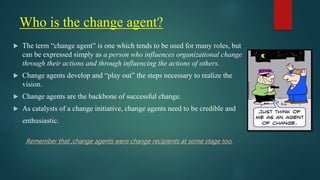
Who is the change agent?
 The term “change agent” is one which tends to be used for many roles, but
can be expressed simply as a person who influences organizational change
through their actions and through influencing the actions of others.
 Change agents develop and “play out” the steps necessary to realize the
vision.
 Change agents are the backbone of successful change.
 As catalysts of a change initiative, change agents need to be credible and
enthusiastic.
Remember that ;change agents were change recipients at some stage too.
 Change agent is someone who is helping to either bring about different
condition (change), but more often it is someone who is leading in the
transition that results from change . Greg Rothwell.
Someone who identifies a future state or goal and then puts the systems in
place to get it done. Jerry Hultin.
A change agent is the person who carries the flag of a need usually not
generally recognized need. Gary Foster.
A change agent is any catalyst that alters the status quo it could be a person
group an event or policies. Louise Andre.
Other terms also used for people who are
responsible for implementing change
 Facilitator
 Project manager
 Problem owner
 Agent of change
Types of Change Agent
 A change agent is a person from inside or outside the organization who
helps an organization transform itself by focusing on such matters as
organizational effectiveness, improvement, and development.
 A change agent usually focuses his efforts on the effect of changing
technologies, structures, and tasks on interpersonal and group relationships
in the organization. The focus is on the people in the organization and their
interactions.
 Individual or group that undertakes the task of introducing and managing a
change in an organization.
 Internal
 External
Internal Change Agents
Advantages
• Time saving
• Ready access to client
• Intimate knowledge of the
organization, its dynamics ,
culture and informal practices.
• Access to variety of
information: internal
company reports and direct
observation.
• Less threatening than
outsiders and better able to
establish rapport and trust
Disadvantages
• Lack of objectivity
• Overly cautious, likely when
dealing with internal power
structure.
• May lack certain skills and
experience in facilitating
organizational change.
External Change Agents
Advantages
• Expertise that is unavailable internally.
• More objective perspective into the
organization development process.
• Ability to probe issues and to question
the status quo
• They are also afforded some deference
and power.
Disadvantages
• Extra time required to familiarizes themselves
with the organization
• Organizations may be wary from the
outsiders.
• Perception within the organization that
outsiders have little invested in outcomes.
To succeed, they must be perceived as trustworthy,
be experts with proven track records, be similar to
those they are working with.
Role of change agent
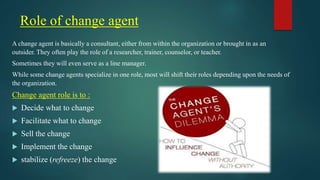
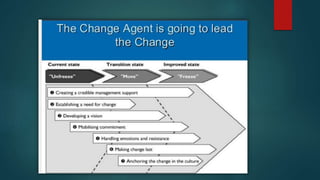
Change agent role is to :
 Decide what to change
 Facilitate what to change
 Sell the change
 Implement the change
 stabilize (refreeze) the change
A change agent is basically a consultant, either from within the organization or brought in as an
outsider. They often play the role of a researcher, trainer, counselor, or teacher.
Sometimes they will even serve as a line manager.
While some change agents specialize in one role, most will shift their roles depending upon the needs of
the organization.
Functions and Role of change agent:
1. Developing specific, measurable objectives
2. Listing techniques needed to accomplish of activities .
3. Developing a timetable for completion of activities.
4. Assessing resources
5. Preparing a budget.
6. Selecting suitable persons needed for change plan.
7. Designing a method evaluating the outcome of activities
8. Anticipating resistance to change.
9. Developing strategies to manage resistance
10.Designing a plan to stabilize (refreeze) the change
Roles & Competencies
You must have four competencies to become an effective change agent:
1. Broad knowledge: You must not only have broad industry knowledge but a broad range of
multidisciplinary knowledge, including conceptual knowledge, diagnostic knowledge,
evaluative knowledge, an understanding of methodology for change, and ethical knowledge.
2. Operational and relational knowledge: You must be able to listen, trust, form relationships,
observe, identify, and report. You must be flexible to deal with different types of
relationships and behaviors.
3. Sensitivity and maturity: You must not only be able to demonstrate sensitivity to others, but
you must also be sensitive and mature enough to be aware of your own motivations.
4. Authenticity: You must be authentic. You must act in accordance with the values you seek to
promote in the organization. Walk the talk
For example, if you recommend a form of management that permits subordinate participation,
you should not attempt to impose these changes without the participation of the organizational
members. In other words, you should practice what you preach.
5 Characteristics of a Change Agent
1. Clear Vision – As mentioned above, a “change agent” does not have
to be the person in authority, but they do however have to have a
clear vision and be able to communicate that clearly with others.
 Where people can be frustrated if they feel that someone is all over the
place on what they see as important and tend to change their vision
often. This will scare away others as they are not sure when they are
on a sinking ship and start to looking for ways out.
 It is essential to note that a clear vision does not mean that there is one
way to do things; in fact, it is essential to tap into the strengths of the
people you work with and help them see that there are many ways to
work toward a common purpose.
Cont’d
 2. Patient yet persistent – Change does not happen overnight and most
people know that.
 To have sustainable change that is meaningful to people, it is something
that they will have to embrace and see importance. Most people need to
experience something before they really understand that, With that being said,
many can get frustrated that change does not happen fast enough and they tend
to push people further away from the vision, then closer.
 The persistence comes in that you will take opportunities to help people get a
step closer often when they are ready, not just giving up on them after the first
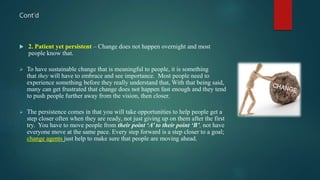
try. You have to move people from their point ‘A’ to their point ‘B’, not have
everyone move at the same pace. Every step forward is a step closer to a goal;
change agents just help to make sure that people are moving ahead.
Cont’d
3. Asks tough questions – It would be easy for someone to
come in and tell you how things should be, but again that is
someone else’s solution.
 When that solution is someone else’s, there is no
accountability to see it through. It is when people feel an
emotional connection to something is when they will truly
move ahead.
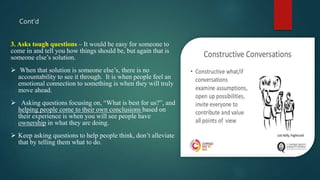
 Asking questions focusing on, “What is best for us?”, and
helping people come to their own conclusions based on
their experience is when you will see people have
ownership in what they are doing.
 Keep asking questions to help people think, don’t alleviate
that by telling them what to do.
Cont’d
 4. Knowledgeable and leads by example – Stephen Covey talked about
the notion that leaders have “character and credibility”; they are not just
seen as good people but that they are also knowledgeable in what they are
speaking about.
 If you want to create “change”, you have to not only be able to articulate
what that looks like, but show it.
Cont’d
5. Strong relationships built on trust
 All of the above, means nothing if you do not have solid relationships with the people
that you serve.
 People will not want to grow if they do not trust the person that is pushing the change.
 The change agents should be approachable and reliable. You should never be afraid to
approach that individual based on their “authority” and usually they will go out of their
way to connect with you.
 That doesn’t mean that they aren’t willing to have tough conversations though; that also
builds trust.
 Trust is also built when you know someone will deal with things and not be afraid to do
what is right, even if it is uncomfortable.
 Sometimes trust is built when you choose to do what is right for your community or
organization, as long as it is always done in a respectful way.
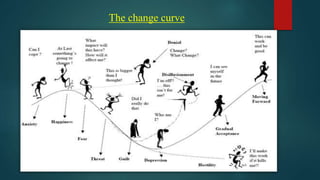
The change curve
if the leader does not “clear the path”, improvement will take a lot longer
than it should.
 What is important to note is that being a “charismatic leader” is not something that
is essential.
 Often, charismatic leaders lack many of these qualities that I have listed above and
although they can seemingly lead change, it is not sustainable ,it becomes too
dependent upon one person.
 For example, was Steve Jobs a change agent, or a charismatic leader?
 Apple is not doing as well since he has passed away and their innovation has seem
to slow down. Steve Jobs was known for being notoriously tough to deal with.
 I believe that change agents will help to create more leaders, not more followers.
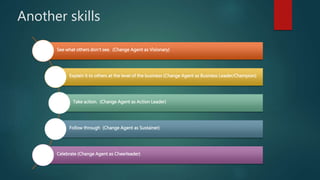
Another skills
See what others don’t see. (Change Agent as Visionary)
Explain it to others at the level of the business (Change Agent as Business Leader/Champion)
Take action. (Change Agent as Action Leader)
Follow through (Change Agent as Sustainer)
Celebrate (Change Agent as Cheerleader)
Best practice / 22 lessons learned
1. Develop a compelling vision
2. Change is a journey not a blueprint: Develop Detailed, Multi-dimensional Plans
 Change Description
 Business Objectives
 Human Objectives
 Key Role Map
 Vision
 Detailed Activities, Resources, Timelines
 Measurements
 3.understand and own the past : the past bound the future success
 4.Build a strong committed management coalition :At All Levels Within the
Organization ,Teach Them Their Job.
 5.Identify all the people who are affected and who are involved.
 6.Analyze their readiness for change.
 7.Start where people are most receptive.
 8.People don’t resist their own ideas.
 9.Manage the drive forces as well as the restraining forces
 10.Establish a darn good reason to change.
 11.Repeat , repeat , repeat , say it once , say it twice , say it again
 12.Monitor the communications
 13.Encourage the heart.
 14.Show results early and often.
 15.Prepare for implementation dip.
 16.Validate the feeling of people.
 17. Deal With the Four “F’s of Loss and Change”:
 Letting Go of Familiar Past (Perhaps a Romanticized View)
 Confronting Feelings About an Uncertain Future
 Dealing With Loss of Face
 Redesigning a Focus on New Realities
 Working on These in Public, Facilitated Forums Allows People to
Constructively Express Their Anxiety and Anger and Helps to Reduce
Passive-Aggressive Inertia and Sabotage
Cont’d
18.Don’t resist resistance.
19.Facilitate rather than just train.
20. Use a Variety of Mediums to Build Competency in the Change
21.Recognize Every Person Is a Change Agent; Educate Leaders of the Change
As Well As the Targets of Their Roles in the Change
 To Be Open to Change
 To Anticipate Change, Not Just React to It
 To Accept That Change Causes Stress and to Developing Coping
Mechanisms
Cont’d
 22. Change Agents Must Be Able to Work With Polar Opposites; Simultaneously
Pushing for Change While Allowing Self-learning to Unfold
 Being Prepared for a Journey of Uncertainty
 Seeing Problems As Sources of Creative Resolution
 Having a Vision, but Not Being Blinded by It
 Valuing the Individual and the Group
 Incorporating Centralizing and Decentralizing Forces
 Being Internally Cohesive, but Externally Oriented
 Valuing Personal Change Agency As the Route to System Change
Cont’d
“HELP SCORES”
 Homophily:It is the degree of closeness and similarity between the change agent and
the client
 Empathy: It involves an understanding of feelings and emotions and thoughts.
 Linkage: It refers to the degree of collaboration between the change agent and the
client
 Proximity: The change agent and the client should have easy access to each other
 Structuring: proper and clear planning of all activities that are related to change
 Capacity: refers to an organization’s capacity to provide the resources that are
needed for successful organizational development effort and implementation.
 Openness: respect and understanding for each other’s ideas, needs and feelings
 Reward
 Energy
 synergy
Thank you

Change Agents' skills and client relationship - Slideshare

  • 1.
    Change agent’s skillsand its relation with client organization Organizational Development
  • 2.
     who isa change agent  types of change agents  Role of the change agent  skills required by a change agent  Best practice / 22 lessons learned Table of content
  • 3.
    Who is thechange agent?  The term “change agent” is one which tends to be used for many roles, but can be expressed simply as a person who influences organizational change through their actions and through influencing the actions of others.  Change agents develop and “play out” the steps necessary to realize the vision.  Change agents are the backbone of successful change.  As catalysts of a change initiative, change agents need to be credible and enthusiastic. Remember that ;change agents were change recipients at some stage too.
  • 4.
     Change agentis someone who is helping to either bring about different condition (change), but more often it is someone who is leading in the transition that results from change . Greg Rothwell. Someone who identifies a future state or goal and then puts the systems in place to get it done. Jerry Hultin. A change agent is the person who carries the flag of a need usually not generally recognized need. Gary Foster. A change agent is any catalyst that alters the status quo it could be a person group an event or policies. Louise Andre.
  • 5.
    Other terms alsoused for people who are responsible for implementing change  Facilitator  Project manager  Problem owner  Agent of change
  • 6.
    Types of ChangeAgent  A change agent is a person from inside or outside the organization who helps an organization transform itself by focusing on such matters as organizational effectiveness, improvement, and development.  A change agent usually focuses his efforts on the effect of changing technologies, structures, and tasks on interpersonal and group relationships in the organization. The focus is on the people in the organization and their interactions.  Individual or group that undertakes the task of introducing and managing a change in an organization.  Internal  External
  • 7.
    Internal Change Agents Advantages •Time saving • Ready access to client • Intimate knowledge of the organization, its dynamics , culture and informal practices. • Access to variety of information: internal company reports and direct observation. • Less threatening than outsiders and better able to establish rapport and trust Disadvantages • Lack of objectivity • Overly cautious, likely when dealing with internal power structure. • May lack certain skills and experience in facilitating organizational change.
  • 8.
    External Change Agents Advantages •Expertise that is unavailable internally. • More objective perspective into the organization development process. • Ability to probe issues and to question the status quo • They are also afforded some deference and power. Disadvantages • Extra time required to familiarizes themselves with the organization • Organizations may be wary from the outsiders. • Perception within the organization that outsiders have little invested in outcomes. To succeed, they must be perceived as trustworthy, be experts with proven track records, be similar to those they are working with.
  • 9.
    Role of changeagent Change agent role is to :  Decide what to change  Facilitate what to change  Sell the change  Implement the change  stabilize (refreeze) the change A change agent is basically a consultant, either from within the organization or brought in as an outsider. They often play the role of a researcher, trainer, counselor, or teacher. Sometimes they will even serve as a line manager. While some change agents specialize in one role, most will shift their roles depending upon the needs of the organization.
  • 10.
    Functions and Roleof change agent: 1. Developing specific, measurable objectives 2. Listing techniques needed to accomplish of activities . 3. Developing a timetable for completion of activities. 4. Assessing resources 5. Preparing a budget. 6. Selecting suitable persons needed for change plan. 7. Designing a method evaluating the outcome of activities 8. Anticipating resistance to change. 9. Developing strategies to manage resistance 10.Designing a plan to stabilize (refreeze) the change
  • 12.
    Roles & Competencies Youmust have four competencies to become an effective change agent: 1. Broad knowledge: You must not only have broad industry knowledge but a broad range of multidisciplinary knowledge, including conceptual knowledge, diagnostic knowledge, evaluative knowledge, an understanding of methodology for change, and ethical knowledge. 2. Operational and relational knowledge: You must be able to listen, trust, form relationships, observe, identify, and report. You must be flexible to deal with different types of relationships and behaviors. 3. Sensitivity and maturity: You must not only be able to demonstrate sensitivity to others, but you must also be sensitive and mature enough to be aware of your own motivations. 4. Authenticity: You must be authentic. You must act in accordance with the values you seek to promote in the organization. Walk the talk For example, if you recommend a form of management that permits subordinate participation, you should not attempt to impose these changes without the participation of the organizational members. In other words, you should practice what you preach.
  • 14.
    5 Characteristics ofa Change Agent 1. Clear Vision – As mentioned above, a “change agent” does not have to be the person in authority, but they do however have to have a clear vision and be able to communicate that clearly with others.  Where people can be frustrated if they feel that someone is all over the place on what they see as important and tend to change their vision often. This will scare away others as they are not sure when they are on a sinking ship and start to looking for ways out.  It is essential to note that a clear vision does not mean that there is one way to do things; in fact, it is essential to tap into the strengths of the people you work with and help them see that there are many ways to work toward a common purpose.
  • 15.
    Cont’d  2. Patientyet persistent – Change does not happen overnight and most people know that.  To have sustainable change that is meaningful to people, it is something that they will have to embrace and see importance. Most people need to experience something before they really understand that, With that being said, many can get frustrated that change does not happen fast enough and they tend to push people further away from the vision, then closer.  The persistence comes in that you will take opportunities to help people get a step closer often when they are ready, not just giving up on them after the first try. You have to move people from their point ‘A’ to their point ‘B’, not have everyone move at the same pace. Every step forward is a step closer to a goal; change agents just help to make sure that people are moving ahead.
  • 16.
    Cont’d 3. Asks toughquestions – It would be easy for someone to come in and tell you how things should be, but again that is someone else’s solution.  When that solution is someone else’s, there is no accountability to see it through. It is when people feel an emotional connection to something is when they will truly move ahead.  Asking questions focusing on, “What is best for us?”, and helping people come to their own conclusions based on their experience is when you will see people have ownership in what they are doing.  Keep asking questions to help people think, don’t alleviate that by telling them what to do.
  • 17.
    Cont’d  4. Knowledgeableand leads by example – Stephen Covey talked about the notion that leaders have “character and credibility”; they are not just seen as good people but that they are also knowledgeable in what they are speaking about.  If you want to create “change”, you have to not only be able to articulate what that looks like, but show it.
  • 18.
    Cont’d 5. Strong relationshipsbuilt on trust  All of the above, means nothing if you do not have solid relationships with the people that you serve.  People will not want to grow if they do not trust the person that is pushing the change.  The change agents should be approachable and reliable. You should never be afraid to approach that individual based on their “authority” and usually they will go out of their way to connect with you.  That doesn’t mean that they aren’t willing to have tough conversations though; that also builds trust.  Trust is also built when you know someone will deal with things and not be afraid to do what is right, even if it is uncomfortable.  Sometimes trust is built when you choose to do what is right for your community or organization, as long as it is always done in a respectful way.
  • 19.
  • 20.
    if the leaderdoes not “clear the path”, improvement will take a lot longer than it should.  What is important to note is that being a “charismatic leader” is not something that is essential.  Often, charismatic leaders lack many of these qualities that I have listed above and although they can seemingly lead change, it is not sustainable ,it becomes too dependent upon one person.  For example, was Steve Jobs a change agent, or a charismatic leader?  Apple is not doing as well since he has passed away and their innovation has seem to slow down. Steve Jobs was known for being notoriously tough to deal with.  I believe that change agents will help to create more leaders, not more followers.
  • 21.
    Another skills See whatothers don’t see. (Change Agent as Visionary) Explain it to others at the level of the business (Change Agent as Business Leader/Champion) Take action. (Change Agent as Action Leader) Follow through (Change Agent as Sustainer) Celebrate (Change Agent as Cheerleader)
  • 22.
    Best practice /22 lessons learned 1. Develop a compelling vision 2. Change is a journey not a blueprint: Develop Detailed, Multi-dimensional Plans  Change Description  Business Objectives  Human Objectives  Key Role Map  Vision  Detailed Activities, Resources, Timelines  Measurements
  • 23.
     3.understand andown the past : the past bound the future success  4.Build a strong committed management coalition :At All Levels Within the Organization ,Teach Them Their Job.  5.Identify all the people who are affected and who are involved.  6.Analyze their readiness for change.  7.Start where people are most receptive.  8.People don’t resist their own ideas.  9.Manage the drive forces as well as the restraining forces  10.Establish a darn good reason to change.  11.Repeat , repeat , repeat , say it once , say it twice , say it again  12.Monitor the communications  13.Encourage the heart.  14.Show results early and often.
  • 24.
     15.Prepare forimplementation dip.  16.Validate the feeling of people.  17. Deal With the Four “F’s of Loss and Change”:  Letting Go of Familiar Past (Perhaps a Romanticized View)  Confronting Feelings About an Uncertain Future  Dealing With Loss of Face  Redesigning a Focus on New Realities  Working on These in Public, Facilitated Forums Allows People to Constructively Express Their Anxiety and Anger and Helps to Reduce Passive-Aggressive Inertia and Sabotage Cont’d
  • 25.
    18.Don’t resist resistance. 19.Facilitaterather than just train. 20. Use a Variety of Mediums to Build Competency in the Change 21.Recognize Every Person Is a Change Agent; Educate Leaders of the Change As Well As the Targets of Their Roles in the Change  To Be Open to Change  To Anticipate Change, Not Just React to It  To Accept That Change Causes Stress and to Developing Coping Mechanisms Cont’d
  • 26.
     22. ChangeAgents Must Be Able to Work With Polar Opposites; Simultaneously Pushing for Change While Allowing Self-learning to Unfold  Being Prepared for a Journey of Uncertainty  Seeing Problems As Sources of Creative Resolution  Having a Vision, but Not Being Blinded by It  Valuing the Individual and the Group  Incorporating Centralizing and Decentralizing Forces  Being Internally Cohesive, but Externally Oriented  Valuing Personal Change Agency As the Route to System Change Cont’d
  • 27.
  • 28.
     Homophily:It isthe degree of closeness and similarity between the change agent and the client  Empathy: It involves an understanding of feelings and emotions and thoughts.  Linkage: It refers to the degree of collaboration between the change agent and the client  Proximity: The change agent and the client should have easy access to each other  Structuring: proper and clear planning of all activities that are related to change  Capacity: refers to an organization’s capacity to provide the resources that are needed for successful organizational development effort and implementation.  Openness: respect and understanding for each other’s ideas, needs and feelings  Reward  Energy  synergy
  • 29.