BY JOEL HARRISON
EDITOR-IN-CHIEF, B2B MARKETING
How to be an
Agent of Change
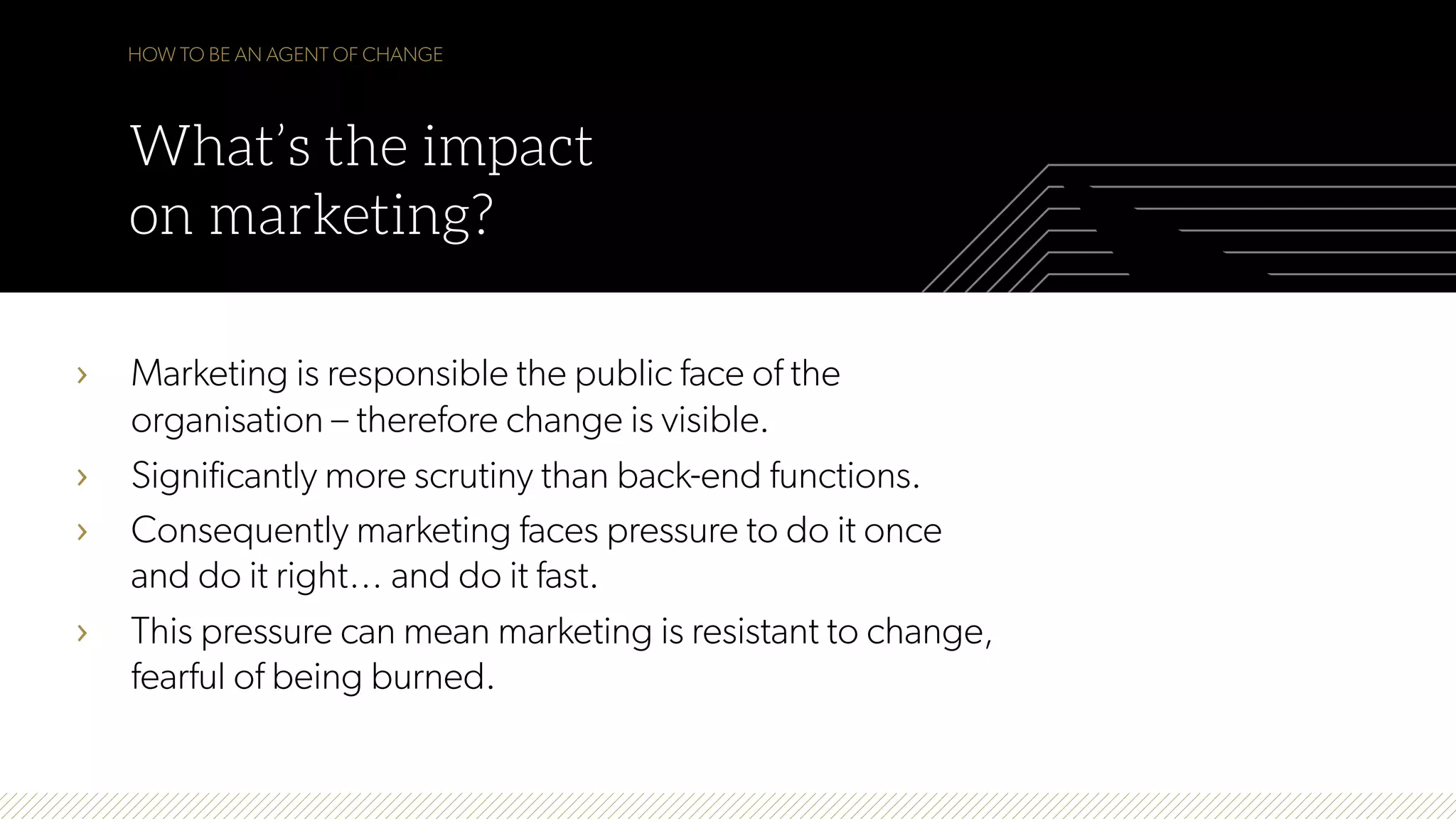
›  Marketing is responsible the public face of the
organisation – therefore change is visible.
›  Significantly more scrutiny than back-end functions.
›  Consequently marketing faces pressure to do it once
and do it right… and do it fast.
›  This pressure can mean marketing is resistant to change,
fearful of being burned.
HOW TO BE AN AGENT OF CHANGE
What’s the impact
on marketing?
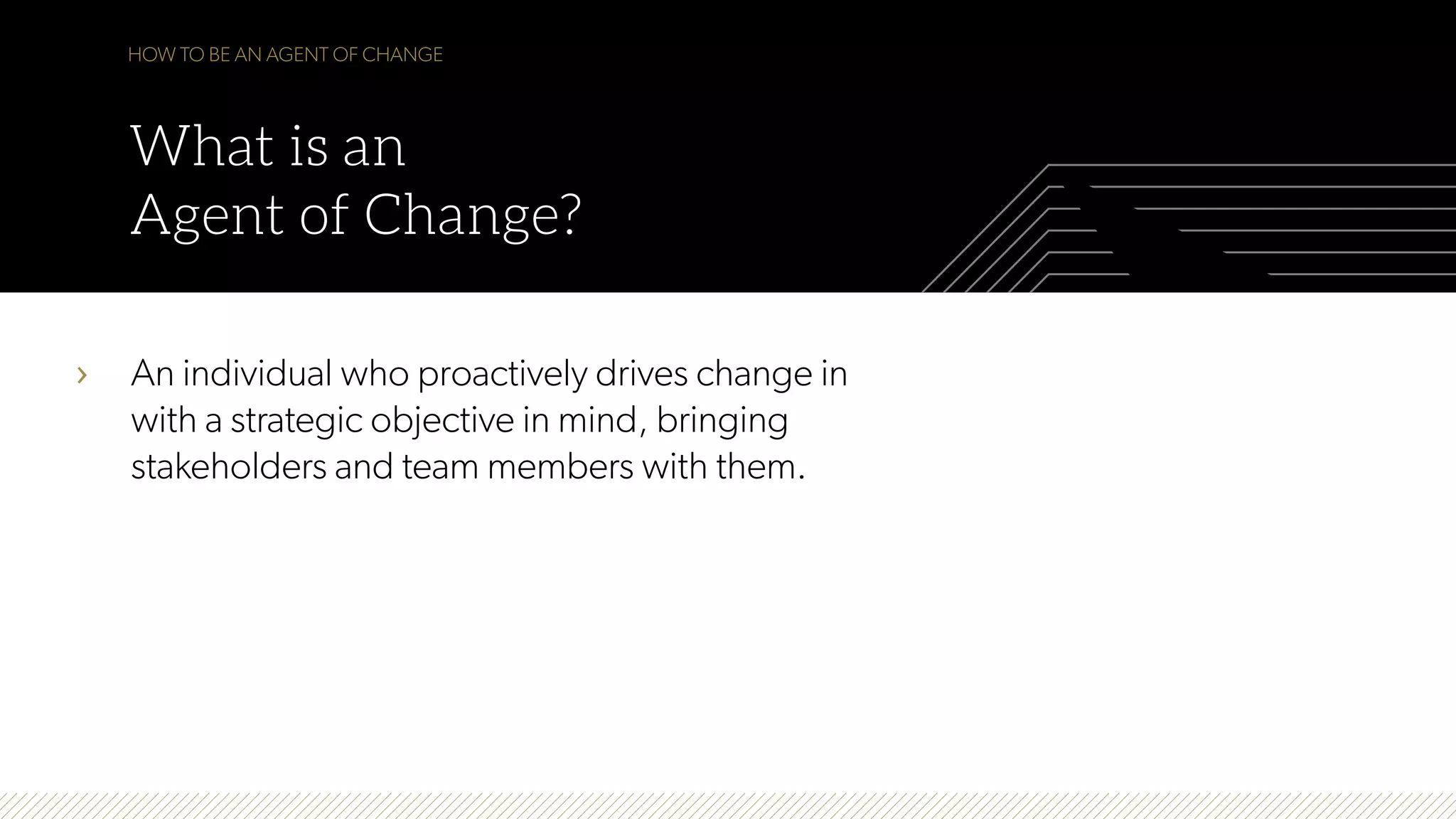
›  An individual who proactively drives change in
with a strategic objective in mind, bringing
stakeholders and team members with them.
HOW TO BE AN AGENT OF CHANGE
What is an
Agent of Change?
Part 1.
Our research – what we asked…
and what we found
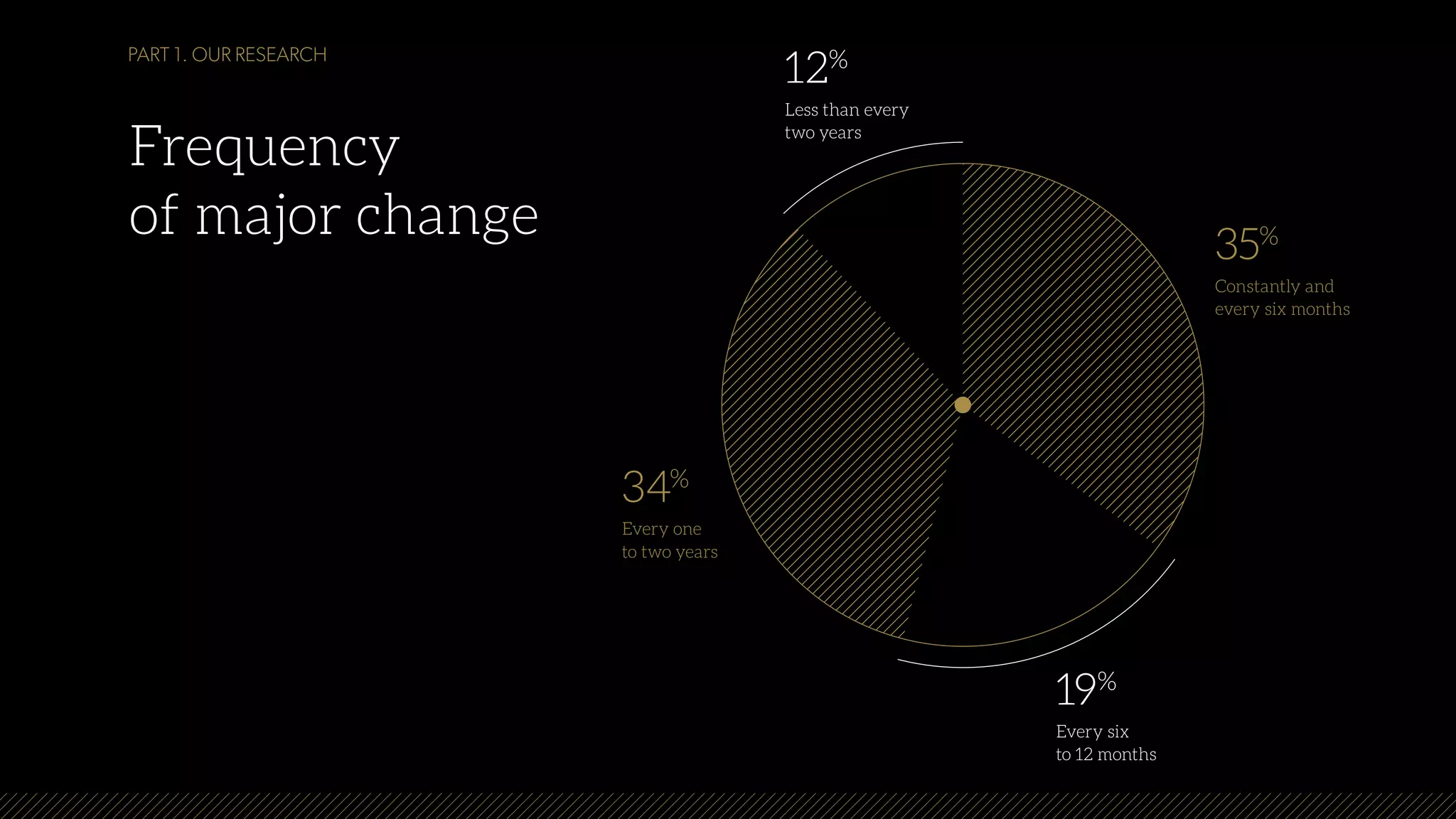
Frequency
of major change 35%
Constantly and
every six months
12%
Less than every
two years
19%
Every six
to 12 months
34%
Every one
to two years
PART 1. OUR RESEARCH
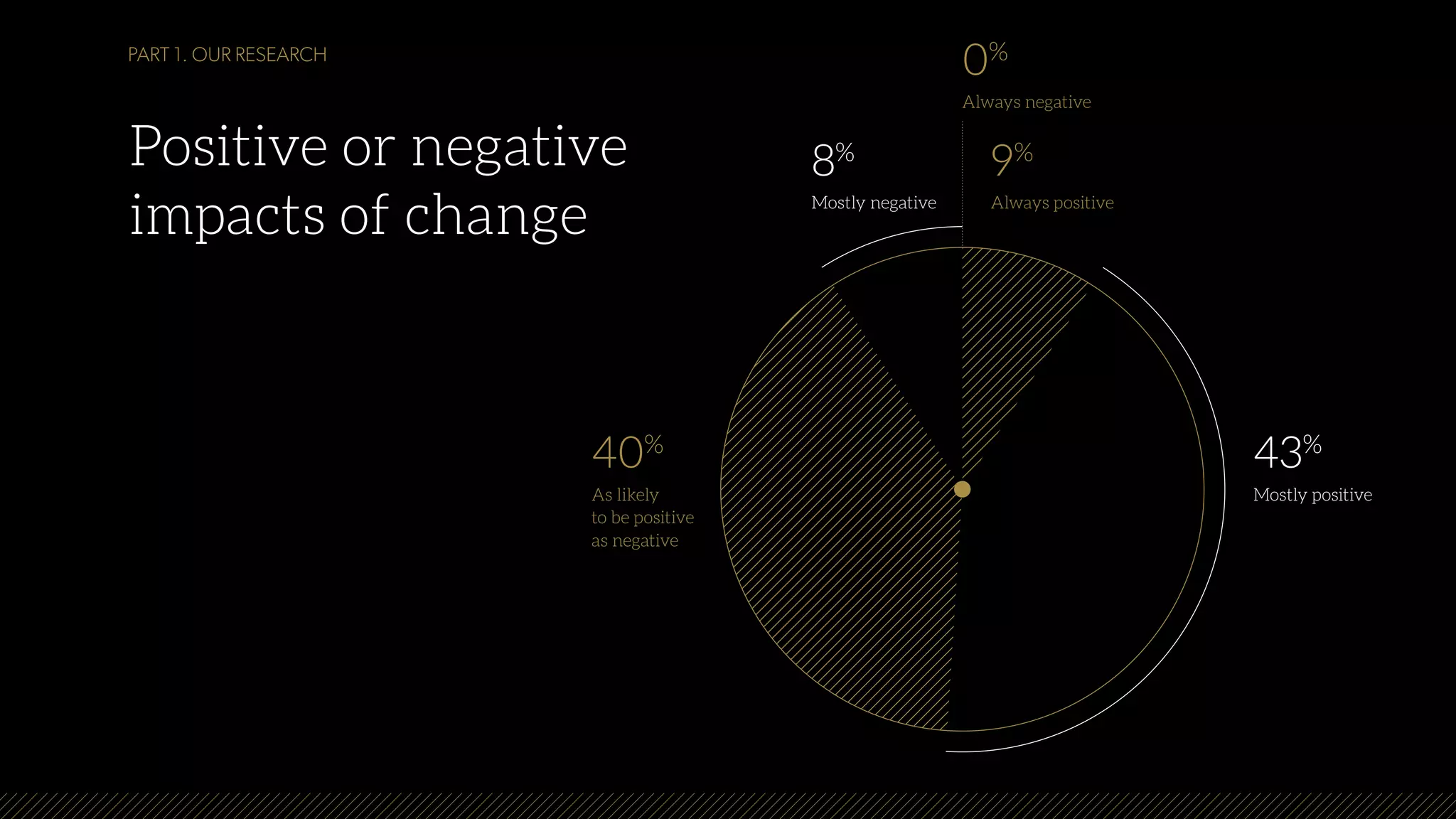
Positive or negative
impacts of change
PART 1. OUR RESEARCH
9%
Always positive
8%
Mostly negative
0%
Always negative
43%
Mostly positive
40%
As likely
to be positive
as negative
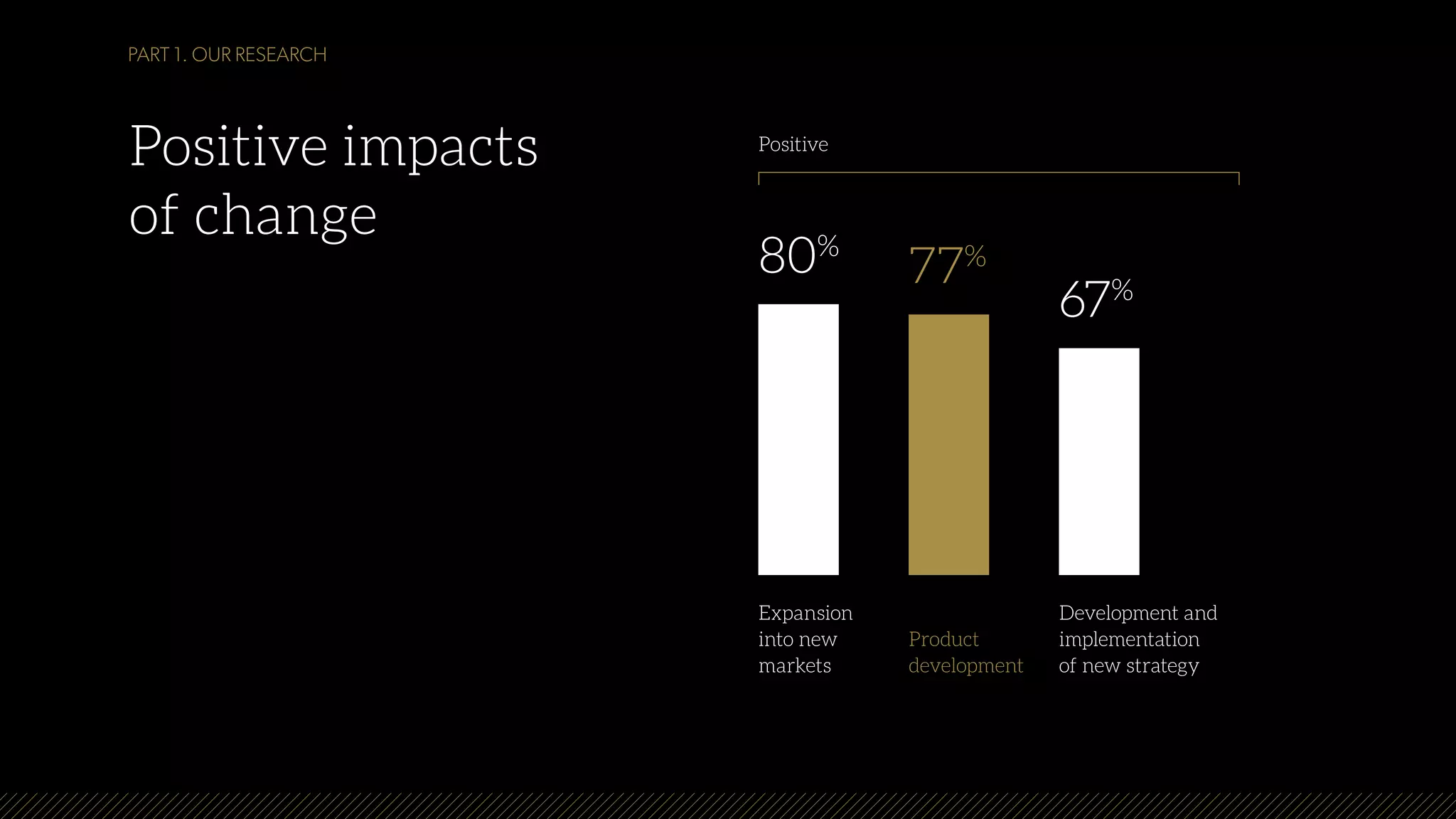
Positive impacts
of change
PART 1. OUR RESEARCH
Positive
77%80%
Expansion
into new
markets
Product
development
Development and
implementation
of new strategy
67%
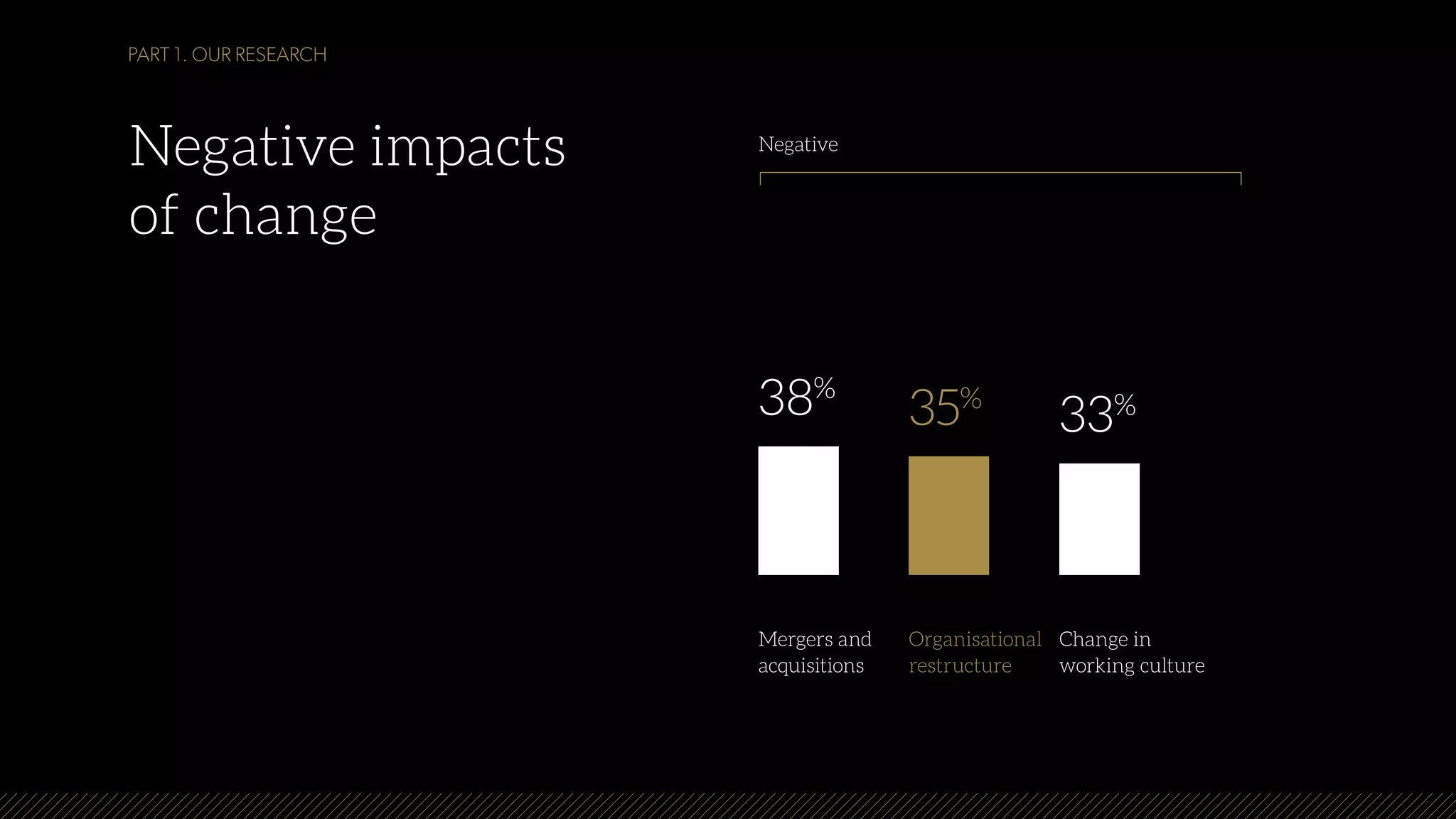
Negative impacts
of change
PART 1. OUR RESEARCH
Negative
35%38%
Mergers and
acquisitions
Organisational
restructure
Change in
working culture
33%
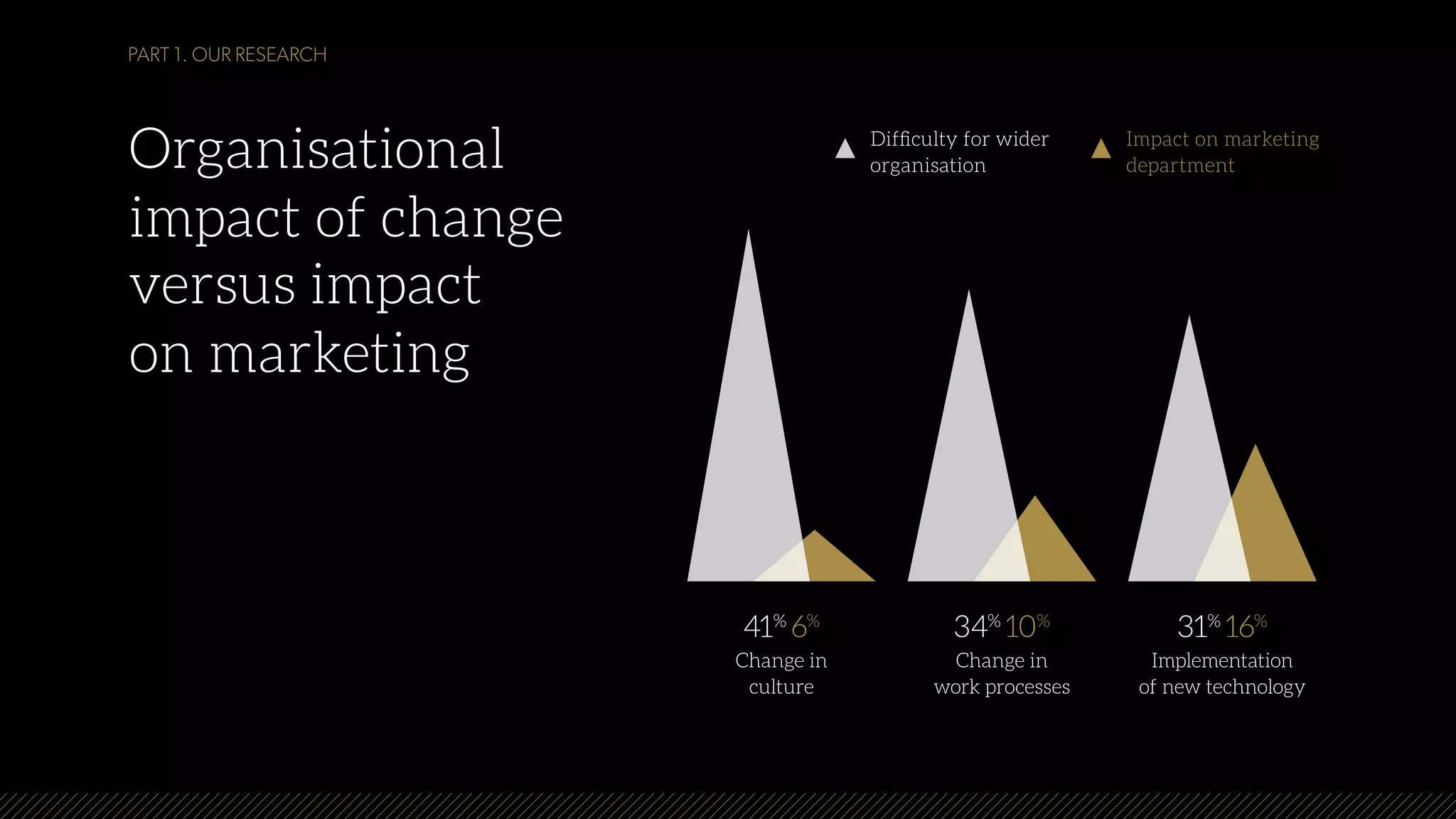
Organisational
impact of change
versus impact
on marketing
Change in
culture
Change in
work processes
Implementation
of new technology
34%
10%
41%
6%
31%
16%
Difficulty for wider
organisation
Impact on marketing
department
PART 1. OUR RESEARCH
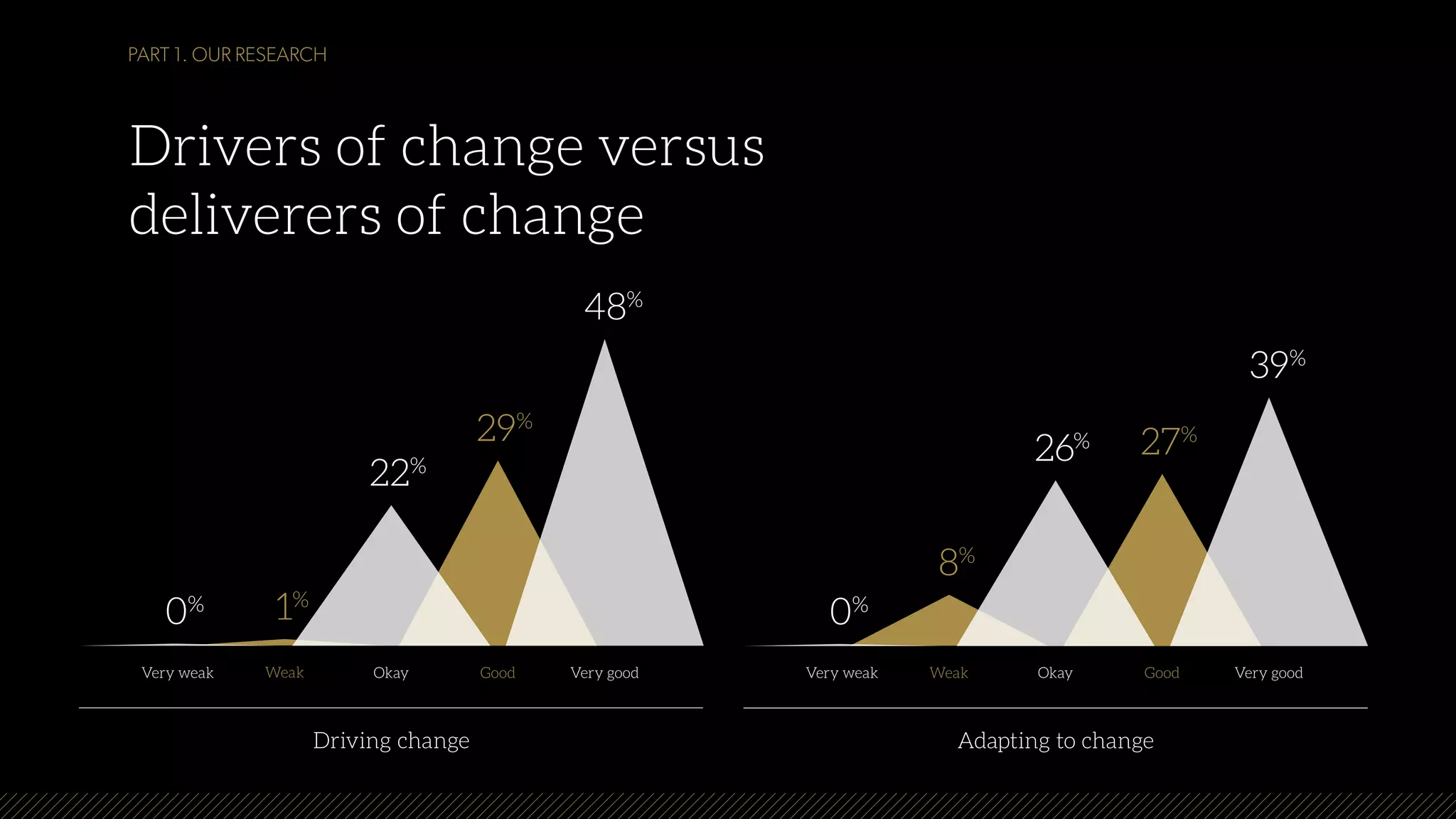
Drivers of change versus
deliverers of change
Driving change
48%
Okay Very good
22%
0%
29%
1%
GoodVery weak Weak
Adapting to change
39%
Okay Very good
26%
0%
27%
8%
GoodVery weak Weak
PART 1. OUR RESEARCH
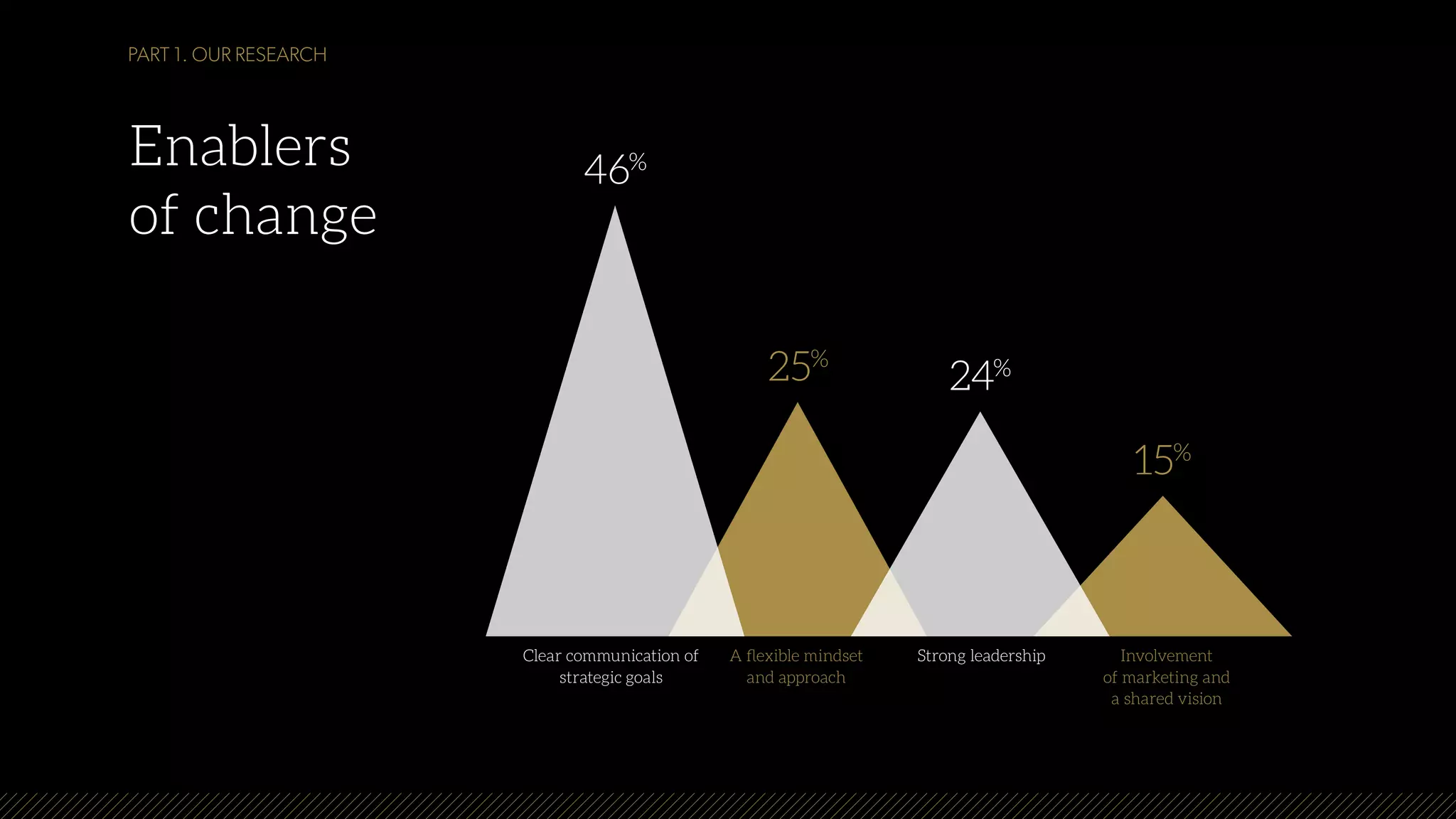
Enablers
of change
Clear communication of
strategic goals
A flexible mindset
and approach
Strong leadership Involvement
of marketing and
a shared vision
46%
25%
24%
15%
PART 1. OUR RESEARCH
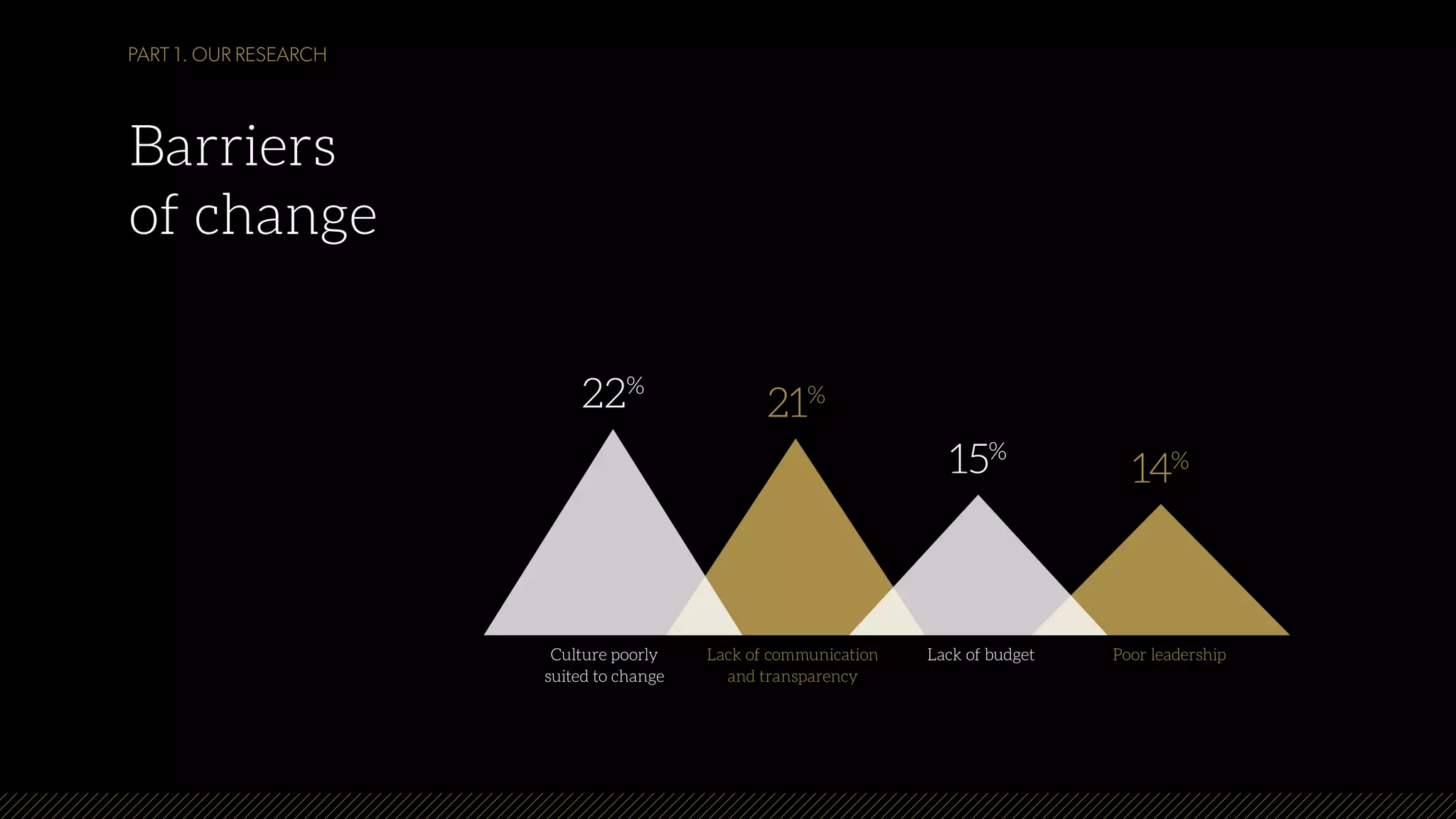
Barriers
of change
Culture poorly
suited to change
Lack of communication
and transparency
Lack of budget Poor leadership
22%
21%
15%
14%
PART 1. OUR RESEARCH
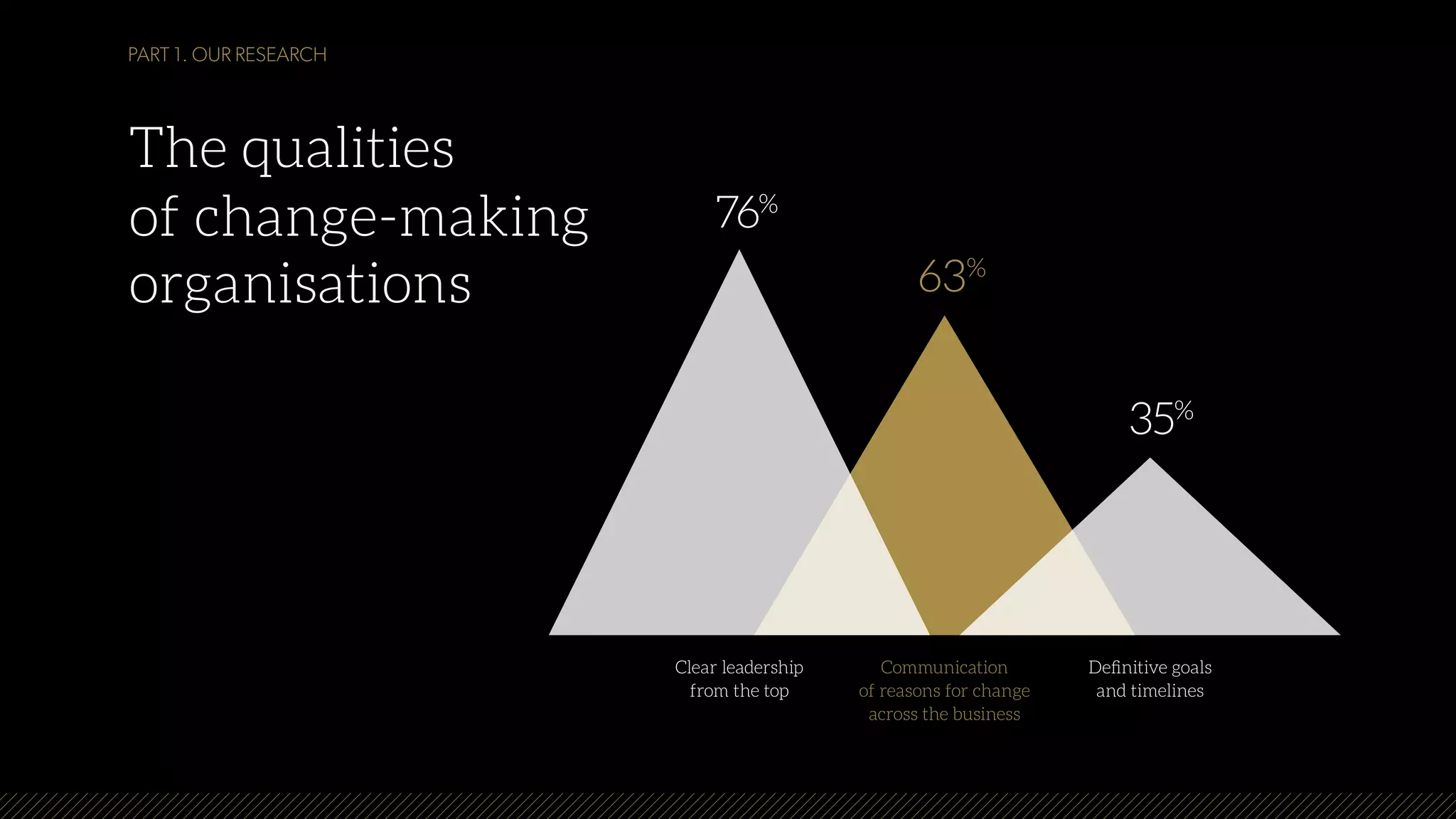
The qualities
of change-making
organisations
35%
Clear leadership
from the top
Definitive goals
and timelines
76%
63%
Communication
of reasons for change
across the business
PART 1. OUR RESEARCH
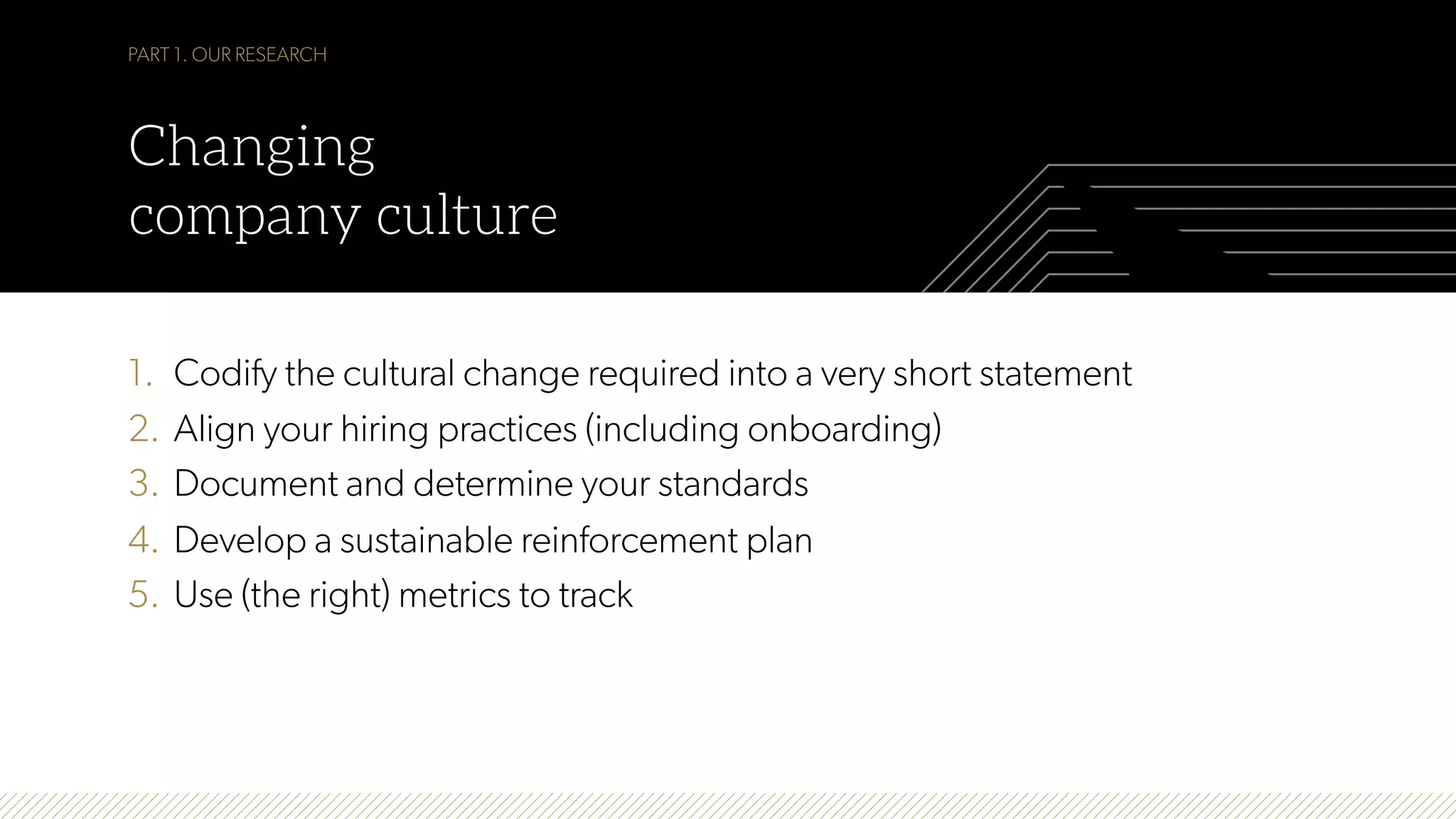
1.  Codify the cultural change required into a very short statement
2.  Align your hiring practices (including onboarding)
3.  Document and determine your standards
4.  Develop a sustainable reinforcement plan
5.  Use (the right) metrics to track
PART 1. OUR RESEARCH
Changing
company culture
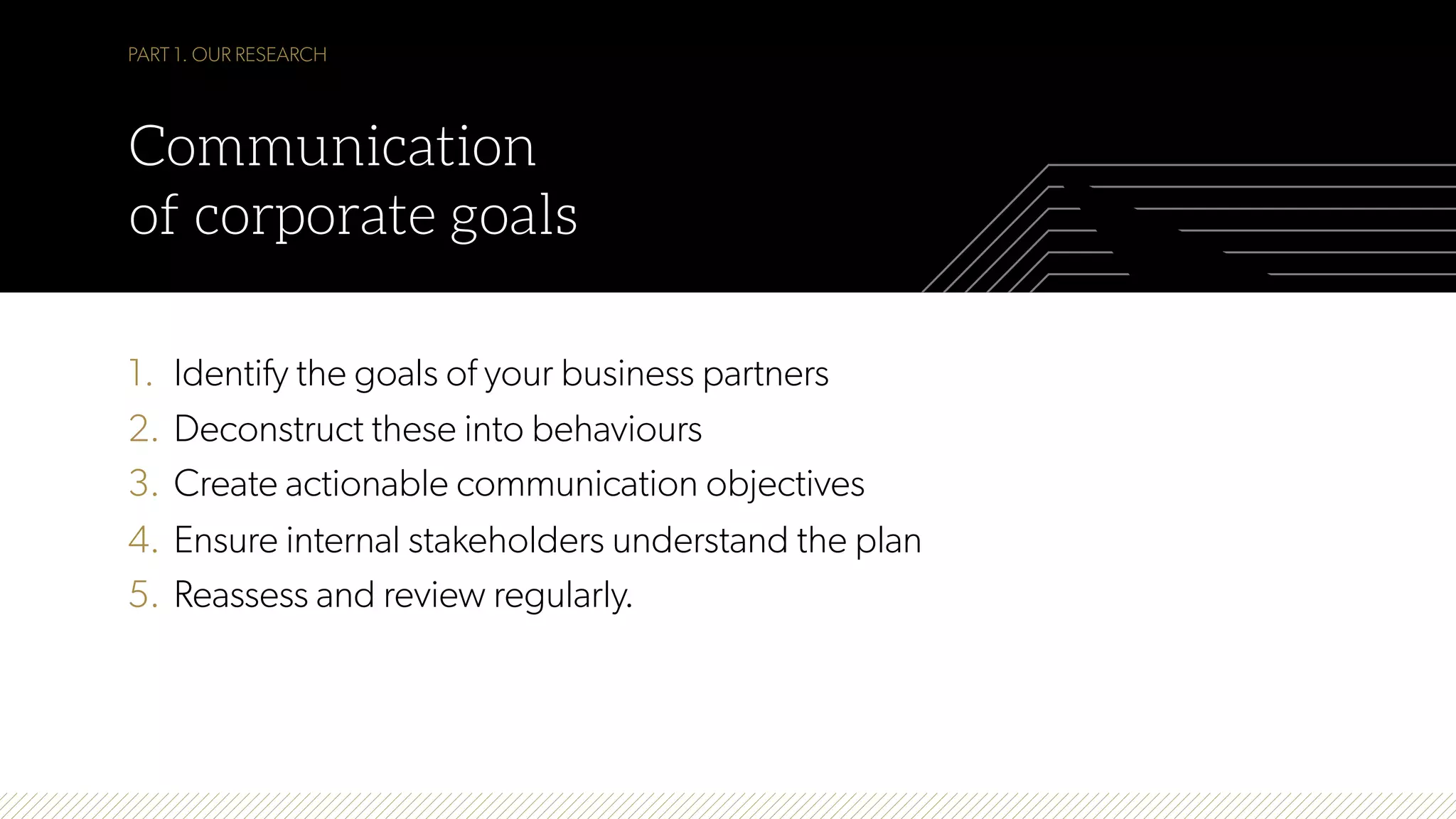
1.  Identify the goals of your business partners
2.  Deconstruct these into behaviours
3.  Create actionable communication objectives
4.  Ensure internal stakeholders understand the plan
5.  Reassess and review regularly.
PART 1. OUR RESEARCH
Communication
of corporate goals
Part 2. The characteristics
of an Agent of Change
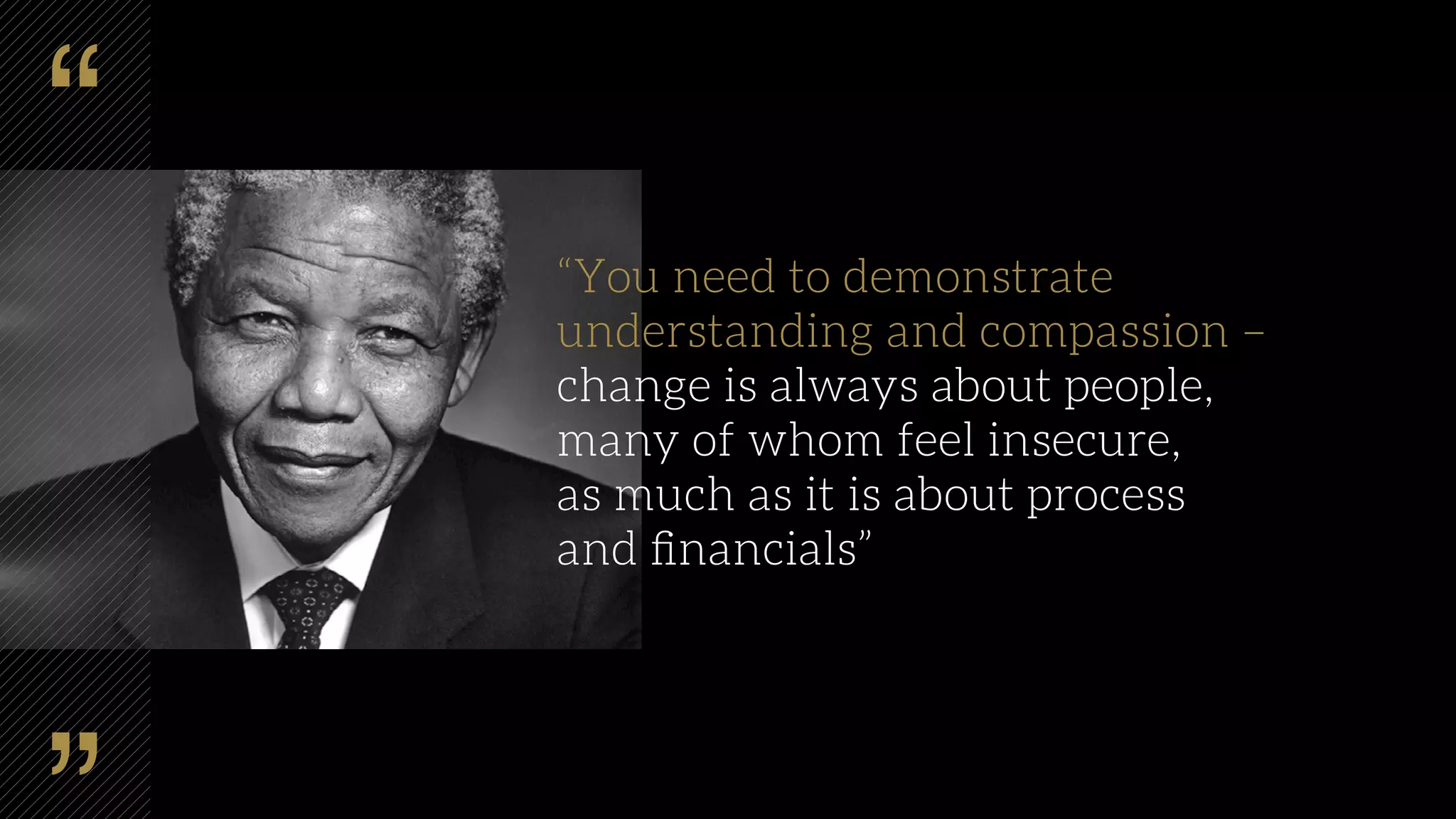
“You need to demonstrate
understanding and compassion –
change is always about people,
many of whom feel insecure,
as much as it is about process
and financials”
PART 2. THE CHARACTERISTICS OF AN AGENT OF CHANGE
1. Be supportive
›  Have sense of empathy, patience and pragmatic understanding
for those struggling to adapt.
›  Provide encouragement and reassurance to your team.
›  Predict potential issues and set up support processes.
›  Collaborate closely with stakeholders outside of marketing –
create a culture of mutual support.
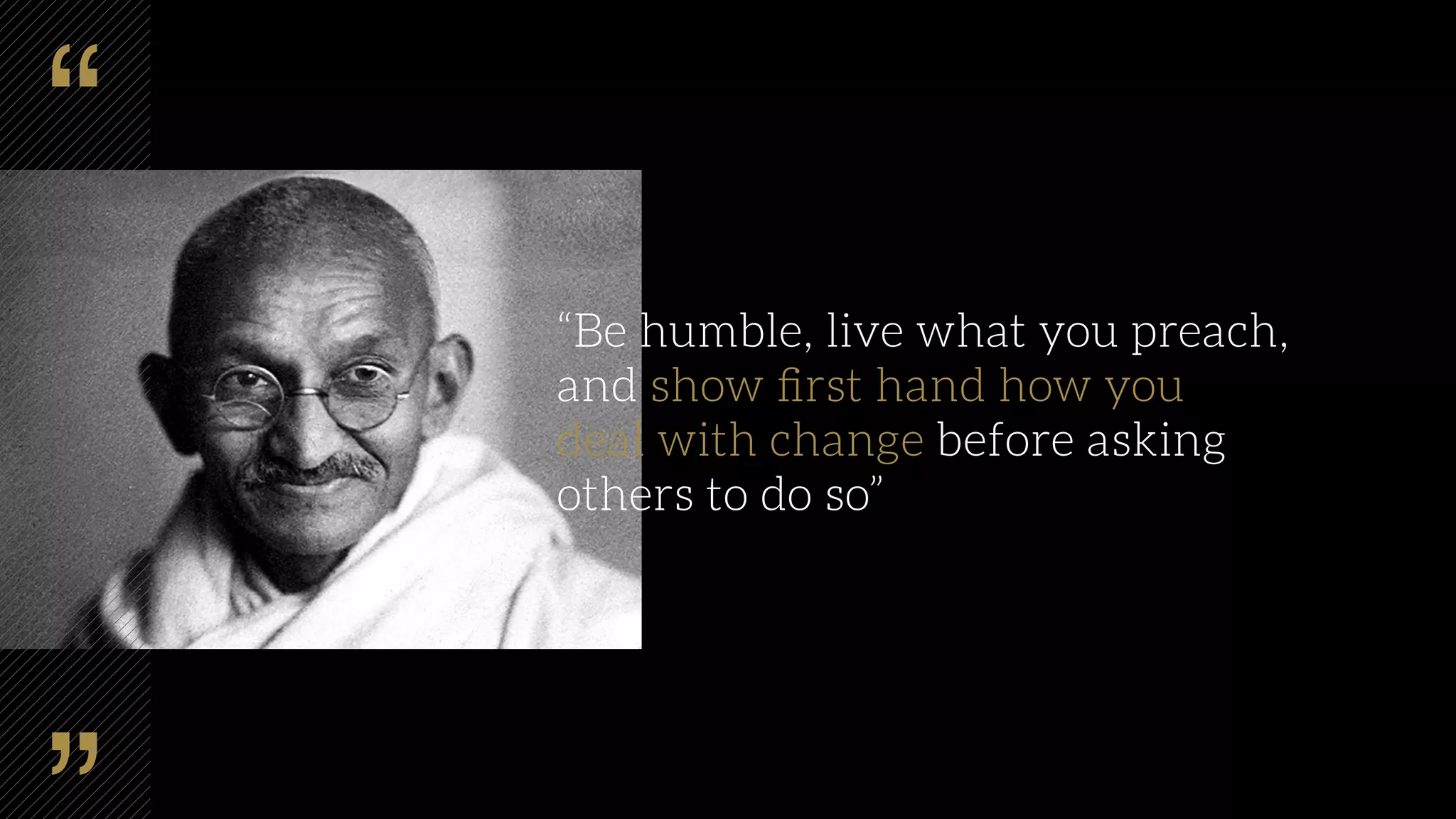
“Be humble, live what you preach,
and show first hand how you
deal with change before asking
others to do so”
PART 2. THE CHARACTERISTICS OF AN AGENT OF CHANGE
2. Be authentic
›  Truly and tangibly believe in the change you are driving.
›  Demonstrate that in your actions, not just words.
›  Use a justification that you believe in.
›  Be candid and sincere, but don’t dismiss or counter
the corporate narrative.
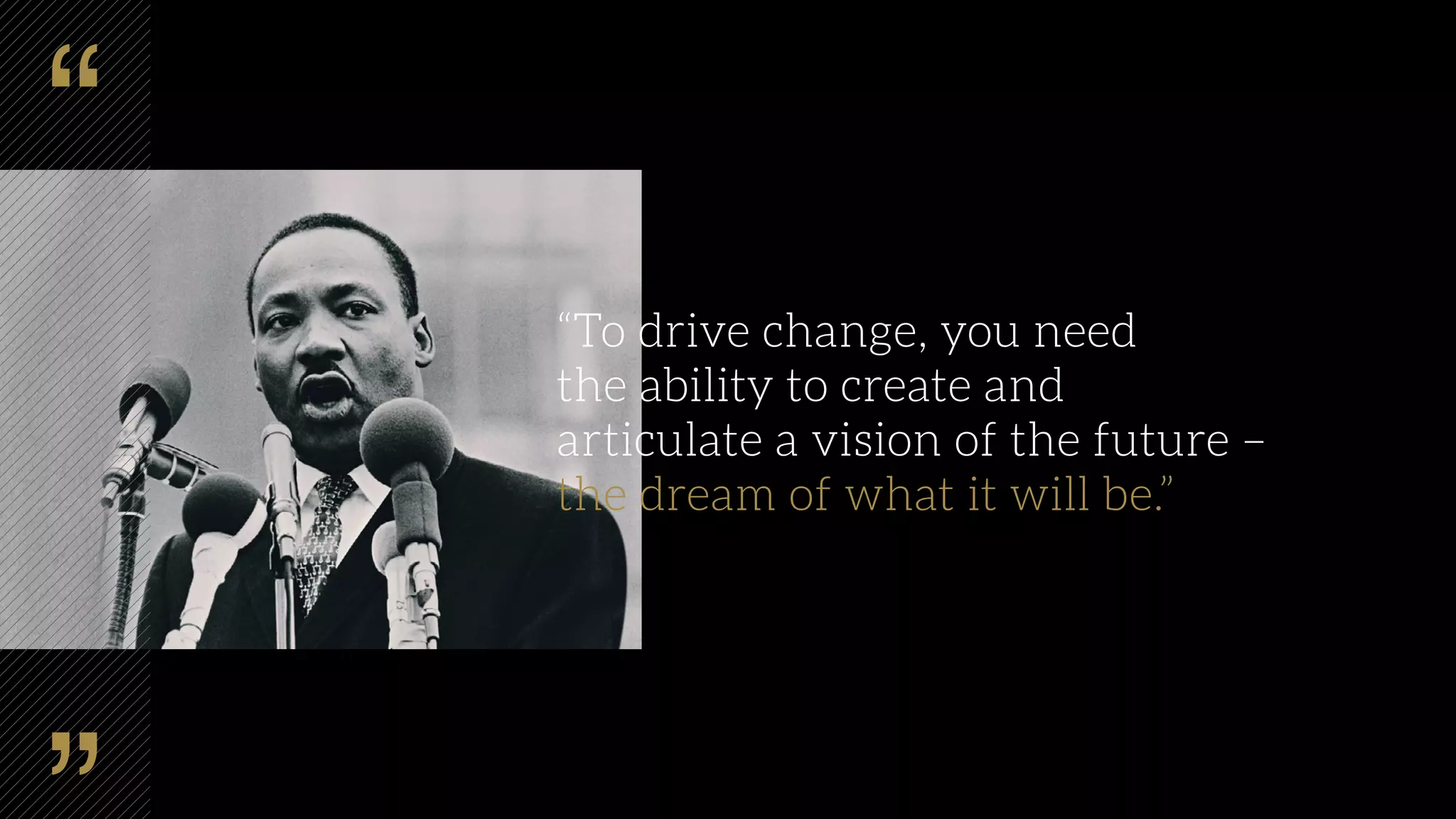
“To drive change, you need
the ability to create and
articulate a vision of the future –
the dream of what it will be.”
PART 2. THE CHARACTERISTICS OF AN AGENT OF CHANGE
3. Be clear and consistent
›  Make sure your message easy to digest and understand,
and does not deviate.
›  Provide a plan which is robust and realistic, not fanciful.
›  Ensure each individual understands the delivery plan,
and their role in it.
›  If required to recalibrate, ensure you communicate
what, why and how with equal clarity, leaving no ambiguity.
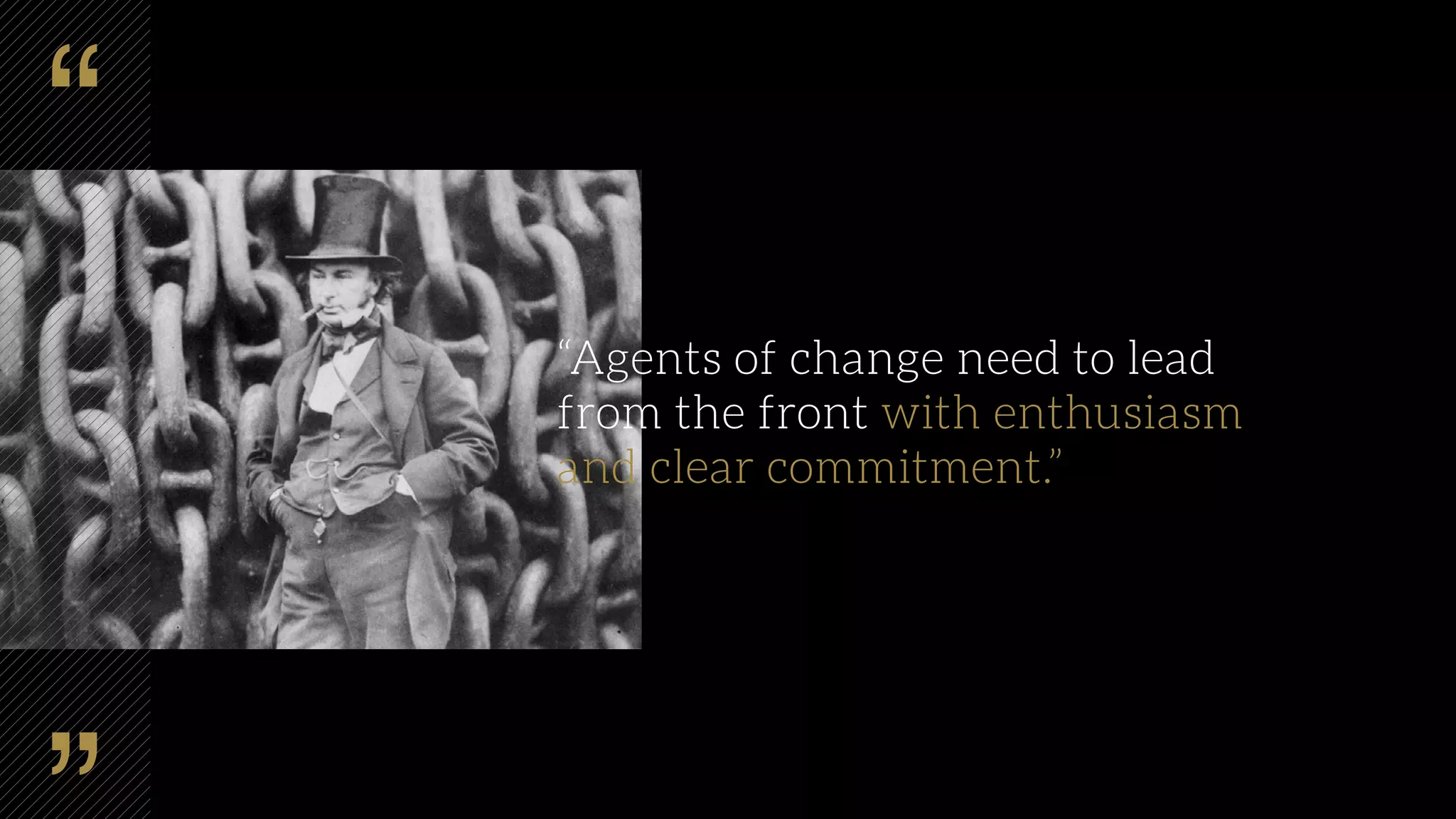
“Agents of change need to lead
from the front with enthusiasm
and clear commitment.”
PART 2. THE CHARACTERISTICS OF AN AGENT OF CHANGE
4. Be positive
›  Be the advocate or ambassador for the change you are driving.
›  Understand the causes of resistance, and address those directly,
but in a conciliatory fashion.
›  Be clear about the obstacles and objectives, and have
a realistic plan to overcome them.
›  Identify and align with other ambassadors, and present
a consistent and united front.
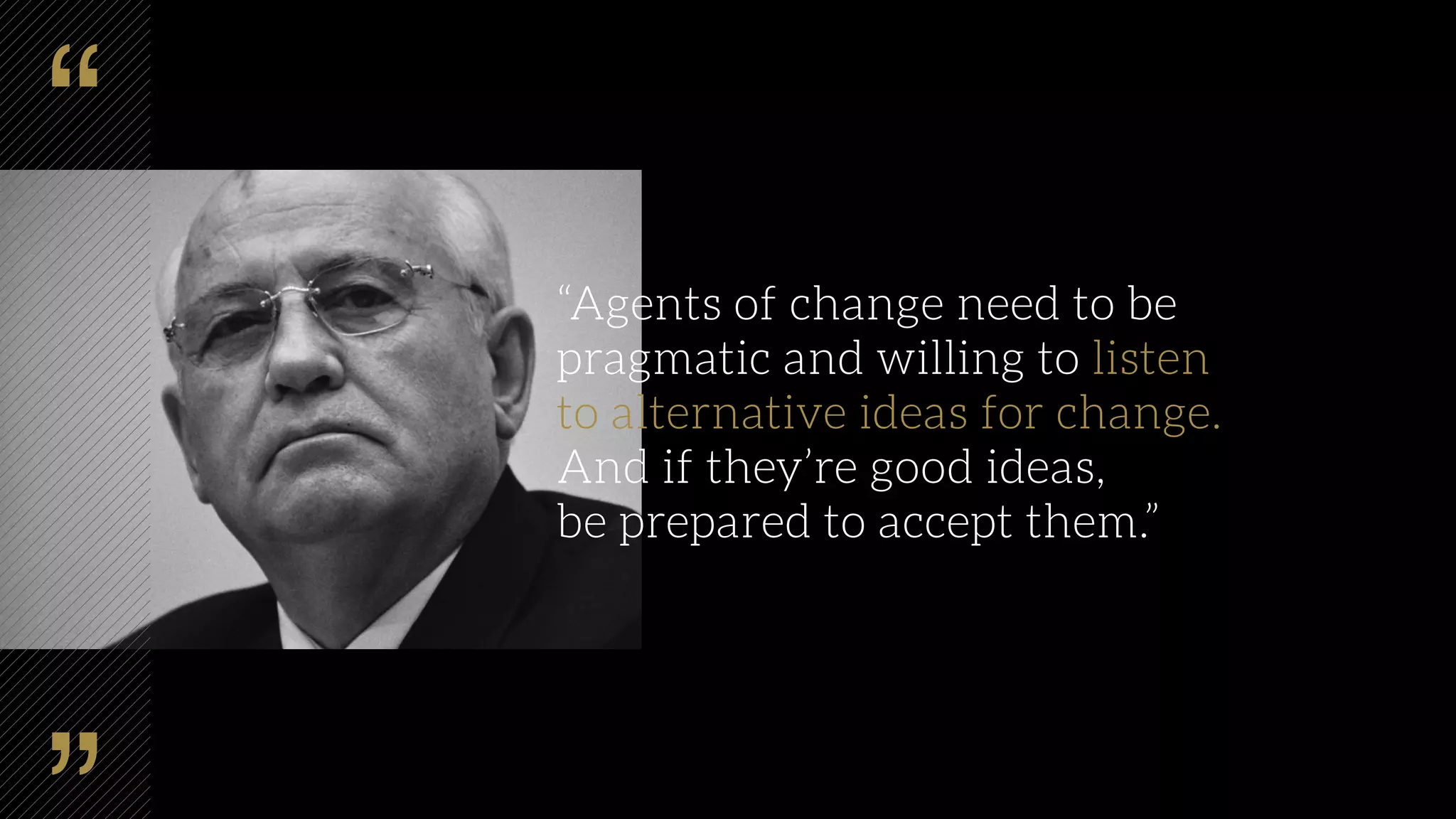
“Agents of change need to be
pragmatic and willing to listen
to alternative ideas for change.
And if they’re good ideas,
be prepared to accept them.”
PART 2. THE CHARACTERISTICS OF AN AGENT OF CHANGE
5. Be pragmatic and flexible
›  Accept that no plan is ever completely watertight.
›  Be willing to adapt to evolving or unforeseen requirements,
and help others do the same.
›  Be focused, but know when to graciously accept
when an objective is not achievable.
›  Take and respond to feedback from across the team.
Part 3.
What’s the alternative?
PART 3. WHAT’S THE ALTERNATIVE?
What if you’re not an
Agent of Change?
›  Agents of change: Proactively drives
change in with a strategic objective
in mind, bringing stakeholders and
team members with them.
›  Enablers of change: Can be relied on
to deliver change originated and
facilitated by others, but with little or
no role in determining the objectives.
›  Victims of change: Needs to be
convinced and cajoled about both
the necessity for change, and
proposed changes themselves.
Likely to be less effective in
convincing others of merits of
change, or its objectives.
PART 3. WHAT’S THE ALTERNATIVE?
A comparison based
on supportiveness
›  Agents create and embody a
supportive environment for their
team and other relevant
stakeholders.
›  Enablers reluctantly try to bring the
team with you, but don’t really get to
grips with their needs and drivers in
embracing it.
›  Victims make little effort to convince
their teams of the merits of the
changes, and are dismissive on
requests for guidance or assistance.
PART 3. WHAT’S THE ALTERNATIVE?
A comparison based
on authenticity?
›  Agents believe to their core in the
change that they are seeking to drive
– whether they instigated it, or not.
›  Enablers toe the party line officially
but without apparent personal
investment… privately harbour
doubts which are sometimes
verbalised.
›  Victims palpably do not align with
let alone agree with enforced
changes, and consequently are
ill equipped to convince others.
HOW TO BE AN AGENT OF CHANGE
In summary
›  All marketers can be Agents of Change.
›  Moreover, marketers should aspire to be one.
›  If you’re not driving change, you may be a victim of change.
›  We all need to keep working at it!
HOW TO BE AN AGENT OF CHANGE
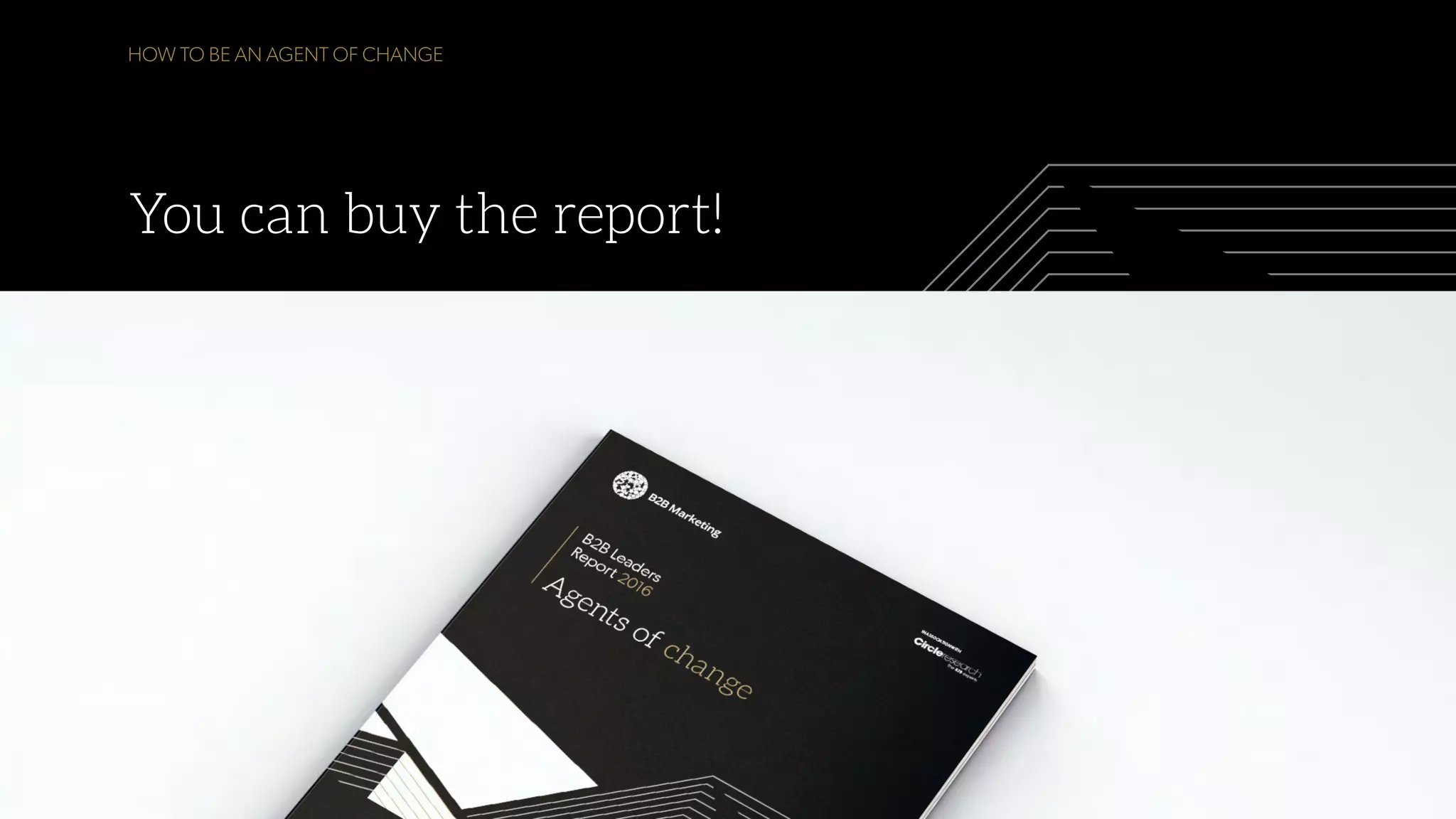
You can buy the report!
Thanks for listening!
Any questions?
BY JOEL HARRISON
EDITOR-IN-CHIEF, B2B MARKETING

B2B Research: How to be an agent of change

  • 1.
    BY JOEL HARRISON EDITOR-IN-CHIEF,B2B MARKETING How to be an Agent of Change
  • 2.
    ›  Marketing isresponsible the public face of the organisation – therefore change is visible. ›  Significantly more scrutiny than back-end functions. ›  Consequently marketing faces pressure to do it once and do it right… and do it fast. ›  This pressure can mean marketing is resistant to change, fearful of being burned. HOW TO BE AN AGENT OF CHANGE What’s the impact on marketing?
  • 3.
    ›  An individualwho proactively drives change in with a strategic objective in mind, bringing stakeholders and team members with them. HOW TO BE AN AGENT OF CHANGE What is an Agent of Change?
  • 4.
    Part 1. Our research– what we asked… and what we found
  • 5.
    Frequency of major change35% Constantly and every six months 12% Less than every two years 19% Every six to 12 months 34% Every one to two years PART 1. OUR RESEARCH
  • 6.
    Positive or negative impactsof change PART 1. OUR RESEARCH 9% Always positive 8% Mostly negative 0% Always negative 43% Mostly positive 40% As likely to be positive as negative
  • 7.
    Positive impacts of change PART1. OUR RESEARCH Positive 77%80% Expansion into new markets Product development Development and implementation of new strategy 67%
  • 8.
    Negative impacts of change PART1. OUR RESEARCH Negative 35%38% Mergers and acquisitions Organisational restructure Change in working culture 33%
  • 9.
    Organisational impact of change versusimpact on marketing Change in culture Change in work processes Implementation of new technology 34% 10% 41% 6% 31% 16% Difficulty for wider organisation Impact on marketing department PART 1. OUR RESEARCH
  • 10.
    Drivers of changeversus deliverers of change Driving change 48% Okay Very good 22% 0% 29% 1% GoodVery weak Weak Adapting to change 39% Okay Very good 26% 0% 27% 8% GoodVery weak Weak PART 1. OUR RESEARCH
  • 11.
    Enablers of change Clear communicationof strategic goals A flexible mindset and approach Strong leadership Involvement of marketing and a shared vision 46% 25% 24% 15% PART 1. OUR RESEARCH
  • 12.
    Barriers of change Culture poorly suitedto change Lack of communication and transparency Lack of budget Poor leadership 22% 21% 15% 14% PART 1. OUR RESEARCH
  • 13.
    The qualities of change-making organisations 35% Clearleadership from the top Definitive goals and timelines 76% 63% Communication of reasons for change across the business PART 1. OUR RESEARCH
  • 14.
    1.  Codify thecultural change required into a very short statement 2.  Align your hiring practices (including onboarding) 3.  Document and determine your standards 4.  Develop a sustainable reinforcement plan 5.  Use (the right) metrics to track PART 1. OUR RESEARCH Changing company culture
  • 15.
    1.  Identify thegoals of your business partners 2.  Deconstruct these into behaviours 3.  Create actionable communication objectives 4.  Ensure internal stakeholders understand the plan 5.  Reassess and review regularly. PART 1. OUR RESEARCH Communication of corporate goals
  • 16.
    Part 2. Thecharacteristics of an Agent of Change
  • 17.
    “You need todemonstrate understanding and compassion – change is always about people, many of whom feel insecure, as much as it is about process and financials”
  • 18.
    PART 2. THECHARACTERISTICS OF AN AGENT OF CHANGE 1. Be supportive ›  Have sense of empathy, patience and pragmatic understanding for those struggling to adapt. ›  Provide encouragement and reassurance to your team. ›  Predict potential issues and set up support processes. ›  Collaborate closely with stakeholders outside of marketing – create a culture of mutual support.
  • 19.
    “Be humble, livewhat you preach, and show first hand how you deal with change before asking others to do so”
  • 20.
    PART 2. THECHARACTERISTICS OF AN AGENT OF CHANGE 2. Be authentic ›  Truly and tangibly believe in the change you are driving. ›  Demonstrate that in your actions, not just words. ›  Use a justification that you believe in. ›  Be candid and sincere, but don’t dismiss or counter the corporate narrative.
  • 21.
    “To drive change,you need the ability to create and articulate a vision of the future – the dream of what it will be.”
  • 22.
    PART 2. THECHARACTERISTICS OF AN AGENT OF CHANGE 3. Be clear and consistent ›  Make sure your message easy to digest and understand, and does not deviate. ›  Provide a plan which is robust and realistic, not fanciful. ›  Ensure each individual understands the delivery plan, and their role in it. ›  If required to recalibrate, ensure you communicate what, why and how with equal clarity, leaving no ambiguity.
  • 23.
    “Agents of changeneed to lead from the front with enthusiasm and clear commitment.”
  • 24.
    PART 2. THECHARACTERISTICS OF AN AGENT OF CHANGE 4. Be positive ›  Be the advocate or ambassador for the change you are driving. ›  Understand the causes of resistance, and address those directly, but in a conciliatory fashion. ›  Be clear about the obstacles and objectives, and have a realistic plan to overcome them. ›  Identify and align with other ambassadors, and present a consistent and united front.
  • 25.
    “Agents of changeneed to be pragmatic and willing to listen to alternative ideas for change. And if they’re good ideas, be prepared to accept them.”
  • 26.
    PART 2. THECHARACTERISTICS OF AN AGENT OF CHANGE 5. Be pragmatic and flexible ›  Accept that no plan is ever completely watertight. ›  Be willing to adapt to evolving or unforeseen requirements, and help others do the same. ›  Be focused, but know when to graciously accept when an objective is not achievable. ›  Take and respond to feedback from across the team.
  • 27.
  • 28.
    PART 3. WHAT’STHE ALTERNATIVE? What if you’re not an Agent of Change? ›  Agents of change: Proactively drives change in with a strategic objective in mind, bringing stakeholders and team members with them. ›  Enablers of change: Can be relied on to deliver change originated and facilitated by others, but with little or no role in determining the objectives. ›  Victims of change: Needs to be convinced and cajoled about both the necessity for change, and proposed changes themselves. Likely to be less effective in convincing others of merits of change, or its objectives.
  • 29.
    PART 3. WHAT’STHE ALTERNATIVE? A comparison based on supportiveness ›  Agents create and embody a supportive environment for their team and other relevant stakeholders. ›  Enablers reluctantly try to bring the team with you, but don’t really get to grips with their needs and drivers in embracing it. ›  Victims make little effort to convince their teams of the merits of the changes, and are dismissive on requests for guidance or assistance.
  • 30.
    PART 3. WHAT’STHE ALTERNATIVE? A comparison based on authenticity? ›  Agents believe to their core in the change that they are seeking to drive – whether they instigated it, or not. ›  Enablers toe the party line officially but without apparent personal investment… privately harbour doubts which are sometimes verbalised. ›  Victims palpably do not align with let alone agree with enforced changes, and consequently are ill equipped to convince others.
  • 31.
    HOW TO BEAN AGENT OF CHANGE In summary ›  All marketers can be Agents of Change. ›  Moreover, marketers should aspire to be one. ›  If you’re not driving change, you may be a victim of change. ›  We all need to keep working at it!
  • 32.
    HOW TO BEAN AGENT OF CHANGE You can buy the report!
  • 33.
    Thanks for listening! Anyquestions? BY JOEL HARRISON EDITOR-IN-CHIEF, B2B MARKETING