ITSM specialization 2009-2009 The change approach for Sourcing
Agenda Outcome of Digital Selftest Vision on Change management Five ways of thinking about change Diagnosis Change strategy Interventionplan & interventions Change agent The Change approach for Sourcing
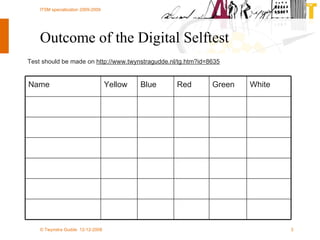
Outcome of the Digital Selftest Test should be made on  http://www.twynstragudde.nl/tg.htm?id=8635 White Green Red Blue Yellow Name
Vision on Change management
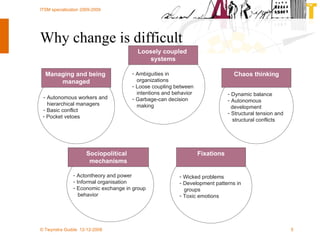
Why change is difficult Autonomous workers and  hierarchical managers  Basic conflict  Pocket vetoes  Managing and being  managed Ambiguities in  organizations Loose coupling between  intentions and behavior Garbage-can decision  making Loosely coupled  systems Dynamic balance Autonomous  development Structural tension and  structural conflicts Chaos thinking Actontheory and power  Informal organisation  Economic exchange in group  behavior  Sociopolitical  mechanisms Wicked problems Development patterns in  groups Toxic emotions Fixations
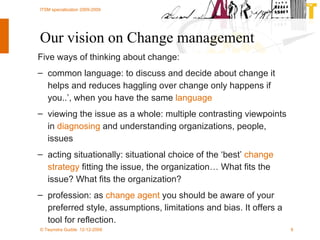
Our vision on Change management Five ways of thinking about change:   common language: to discuss and decide about change it helps and reduces haggling over change only happens if you..’, when you have the same  language viewing the issue as a whole: multiple contrasting viewpoints in  diagnosing  and understanding organizations, people, issues acting situationally: situational choice of the ‘best’  change strategy  fitting the issue, the organization… What fits the issue? What fits the organization?  profession: as  change agent  you should be aware of your preferred style, assumptions, limitations and bias. It offers a tool for reflection.
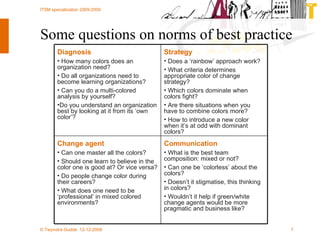
Some questions on norms of best practice Communication What is the best team composition: mixed or not?  Can one be ‘colorless’ about the colors?  Doesn’t it stigmatise, this thinking in colors? Wouldn’t it help if green/white change agents would be more pragmatic and business like? Change agent Can one master all the colors?  Should one learn to believe in the color one is good at? Or vice versa? Do people change color during their careers? What does one need to be ‘professional’ in mixed colored environments? Strategy Does a ‘rainbow’ approach work?  What criteria determines appropriate color of change strategy? Which colors dominate when colors fight?  Are there situations when you have to combine colors more? How to introduce a new color when it’s at odd with dominant colors? Diagnosis How many colors does an organization need?  Do all organizations need to become learning organizations?  Can you do a multi-colored analysis by yourself? Do you understand an organization best by looking at it from its ‘own color’?
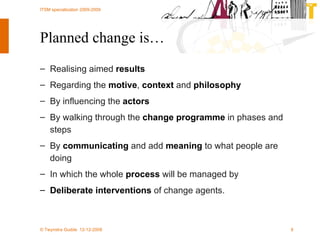
Planned change is… Realising aimed  results  Regarding the  motive ,  context  and  philosophy By influencing the  actors  By walking through the  change programme  in phases and steps  By  communicating  and add  meaning  to what people are doing  In which the whole  process  will be managed by  Deliberate interventions  of change agents.
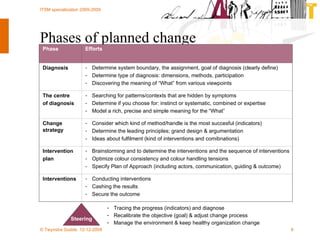
Phases of planned change Steering Tracing the progress (indicators) and diagnose Recalibrate the   objective (goal) & adjust change process Manage the environment & keep healthy organization change Consider which kind of method/handle is the most succesful (indicators) Determine the leading principles; grand design & argumentation Ideas about fulfilment (kind of interventions and comibnations) Change strategy Searching for patterns/contexts that are hidden by symptoms Determine if you choose for: instinct or systematic, combined or expertise Model a rich, precise and simple meaning for the “What” The centre  of diagnosis Determine system boundary, the assignment, goal of diagnosis (clearly define) Determine type of diagnosis: dimensions, methods, participation Discovering the meaning of “What” from various viewpoints Diagnosis Conducting interventions Cashing the results Secure the outcome Interventions Brainstorming and to determine the interventions and the sequence of interventions Optimize colour consistency and colour handling tensions Specify Plan of Approach (including actors, communication, guiding & outcome) Intervention plan Efforts Phase
Five ways of thinking about change
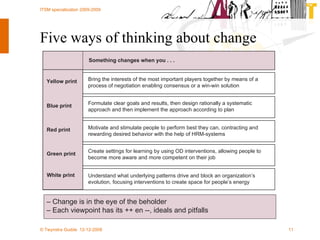
Five ways of thinking about change Understand what underlying patterns drive and block an organization’s evolution, focusing interventions to create space for people’s energy Create settings for learning by using OD interventions, allowing people to become more aware and more competent on their job Bring the interests of the most important players together by means of a process of negotiation enabling consensus or a win-win solution Motivate and stimulate people to perform best they can, contracting and  rewarding desired behavior with the help of HRM-systems  Formulate clear goals and results, then design rationally a systematic approach and then implement the approach according to plan Change is in the eye of the beholder Each viewpoint has its ++ en --, ideals and pitfalls Red print Green print Blue print White print Yellow print Something changes when you . . .
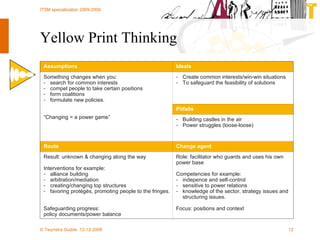
Yellow Print Thinking Role: facilitator who guards and uses his own  power base Competencies for example: indepence and self-control sensitive to power relations knowledge of the sector, strategy issues and structuring issues. Focus: positions and context Result:  unknown & changing along the way   Interventions for example: a lliance building arbitration/mediation creating/changing top structures favoring protégés, promoting people to the fringes. Safeguarding progress: policy documents/power balance Change agent Route Building castles in the air Power struggles (loose-loose) Something changes when you: search for common interests compel people to take certain positions form coalitions formulate new policies. “ Changing = a power game” Pitfalls Create common interests/win-win situations To safeguard the feasibility of solutions Ideals Assumptions
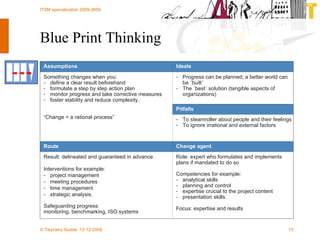
Blue Print Thinking Role:  expert who formulates and implements plans if mandated to do so Competencies for example: analytical skills planning and control expertise crucial to the project content presentation skills. Focus:  expertise and results Result: delineated and guaranteed in advance Interventions for example:   project management meeting procedures time management strategic analysis. Safeguarding progress: monitoring, benchmarking, ISO systems Change agent Route To steamroller about people and their feelings To ignore irrational and external factors Something changes when you:  define a clear result beforehand formulate a step by step action plan monitor progress and take corrective measures foster stability and reduce complexity. “ Change = a rational process” Pitfalls Progress can be planned; a better world can be ´built´ The ´best´ solution (tangible aspects of organizations) Ideals Assumptions
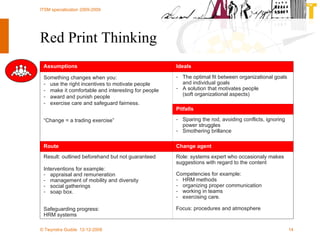
Red Print Thinking Role:  systems expert who occasionaly makes suggestions with regard to the content Competencies for example: HRM methods organizing proper communication working in teams exercising care. Focus:  p rocedures and atmosphere Result: outlined beforehand but not guaranteed Interventions for example:   appraisal and remuneration management of mobility and diversity social gatherings soap box. Safeguarding progress: HRM systems Change agent Route Sparing the rod, avoiding conflicts, ignoring power struggles Smothering brillance Something changes when you:  use the right incentives to motivate people make it comfortable and interesting for people award and punish people exercise care and safeguard fairness. “ Change = a trading exercise” Pitfalls The optimal fit between organizational goals and individual goals A solution that motivates people  (soft organizational aspects) Ideals Assumptions
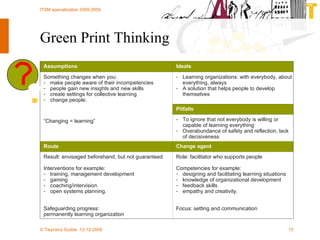
Green Print Thinking Role: facilitator who supports people Competencies for example: designing and facilitating learning situations knowledge of organizational development feedback skills empathy and creativity. Focus:  s etting and communication Result: envisaged beforehand, but not guaranteed Interventions for example: training, management development gaming coaching/intervision open systems planning. Safeguarding progress: permanently learning organization Change agent Route To ignore that not everybody is willing or capable of learning everything Overabundance of safety and reflection, lack of decisiveness Something changes when you: make people aware of their incompetencies people gain new insights and new skills create settings for collective learning change people. “ Changing = learning” Pitfalls Learning organizations: with everybody, about everything, always A solution that helps people to develop themselves Ideals Assumptions
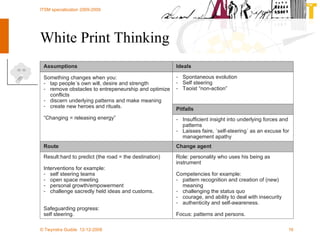
White Print Thinking Role:  p ersonality who uses his being as  instrument Competencies for example: pattern recognition and creation of (new) meaning challenging the status quo courage, and ability to deal with insecurity authenticity and self-awareness. Focus:  patterns and persons. Result:hard to predict (the road = the destination) Interventions for example: self steering teams open space meeting personal growth/empowerment challenge sacredly held ideas and customs. Safeguarding progress: self steering. Change agent Route Insufficient insight into underlying forces and patterns Laisses faire, ´self-steering´ as an excuse for management apathy Something changes when you:  tap people´s own will, desire and strength remove obstacles to entrepeneurship and optimize conflicts discern underlying patterns and make meaning create new heroes and rituals. “ Changing = releasing energy” Pitfalls S pontaneous evolution Self steering Taoist “non-action” Ideals Assumptions
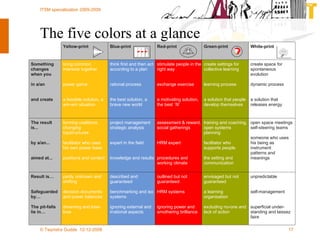
The five colors at a glance open space meetings self-steering teams someone who uses his being as instrument patterns and meanings training and coaching, open systems planning facilitator who supports people the setting and communication assessment & reward, social gatherings HRM expert procedures and working climate project management strategic analysis expert in the field knowledge and results forming coalitions, changing topstructures facilitator who uses his own power base positions and context The result is... by a/an... aimed at... unpredictable self-management superficial under-standing and laissez faire envisaged but not guaranteed a learning organisation excluding no-one and lack of action outlined but not guaranteed HRM systems ignoring power and smothering brilliance described and guaranteed benchmarking and iso systems ignoring external and irrational aspects partly unknown and shifting decision documents and power balances dreaming and lose-lose Result is… Safeguarded by… The pit-falls lie in… create space for spontaneous evolution dynamic process a solution that releases energy create settings for collective learning learning process a solution that people develop themselves stimulate people in the right way exchange exercise a motivating solution, the best ´fit´ think first and then act according to a plan rational process the best solution, a brave new world bring common interests together power game a feasible solution, a win-win situation Something changes when you in a/an and create White-print Green-print Red-print Blue-print Yellow-print
Diagnosis
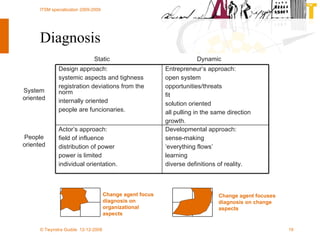
Diagnosis Change agent focuses diagnosis on change aspects Change agent focus diagnosis on organizational aspects Static Dynamic System oriented People oriented Developmental approach: sense-making ‘ everything flows’ learning diverse definitions of reality. Actor’s approach: field of influence distribution of power power is limited individual orientation. Entrepreneur’s approach: open system opportunities/threats fit solution oriented all pulling in the same direction growth. Design approach: systemic aspects and tighness registration deviations from the norm internally oriented people are funcionaries.
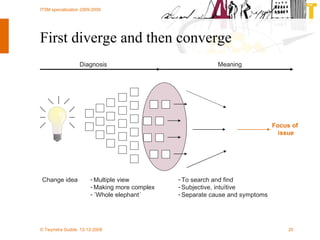
First diverge and then converge Change idea Diagnosis Meaning Multiple view Making more complex ´Whole elephant´ To search and find Subjective, intuïtive Separate cause and symptoms Focus of  issue
Change strategy
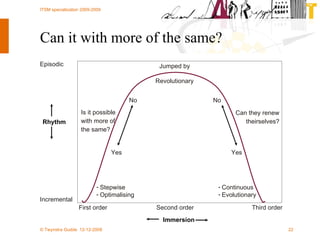
Can it with more of the same? Is it possible with more of the same? Immersion Continuous Evolutionary No Third order Episodic Rhythm Incremental First order Second order Can they renew theirselves? Stepwise Optimalising Yes No Yes Revolutionary Jumped by
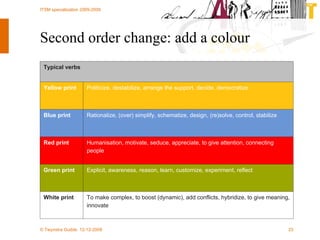
Second order change: add a colour To make complex, to boost (dynamic), add conflicts, hybridize, to give meaning, innovate White print Explicit, awareness, reason, learn, customize, experiment, reflect Green print Humanisation, motivate, seduce, appreciate, to give attention, connecting people  Red print Rationalize, (over) simplify, schematize, design, (re)solve, control, stabilize Blue print Politicize, destabilize, arrange the support, decide, democratize Yellow print Typical verbs
Intervention plan & interventions
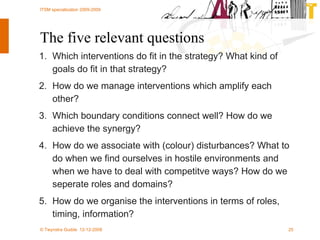
The five relevant questions Which interventions do fit in the strategy? What kind of goals do fit in that strategy?  How do we manage interventions which amplify each other?  Which boundary conditions connect well? How do we achieve the synergy? How do we associate with (colour) disturbances? What to do when we find ourselves in hostile environments  and when we have to deal with competitve ways?  How do we seperate roles and domains?  How do we organise the interventions in terms of roles, timing, information?
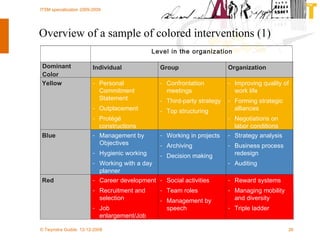
Overview of a sample of colored interventions (1) Strategy analysis Business process redesign Auditing Working in projects Archiving Decision making M anagement by Objectives Hygienic working Working with a day planner Blue Reward systems Managing mobility and diversity Triple ladder Social activities Team roles Management by speech Career development Recruitment and selection Job enlargement/Job enrichment Red Confrontation meetings  Third-party strategy Top structuring Group Yellow Dominant  Color Improving quality of work life Forming strategic alliances Negotiations on labor conditions Personal Commitment Statement Outplacement Protégé constructions  Organization Individual Level in the organization
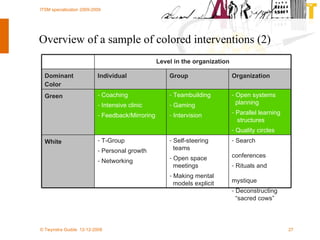
Overview of a sample of colored interventions (2) Search    conferences Rituals and    mystique Deconstructing    “sacred cows” Self-steering    teams  Open space    meetings  Making mental    models explicit T-Group  Personal growth Networking  White Open systems    planning Parallel learning    structures Quality circles Teambuilding  Gaming Intervision  Coaching  Intensive clinic  Feedback/Mirroring Green Organization Group Individual Dominant Color Level in the organization
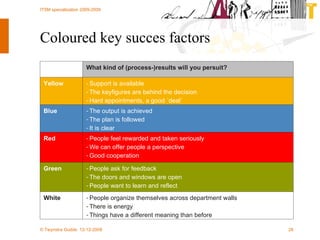
Coloured key succes factors People organize themselves across department walls  There is energy  Things have a different meaning than before  White People ask for feedback The doors and windows are open People want to learn and reflect Green People feel rewarded and taken seriously We can offer people a perspective Good cooperation Red The output is achieved The plan is followed  It is clear Blue Support is available The keyfigures are behind the decision Hard appointments, a good ´deal´ Yellow What kind of (process-)results will you persuit?
Change agent
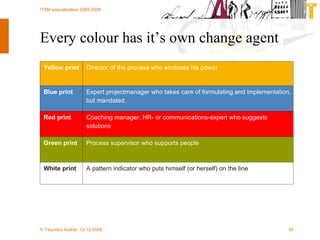
Every colour has it’s own change agent A pattern indicator who puts himself (or herself) on the line White print Process supervisor who supports people  Green print Coaching manager, HR- or communications-expert who suggests solutions  Red print Expert projectmanager who takes care of formulating and implementation, but mandated.  Blue print Director of the process who encloses his power Yellow print
The Change approach for Sourcing
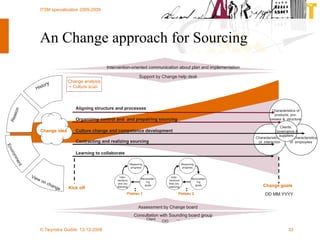
Sourcing asks for controlled change Sourcing is a fundamental change and therefore should be  approached as a change Sourcing is about technology, people and organization; all three elements deserve special attention Much attention should to be paid to collaboration and to learning to collaborate
An Change approach for Sourcing … . Change idea Intervention-oriented communication about plan and implementation Support by Change help desk Assessment by Change board Consultation with Sounding board group CIO Client … Characteristics  of  interaction Characteristics of  employees Characteristics of products, pro- cesses &  structure Clients,  Governance & suppliers Histor y Reason Environment View on change Kick off Change analysis + Culture scan DD MM YYYY Change goals Aligning structure and processes Organizing control and  and prepairing sourcing Contracting and realizing sourcing Culture change and competence development Learning to collaborate Inter- ventions And (re)  planning Reconsider- Ing goals Measuring progress Plateau 2 Inter- ventions and (re) planning Reconsider- ing goals Measuring progress Plateau 1
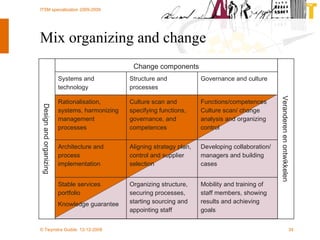
Mix organizing and change Veranderen en ontwikkelen Design and organizing Governance and culture Structure and processes Systems and technology Mobility and training of staff members, showing results and achieving goals Organizing structure, securing processes, starting sourcing and appointing staff Stable services portfolio Knowledge guarantee Developing collaboration/ managers and building cases Aligning strategy plan, control and supplier selection Architecture and process implementation Functions/competences Culture scan/ change analysis and  organizing control Culture scan and  specifying functions, governance, and competences Rationalisation, systems, harmonizing management processes Change components
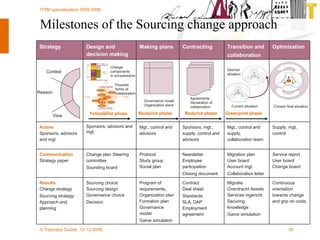
Milestones of the Sourcing change approach Yellowprint phase Blueprint phase Redprint phase Greenprint phase Change components In enneahedron Governance model Organization plans Agreements Declaration of collaboration Current situation Desired situation Chosen final situation Possible forms of collaboration  Service report User board Change board Migration plan User board Account mgt. Collaboration letter Newsletter Employee participation Closing document Protocol Study group Social plan Change plan Steering committee Sounding board Communication Strategy paper Migratie Overdracht Assets Services ingericht Securing knowledge Game simulation Mgt., control and supply, collaboration team Transition and collaboration Continuous orientation towards change and grip on costs Contract Deal sheet Standards SLA, DAP Employment agreement Program of requirements, Organization plan Formation plan Governance model Game simulation Sourcing choice Sourcing design Governance choice Decision Results Change strategy Sourcing strategy Approach and planning Supply, mgt., control Sponsors, mgt., supply, control and advisors Mgt., control and advisors Sponsors, advisors and mgt. Actors Sponsors, advisors and mgt. Optimization Contracting Making plans Design and decision making Strategy Context Reason View
Sample game simulation
With game simulation one learns to change Game simulation is based on a future situation and makes people concerned realize that it will work Game simulation is about following a correct procedure,  collaborative processes in the chain, governace and implementation A process that in reality lasts a couple of days is played within 2 to 3 hours The game is used as a change intenvention and definite arragements about design, communication, consequences and improvements can be made
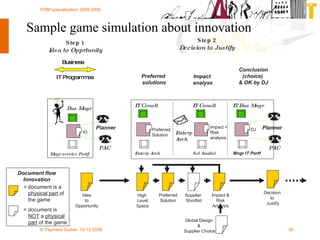
Sample game simulation about innovation Step 1 Idea to Opprtunity Step 2 Decision to Justify Mngr service Portf Bus Mngr IT Conslt Enterp Arch  IO Preferred Solution Planner IT Conslt Sol Analist Impact + Risk analysis IT Bus Mngr Mngr IT Portf DJ Planner Business IT Programmes Enterp Arch PAC PAC Preferred  solutions Impact  analyse Conclusion (choice)  & OK by DJ Idea to Opportunity = document is a    physical part  of    the game =  document is    NOT  a  physical   part  of the game High  Level Specs Preferred Solution Supplier  Shortlist Impact & Risk Analysis Global Design  &  Supplier Choice Decision  to  Justify Document flow Innovation
All rights reserved. No part of this presentation may be reproduced or published in any form or by any means without the prior written permission of Twynstra Gudde. Frank Willems [email_address] www.twynstragudde.nl

Sourcing Lecture 2 Change Management

  • 1.
    ITSM specialization 2009-2009The change approach for Sourcing
  • 2.
    Agenda Outcome ofDigital Selftest Vision on Change management Five ways of thinking about change Diagnosis Change strategy Interventionplan & interventions Change agent The Change approach for Sourcing
  • 3.
    Outcome of theDigital Selftest Test should be made on http://www.twynstragudde.nl/tg.htm?id=8635 White Green Red Blue Yellow Name
  • 4.
    Vision on Changemanagement
  • 5.
    Why change isdifficult Autonomous workers and hierarchical managers Basic conflict Pocket vetoes Managing and being managed Ambiguities in organizations Loose coupling between intentions and behavior Garbage-can decision making Loosely coupled systems Dynamic balance Autonomous development Structural tension and structural conflicts Chaos thinking Actontheory and power Informal organisation Economic exchange in group behavior Sociopolitical mechanisms Wicked problems Development patterns in groups Toxic emotions Fixations
  • 6.
    Our vision onChange management Five ways of thinking about change: common language: to discuss and decide about change it helps and reduces haggling over change only happens if you..’, when you have the same language viewing the issue as a whole: multiple contrasting viewpoints in diagnosing and understanding organizations, people, issues acting situationally: situational choice of the ‘best’ change strategy fitting the issue, the organization… What fits the issue? What fits the organization? profession: as change agent you should be aware of your preferred style, assumptions, limitations and bias. It offers a tool for reflection.
  • 7.
    Some questions onnorms of best practice Communication What is the best team composition: mixed or not? Can one be ‘colorless’ about the colors? Doesn’t it stigmatise, this thinking in colors? Wouldn’t it help if green/white change agents would be more pragmatic and business like? Change agent Can one master all the colors? Should one learn to believe in the color one is good at? Or vice versa? Do people change color during their careers? What does one need to be ‘professional’ in mixed colored environments? Strategy Does a ‘rainbow’ approach work? What criteria determines appropriate color of change strategy? Which colors dominate when colors fight? Are there situations when you have to combine colors more? How to introduce a new color when it’s at odd with dominant colors? Diagnosis How many colors does an organization need? Do all organizations need to become learning organizations? Can you do a multi-colored analysis by yourself? Do you understand an organization best by looking at it from its ‘own color’?
  • 8.
    Planned change is…Realising aimed results Regarding the motive , context and philosophy By influencing the actors By walking through the change programme in phases and steps By communicating and add meaning to what people are doing In which the whole process will be managed by Deliberate interventions of change agents.
  • 9.
    Phases of plannedchange Steering Tracing the progress (indicators) and diagnose Recalibrate the objective (goal) & adjust change process Manage the environment & keep healthy organization change Consider which kind of method/handle is the most succesful (indicators) Determine the leading principles; grand design & argumentation Ideas about fulfilment (kind of interventions and comibnations) Change strategy Searching for patterns/contexts that are hidden by symptoms Determine if you choose for: instinct or systematic, combined or expertise Model a rich, precise and simple meaning for the “What” The centre of diagnosis Determine system boundary, the assignment, goal of diagnosis (clearly define) Determine type of diagnosis: dimensions, methods, participation Discovering the meaning of “What” from various viewpoints Diagnosis Conducting interventions Cashing the results Secure the outcome Interventions Brainstorming and to determine the interventions and the sequence of interventions Optimize colour consistency and colour handling tensions Specify Plan of Approach (including actors, communication, guiding & outcome) Intervention plan Efforts Phase
  • 10.
    Five ways ofthinking about change
  • 11.
    Five ways ofthinking about change Understand what underlying patterns drive and block an organization’s evolution, focusing interventions to create space for people’s energy Create settings for learning by using OD interventions, allowing people to become more aware and more competent on their job Bring the interests of the most important players together by means of a process of negotiation enabling consensus or a win-win solution Motivate and stimulate people to perform best they can, contracting and rewarding desired behavior with the help of HRM-systems Formulate clear goals and results, then design rationally a systematic approach and then implement the approach according to plan Change is in the eye of the beholder Each viewpoint has its ++ en --, ideals and pitfalls Red print Green print Blue print White print Yellow print Something changes when you . . .
  • 12.
    Yellow Print ThinkingRole: facilitator who guards and uses his own power base Competencies for example: indepence and self-control sensitive to power relations knowledge of the sector, strategy issues and structuring issues. Focus: positions and context Result: unknown & changing along the way Interventions for example: a lliance building arbitration/mediation creating/changing top structures favoring protégés, promoting people to the fringes. Safeguarding progress: policy documents/power balance Change agent Route Building castles in the air Power struggles (loose-loose) Something changes when you: search for common interests compel people to take certain positions form coalitions formulate new policies. “ Changing = a power game” Pitfalls Create common interests/win-win situations To safeguard the feasibility of solutions Ideals Assumptions
  • 13.
    Blue Print ThinkingRole: expert who formulates and implements plans if mandated to do so Competencies for example: analytical skills planning and control expertise crucial to the project content presentation skills. Focus: expertise and results Result: delineated and guaranteed in advance Interventions for example: project management meeting procedures time management strategic analysis. Safeguarding progress: monitoring, benchmarking, ISO systems Change agent Route To steamroller about people and their feelings To ignore irrational and external factors Something changes when you: define a clear result beforehand formulate a step by step action plan monitor progress and take corrective measures foster stability and reduce complexity. “ Change = a rational process” Pitfalls Progress can be planned; a better world can be ´built´ The ´best´ solution (tangible aspects of organizations) Ideals Assumptions
  • 14.
    Red Print ThinkingRole: systems expert who occasionaly makes suggestions with regard to the content Competencies for example: HRM methods organizing proper communication working in teams exercising care. Focus: p rocedures and atmosphere Result: outlined beforehand but not guaranteed Interventions for example: appraisal and remuneration management of mobility and diversity social gatherings soap box. Safeguarding progress: HRM systems Change agent Route Sparing the rod, avoiding conflicts, ignoring power struggles Smothering brillance Something changes when you: use the right incentives to motivate people make it comfortable and interesting for people award and punish people exercise care and safeguard fairness. “ Change = a trading exercise” Pitfalls The optimal fit between organizational goals and individual goals A solution that motivates people (soft organizational aspects) Ideals Assumptions
  • 15.
    Green Print ThinkingRole: facilitator who supports people Competencies for example: designing and facilitating learning situations knowledge of organizational development feedback skills empathy and creativity. Focus: s etting and communication Result: envisaged beforehand, but not guaranteed Interventions for example: training, management development gaming coaching/intervision open systems planning. Safeguarding progress: permanently learning organization Change agent Route To ignore that not everybody is willing or capable of learning everything Overabundance of safety and reflection, lack of decisiveness Something changes when you: make people aware of their incompetencies people gain new insights and new skills create settings for collective learning change people. “ Changing = learning” Pitfalls Learning organizations: with everybody, about everything, always A solution that helps people to develop themselves Ideals Assumptions
  • 16.
    White Print ThinkingRole: p ersonality who uses his being as instrument Competencies for example: pattern recognition and creation of (new) meaning challenging the status quo courage, and ability to deal with insecurity authenticity and self-awareness. Focus: patterns and persons. Result:hard to predict (the road = the destination) Interventions for example: self steering teams open space meeting personal growth/empowerment challenge sacredly held ideas and customs. Safeguarding progress: self steering. Change agent Route Insufficient insight into underlying forces and patterns Laisses faire, ´self-steering´ as an excuse for management apathy Something changes when you: tap people´s own will, desire and strength remove obstacles to entrepeneurship and optimize conflicts discern underlying patterns and make meaning create new heroes and rituals. “ Changing = releasing energy” Pitfalls S pontaneous evolution Self steering Taoist “non-action” Ideals Assumptions
  • 17.
    The five colorsat a glance open space meetings self-steering teams someone who uses his being as instrument patterns and meanings training and coaching, open systems planning facilitator who supports people the setting and communication assessment & reward, social gatherings HRM expert procedures and working climate project management strategic analysis expert in the field knowledge and results forming coalitions, changing topstructures facilitator who uses his own power base positions and context The result is... by a/an... aimed at... unpredictable self-management superficial under-standing and laissez faire envisaged but not guaranteed a learning organisation excluding no-one and lack of action outlined but not guaranteed HRM systems ignoring power and smothering brilliance described and guaranteed benchmarking and iso systems ignoring external and irrational aspects partly unknown and shifting decision documents and power balances dreaming and lose-lose Result is… Safeguarded by… The pit-falls lie in… create space for spontaneous evolution dynamic process a solution that releases energy create settings for collective learning learning process a solution that people develop themselves stimulate people in the right way exchange exercise a motivating solution, the best ´fit´ think first and then act according to a plan rational process the best solution, a brave new world bring common interests together power game a feasible solution, a win-win situation Something changes when you in a/an and create White-print Green-print Red-print Blue-print Yellow-print
  • 18.
  • 19.
    Diagnosis Change agentfocuses diagnosis on change aspects Change agent focus diagnosis on organizational aspects Static Dynamic System oriented People oriented Developmental approach: sense-making ‘ everything flows’ learning diverse definitions of reality. Actor’s approach: field of influence distribution of power power is limited individual orientation. Entrepreneur’s approach: open system opportunities/threats fit solution oriented all pulling in the same direction growth. Design approach: systemic aspects and tighness registration deviations from the norm internally oriented people are funcionaries.
  • 20.
    First diverge andthen converge Change idea Diagnosis Meaning Multiple view Making more complex ´Whole elephant´ To search and find Subjective, intuïtive Separate cause and symptoms Focus of issue
  • 21.
  • 22.
    Can it withmore of the same? Is it possible with more of the same? Immersion Continuous Evolutionary No Third order Episodic Rhythm Incremental First order Second order Can they renew theirselves? Stepwise Optimalising Yes No Yes Revolutionary Jumped by
  • 23.
    Second order change:add a colour To make complex, to boost (dynamic), add conflicts, hybridize, to give meaning, innovate White print Explicit, awareness, reason, learn, customize, experiment, reflect Green print Humanisation, motivate, seduce, appreciate, to give attention, connecting people Red print Rationalize, (over) simplify, schematize, design, (re)solve, control, stabilize Blue print Politicize, destabilize, arrange the support, decide, democratize Yellow print Typical verbs
  • 24.
    Intervention plan &interventions
  • 25.
    The five relevantquestions Which interventions do fit in the strategy? What kind of goals do fit in that strategy? How do we manage interventions which amplify each other? Which boundary conditions connect well? How do we achieve the synergy? How do we associate with (colour) disturbances? What to do when we find ourselves in hostile environments and when we have to deal with competitve ways? How do we seperate roles and domains? How do we organise the interventions in terms of roles, timing, information?
  • 26.
    Overview of asample of colored interventions (1) Strategy analysis Business process redesign Auditing Working in projects Archiving Decision making M anagement by Objectives Hygienic working Working with a day planner Blue Reward systems Managing mobility and diversity Triple ladder Social activities Team roles Management by speech Career development Recruitment and selection Job enlargement/Job enrichment Red Confrontation meetings Third-party strategy Top structuring Group Yellow Dominant Color Improving quality of work life Forming strategic alliances Negotiations on labor conditions Personal Commitment Statement Outplacement Protégé constructions Organization Individual Level in the organization
  • 27.
    Overview of asample of colored interventions (2) Search conferences Rituals and mystique Deconstructing “sacred cows” Self-steering teams  Open space meetings  Making mental models explicit T-Group  Personal growth Networking White Open systems planning Parallel learning structures Quality circles Teambuilding  Gaming Intervision Coaching  Intensive clinic  Feedback/Mirroring Green Organization Group Individual Dominant Color Level in the organization
  • 28.
    Coloured key succesfactors People organize themselves across department walls There is energy Things have a different meaning than before White People ask for feedback The doors and windows are open People want to learn and reflect Green People feel rewarded and taken seriously We can offer people a perspective Good cooperation Red The output is achieved The plan is followed It is clear Blue Support is available The keyfigures are behind the decision Hard appointments, a good ´deal´ Yellow What kind of (process-)results will you persuit?
  • 29.
  • 30.
    Every colour hasit’s own change agent A pattern indicator who puts himself (or herself) on the line White print Process supervisor who supports people Green print Coaching manager, HR- or communications-expert who suggests solutions Red print Expert projectmanager who takes care of formulating and implementation, but mandated. Blue print Director of the process who encloses his power Yellow print
  • 31.
    The Change approachfor Sourcing
  • 32.
    Sourcing asks forcontrolled change Sourcing is a fundamental change and therefore should be approached as a change Sourcing is about technology, people and organization; all three elements deserve special attention Much attention should to be paid to collaboration and to learning to collaborate
  • 33.
    An Change approachfor Sourcing … . Change idea Intervention-oriented communication about plan and implementation Support by Change help desk Assessment by Change board Consultation with Sounding board group CIO Client … Characteristics of interaction Characteristics of employees Characteristics of products, pro- cesses & structure Clients, Governance & suppliers Histor y Reason Environment View on change Kick off Change analysis + Culture scan DD MM YYYY Change goals Aligning structure and processes Organizing control and and prepairing sourcing Contracting and realizing sourcing Culture change and competence development Learning to collaborate Inter- ventions And (re) planning Reconsider- Ing goals Measuring progress Plateau 2 Inter- ventions and (re) planning Reconsider- ing goals Measuring progress Plateau 1
  • 34.
    Mix organizing andchange Veranderen en ontwikkelen Design and organizing Governance and culture Structure and processes Systems and technology Mobility and training of staff members, showing results and achieving goals Organizing structure, securing processes, starting sourcing and appointing staff Stable services portfolio Knowledge guarantee Developing collaboration/ managers and building cases Aligning strategy plan, control and supplier selection Architecture and process implementation Functions/competences Culture scan/ change analysis and organizing control Culture scan and specifying functions, governance, and competences Rationalisation, systems, harmonizing management processes Change components
  • 35.
    Milestones of theSourcing change approach Yellowprint phase Blueprint phase Redprint phase Greenprint phase Change components In enneahedron Governance model Organization plans Agreements Declaration of collaboration Current situation Desired situation Chosen final situation Possible forms of collaboration Service report User board Change board Migration plan User board Account mgt. Collaboration letter Newsletter Employee participation Closing document Protocol Study group Social plan Change plan Steering committee Sounding board Communication Strategy paper Migratie Overdracht Assets Services ingericht Securing knowledge Game simulation Mgt., control and supply, collaboration team Transition and collaboration Continuous orientation towards change and grip on costs Contract Deal sheet Standards SLA, DAP Employment agreement Program of requirements, Organization plan Formation plan Governance model Game simulation Sourcing choice Sourcing design Governance choice Decision Results Change strategy Sourcing strategy Approach and planning Supply, mgt., control Sponsors, mgt., supply, control and advisors Mgt., control and advisors Sponsors, advisors and mgt. Actors Sponsors, advisors and mgt. Optimization Contracting Making plans Design and decision making Strategy Context Reason View
  • 36.
  • 37.
    With game simulationone learns to change Game simulation is based on a future situation and makes people concerned realize that it will work Game simulation is about following a correct procedure, collaborative processes in the chain, governace and implementation A process that in reality lasts a couple of days is played within 2 to 3 hours The game is used as a change intenvention and definite arragements about design, communication, consequences and improvements can be made
  • 38.
    Sample game simulationabout innovation Step 1 Idea to Opprtunity Step 2 Decision to Justify Mngr service Portf Bus Mngr IT Conslt Enterp Arch IO Preferred Solution Planner IT Conslt Sol Analist Impact + Risk analysis IT Bus Mngr Mngr IT Portf DJ Planner Business IT Programmes Enterp Arch PAC PAC Preferred solutions Impact analyse Conclusion (choice) & OK by DJ Idea to Opportunity = document is a physical part of the game = document is NOT a physical part of the game High Level Specs Preferred Solution Supplier Shortlist Impact & Risk Analysis Global Design & Supplier Choice Decision to Justify Document flow Innovation
  • 39.
    All rights reserved.No part of this presentation may be reproduced or published in any form or by any means without the prior written permission of Twynstra Gudde. Frank Willems [email_address] www.twynstragudde.nl