Organizational Change: How to Make
it Happen in Today’s Workplace
50th MBA Anniversary Weekend
June 2, 2017
Prof. Ronald R. Sims
1
2
"One cannot become a butterfly by
remaining a caterpillar."
Change defined:
• “to make the form, nature, content, future
course, etc., of (something) different from
what it is or from what it would be if left
alone.”
• “to transform or convert (usually followed
by into): The witch changed the prince into
a toad.” - Dictionary.com
3
Change Reflection Quiz (True – False)
1. My organization has gone through a
major change in the past two years.

2. My organization will go through a major
change in the next three to five years.
3. I know I am an effective leader / change
agent.
4. Others would say I am an effective leader
/ change agent.
4
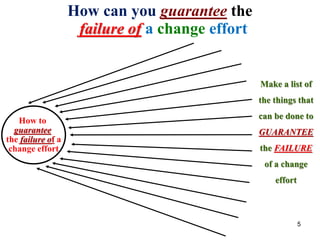
How can you guarantee thee
failure of a change effort
How to
guarantee
the failure of a
change effort
Make a list of
the things that
can be done to
GUARANTEE
the FAILURE
of a change
effort
5
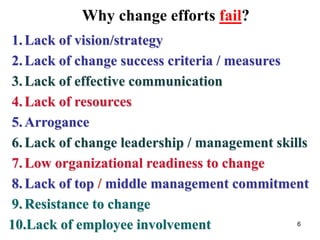
Why change efforts fail?
1.Lack of vision/strategy
2.Lack of change success criteria / measures
3.Lack of effective communication
4.Lack of resources
5.Arrogance
6.Lack of change leadership / management skills
7.Low organizational readiness to change
8.Lack of top / middle management commitment
9.Resistance to change
10.Lack of employee involvement 6
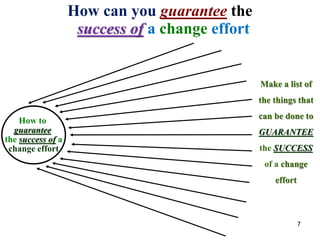
How can you guarantee thee
success of a change effort
How to
guarantee
the success of a
change effort
Make a list of
the things that
can be done to
GUARANTEE
the SUCCESS
of a change
effort
7
“Change failures do not usually result
from leaders not knowing what to do;
rather these failures result because leaders
fail to do what they know full well they
should & must do. Most leaders never get
fully comfortable with the changes that
they wish for their organizations.”
8
Examples of ill-conceived, badly executed & poorly
led change are:
• Knee-jerk Change—based on hasty decisions made without
due diligence or sufficient input from affected parties
• Cinderella Change—expecting to succeed without seeking
out & addressing the reasons for the failure of previous
initiatives; requires a Fairy Godmother
• Do As I Say Change—when leaders speak the right words
but do not demonstrate their commitment through actions
• Yo-Yo Change—unpredictable, exemplified by ever-
changing priorities, plans, & promises
• Tightrope Change—when employees are asked to “work
without a net” of education & training to perform their
altered jobs
• Dishonest Change—uses communication that is unclear or
glosses over expected negatives like possible job loss 9
Is there a “compelling” reason for
our organization to change?
10
Question in need of an answer:
Change shouldn’t be “Just another
flavor of the month”
11
A Quiz That You Cannot Fail!
•Do we know how we would like to be different?
(Where, Clarity)
•Are we clear on the changes that we intend to
create in the future? (What, Clarity)
•Are there compelling reasons to change?
(Why, Urgency)
•Are we passionate, positive, & realistic about the
opportunity / improvements? (Attitude)
•Are we confident that we can create the changes
we envision? (Confidence)
•Is there enough in it for me (others) to commit
to the effort? (Alignment) 12
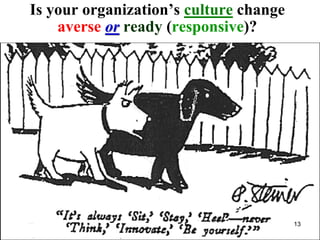
Is your organization’s culture change
averse or ready (responsive)?
13
How do you stack up against the
characteristics of a successful change leader?
1. 360-degree influence
2. Strong communication skills
3. A “big-picture,” strategic mindset
4. Conflict-resolution skills
5. Personal willingness & talent for change
6. Passion for change
14
Twenty-Three Change
Best Practices / Lessons Learned
15
# 1: Develop a Compelling Vision
• How Things Will Be Better With the Change
• More Than Sloganeering
• Leaders & Change Agents Need Their Own
Individual Visions & Need to Know How
That Fits Into the Organization’s Vision
• People Need to See How They Fit Into That
Vision
16
# 2: Change Is a Journey, Not a Blueprint
• Develop Detailed, Multi-dimensional Plans
– Change Description
– Business Objectives
– Human Objectives
– Key Role Map
– Vision
– Detailed Activities, Resources, Timelines
– Measurements
• Recognize That This Is a Journey
– Will Need to Adapt Plan As Needs Change17
# 3: Warning: Need to Balance
“Preparing For” & “Implementing”
• There Is a Need to Develop a Comprehensive
Plan for the Change
• There Is a Need to Get the Organization Ready
for the Change
• But If It Takes Too Long, People Lose Interest
& Motivation
• So, Plan for Short Projects That Will Engage
the People 18
# 4: Understand & Own the Past
• The Past Bounds Future Success
• Identify Critical Success Factors From
Previous Successful Changes in the
Organization
– Surveys
– Interviews
– Lessons Learned Sessions
• Acknowledge Past Failures
– Explicitly Plan on Countermeasures 19
# 5: Build a Strong, Committed Leadership
Coalition
• At All Levels Within the Organization
• Teach Them Their Job
– Establish a Clear Vision
– Articulate That Vision
– Communicate With the Affected Groups
– Focus Energies on Their Direct Reports
– Monitor Progress
– Eliminate Obstacles
– Recognize and Reward Short-term Wins
– Stick With It for the Long Haul
20
# 6: Identify All the People Who Are
Affected or Who Need to Be Involved
• Create a Key Role Map of the Formal
Organization
– Sponsors (at All Levels), Change Agents, Targets
• Also Identify Key Informal Organization People
(Understand Why They Have This Influence)
– Opinion Shapers, Gate Keepers, Idea Champions
• Develop an Understanding of Their
– Level of Influence & Level of Commitment to the
Change 21
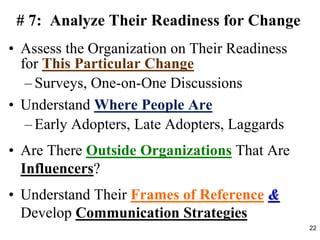
# 7: Analyze Their Readiness for Change
• Assess the Organization on Their Readiness
for This Particular Change
– Surveys, One-on-One Discussions
• Understand Where People Are
– Early Adopters, Late Adopters, Laggards
• Are There Outside Organizations That Are
Influencers?
• Understand Their Frames of Reference &
Develop Communication Strategies
22
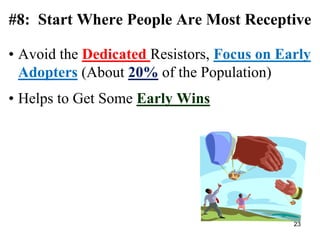
#8: Start Where People Are Most Receptive
• Avoid the Dedicated Resistors, Focus on Early
Adopters (About 20% of the Population)
• Helps to Get Some Early Wins
23
# 9: People Don’t Resist Their Own Ideas
• Get People Involved Early in the Planning
• Even If They Can’t Plan “What”, They Can
Plan “How”
• They Are Changed by the Act of Participating
in Planning the Change
• Surfaces Resistance Early & Can Potentially
Manage It
24
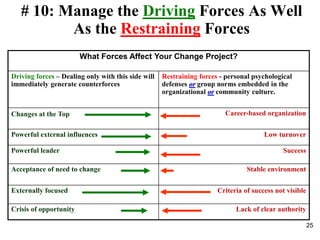
# 10: Manage the Driving Forces As Well
As the Restraining Forces
What Forces Affect Your Change Project?
Driving forces – Dealing only with this side will
immediately generate counterforces
Restraining forces - personal psychological
defenses or group norms embedded in the
organizational or community culture.
Changes at the Top Career-based organization
Powerful external influences Low turnover
Powerful leader Success
Acceptance of need to change Stable environment
Externally focused Criteria of success not visible
Crisis of opportunity Lack of clear authority
25
# 11: Establish a Darn Good Reason to
Change
• Substitute One Fear for Another
– Make the Anxiety Associated With Not
Changing Greater Than the Anxiety of
Changing
– Intentionally Create Disorder
• Remove the Mechanisms That Allow
People to Stay the Same
26
#12: Say It Once, Say It Twice, & Say It Again
• Keep It Simple – No Jargon
• Use Language of the People
• Use Storytelling
• Use Different Mediums
– Memos, Group Meetings, Stories in
Newsletters, & One-on-one Meetings
– (Have Different Levels of Impact)
• Change Style of Communication Depending
Upon
– Where You Are in the Change
– Who You Are Communicating With
• Walk the Talk, Be Honest
27
# 13: But Monitor the Communications
• Communicate Often, Regularly
• Control The Grapevine & Rumor Mill
• Provide Two-Way Q&A Opportunities
• Encourage & Monitor Employee Feedback
• Listen & Keep Listening
• Measure Communication Results &
Celebrate Successes
• Make Communication Monitoring the
Responsibility of Change & Transition
Teams
28
# 14: Show Results – Early & Often
• Plan for Goals (Long & Near Term) That Are
Measurable, Tangible & Clear
– Explicitly Tied to Vision
• Not a Count of Activities
– # Of People Trained in . . . .
– # Of Procedures Written
• Performance Results That Matter to
Customers, Employees or Shareholders
– Reduction in Delivered Defects, Reduction
in Cycle Time 29
# 15: Prepare for “Implementation Dip”
• Things Often Get Worse Before They Get
Better
• Increase the Communication
– Change the Medium & Words
– Focus on What Is Ahead
– Provide As Much Information As Possible
• Allow Resistance to Surface & Manage It
30
# 16: Validate the Feelings of People
• Resistance Can Be at Systemic or Behavioral
Level
– Systemic – Lack of Appropriate Knowledge,
Information, Skills & Managerial Capacity
(Cognitive)
– Behavioral – Reactions, Perceptions &
Assumptions (Emotional)
• Acknowledge the Pain of Changing
31
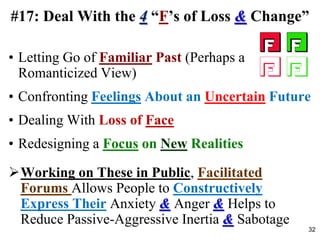
• Letting Go of Familiar Past (Perhaps a
Romanticized View)
• Confronting Feelings About an Uncertain Future
• Dealing With Loss of Face
• Redesigning a Focus on New Realities
Working on These in Public, Facilitated
Forums Allows People to Constructively
Express Their Anxiety & Anger & Helps to
Reduce Passive-Aggressive Inertia & Sabotage
#17: Deal With the 4 “F’s of Loss & Change”
32
# 18: Don’t Resist Resistance
• Resistance Is
– Inevitable
– A Natural Function of Change
– Manageable
• Resistance Is Not
– Necessarily Logical
– A Sign of Disloyalty
– To Be Taken Personally
– A Sign That the Change Project Is Out of
Control 33
# 19: Use a Variety of Mediums to Build
Competency in the Change
• Train Employees As Facilitators for the
Change
– Helps Them to Demonstrate Active
Commitment to the Change
– Can Immediately Reinforce the Change
• Study Groups / Teams, Coaching
• Web-based, Classroom Training
• Action-learning
34
#20 : Be a Successful Change Leader
1. Learn the Fundamentals of Change Management.
2. Be Familiar With the Current State of Your
Organization / Environment, & The Case for
Change.
3. Understand Your Organization’s Track Record
For Change.
4. Educate ALL Employees On Their Roles in the
Change
– To Be Open to Change
– To Anticipate Change, Not Just React to It
– To Accept That Change Causes Stress & to
Developing Coping Mechanisms 35
In Conclusion: The World is Changing!
“The world is too big for us. Too much is going on,
too many crimes, too much violence & excitement.
Try as you will, you get behind in the race in spite
of yourself. It is an incessant strain to keep pace,
& still you lose ground. Science empties its
discoveries on you so fast you stagger beneath
them in hopeless bewilderment. The political
world is news changing so rapidly that you’re out
of breath trying to keep pace with who’s in &
who’s out. Everything is high pressure. Human
nature can’t endure much more!”
•The Atlantic Journal - June 16, 1833 36
When you’re finished changing,
you’re finished. Kathleen Romero
37
QUESTIONS?
38

Ron Sims- Organizational Change

  • 1.
    Organizational Change: Howto Make it Happen in Today’s Workplace 50th MBA Anniversary Weekend June 2, 2017 Prof. Ronald R. Sims 1
  • 2.
    2 "One cannot becomea butterfly by remaining a caterpillar."
  • 3.
    Change defined: • “tomake the form, nature, content, future course, etc., of (something) different from what it is or from what it would be if left alone.” • “to transform or convert (usually followed by into): The witch changed the prince into a toad.” - Dictionary.com 3
  • 4.
    Change Reflection Quiz(True – False) 1. My organization has gone through a major change in the past two years. 2. My organization will go through a major change in the next three to five years. 3. I know I am an effective leader / change agent. 4. Others would say I am an effective leader / change agent. 4
  • 5.
    How can youguarantee thee failure of a change effort How to guarantee the failure of a change effort Make a list of the things that can be done to GUARANTEE the FAILURE of a change effort 5
  • 6.
    Why change effortsfail? 1.Lack of vision/strategy 2.Lack of change success criteria / measures 3.Lack of effective communication 4.Lack of resources 5.Arrogance 6.Lack of change leadership / management skills 7.Low organizational readiness to change 8.Lack of top / middle management commitment 9.Resistance to change 10.Lack of employee involvement 6
  • 7.
    How can youguarantee thee success of a change effort How to guarantee the success of a change effort Make a list of the things that can be done to GUARANTEE the SUCCESS of a change effort 7
  • 8.
    “Change failures donot usually result from leaders not knowing what to do; rather these failures result because leaders fail to do what they know full well they should & must do. Most leaders never get fully comfortable with the changes that they wish for their organizations.” 8
  • 9.
    Examples of ill-conceived,badly executed & poorly led change are: • Knee-jerk Change—based on hasty decisions made without due diligence or sufficient input from affected parties • Cinderella Change—expecting to succeed without seeking out & addressing the reasons for the failure of previous initiatives; requires a Fairy Godmother • Do As I Say Change—when leaders speak the right words but do not demonstrate their commitment through actions • Yo-Yo Change—unpredictable, exemplified by ever- changing priorities, plans, & promises • Tightrope Change—when employees are asked to “work without a net” of education & training to perform their altered jobs • Dishonest Change—uses communication that is unclear or glosses over expected negatives like possible job loss 9
  • 10.
    Is there a“compelling” reason for our organization to change? 10 Question in need of an answer:
  • 11.
    Change shouldn’t be“Just another flavor of the month” 11
  • 12.
    A Quiz ThatYou Cannot Fail! •Do we know how we would like to be different? (Where, Clarity) •Are we clear on the changes that we intend to create in the future? (What, Clarity) •Are there compelling reasons to change? (Why, Urgency) •Are we passionate, positive, & realistic about the opportunity / improvements? (Attitude) •Are we confident that we can create the changes we envision? (Confidence) •Is there enough in it for me (others) to commit to the effort? (Alignment) 12
  • 13.
    Is your organization’sculture change averse or ready (responsive)? 13
  • 14.
    How do youstack up against the characteristics of a successful change leader? 1. 360-degree influence 2. Strong communication skills 3. A “big-picture,” strategic mindset 4. Conflict-resolution skills 5. Personal willingness & talent for change 6. Passion for change 14
  • 15.
  • 16.
    # 1: Developa Compelling Vision • How Things Will Be Better With the Change • More Than Sloganeering • Leaders & Change Agents Need Their Own Individual Visions & Need to Know How That Fits Into the Organization’s Vision • People Need to See How They Fit Into That Vision 16
  • 17.
    # 2: ChangeIs a Journey, Not a Blueprint • Develop Detailed, Multi-dimensional Plans – Change Description – Business Objectives – Human Objectives – Key Role Map – Vision – Detailed Activities, Resources, Timelines – Measurements • Recognize That This Is a Journey – Will Need to Adapt Plan As Needs Change17
  • 18.
    # 3: Warning:Need to Balance “Preparing For” & “Implementing” • There Is a Need to Develop a Comprehensive Plan for the Change • There Is a Need to Get the Organization Ready for the Change • But If It Takes Too Long, People Lose Interest & Motivation • So, Plan for Short Projects That Will Engage the People 18
  • 19.
    # 4: Understand& Own the Past • The Past Bounds Future Success • Identify Critical Success Factors From Previous Successful Changes in the Organization – Surveys – Interviews – Lessons Learned Sessions • Acknowledge Past Failures – Explicitly Plan on Countermeasures 19
  • 20.
    # 5: Builda Strong, Committed Leadership Coalition • At All Levels Within the Organization • Teach Them Their Job – Establish a Clear Vision – Articulate That Vision – Communicate With the Affected Groups – Focus Energies on Their Direct Reports – Monitor Progress – Eliminate Obstacles – Recognize and Reward Short-term Wins – Stick With It for the Long Haul 20
  • 21.
    # 6: IdentifyAll the People Who Are Affected or Who Need to Be Involved • Create a Key Role Map of the Formal Organization – Sponsors (at All Levels), Change Agents, Targets • Also Identify Key Informal Organization People (Understand Why They Have This Influence) – Opinion Shapers, Gate Keepers, Idea Champions • Develop an Understanding of Their – Level of Influence & Level of Commitment to the Change 21
  • 22.
    # 7: AnalyzeTheir Readiness for Change • Assess the Organization on Their Readiness for This Particular Change – Surveys, One-on-One Discussions • Understand Where People Are – Early Adopters, Late Adopters, Laggards • Are There Outside Organizations That Are Influencers? • Understand Their Frames of Reference & Develop Communication Strategies 22
  • 23.
    #8: Start WherePeople Are Most Receptive • Avoid the Dedicated Resistors, Focus on Early Adopters (About 20% of the Population) • Helps to Get Some Early Wins 23
  • 24.
    # 9: PeopleDon’t Resist Their Own Ideas • Get People Involved Early in the Planning • Even If They Can’t Plan “What”, They Can Plan “How” • They Are Changed by the Act of Participating in Planning the Change • Surfaces Resistance Early & Can Potentially Manage It 24
  • 25.
    # 10: Managethe Driving Forces As Well As the Restraining Forces What Forces Affect Your Change Project? Driving forces – Dealing only with this side will immediately generate counterforces Restraining forces - personal psychological defenses or group norms embedded in the organizational or community culture. Changes at the Top Career-based organization Powerful external influences Low turnover Powerful leader Success Acceptance of need to change Stable environment Externally focused Criteria of success not visible Crisis of opportunity Lack of clear authority 25
  • 26.
    # 11: Establisha Darn Good Reason to Change • Substitute One Fear for Another – Make the Anxiety Associated With Not Changing Greater Than the Anxiety of Changing – Intentionally Create Disorder • Remove the Mechanisms That Allow People to Stay the Same 26
  • 27.
    #12: Say ItOnce, Say It Twice, & Say It Again • Keep It Simple – No Jargon • Use Language of the People • Use Storytelling • Use Different Mediums – Memos, Group Meetings, Stories in Newsletters, & One-on-one Meetings – (Have Different Levels of Impact) • Change Style of Communication Depending Upon – Where You Are in the Change – Who You Are Communicating With • Walk the Talk, Be Honest 27
  • 28.
    # 13: ButMonitor the Communications • Communicate Often, Regularly • Control The Grapevine & Rumor Mill • Provide Two-Way Q&A Opportunities • Encourage & Monitor Employee Feedback • Listen & Keep Listening • Measure Communication Results & Celebrate Successes • Make Communication Monitoring the Responsibility of Change & Transition Teams 28
  • 29.
    # 14: ShowResults – Early & Often • Plan for Goals (Long & Near Term) That Are Measurable, Tangible & Clear – Explicitly Tied to Vision • Not a Count of Activities – # Of People Trained in . . . . – # Of Procedures Written • Performance Results That Matter to Customers, Employees or Shareholders – Reduction in Delivered Defects, Reduction in Cycle Time 29
  • 30.
    # 15: Preparefor “Implementation Dip” • Things Often Get Worse Before They Get Better • Increase the Communication – Change the Medium & Words – Focus on What Is Ahead – Provide As Much Information As Possible • Allow Resistance to Surface & Manage It 30
  • 31.
    # 16: Validatethe Feelings of People • Resistance Can Be at Systemic or Behavioral Level – Systemic – Lack of Appropriate Knowledge, Information, Skills & Managerial Capacity (Cognitive) – Behavioral – Reactions, Perceptions & Assumptions (Emotional) • Acknowledge the Pain of Changing 31
  • 32.
    • Letting Goof Familiar Past (Perhaps a Romanticized View) • Confronting Feelings About an Uncertain Future • Dealing With Loss of Face • Redesigning a Focus on New Realities Working on These in Public, Facilitated Forums Allows People to Constructively Express Their Anxiety & Anger & Helps to Reduce Passive-Aggressive Inertia & Sabotage #17: Deal With the 4 “F’s of Loss & Change” 32
  • 33.
    # 18: Don’tResist Resistance • Resistance Is – Inevitable – A Natural Function of Change – Manageable • Resistance Is Not – Necessarily Logical – A Sign of Disloyalty – To Be Taken Personally – A Sign That the Change Project Is Out of Control 33
  • 34.
    # 19: Usea Variety of Mediums to Build Competency in the Change • Train Employees As Facilitators for the Change – Helps Them to Demonstrate Active Commitment to the Change – Can Immediately Reinforce the Change • Study Groups / Teams, Coaching • Web-based, Classroom Training • Action-learning 34
  • 35.
    #20 : Bea Successful Change Leader 1. Learn the Fundamentals of Change Management. 2. Be Familiar With the Current State of Your Organization / Environment, & The Case for Change. 3. Understand Your Organization’s Track Record For Change. 4. Educate ALL Employees On Their Roles in the Change – To Be Open to Change – To Anticipate Change, Not Just React to It – To Accept That Change Causes Stress & to Developing Coping Mechanisms 35
  • 36.
    In Conclusion: TheWorld is Changing! “The world is too big for us. Too much is going on, too many crimes, too much violence & excitement. Try as you will, you get behind in the race in spite of yourself. It is an incessant strain to keep pace, & still you lose ground. Science empties its discoveries on you so fast you stagger beneath them in hopeless bewilderment. The political world is news changing so rapidly that you’re out of breath trying to keep pace with who’s in & who’s out. Everything is high pressure. Human nature can’t endure much more!” •The Atlantic Journal - June 16, 1833 36
  • 37.
    When you’re finishedchanging, you’re finished. Kathleen Romero 37
  • 38.