WELCOME TO MY PRESENTATION
FACULTY OF FISHERY SCIENCES ( WBUAFS )
A SEMINAR
ON
Change agent – meaning, roles, factors of
success, change agent contact.
FEX-506
SUBMITTED BY
ABDUL HANNAN MONDAL
M/F/2020/01
“Person who act as catalysts and
assume the responsibility for managing
change are called change agents”
Change agents are the backbone of successful change.
A change agent is the person who carries the flag of a need usually not generally
recognized need – by Gary Foster.
A change agent is any catalyst that alters the status quo it could be a person group
an event or policies – by Louise Andre.
WHO IS CHANGE
AGENT ?
INTRODUCTION - Change Agent
• Who in organizations is responsible for managing planned change activities?
• The answer is Change Agents.
The term change agents is used in broad sense because a change agent can be managers or non-managers, employees of
organization or an outside consultants.
For major change efforts, top managers are increasingly turning to temporary outside consultants with specialized knowledge in
theory and methods of change, in an organization is known as a change agent.
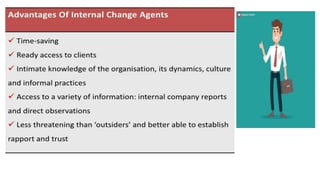
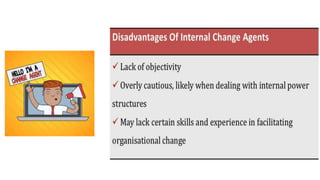
Change agents can be internal, such as managers or employees who are appointed to oversee the change process. In many
innovative-driven companies, managers and employees alike are being trained to develop the needed skills to oversee change .
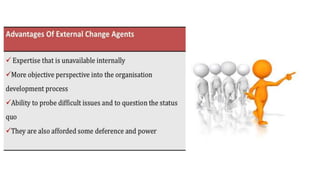
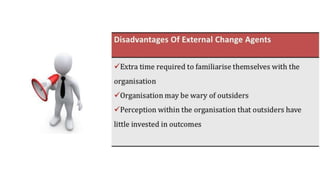
 Change agents also can be external, such as consultants from outside the firm.
Change agents can broadly be classified as:
• 1. External Change Agents
• 2. Internal Change Agents
• 3. External-Internal Change Agents
GENERAL CLASSIFICATION OF CHANGE AGENT
External Change Agents
These are outside consultants who are temporary employed in the
organization to remain engaged only for the duration of the change
process.
Internal Change Agents
These are individuals working for the organization who know
something about its problems and has experience of improving
situation in the same organization. These Internal Change Agents,
when assigned a responsibility of intervening in a system come
from entirely different department or division of their organization.
Change AgentTypes
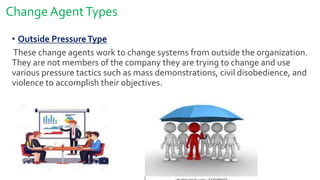
• Outside PressureType
These change agents work to change systems from outside the organization.
They are not members of the company they are trying to change and use
various pressure tactics such as mass demonstrations, civil disobedience, and
violence to accomplish their objectives.
Cont..
• People-Change-Technology Type
The focus of activity for this type of change agent is the
agent may be concerned with employee morale and motivation,
absenteeism, turnover, and the quality of work performed. The
include job enrichment, goal setting, and behavior modification.
Cont..
• Analysis-for-the-Top Type
The focus of this change agent is on changing the
so as to improve output and efficiency. The change agent uses
research, systems analysis, policy studies, and other forms of
approaches to change the organization's structure or
Cont..
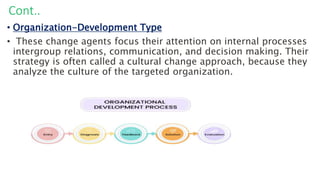
• Organization-Development Type
• These change agents focus their attention on internal processes
intergroup relations, communication, and decision making. Their
strategy is often called a cultural change approach, because they
analyze the culture of the targeted organization.
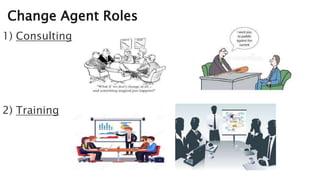
Change Agent Roles
1) Consulting
2) Training
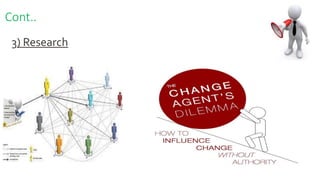
Cont..
3) Research
Change agents should possess:
1.Resilience
2.Insight
3.Identity
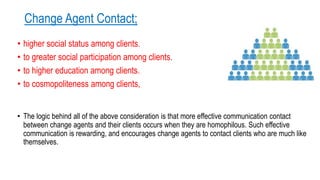
Change Agent Contact;
• higher social status among clients.
• to greater social participation among clients.
• to higher education among clients.
• to cosmopoliteness among clients,
• The logic behind all of the above consideration is that more effective communication contact
between change agents and their clients occurs when they are homophilous. Such effective
communication is rewarding, and encourages change agents to contact clients who are much like
themselves.
factors in change agent success
• Change agent success is positively related to the extent
of change agent effort in contacting clients
• Change agent effort:
• Change agent versus client orientation:
• Compatibility with clients’ needs:
• Change agent empathy:
• Homophily and change agent contact :
• Change agent credibility:
CONCLUSION
• Every organizational change, whether large or small, requires one or more change
agents. A change agent is anyone who has the skill and power to guide and
facilitate the change effort. Change agents may be either external or internal. The
success of any change effort depends heavily on the quality and workability of the
relationship between the change agent and the key decision makers within the
organization.
• Remember that ;change agents were change recipients at some stage too.
REFERENCES
• Anderson, L. A. (2011). The change leader’s roadmap:
• How to navigate your organization’s transformation. New York, NY: Routledge. Burke, W. W. (2011).
• Organizational change: Theory and practice. Thousand Oaks, CA: Sage. Carnall, C. (2008).
• Managing change in organizations. Upper Saddle River, NJ: Prentice Hall. Dawson, P. M. B. (2010).
• Managing change, creativity and innovation. Thousand Oaks, CA: Sage. deBruijn, H. (2011).
• Managing professionals. New York, NY: Routledge.
THANK YOU SIR

Change Agent ppt

  • 1.
    WELCOME TO MYPRESENTATION
  • 2.
    FACULTY OF FISHERYSCIENCES ( WBUAFS ) A SEMINAR ON Change agent – meaning, roles, factors of success, change agent contact. FEX-506 SUBMITTED BY ABDUL HANNAN MONDAL M/F/2020/01
  • 3.
    “Person who actas catalysts and assume the responsibility for managing change are called change agents” Change agents are the backbone of successful change. A change agent is the person who carries the flag of a need usually not generally recognized need – by Gary Foster. A change agent is any catalyst that alters the status quo it could be a person group an event or policies – by Louise Andre. WHO IS CHANGE AGENT ?
  • 4.
    INTRODUCTION - ChangeAgent • Who in organizations is responsible for managing planned change activities? • The answer is Change Agents. The term change agents is used in broad sense because a change agent can be managers or non-managers, employees of organization or an outside consultants. For major change efforts, top managers are increasingly turning to temporary outside consultants with specialized knowledge in theory and methods of change, in an organization is known as a change agent. Change agents can be internal, such as managers or employees who are appointed to oversee the change process. In many innovative-driven companies, managers and employees alike are being trained to develop the needed skills to oversee change .  Change agents also can be external, such as consultants from outside the firm. Change agents can broadly be classified as: • 1. External Change Agents • 2. Internal Change Agents • 3. External-Internal Change Agents
  • 5.
    GENERAL CLASSIFICATION OFCHANGE AGENT External Change Agents These are outside consultants who are temporary employed in the organization to remain engaged only for the duration of the change process. Internal Change Agents These are individuals working for the organization who know something about its problems and has experience of improving situation in the same organization. These Internal Change Agents, when assigned a responsibility of intervening in a system come from entirely different department or division of their organization.
  • 10.
    Change AgentTypes • OutsidePressureType These change agents work to change systems from outside the organization. They are not members of the company they are trying to change and use various pressure tactics such as mass demonstrations, civil disobedience, and violence to accomplish their objectives.
  • 11.
    Cont.. • People-Change-Technology Type Thefocus of activity for this type of change agent is the agent may be concerned with employee morale and motivation, absenteeism, turnover, and the quality of work performed. The include job enrichment, goal setting, and behavior modification.
  • 12.
    Cont.. • Analysis-for-the-Top Type Thefocus of this change agent is on changing the so as to improve output and efficiency. The change agent uses research, systems analysis, policy studies, and other forms of approaches to change the organization's structure or
  • 13.
    Cont.. • Organization-Development Type •These change agents focus their attention on internal processes intergroup relations, communication, and decision making. Their strategy is often called a cultural change approach, because they analyze the culture of the targeted organization.
  • 14.
    Change Agent Roles 1)Consulting 2) Training
  • 15.
  • 16.
    Change agents shouldpossess: 1.Resilience 2.Insight 3.Identity
  • 18.
    Change Agent Contact; •higher social status among clients. • to greater social participation among clients. • to higher education among clients. • to cosmopoliteness among clients, • The logic behind all of the above consideration is that more effective communication contact between change agents and their clients occurs when they are homophilous. Such effective communication is rewarding, and encourages change agents to contact clients who are much like themselves.
  • 21.
    factors in changeagent success • Change agent success is positively related to the extent of change agent effort in contacting clients • Change agent effort: • Change agent versus client orientation: • Compatibility with clients’ needs: • Change agent empathy: • Homophily and change agent contact : • Change agent credibility:
  • 22.
    CONCLUSION • Every organizationalchange, whether large or small, requires one or more change agents. A change agent is anyone who has the skill and power to guide and facilitate the change effort. Change agents may be either external or internal. The success of any change effort depends heavily on the quality and workability of the relationship between the change agent and the key decision makers within the organization. • Remember that ;change agents were change recipients at some stage too.
  • 23.
    REFERENCES • Anderson, L.A. (2011). The change leader’s roadmap: • How to navigate your organization’s transformation. New York, NY: Routledge. Burke, W. W. (2011). • Organizational change: Theory and practice. Thousand Oaks, CA: Sage. Carnall, C. (2008). • Managing change in organizations. Upper Saddle River, NJ: Prentice Hall. Dawson, P. M. B. (2010). • Managing change, creativity and innovation. Thousand Oaks, CA: Sage. deBruijn, H. (2011). • Managing professionals. New York, NY: Routledge.
  • 24.