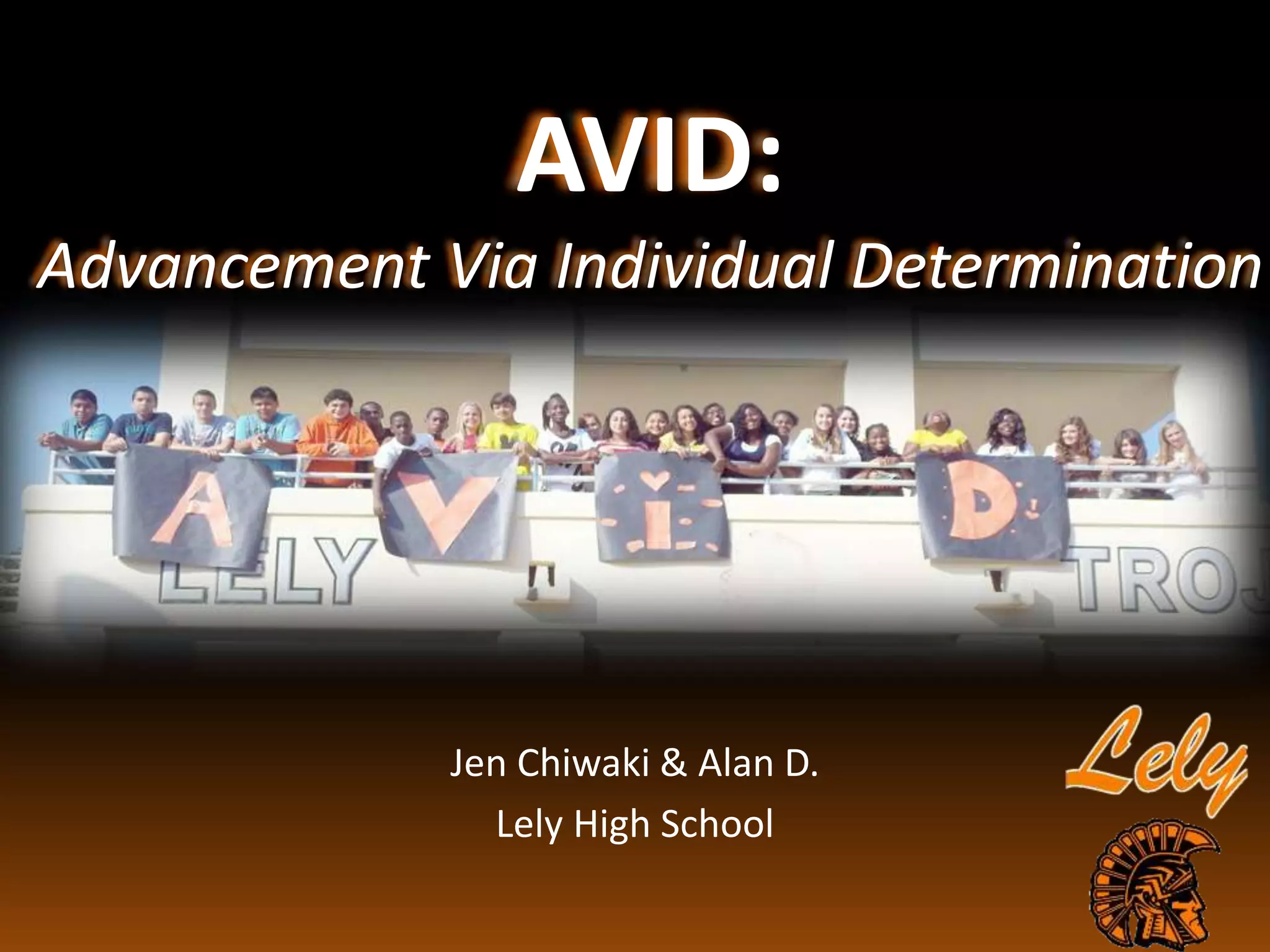
AVID:
Advancement Via Individual Determination
Jen Chiwaki & Alan D.
Lely High School
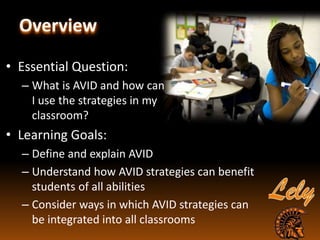
Overview
• Essential Question:
– What is AVID and how can
I use the strategies in my
classroom?
• Learning Goals:
– Define and explain AVID
– Understand how AVID strategies can benefit
students of all abilities
– Consider ways in which AVID strategies can
be integrated into all classrooms
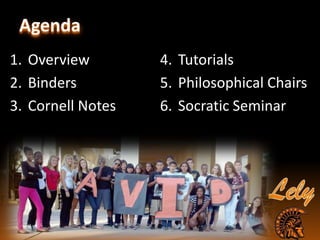
Agenda
1. Overview
2. Binders
3. Cornell Notes
4. Tutorials
5. Philosophical Chairs
6. Socratic Seminar
1. Overview
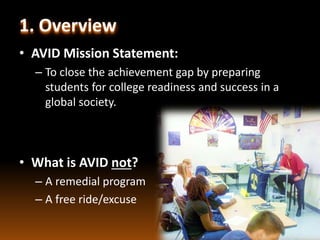
• AVID Mission Statement:
– To close the achievement gap by preparing
students for college readiness and success in a
global society.
• What is AVID not?
– A remedial program
– A free ride/excuse
1. Overview
• The LHS AVID Site Team:
– Jen Chiwaki AVID Coordinator/Elective Teacher
– Alan Davis AVID Elective Teacher
– Jon Bremseth AVID Administrator
– Ed Boaz AVID Guidance Counselor
– Cyndi Werner Math Representative
– Christi Patterson English Representative
– Catherine Hunt CTE Representative
– Kyle Manders English Representative
– Sharon Murray Social Studies Representative
1. Overview
• Why AVID?
– 2008-2009 Hillsborough County AVID Graduates
who expect to attend college: 100%
– 2007-2008 AVID Graduates nation-wide who plan
to enroll in a college or university: 97%
– 2008-2009 LHS Graduation Rate: 82.3%
1. Overview
• Who is an AVID Student?
– These capable students, in the middle, often are not
realizing their full potential academically. Criteria to
consider for recruitment include:
• FCAT Scores (usually average to above average)
• Grades (usually average)
• Attendance
• Positive attitude
• College Potential
• Desire and Determination
• Family Support
• Historical Under-representation
in 4-year Colleges
• Other Special Circumstances
1. Overview
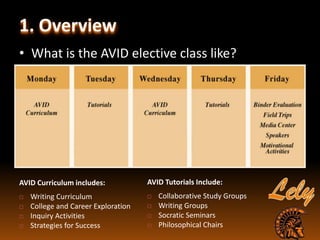
• What is the AVID elective class like?
AVID Curriculum includes:
 Writing Curriculum
 College and Career Exploration
 Inquiry Activities
 Strategies for Success
AVID Tutorials Include:
 Collaborative Study Groups
 Writing Groups
 Socratic Seminars
 Philosophical Chairs
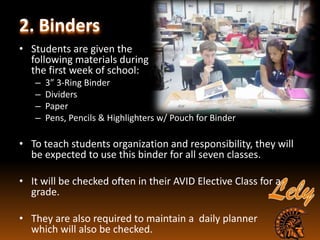
2. Binders
• Students are given the
following materials during
the first week of school:
– 3” 3-Ring Binder
– Dividers
– Paper
– Pens, Pencils & Highlighters w/ Pouch for Binder
• To teach students organization and responsibility, they will
be expected to use this binder for all seven classes.
• It will be checked often in their AVID Elective Class for a
grade.
• They are also required to maintain a daily planner
which will also be checked.
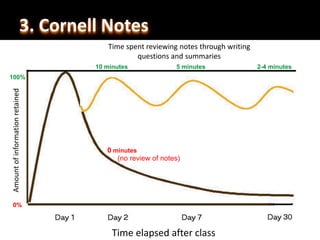
3. Cornell Notes
Time elapsed after class
Time spent reviewing notes through writing
questions and summaries
0 minutes
(no review of notes)
10 minutes 5 minutes 2-4 minutes
Amountofinformationretained
100%
0%
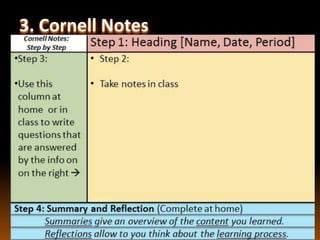
3. Cornell Notes
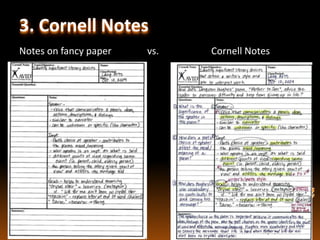
3. Cornell Notes
• Model the strategy on the doc cam.
– Think aloud as you take the notes with them.
• Have students volunteer to be the model
Cornell Note-takers on the doc cam.
• Use for homework or exit slips:
– Encourage students to generate H.O.T.
questions for the question column.
– Summary/reflections
3. Cornell Notes
Notes on fancy paper vs. Cornell Notes
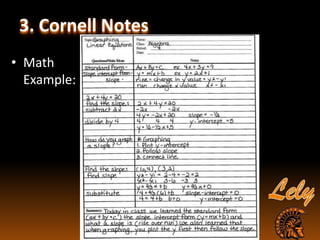
3. Cornell Notes
• Math
Example:
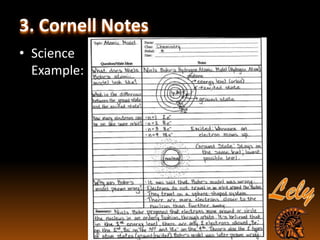
3. Cornell Notes
• Science
Example:
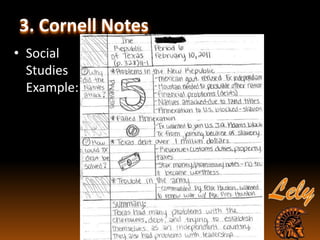
3. Cornell Notes
• Social
Studies
Example:
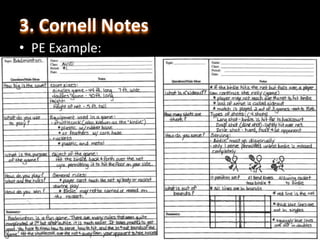
3. Cornell Notes
• PE Example:
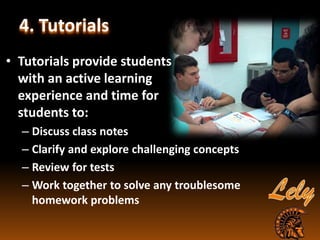
4. Tutorials
• Tutorials provide students
with an active learning
experience and time for
students to:
– Discuss class notes
– Clarify and explore challenging concepts
– Review for tests
– Work together to solve any troublesome
homework problems
4. Tutorials
• The Tutorial Request Form
• A tutorial group is
comprised of:
– approximately 5-7 students
– one discussion leader who is a local college
student or community member.
• Matt’s Story
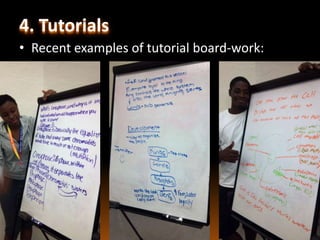
4. Tutorials
• Recent examples of tutorial board-work:
5. Philosophical Chairs
• In class, students question, statement, or
quote to produce thought and discussion.
• Students must decide whether they agree or
disagree with topic.
• Chairs are placed in two lines facing
each other, with each line representing
the two sides of the topic.
5. Philosophical Chairs
• Students will discuss the topic in an orderly
fashion.
• If someone makes a very convincing point,
students can move to the opposite side. They
can change sides at any time, as often as they
feel compelled.
• After 30-40 minutes of discussion,
students will write a summary/reflection
of the topic.
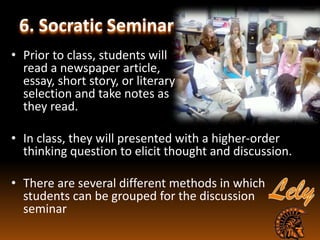
6. Socratic Seminar
• Prior to class, students will
read a newspaper article,
essay, short story, or literary
selection and take notes as
they read.
• In class, they will presented with a higher-order
thinking question to elicit thought and discussion.
• There are several different methods in which
students can be grouped for the discussion
seminar
Recap
• Essential Question:
– What is AVID and how can I use the strategies in
my classroom?
• Learning Goals:
– Define and explain AVID
– Understand how AVID strategies can benefit
students of all abilities
– Consider ways in which AVID strategies can
be integrated into all classrooms

AVID Overview - Cornell Notes

  • 1.
    AVID: Advancement Via IndividualDetermination Jen Chiwaki & Alan D. Lely High School
  • 2.
    Overview • Essential Question: –What is AVID and how can I use the strategies in my classroom? • Learning Goals: – Define and explain AVID – Understand how AVID strategies can benefit students of all abilities – Consider ways in which AVID strategies can be integrated into all classrooms
  • 3.
    Agenda 1. Overview 2. Binders 3.Cornell Notes 4. Tutorials 5. Philosophical Chairs 6. Socratic Seminar
  • 4.
    1. Overview • AVIDMission Statement: – To close the achievement gap by preparing students for college readiness and success in a global society. • What is AVID not? – A remedial program – A free ride/excuse
  • 5.
    1. Overview • TheLHS AVID Site Team: – Jen Chiwaki AVID Coordinator/Elective Teacher – Alan Davis AVID Elective Teacher – Jon Bremseth AVID Administrator – Ed Boaz AVID Guidance Counselor – Cyndi Werner Math Representative – Christi Patterson English Representative – Catherine Hunt CTE Representative – Kyle Manders English Representative – Sharon Murray Social Studies Representative
  • 6.
    1. Overview • WhyAVID? – 2008-2009 Hillsborough County AVID Graduates who expect to attend college: 100% – 2007-2008 AVID Graduates nation-wide who plan to enroll in a college or university: 97% – 2008-2009 LHS Graduation Rate: 82.3%
  • 7.
    1. Overview • Whois an AVID Student? – These capable students, in the middle, often are not realizing their full potential academically. Criteria to consider for recruitment include: • FCAT Scores (usually average to above average) • Grades (usually average) • Attendance • Positive attitude • College Potential • Desire and Determination • Family Support • Historical Under-representation in 4-year Colleges • Other Special Circumstances
  • 8.
    1. Overview • Whatis the AVID elective class like? AVID Curriculum includes:  Writing Curriculum  College and Career Exploration  Inquiry Activities  Strategies for Success AVID Tutorials Include:  Collaborative Study Groups  Writing Groups  Socratic Seminars  Philosophical Chairs
  • 9.
    2. Binders • Studentsare given the following materials during the first week of school: – 3” 3-Ring Binder – Dividers – Paper – Pens, Pencils & Highlighters w/ Pouch for Binder • To teach students organization and responsibility, they will be expected to use this binder for all seven classes. • It will be checked often in their AVID Elective Class for a grade. • They are also required to maintain a daily planner which will also be checked.
  • 10.
    3. Cornell Notes Timeelapsed after class Time spent reviewing notes through writing questions and summaries 0 minutes (no review of notes) 10 minutes 5 minutes 2-4 minutes Amountofinformationretained 100% 0%
  • 11.
  • 12.
    3. Cornell Notes •Model the strategy on the doc cam. – Think aloud as you take the notes with them. • Have students volunteer to be the model Cornell Note-takers on the doc cam. • Use for homework or exit slips: – Encourage students to generate H.O.T. questions for the question column. – Summary/reflections
  • 13.
    3. Cornell Notes Noteson fancy paper vs. Cornell Notes
  • 14.
    3. Cornell Notes •Math Example:
  • 15.
    3. Cornell Notes •Science Example:
  • 16.
    3. Cornell Notes •Social Studies Example:
  • 17.
  • 18.
    4. Tutorials • Tutorialsprovide students with an active learning experience and time for students to: – Discuss class notes – Clarify and explore challenging concepts – Review for tests – Work together to solve any troublesome homework problems
  • 19.
    4. Tutorials • TheTutorial Request Form • A tutorial group is comprised of: – approximately 5-7 students – one discussion leader who is a local college student or community member. • Matt’s Story
  • 20.
    4. Tutorials • Recentexamples of tutorial board-work:
  • 21.
    5. Philosophical Chairs •In class, students question, statement, or quote to produce thought and discussion. • Students must decide whether they agree or disagree with topic. • Chairs are placed in two lines facing each other, with each line representing the two sides of the topic.
  • 22.
    5. Philosophical Chairs •Students will discuss the topic in an orderly fashion. • If someone makes a very convincing point, students can move to the opposite side. They can change sides at any time, as often as they feel compelled. • After 30-40 minutes of discussion, students will write a summary/reflection of the topic.
  • 23.
    6. Socratic Seminar •Prior to class, students will read a newspaper article, essay, short story, or literary selection and take notes as they read. • In class, they will presented with a higher-order thinking question to elicit thought and discussion. • There are several different methods in which students can be grouped for the discussion seminar
  • 24.
    Recap • Essential Question: –What is AVID and how can I use the strategies in my classroom? • Learning Goals: – Define and explain AVID – Understand how AVID strategies can benefit students of all abilities – Consider ways in which AVID strategies can be integrated into all classrooms