The Art of
Reading &
Annotating
Reading is making meaning from
What is reading?   printed words. It requires that the
                   reader:
                      • Identify the words
                         – a process called word recognition
                      • Construct an understanding from them
                         – a process called comprehension
                      • Coordinate identifying words and
                        making meaning so that reading is
                        automatic and accurate
                         – an achievement called fluency
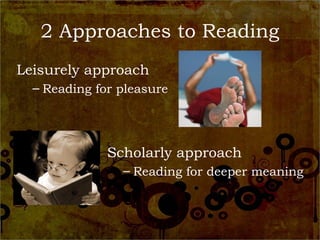
2 Approaches to Reading
Leisurely approach
  – Reading for pleasure


              Scholarly approach
                – Reading for deeper meaning
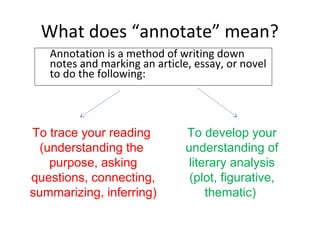
What does “annotate” mean?
   Annotation is a method of writing down
   notes and marking an article, essay, or novel
   to do the following:


To trace your reading          To develop your
  (understanding the           understanding of
    purpose, asking             literary analysis
questions, connecting,          (plot, figurative,
summarizing, inferring)             thematic)
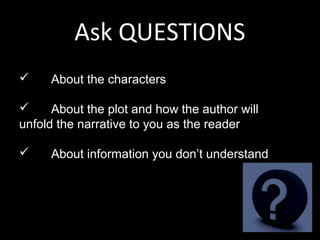
Ask QUESTIONS
    About the characters

     About the plot and how the author will
unfold the narrative to you as the reader

    About information you don’t understand
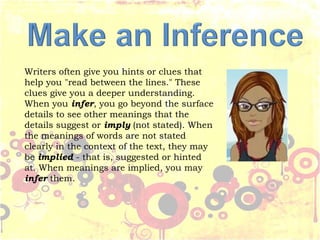
Writers often give you hints or clues that
help you "read between the lines." These
clues give you a deeper understanding.
When you infer, you go beyond the surface
details to see other meanings that the
details suggest or imply (not stated). When
the meanings of words are not stated
clearly in the context of the text, they may
be implied - that is, suggested or hinted
at. When meanings are implied, you may
infer them.
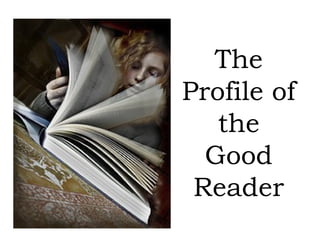
The
Profile of
   the
  Good
 Reader
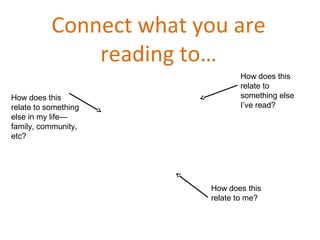
Connect what you are
               reading to…
                                How does this
                                relate to
How does this                   something else
relate to something             I’ve read?
else in my life—
family, community,
etc?


                         How does this
                         relate to me?
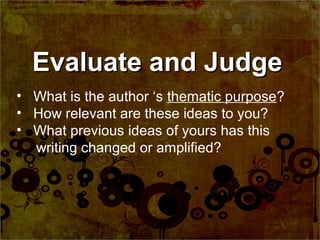
Evaluate and Judge
• What is the author ‘s thematic purpose?
• How relevant are these ideas to you?
• What previous ideas of yours has this
  writing changed or amplified?
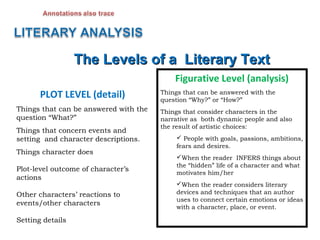
The Levels of a Literary Text
                                           Figurative Level (analysis)
       PLOT LEVEL (detail)             Things that can be answered with the
                                       question “Why?” or “How?”
Things that can be answered with the   Things that consider characters in the
question “What?”                       narrative as both dynamic people and also
                                       the result of artistic choices:
Things that concern events and
setting and character descriptions.          People with goals, passions, ambitions,
                                            fears and desires.
Things character does
                                            When the reader INFERS things about
                                            the “hidden” life of a character and what
Plot-level outcome of character’s
                                            motivates him/her
actions
                                            When the reader considers literary
Other characters’ reactions to              devices and techniques that an author
                                            uses to connect certain emotions or ideas
events/other characters
                                            with a character, place, or event.

Setting details
And the last and most sophisticated level:

       THEMATIC Level
When the reader can make thematic
evaluations and statements.

When the reader says a character/
represents a CONCEPT or an IDEA
by design; these take on a deeper
message, or overall point that the
author is conveying.

When the reader considers
universal themes that the author
has asked to consider
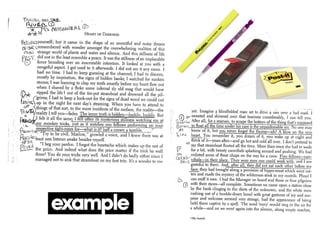
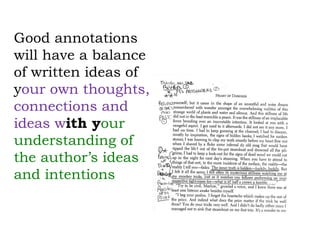
Good annotations
will have a balance
of written ideas of
your own thoughts,
connections and
ideas with your
understanding of
the author’s ideas
and intentions
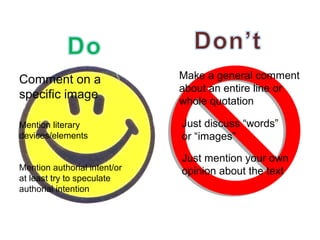
Comment on a                  Make a general comment
                              about an entire line or
specific image
                              whole quotation

Mention literary              Just discuss “words”
devices/elements              or “images”

                              Just mention your own
Mention authorial intent/or   opinion about the text
at least try to speculate
authorial intention

Reading and Annotation

  • 1.
    The Art of Reading& Annotating
  • 2.
    Reading is makingmeaning from What is reading? printed words. It requires that the reader: • Identify the words – a process called word recognition • Construct an understanding from them – a process called comprehension • Coordinate identifying words and making meaning so that reading is automatic and accurate – an achievement called fluency
  • 3.
    2 Approaches toReading Leisurely approach – Reading for pleasure Scholarly approach – Reading for deeper meaning
  • 4.
    What does “annotate”mean? Annotation is a method of writing down notes and marking an article, essay, or novel to do the following: To trace your reading To develop your (understanding the understanding of purpose, asking literary analysis questions, connecting, (plot, figurative, summarizing, inferring) thematic)
  • 5.
    Ask QUESTIONS  About the characters  About the plot and how the author will unfold the narrative to you as the reader  About information you don’t understand
  • 6.
    Writers often giveyou hints or clues that help you "read between the lines." These clues give you a deeper understanding. When you infer, you go beyond the surface details to see other meanings that the details suggest or imply (not stated). When the meanings of words are not stated clearly in the context of the text, they may be implied - that is, suggested or hinted at. When meanings are implied, you may infer them.
  • 8.
    The Profile of the Good Reader
  • 9.
    Connect what youare reading to… How does this relate to How does this something else relate to something I’ve read? else in my life— family, community, etc? How does this relate to me?
  • 10.
    Evaluate and Judge •What is the author ‘s thematic purpose? • How relevant are these ideas to you? • What previous ideas of yours has this writing changed or amplified?
  • 11.
    The Levels ofa Literary Text Figurative Level (analysis) PLOT LEVEL (detail) Things that can be answered with the question “Why?” or “How?” Things that can be answered with the Things that consider characters in the question “What?” narrative as both dynamic people and also the result of artistic choices: Things that concern events and setting and character descriptions.  People with goals, passions, ambitions, fears and desires. Things character does When the reader INFERS things about the “hidden” life of a character and what Plot-level outcome of character’s motivates him/her actions When the reader considers literary Other characters’ reactions to devices and techniques that an author uses to connect certain emotions or ideas events/other characters with a character, place, or event. Setting details
  • 12.
    And the lastand most sophisticated level: THEMATIC Level When the reader can make thematic evaluations and statements. When the reader says a character/ represents a CONCEPT or an IDEA by design; these take on a deeper message, or overall point that the author is conveying. When the reader considers universal themes that the author has asked to consider
  • 13.
    Good annotations will havea balance of written ideas of your own thoughts, connections and ideas with your understanding of the author’s ideas and intentions
  • 14.
    Comment on a Make a general comment about an entire line or specific image whole quotation Mention literary Just discuss “words” devices/elements or “images” Just mention your own Mention authorial intent/or opinion about the text at least try to speculate authorial intention