Submitted By:- Chitwandeep Kaur Palne
Class- 10 C
Roll No- 13
Ques 1:-Why does the bottom of a tank
or a pond appear to be raised?
If we look into a tank or a pond of water, it appears to be less deep than it really is.
This is due to the refraction of light which takes place when light rays pass the tank of
water into the air.
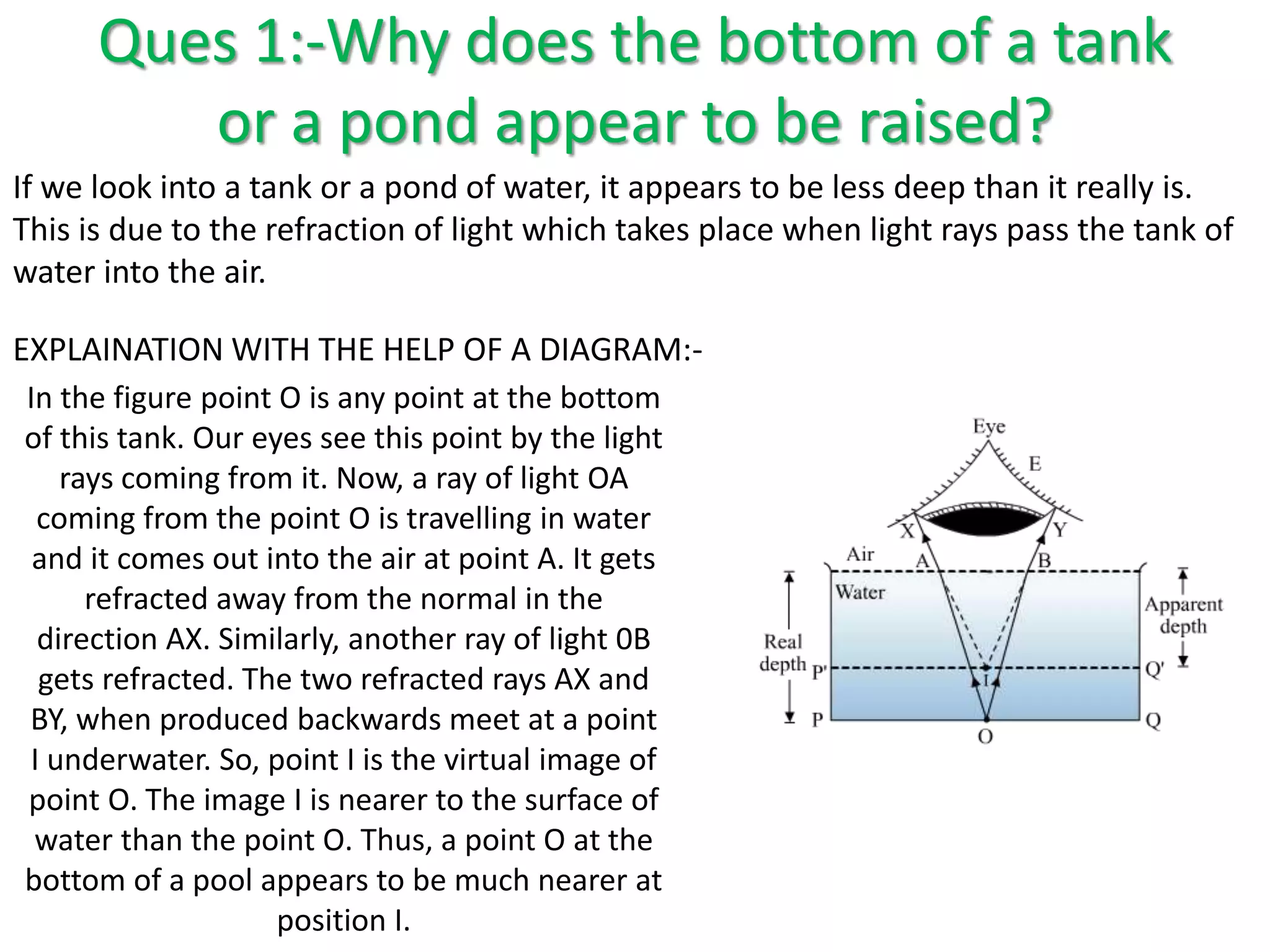
In the figure point O is any point at the bottom
of this tank. Our eyes see this point by the light
rays coming from it. Now, a ray of light OA
coming from the point O is travelling in water
and it comes out into the air at point A. It gets
refracted away from the normal in the
direction AX. Similarly, another ray of light 0B
gets refracted. The two refracted rays AX and
BY, when produced backwards meet at a point
I underwater. So, point I is the virtual image of
point O. The image I is nearer to the surface of
water than the point O. Thus, a point O at the
bottom of a pool appears to be much nearer at
position I.
EXPLAINATION WITH THE HELP OF A DIAGRAM:-
Ques 2:- When a thick glass slab is placed over
some printed matter, why do the letters appear
to be raised?
The letters appear raised due to a phenomenon known as refraction. Refraction of light
takes places when the light passes through glass into air.
EXPLAINATION WITH THE HELP OF A DIAGRAM
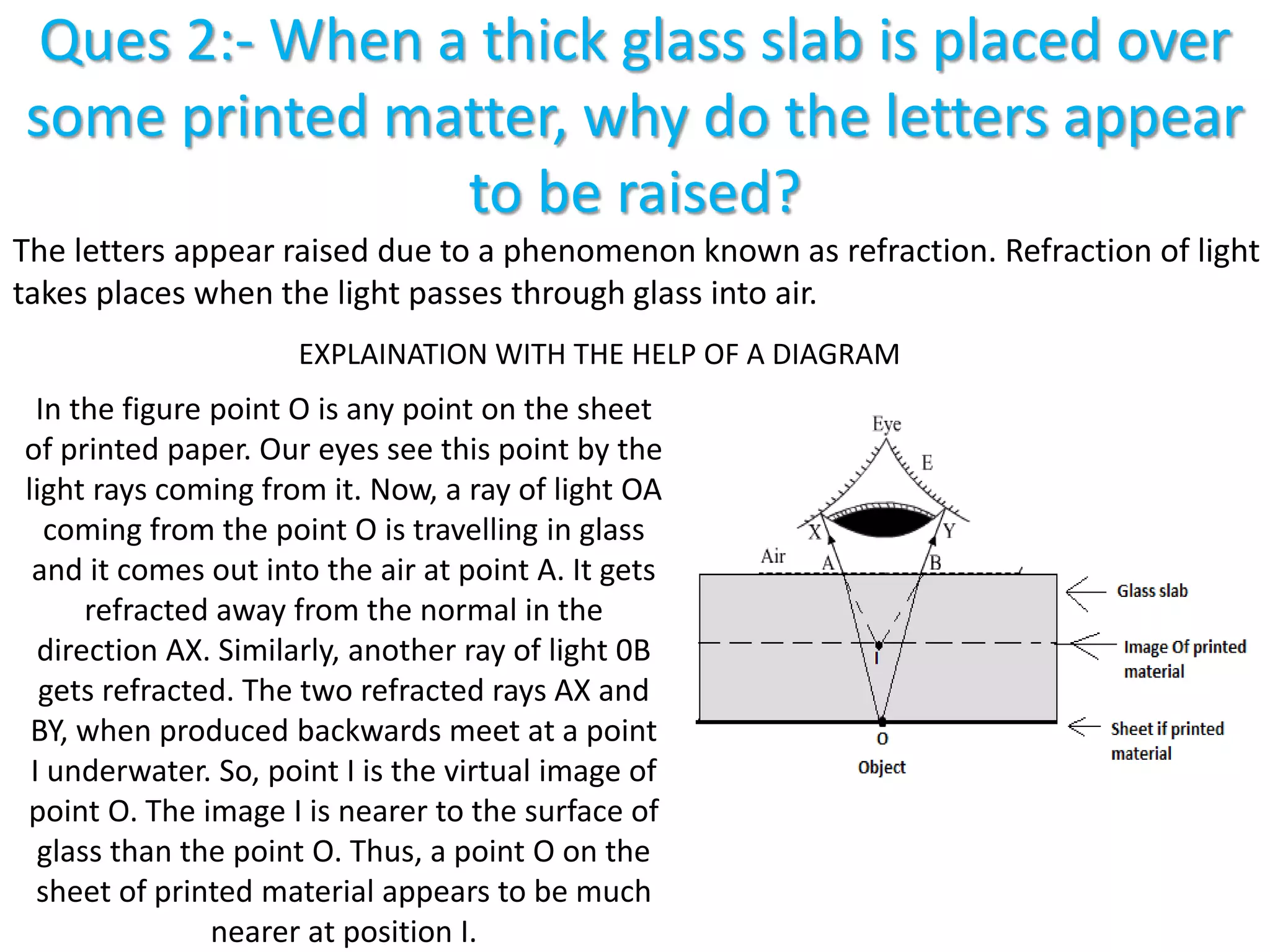
In the figure point O is any point on the sheet
of printed paper. Our eyes see this point by the
light rays coming from it. Now, a ray of light OA
coming from the point O is travelling in glass
and it comes out into the air at point A. It gets
refracted away from the normal in the
direction AX. Similarly, another ray of light 0B
gets refracted. The two refracted rays AX and
BY, when produced backwards meet at a point
I underwater. So, point I is the virtual image of
point O. The image I is nearer to the surface of
glass than the point O. Thus, a point O on the
sheet of printed material appears to be much
nearer at position I.
Ques 3:-Why does a pencil partly immersed
in water appears to be displaced at the
interface of air and water?
When you immerse a stick in water ,You are actually putting in from rarer medium to denser
medium. When the rays of light pass from rarer medium to denser medium they move towards
the normal. So the part of stick immersed in water appears to be broken towards the normal
drawn at the interface. Hence a stick appears to bend when immersed in water
EXPLAINATION WITH THE HELP OF A DIAGRAM:-
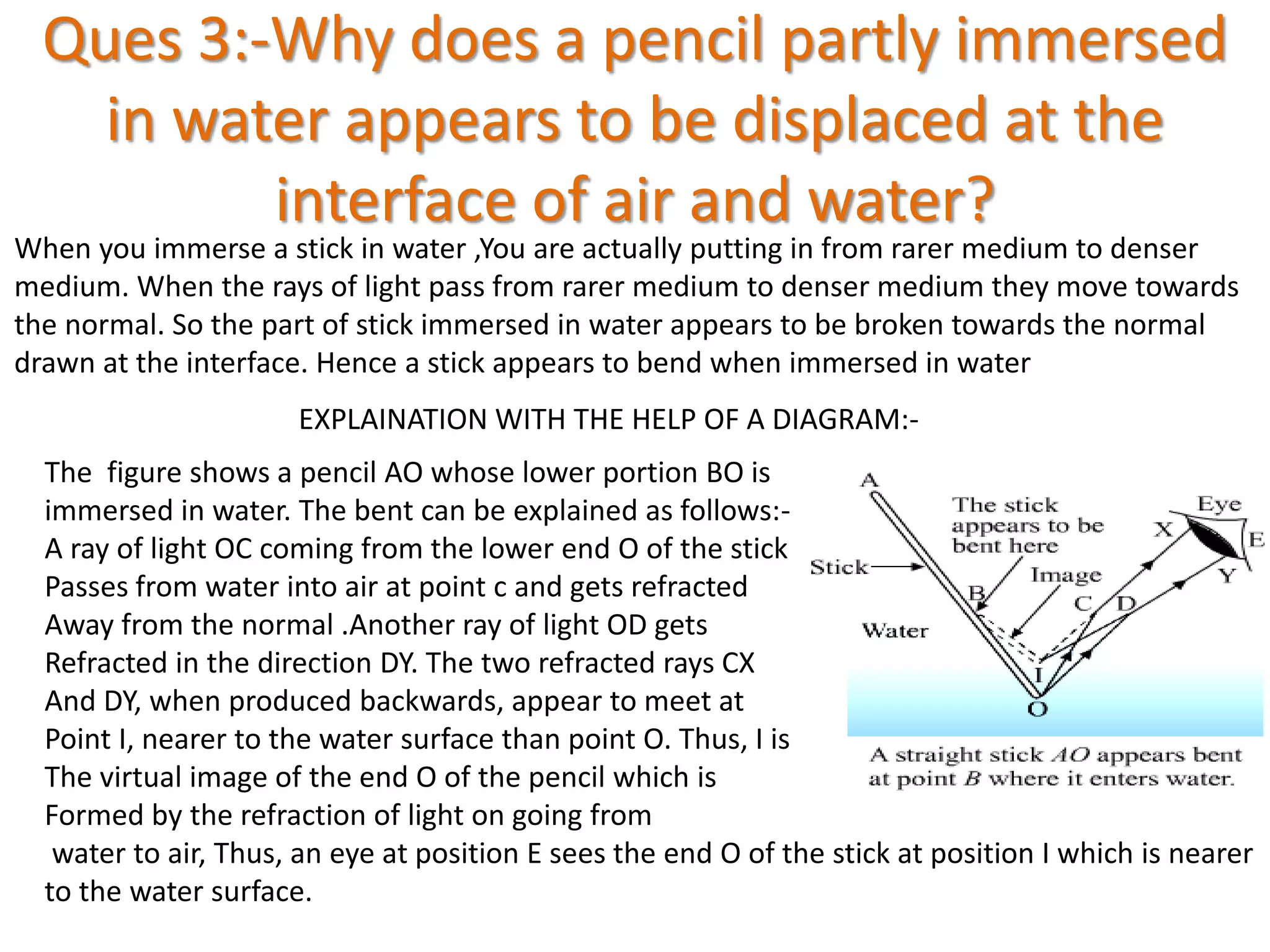
The figure shows a pencil AO whose lower portion BO is
immersed in water. The bent can be explained as follows:-
A ray of light OC coming from the lower end O of the stick
Passes from water into air at point c and gets refracted
Away from the normal .Another ray of light OD gets
Refracted in the direction DY. The two refracted rays CX
And DY, when produced backwards, appear to meet at
Point I, nearer to the water surface than point O. Thus, I is
The virtual image of the end O of the pencil which is
Formed by the refraction of light on going from
water to air, Thus, an eye at position E sees the end O of the stick at position I which is nearer
to the water surface.
Ques 4:- A lemon kept in water in a glass
tumbler appears to be bigger than its
actual size. Why?
This also happens due to refraction phenomenon. Light is refracted as it passes from water
into the air. Once the light has crossed the interface between the two media, it continues to
travel in a straight line. The direction of that line is different than it was in the former medium.
Refraction creates a magnifying effect, so the lemon looks bigger and closer than its actual size
and depth.
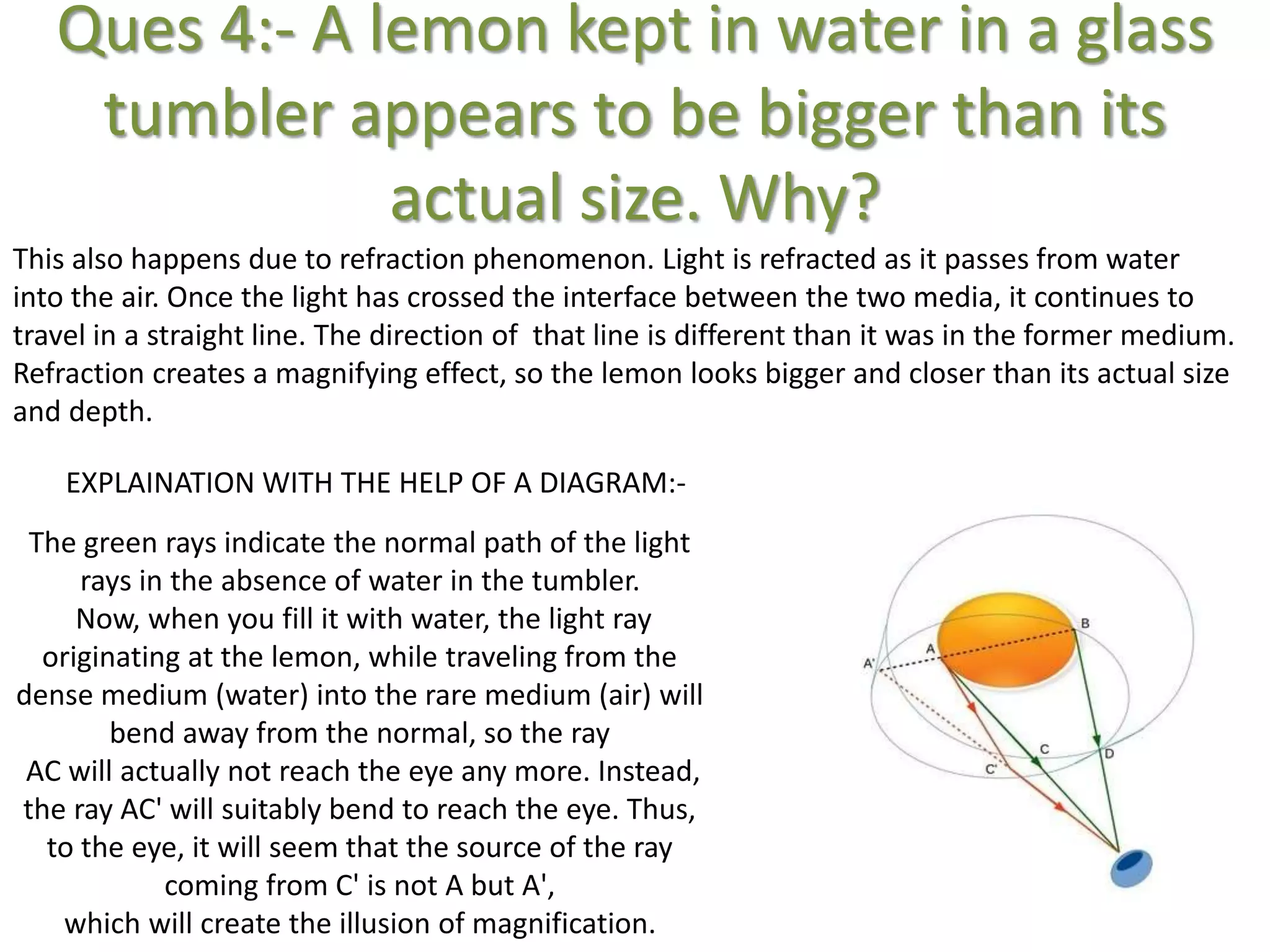
The green rays indicate the normal path of the light
rays in the absence of water in the tumbler.
Now, when you fill it with water, the light ray
originating at the lemon, while traveling from the
dense medium (water) into the rare medium (air) will
bend away from the normal, so the ray
AC will actually not reach the eye any more. Instead,
the ray AC' will suitably bend to reach the eye. Thus,
to the eye, it will seem that the source of the ray
coming from C' is not A but A',
which will create the illusion of magnification.
EXPLAINATION WITH THE HELP OF A DIAGRAM:-
Activity 10.7-Explanation
Activity 10.7-
•Place a coin at the bottom of a bucket filled with water. „
•With your eye to a side above water, try to pick up the coin in one go.
Did you succeed in picking up the coin? „
•Repeat the Activity. Why did you not succeed in doing it in one go?
•„Ask your friends to do this. Compare your experience with theirs.
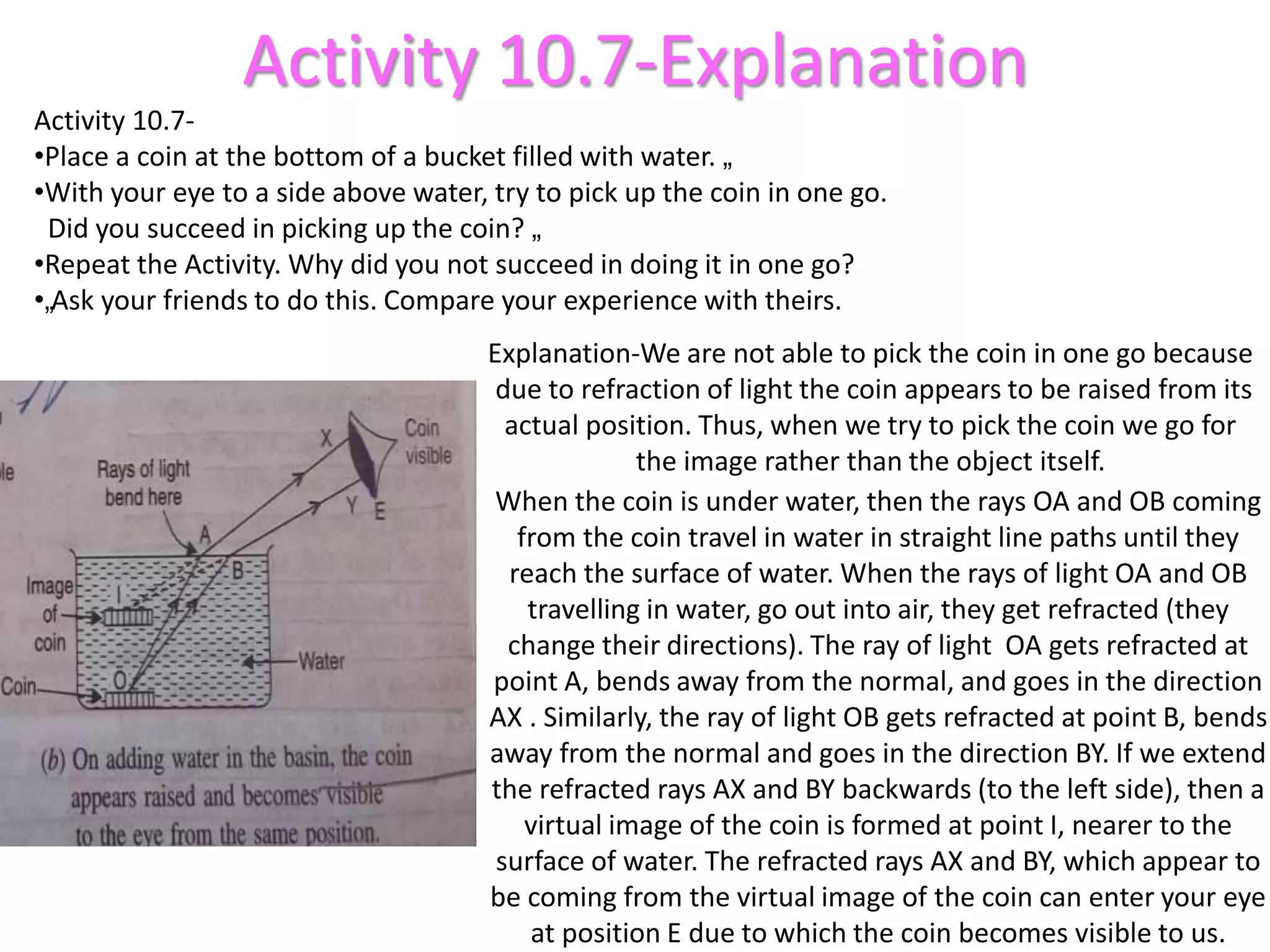
Explanation-We are not able to pick the coin in one go because
due to refraction of light the coin appears to be raised from its
actual position. Thus, when we try to pick the coin we go for
the image rather than the object itself.
When the coin is under water, then the rays OA and OB coming
from the coin travel in water in straight line paths until they
reach the surface of water. When the rays of light OA and OB
travelling in water, go out into air, they get refracted (they
change their directions). The ray of light OA gets refracted at
point A, bends away from the normal, and goes in the direction
AX . Similarly, the ray of light OB gets refracted at point B, bends
away from the normal and goes in the direction BY. If we extend
the refracted rays AX and BY backwards (to the left side), then a
virtual image of the coin is formed at point I, nearer to the
surface of water. The refracted rays AX and BY, which appear to
be coming from the virtual image of the coin can enter your eye
at position E due to which the coin becomes visible to us.
Activity 10.8-Explanation Activity 10.8-
•Place a large shallow bowl on a Table and put a coin in it. „
• Move away slowly from the bowl. Stop when the coin just disappears from your sight.
• „Ask a friend to pour water gently into the bowl without disturbing the coin.
•„Keep looking for the coin from your position. Does the coin becomes visible again from your position?
How could this happen?
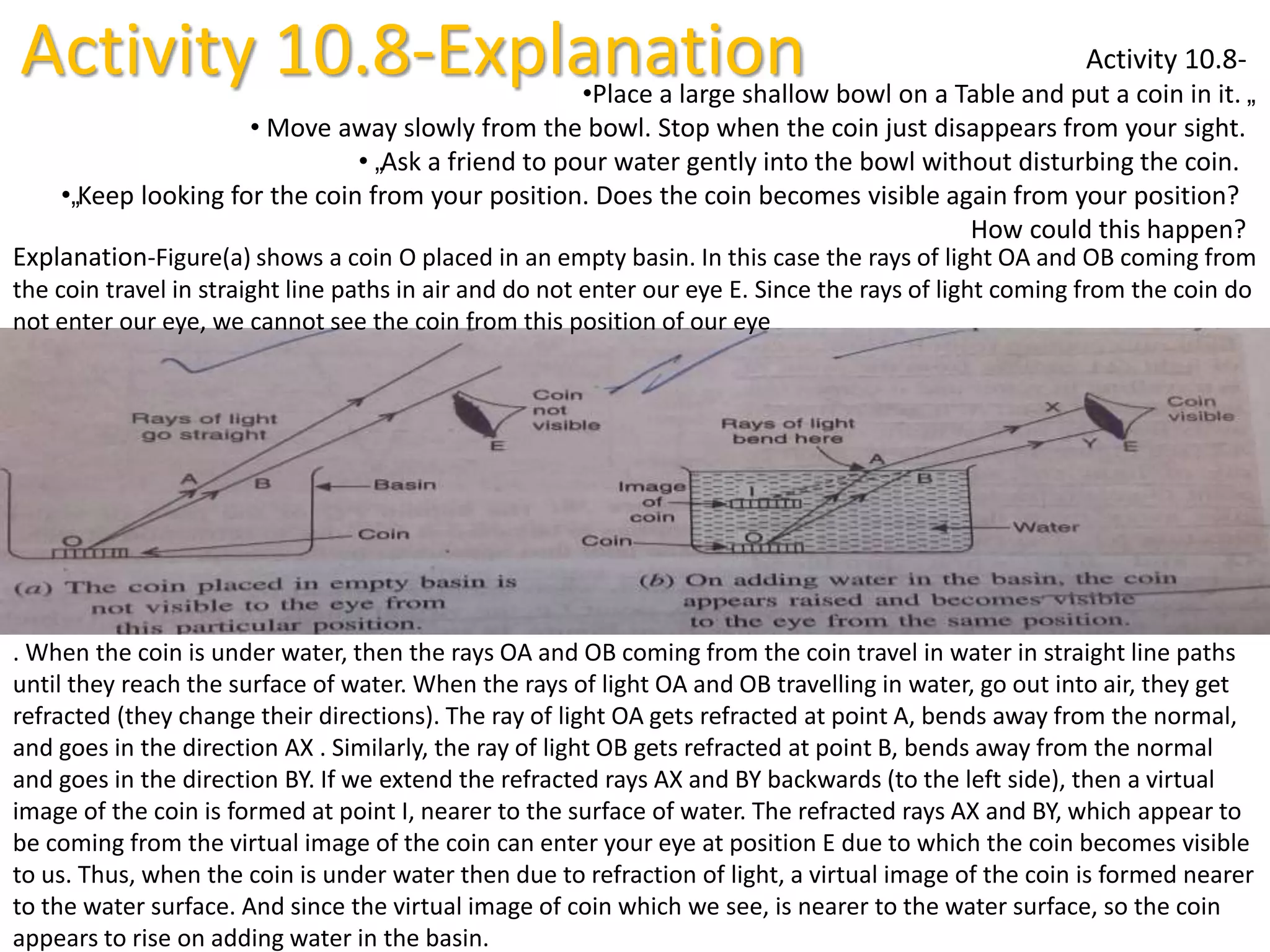
Explanation-Figure(a) shows a coin O placed in an empty basin. In this case the rays of light OA and OB coming from
the coin travel in straight line paths in air and do not enter our eye E. Since the rays of light coming from the coin do
not enter our eye, we cannot see the coin from this position of our eye
. When the coin is under water, then the rays OA and OB coming from the coin travel in water in straight line paths
until they reach the surface of water. When the rays of light OA and OB travelling in water, go out into air, they get
refracted (they change their directions). The ray of light OA gets refracted at point A, bends away from the normal,
and goes in the direction AX . Similarly, the ray of light OB gets refracted at point B, bends away from the normal
and goes in the direction BY. If we extend the refracted rays AX and BY backwards (to the left side), then a virtual
image of the coin is formed at point I, nearer to the surface of water. The refracted rays AX and BY, which appear to
be coming from the virtual image of the coin can enter your eye at position E due to which the coin becomes visible
to us. Thus, when the coin is under water then due to refraction of light, a virtual image of the coin is formed nearer
to the water surface. And since the virtual image of coin which we see, is nearer to the water surface, so the coin
appears to rise on adding water in the basin.
Activity 10.9-ExplanationActivity 10.9-
•Draw a thick straight line in ink, over a sheet of white paper placed on a Table. „
•Place a glass slab over the line in such a way that one of its edges makes an angle with the line.
•Look at the portion of the line under the slab from the sides. What do you observe? Does the line
under the glass slab appear to be bent at the edges? „
•Next, place the glass slab such that it is normal to the line. What do you observe now? Does the part
of the line under the glass slab appear bent? „
•Look at the line from the top of the glass slab. Does the part of the line, beneath the slab, appear to
be raised? Why does this happen?
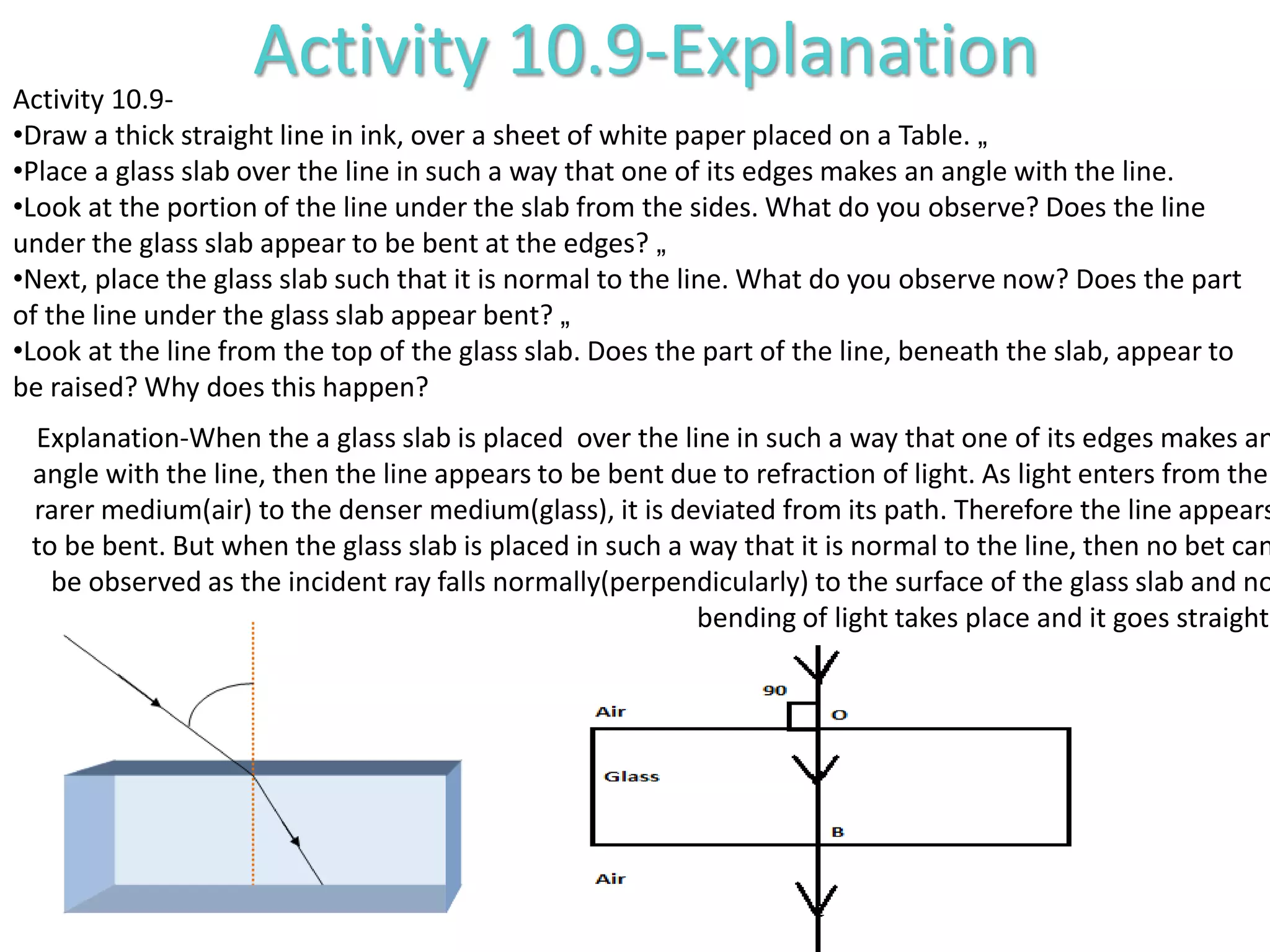
Explanation-When the a glass slab is placed over the line in such a way that one of its edges makes an
angle with the line, then the line appears to be bent due to refraction of light. As light enters from the
rarer medium(air) to the denser medium(glass), it is deviated from its path. Therefore the line appears
to be bent. But when the glass slab is placed in such a way that it is normal to the line, then no bet can
be observed as the incident ray falls normally(perpendicularly) to the surface of the glass slab and no
bending of light takes place and it goes straight.

Physics project

  • 1.
    Submitted By:- ChitwandeepKaur Palne Class- 10 C Roll No- 13
  • 2.
    Ques 1:-Why doesthe bottom of a tank or a pond appear to be raised? If we look into a tank or a pond of water, it appears to be less deep than it really is. This is due to the refraction of light which takes place when light rays pass the tank of water into the air. In the figure point O is any point at the bottom of this tank. Our eyes see this point by the light rays coming from it. Now, a ray of light OA coming from the point O is travelling in water and it comes out into the air at point A. It gets refracted away from the normal in the direction AX. Similarly, another ray of light 0B gets refracted. The two refracted rays AX and BY, when produced backwards meet at a point I underwater. So, point I is the virtual image of point O. The image I is nearer to the surface of water than the point O. Thus, a point O at the bottom of a pool appears to be much nearer at position I. EXPLAINATION WITH THE HELP OF A DIAGRAM:-
  • 3.
    Ques 2:- Whena thick glass slab is placed over some printed matter, why do the letters appear to be raised? The letters appear raised due to a phenomenon known as refraction. Refraction of light takes places when the light passes through glass into air. EXPLAINATION WITH THE HELP OF A DIAGRAM In the figure point O is any point on the sheet of printed paper. Our eyes see this point by the light rays coming from it. Now, a ray of light OA coming from the point O is travelling in glass and it comes out into the air at point A. It gets refracted away from the normal in the direction AX. Similarly, another ray of light 0B gets refracted. The two refracted rays AX and BY, when produced backwards meet at a point I underwater. So, point I is the virtual image of point O. The image I is nearer to the surface of glass than the point O. Thus, a point O on the sheet of printed material appears to be much nearer at position I.
  • 5.
    Ques 3:-Why doesa pencil partly immersed in water appears to be displaced at the interface of air and water? When you immerse a stick in water ,You are actually putting in from rarer medium to denser medium. When the rays of light pass from rarer medium to denser medium they move towards the normal. So the part of stick immersed in water appears to be broken towards the normal drawn at the interface. Hence a stick appears to bend when immersed in water EXPLAINATION WITH THE HELP OF A DIAGRAM:- The figure shows a pencil AO whose lower portion BO is immersed in water. The bent can be explained as follows:- A ray of light OC coming from the lower end O of the stick Passes from water into air at point c and gets refracted Away from the normal .Another ray of light OD gets Refracted in the direction DY. The two refracted rays CX And DY, when produced backwards, appear to meet at Point I, nearer to the water surface than point O. Thus, I is The virtual image of the end O of the pencil which is Formed by the refraction of light on going from water to air, Thus, an eye at position E sees the end O of the stick at position I which is nearer to the water surface.
  • 6.
    Ques 4:- Alemon kept in water in a glass tumbler appears to be bigger than its actual size. Why? This also happens due to refraction phenomenon. Light is refracted as it passes from water into the air. Once the light has crossed the interface between the two media, it continues to travel in a straight line. The direction of that line is different than it was in the former medium. Refraction creates a magnifying effect, so the lemon looks bigger and closer than its actual size and depth. The green rays indicate the normal path of the light rays in the absence of water in the tumbler. Now, when you fill it with water, the light ray originating at the lemon, while traveling from the dense medium (water) into the rare medium (air) will bend away from the normal, so the ray AC will actually not reach the eye any more. Instead, the ray AC' will suitably bend to reach the eye. Thus, to the eye, it will seem that the source of the ray coming from C' is not A but A', which will create the illusion of magnification. EXPLAINATION WITH THE HELP OF A DIAGRAM:-
  • 8.
    Activity 10.7-Explanation Activity 10.7- •Placea coin at the bottom of a bucket filled with water. „ •With your eye to a side above water, try to pick up the coin in one go. Did you succeed in picking up the coin? „ •Repeat the Activity. Why did you not succeed in doing it in one go? •„Ask your friends to do this. Compare your experience with theirs. Explanation-We are not able to pick the coin in one go because due to refraction of light the coin appears to be raised from its actual position. Thus, when we try to pick the coin we go for the image rather than the object itself. When the coin is under water, then the rays OA and OB coming from the coin travel in water in straight line paths until they reach the surface of water. When the rays of light OA and OB travelling in water, go out into air, they get refracted (they change their directions). The ray of light OA gets refracted at point A, bends away from the normal, and goes in the direction AX . Similarly, the ray of light OB gets refracted at point B, bends away from the normal and goes in the direction BY. If we extend the refracted rays AX and BY backwards (to the left side), then a virtual image of the coin is formed at point I, nearer to the surface of water. The refracted rays AX and BY, which appear to be coming from the virtual image of the coin can enter your eye at position E due to which the coin becomes visible to us.
  • 9.
    Activity 10.8-Explanation Activity10.8- •Place a large shallow bowl on a Table and put a coin in it. „ • Move away slowly from the bowl. Stop when the coin just disappears from your sight. • „Ask a friend to pour water gently into the bowl without disturbing the coin. •„Keep looking for the coin from your position. Does the coin becomes visible again from your position? How could this happen? Explanation-Figure(a) shows a coin O placed in an empty basin. In this case the rays of light OA and OB coming from the coin travel in straight line paths in air and do not enter our eye E. Since the rays of light coming from the coin do not enter our eye, we cannot see the coin from this position of our eye . When the coin is under water, then the rays OA and OB coming from the coin travel in water in straight line paths until they reach the surface of water. When the rays of light OA and OB travelling in water, go out into air, they get refracted (they change their directions). The ray of light OA gets refracted at point A, bends away from the normal, and goes in the direction AX . Similarly, the ray of light OB gets refracted at point B, bends away from the normal and goes in the direction BY. If we extend the refracted rays AX and BY backwards (to the left side), then a virtual image of the coin is formed at point I, nearer to the surface of water. The refracted rays AX and BY, which appear to be coming from the virtual image of the coin can enter your eye at position E due to which the coin becomes visible to us. Thus, when the coin is under water then due to refraction of light, a virtual image of the coin is formed nearer to the water surface. And since the virtual image of coin which we see, is nearer to the water surface, so the coin appears to rise on adding water in the basin.
  • 11.
    Activity 10.9-ExplanationActivity 10.9- •Drawa thick straight line in ink, over a sheet of white paper placed on a Table. „ •Place a glass slab over the line in such a way that one of its edges makes an angle with the line. •Look at the portion of the line under the slab from the sides. What do you observe? Does the line under the glass slab appear to be bent at the edges? „ •Next, place the glass slab such that it is normal to the line. What do you observe now? Does the part of the line under the glass slab appear bent? „ •Look at the line from the top of the glass slab. Does the part of the line, beneath the slab, appear to be raised? Why does this happen? Explanation-When the a glass slab is placed over the line in such a way that one of its edges makes an angle with the line, then the line appears to be bent due to refraction of light. As light enters from the rarer medium(air) to the denser medium(glass), it is deviated from its path. Therefore the line appears to be bent. But when the glass slab is placed in such a way that it is normal to the line, then no bet can be observed as the incident ray falls normally(perpendicularly) to the surface of the glass slab and no bending of light takes place and it goes straight.