KENDRIYA VIDYALAYA, ANDAL
PHYSICS INVESTIGATORY PROJECT
2022-2023
Topic: To find the refractive indices of (a) water (b) oil (transparent) using a
plane mirror, an equiconvex lens ( made from a glass of known refractive
index) and an adjustable object needle.
Guided By : Mr. Rakesh Kumar Choudhary sir
Submitted by : Bisakha Lall
CONTENTS
1. Certificate
2. Acknowledgement
3. Introduction
4. Aim
5. Apparatus
6. Diagram
7. Theory
8. Procedure
9. Observations
10. Calculations
11. Results
12. Precautions
13. Sources of error
14. Bibliography
CERTIFICATE
This is to certify that Bisakha Lall of class 12, Kendriya Vidyalaya
Andal has successfully completed the project on the topic “To find
the refractive indices of (a) water (b) oil (transparent) using a plane
mirror, an equiconvex lens ( made from a glass of known refractive
index) and an adjustable object needle.” under the guidance of Mr.
Rakesh Kumar Choudhary sir in session 2022-2023
Internal Examiner External Examiner
Principal
ACKNOWLEDGEMENT
I would like to thank the CBSE, for providing me the
opportunity to carry out the investigatory project. I also take
this opportunity to express my sincere gratitude to my
physics teacher Mr. Rakesh Kumar Choudhary sir for guiding
me and improving a sound base of knowledge pertaining to this
project which ensures the successful completion of this
project.I wish to express my great thank to my Principal Mr.
Sanjay Singh Sengar who helped me to accomplish this
project by providing me all necessary facilities and support.
INTRODUCTION
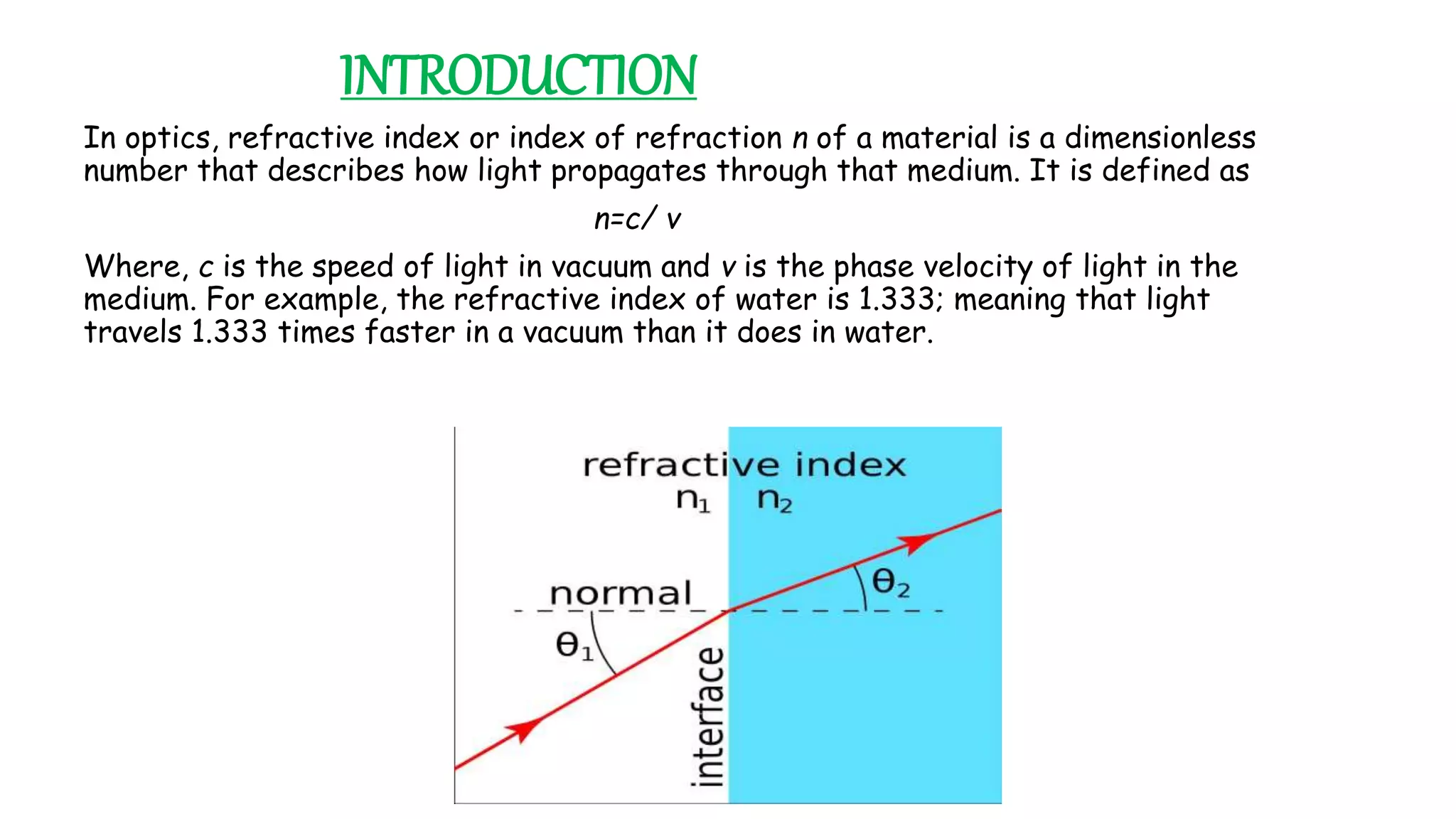
In optics, refractive index or index of refraction n of a material is a dimensionless
number that describes how light propagates through that medium. It is defined as
n=c/ v
Where, c is the speed of light in vacuum and v is the phase velocity of light in the
medium. For example, the refractive index of water is 1.333; meaning that light
travels 1.333 times faster in a vacuum than it does in water.
APPARATUS
1. Convex lens
2. Plane water
3. Water
4. Oil
5. Clamp Stand
6. An optical needle
7. Plumb line
8. Knitting needle
9. Half meter scale
10. Glass slab
11. Spherometer
DIAGRAM
THEORY
• If f1 and f2 be the focal length of the glass convex lens and
liquid lens and f be the focal length of their combination then:-
1/f = 1/f2 + 1/f2 or f2= f. f2/ f1- f
• Liquid Lena formed a Plano- concave lens with R1= R and R2=
infinity then by using lens Maker’s formula
1/f2= (n-1) [1/R1- 1/R2]
= (n-1) [1/R1 – 1/infinity]
= (n-1)[ 1/R -0]
1/f2= n-1/ R
n= R/f2+1
Where n = refractive index of the liquid
R = the radius of the curvature of the convex lens.
• The radius of the lower surface of the convex lens is given by:-
R = l²/6h + h/2
Here, l is the average distance between the legs of the
spherometer and h is the difference in the reading of the
spherometer when placed first on the convex lens and then on
plane mirror.
PROCEDURE
(a) For focal length of convex lens:-
1. Find the rough focal length of the convex lens.
2. Place a plane mirror on the horizontal base of the iron stand and
then a convex lens on the plane mirror.
3. Hold the needle in the clamp stand and adjust its position on the
stand such that there is no parallax between tip of the needle and
its image.
4. Measure distance between tip and upper surface of the lens by using
a plumb line and half meter scale. Also measure the distance
between tip of needle and upper surface of the mirror. Take the
mean of the two readings. This means distance will be equal to the
focal length of the convex lens (f1).
(b) For focal length of the combination:-
5.Put a few drops of the water on the plane mirror and put
the convex lens over it with its same face above as before.
The water spreads in a form of layer and acts like a Plano-
concave lens.
6. Repeat the steps 3 and 4 to determine the equivalent focal
length of the combination
7. Record the observation.
8. Repeat the steps 5,6,7 for other transparent liquid (oil).
(c) For radius of curvature of convex lens surface:-
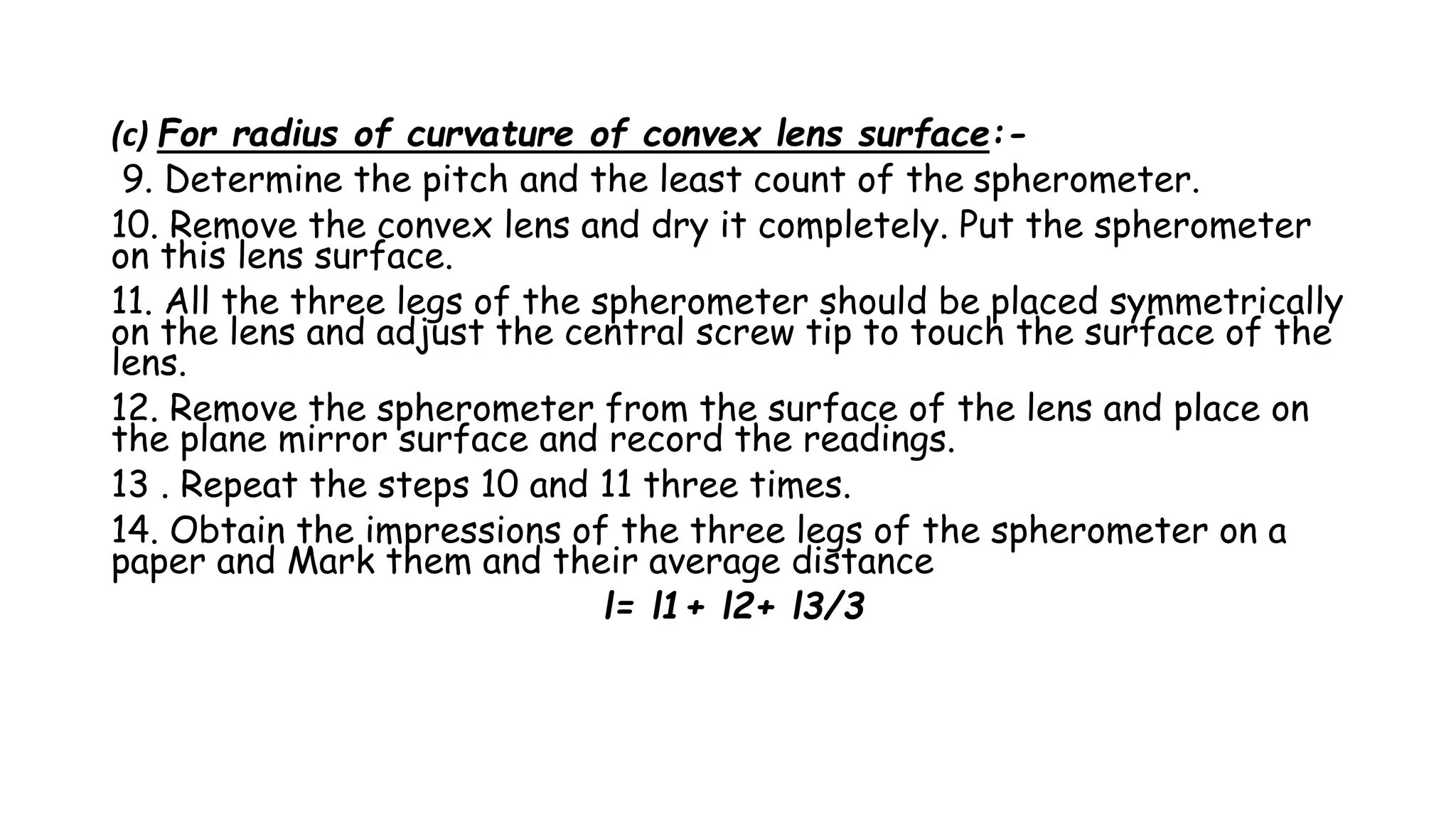
9. Determine the pitch and the least count of the spherometer.
10. Remove the convex lens and dry it completely. Put the spherometer
on this lens surface.
11. All the three legs of the spherometer should be placed symmetrically
on the lens and adjust the central screw tip to touch the surface of the
lens.
12. Remove the spherometer from the surface of the lens and place on
the plane mirror surface and record the readings.
13 . Repeat the steps 10 and 11 three times.
14. Obtain the impressions of the three legs of the spherometer on a
paper and Mark them and their average distance
l= l1+ l2+ l3/3
OBSERVATIONS
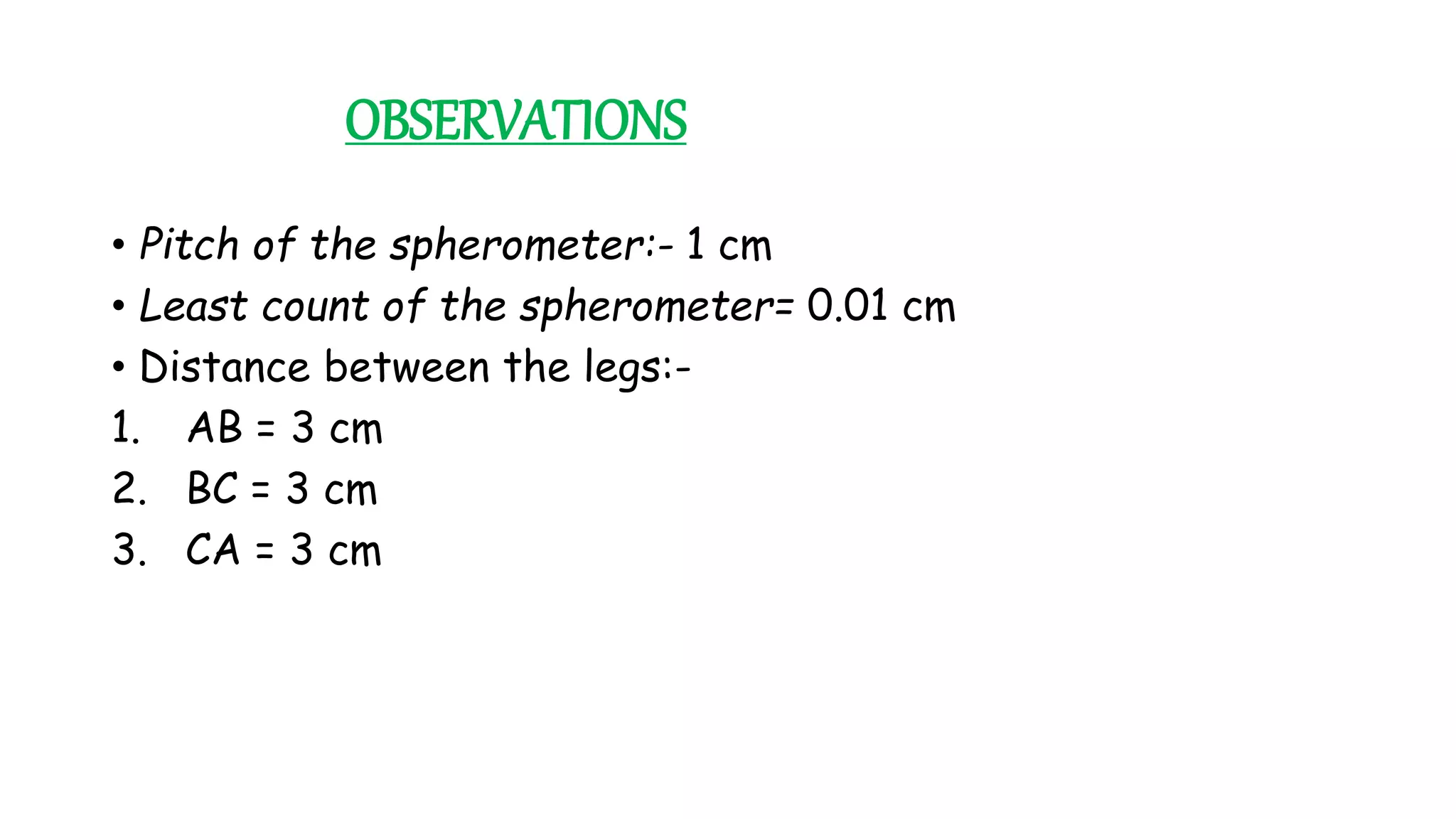
• Pitch of the spherometer:- 1 cm
• Least count of the spherometer= 0.01 cm
• Distance between the legs:-
1. AB = 3 cm
2. BC = 3 cm
3. CA = 3 cm
CALCULATIONS
• Mean distance between two legs:-
l= AB + BC + CA/3 = 3 cm
• Mean of h = (0.555+0.6)/2 = 0.5755 cm
• To find the radius of curvature of the convex lens:-
R = l²/6h + h/2 = 2.8861 cm
• Measurement of refractive indices of water and oil:-
a) With water between the convex lens and the plane mirror.
μ1 = 1 + R/ f2 = 1 + 2.8861/34.7 = 1.0831
b) With oil between the convex lens and the plane mirror
μ2= 1+ R/ f3 = 1 + 2.8861/10 = 1.2886
RESULTS
• The refractive index of water is μ1 = 1.0831
• The refractive index of oil is μ1 = 1.2886
PRECAUTIONS
1. The plane mirror should be clean and fully shining surface
2. The liquid taken should be transparent.
3. The parallax should be removed tip to tip.
4. The eye should be at a distance about 30 cm from the needle
while removing the parallax.
5. Only few drops of liquid should be taken so that its layer
should be thick.
6. The legs of the spherometer should be vertical.
7. The centre leg of the spherometer should turn in one direction
only.
SOURCES OF ERROR
1. Liquid may not be quite transparent.
2. The parallax may not be fully removed.
3. The spherometer legs should be placed symmetrical on the
surface of the convex lens.
4. The tip of the central screw should not just touch the
surface of lens or mirror.
BIBLIOGRAPHY
• www.wikipedia.org
• www.slideshare.net
• www.scribd.com
• Physics lab manual.
• NCERT physics textbook class XII
THANK YOU!

Physics investigatory project.pptx

  • 1.
    KENDRIYA VIDYALAYA, ANDAL PHYSICSINVESTIGATORY PROJECT 2022-2023 Topic: To find the refractive indices of (a) water (b) oil (transparent) using a plane mirror, an equiconvex lens ( made from a glass of known refractive index) and an adjustable object needle. Guided By : Mr. Rakesh Kumar Choudhary sir Submitted by : Bisakha Lall
  • 2.
    CONTENTS 1. Certificate 2. Acknowledgement 3.Introduction 4. Aim 5. Apparatus 6. Diagram 7. Theory 8. Procedure 9. Observations 10. Calculations 11. Results 12. Precautions 13. Sources of error 14. Bibliography
  • 3.
    CERTIFICATE This is tocertify that Bisakha Lall of class 12, Kendriya Vidyalaya Andal has successfully completed the project on the topic “To find the refractive indices of (a) water (b) oil (transparent) using a plane mirror, an equiconvex lens ( made from a glass of known refractive index) and an adjustable object needle.” under the guidance of Mr. Rakesh Kumar Choudhary sir in session 2022-2023 Internal Examiner External Examiner Principal
  • 4.
    ACKNOWLEDGEMENT I would liketo thank the CBSE, for providing me the opportunity to carry out the investigatory project. I also take this opportunity to express my sincere gratitude to my physics teacher Mr. Rakesh Kumar Choudhary sir for guiding me and improving a sound base of knowledge pertaining to this project which ensures the successful completion of this project.I wish to express my great thank to my Principal Mr. Sanjay Singh Sengar who helped me to accomplish this project by providing me all necessary facilities and support.
  • 5.
    INTRODUCTION In optics, refractiveindex or index of refraction n of a material is a dimensionless number that describes how light propagates through that medium. It is defined as n=c/ v Where, c is the speed of light in vacuum and v is the phase velocity of light in the medium. For example, the refractive index of water is 1.333; meaning that light travels 1.333 times faster in a vacuum than it does in water.
  • 6.
    APPARATUS 1. Convex lens 2.Plane water 3. Water 4. Oil 5. Clamp Stand 6. An optical needle 7. Plumb line 8. Knitting needle 9. Half meter scale 10. Glass slab 11. Spherometer
  • 7.
  • 8.
    THEORY • If f1and f2 be the focal length of the glass convex lens and liquid lens and f be the focal length of their combination then:- 1/f = 1/f2 + 1/f2 or f2= f. f2/ f1- f • Liquid Lena formed a Plano- concave lens with R1= R and R2= infinity then by using lens Maker’s formula 1/f2= (n-1) [1/R1- 1/R2] = (n-1) [1/R1 – 1/infinity] = (n-1)[ 1/R -0] 1/f2= n-1/ R
  • 9.
    n= R/f2+1 Where n= refractive index of the liquid R = the radius of the curvature of the convex lens. • The radius of the lower surface of the convex lens is given by:- R = l²/6h + h/2 Here, l is the average distance between the legs of the spherometer and h is the difference in the reading of the spherometer when placed first on the convex lens and then on plane mirror.
  • 10.
    PROCEDURE (a) For focallength of convex lens:- 1. Find the rough focal length of the convex lens. 2. Place a plane mirror on the horizontal base of the iron stand and then a convex lens on the plane mirror. 3. Hold the needle in the clamp stand and adjust its position on the stand such that there is no parallax between tip of the needle and its image. 4. Measure distance between tip and upper surface of the lens by using a plumb line and half meter scale. Also measure the distance between tip of needle and upper surface of the mirror. Take the mean of the two readings. This means distance will be equal to the focal length of the convex lens (f1).
  • 11.
    (b) For focallength of the combination:- 5.Put a few drops of the water on the plane mirror and put the convex lens over it with its same face above as before. The water spreads in a form of layer and acts like a Plano- concave lens. 6. Repeat the steps 3 and 4 to determine the equivalent focal length of the combination 7. Record the observation. 8. Repeat the steps 5,6,7 for other transparent liquid (oil).
  • 12.
    (c) For radiusof curvature of convex lens surface:- 9. Determine the pitch and the least count of the spherometer. 10. Remove the convex lens and dry it completely. Put the spherometer on this lens surface. 11. All the three legs of the spherometer should be placed symmetrically on the lens and adjust the central screw tip to touch the surface of the lens. 12. Remove the spherometer from the surface of the lens and place on the plane mirror surface and record the readings. 13 . Repeat the steps 10 and 11 three times. 14. Obtain the impressions of the three legs of the spherometer on a paper and Mark them and their average distance l= l1+ l2+ l3/3
  • 13.
    OBSERVATIONS • Pitch ofthe spherometer:- 1 cm • Least count of the spherometer= 0.01 cm • Distance between the legs:- 1. AB = 3 cm 2. BC = 3 cm 3. CA = 3 cm
  • 14.
    CALCULATIONS • Mean distancebetween two legs:- l= AB + BC + CA/3 = 3 cm • Mean of h = (0.555+0.6)/2 = 0.5755 cm • To find the radius of curvature of the convex lens:- R = l²/6h + h/2 = 2.8861 cm • Measurement of refractive indices of water and oil:- a) With water between the convex lens and the plane mirror. μ1 = 1 + R/ f2 = 1 + 2.8861/34.7 = 1.0831 b) With oil between the convex lens and the plane mirror μ2= 1+ R/ f3 = 1 + 2.8861/10 = 1.2886
  • 15.
    RESULTS • The refractiveindex of water is μ1 = 1.0831 • The refractive index of oil is μ1 = 1.2886
  • 16.
    PRECAUTIONS 1. The planemirror should be clean and fully shining surface 2. The liquid taken should be transparent. 3. The parallax should be removed tip to tip. 4. The eye should be at a distance about 30 cm from the needle while removing the parallax. 5. Only few drops of liquid should be taken so that its layer should be thick. 6. The legs of the spherometer should be vertical. 7. The centre leg of the spherometer should turn in one direction only.
  • 17.
    SOURCES OF ERROR 1.Liquid may not be quite transparent. 2. The parallax may not be fully removed. 3. The spherometer legs should be placed symmetrical on the surface of the convex lens. 4. The tip of the central screw should not just touch the surface of lens or mirror.
  • 18.
    BIBLIOGRAPHY • www.wikipedia.org • www.slideshare.net •www.scribd.com • Physics lab manual. • NCERT physics textbook class XII
  • 19.