Sheet Metal Testing Challenges
2
Table of Contents
• Sheet Metal Key Industries
• Challenges of Testing Stronger Material
• Challenges Determining Formability Properties
• Extensometer Selection
• Effect of Efficiency
3
Sheet Metal Industries
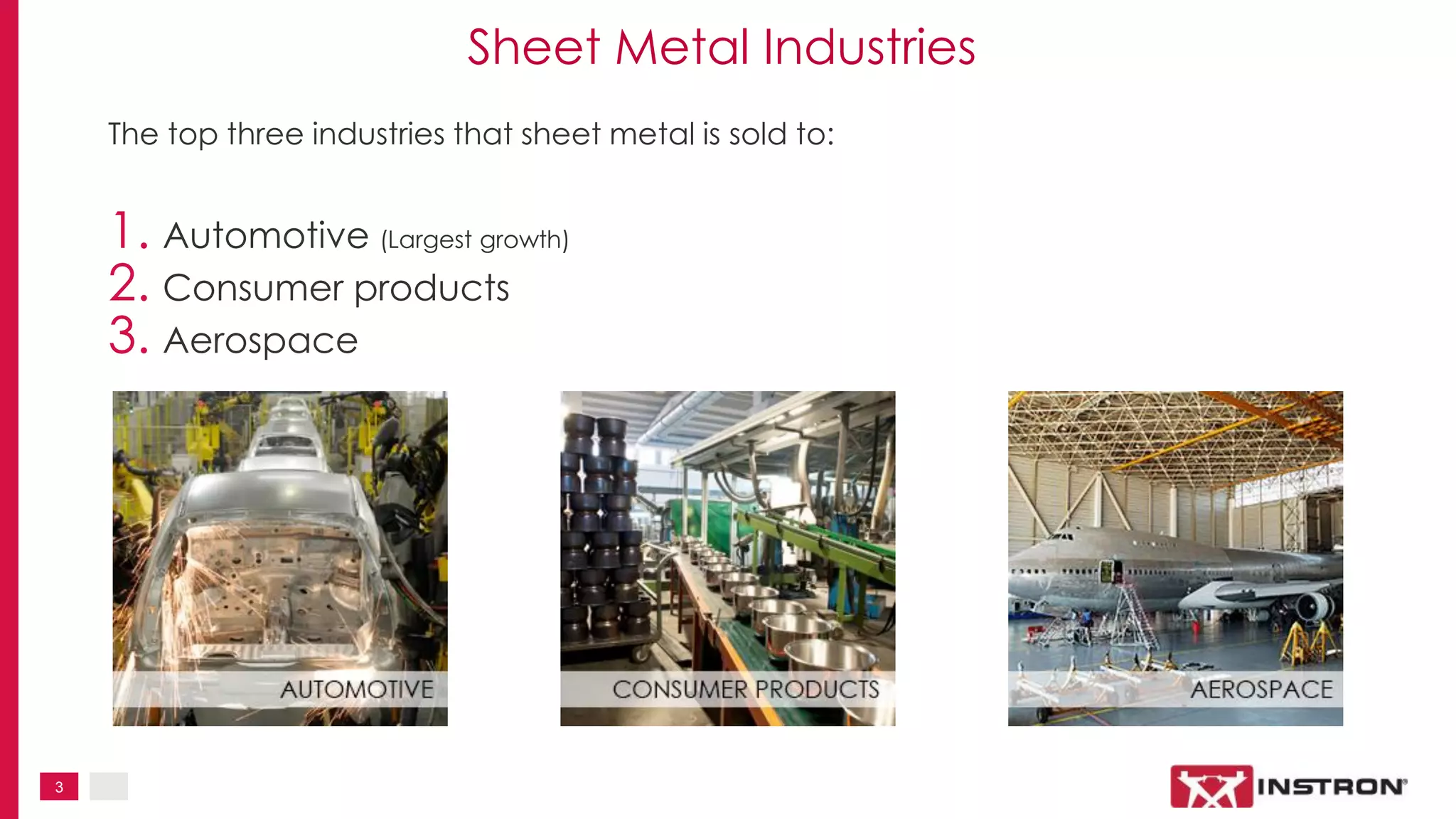
The top three industries that sheet metal is sold to:
1. Automotive (Largest growth)
2. Consumer products
3. Aerospace
4
Automotive Sheet Metal Industry Summary
• Reduce Emissions
• The metals industry is producing stronger material than ever before!
• Competition from Composite Material to Replace Metal
• Formability is a key differentiator for metals
• Increasing strength attempts to minimize composite material benefits
• Aluminum ‘Taking’ Traditional Steel Market Share
• Increased testing scrutiny from Automotive OEMs
• GROWTH!
• Growth = More metal needed = More testing required
E F
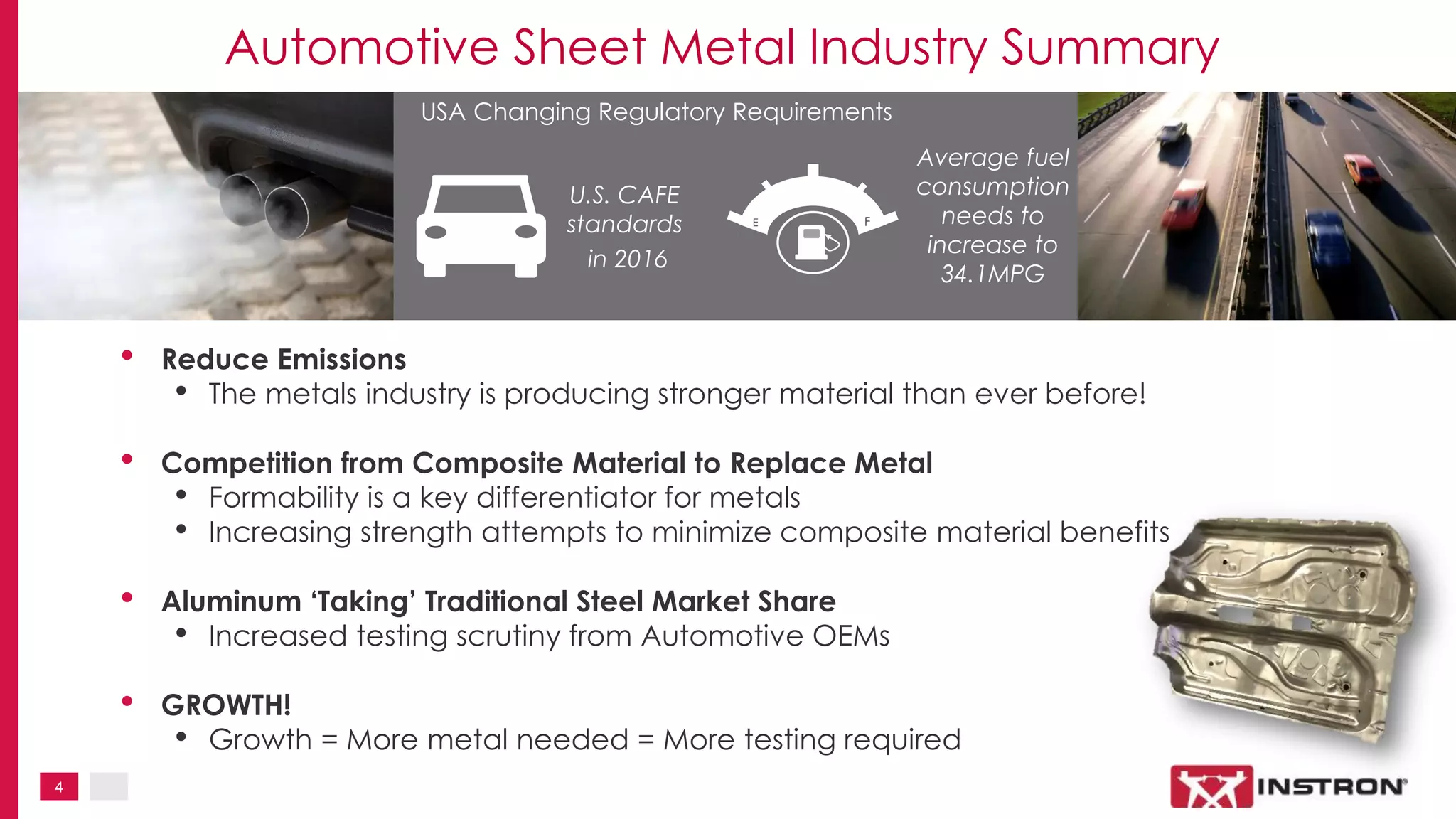
USA Changing Regulatory Requirements
U.S. CAFE
standards
in 2016
Average fuel
consumption
needs to
increase to
34.1MPG
E F
USA Changing Regulatory Requirements
U.S. CAFE
standards
in 2016
Average fuel
consumption
needs to
increase to
34.1MPG
5
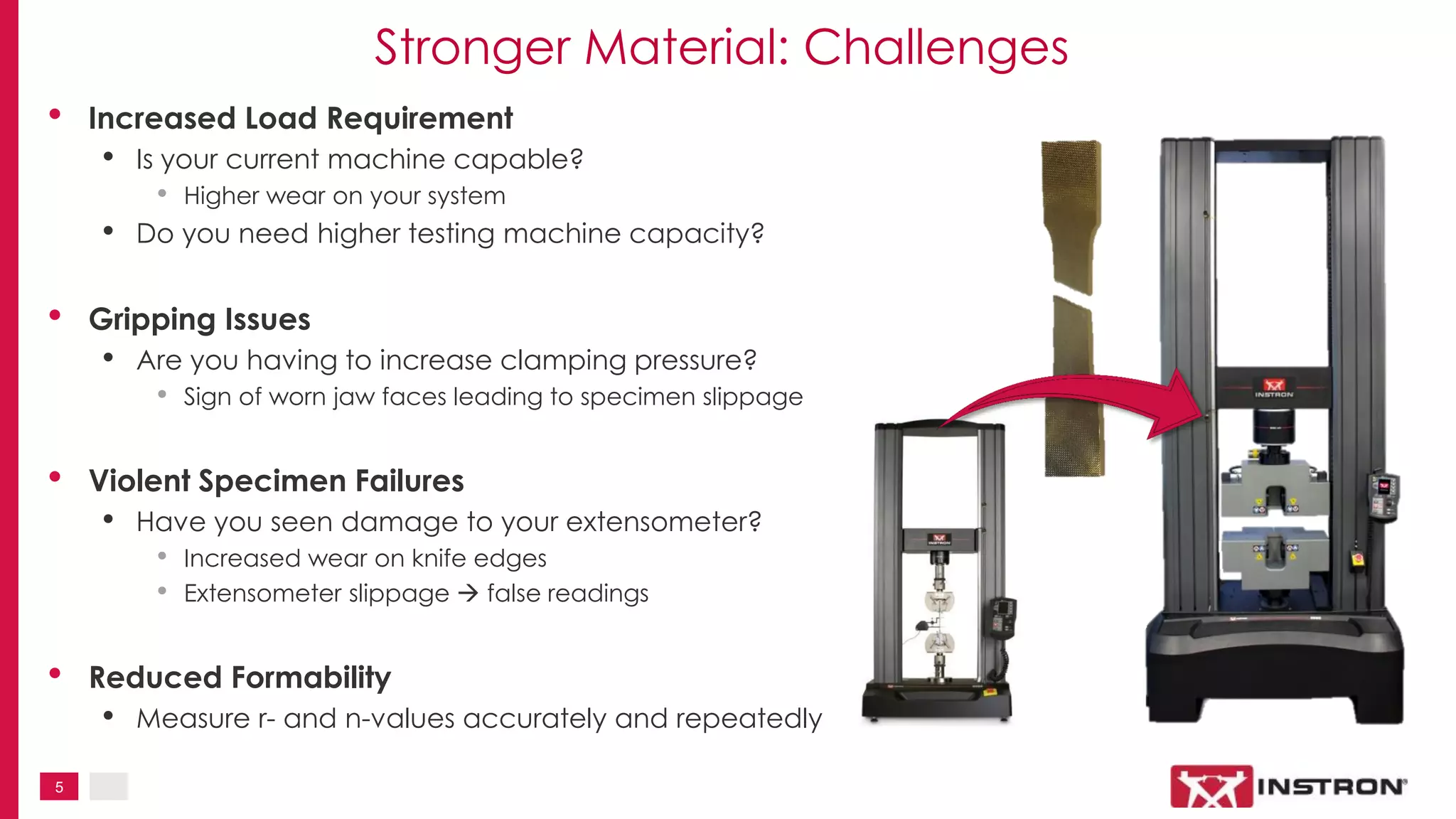
Stronger Material: Challenges
• Increased Load Requirement
• Is your current machine capable?
• Higher wear on your system
• Do you need higher testing machine capacity?
• Gripping Issues
• Are you having to increase clamping pressure?
• Sign of worn jaw faces leading to specimen slippage
• Violent Specimen Failures
• Have you seen damage to your extensometer?
• Increased wear on knife edges
• Extensometer slippage  false readings
• Reduced Formability
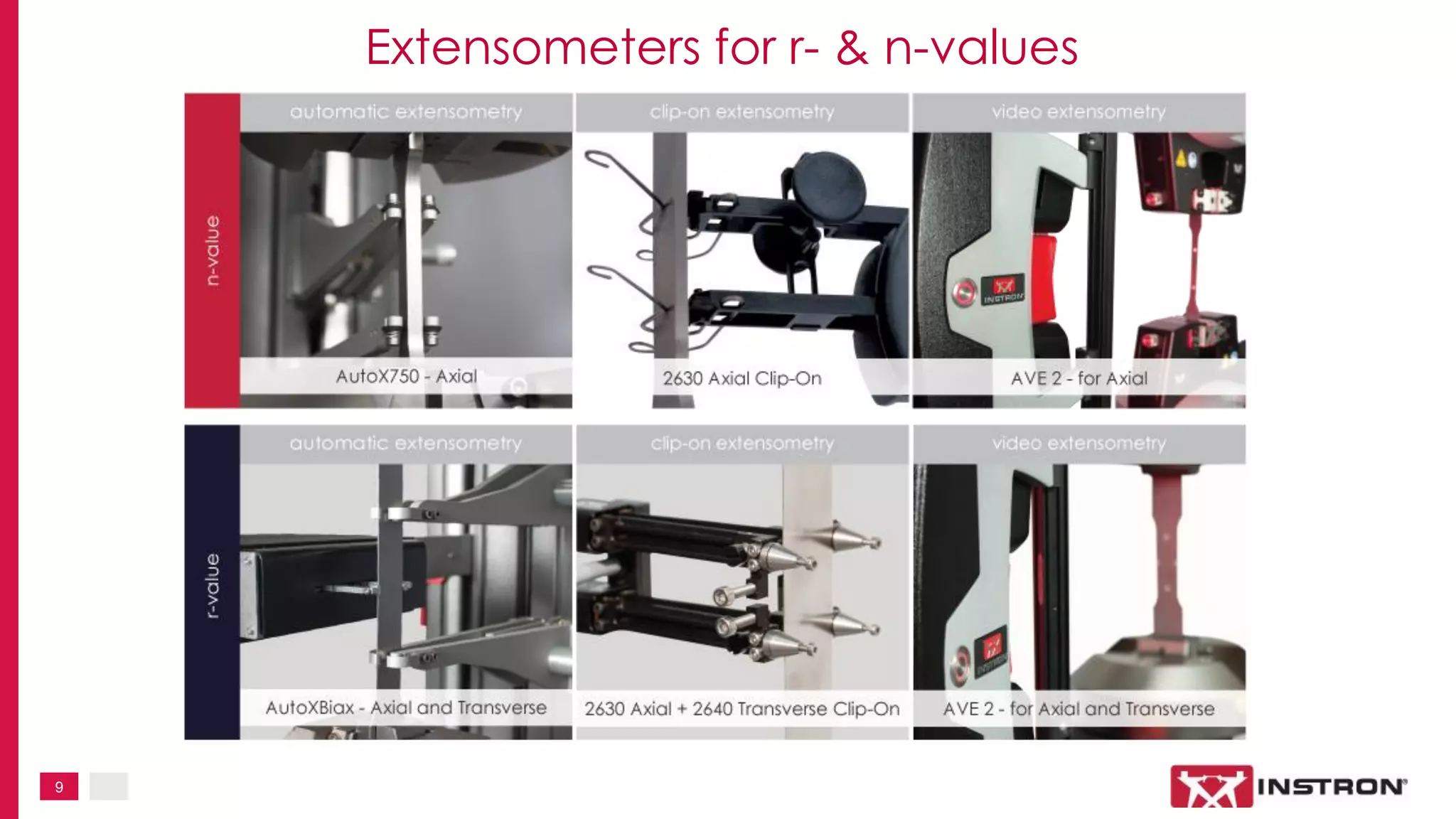
• Measure r- and n-values accurately and repeatedly
6
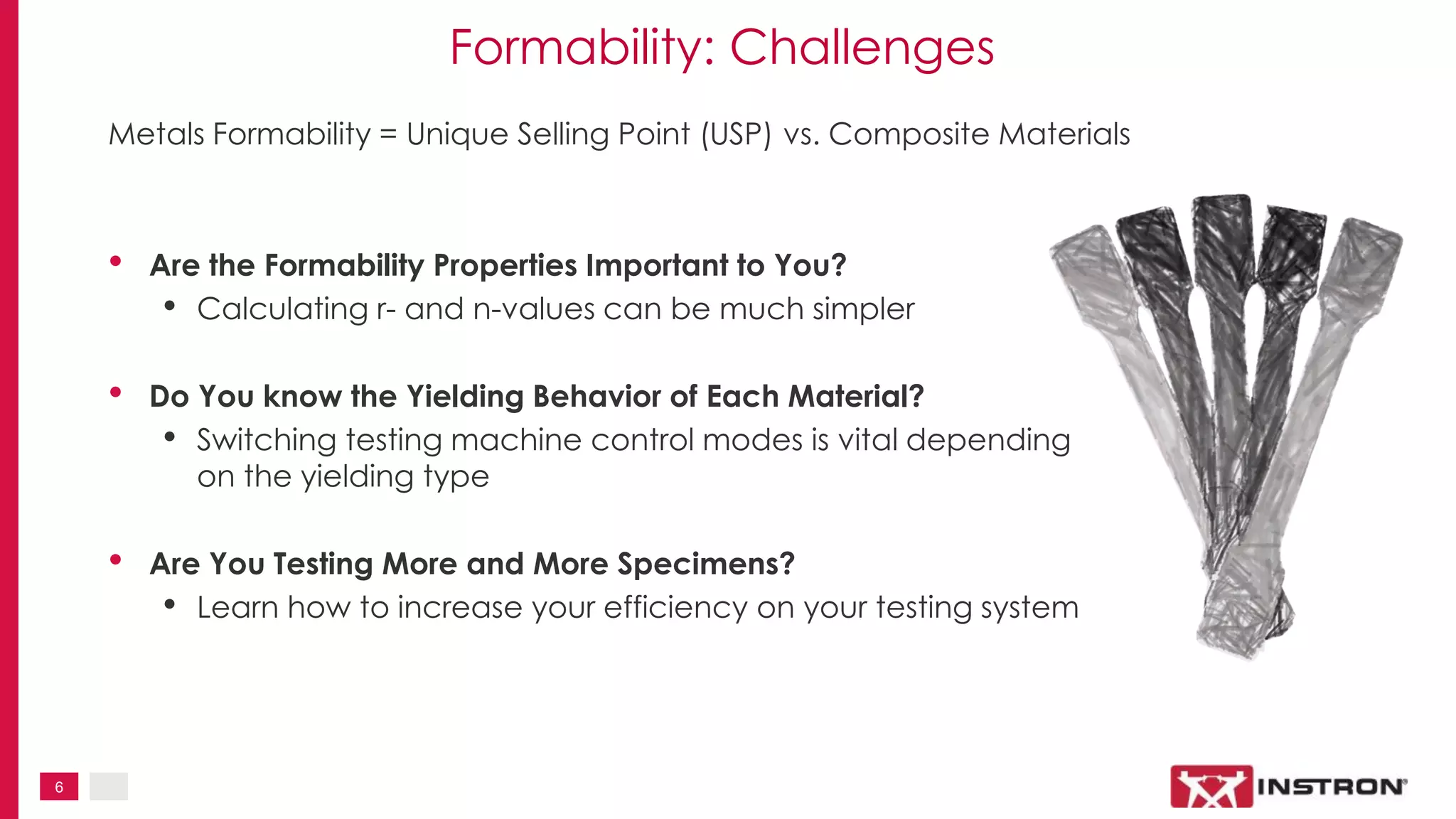
Formability: Challenges
Metals Formability = Unique Selling Point (USP) vs. Composite Materials
• Are the Formability Properties Important to You?
• Calculating r- and n-values can be much simpler
• Do You know the Yielding Behavior of Each Material?
• Switching testing machine control modes is vital depending
on the yielding type
• Are You Testing More and More Specimens?
• Learn how to increase your efficiency on your testing system
7
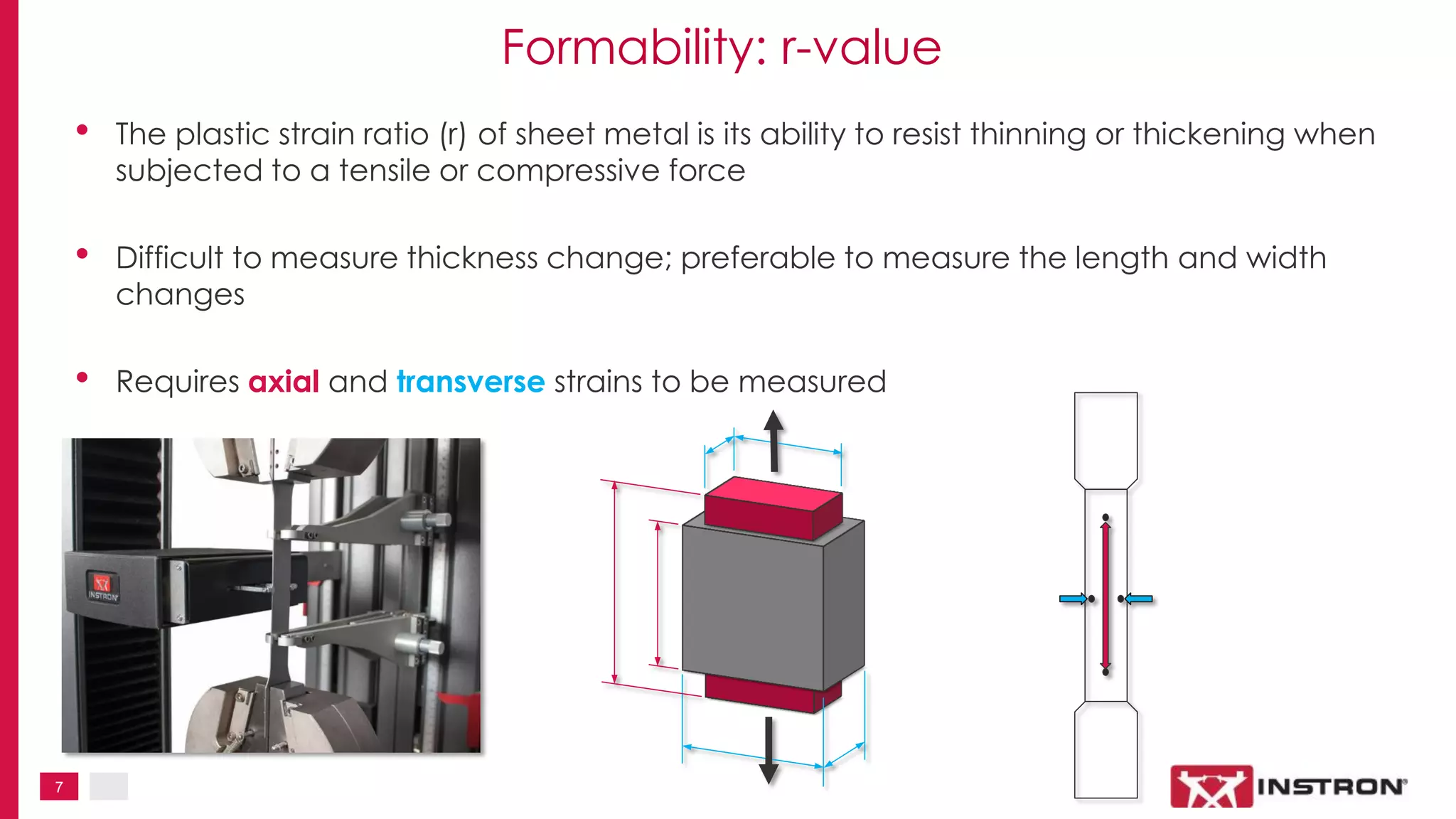
Formability: r-value
• The plastic strain ratio (r) of sheet metal is its ability to resist thinning or thickening when
subjected to a tensile or compressive force
• Difficult to measure thickness change; preferable to measure the length and width
changes
• Requires axial and transverse strains to be measured
8
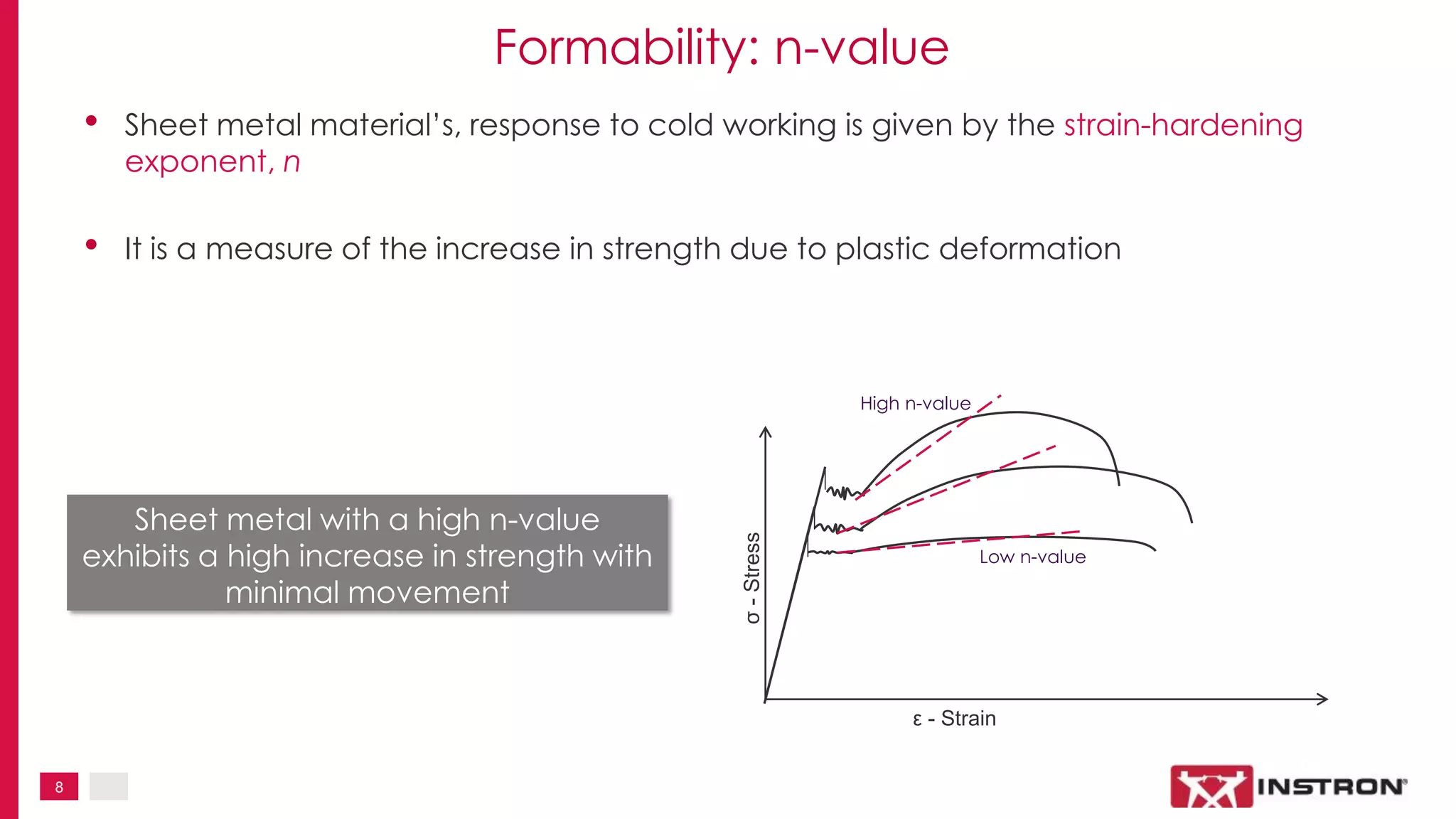
Formability: n-value
• Sheet metal material’s, response to cold working is given by the strain-hardening
exponent, n
• It is a measure of the increase in strength due to plastic deformation
Sheet metal with a high n-value
exhibits a high increase in strength with
minimal movement
σ-Stress
ε - Strain
High n-value
Low n-value
9
Extensometers for r- & n-values
10
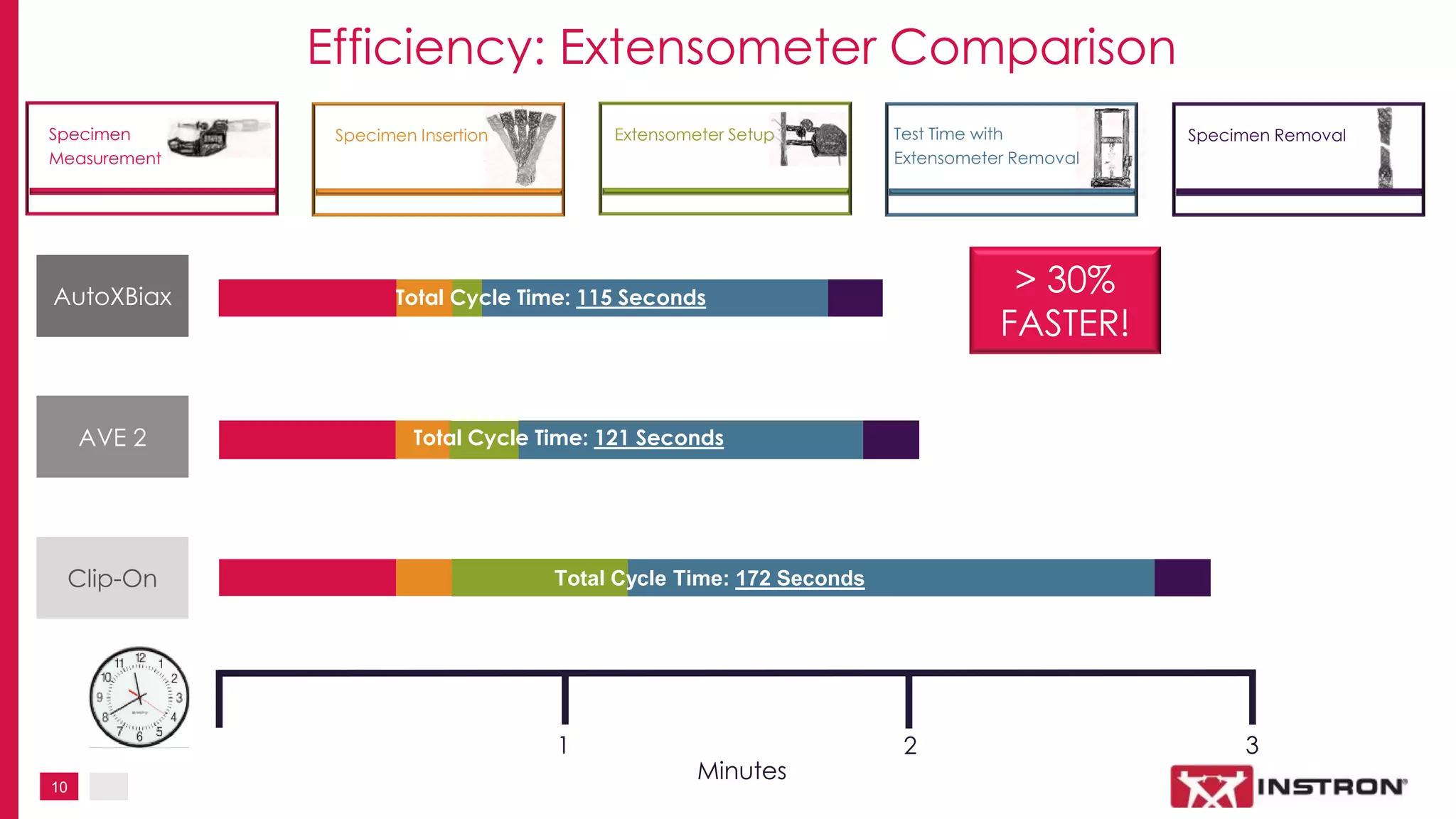
Efficiency: Extensometer Comparison
Specimen
Measurement
Minutes
1 2 3
AutoXBiax
Clip-On
> 30%
FASTER!
Specimen Insertion Extensometer Setup Test Time with
Extensometer Removal
Specimen Removal
Total Cycle Time: 172 Seconds
AVE 2 Total Cycle Time: 121 Seconds
Total Cycle Time: 115 Seconds
11
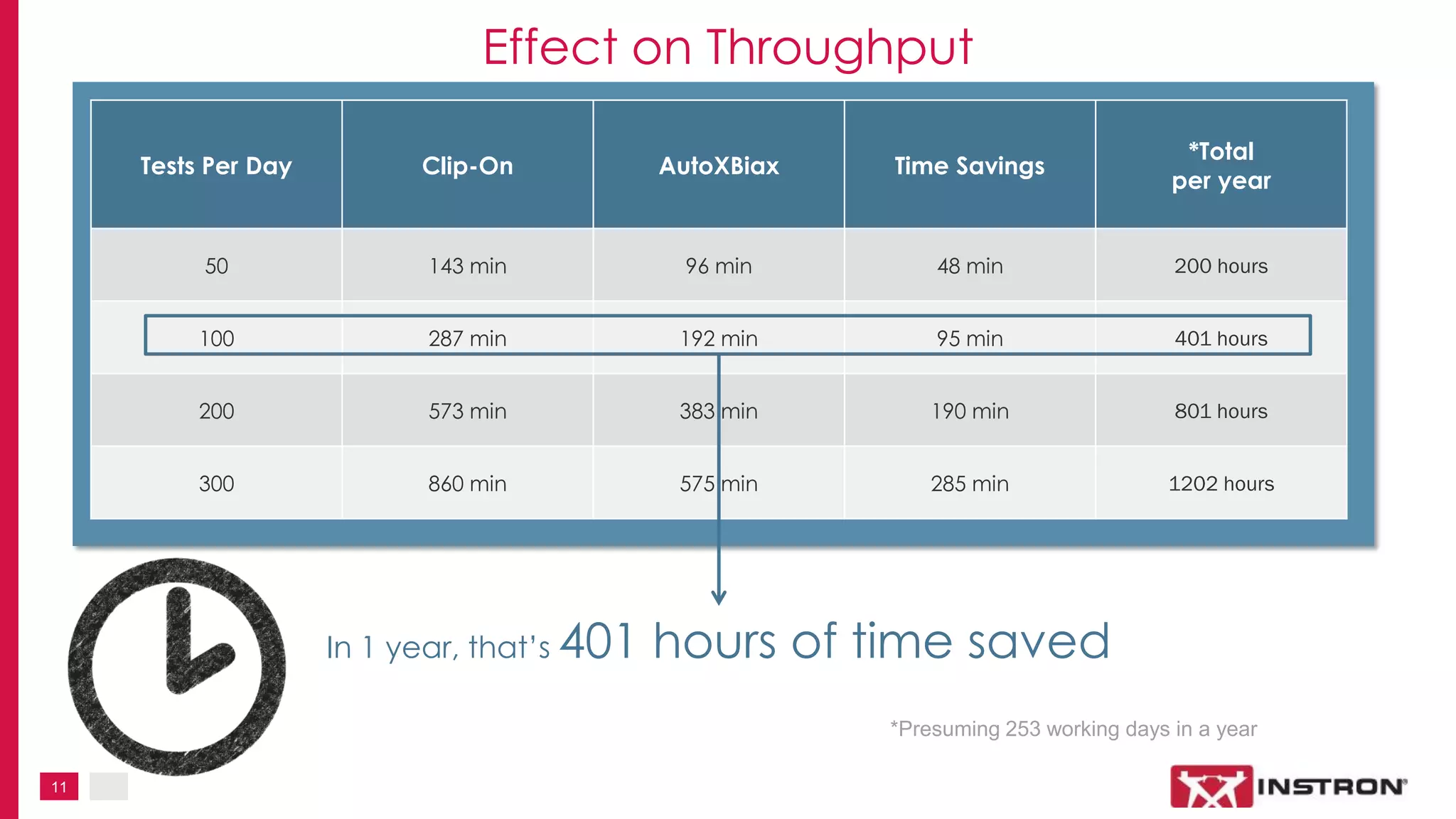
Tests Per Day Clip-On AutoXBiax Time Savings
*Total
per year
50 143 min 96 min 48 min 200 hours
100 287 min 192 min 95 min 401 hours
200 573 min 383 min 190 min 801 hours
300 860 min 575 min 285 min 1202 hours
Effect on Throughput
*Presuming 253 working days in a year
In 1 year, that’s 401 hours of time saved
12
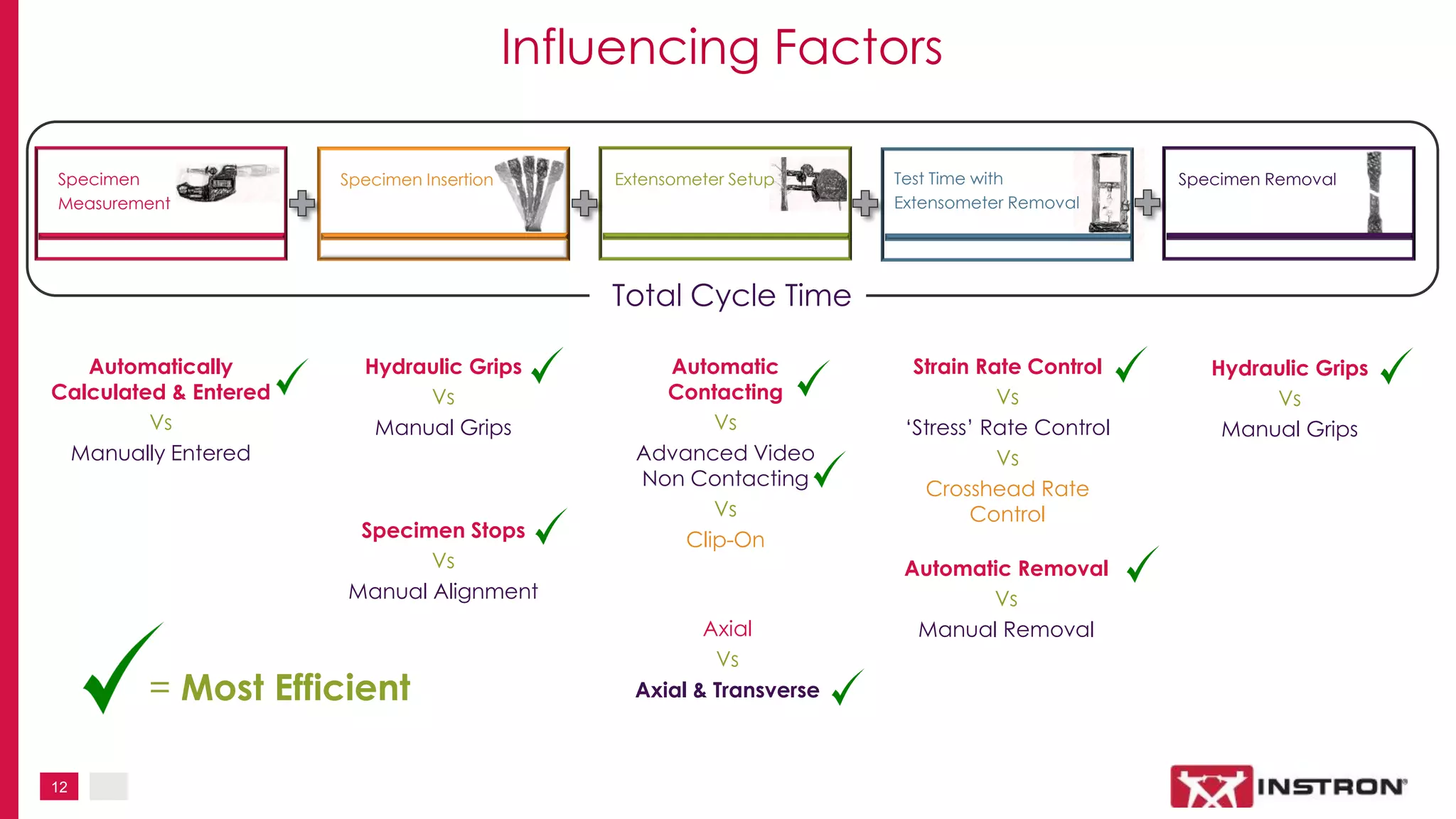
Influencing Factors
Specimen
Measurement
Specimen Insertion Extensometer Setup Test Time with
Extensometer Removal
Specimen Removal
Automatically
Calculated & Entered
Vs
Manually Entered
Hydraulic Grips
Vs
Manual Grips
Specimen Stops
Vs
Manual Alignment
Automatic
Contacting
Vs
Advanced Video
Non Contacting
Vs
Clip-On
Axial
Vs
Axial & Transverse
Strain Rate Control
Vs
‘Stress’ Rate Control
Vs
Crosshead Rate
Control
Hydraulic Grips
Vs
Manual Grips
= Most Efficient
Total Cycle Time
Automatic Removal
Vs
Manual Removal
13
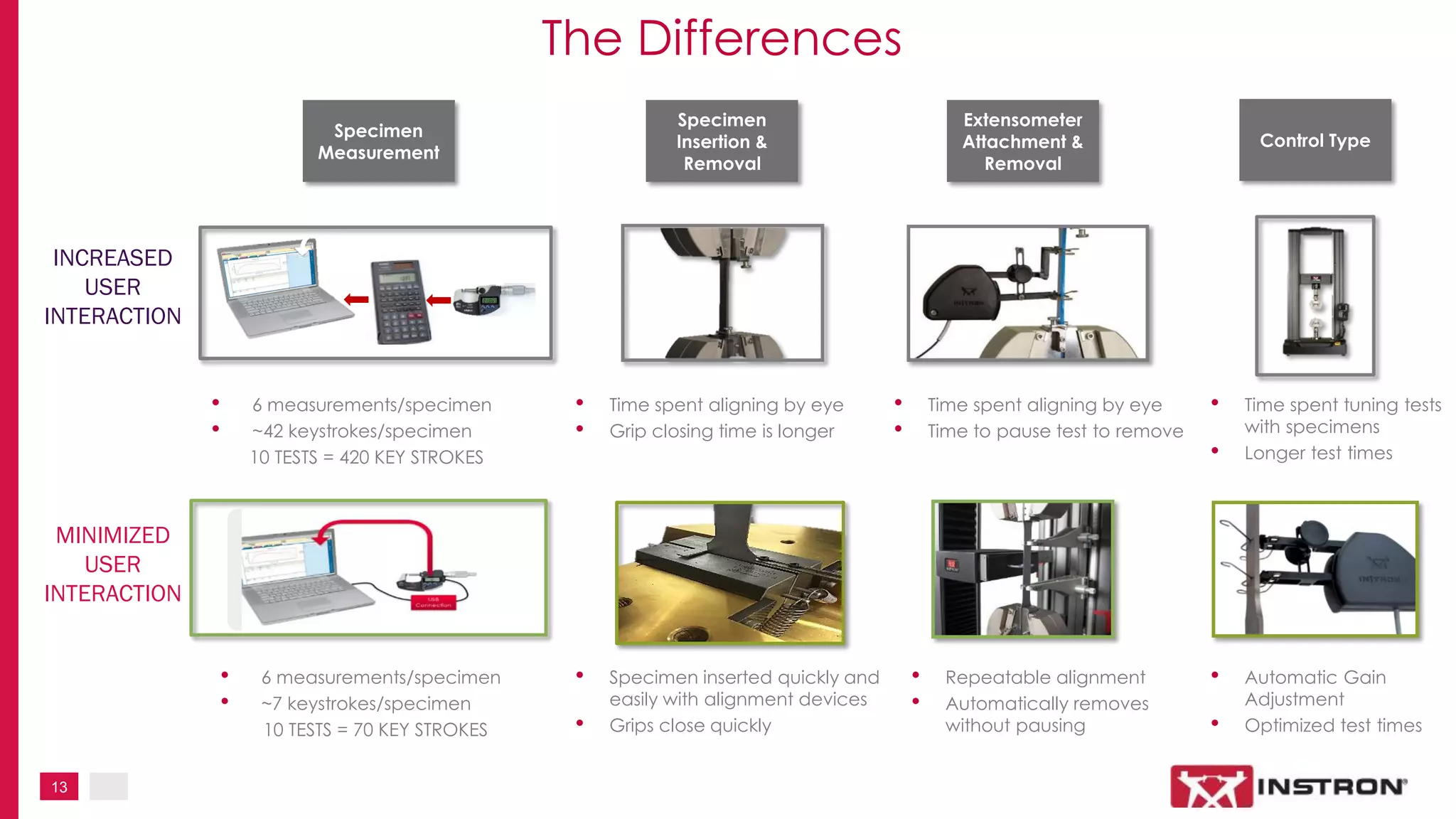
The Differences
• 6 measurements/specimen
• ~42 keystrokes/specimen
10 TESTS = 420 KEY STROKES
• Time spent aligning by eye
• Grip closing time is longer
• Time spent aligning by eye
• Time to pause test to remove
• Repeatable alignment
• Automatically removes
without pausing
Specimen
Measurement
Specimen
Insertion &
Removal
Extensometer
Attachment &
Removal
Control Type
• Automatic Gain
Adjustment
• Optimized test times
INCREASED
USER
INTERACTION
MINIMIZED
USER
INTERACTION
• Specimen inserted quickly and
easily with alignment devices
• Grips close quickly
• 6 measurements/specimen
• ~7 keystrokes/specimen
10 TESTS = 70 KEY STROKES
• Time spent tuning tests
with specimens
• Longer test times
14
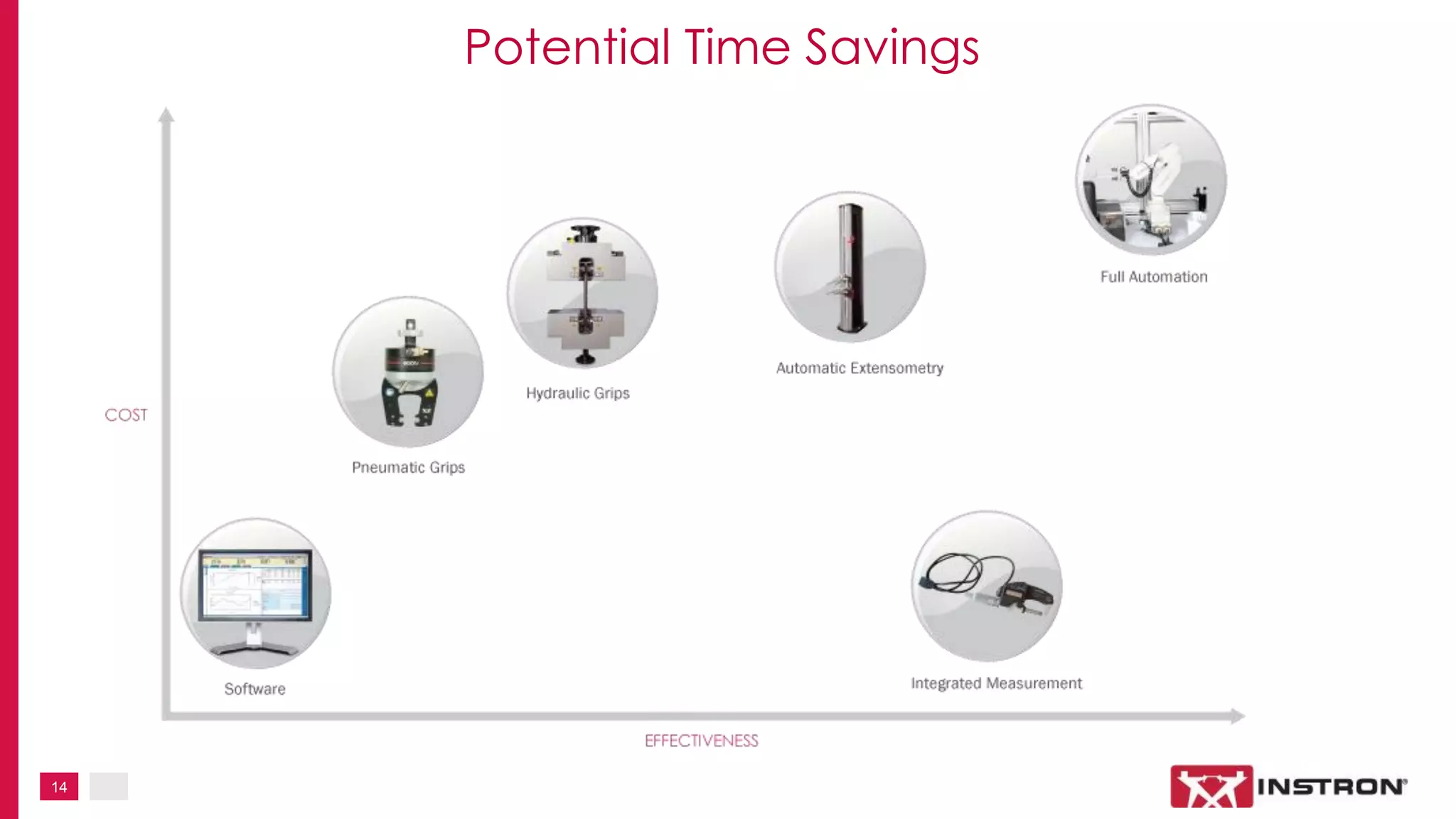
Potential Time Savings
15
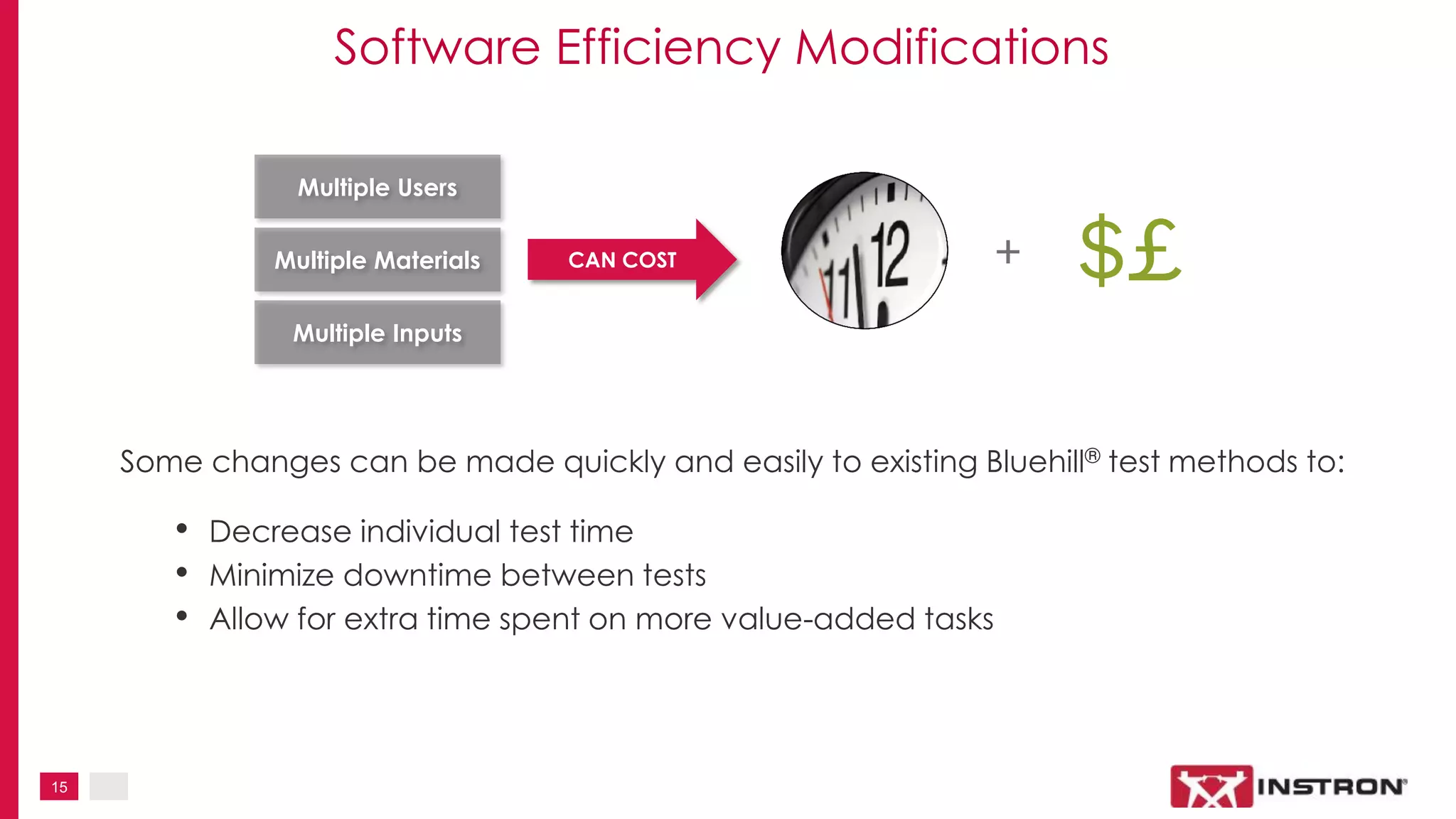
Software Efficiency Modifications
Multiple Users
Multiple Materials
Multiple Inputs
CAN COST
$£
Some changes can be made quickly and easily to existing Bluehill® test methods to:
• Decrease individual test time
• Minimize downtime between tests
• Allow for extra time spent on more value-added tasks
+
16
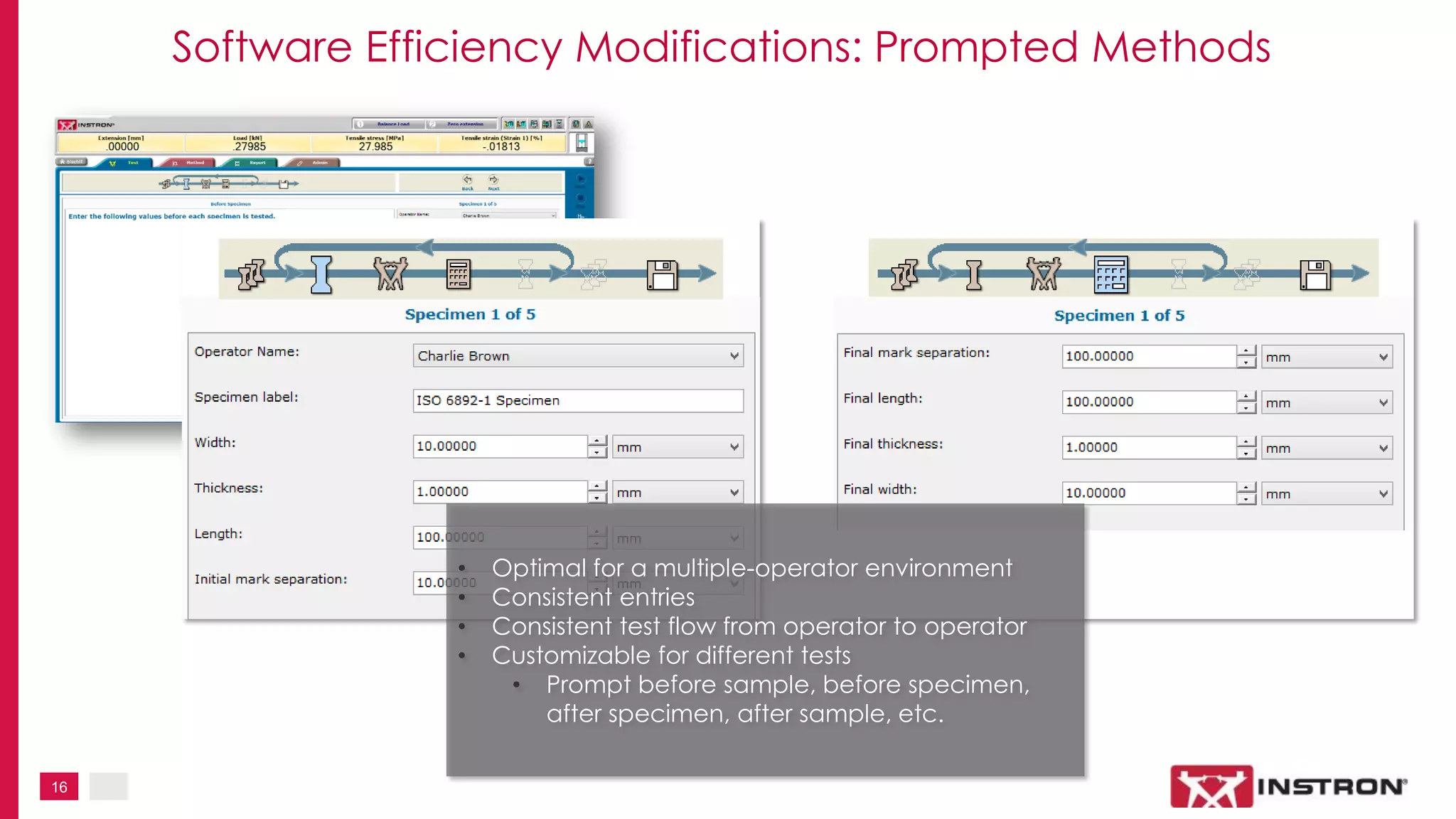
Software Efficiency Modifications: Prompted Methods
• Optimal for a multiple-operator environment
• Consistent entries
• Consistent test flow from operator to operator
• Customizable for different tests
• Prompt before sample, before specimen,
after specimen, after sample, etc.
17
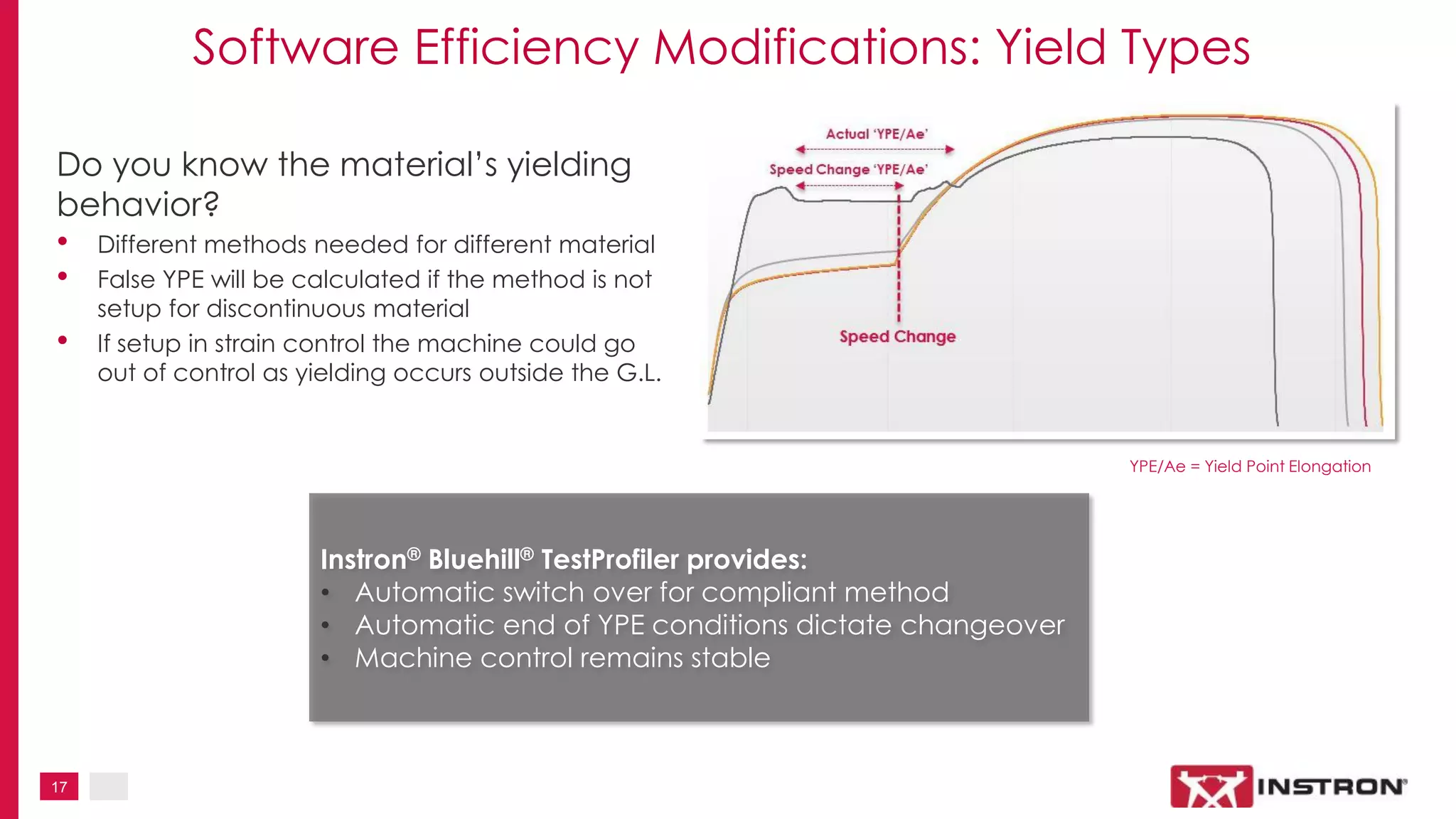
Software Efficiency Modifications: Yield Types
Do you know the material’s yielding
behavior?
• Different methods needed for different material
• False YPE will be calculated if the method is not
setup for discontinuous material
• If setup in strain control the machine could go
out of control as yielding occurs outside the G.L.
Instron® Bluehill® TestProfiler provides:
• Automatic switch over for compliant method
• Automatic end of YPE conditions dictate changeover
• Machine control remains stable
YPE/Ae = Yield Point Elongation
18
Get your lab prepared today.
Contact your local
Instron® Sales Representative
Visit www.instron.com
for more information

Sheet Metal Testing Challenges

  • 1.
  • 2.
    2 Table of Contents •Sheet Metal Key Industries • Challenges of Testing Stronger Material • Challenges Determining Formability Properties • Extensometer Selection • Effect of Efficiency
  • 3.
    3 Sheet Metal Industries Thetop three industries that sheet metal is sold to: 1. Automotive (Largest growth) 2. Consumer products 3. Aerospace
  • 4.
    4 Automotive Sheet MetalIndustry Summary • Reduce Emissions • The metals industry is producing stronger material than ever before! • Competition from Composite Material to Replace Metal • Formability is a key differentiator for metals • Increasing strength attempts to minimize composite material benefits • Aluminum ‘Taking’ Traditional Steel Market Share • Increased testing scrutiny from Automotive OEMs • GROWTH! • Growth = More metal needed = More testing required E F USA Changing Regulatory Requirements U.S. CAFE standards in 2016 Average fuel consumption needs to increase to 34.1MPG E F USA Changing Regulatory Requirements U.S. CAFE standards in 2016 Average fuel consumption needs to increase to 34.1MPG
  • 5.
    5 Stronger Material: Challenges •Increased Load Requirement • Is your current machine capable? • Higher wear on your system • Do you need higher testing machine capacity? • Gripping Issues • Are you having to increase clamping pressure? • Sign of worn jaw faces leading to specimen slippage • Violent Specimen Failures • Have you seen damage to your extensometer? • Increased wear on knife edges • Extensometer slippage  false readings • Reduced Formability • Measure r- and n-values accurately and repeatedly
  • 6.
    6 Formability: Challenges Metals Formability= Unique Selling Point (USP) vs. Composite Materials • Are the Formability Properties Important to You? • Calculating r- and n-values can be much simpler • Do You know the Yielding Behavior of Each Material? • Switching testing machine control modes is vital depending on the yielding type • Are You Testing More and More Specimens? • Learn how to increase your efficiency on your testing system
  • 7.
    7 Formability: r-value • Theplastic strain ratio (r) of sheet metal is its ability to resist thinning or thickening when subjected to a tensile or compressive force • Difficult to measure thickness change; preferable to measure the length and width changes • Requires axial and transverse strains to be measured
  • 8.
    8 Formability: n-value • Sheetmetal material’s, response to cold working is given by the strain-hardening exponent, n • It is a measure of the increase in strength due to plastic deformation Sheet metal with a high n-value exhibits a high increase in strength with minimal movement σ-Stress ε - Strain High n-value Low n-value
  • 9.
  • 10.
    10 Efficiency: Extensometer Comparison Specimen Measurement Minutes 12 3 AutoXBiax Clip-On > 30% FASTER! Specimen Insertion Extensometer Setup Test Time with Extensometer Removal Specimen Removal Total Cycle Time: 172 Seconds AVE 2 Total Cycle Time: 121 Seconds Total Cycle Time: 115 Seconds
  • 11.
    11 Tests Per DayClip-On AutoXBiax Time Savings *Total per year 50 143 min 96 min 48 min 200 hours 100 287 min 192 min 95 min 401 hours 200 573 min 383 min 190 min 801 hours 300 860 min 575 min 285 min 1202 hours Effect on Throughput *Presuming 253 working days in a year In 1 year, that’s 401 hours of time saved
  • 12.
    12 Influencing Factors Specimen Measurement Specimen InsertionExtensometer Setup Test Time with Extensometer Removal Specimen Removal Automatically Calculated & Entered Vs Manually Entered Hydraulic Grips Vs Manual Grips Specimen Stops Vs Manual Alignment Automatic Contacting Vs Advanced Video Non Contacting Vs Clip-On Axial Vs Axial & Transverse Strain Rate Control Vs ‘Stress’ Rate Control Vs Crosshead Rate Control Hydraulic Grips Vs Manual Grips = Most Efficient Total Cycle Time Automatic Removal Vs Manual Removal
  • 13.
    13 The Differences • 6measurements/specimen • ~42 keystrokes/specimen 10 TESTS = 420 KEY STROKES • Time spent aligning by eye • Grip closing time is longer • Time spent aligning by eye • Time to pause test to remove • Repeatable alignment • Automatically removes without pausing Specimen Measurement Specimen Insertion & Removal Extensometer Attachment & Removal Control Type • Automatic Gain Adjustment • Optimized test times INCREASED USER INTERACTION MINIMIZED USER INTERACTION • Specimen inserted quickly and easily with alignment devices • Grips close quickly • 6 measurements/specimen • ~7 keystrokes/specimen 10 TESTS = 70 KEY STROKES • Time spent tuning tests with specimens • Longer test times
  • 14.
  • 15.
    15 Software Efficiency Modifications MultipleUsers Multiple Materials Multiple Inputs CAN COST $£ Some changes can be made quickly and easily to existing Bluehill® test methods to: • Decrease individual test time • Minimize downtime between tests • Allow for extra time spent on more value-added tasks +
  • 16.
    16 Software Efficiency Modifications:Prompted Methods • Optimal for a multiple-operator environment • Consistent entries • Consistent test flow from operator to operator • Customizable for different tests • Prompt before sample, before specimen, after specimen, after sample, etc.
  • 17.
    17 Software Efficiency Modifications:Yield Types Do you know the material’s yielding behavior? • Different methods needed for different material • False YPE will be calculated if the method is not setup for discontinuous material • If setup in strain control the machine could go out of control as yielding occurs outside the G.L. Instron® Bluehill® TestProfiler provides: • Automatic switch over for compliant method • Automatic end of YPE conditions dictate changeover • Machine control remains stable YPE/Ae = Yield Point Elongation
  • 18.
    18 Get your labprepared today. Contact your local Instron® Sales Representative Visit www.instron.com for more information