PHYSIOTHERAPY
IN MND
Dr. Quazi Ibtesaam Huma (MPT)
Dr. Suvarna Ganvir (Phd, Prof & HOD)
Dept. of Neurophysiotherapy
DVVPF’s College of Physiotherapy
Content
 Introduction
 Types of MND
 Clinical Features of MND
 Diagnostic Procedure
 Management: 1) Pharmaceutical
2) Physiotherapy
Motor Neuron Disease
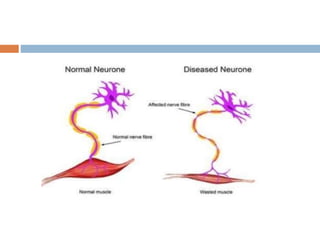
 Motor Neuron Disease are a group of
neurodegenerative disorders that affects the
nerves in the spine and brain to progressively
lose its function.
 Motor neuron diseases (MND) include a
heterogeneous spectrum of inherited and
sporadic (no family history) clinical disorders of
the upper motor neurons (UMNs), lower motor
neurons (LMNs), or a combination of both.
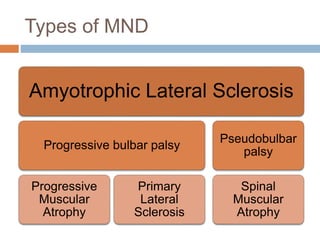
Types of MND
Amyotrophic Lateral Sclerosis
Progressive bulbar palsy
Progressive
Muscular
Atrophy
Primary
Lateral
Sclerosis
Pseudobulbar
palsy
Spinal
Muscular
Atrophy
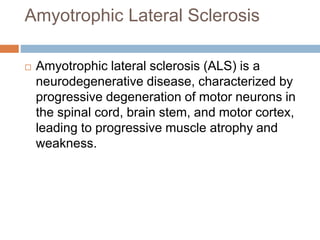
Amyotrophic Lateral Sclerosis
 Amyotrophic lateral sclerosis (ALS) is a
neurodegenerative disease, characterized by
progressive degeneration of motor neurons in
the spinal cord, brain stem, and motor cortex,
leading to progressive muscle atrophy and
weakness.
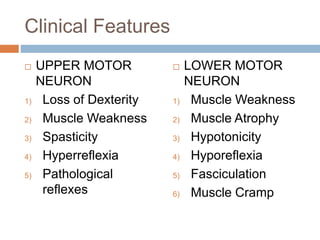
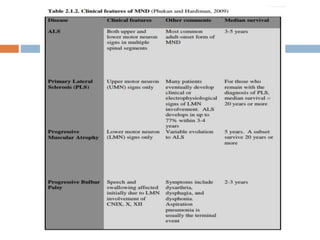
Clinical Features
 UPPER MOTOR
NEURON
1) Loss of Dexterity
2) Muscle Weakness
3) Spasticity
4) Hyperreflexia
5) Pathological
reflexes
 LOWER MOTOR
NEURON
1) Muscle Weakness
2) Muscle Atrophy
3) Hypotonicity
4) Hyporeflexia
5) Fasciculation
6) Muscle Cramp
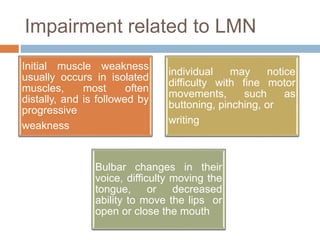
Impairment related to LMN
Initial muscle weakness
usually occurs in isolated
muscles, most often
distally, and is followed by
progressive
weakness
individual may notice
difficulty with fine motor
movements, such as
buttoning, pinching, or
writing
Bulbar changes in their
voice, difficulty moving the
tongue, or decreased
ability to move the lips or
open or close the mouth
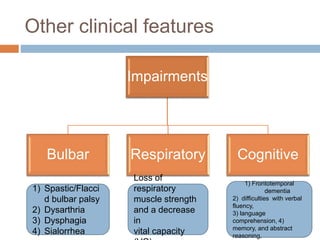
Other clinical features
Impairments
Bulbar Respiratory Cognitive
1) Spastic/Flacci
d bulbar palsy
2) Dysarthria
3) Dysphagia
4) Sialorrhea
Loss of
respiratory
muscle strength
and a decrease
in
vital capacity
1) Frontotemporal
dementia
2) difficulties with verbal
fluency,
3) language
comprehension, 4)
memory, and abstract
reasoning,
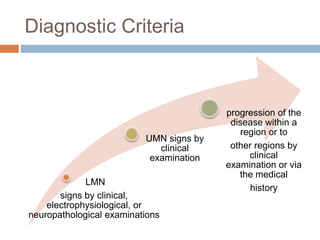
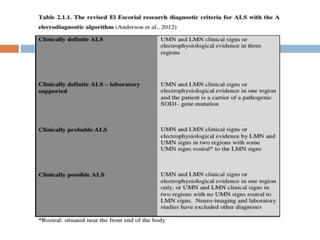
Diagnostic Criteria
LMN
signs by clinical,
electrophysiological, or
neuropathological examinations
UMN signs by
clinical
examination
progression of the
disease within a
region or to
other regions by
clinical
examination or via
the medical
history
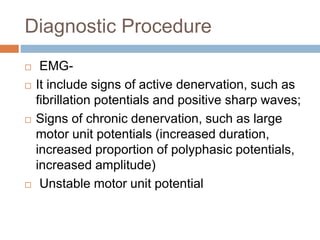
Diagnostic Procedure
 EMG-
 It include signs of active denervation, such as
fibrillation potentials and positive sharp waves;
 Signs of chronic denervation, such as large
motor unit potentials (increased duration,
increased proportion of polyphasic potentials,
increased amplitude)
 Unstable motor unit potential
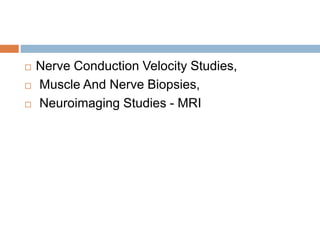
 Nerve Conduction Velocity Studies,
 Muscle And Nerve Biopsies,
 Neuroimaging Studies - MRI
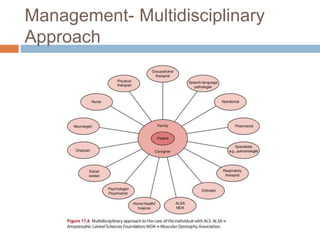
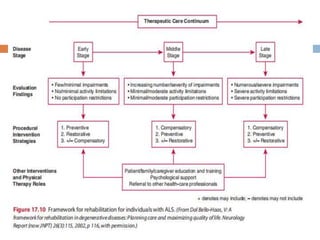
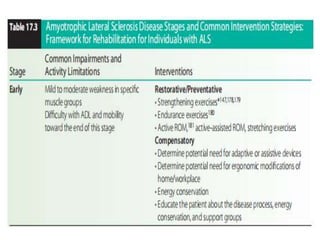
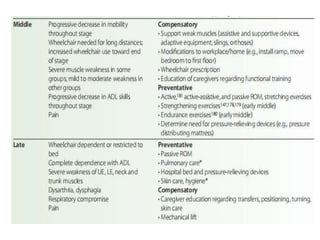
Management- Multidisciplinary
Approach
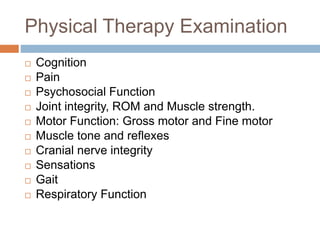
Physical Therapy Examination
 Cognition
 Pain
 Psychosocial Function
 Joint integrity, ROM and Muscle strength.
 Motor Function: Gross motor and Fine motor
 Muscle tone and reflexes
 Cranial nerve integrity
 Sensations
 Gait
 Respiratory Function
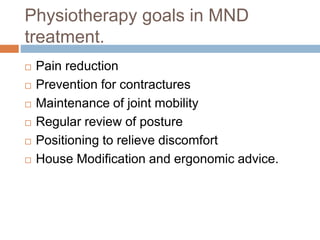
Physiotherapy goals in MND
treatment.
 Pain reduction
 Prevention for contractures
 Maintenance of joint mobility
 Regular review of posture
 Positioning to relieve discomfort
 House Modification and ergonomic advice.
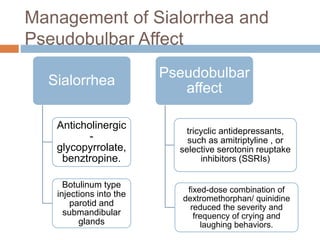
Management of Sialorrhea and
Pseudobulbar Affect
Sialorrhea
Anticholinergic
-
glycopyrrolate,
benztropine.
Botulinum type
injections into the
parotid and
submandibular
glands
Pseudobulbar
affect
tricyclic antidepressants,
such as amitriptyline , or
selective serotonin reuptake
inhibitors (SSRIs)
fixed-dose combination of
dextromethorphan/ quinidine
reduced the severity and
frequency of crying and
laughing behaviors.
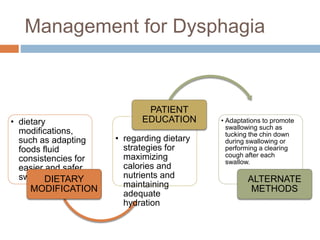
Management for Dysphagia
• dietary
modifications,
such as adapting
foods fluid
consistencies for
easier and safer
swallowing
DIETARY
MODIFICATION
• regarding dietary
strategies for
maximizing
calories and
nutrients and
maintaining
adequate
hydration
PATIENT
EDUCATION • Adaptations to promote
swallowing such as
tucking the chin down
during swallowing or
performing a clearing
cough after each
swallow.
ALTERNATE
METHODS
PEG procedure.
 A PEG may be recommended as the disease
progresses.
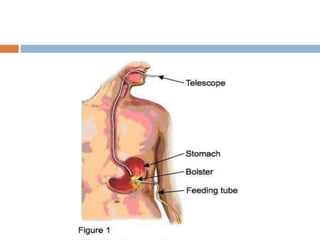
 A PEG is a type of gastrostomy tube inserted
via endoscopic surgery that creates a
permanent opening into the stomach for the
introduction of food.
 Studies have found that PEG insertion may
prolong survival. Patients with PEG were
found to live 1 to 4 months longer than those
individuals who refused it.
Management of Dysphagia
 A palatal lift prosthesis may be prescribed for
individuals with good articulation but who have a
breathy voice quality or decreased loudness
because of excessive air loss through the nose.
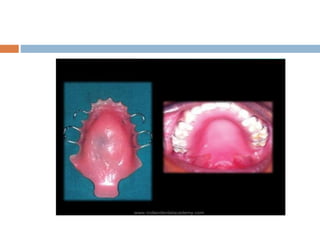
 The device, a dental appliance designed to attach
to the existing teeth and to elevate the soft palate,
is custom-made by a prosthodontist.
 It allows the soft palate to close around the
surrounding structures such as the pharynx, making
verbal communication more understandable by
reducing or eliminating hypernasal speech.
 The device also lowers the hard palate, which
reduces tongue movement allowing speech to be
less fatiguing
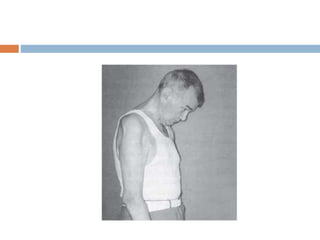
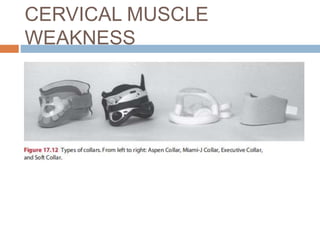
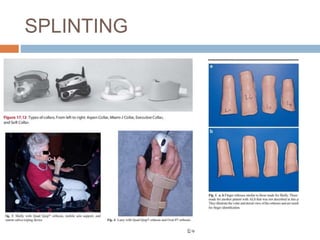
CERVICAL MUSCLE
WEAKNESS
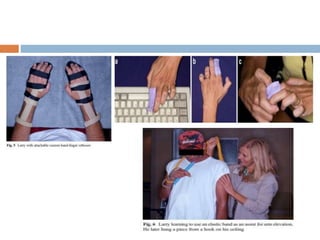
SPLINTING
Respiratory Muscle Weakness
 Inspiratory Muscle Training
 Airway clearance technique
 HF-CWO is an external noninvasive modality
that transmits high-frequency oscillatory
pressures through the chest wall, thereby
mobilizing secretions from the small peripheral
airways and enhancing secretion clearance
and gas exchange
Spasticity Management
 PROM
 Slow sustained stretch
 Splinting
 Postural and positioning techniques
Gait training
 Weight of the device is an important factor to
consider in decision making, while also taking
into account which device will ensure optimal
function and safety.
 Wheeled walkers, which do require the patient
to lift the device, are usually recommended.
Modification for mobility
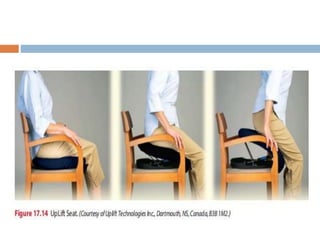
 Chair glides or stairway lifts can be suggested
for those individuals who live in multilevel
homes
 Power wheelchair and power scooters may be
suitable for a patient with adequate UE and
trunk strength in the earlier stages of ALS.
DISEASE-SPECIFIC AND
QUALITY-OF-LIFE MEASURES
DISEASE SPECIFIC SCALE:
 ALS Functional Rating Scale (ALSFRS)
 Appel ALS Scale (AALS)
 ALS Severity Scale (ALSSS)
 Norris Scale
QUALITY OF LIFE MEASURES:
 SF-36
 Schedule for Evaluation of Individual Quality of Life—
Direct Weighting (SEIQoL-DW
 Sickness Impact Profile (SIP).
 Amyotrophic Lateral Sclerosis Assessment
Questionnaire (ALSAQ-40)
 A study conducted by Annerieke C van
Groenestijn et al (2019)
 To study the effectiveness of aerobic exercise
therapy (AET) on disease-specific and generic
HRQoL in ambulatory patients with ALS.
 Consisted of two groups: AET consisted of a
16-week aerobic cycling exercise program and
Usual Care group.
Aerobic Exercise Therapy in Ambulatory
Patients With ALS: A Randomized Controlled
Trial
 Primary outcome measures were the 40-item ALS
assessment questionnaire (ALSAQ-40), and the
mental component summary (MCS) and physical
component summary (PCS) scores of the short-
form survey (SF-36).
 AET+UC was not superior to UC alone in
preserving HRQoL in ambulatory ALS patient.
However, the study was unfortunately
underpowered, because only 10 patients
completed the protocol. AET+UC may preserve
disease-specific HRQoL in slow progressor.
References
 Susan O’ Sullivan, Physical Rehabilitation, 6th
Edition.
 Cindy C. Ivy, Susan M. Smith; Upper Extremity
Orthoses in Amyotrophic Lateral Sclerosis/ MND:
Three Case Reports; Hand (2014)9:543-550
 Vanina Dal B.; Physical therapy for individuals
with Amyotrophic Lateral Sclerosis: A current
insights; Degenerative neurological and
Neuromuscular Disease 2018:8.
 Annerieke C., Carin D., Ruben P., Aerobic
Exercise Therapy in ambulatory Patients with
ALS: A RCT. Neurorehabilitation and neural repair
33(2).
Thank You

physiotherapy in MND.pptx

  • 1.
    PHYSIOTHERAPY IN MND Dr. QuaziIbtesaam Huma (MPT) Dr. Suvarna Ganvir (Phd, Prof & HOD) Dept. of Neurophysiotherapy DVVPF’s College of Physiotherapy
  • 2.
    Content  Introduction  Typesof MND  Clinical Features of MND  Diagnostic Procedure  Management: 1) Pharmaceutical 2) Physiotherapy
  • 3.
    Motor Neuron Disease Motor Neuron Disease are a group of neurodegenerative disorders that affects the nerves in the spine and brain to progressively lose its function.  Motor neuron diseases (MND) include a heterogeneous spectrum of inherited and sporadic (no family history) clinical disorders of the upper motor neurons (UMNs), lower motor neurons (LMNs), or a combination of both.
  • 5.
    Types of MND AmyotrophicLateral Sclerosis Progressive bulbar palsy Progressive Muscular Atrophy Primary Lateral Sclerosis Pseudobulbar palsy Spinal Muscular Atrophy
  • 6.
    Amyotrophic Lateral Sclerosis Amyotrophic lateral sclerosis (ALS) is a neurodegenerative disease, characterized by progressive degeneration of motor neurons in the spinal cord, brain stem, and motor cortex, leading to progressive muscle atrophy and weakness.
  • 7.
    Clinical Features  UPPERMOTOR NEURON 1) Loss of Dexterity 2) Muscle Weakness 3) Spasticity 4) Hyperreflexia 5) Pathological reflexes  LOWER MOTOR NEURON 1) Muscle Weakness 2) Muscle Atrophy 3) Hypotonicity 4) Hyporeflexia 5) Fasciculation 6) Muscle Cramp
  • 8.
    Impairment related toLMN Initial muscle weakness usually occurs in isolated muscles, most often distally, and is followed by progressive weakness individual may notice difficulty with fine motor movements, such as buttoning, pinching, or writing Bulbar changes in their voice, difficulty moving the tongue, or decreased ability to move the lips or open or close the mouth
  • 9.
    Other clinical features Impairments BulbarRespiratory Cognitive 1) Spastic/Flacci d bulbar palsy 2) Dysarthria 3) Dysphagia 4) Sialorrhea Loss of respiratory muscle strength and a decrease in vital capacity 1) Frontotemporal dementia 2) difficulties with verbal fluency, 3) language comprehension, 4) memory, and abstract reasoning,
  • 12.
    Diagnostic Criteria LMN signs byclinical, electrophysiological, or neuropathological examinations UMN signs by clinical examination progression of the disease within a region or to other regions by clinical examination or via the medical history
  • 14.
    Diagnostic Procedure  EMG- It include signs of active denervation, such as fibrillation potentials and positive sharp waves;  Signs of chronic denervation, such as large motor unit potentials (increased duration, increased proportion of polyphasic potentials, increased amplitude)  Unstable motor unit potential
  • 15.
     Nerve ConductionVelocity Studies,  Muscle And Nerve Biopsies,  Neuroimaging Studies - MRI
  • 16.
  • 17.
    Physical Therapy Examination Cognition  Pain  Psychosocial Function  Joint integrity, ROM and Muscle strength.  Motor Function: Gross motor and Fine motor  Muscle tone and reflexes  Cranial nerve integrity  Sensations  Gait  Respiratory Function
  • 18.
    Physiotherapy goals inMND treatment.  Pain reduction  Prevention for contractures  Maintenance of joint mobility  Regular review of posture  Positioning to relieve discomfort  House Modification and ergonomic advice.
  • 19.
    Management of Sialorrheaand Pseudobulbar Affect Sialorrhea Anticholinergic - glycopyrrolate, benztropine. Botulinum type injections into the parotid and submandibular glands Pseudobulbar affect tricyclic antidepressants, such as amitriptyline , or selective serotonin reuptake inhibitors (SSRIs) fixed-dose combination of dextromethorphan/ quinidine reduced the severity and frequency of crying and laughing behaviors.
  • 20.
    Management for Dysphagia •dietary modifications, such as adapting foods fluid consistencies for easier and safer swallowing DIETARY MODIFICATION • regarding dietary strategies for maximizing calories and nutrients and maintaining adequate hydration PATIENT EDUCATION • Adaptations to promote swallowing such as tucking the chin down during swallowing or performing a clearing cough after each swallow. ALTERNATE METHODS
  • 21.
    PEG procedure.  APEG may be recommended as the disease progresses.  A PEG is a type of gastrostomy tube inserted via endoscopic surgery that creates a permanent opening into the stomach for the introduction of food.  Studies have found that PEG insertion may prolong survival. Patients with PEG were found to live 1 to 4 months longer than those individuals who refused it.
  • 23.
    Management of Dysphagia A palatal lift prosthesis may be prescribed for individuals with good articulation but who have a breathy voice quality or decreased loudness because of excessive air loss through the nose.  The device, a dental appliance designed to attach to the existing teeth and to elevate the soft palate, is custom-made by a prosthodontist.  It allows the soft palate to close around the surrounding structures such as the pharynx, making verbal communication more understandable by reducing or eliminating hypernasal speech.  The device also lowers the hard palate, which reduces tongue movement allowing speech to be less fatiguing
  • 26.
  • 29.
  • 32.
    Respiratory Muscle Weakness Inspiratory Muscle Training  Airway clearance technique  HF-CWO is an external noninvasive modality that transmits high-frequency oscillatory pressures through the chest wall, thereby mobilizing secretions from the small peripheral airways and enhancing secretion clearance and gas exchange
  • 33.
    Spasticity Management  PROM Slow sustained stretch  Splinting  Postural and positioning techniques
  • 34.
    Gait training  Weightof the device is an important factor to consider in decision making, while also taking into account which device will ensure optimal function and safety.  Wheeled walkers, which do require the patient to lift the device, are usually recommended.
  • 35.
    Modification for mobility Chair glides or stairway lifts can be suggested for those individuals who live in multilevel homes  Power wheelchair and power scooters may be suitable for a patient with adequate UE and trunk strength in the earlier stages of ALS.
  • 38.
    DISEASE-SPECIFIC AND QUALITY-OF-LIFE MEASURES DISEASESPECIFIC SCALE:  ALS Functional Rating Scale (ALSFRS)  Appel ALS Scale (AALS)  ALS Severity Scale (ALSSS)  Norris Scale QUALITY OF LIFE MEASURES:  SF-36  Schedule for Evaluation of Individual Quality of Life— Direct Weighting (SEIQoL-DW  Sickness Impact Profile (SIP).  Amyotrophic Lateral Sclerosis Assessment Questionnaire (ALSAQ-40)
  • 39.
     A studyconducted by Annerieke C van Groenestijn et al (2019)  To study the effectiveness of aerobic exercise therapy (AET) on disease-specific and generic HRQoL in ambulatory patients with ALS.  Consisted of two groups: AET consisted of a 16-week aerobic cycling exercise program and Usual Care group. Aerobic Exercise Therapy in Ambulatory Patients With ALS: A Randomized Controlled Trial
  • 40.
     Primary outcomemeasures were the 40-item ALS assessment questionnaire (ALSAQ-40), and the mental component summary (MCS) and physical component summary (PCS) scores of the short- form survey (SF-36).  AET+UC was not superior to UC alone in preserving HRQoL in ambulatory ALS patient. However, the study was unfortunately underpowered, because only 10 patients completed the protocol. AET+UC may preserve disease-specific HRQoL in slow progressor.
  • 41.
    References  Susan O’Sullivan, Physical Rehabilitation, 6th Edition.  Cindy C. Ivy, Susan M. Smith; Upper Extremity Orthoses in Amyotrophic Lateral Sclerosis/ MND: Three Case Reports; Hand (2014)9:543-550  Vanina Dal B.; Physical therapy for individuals with Amyotrophic Lateral Sclerosis: A current insights; Degenerative neurological and Neuromuscular Disease 2018:8.  Annerieke C., Carin D., Ruben P., Aerobic Exercise Therapy in ambulatory Patients with ALS: A RCT. Neurorehabilitation and neural repair 33(2).
  • 42.