Capacity building and human resources 
development to foster implementation of 
scientific innovations in agrarian system 
of dry lands in Central Asia 
Prof. V.A. Dukhovny 
Director 
Scientific Information Center of 
Interstate Commission for Water 
Coordination in Central Asia 
Tashkent 
28-30 April 2014 
ICARDA meeting 
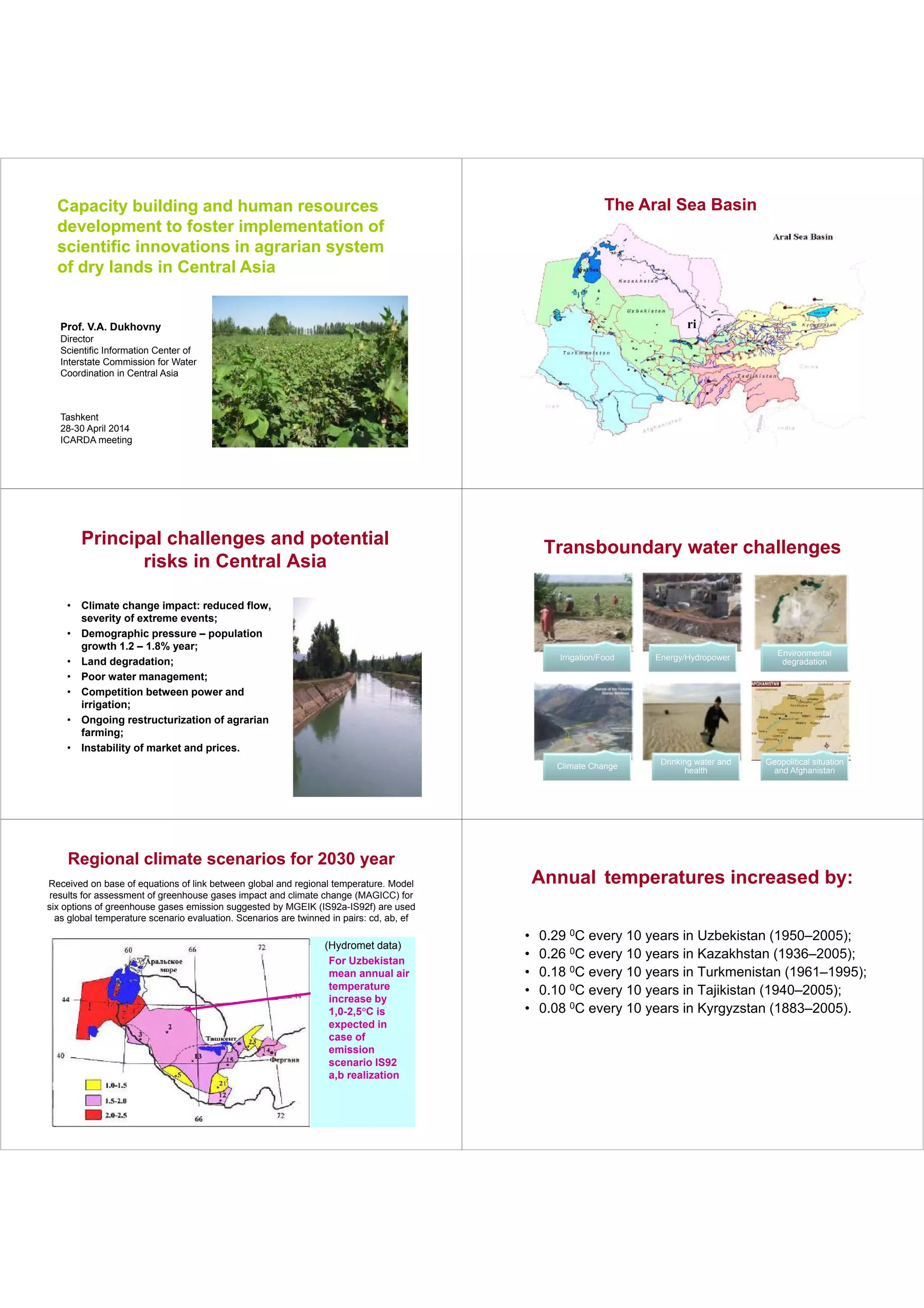
The Aral Sea Basin 
ri 
Principal challenges and potential 
risks in Central Asia 
• Climate change impact: reduced flow, 
severity of extreme events; 
• Demographic pressure – population 
growth 1.2 – 1.8% year; 
• Land degradation; 
• Poor water management; 
• Competition between power and 
irrigation; 
• Ongoing restructurization of agrarian 
farming; 
• Instability of market and prices. 
Transboundary water challenges 
Irrigation/Food Energy/Hydropower Environmental 
degradation 
Climate Change Drinking water and 
health 
Geopolitical situation 
and Afghanistan 
Regional climate scenarios for 2030 year 
Received on base of equations of link between global and regional temperature. Model 
results for assessment of greenhouse gases impact and climate change (MAGICC) for 
six options of greenhouse gases emission suggested by MGEIK (IS92a-IS92f) are used 
as global temperature scenario evaluation. Scenarios are twinned in pairs: сd, ab, ef 
(Hydromet data) 
For Uzbekistan 
mean annual air 
temperature 
increase by 
1,0-2,5°С is 
expected in 
case of 
emission 
scenario IS92 
a,b realization 
Annual temperatures increased by: 
• 0.29 0C every 10 years in Uzbekistan (1950–2005); 
• 0.26 0C every 10 years in Kazakhstan (1936–2005); 
• 0.18 0C every 10 years in Turkmenistan (1961–1995); 
• 0.10 0C every 10 years in Tajikistan (1940–2005); 
• 0.08 0C every 10 years in Kyrgyzstan (1883–2005).
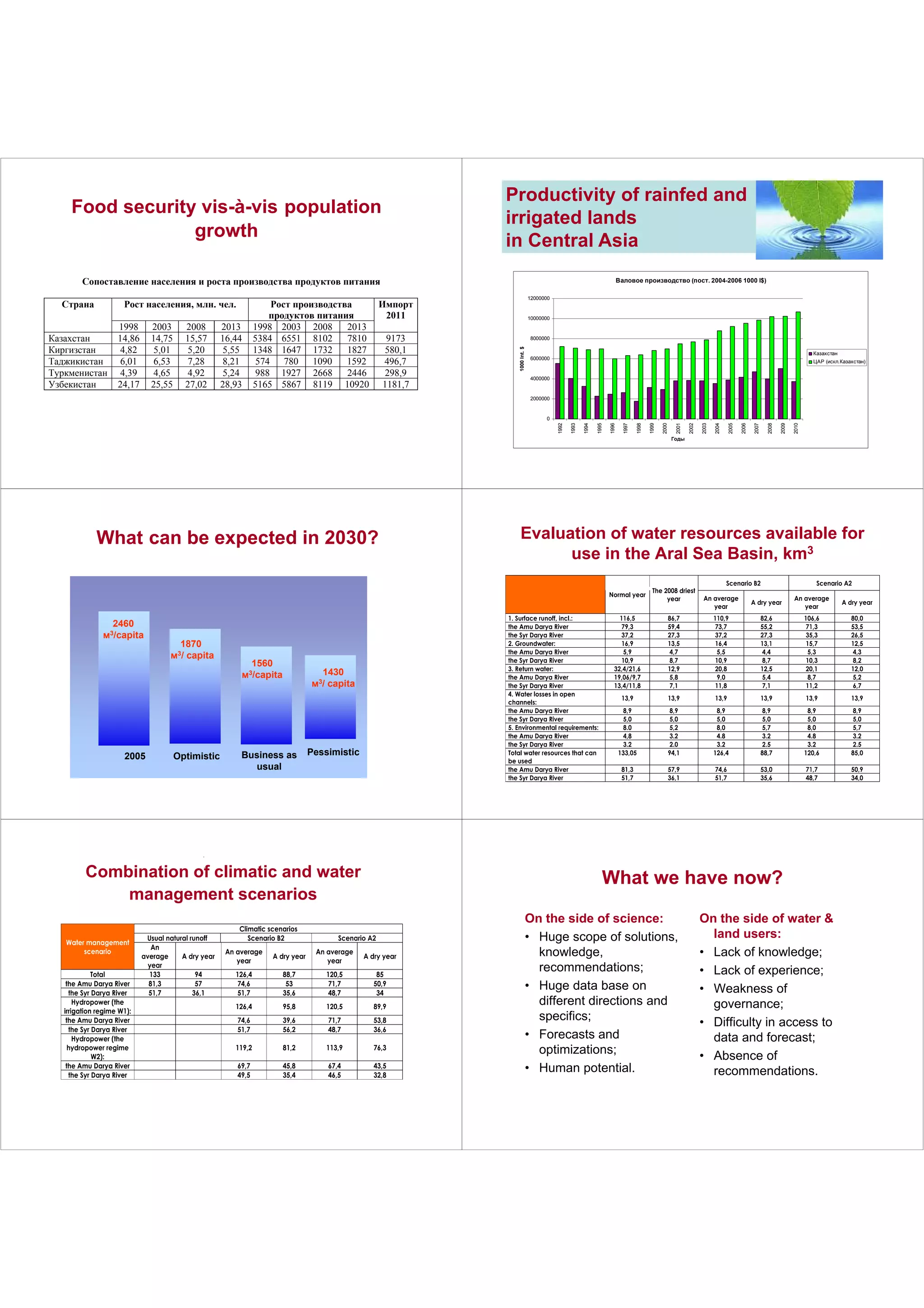
Food security vis-à-vis population 
growth 
Таблица 3 
Сопоставление населения и роста производства продуктов питания 
Страна Рост населения, млн. чел. Рост производства 
продуктов питания 
Импорт 
2011 
1998 2003 2008 2013 1998 2003 2008 2013 
Казахстан 14,86 14,75 15,57 16,44 5384 6551 8102 7810 9173 
Киргизстан 4,82 5,01 5,20 5,55 1348 1647 1732 1827 580,1 
Таджикистан 6,01 6,53 7,28 8,21 574 780 1090 1592 496,7 
Туркменистан 4,39 4,65 4,92 5,24 988 1927 2668 2446 298,9 
Узбекистан 24,17 25,55 27,02 28,93 5165 5867 8119 10920 1181,7 
Productivity of rainfed and 
irrigated lands 
in Central Asia 
Валовое производство (пост. 2004-2006 1000 I$) 
12000000 
10000000 
8000000 
6000000 
4000000 
2000000 
0 
1992 
1993 
1994 
1995 
1996 
1997 
1998 
1999 
2000 
2001 
2002 
2003 
2004 
2005 
2006 
2007 
2008 
2009 
2010 
Годы 
1000 Int. $ 
Казахстан 
ЦАР (искл.Казахстан) 
What can be expected in 2030? 
1870 
м3/ capita 
2005 Optimistic 
1560 
м3/capita 1430 
м3/ capita 
Business as 
usual 
Pessimistic 
2460 
м3/capita 
Evaluation of water resources available for 
use in the Aral Sea Basin, km3 
Combination of climatic and water 
management scenarios 
What we have now? 
On the side of science: 
• Huge scope of solutions, 
knowledge, 
recommendations; 
• Huge data base on 
different directions and 
specifics; 
• Forecasts and 
optimizations; 
• Human potential. 
On the side of water & 
land users: 
• Lack of knowledge; 
• Lack of experience; 
• Weakness of 
governance; 
• Difficulty in access to 
data and forecast; 
• Absence of 
recommendations.
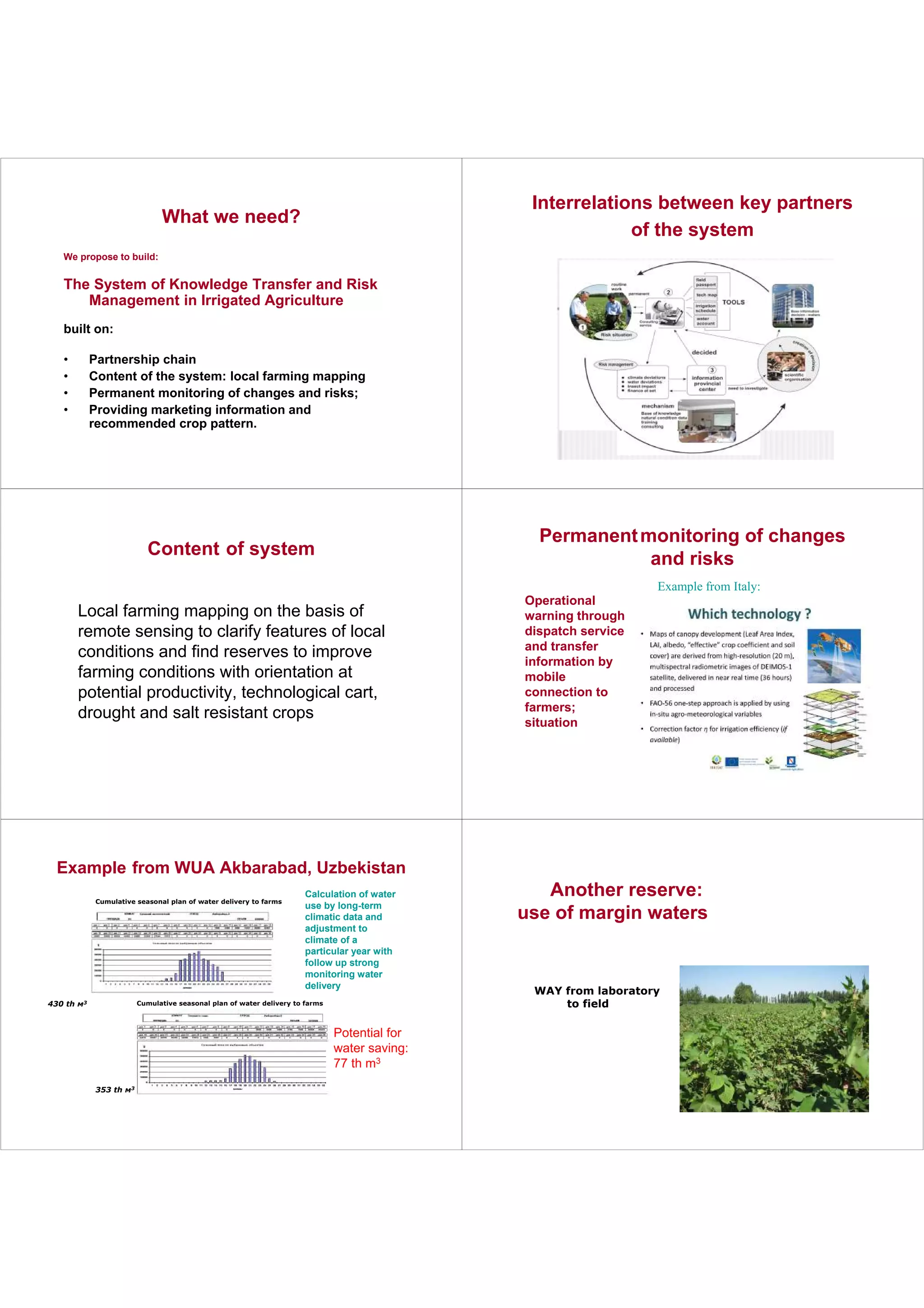
What we need? 
We propose to build: 
The System of Knowledge Transfer and Risk 
Management in Irrigated Agriculture 
built on: 
• Partnership chain 
• Content of the system: local farming mapping 
• Permanent monitoring of changes and risks; 
• Providing marketing information and 
recommended crop pattern. 
Interrelations between key partners 
of the system 
Content of system 
Local farming mapping on the basis of 
remote sensing to clarify features of local 
conditions and find reserves to improve 
farming conditions with orientation at 
potential productivity, technological cart, 
drought and salt resistant crops 
Permanentmonitoring of changes 
and risks 
Operational 
warning through 
dispatch service 
and transfer 
information by 
mobile 
connection to 
farmers; 
situation 
Example from Italy: 
Example from WUA Akbarabad, Uzbekistan 
Calculation of water 
use by long-term 
climatic data and 
adjustment to 
climate of a 
particular year with 
follow up strong 
monitoring water 
delivery 
Cumulative seasonal plan of water delivery to farms 
Cumulative seasonal plan of water 430 th м3 delivery to farms 
353 th м3 
Potential for 
water saving: 
77 th m3 
Another reserve: 
use of margin waters 
WAY from laboratory 
to field
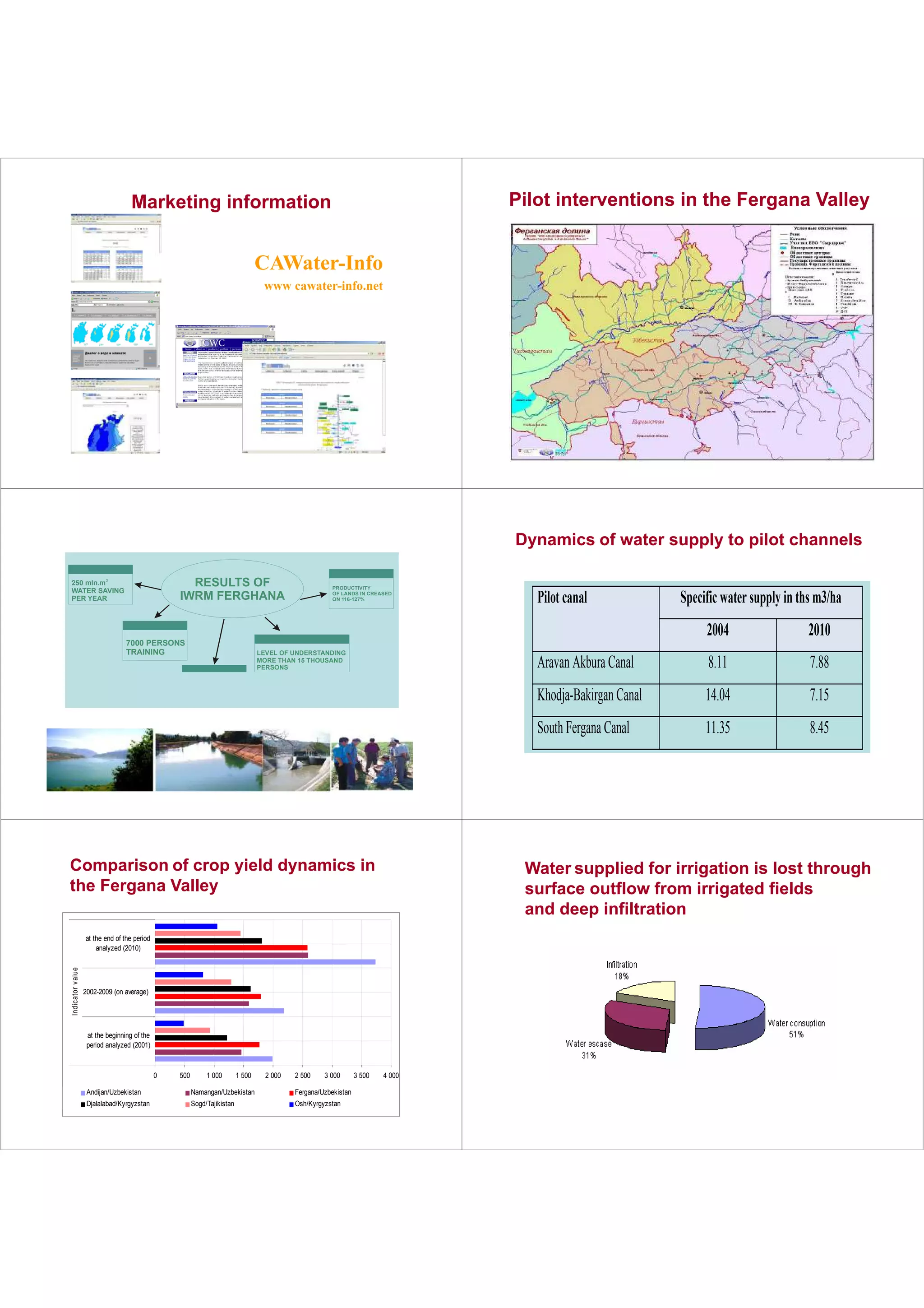
Marketing information Pilot interventions in the Fergana Valley 
CAWater-Info 
www cawater-info.net 
PRODUCTIVITY 
OF LANDS IN CREASED 
ON 116-127% 
3 
250 mln.m 
WATER SAVING 
PER YEAR 
RESULTS OF 
Dynamics of water supply to pilot channels 
IWRM FERGHANA Pilot canal Specific water supply in ths m3/ha 
7000 PERSONS 
TRAINING LEVEL OF UNDERSTANDING 
MORE THAN 15 THOUSAND 
PERSONS 
2004 2010 
Aravan Akbura Canal 8.11 7.88 
Khodja-Bakirgan Canal 14.04 7.15 
South Fergana Canal 11.35 8.45 
Comparison of crop yield dynamics in 
the Fergana Valley 
0 500 1 000 1 500 2 000 2 500 3 000 3 500 4 000 
at the end of the period 
analyzed (2010) 
2002-2009 (on average) 
at the beginning of the 
period analyzed (2001) 
Indicator v alue 
Andijan/Uzbekistan Namangan/Uzbekistan Fergana/Uzbekistan 
Djalalabad/Kyrgyzstan Sogd/Tajikistan Osh/Kyrgyzstan 
Water supplied for irrigation is lost through 
surface outflow from irrigated fields 
and deep infiltration
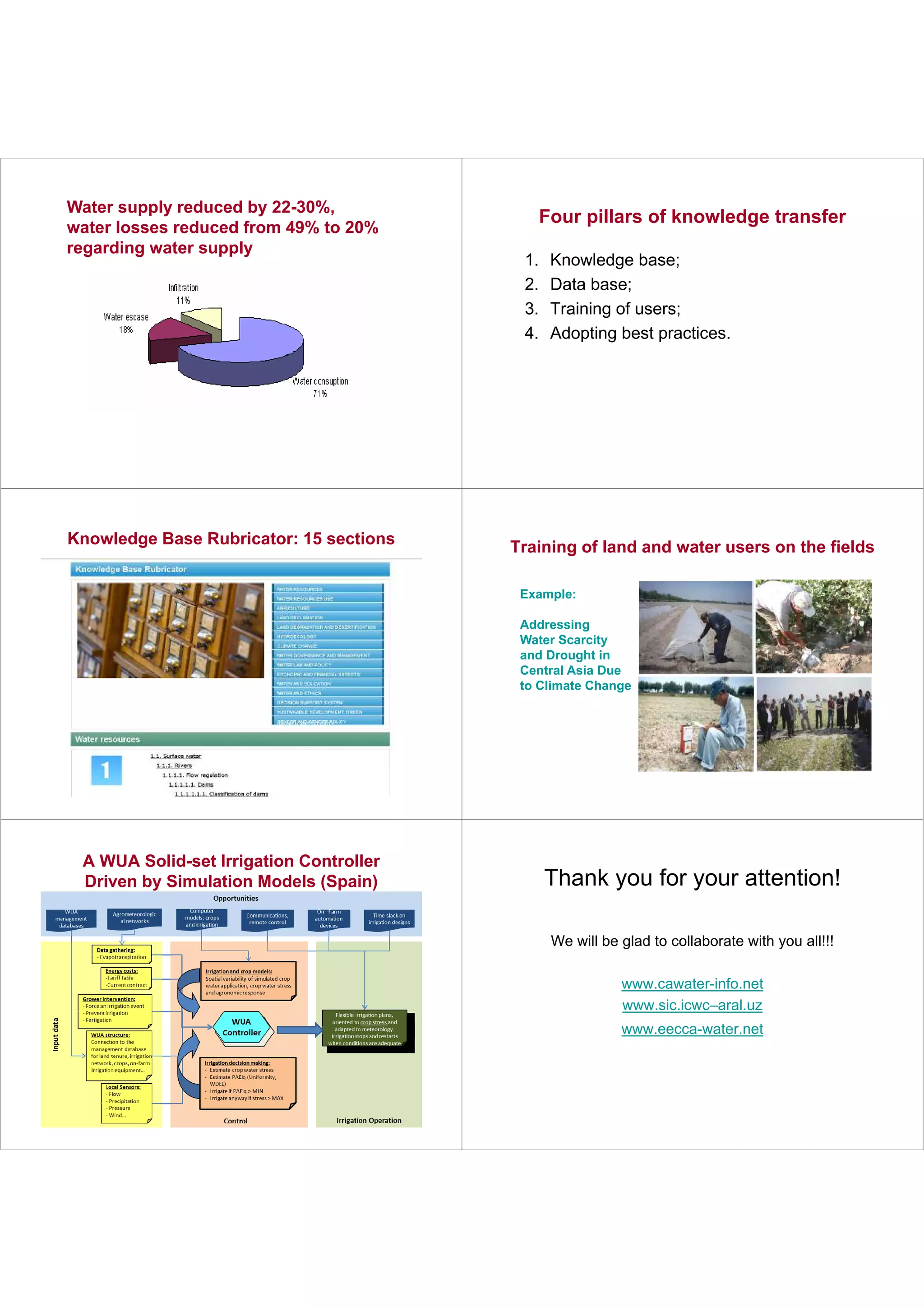
Water supply reduced by 22-30%, 
water losses reduced from 49% to 20% 
regarding water supply 
Four pillars of knowledge transfer 
1. Knowledge base; 
2. Data base; 
3. Training of users; 
4. Adopting best practices. 
Knowledge Base Rubricator: 15 sections 
Training of land and water users on the fields 
Example: 
Addressing 
Water Scarcity 
and Drought in 
Central Asia Due 
to Climate Change 
A WUA Solid-set Irrigation Controller 
Driven by Simulation Models (Spain) Thank you for your attention! 
We will be glad to collaborate with you all!!! 
www.cawater-info.net 
www.sic.icwc–aral.uz 
www.eecca-water.net

Capacity building and human resources development

  • 1.
    Capacity building andhuman resources development to foster implementation of scientific innovations in agrarian system of dry lands in Central Asia Prof. V.A. Dukhovny Director Scientific Information Center of Interstate Commission for Water Coordination in Central Asia Tashkent 28-30 April 2014 ICARDA meeting The Aral Sea Basin ri Principal challenges and potential risks in Central Asia • Climate change impact: reduced flow, severity of extreme events; • Demographic pressure – population growth 1.2 – 1.8% year; • Land degradation; • Poor water management; • Competition between power and irrigation; • Ongoing restructurization of agrarian farming; • Instability of market and prices. Transboundary water challenges Irrigation/Food Energy/Hydropower Environmental degradation Climate Change Drinking water and health Geopolitical situation and Afghanistan Regional climate scenarios for 2030 year Received on base of equations of link between global and regional temperature. Model results for assessment of greenhouse gases impact and climate change (MAGICC) for six options of greenhouse gases emission suggested by MGEIK (IS92a-IS92f) are used as global temperature scenario evaluation. Scenarios are twinned in pairs: сd, ab, ef (Hydromet data) For Uzbekistan mean annual air temperature increase by 1,0-2,5°С is expected in case of emission scenario IS92 a,b realization Annual temperatures increased by: • 0.29 0C every 10 years in Uzbekistan (1950–2005); • 0.26 0C every 10 years in Kazakhstan (1936–2005); • 0.18 0C every 10 years in Turkmenistan (1961–1995); • 0.10 0C every 10 years in Tajikistan (1940–2005); • 0.08 0C every 10 years in Kyrgyzstan (1883–2005).
  • 2.
    Food security vis-à-vispopulation growth Таблица 3 Сопоставление населения и роста производства продуктов питания Страна Рост населения, млн. чел. Рост производства продуктов питания Импорт 2011 1998 2003 2008 2013 1998 2003 2008 2013 Казахстан 14,86 14,75 15,57 16,44 5384 6551 8102 7810 9173 Киргизстан 4,82 5,01 5,20 5,55 1348 1647 1732 1827 580,1 Таджикистан 6,01 6,53 7,28 8,21 574 780 1090 1592 496,7 Туркменистан 4,39 4,65 4,92 5,24 988 1927 2668 2446 298,9 Узбекистан 24,17 25,55 27,02 28,93 5165 5867 8119 10920 1181,7 Productivity of rainfed and irrigated lands in Central Asia Валовое производство (пост. 2004-2006 1000 I$) 12000000 10000000 8000000 6000000 4000000 2000000 0 1992 1993 1994 1995 1996 1997 1998 1999 2000 2001 2002 2003 2004 2005 2006 2007 2008 2009 2010 Годы 1000 Int. $ Казахстан ЦАР (искл.Казахстан) What can be expected in 2030? 1870 м3/ capita 2005 Optimistic 1560 м3/capita 1430 м3/ capita Business as usual Pessimistic 2460 м3/capita Evaluation of water resources available for use in the Aral Sea Basin, km3 Combination of climatic and water management scenarios What we have now? On the side of science: • Huge scope of solutions, knowledge, recommendations; • Huge data base on different directions and specifics; • Forecasts and optimizations; • Human potential. On the side of water & land users: • Lack of knowledge; • Lack of experience; • Weakness of governance; • Difficulty in access to data and forecast; • Absence of recommendations.
  • 3.
    What we need? We propose to build: The System of Knowledge Transfer and Risk Management in Irrigated Agriculture built on: • Partnership chain • Content of the system: local farming mapping • Permanent monitoring of changes and risks; • Providing marketing information and recommended crop pattern. Interrelations between key partners of the system Content of system Local farming mapping on the basis of remote sensing to clarify features of local conditions and find reserves to improve farming conditions with orientation at potential productivity, technological cart, drought and salt resistant crops Permanentmonitoring of changes and risks Operational warning through dispatch service and transfer information by mobile connection to farmers; situation Example from Italy: Example from WUA Akbarabad, Uzbekistan Calculation of water use by long-term climatic data and adjustment to climate of a particular year with follow up strong monitoring water delivery Cumulative seasonal plan of water delivery to farms Cumulative seasonal plan of water 430 th м3 delivery to farms 353 th м3 Potential for water saving: 77 th m3 Another reserve: use of margin waters WAY from laboratory to field
  • 4.
    Marketing information Pilotinterventions in the Fergana Valley CAWater-Info www cawater-info.net PRODUCTIVITY OF LANDS IN CREASED ON 116-127% 3 250 mln.m WATER SAVING PER YEAR RESULTS OF Dynamics of water supply to pilot channels IWRM FERGHANA Pilot canal Specific water supply in ths m3/ha 7000 PERSONS TRAINING LEVEL OF UNDERSTANDING MORE THAN 15 THOUSAND PERSONS 2004 2010 Aravan Akbura Canal 8.11 7.88 Khodja-Bakirgan Canal 14.04 7.15 South Fergana Canal 11.35 8.45 Comparison of crop yield dynamics in the Fergana Valley 0 500 1 000 1 500 2 000 2 500 3 000 3 500 4 000 at the end of the period analyzed (2010) 2002-2009 (on average) at the beginning of the period analyzed (2001) Indicator v alue Andijan/Uzbekistan Namangan/Uzbekistan Fergana/Uzbekistan Djalalabad/Kyrgyzstan Sogd/Tajikistan Osh/Kyrgyzstan Water supplied for irrigation is lost through surface outflow from irrigated fields and deep infiltration
  • 5.
    Water supply reducedby 22-30%, water losses reduced from 49% to 20% regarding water supply Four pillars of knowledge transfer 1. Knowledge base; 2. Data base; 3. Training of users; 4. Adopting best practices. Knowledge Base Rubricator: 15 sections Training of land and water users on the fields Example: Addressing Water Scarcity and Drought in Central Asia Due to Climate Change A WUA Solid-set Irrigation Controller Driven by Simulation Models (Spain) Thank you for your attention! We will be glad to collaborate with you all!!! www.cawater-info.net www.sic.icwc–aral.uz www.eecca-water.net