

Liberty
POLITICAL PHILOSOPHY
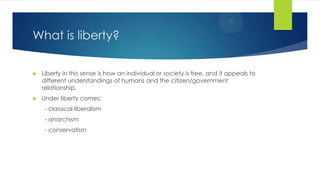
What is liberty?
 Liberty in this sense is how an individual or society is free, and it appeals to
different understandings of humans and the citizen/government
relationship.
 Under liberty comes;
- classical liberalism
- anarchism
- conservatism
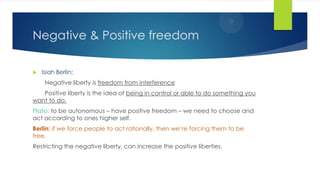
Negative & Positive freedom
 Isiah Berlin;
Negative liberty is freedom from interference
Positive liberty is the idea of being in control or able to do something you
want to do.
Plato: to be autonomous – have positive freedom – we need to choose and
act according to ones higher self.
Berlin: if we force people to act rationally, then we’re forcing them to be
free.
Restricting the negative liberty, can increase the positive liberties.
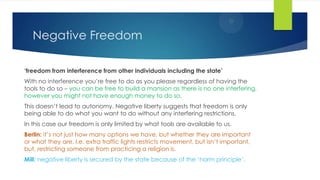
Negative Freedom
‘freedom from interference from other individuals including the state’
With no interference you’re free to do as you please regardless of having the
tools to do so – you can be free to build a mansion as there is no one interfering,
however you might not have enough money to do so.
This doesn’t lead to autonomy. Negative liberty suggests that freedom is only
being able to do what you want to do without any interfering restrictions.
In this case our freedom is only limited by what tools are available to us.
Berlin: it’s not just how many options we have, but whether they are important
or what they are. I.e. extra traffic lights restricts movement, but isn’t important,
but, restricting someone from practicing a religion is.
Mill: negative liberty is secured by the state because of the ‘harm principle’.
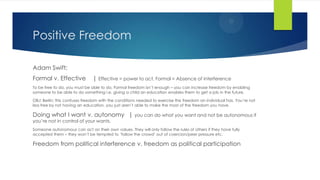
Positive Freedom
Adam Swift;
Formal v. Effective | Effective = power to act, Formal = Absence of interference
To be free to do, you must be able to do. Formal freedom isn’t enough – you can increase freedom by enabling
someone to be able to do something i.e. giving a child an education enables them to get a job in the future.
OBJ: Berlin: this confuses freedom with the conditions needed to exercise the freedom an individual has. You’re not
less free by not having an education, you just aren’t able to make the most of the freedom you have.
Doing what I want v. autonomy | you can do what you want and not be autonomous if
you’re not in control of your wants.
Someone autonomous can act on their own values. They will only follow the rules of others if they have fully
accepted them – they won’t be tempted to ‘follow the crowd’ out of coercion/peer pressure etc.
Freedom from political interference v. freedom as political participation
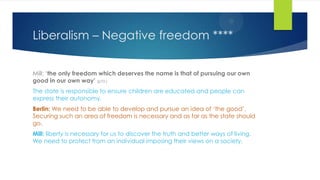
Liberalism – Negative freedom ****
Mill: ‘the only freedom which deserves the name is that of pursuing our own
good in our own way’ (p72.)
The state is responsible to ensure children are educated and people can
express their autonomy.
Berlin: We need to be able to develop and pursue an idea of ‘the good’.
Securing such an area of freedom is necessary and as far as the state should
go.
Mill: liberty is necessary for us to discover the truth and better ways of living.
We need to protect from an individual imposing their views on a society.
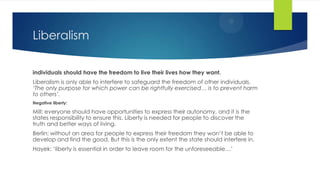
Liberalism
individuals should have the freedom to live their lives how they want.
Liberalism is only able to interfere to safeguard the freedom of other individuals.
‘The only purpose for which power can be rightfully exercised… is to prevent harm
to others’.
Negative liberty:
Mill: everyone should have opportunities to express their autonomy, and it is the
states responsibility to ensure this. Liberty is needed for people to discover the
truth and better ways of living.
Berlin: without an area for people to express their freedom they won’t be able to
develop and find the good. But this is the only extent the state should interfere in.
Hayek: ‘liberty is essential in order to leave room for the unforeseeable…’
Liberty

Liberty

  • 1.
  • 2.
    What is liberty? Liberty in this sense is how an individual or society is free, and it appeals to different understandings of humans and the citizen/government relationship.  Under liberty comes; - classical liberalism - anarchism - conservatism
  • 3.
    Negative & Positivefreedom  Isiah Berlin; Negative liberty is freedom from interference Positive liberty is the idea of being in control or able to do something you want to do. Plato: to be autonomous – have positive freedom – we need to choose and act according to ones higher self. Berlin: if we force people to act rationally, then we’re forcing them to be free. Restricting the negative liberty, can increase the positive liberties.
  • 4.
    Negative Freedom ‘freedom frominterference from other individuals including the state’ With no interference you’re free to do as you please regardless of having the tools to do so – you can be free to build a mansion as there is no one interfering, however you might not have enough money to do so. This doesn’t lead to autonomy. Negative liberty suggests that freedom is only being able to do what you want to do without any interfering restrictions. In this case our freedom is only limited by what tools are available to us. Berlin: it’s not just how many options we have, but whether they are important or what they are. I.e. extra traffic lights restricts movement, but isn’t important, but, restricting someone from practicing a religion is. Mill: negative liberty is secured by the state because of the ‘harm principle’.
  • 5.
    Positive Freedom Adam Swift; Formalv. Effective | Effective = power to act, Formal = Absence of interference To be free to do, you must be able to do. Formal freedom isn’t enough – you can increase freedom by enabling someone to be able to do something i.e. giving a child an education enables them to get a job in the future. OBJ: Berlin: this confuses freedom with the conditions needed to exercise the freedom an individual has. You’re not less free by not having an education, you just aren’t able to make the most of the freedom you have. Doing what I want v. autonomy | you can do what you want and not be autonomous if you’re not in control of your wants. Someone autonomous can act on their own values. They will only follow the rules of others if they have fully accepted them – they won’t be tempted to ‘follow the crowd’ out of coercion/peer pressure etc. Freedom from political interference v. freedom as political participation
  • 6.
    Liberalism – Negativefreedom **** Mill: ‘the only freedom which deserves the name is that of pursuing our own good in our own way’ (p72.) The state is responsible to ensure children are educated and people can express their autonomy. Berlin: We need to be able to develop and pursue an idea of ‘the good’. Securing such an area of freedom is necessary and as far as the state should go. Mill: liberty is necessary for us to discover the truth and better ways of living. We need to protect from an individual imposing their views on a society.
  • 7.
    Liberalism individuals should havethe freedom to live their lives how they want. Liberalism is only able to interfere to safeguard the freedom of other individuals. ‘The only purpose for which power can be rightfully exercised… is to prevent harm to others’. Negative liberty: Mill: everyone should have opportunities to express their autonomy, and it is the states responsibility to ensure this. Liberty is needed for people to discover the truth and better ways of living. Berlin: without an area for people to express their freedom they won’t be able to develop and find the good. But this is the only extent the state should interfere in. Hayek: ‘liberty is essential in order to leave room for the unforeseeable…’