By Abhinandan Kaul
 The word “Liberty” has been derived from Latin word
“Liber”.
 Liberty has 3 connotations-
1) Choice
2) Absence of Constraints
3) Conditions for Existence
“Liberty is a concept about
whose nature men have
quarreled perhaps more than
about any other”
Two Cateogries of Liberty-
1) Freedom as non-commitment-
One’s freedom to choose between certain
alternatives, uncommitted by prior decision or
obligation
2) Freedom as non-obstruction-
The freedom to enact the choice one has
made in any instance.
As long as one has not yet deliberated and
formed a decision between certain alternatives,
one is free to do one or another of the
alternatives. The very fact of deliberating and
making up one’s mind means that that freedom
is lost.
“Freedom signifies the absence of all
impediments to action that aren’t contained in
the nature and intrinsic quality of the agent.”
-Thomas Hobbes
 When the impediments to motion are external, then an entity
is said to lack freedom.
 When the impediments to motion are internal, an entity is
said to lack power.
 For choice to be exercised in exercise of Liberty,
existence conditions have to exist. Such
conditions can include material resources as well
as a moral framework, both of which find place
in John Locke’s understanding of Liberty.
 Locke understands liberty as choice exercised in
a moral framework. The moral framework is
based on the Laws of Nature of which equality is
a major tenet.
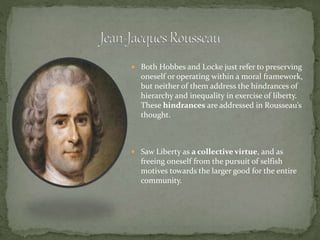
 Both Hobbes and Locke just refer to preserving
oneself or operating within a moral framework,
but neither of them address the hindrances of
hierarchy and inequality in exercise of liberty.
These hindrances are addressed in Rousseau’s
thought.
 Saw Liberty as a collective virtue, and as
freeing oneself from the pursuit of selfish
motives towards the larger good for the entire
community.
“A free people obeys, but
does not serve, has leaders
but no masters, it obeys
laws, and it is due to the
strength of laws that it is
not forced to obey man.”
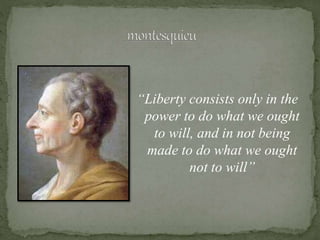
“Liberty consists only in the
power to do what we ought
to will, and in not being
made to do what we ought
not to will”
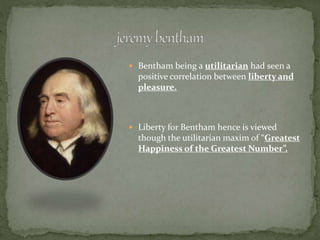
 Bentham being a utilitarian had seen a
positive correlation between liberty and
pleasure.
 Liberty for Bentham hence is viewed
though the utilitarian maxim of “Greatest
Happiness of the Greatest Number”.
1) Such a notion of liberty isn’t accompanied
by a sense of moral responsibility.
2) Secondly, it violates the “Harm
principle”
3) Thirdly, the utilitarian maxim of the
“Greatest Happiness to Greatest
Number” is violated.
 What defines human nature is the
ability to express creativity, and the
circumstances that create situations
of inability of expression of self are
those that deny liberty.
 Marx held capitalism responsible
for the lack of opportunities of self
realization.
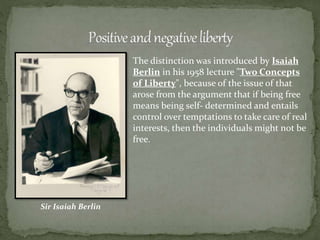
 The distinction was introduced by Isaiah
Berlin in his 1958 lecture "Two Concepts
of Liberty", because of the issue of that
arose from the argument that if being free
means being self- determined and entails
control over temptations to take care of real
interests, then the individuals might not be
free.
Sir Isaiah Berlin
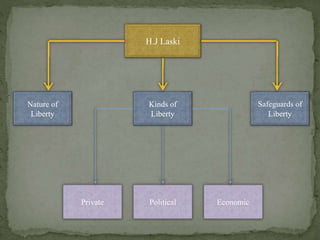
 The most comprehensive views on
Positive Liberty were expressed by H.J
Laski in his book ‘A Grammar of
Politics’.
 His views can be discussed on three
premises:
(i) Nature of liberty.
(ii) Kinds of liberty.
(iii) Safeguards to liberty.
H.J. Laski
H.J Laski
Nature of
Liberty
Safeguards of
Liberty
Kinds of
Liberty
Political Economic
Private
 On the whole Mill's concept of
Liberty was negative and based
upon non interference.
 He objected to social control over
what he regarded as the self
regarding activities of the
individual because he considered
all restraints as evil.
John Stuart Mill
•The relationship between liberty and democracy is complex, as
being part of a democracy entails limiting certain personal liberties
at the expense of democratic principles, while people safeguard their
individual liberties by putting limitations on democracy.
•Liberty is an integral part of democracy and helps in upholding the
democratic character of a sate, both are mutually compatible and
inextricably linked with each other.
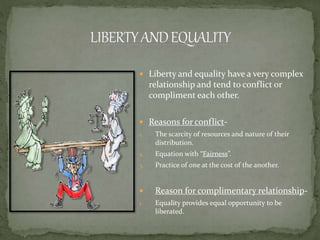
 Liberty and equality have a very complex
relationship and tend to conflict or
compliment each other.
 Reasons for conflict-
1. The scarcity of resources and nature of their
distribution.
2. Equation with “Fairness”.
3. Practice of one at the cost of the another.
 Reason for complimentary relationship-
1. Equality provides equal opportunity to be
liberated.
1. Bhargava Rajeev and Acharya , Ashok (Editors)- Political Theory An
Introduction, Pearson Education, Delhi, 2008
2. Haywood Andrew- Political Theory- An Introduction, Palgrave
Macmillan, New York, 2004.
3. Haywood Andrew- Key Concepts in Politics, Palgrave Macmillan,
New York, 2000.
4. Thomson David- Political Ideas, Pelican Books, Great Britain 1969.
5. www.jstore.org

Presentation On Liberty

  • 1.
  • 2.
     The word“Liberty” has been derived from Latin word “Liber”.  Liberty has 3 connotations- 1) Choice 2) Absence of Constraints 3) Conditions for Existence
  • 3.
    “Liberty is aconcept about whose nature men have quarreled perhaps more than about any other”
  • 4.
    Two Cateogries ofLiberty- 1) Freedom as non-commitment- One’s freedom to choose between certain alternatives, uncommitted by prior decision or obligation 2) Freedom as non-obstruction- The freedom to enact the choice one has made in any instance.
  • 5.
    As long asone has not yet deliberated and formed a decision between certain alternatives, one is free to do one or another of the alternatives. The very fact of deliberating and making up one’s mind means that that freedom is lost.
  • 6.
    “Freedom signifies theabsence of all impediments to action that aren’t contained in the nature and intrinsic quality of the agent.” -Thomas Hobbes
  • 7.
     When theimpediments to motion are external, then an entity is said to lack freedom.  When the impediments to motion are internal, an entity is said to lack power.
  • 8.
     For choiceto be exercised in exercise of Liberty, existence conditions have to exist. Such conditions can include material resources as well as a moral framework, both of which find place in John Locke’s understanding of Liberty.  Locke understands liberty as choice exercised in a moral framework. The moral framework is based on the Laws of Nature of which equality is a major tenet.
  • 9.
     Both Hobbesand Locke just refer to preserving oneself or operating within a moral framework, but neither of them address the hindrances of hierarchy and inequality in exercise of liberty. These hindrances are addressed in Rousseau’s thought.  Saw Liberty as a collective virtue, and as freeing oneself from the pursuit of selfish motives towards the larger good for the entire community.
  • 10.
    “A free peopleobeys, but does not serve, has leaders but no masters, it obeys laws, and it is due to the strength of laws that it is not forced to obey man.”
  • 12.
    “Liberty consists onlyin the power to do what we ought to will, and in not being made to do what we ought not to will”
  • 13.
     Bentham beinga utilitarian had seen a positive correlation between liberty and pleasure.  Liberty for Bentham hence is viewed though the utilitarian maxim of “Greatest Happiness of the Greatest Number”.
  • 14.
    1) Such anotion of liberty isn’t accompanied by a sense of moral responsibility. 2) Secondly, it violates the “Harm principle” 3) Thirdly, the utilitarian maxim of the “Greatest Happiness to Greatest Number” is violated.
  • 15.
     What defineshuman nature is the ability to express creativity, and the circumstances that create situations of inability of expression of self are those that deny liberty.  Marx held capitalism responsible for the lack of opportunities of self realization.
  • 16.
     The distinctionwas introduced by Isaiah Berlin in his 1958 lecture "Two Concepts of Liberty", because of the issue of that arose from the argument that if being free means being self- determined and entails control over temptations to take care of real interests, then the individuals might not be free. Sir Isaiah Berlin
  • 18.
     The mostcomprehensive views on Positive Liberty were expressed by H.J Laski in his book ‘A Grammar of Politics’.  His views can be discussed on three premises: (i) Nature of liberty. (ii) Kinds of liberty. (iii) Safeguards to liberty. H.J. Laski
  • 19.
    H.J Laski Nature of Liberty Safeguardsof Liberty Kinds of Liberty Political Economic Private
  • 20.
     On thewhole Mill's concept of Liberty was negative and based upon non interference.  He objected to social control over what he regarded as the self regarding activities of the individual because he considered all restraints as evil. John Stuart Mill
  • 21.
    •The relationship betweenliberty and democracy is complex, as being part of a democracy entails limiting certain personal liberties at the expense of democratic principles, while people safeguard their individual liberties by putting limitations on democracy. •Liberty is an integral part of democracy and helps in upholding the democratic character of a sate, both are mutually compatible and inextricably linked with each other.
  • 22.
     Liberty andequality have a very complex relationship and tend to conflict or compliment each other.  Reasons for conflict- 1. The scarcity of resources and nature of their distribution. 2. Equation with “Fairness”. 3. Practice of one at the cost of the another.  Reason for complimentary relationship- 1. Equality provides equal opportunity to be liberated.
  • 23.
    1. Bhargava Rajeevand Acharya , Ashok (Editors)- Political Theory An Introduction, Pearson Education, Delhi, 2008 2. Haywood Andrew- Political Theory- An Introduction, Palgrave Macmillan, New York, 2004. 3. Haywood Andrew- Key Concepts in Politics, Palgrave Macmillan, New York, 2000. 4. Thomson David- Political Ideas, Pelican Books, Great Britain 1969. 5. www.jstore.org