
Dr. Vikas Khokhar
 Word Liberty derived from the Latin word
‘liber’ means freedom.
 Liberty is a term used to describe the state of
being free within society from oppressive
restrictions imposed by authority on one's
way of life, behavior, or political views.
 It refers to the state of being free from
external constraints or limitations that would
prevent individuals from pursuing their
interests, goals, and desires.
 Seely - “Liberty is the opposite of over
government.”
 Gettel- “Liberty is the positive power of
doing and enjoying those things which are
worthy of enjoyment and work.”
 Mckechnie - “Freedom is not the absence of
all restraints but rather is substitution of
rational ones for the irrational.”
 Laski - “Liberty is the large maintenance of
the atmosphere in which men have the
opportunity to be their best selves.”
 Cole - “ Liberty is the freedom of the
individual to express without external
hindrances to his personality.”
 Herbert Spencer - “Every man is free to do
what he wishes, provided he infringes not the
equal freedom of any other man.
 John Locke - "Liberty consists in the power of
doing that which is permitted by the law."
 John Stuart Mill - "The only freedom which
deserves the name is that of pursuing our
own good in our own way, so long as we do
not attempt to deprive others of theirs or
impede their efforts to obtain it."
 George Bernard Shaw - "Liberty means
responsibility. That is why most men dread
it."
 Lord Acton - "Liberty is the prevention of
control by others."
 Isaiah Berlin - Negative liberty is the absence
of external constraints, while positive liberty
is the ability to control one's own life and
achieve one's goals
 "Liberty consists in the power of doing that
which is permitted by the law." – Cicero.
 "Liberty is the right to do what the law
permits." - Charles de Montesquieu.
1. Absence of some constraints.
2. Liberty is a right.
3. Liberty in not absolute.
4. Liberty requires some condition.
5. Over government is opposite to liberty.
6. Liberty consists in self realization.
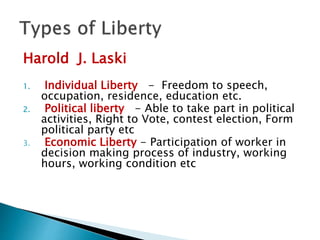
Harold J. Laski
1. Individual Liberty - Freedom to speech,
occupation, residence, education etc.
2. Political liberty - Able to take part in political
activities, Right to Vote, contest election, Form
political party etc
3. Economic Liberty - Participation of worker in
decision making process of industry, working
hours, working condition etc
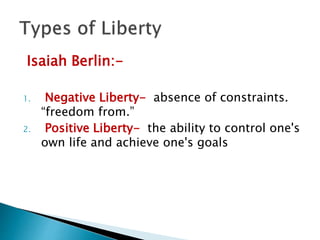
Isaiah Berlin:-
1. Negative Liberty- absence of constraints.
“freedom from.”
2. Positive Liberty- the ability to control one's
own life and achieve one's goals
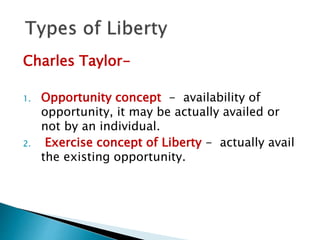
Charles Taylor-
1. Opportunity concept - availability of
opportunity, it may be actually availed or
not by an individual.
2. Exercise concept of Liberty - actually avail
the existing opportunity.
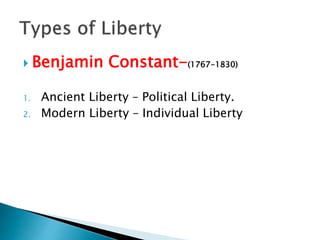
 Benjamin Constant-(1767-1830)
1. Ancient Liberty – Political Liberty.
2. Modern Liberty – Individual Liberty
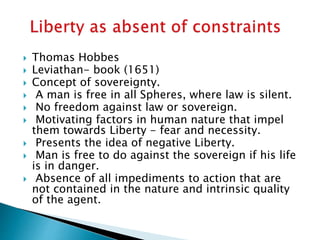
 Thomas Hobbes
 Leviathan- book (1651)
 Concept of sovereignty.
 A man is free in all Spheres, where law is silent.
 No freedom against law or sovereign.
 Motivating factors in human nature that impel
them towards Liberty - fear and necessity.
 Presents the idea of negative Liberty.
 Man is free to do against the sovereign if his life
is in danger.
 Absence of all impediments to action that are
not contained in the nature and intrinsic quality
of the agent.
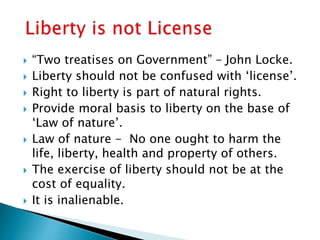
 “Two treatises on Government” – John Locke.
 Liberty should not be confused with ‘license’.
 Right to liberty is part of natural rights.
 Provide moral basis to liberty on the base of
‘Law of nature’.
 Law of nature - No one ought to harm the
life, liberty, health and property of others.
 The exercise of liberty should not be at the
cost of equality.
 It is inalienable.
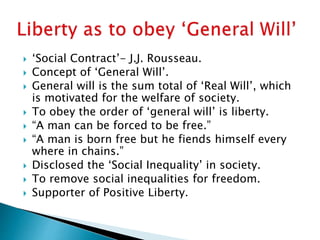
 ‘Social Contract’- J.J. Rousseau.
 Concept of ‘General Will’.
 General will is the sum total of ‘Real Will’, which
is motivated for the welfare of society.
 To obey the order of ‘general will’ is liberty.
 “A man can be forced to be free.”
 “A man is born free but he fiends himself every
where in chains.”
 Disclosed the ‘Social Inequality’ in society.
 To remove social inequalities for freedom.
 Supporter of Positive Liberty.
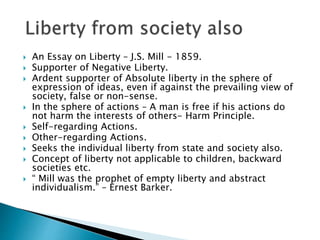
 An Essay on Liberty – J.S. Mill - 1859.
 Supporter of Negative Liberty.
 Ardent supporter of Absolute liberty in the sphere of
expression of ideas, even if against the prevailing view of
society, false or non-sense.
 In the sphere of actions – A man is free if his actions do
not harm the interests of others- Harm Principle.
 Self-regarding Actions.
 Other-regarding Actions.
 Seeks the individual liberty from state and society also.
 Concept of liberty not applicable to children, backward
societies etc.
 “ Mill was the prophet of empty liberty and abstract
individualism.” – Ernest Barker.
 “A Grammar of Politics” -Harold J. Laski
 Three levels of Liberty:-
1. Nature of Liberty- Availability of opportunity,
Environment for exercise of liberty, Laws to
regulate Behaviour.
2. Forms of Liberty- Individual, Political &
Economic.
3. Safeguards of liberty- End of privileges,
Presence of Rights & Responsible Govt.
 “Two concepts of Liberty”- Isaiah Berlin .
 Negative & Positive Liberty.
 Negative Liberty – If one is not prevented by
others to attain his goals.
 Positive Liberty – Individual is own master.
 State can provide only negative liberty,
Positive liberty is beyond the scope of the
state.
 ‘If one can not fly like an eagle or swim like a
whale, one is by no means deprived of
political liberty on his count.’
 The existing social inequalities can not be
questioned from the point of view of liberty.
 Freedom of the opportunity to act, not action
itself.
 Liberty is not related to Democracy, Equality
and justice.
 For the welfare of people or Justice, Liberty
can not be redistributed.
 Criticized by C. B. Macpherson in his book –
‘Democratic Theory: Essay on Retrieval’.
 ‘Capitalism and freedom’ – Milton Friedman-
1962.
 Capitalism or competitive market society is a
necessary condition of Liberty.
 To develop equality, freedom can not be
sacrifice.
 Supporter of negative freedom.
 To maximize freedom government should
handle only those matters, which cannot be
handled by market.
 ‘ Anarchy, State and Utopia’ - Robert Nozick -1974.
 Redefine social contract theory of the origin of state
of John Locke.
 On basis of this theory Nozick says that state is for
the protection of individual property.
 Acquisition of property without force or fraud is just
which should not be re-distributed to remove
inequalities.
 All inequalities of the wealth and power due to
different level of talent and efforts of individuals.
 Supporter of negative Liberty.
 ‘Constitution of Liberty’ - F. A. Hayek -1960 .
 Individual freedom is the absence of coercion on
one people by the arbitrary will of another.
 This meaning of freedom should not be confused
with other type of freedom- political freedom
inner freedom and freedom as power.
 Political freedom is neither a necessary condition
of freedom.
 It is better that many should have full freedom
than that all should have a limited freedom.
 Marxist view of Liberty.
 Positive aspect of Liberty.
 Liberty is the end of elimination, exploitation and
meet necessities.
 Emphasis on ‘Exercise concept of Liberty’.
 ‘Economic and Philosophical manuscripts’ - 1844
- Ideas of Young Marx.
 Criticize capitalism on the basis of humanitarian
ideas.
 Liberty is the ‘self realization’ of Individual.
 Reject the atomistic view of the individual.
Individual can get freedom only in society.
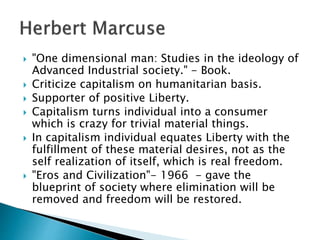
 "One dimensional man: Studies in the ideology of
Advanced Industrial society." - Book.
 Criticize capitalism on humanitarian basis.
 Supporter of positive Liberty.
 Capitalism turns individual into a consumer
which is crazy for trivial material things.
 In capitalism individual equates Liberty with the
fulfillment of these material desires, not as the
self realization of itself, which is real freedom.
 "Eros and Civilization"- 1966 - gave the
blueprint of society where elimination will be
removed and freedom will be restored.
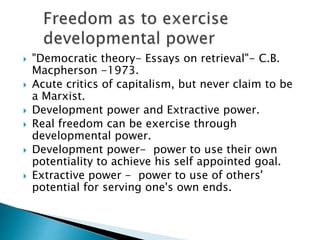
 "Democratic theory- Essays on retrieval"- C.B.
Macpherson -1973.
 Acute critics of capitalism, but never claim to be
a Marxist.
 Development power and Extractive power.
 Real freedom can be exercise through
developmental power.
 Development power- power to use their own
potentiality to achieve his self appointed goal.
 Extractive power - power to use of others'
potential for serving one's own ends.
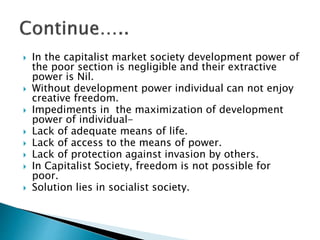
 In the capitalist market society development power of
the poor section is negligible and their extractive
power is Nil.
 Without development power individual can not enjoy
creative freedom.
 Impediments in the maximization of development
power of individual-
 Lack of adequate means of life.
 Lack of access to the means of power.
 Lack of protection against invasion by others.
 In Capitalist Society, freedom is not possible for
poor.
 Solution lies in socialist society.
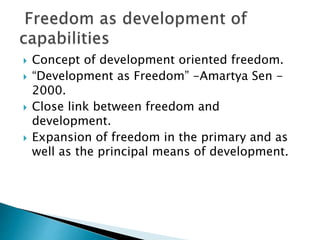
 Concept of development oriented freedom.
 “Development as Freedom” -Amartya Sen -
2000.
 Close link between freedom and
development.
 Expansion of freedom in the primary and as
well as the principal means of development.
 Charles Taylor
1. “Opportunity concept of freedom”.
2. “Exercise concept of freedom”.
 Freedom is the self realization of individual.
 Pure opportunity concept of freedom
inadequate to attain freedom inclusive of self
realization.
 Merely exercising freedom does not lead to
the attainment of self realization.
 One is not free if one is motivated through
fear or false consciousness.
 Gerald MacCallum - Freedom is a ‘Triadic
relationship’.
 X is free from Y to do or become Z.
 No simple dichotomy between positive and
negative Liberty.
1. Morality of Freedom – Joseph Raz – 1986.
2. Freedom from Fear – Aung sang Su Ki –
1990.
3. Long Walk to Freedom – Nelson Mandela –
1995.
4. 'Escape from freedom' - Eric Fromm-1941.
5. John Locke: "Where there is no law, there is
no freedom.“
6. Jean-Jacques Rousseau: "Man is born free,
and everywhere he is in chains."
 Immanuel Kant: "The freedom of one person
can never be a mere means to the satisfaction
of the arbitrary will of another."
Thank You

LIBERTY.pptx

  • 1.
  • 2.
     Word Libertyderived from the Latin word ‘liber’ means freedom.  Liberty is a term used to describe the state of being free within society from oppressive restrictions imposed by authority on one's way of life, behavior, or political views.  It refers to the state of being free from external constraints or limitations that would prevent individuals from pursuing their interests, goals, and desires.
  • 3.
     Seely -“Liberty is the opposite of over government.”  Gettel- “Liberty is the positive power of doing and enjoying those things which are worthy of enjoyment and work.”  Mckechnie - “Freedom is not the absence of all restraints but rather is substitution of rational ones for the irrational.”
  • 4.
     Laski -“Liberty is the large maintenance of the atmosphere in which men have the opportunity to be their best selves.”  Cole - “ Liberty is the freedom of the individual to express without external hindrances to his personality.”  Herbert Spencer - “Every man is free to do what he wishes, provided he infringes not the equal freedom of any other man.
  • 5.
     John Locke- "Liberty consists in the power of doing that which is permitted by the law."  John Stuart Mill - "The only freedom which deserves the name is that of pursuing our own good in our own way, so long as we do not attempt to deprive others of theirs or impede their efforts to obtain it."
  • 6.
     George BernardShaw - "Liberty means responsibility. That is why most men dread it."  Lord Acton - "Liberty is the prevention of control by others."
  • 7.
     Isaiah Berlin- Negative liberty is the absence of external constraints, while positive liberty is the ability to control one's own life and achieve one's goals  "Liberty consists in the power of doing that which is permitted by the law." – Cicero.  "Liberty is the right to do what the law permits." - Charles de Montesquieu.
  • 8.
    1. Absence ofsome constraints. 2. Liberty is a right. 3. Liberty in not absolute. 4. Liberty requires some condition. 5. Over government is opposite to liberty. 6. Liberty consists in self realization.
  • 9.
    Harold J. Laski 1.Individual Liberty - Freedom to speech, occupation, residence, education etc. 2. Political liberty - Able to take part in political activities, Right to Vote, contest election, Form political party etc 3. Economic Liberty - Participation of worker in decision making process of industry, working hours, working condition etc
  • 10.
    Isaiah Berlin:- 1. NegativeLiberty- absence of constraints. “freedom from.” 2. Positive Liberty- the ability to control one's own life and achieve one's goals
  • 11.
    Charles Taylor- 1. Opportunityconcept - availability of opportunity, it may be actually availed or not by an individual. 2. Exercise concept of Liberty - actually avail the existing opportunity.
  • 12.
     Benjamin Constant-(1767-1830) 1.Ancient Liberty – Political Liberty. 2. Modern Liberty – Individual Liberty
  • 13.
     Thomas Hobbes Leviathan- book (1651)  Concept of sovereignty.  A man is free in all Spheres, where law is silent.  No freedom against law or sovereign.  Motivating factors in human nature that impel them towards Liberty - fear and necessity.  Presents the idea of negative Liberty.  Man is free to do against the sovereign if his life is in danger.  Absence of all impediments to action that are not contained in the nature and intrinsic quality of the agent.
  • 14.
     “Two treatiseson Government” – John Locke.  Liberty should not be confused with ‘license’.  Right to liberty is part of natural rights.  Provide moral basis to liberty on the base of ‘Law of nature’.  Law of nature - No one ought to harm the life, liberty, health and property of others.  The exercise of liberty should not be at the cost of equality.  It is inalienable.
  • 15.
     ‘Social Contract’-J.J. Rousseau.  Concept of ‘General Will’.  General will is the sum total of ‘Real Will’, which is motivated for the welfare of society.  To obey the order of ‘general will’ is liberty.  “A man can be forced to be free.”  “A man is born free but he fiends himself every where in chains.”  Disclosed the ‘Social Inequality’ in society.  To remove social inequalities for freedom.  Supporter of Positive Liberty.
  • 16.
     An Essayon Liberty – J.S. Mill - 1859.  Supporter of Negative Liberty.  Ardent supporter of Absolute liberty in the sphere of expression of ideas, even if against the prevailing view of society, false or non-sense.  In the sphere of actions – A man is free if his actions do not harm the interests of others- Harm Principle.  Self-regarding Actions.  Other-regarding Actions.  Seeks the individual liberty from state and society also.  Concept of liberty not applicable to children, backward societies etc.  “ Mill was the prophet of empty liberty and abstract individualism.” – Ernest Barker.
  • 17.
     “A Grammarof Politics” -Harold J. Laski  Three levels of Liberty:- 1. Nature of Liberty- Availability of opportunity, Environment for exercise of liberty, Laws to regulate Behaviour. 2. Forms of Liberty- Individual, Political & Economic. 3. Safeguards of liberty- End of privileges, Presence of Rights & Responsible Govt.
  • 18.
     “Two conceptsof Liberty”- Isaiah Berlin .  Negative & Positive Liberty.  Negative Liberty – If one is not prevented by others to attain his goals.  Positive Liberty – Individual is own master.  State can provide only negative liberty, Positive liberty is beyond the scope of the state.
  • 19.
     ‘If onecan not fly like an eagle or swim like a whale, one is by no means deprived of political liberty on his count.’  The existing social inequalities can not be questioned from the point of view of liberty.  Freedom of the opportunity to act, not action itself.  Liberty is not related to Democracy, Equality and justice.
  • 20.
     For thewelfare of people or Justice, Liberty can not be redistributed.  Criticized by C. B. Macpherson in his book – ‘Democratic Theory: Essay on Retrieval’.
  • 21.
     ‘Capitalism andfreedom’ – Milton Friedman- 1962.  Capitalism or competitive market society is a necessary condition of Liberty.  To develop equality, freedom can not be sacrifice.  Supporter of negative freedom.  To maximize freedom government should handle only those matters, which cannot be handled by market.
  • 22.
     ‘ Anarchy,State and Utopia’ - Robert Nozick -1974.  Redefine social contract theory of the origin of state of John Locke.  On basis of this theory Nozick says that state is for the protection of individual property.  Acquisition of property without force or fraud is just which should not be re-distributed to remove inequalities.  All inequalities of the wealth and power due to different level of talent and efforts of individuals.  Supporter of negative Liberty.
  • 23.
     ‘Constitution ofLiberty’ - F. A. Hayek -1960 .  Individual freedom is the absence of coercion on one people by the arbitrary will of another.  This meaning of freedom should not be confused with other type of freedom- political freedom inner freedom and freedom as power.  Political freedom is neither a necessary condition of freedom.  It is better that many should have full freedom than that all should have a limited freedom.
  • 24.
     Marxist viewof Liberty.  Positive aspect of Liberty.  Liberty is the end of elimination, exploitation and meet necessities.  Emphasis on ‘Exercise concept of Liberty’.  ‘Economic and Philosophical manuscripts’ - 1844 - Ideas of Young Marx.  Criticize capitalism on the basis of humanitarian ideas.  Liberty is the ‘self realization’ of Individual.  Reject the atomistic view of the individual. Individual can get freedom only in society.
  • 25.
     "One dimensionalman: Studies in the ideology of Advanced Industrial society." - Book.  Criticize capitalism on humanitarian basis.  Supporter of positive Liberty.  Capitalism turns individual into a consumer which is crazy for trivial material things.  In capitalism individual equates Liberty with the fulfillment of these material desires, not as the self realization of itself, which is real freedom.  "Eros and Civilization"- 1966 - gave the blueprint of society where elimination will be removed and freedom will be restored.
  • 26.
     "Democratic theory-Essays on retrieval"- C.B. Macpherson -1973.  Acute critics of capitalism, but never claim to be a Marxist.  Development power and Extractive power.  Real freedom can be exercise through developmental power.  Development power- power to use their own potentiality to achieve his self appointed goal.  Extractive power - power to use of others' potential for serving one's own ends.
  • 27.
     In thecapitalist market society development power of the poor section is negligible and their extractive power is Nil.  Without development power individual can not enjoy creative freedom.  Impediments in the maximization of development power of individual-  Lack of adequate means of life.  Lack of access to the means of power.  Lack of protection against invasion by others.  In Capitalist Society, freedom is not possible for poor.  Solution lies in socialist society.
  • 28.
     Concept ofdevelopment oriented freedom.  “Development as Freedom” -Amartya Sen - 2000.  Close link between freedom and development.  Expansion of freedom in the primary and as well as the principal means of development.
  • 29.
     Charles Taylor 1.“Opportunity concept of freedom”. 2. “Exercise concept of freedom”.  Freedom is the self realization of individual.  Pure opportunity concept of freedom inadequate to attain freedom inclusive of self realization.  Merely exercising freedom does not lead to the attainment of self realization.  One is not free if one is motivated through fear or false consciousness.
  • 30.
     Gerald MacCallum- Freedom is a ‘Triadic relationship’.  X is free from Y to do or become Z.  No simple dichotomy between positive and negative Liberty.
  • 31.
    1. Morality ofFreedom – Joseph Raz – 1986. 2. Freedom from Fear – Aung sang Su Ki – 1990. 3. Long Walk to Freedom – Nelson Mandela – 1995. 4. 'Escape from freedom' - Eric Fromm-1941. 5. John Locke: "Where there is no law, there is no freedom.“ 6. Jean-Jacques Rousseau: "Man is born free, and everywhere he is in chains."
  • 32.
     Immanuel Kant:"The freedom of one person can never be a mere means to the satisfaction of the arbitrary will of another."
  • 33.