Economic Base Theory
Presented to: Mam Sana
Presented By: Hamza Paracha (8th Semester)
Introduction
• Introduced by the economic geographer John Alexander in
the mid-1950s
• The Economic base theory tells us that the rate of economic
growth of a region is determined by the amount of the
increase in exports from the region, meaning that through
exporting more goods or preventing fewer imports can help
increase the economic growth of a region.
Introduction cont..
• Economic base theory is the notion that a region’s economy is
divided Into two sectors: the basic and non-basic sectors and
all the economic activities are based on base and non-base
activities.
• All those activities that brings money from outside of the
region are called Basic activities; whereas all other economic
activities in the region are called Non-Basic activities.
Basic Sector
Also known as Export Sector. Consists of firms and
parts of firms whose economic activity is dependent
upon factors external to the local economy i.e. export
markets external to the country and region. Eg.
Manufacturing, agriculture, forestry, fishing, mining,
national govt, hotels/lodging etc.
Non-Basic Sector
• Also known as Local Sector. Consists of firms and
parts of firms whose economic activity is
dependent largely on local economic conditions Eg.
retail trade, wholesale trade, local government,
services, construction, transportation,
communication.
Economic base theory Assumptions
• Economic base theory assumes that the export
sector is the primary cause of local economic
growth.
• Economic base theory assumes that all local
economic activities can be assigned to either the
basic or non-basic sector i.e.. any economy activity
is base or non-base (export or local).
Economic base theory
• Economic base theory has several advantages as an
explanation for how the economy works, and how a region
can generate prosperity, and it is easy to explain in a
nontechnical way.
• Regional prosperity is achieved by building up the base
through exporting more goods from the base or preventing
fewer imports.
The Base Multiplier
• It is method for estimating the impact of the basic sector upon the
local economy.
• Formula:
Base multiplier = Total employment
Base employment
• E.g. Basic jobs in a Region (agriculture + tourism + mining etc.) are
100 and non basic jobs (retail + local business etc.) are 200 so the
Total Jobs Basic + non Basic = 300
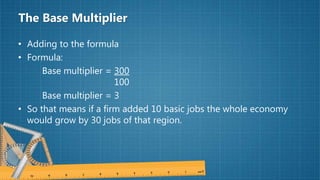
The Base Multiplier
• Adding to the formula
• Formula:
Base multiplier = 300
100
Base multiplier = 3
• So that means if a firm added 10 basic jobs the whole economy
would grow by 30 jobs of that region.
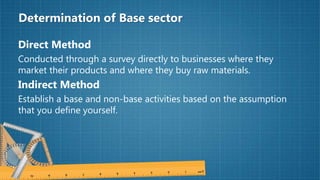
Determination of Base sector
Direct Method
Conducted through a survey directly to businesses where they
market their products and where they buy raw materials.
Indirect Method
Establish a base and non-base activities based on the assumption
that you define yourself.
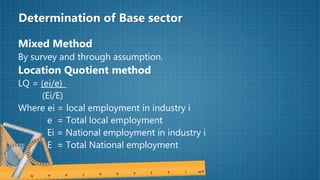
Determination of Base sector
Mixed Method
By survey and through assumption.
Location Quotient method
LQ = (ei/e)
(Ei/E)
Where ei = local employment in industry i
e = Total local employment
Ei = National employment in industry i
E = Total National employment
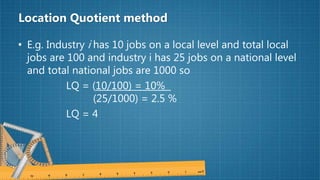
Location Quotient method
• E.g. Industry i has 10 jobs on a local level and total local
jobs are 100 and industry i has 25 jobs on a national level
and total national jobs are 1000 so
LQ = (10/100) = 10%
(25/1000) = 2.5 %
LQ = 4
Location Quotient method
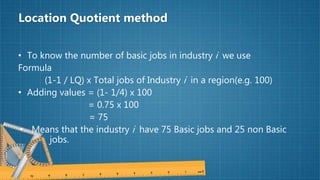
• To know the number of basic jobs in industry i we use
Formula
(1-1 / LQ) x Total jobs of Industry i in a region(e.g. 100)
• Adding values = (1- 1/4) x 100
= 0.75 x 100
= 75
• Means that the industry i have 75 Basic jobs and 25 non Basic
jobs.
Economic base theory

Economic base theory

  • 1.
    Economic Base Theory Presentedto: Mam Sana Presented By: Hamza Paracha (8th Semester)
  • 2.
    Introduction • Introduced bythe economic geographer John Alexander in the mid-1950s • The Economic base theory tells us that the rate of economic growth of a region is determined by the amount of the increase in exports from the region, meaning that through exporting more goods or preventing fewer imports can help increase the economic growth of a region.
  • 3.
    Introduction cont.. • Economicbase theory is the notion that a region’s economy is divided Into two sectors: the basic and non-basic sectors and all the economic activities are based on base and non-base activities. • All those activities that brings money from outside of the region are called Basic activities; whereas all other economic activities in the region are called Non-Basic activities.
  • 4.
    Basic Sector Also knownas Export Sector. Consists of firms and parts of firms whose economic activity is dependent upon factors external to the local economy i.e. export markets external to the country and region. Eg. Manufacturing, agriculture, forestry, fishing, mining, national govt, hotels/lodging etc.
  • 5.
    Non-Basic Sector • Alsoknown as Local Sector. Consists of firms and parts of firms whose economic activity is dependent largely on local economic conditions Eg. retail trade, wholesale trade, local government, services, construction, transportation, communication.
  • 6.
    Economic base theoryAssumptions • Economic base theory assumes that the export sector is the primary cause of local economic growth. • Economic base theory assumes that all local economic activities can be assigned to either the basic or non-basic sector i.e.. any economy activity is base or non-base (export or local).
  • 7.
    Economic base theory •Economic base theory has several advantages as an explanation for how the economy works, and how a region can generate prosperity, and it is easy to explain in a nontechnical way. • Regional prosperity is achieved by building up the base through exporting more goods from the base or preventing fewer imports.
  • 8.
    The Base Multiplier •It is method for estimating the impact of the basic sector upon the local economy. • Formula: Base multiplier = Total employment Base employment • E.g. Basic jobs in a Region (agriculture + tourism + mining etc.) are 100 and non basic jobs (retail + local business etc.) are 200 so the Total Jobs Basic + non Basic = 300
  • 9.
    The Base Multiplier •Adding to the formula • Formula: Base multiplier = 300 100 Base multiplier = 3 • So that means if a firm added 10 basic jobs the whole economy would grow by 30 jobs of that region.
  • 10.
    Determination of Basesector Direct Method Conducted through a survey directly to businesses where they market their products and where they buy raw materials. Indirect Method Establish a base and non-base activities based on the assumption that you define yourself.
  • 11.
    Determination of Basesector Mixed Method By survey and through assumption. Location Quotient method LQ = (ei/e) (Ei/E) Where ei = local employment in industry i e = Total local employment Ei = National employment in industry i E = Total National employment
  • 12.
    Location Quotient method •E.g. Industry i has 10 jobs on a local level and total local jobs are 100 and industry i has 25 jobs on a national level and total national jobs are 1000 so LQ = (10/100) = 10% (25/1000) = 2.5 % LQ = 4
  • 13.
    Location Quotient method •To know the number of basic jobs in industry i we use Formula (1-1 / LQ) x Total jobs of Industry i in a region(e.g. 100) • Adding values = (1- 1/4) x 100 = 0.75 x 100 = 75 • Means that the industry i have 75 Basic jobs and 25 non Basic jobs.