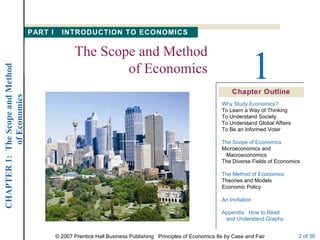
Chapter Outline 1 The Scope and Method of Economics Why Study Economics? To Learn a Way of Thinking To Understand Society To Understand Global Affairs To Be an Informed Voter The Scope of Economics Microeconomics and   Macroeconomics The Diverse Fields of Economics The Method of Economics Theories and Models Economic Policy An Invitation Appendix:  How to Read   and Understand Graphs PART I  INTRODUCTION TO ECONOMICS
THE SCOPE AND METHOD OF ECONOMICS economics  The study of how individuals and societies choose to use the scarce resources that nature and previous generations have provided. Economics is the study of how individuals and societies choose to use the scarce resources that nature and previous generations have provided. The key word in this definition is choose. Economics is a behavioral, or social, science. In large measure it is the study of how people make choices. The choices that people make, when added up, translate into societal choices.
There are four main reasons to study economics: to learn a way of thinking, to understand society, to understand global affairs, and  to be an informed voter. WHY STUDY ECONOMICS?
Three fundamental concepts: Opportunity cost Marginalism , and Efficient markets TO LEARN A WAY OF THINKING WHY STUDY ECONOMICS?
opportunity cost   The best alternative that we forgo, or give up, when we make a choice or a decision. WHY STUDY ECONOMICS? scarce  Limited. Opportunity Cost
WHY STUDY ECONOMICS? marginalism   The process of analyzing the additional or incremental costs or benefits arising from a choice or decision. sunk costs  Costs that cannot be avoided, regardless of what is done in the future, because they have already been incurred. Marginalism and Sunk Costs
WHY STUDY ECONOMICS? efficient market   A market in which profit opportunities are eliminated almost instantaneously. Efficient Markets—No Free Lunch The study of economics teaches us a way of thinking and helps us make decisions.
WHY STUDY ECONOMICS? Industrial Revolution   The period in England during the late eighteenth and early nineteenth centuries in which new manufacturing technologies and improved transportation gave rise to the modern factory system and a massive movement of the population from the countryside to the cities. TO UNDERSTAND SOCIETY The study of economics is an essential part of the study of society.
WHY STUDY ECONOMICS? TO UNDERSTAND GLOBAL AFFAIRS An understanding of economics is essential to an understanding of global affairs. The events of September 11, 2001, dealt a blow to the tourism industry and left airlines in deep financial trouble.
WHY STUDY ECONOMICS? TO BE AN INFORMED VOTER When we participate in the political process, we are voting on issues that require a basic understanding of economics. A knowledge of economics is essential to be an informed voter.
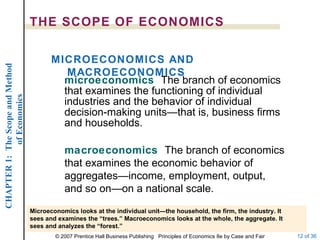
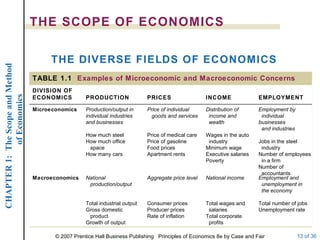
microeconomics   The branch of economics that examines the functioning of individual industries and the behavior of individual decision-making units—that is, business firms and households. THE SCOPE OF ECONOMICS MICROECONOMICS AND MACROECONOMICS macroeconomics   The branch of economics that examines the economic behavior of aggregates—income, employment, output, and so on—on a national scale. Microeconomics looks at the individual unit—the household, the firm, the industry. It sees and examines the “trees.” Macroeconomics looks at the whole, the aggregate. It sees and analyzes the “forest.”
THE SCOPE OF ECONOMICS THE DIVERSE FIELDS OF ECONOMICS Employment by   individual businesses   and industries Jobs in the steel   industry Number of employees   in a firm Number of   accountants Distribution of    income and    wealth Wages in the auto   industry Minimum wage Executive salaries Poverty Price of individual   goods and services   Price of medical care Price of gasoline Food prices Apartment rents Production/output in individual industries and businesses   How much steel How much office   space How many cars Microeconomics Employment and    unemployment in    the economy Total number of jobs Unemployment rate National income Total wages and   salaries   Total corporate   profits Aggregate price level   Consumer prices Producer prices Rate of inflation National    production/output   Total industrial output Gross domestic   product Growth of output Macroeconomics EMPLOYMENT INCOME PRICES PRODUCTION DIVISION OF ECONOMICS TABLE 1.1  Examples of Microeconomic and Macroeconomic Concerns
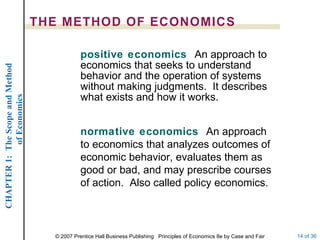
THE METHOD OF ECONOMICS positive economics  An approach to economics that seeks to understand behavior and the operation of systems without making judgments.  It describes what exists and how it works. normative economics  An approach to economics that analyzes outcomes of economic behavior, evaluates them as good or bad, and may prescribe courses of action.  Also called policy economics.
THE METHOD OF ECONOMICS descriptive economics  The compilation of data that describe phenomena and facts. Descriptive Economics and Economic Theory economic theory  A statement or set of related statements about cause and effect, action and reaction.
THE METHOD OF ECONOMICS model  A formal statement of a theory, usually a mathematical statement of a presumed relationship between two or more variables. variable  A measure that can change from time to time or from observation to observation. THEORIES AND MODELS
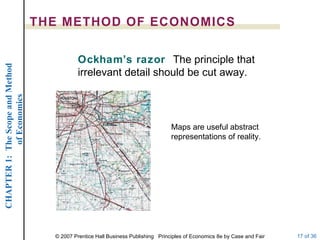
THE METHOD OF ECONOMICS Ockham’s razor  The principle that irrelevant detail should be cut away. Maps are useful abstract representations of reality.
THE METHOD OF ECONOMICS ceteris paribus ,  or  all else equal  A device used to analyze the relationship between two variables while the values of other variables are held unchanged. All Else Equal:  Ceteris Paribus Using the device of ceteris paribus is one part of the process of abstraction. In formulating economic theory, the concept helps us simplify reality to focus on the relationships that interest us.
THE METHOD OF ECONOMICS The most common method of expressing the quantitative relationship between two variables is graphing that relationship on a two-dimensional plane. Expressing Models in Words, Graphs, and Equations
THE METHOD OF ECONOMICS Cautions and Pitfalls The  Post Hoc  Fallacy post hoc, ergo propter hoc   Literally, “after this (in time), therefore because of this.”  A common error made in thinking about causation: If Event A happens before Event B, it is not necessarily true that A caused B.
THE METHOD OF ECONOMICS The Fallacy of Composition fallacy of composition  The erroneous belief that what is true for a part is necessarily true for the whole.
THE METHOD OF ECONOMICS empirical economics  The collection and use of data to test economic theories. Testing Theories and Models:  Empirical Economics
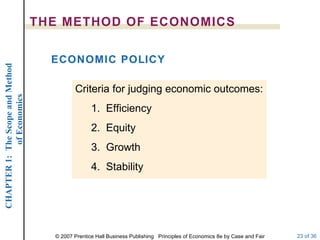
THE METHOD OF ECONOMICS ECONOMIC POLICY Criteria for judging economic outcomes: 1.  Efficiency 2.  Equity 3.  Growth 4.  Stability
THE METHOD OF ECONOMICS efficiency  In economics, allocative efficiency. An efficient economy is one that produces what people want at the least possible cost. Efficiency equity  Fairness. Equity
THE METHOD OF ECONOMICS economic growth  An increase in the total output of an economy. Growth stability  A condition in which national output is growing steadily, with low inflation and full employment of resources. Stability
AN INVITATION As you proceed, it is important that you keep track of what you have learned in earlier chapters. This book has a plan; it proceeds step by step, each section building on the last.  It would be a good idea to read each chapter’s table of contents and scan each chapter before you read it to be sure you understand where it fits in the big picture.
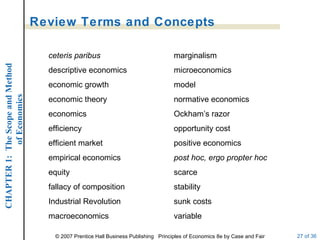
Review Terms and Concepts ceteris paribus descriptive economics economic growth economic theory economics efficiency efficient market empirical economics equity fallacy of composition Industrial Revolution macroeconomics marginalism microeconomics model normative economics Ockham’s razor opportunity cost positive economics post hoc, ergo propter hoc scarce stability sunk costs variable
A  graph  is a two-dimensional representation of a set of numbers, or data. Appendix HOW TO READ AND UNDERSTAND GRAPHS
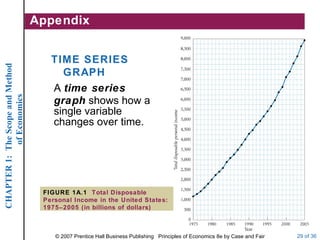
Appendix A  time series graph  shows how a single variable changes over time. TIME SERIES GRAPH FIGURE 1A.1  Total Disposable Personal Income in the United States: 1975–2005 (in billions of dollars)
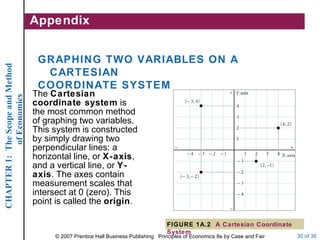
Appendix The  Cartesian coordinate system  is the most common method of graphing two variables. This system is constructed by simply drawing two perpendicular lines: a horizontal line, or  X-axis , and a vertical line, or  Y-axis . The axes contain measurement scales that intersect at 0 (zero). This point is called the  origin . GRAPHING TWO VARIABLES ON A CARTESIAN COORDINATE SYSTEM FIGURE 1A.2  A Cartesian Coordinate System
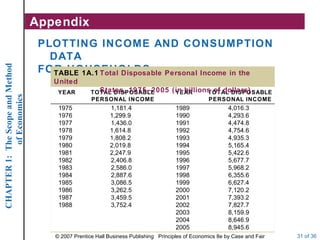
Appendix PLOTTING INCOME AND CONSUMPTION DATA FOR HOUSEHOLDS 4,016.3 4,293.6 4,474.8 4,754.6 4,935.3 5,165.4 5,422.6 5,677.7 5,968.2 6,355.6 6,627.4 7,120.2 7,393.2 7,827.7 8,159.9 8,646.9 8,945.6 1989 1990 1991 1992 1993 1994 1995 1996 1997 1998 1999 2000 2001 2002 2003 2004 2005 1,181.4 1,299.9  1,436.0 1,614.8  1,808.2  2,019.8  2,247.9  2,406.8 2,586.0 2,887.6 3,086.5 3,262.5 3,459.5 3,752.4 1975 1976 1977 1978 1979 1980 1981 1982 1983 1984 1985 1986 1987 1988 TOTAL DISPOSABLE PERSONAL INCOME YEAR TOTAL DISPOSABLE PERSONAL INCOME YEAR TABLE 1A.1 Total Disposable Personal Income in the United States, 1975–2005 (in billions of dollars)
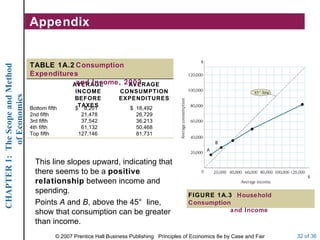
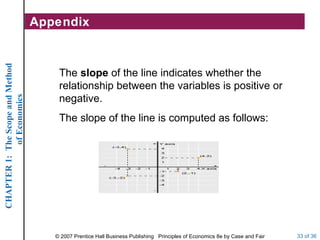
Appendix This line slopes upward, indicating that there seems to be a  positive relationship  between income and spending. Points  A  and  B , above the 45 °  line, show that consumption can be greater than income. FIGURE 1A.3  Household Consumption and Income $  18,492 26,729 36,213 50,468 81,731 $  8,201 21,478 37,542 61,132 127,146 Bottom fifth 2nd fifth 3rd fifth 4th fifth Top fifth AVERAGE CONSUMPTION EXPENDITURES AVERAGE INCOME BEFORE TAXES TABLE 1A.2 Consumption Expenditures and Income, 2003
Appendix The  slope  of the line indicates whether the relationship between the variables is positive or negative. The slope of the line is computed as follows:
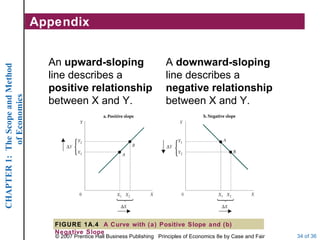
Appendix A  downward-sloping  line describes a  negative relationship  between X and Y. An  upward-sloping  line describes a  positive relationship  between X and Y. FIGURE 1A.4  A Curve with (a) Positive Slope and (b) Negative Slope
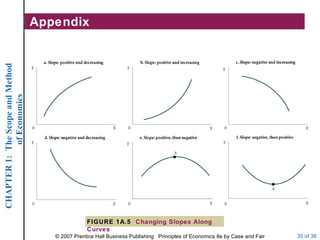
Appendix FIGURE 1A.5  Changing Slopes Along Curves
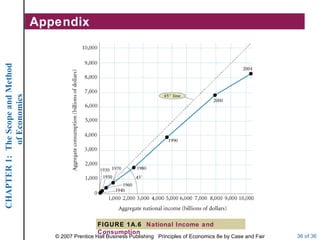
Appendix FIGURE 1A.6  National Income and Consumption

Case Econ08 Ppt 01

  • 1.
  • 2.
    Chapter Outline 1The Scope and Method of Economics Why Study Economics? To Learn a Way of Thinking To Understand Society To Understand Global Affairs To Be an Informed Voter The Scope of Economics Microeconomics and Macroeconomics The Diverse Fields of Economics The Method of Economics Theories and Models Economic Policy An Invitation Appendix: How to Read and Understand Graphs PART I INTRODUCTION TO ECONOMICS
  • 3.
    THE SCOPE ANDMETHOD OF ECONOMICS economics The study of how individuals and societies choose to use the scarce resources that nature and previous generations have provided. Economics is the study of how individuals and societies choose to use the scarce resources that nature and previous generations have provided. The key word in this definition is choose. Economics is a behavioral, or social, science. In large measure it is the study of how people make choices. The choices that people make, when added up, translate into societal choices.
  • 4.
    There are fourmain reasons to study economics: to learn a way of thinking, to understand society, to understand global affairs, and to be an informed voter. WHY STUDY ECONOMICS?
  • 5.
    Three fundamental concepts:Opportunity cost Marginalism , and Efficient markets TO LEARN A WAY OF THINKING WHY STUDY ECONOMICS?
  • 6.
    opportunity cost The best alternative that we forgo, or give up, when we make a choice or a decision. WHY STUDY ECONOMICS? scarce Limited. Opportunity Cost
  • 7.
    WHY STUDY ECONOMICS?marginalism The process of analyzing the additional or incremental costs or benefits arising from a choice or decision. sunk costs Costs that cannot be avoided, regardless of what is done in the future, because they have already been incurred. Marginalism and Sunk Costs
  • 8.
    WHY STUDY ECONOMICS?efficient market A market in which profit opportunities are eliminated almost instantaneously. Efficient Markets—No Free Lunch The study of economics teaches us a way of thinking and helps us make decisions.
  • 9.
    WHY STUDY ECONOMICS?Industrial Revolution The period in England during the late eighteenth and early nineteenth centuries in which new manufacturing technologies and improved transportation gave rise to the modern factory system and a massive movement of the population from the countryside to the cities. TO UNDERSTAND SOCIETY The study of economics is an essential part of the study of society.
  • 10.
    WHY STUDY ECONOMICS?TO UNDERSTAND GLOBAL AFFAIRS An understanding of economics is essential to an understanding of global affairs. The events of September 11, 2001, dealt a blow to the tourism industry and left airlines in deep financial trouble.
  • 11.
    WHY STUDY ECONOMICS?TO BE AN INFORMED VOTER When we participate in the political process, we are voting on issues that require a basic understanding of economics. A knowledge of economics is essential to be an informed voter.
  • 12.
    microeconomics The branch of economics that examines the functioning of individual industries and the behavior of individual decision-making units—that is, business firms and households. THE SCOPE OF ECONOMICS MICROECONOMICS AND MACROECONOMICS macroeconomics The branch of economics that examines the economic behavior of aggregates—income, employment, output, and so on—on a national scale. Microeconomics looks at the individual unit—the household, the firm, the industry. It sees and examines the “trees.” Macroeconomics looks at the whole, the aggregate. It sees and analyzes the “forest.”
  • 13.
    THE SCOPE OFECONOMICS THE DIVERSE FIELDS OF ECONOMICS Employment by individual businesses and industries Jobs in the steel industry Number of employees in a firm Number of accountants Distribution of income and wealth Wages in the auto industry Minimum wage Executive salaries Poverty Price of individual goods and services   Price of medical care Price of gasoline Food prices Apartment rents Production/output in individual industries and businesses   How much steel How much office space How many cars Microeconomics Employment and unemployment in the economy Total number of jobs Unemployment rate National income Total wages and salaries   Total corporate profits Aggregate price level   Consumer prices Producer prices Rate of inflation National production/output   Total industrial output Gross domestic product Growth of output Macroeconomics EMPLOYMENT INCOME PRICES PRODUCTION DIVISION OF ECONOMICS TABLE 1.1 Examples of Microeconomic and Macroeconomic Concerns
  • 14.
    THE METHOD OFECONOMICS positive economics An approach to economics that seeks to understand behavior and the operation of systems without making judgments. It describes what exists and how it works. normative economics An approach to economics that analyzes outcomes of economic behavior, evaluates them as good or bad, and may prescribe courses of action. Also called policy economics.
  • 15.
    THE METHOD OFECONOMICS descriptive economics The compilation of data that describe phenomena and facts. Descriptive Economics and Economic Theory economic theory A statement or set of related statements about cause and effect, action and reaction.
  • 16.
    THE METHOD OFECONOMICS model A formal statement of a theory, usually a mathematical statement of a presumed relationship between two or more variables. variable A measure that can change from time to time or from observation to observation. THEORIES AND MODELS
  • 17.
    THE METHOD OFECONOMICS Ockham’s razor The principle that irrelevant detail should be cut away. Maps are useful abstract representations of reality.
  • 18.
    THE METHOD OFECONOMICS ceteris paribus , or all else equal A device used to analyze the relationship between two variables while the values of other variables are held unchanged. All Else Equal: Ceteris Paribus Using the device of ceteris paribus is one part of the process of abstraction. In formulating economic theory, the concept helps us simplify reality to focus on the relationships that interest us.
  • 19.
    THE METHOD OFECONOMICS The most common method of expressing the quantitative relationship between two variables is graphing that relationship on a two-dimensional plane. Expressing Models in Words, Graphs, and Equations
  • 20.
    THE METHOD OFECONOMICS Cautions and Pitfalls The Post Hoc Fallacy post hoc, ergo propter hoc Literally, “after this (in time), therefore because of this.” A common error made in thinking about causation: If Event A happens before Event B, it is not necessarily true that A caused B.
  • 21.
    THE METHOD OFECONOMICS The Fallacy of Composition fallacy of composition The erroneous belief that what is true for a part is necessarily true for the whole.
  • 22.
    THE METHOD OFECONOMICS empirical economics The collection and use of data to test economic theories. Testing Theories and Models: Empirical Economics
  • 23.
    THE METHOD OFECONOMICS ECONOMIC POLICY Criteria for judging economic outcomes: 1. Efficiency 2. Equity 3. Growth 4. Stability
  • 24.
    THE METHOD OFECONOMICS efficiency In economics, allocative efficiency. An efficient economy is one that produces what people want at the least possible cost. Efficiency equity Fairness. Equity
  • 25.
    THE METHOD OFECONOMICS economic growth An increase in the total output of an economy. Growth stability A condition in which national output is growing steadily, with low inflation and full employment of resources. Stability
  • 26.
    AN INVITATION Asyou proceed, it is important that you keep track of what you have learned in earlier chapters. This book has a plan; it proceeds step by step, each section building on the last. It would be a good idea to read each chapter’s table of contents and scan each chapter before you read it to be sure you understand where it fits in the big picture.
  • 27.
    Review Terms andConcepts ceteris paribus descriptive economics economic growth economic theory economics efficiency efficient market empirical economics equity fallacy of composition Industrial Revolution macroeconomics marginalism microeconomics model normative economics Ockham’s razor opportunity cost positive economics post hoc, ergo propter hoc scarce stability sunk costs variable
  • 28.
    A graph is a two-dimensional representation of a set of numbers, or data. Appendix HOW TO READ AND UNDERSTAND GRAPHS
  • 29.
    Appendix A time series graph shows how a single variable changes over time. TIME SERIES GRAPH FIGURE 1A.1 Total Disposable Personal Income in the United States: 1975–2005 (in billions of dollars)
  • 30.
    Appendix The Cartesian coordinate system is the most common method of graphing two variables. This system is constructed by simply drawing two perpendicular lines: a horizontal line, or X-axis , and a vertical line, or Y-axis . The axes contain measurement scales that intersect at 0 (zero). This point is called the origin . GRAPHING TWO VARIABLES ON A CARTESIAN COORDINATE SYSTEM FIGURE 1A.2 A Cartesian Coordinate System
  • 31.
    Appendix PLOTTING INCOMEAND CONSUMPTION DATA FOR HOUSEHOLDS 4,016.3 4,293.6 4,474.8 4,754.6 4,935.3 5,165.4 5,422.6 5,677.7 5,968.2 6,355.6 6,627.4 7,120.2 7,393.2 7,827.7 8,159.9 8,646.9 8,945.6 1989 1990 1991 1992 1993 1994 1995 1996 1997 1998 1999 2000 2001 2002 2003 2004 2005 1,181.4 1,299.9 1,436.0 1,614.8 1,808.2 2,019.8 2,247.9 2,406.8 2,586.0 2,887.6 3,086.5 3,262.5 3,459.5 3,752.4 1975 1976 1977 1978 1979 1980 1981 1982 1983 1984 1985 1986 1987 1988 TOTAL DISPOSABLE PERSONAL INCOME YEAR TOTAL DISPOSABLE PERSONAL INCOME YEAR TABLE 1A.1 Total Disposable Personal Income in the United States, 1975–2005 (in billions of dollars)
  • 32.
    Appendix This lineslopes upward, indicating that there seems to be a positive relationship between income and spending. Points A and B , above the 45 ° line, show that consumption can be greater than income. FIGURE 1A.3 Household Consumption and Income $ 18,492 26,729 36,213 50,468 81,731 $ 8,201 21,478 37,542 61,132 127,146 Bottom fifth 2nd fifth 3rd fifth 4th fifth Top fifth AVERAGE CONSUMPTION EXPENDITURES AVERAGE INCOME BEFORE TAXES TABLE 1A.2 Consumption Expenditures and Income, 2003
  • 33.
    Appendix The slope of the line indicates whether the relationship between the variables is positive or negative. The slope of the line is computed as follows:
  • 34.
    Appendix A downward-sloping line describes a negative relationship between X and Y. An upward-sloping line describes a positive relationship between X and Y. FIGURE 1A.4 A Curve with (a) Positive Slope and (b) Negative Slope
  • 35.
    Appendix FIGURE 1A.5 Changing Slopes Along Curves
  • 36.
    Appendix FIGURE 1A.6 National Income and Consumption

Editor's Notes

  • #15 Opportunity cost does not have to be measured in dollar terms. The value of an alternative activity is usually measured in both monetary and nonmonetary costs. Opportunity cost is referred to as implicit cost. Accountants count only explicit costs. Economic cost is higher than accounting costs because it includes implicit, or opportunity, cost.
  • #16 Opportunity cost does not have to be measured in dollar terms. The value of an alternative activity is usually measured in both monetary and nonmonetary costs. Opportunity cost is referred to as implicit cost. Accountants count only explicit costs. Economic cost is higher than accounting costs because it includes implicit, or opportunity, cost.
  • #17 Opportunity cost does not have to be measured in dollar terms. The value of an alternative activity is usually measured in both monetary and nonmonetary costs. Opportunity cost is referred to as implicit cost. Accountants count only explicit costs. Economic cost is higher than accounting costs because it includes implicit, or opportunity, cost.
  • #18 Opportunity cost does not have to be measured in dollar terms. The value of an alternative activity is usually measured in both monetary and nonmonetary costs. Opportunity cost is referred to as implicit cost. Accountants count only explicit costs. Economic cost is higher than accounting costs because it includes implicit, or opportunity, cost.
  • #19 Opportunity cost does not have to be measured in dollar terms. The value of an alternative activity is usually measured in both monetary and nonmonetary costs. Opportunity cost is referred to as implicit cost. Accountants count only explicit costs. Economic cost is higher than accounting costs because it includes implicit, or opportunity, cost.
  • #20 Opportunity cost does not have to be measured in dollar terms. The value of an alternative activity is usually measured in both monetary and nonmonetary costs. Opportunity cost is referred to as implicit cost. Accountants count only explicit costs. Economic cost is higher than accounting costs because it includes implicit, or opportunity, cost.
  • #21 Opportunity cost does not have to be measured in dollar terms. The value of an alternative activity is usually measured in both monetary and nonmonetary costs. Opportunity cost is referred to as implicit cost. Accountants count only explicit costs. Economic cost is higher than accounting costs because it includes implicit, or opportunity, cost.
  • #22 Opportunity cost does not have to be measured in dollar terms. The value of an alternative activity is usually measured in both monetary and nonmonetary costs. Opportunity cost is referred to as implicit cost. Accountants count only explicit costs. Economic cost is higher than accounting costs because it includes implicit, or opportunity, cost.
  • #23 Opportunity cost does not have to be measured in dollar terms. The value of an alternative activity is usually measured in both monetary and nonmonetary costs. Opportunity cost is referred to as implicit cost. Accountants count only explicit costs. Economic cost is higher than accounting costs because it includes implicit, or opportunity, cost.
  • #24 Opportunity cost does not have to be measured in dollar terms. The value of an alternative activity is usually measured in both monetary and nonmonetary costs. Opportunity cost is referred to as implicit cost. Accountants count only explicit costs. Economic cost is higher than accounting costs because it includes implicit, or opportunity, cost.
  • #25 Opportunity cost does not have to be measured in dollar terms. The value of an alternative activity is usually measured in both monetary and nonmonetary costs. Opportunity cost is referred to as implicit cost. Accountants count only explicit costs. Economic cost is higher than accounting costs because it includes implicit, or opportunity, cost.
  • #26 Opportunity cost does not have to be measured in dollar terms. The value of an alternative activity is usually measured in both monetary and nonmonetary costs. Opportunity cost is referred to as implicit cost. Accountants count only explicit costs. Economic cost is higher than accounting costs because it includes implicit, or opportunity, cost.
  • #27 Opportunity cost does not have to be measured in dollar terms. The value of an alternative activity is usually measured in both monetary and nonmonetary costs. Opportunity cost is referred to as implicit cost. Accountants count only explicit costs. Economic cost is higher than accounting costs because it includes implicit, or opportunity, cost.