The Scope and Method of Economics Appendix:  How to Read and Understand Graphs Prepared by:  Fernando Quijano  and Yvonn Quijano
The Study of Economics Economics  is the study of how individuals and societies choose to use the scarce resources that nature and previous generations have provided.
Why Study Economics? An important reason for studying economics is  to learn a way of thinking. Three fundamental concepts: Opportunity cost Marginalism , and Efficient markets
Opportunity Cost Opportunity cost  is the best alternative that we forgo, or give up, when we make a choice or a decision. Nearly all decisions involve trade-offs.
Marginalism In weighing the costs and benefits of a decision, it is important to weigh only the costs and benefits that arise from the decision.
Marginalism For example, when a firm decides whether to produce additional output, it considers only the  additional  (or marginal cost), not the sunk cost. Sunk costs  are costs that cannot be avoided, regardless of what is done in the future, because they have already been incurred.
Efficient Markets An  efficient market  is one in which profit opportunities are eliminated almost instantaneously. There is no free lunch!  Profit opportunities are rare because, at any one time, there are many people searching for them.
More Reasons to Study Economics The study of economics is an essential part of the study of society. Economic decisions often have enormous consequences. During the  Industrial Revolution , new manufacturing technologies and improved transportation gave rise to the modern factory system.
More Reasons to Study Economics An understanding of economics is essential to an understanding of global affairs. Voting decisions also require a basic understanding of economics.
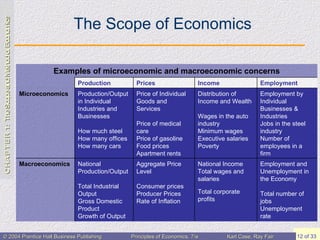
The Scope of Economics Microeconomics  is the branch of economics that examines the behavior of individual decision-making units—that is, business firms and households.
The Scope of Economics Macroeconomics  is the branch of economics that examines the behavior of  economic   aggregates — income, output, employment, and so on—on a national scale.
The Scope of Economics Employment by Individual Businesses & Industries Jobs in the steel industry Number of employees in a firm Distribution of Income and Wealth   Wages in the auto  industry Minimum wages Executive salaries Poverty Price of Individual Goods and Services   Price of medical care Price of gasoline Food prices Apartment rents Production/Output in Individual Industries and Businesses   How much steel How many offices How many cars Microeconomics Employment and Unemployment in the Economy   Total number of jobs Unemployment rate National Income Total wages and salaries   Total corporate profits Aggregate Price Level   Consumer prices Producer Prices Rate of Inflation National Production/Output   Total Industrial Output Gross Domestic Product Growth of Output Macroeconomics Employment Income Prices Production Examples of microeconomic and macroeconomic concerns
The Method of Economics Positive economics  studies economic behavior without making judgments.  It describes what exists and how it works.
The Method of Economics Normative economics ,  also called policy economics, analyzes outcomes of economic behavior, evaluates them as good or bad, and may prescribe courses of action.
The Method of Economics Positive economics  includes: Descriptive economics , which involves the compilation of data that describe phenomena and facts. Economic theory,  which involves building models of behavior. An  economic   theory  is a general statement of cause and effect, action and reaction.
Theories and Models Theories involve models, and models involve variables. A  model  is a formal statement of a theory.  Models are descriptions of the relationship between two or more variables.
Theories and Models Ockham’s razor  is the principle that irrelevant detail should be cut away.  Models are simplifications, not complications, of reality.
Theories and Models A  variable  is a measure that can change from observation to observation. The  ceteris paribus  device is part of the process of abstraction. Using the  ceteris paribus,  or  all else equal, assumption , economists study the relationship between two variables while the values of other variables remain constant.
Theories and Models Pitfalls to avoid in formulating economic theory: The  post hoc, ergo propter hoc fallacy   refers to a common error made in thinking about causation:  If event A happened before event B, it is not necessarily true that A caused B. The  fallacy of composition  is the erroneous belief that what is true for a part is also true for the whole.
The Method of Economics Empirical economics  refers to the collection and use of data to test economic theories. Many data sets are available to facilitate economic research.  They are collected by both government agencies and private companies,
Economic Policy Criteria for judging economic outcomes: Efficiency , or allocative efficiency.  An efficient economy is one that produces what people want at the least possible cost . Equity , or  fairness of economic outcomes.
Economic Policy Criteria for judging economic outcomes: Economic growth , or  an increase in the total output of an economy. Economic stability , or the condition in which output is steady or growing, with low inflation and full employment of resources.
Review Terms and Concepts ceteris paribus descriptive economics economic growth economic theory economics efficiency efficient market empirical economics equity fallacy of composition Industrial Revolution macroeconomics microeconomics model normative economics ockham’s  razor opportunity cost positive economics post hoc, ergo  propter  hoc stability sunk costs variable
Appendix: How to Read and Understand Graphs A  graph  is a two-dimensional representation of a set of numbers or data.
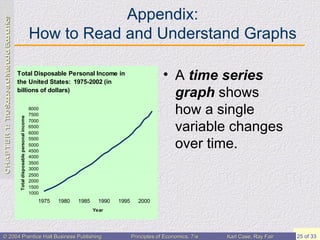
Appendix: How to Read and Understand Graphs A  time series graph  shows how a single variable changes over time.
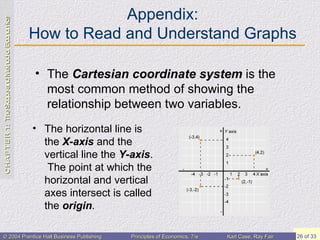
Appendix: How to Read and Understand Graphs The  Cartesian coordinate system  is the most common method of showing the relationship between two variables. The horizontal line is the  X-axis  and the vertical line the  Y-axis .  The point at which the horizontal and vertical axes intersect is called the  origin .
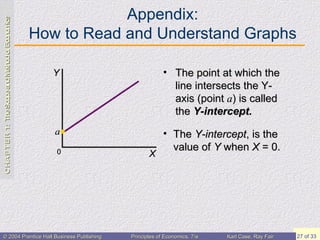
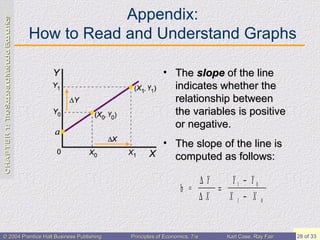
Appendix: How to Read and Understand Graphs The point at which the line intersects the Y-axis (point  a ) is called the  Y-intercept. The  Y-intercept , is the value of  Y  when  X  = 0.
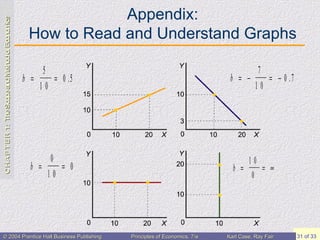
Appendix: How to Read and Understand Graphs The  slope  of the line indicates whether the relationship between the variables is positive or negative. The slope of the line is computed as follows:
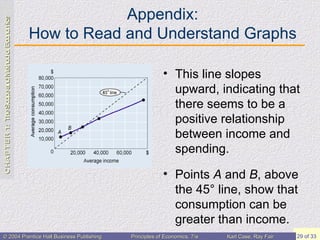
Appendix: How to Read and Understand Graphs This line slopes upward, indicating that there seems to be a positive relationship between income and spending. Points  A  and  B , above the 45 °  line, show that consumption can be greater than income.
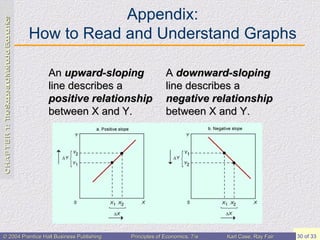
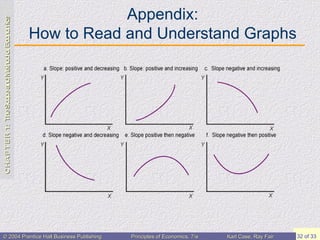
Appendix: How to Read and Understand Graphs A  downward-sloping  line describes a  negative relationship  between X and Y. An  upward-sloping  line describes a  positive relationship  between X and   Y.
Appendix: How to Read and Understand Graphs
Appendix: How to Read and Understand Graphs Cartesian coordinate system graph negative relationship origin positive relationship slope time series graph X-axis Y-axis Y-intercept

econ Ch01

  • 1.
    The Scope andMethod of Economics Appendix: How to Read and Understand Graphs Prepared by: Fernando Quijano and Yvonn Quijano
  • 2.
    The Study ofEconomics Economics is the study of how individuals and societies choose to use the scarce resources that nature and previous generations have provided.
  • 3.
    Why Study Economics?An important reason for studying economics is to learn a way of thinking. Three fundamental concepts: Opportunity cost Marginalism , and Efficient markets
  • 4.
    Opportunity Cost Opportunitycost is the best alternative that we forgo, or give up, when we make a choice or a decision. Nearly all decisions involve trade-offs.
  • 5.
    Marginalism In weighingthe costs and benefits of a decision, it is important to weigh only the costs and benefits that arise from the decision.
  • 6.
    Marginalism For example,when a firm decides whether to produce additional output, it considers only the additional (or marginal cost), not the sunk cost. Sunk costs are costs that cannot be avoided, regardless of what is done in the future, because they have already been incurred.
  • 7.
    Efficient Markets An efficient market is one in which profit opportunities are eliminated almost instantaneously. There is no free lunch! Profit opportunities are rare because, at any one time, there are many people searching for them.
  • 8.
    More Reasons toStudy Economics The study of economics is an essential part of the study of society. Economic decisions often have enormous consequences. During the Industrial Revolution , new manufacturing technologies and improved transportation gave rise to the modern factory system.
  • 9.
    More Reasons toStudy Economics An understanding of economics is essential to an understanding of global affairs. Voting decisions also require a basic understanding of economics.
  • 10.
    The Scope ofEconomics Microeconomics is the branch of economics that examines the behavior of individual decision-making units—that is, business firms and households.
  • 11.
    The Scope ofEconomics Macroeconomics is the branch of economics that examines the behavior of economic aggregates — income, output, employment, and so on—on a national scale.
  • 12.
    The Scope ofEconomics Employment by Individual Businesses & Industries Jobs in the steel industry Number of employees in a firm Distribution of Income and Wealth   Wages in the auto industry Minimum wages Executive salaries Poverty Price of Individual Goods and Services   Price of medical care Price of gasoline Food prices Apartment rents Production/Output in Individual Industries and Businesses   How much steel How many offices How many cars Microeconomics Employment and Unemployment in the Economy   Total number of jobs Unemployment rate National Income Total wages and salaries   Total corporate profits Aggregate Price Level   Consumer prices Producer Prices Rate of Inflation National Production/Output   Total Industrial Output Gross Domestic Product Growth of Output Macroeconomics Employment Income Prices Production Examples of microeconomic and macroeconomic concerns
  • 13.
    The Method ofEconomics Positive economics studies economic behavior without making judgments. It describes what exists and how it works.
  • 14.
    The Method ofEconomics Normative economics , also called policy economics, analyzes outcomes of economic behavior, evaluates them as good or bad, and may prescribe courses of action.
  • 15.
    The Method ofEconomics Positive economics includes: Descriptive economics , which involves the compilation of data that describe phenomena and facts. Economic theory, which involves building models of behavior. An economic theory is a general statement of cause and effect, action and reaction.
  • 16.
    Theories and ModelsTheories involve models, and models involve variables. A model is a formal statement of a theory. Models are descriptions of the relationship between two or more variables.
  • 17.
    Theories and ModelsOckham’s razor is the principle that irrelevant detail should be cut away. Models are simplifications, not complications, of reality.
  • 18.
    Theories and ModelsA variable is a measure that can change from observation to observation. The ceteris paribus device is part of the process of abstraction. Using the ceteris paribus, or all else equal, assumption , economists study the relationship between two variables while the values of other variables remain constant.
  • 19.
    Theories and ModelsPitfalls to avoid in formulating economic theory: The post hoc, ergo propter hoc fallacy refers to a common error made in thinking about causation: If event A happened before event B, it is not necessarily true that A caused B. The fallacy of composition is the erroneous belief that what is true for a part is also true for the whole.
  • 20.
    The Method ofEconomics Empirical economics refers to the collection and use of data to test economic theories. Many data sets are available to facilitate economic research. They are collected by both government agencies and private companies,
  • 21.
    Economic Policy Criteriafor judging economic outcomes: Efficiency , or allocative efficiency. An efficient economy is one that produces what people want at the least possible cost . Equity , or fairness of economic outcomes.
  • 22.
    Economic Policy Criteriafor judging economic outcomes: Economic growth , or an increase in the total output of an economy. Economic stability , or the condition in which output is steady or growing, with low inflation and full employment of resources.
  • 23.
    Review Terms andConcepts ceteris paribus descriptive economics economic growth economic theory economics efficiency efficient market empirical economics equity fallacy of composition Industrial Revolution macroeconomics microeconomics model normative economics ockham’s razor opportunity cost positive economics post hoc, ergo propter hoc stability sunk costs variable
  • 24.
    Appendix: How toRead and Understand Graphs A graph is a two-dimensional representation of a set of numbers or data.
  • 25.
    Appendix: How toRead and Understand Graphs A time series graph shows how a single variable changes over time.
  • 26.
    Appendix: How toRead and Understand Graphs The Cartesian coordinate system is the most common method of showing the relationship between two variables. The horizontal line is the X-axis and the vertical line the Y-axis . The point at which the horizontal and vertical axes intersect is called the origin .
  • 27.
    Appendix: How toRead and Understand Graphs The point at which the line intersects the Y-axis (point a ) is called the Y-intercept. The Y-intercept , is the value of Y when X = 0.
  • 28.
    Appendix: How toRead and Understand Graphs The slope of the line indicates whether the relationship between the variables is positive or negative. The slope of the line is computed as follows:
  • 29.
    Appendix: How toRead and Understand Graphs This line slopes upward, indicating that there seems to be a positive relationship between income and spending. Points A and B , above the 45 ° line, show that consumption can be greater than income.
  • 30.
    Appendix: How toRead and Understand Graphs A downward-sloping line describes a negative relationship between X and Y. An upward-sloping line describes a positive relationship between X and Y.
  • 31.
    Appendix: How toRead and Understand Graphs
  • 32.
    Appendix: How toRead and Understand Graphs
  • 33.
    Appendix: How toRead and Understand Graphs Cartesian coordinate system graph negative relationship origin positive relationship slope time series graph X-axis Y-axis Y-intercept

Editor's Notes

  • #8 Opportunity cost does not have to be measured in dollar terms. The value of an alternative activity is usually measured in both monetary and nonmonetary costs. Opportunity cost is referred to as implicit cost. Accountants count only explicit costs. Economic cost is higher than accounting costs because it includes implicit, or opportunity, cost.