Message Queuing Telemetry Transport (MQTT)
Message Format
Khamdamboy Urunov, a Ph.D. student.
Special Communication Research
Center.,
Graduate School of Financial
Information Security., Kookmin
MQTT model (1/3)
2
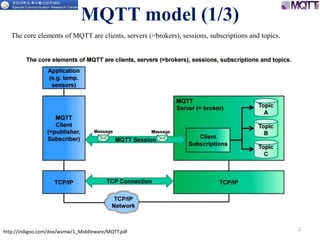
The core elements of MQTT are clients, servers (=brokers), sessions, subscriptions and topics.
http://indigoo.com/dox/wsmw/1_Middleware/MQTT.pdf
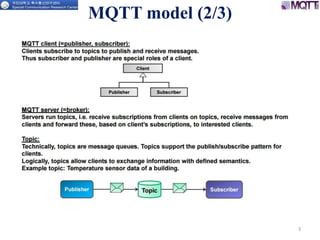
MQTT model (2/3)
3
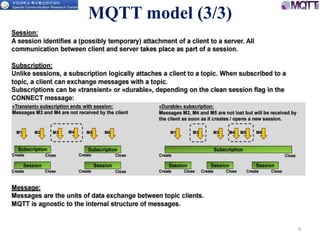
MQTT model (3/3)
4
5
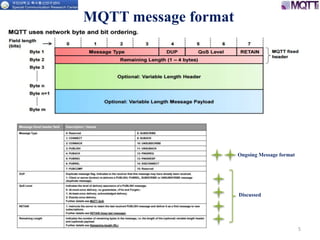
MQTT message format
Ongoing Message format
Discussed
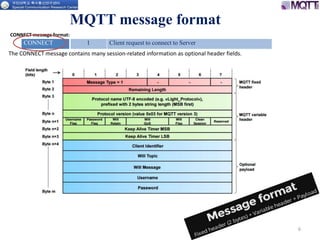
CONNECT message format:
6
MQTT message format
The CONNECT message contains many session-related information as optional header fields.
CONNECT 1 Client request to connect to Server
7
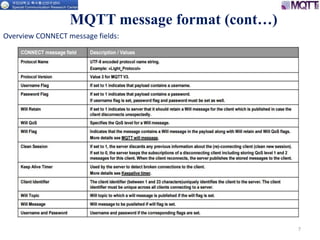
Overview CONNECT message fields:
MQTT message format (cont…)
8
MQTT message format (cont…)
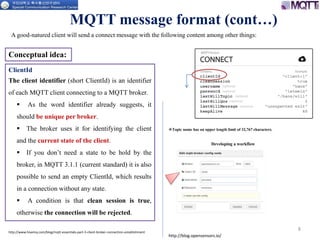
A good-natured client will send a connect message with the following content among other things:
ClientId
The client identifier (short ClientId) is an identifier
of each MQTT client connecting to a MQTT broker.
 As the word identifier already suggests, it
should be unique per broker.
 The broker uses it for identifying the client
and the current state of the client.
 If you don’t need a state to be hold by the
broker, in MQTT 3.1.1 (current standard) it is also
possible to send an empty ClientId, which results
in a connection without any state.
 A condition is that clean session is true,
otherwise the connection will be rejected.
http://www.hivemq.com/blog/mqtt-essentials-part-3-client-broker-connection-establishment
Conceptual idea:
Topic name has an upper length limit of 32,767 characters.
http://blog.opensensors.io/
Developing a workflow
9
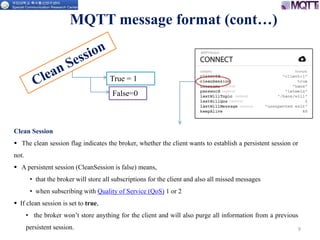
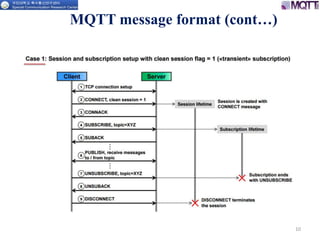
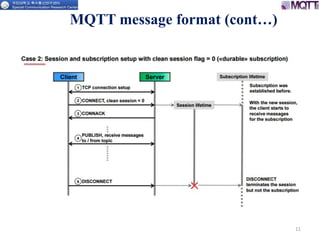
Clean Session
 The clean session flag indicates the broker, whether the client wants to establish a persistent session or
not.
 A persistent session (CleanSession is false) means,
• that the broker will store all subscriptions for the client and also all missed messages
• when subscribing with Quality of Service (QoS) 1 or 2
 If clean session is set to true,
• the broker won’t store anything for the client and will also purge all information from a previous
persistent session.
MQTT message format (cont…)
True = 1
False=0
10
MQTT message format (cont…)
11
MQTT message format (cont…)
12
Username & Password flag
 MQTT allows to send a username and password
for authenticating the client and also authorization.
 However, the password is sent in plaintext,
• if it isn’t encrypted or hashed by
implementation
• or TLS is used underneath.
 We highly recommend to use username and
password together with a secure transport of it.
 In brokers like HiveMQ it is also possible to
authenticate clients with an SSL (secure sockets
layer) certificate, so no username and password is
needed.
MQTT message format (cont…)
http://slides.com/disk91/mqtt#/13
MQTT Will
Message
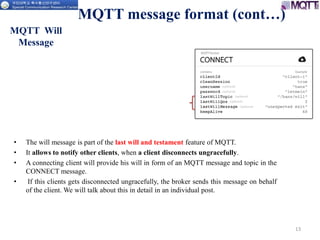
• The will message is part of the last will and testament feature of MQTT.
• It allows to notify other clients, when a client disconnects ungracefully.
• A connecting client will provide his will in form of an MQTT message and topic in the
CONNECT message.
• If this clients gets disconnected ungracefully, the broker sends this message on behalf
of the client. We will talk about this in detail in an individual post.
13
MQTT message format (cont…)
14
If a message is published with a topic, the broker distributes it to all subscribers following the topic.
• If nobody is currently following that topic, the message is lost – it isn't cached because there is no queue.
• To prevent this behavior, users can set a retained flag when publishing.
This flag prompts the broker to store the message and to offer it to future subscribers.
• If, for example, the outside temperature is published with temp/terrace and a client subscribes to this topic hours
later,
• this client is immediately sent this recently published temperature value (last-known value) if the retained flag is
set.
What happens if a client unexpectedly fails?
• LWT (Last Will and Testament) is an important feature of MQTT.
• A client tells the broker during the connection setup that: "In case of my death, please send the following message
with this topic …" If the broker then detects that this client is no longer alive, it does as it was told and publishes the
message with the desired topic.
• MQTT thus has monitoring installed: It's easy to write to clients that respond to the passing of other clients, such
as by sending alerts.
LWT messages are often used together with the retained flag in order to permanently describe the state of a client:
• When starting, a client will,
• for example, publish a status message with a retained flag with the clients/id/status topic.
• If this client deceases, the broker would distribute the dead message with a retained flag and the same topic on its
behalf.
MQTT message format
(cont…)
Last Will and Testament
http://www.admin-magazine.com/Archive/2015/30/Using-the-MQTT-IoT-protocol-for-unusual-but-useful-purposes
15
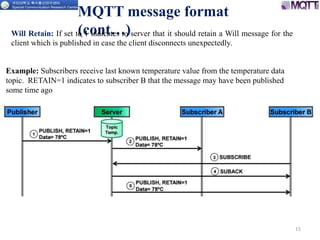
Example: Subscribers receive last known temperature value from the temperature data
topic. RETAIN=1 indicates to subscriber B that the message may have been published
some time ago
MQTT message format
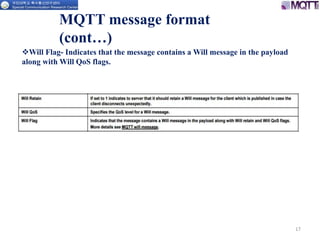
(cont…)Will Retain: If set to 1 indicates to server that it should retain a Will message for the
client which is published in case the client disconnects unexpectedly.
16
MQTT message format
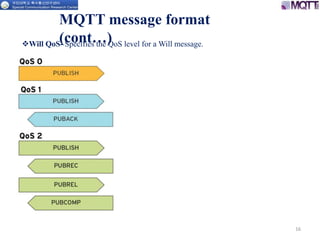
(cont…)Will QoS- Specifies the QoS level for a Will message.
17
MQTT message format
(cont…)
Will Flag- Indicates that the message contains a Will message in the payload
along with Will QoS flags.
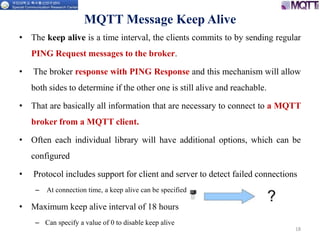
MQTT Message Keep Alive
• The keep alive is a time interval, the clients commits to by sending regular
PING Request messages to the broker.
• The broker response with PING Response and this mechanism will allow
both sides to determine if the other one is still alive and reachable.
• That are basically all information that are necessary to connect to a MQTT
broker from a MQTT client.
• Often each individual library will have additional options, which can be
configured
• Protocol includes support for client and server to detect failed connections
– At connection time, a keep alive can be specified
• Maximum keep alive interval of 18 hours
– Can specify a value of 0 to disable keep alive
18
http://www.slideshare.net/henriksjostrand/devmobile-2013-low-latencymessagingusingmqtt 19
MQTT Message Keep Alive (cont…)
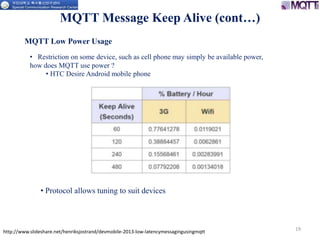
MQTT Low Power Usage
• Restriction on some device, such as cell phone may simply be available power,
how does MQTT use power ?
• HTC Desire Android mobile phone
• Protocol allows tuning to suit devices
MQTT & HTTP
20
http://www.slideshare.net/henriksjostrand/devmobile-2013-low-latencymessagingusingmqtt
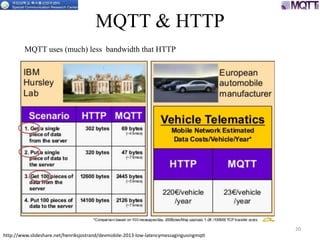
MQTT uses (much) less bandwidth that HTTP
21
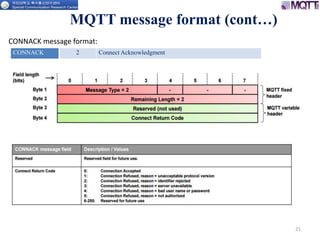
CONNACK message format:
MQTT message format (cont…)
CONNACK 2 Connect Acknowledgment
22
MQTT message format (cont…)
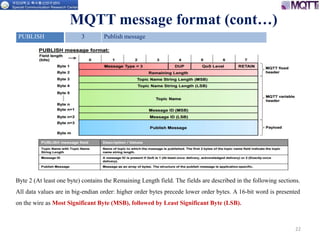
PUBLISH 3 Publish message
Byte 2 (At least one byte) contains the Remaining Length field. The fields are described in the following sections.
All data values are in big-endian order: higher order bytes precede lower order bytes. A 16-bit word is presented
on the wire as Most Significant Byte (MSB), followed by Least Significant Byte (LSB).
23
MQTT message format (cont…)
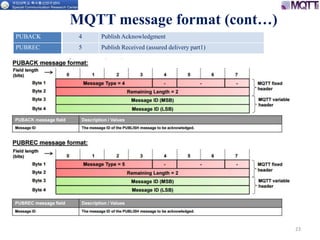
PUBACK 4 Publish Acknowledgment
PUBREC 5 Publish Received (assured delivery part1)
24
MQTT message format (cont…)
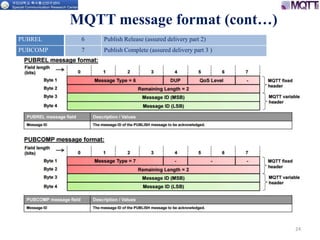
PUBREL 6 Publish Release (assured delivery part 2)
PUBCOMP 7 Publish Complete (assured delivery part 3 )
25
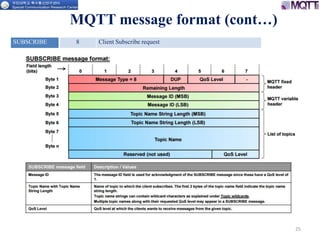
MQTT message format (cont…)
SUBSCRIBE 8 Client Subscribe request
26
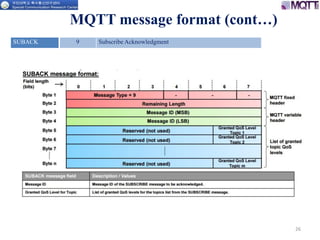
MQTT message format (cont…)
SUBACK 9 Subscribe Acknowledgment
27
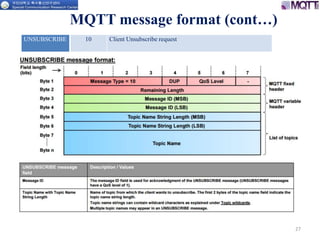
MQTT message format (cont…)
UNSUBSCRIBE 10 Client Unsubscribe request
28
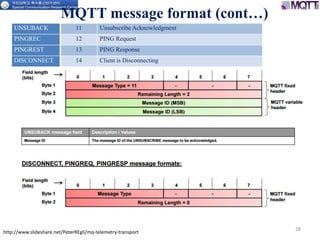
MQTT message format (cont…)
UNSUBACK 11 Unsubscribe Acknowledgment
PINGREC 12 PING Request
PINGREST 13 PING Response
DISCONNECT 14 Client is Disconnecting
http://www.slideshare.net/PeterREgli/mq-telemetry-transport
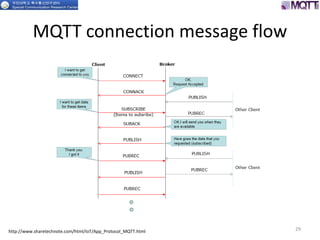
MQTT connection message flow
29http://www.sharetechnote.com/html/IoT/App_Protocol_MQTT.html
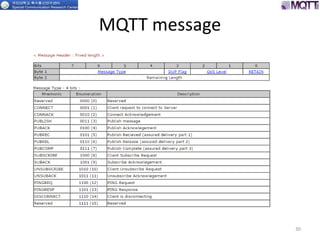
MQTT message
30
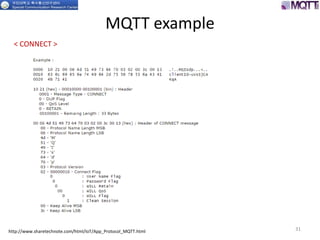
MQTT example
31http://www.sharetechnote.com/html/IoT/App_Protocol_MQTT.html
< CONNECT >
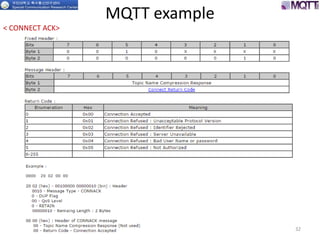
MQTT example
32
< CONNECT ACK>
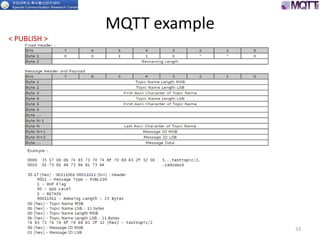
MQTT example
33
< PUBLISH >
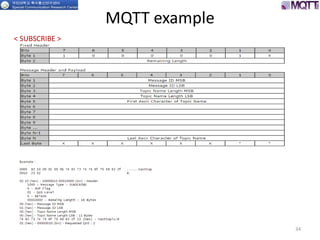
MQTT example
34
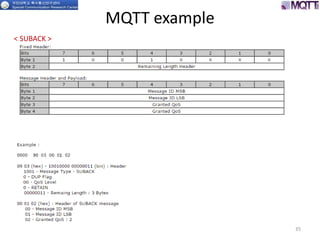
< SUBSCRIBE >
MQTT example
35
< SUBACK >
MQTT format (cont…)
36
 Payload
 Message identifier
 MQTT and UTF-8
 Unused bits
The following types of MQTT command message have a payload:
CONNECT
 The payload contains one or more UTF-8 encoded strings.
 They specify a unqiue identifier for the client, a Will topic and message and the User Name and Password to
use.
 All but the first are optional and their presence is determined based on flags in the variable header.
SUBSCRIBE
The payload contains a list of topic names to which the client can subscribe, and the QoS level. These strings are
UTF-encoded.
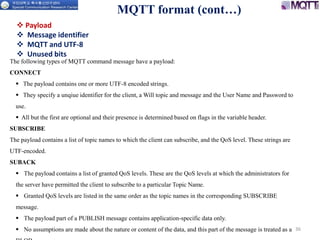
SUBACK
 The payload contains a list of granted QoS levels. These are the QoS levels at which the administrators for
the server have permitted the client to subscribe to a particular Topic Name.
 Granted QoS levels are listed in the same order as the topic names in the corresponding SUBSCRIBE
message.
 The payload part of a PUBLISH message contains application-specific data only.
 No assumptions are made about the nature or content of the data, and this part of the message is treated as a
MQTT format (cont…)
37
 Payload
 Message identifier
 MQTT and UTF-8
 Unused bits
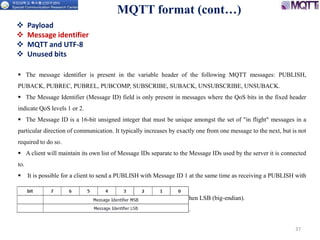
 The message identifier is present in the variable header of the following MQTT messages: PUBLISH,
PUBACK, PUBREC, PUBREL, PUBCOMP, SUBSCRIBE, SUBACK, UNSUBSCRIBE, UNSUBACK.
 The Message Identifier (Message ID) field is only present in messages where the QoS bits in the fixed header
indicate QoS levels 1 or 2.
 The Message ID is a 16-bit unsigned integer that must be unique amongst the set of "in flight" messages in a
particular direction of communication. It typically increases by exactly one from one message to the next, but is not
required to do so.
 A client will maintain its own list of Message IDs separate to the Message IDs used by the server it is connected
to.
 It is possible for a client to send a PUBLISH with Message ID 1 at the same time as receiving a PUBLISH with
Message ID 1.
 The ordering of the two bytes of the Message Identifier is MSB, then LSB (big-endian).
 Do not use Message ID 0. It is reserved as an invalid Message ID.
MQTT format (cont…)
38
 Payload
 Message identifier
 MQTT and UTF-8
 Unused bits
 UTF-8 is an efficient encoding of Unicode character-strings that optimizes the encoding of
ASCII characters in support of text-based communications.
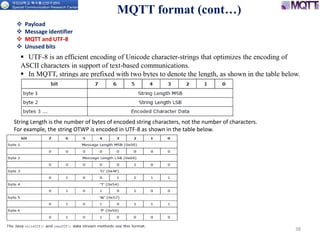
 In MQTT, strings are prefixed with two bytes to denote the length, as shown in the table below.
String Length is the number of bytes of encoded string characters, not the number of characters.
For example, the string OTWP is encoded in UTF-8 as shown in the table below.
MQTT format (cont…)
39
Any bits marked as unused should be set to zero (0).
 Payload
 Message identifier
 MQTT and UTF-8
 Unused bits
Schedule of next plan
• Next step compare MQTT and CoAP protocols
• Analysis source code steps
• Make those u_CoAP, u_MQTT protocols message format
40
1. https://github.com/aoabook/WroxAccessories/blob/master/src/com/wiley/wroxaccessories/MQTT.java
2. https://www.crossdart.info/p/mqtt/1.1.0/mqtt_message_publish.dart.html
3. http://iicb.org/viewpaper/1
4. http://www.javased.com/?source_dir=Racenet-for-Android/src/com/albin/mqtt/message/RetryableMessage.java
5. http://www.programcreek.com/java-api-examples/index.php?api=org.dna.mqtt.moquette.proto.messages.AbstractMessage.QOSType
6. http://indigoo.com/
Link of the source code:
Thank you
hamdamboy.urunov@gmail.com
41

Message queuing telemetry transport (mqtt) message format

  • 1.
    Message Queuing TelemetryTransport (MQTT) Message Format Khamdamboy Urunov, a Ph.D. student. Special Communication Research Center., Graduate School of Financial Information Security., Kookmin
  • 2.
    MQTT model (1/3) 2 Thecore elements of MQTT are clients, servers (=brokers), sessions, subscriptions and topics. http://indigoo.com/dox/wsmw/1_Middleware/MQTT.pdf
  • 3.
  • 4.
  • 5.
    5 MQTT message format OngoingMessage format Discussed
  • 6.
    CONNECT message format: 6 MQTTmessage format The CONNECT message contains many session-related information as optional header fields. CONNECT 1 Client request to connect to Server
  • 7.
    7 Overview CONNECT messagefields: MQTT message format (cont…)
  • 8.
    8 MQTT message format(cont…) A good-natured client will send a connect message with the following content among other things: ClientId The client identifier (short ClientId) is an identifier of each MQTT client connecting to a MQTT broker.  As the word identifier already suggests, it should be unique per broker.  The broker uses it for identifying the client and the current state of the client.  If you don’t need a state to be hold by the broker, in MQTT 3.1.1 (current standard) it is also possible to send an empty ClientId, which results in a connection without any state.  A condition is that clean session is true, otherwise the connection will be rejected. http://www.hivemq.com/blog/mqtt-essentials-part-3-client-broker-connection-establishment Conceptual idea: Topic name has an upper length limit of 32,767 characters. http://blog.opensensors.io/ Developing a workflow
  • 9.
    9 Clean Session  Theclean session flag indicates the broker, whether the client wants to establish a persistent session or not.  A persistent session (CleanSession is false) means, • that the broker will store all subscriptions for the client and also all missed messages • when subscribing with Quality of Service (QoS) 1 or 2  If clean session is set to true, • the broker won’t store anything for the client and will also purge all information from a previous persistent session. MQTT message format (cont…) True = 1 False=0
  • 10.
  • 11.
  • 12.
    12 Username & Passwordflag  MQTT allows to send a username and password for authenticating the client and also authorization.  However, the password is sent in plaintext, • if it isn’t encrypted or hashed by implementation • or TLS is used underneath.  We highly recommend to use username and password together with a secure transport of it.  In brokers like HiveMQ it is also possible to authenticate clients with an SSL (secure sockets layer) certificate, so no username and password is needed. MQTT message format (cont…) http://slides.com/disk91/mqtt#/13
  • 13.
    MQTT Will Message • Thewill message is part of the last will and testament feature of MQTT. • It allows to notify other clients, when a client disconnects ungracefully. • A connecting client will provide his will in form of an MQTT message and topic in the CONNECT message. • If this clients gets disconnected ungracefully, the broker sends this message on behalf of the client. We will talk about this in detail in an individual post. 13 MQTT message format (cont…)
  • 14.
    14 If a messageis published with a topic, the broker distributes it to all subscribers following the topic. • If nobody is currently following that topic, the message is lost – it isn't cached because there is no queue. • To prevent this behavior, users can set a retained flag when publishing. This flag prompts the broker to store the message and to offer it to future subscribers. • If, for example, the outside temperature is published with temp/terrace and a client subscribes to this topic hours later, • this client is immediately sent this recently published temperature value (last-known value) if the retained flag is set. What happens if a client unexpectedly fails? • LWT (Last Will and Testament) is an important feature of MQTT. • A client tells the broker during the connection setup that: "In case of my death, please send the following message with this topic …" If the broker then detects that this client is no longer alive, it does as it was told and publishes the message with the desired topic. • MQTT thus has monitoring installed: It's easy to write to clients that respond to the passing of other clients, such as by sending alerts. LWT messages are often used together with the retained flag in order to permanently describe the state of a client: • When starting, a client will, • for example, publish a status message with a retained flag with the clients/id/status topic. • If this client deceases, the broker would distribute the dead message with a retained flag and the same topic on its behalf. MQTT message format (cont…) Last Will and Testament http://www.admin-magazine.com/Archive/2015/30/Using-the-MQTT-IoT-protocol-for-unusual-but-useful-purposes
  • 15.
    15 Example: Subscribers receivelast known temperature value from the temperature data topic. RETAIN=1 indicates to subscriber B that the message may have been published some time ago MQTT message format (cont…)Will Retain: If set to 1 indicates to server that it should retain a Will message for the client which is published in case the client disconnects unexpectedly.
  • 16.
    16 MQTT message format (cont…)WillQoS- Specifies the QoS level for a Will message.
  • 17.
    17 MQTT message format (cont…) WillFlag- Indicates that the message contains a Will message in the payload along with Will QoS flags.
  • 18.
    MQTT Message KeepAlive • The keep alive is a time interval, the clients commits to by sending regular PING Request messages to the broker. • The broker response with PING Response and this mechanism will allow both sides to determine if the other one is still alive and reachable. • That are basically all information that are necessary to connect to a MQTT broker from a MQTT client. • Often each individual library will have additional options, which can be configured • Protocol includes support for client and server to detect failed connections – At connection time, a keep alive can be specified • Maximum keep alive interval of 18 hours – Can specify a value of 0 to disable keep alive 18
  • 19.
    http://www.slideshare.net/henriksjostrand/devmobile-2013-low-latencymessagingusingmqtt 19 MQTT MessageKeep Alive (cont…) MQTT Low Power Usage • Restriction on some device, such as cell phone may simply be available power, how does MQTT use power ? • HTC Desire Android mobile phone • Protocol allows tuning to suit devices
  • 20.
  • 21.
    21 CONNACK message format: MQTTmessage format (cont…) CONNACK 2 Connect Acknowledgment
  • 22.
    22 MQTT message format(cont…) PUBLISH 3 Publish message Byte 2 (At least one byte) contains the Remaining Length field. The fields are described in the following sections. All data values are in big-endian order: higher order bytes precede lower order bytes. A 16-bit word is presented on the wire as Most Significant Byte (MSB), followed by Least Significant Byte (LSB).
  • 23.
    23 MQTT message format(cont…) PUBACK 4 Publish Acknowledgment PUBREC 5 Publish Received (assured delivery part1)
  • 24.
    24 MQTT message format(cont…) PUBREL 6 Publish Release (assured delivery part 2) PUBCOMP 7 Publish Complete (assured delivery part 3 )
  • 25.
    25 MQTT message format(cont…) SUBSCRIBE 8 Client Subscribe request
  • 26.
    26 MQTT message format(cont…) SUBACK 9 Subscribe Acknowledgment
  • 27.
    27 MQTT message format(cont…) UNSUBSCRIBE 10 Client Unsubscribe request
  • 28.
    28 MQTT message format(cont…) UNSUBACK 11 Unsubscribe Acknowledgment PINGREC 12 PING Request PINGREST 13 PING Response DISCONNECT 14 Client is Disconnecting http://www.slideshare.net/PeterREgli/mq-telemetry-transport
  • 29.
    MQTT connection messageflow 29http://www.sharetechnote.com/html/IoT/App_Protocol_MQTT.html
  • 30.
  • 31.
  • 32.
  • 33.
  • 34.
  • 35.
  • 36.
    MQTT format (cont…) 36 Payload  Message identifier  MQTT and UTF-8  Unused bits The following types of MQTT command message have a payload: CONNECT  The payload contains one or more UTF-8 encoded strings.  They specify a unqiue identifier for the client, a Will topic and message and the User Name and Password to use.  All but the first are optional and their presence is determined based on flags in the variable header. SUBSCRIBE The payload contains a list of topic names to which the client can subscribe, and the QoS level. These strings are UTF-encoded. SUBACK  The payload contains a list of granted QoS levels. These are the QoS levels at which the administrators for the server have permitted the client to subscribe to a particular Topic Name.  Granted QoS levels are listed in the same order as the topic names in the corresponding SUBSCRIBE message.  The payload part of a PUBLISH message contains application-specific data only.  No assumptions are made about the nature or content of the data, and this part of the message is treated as a
  • 37.
    MQTT format (cont…) 37 Payload  Message identifier  MQTT and UTF-8  Unused bits  The message identifier is present in the variable header of the following MQTT messages: PUBLISH, PUBACK, PUBREC, PUBREL, PUBCOMP, SUBSCRIBE, SUBACK, UNSUBSCRIBE, UNSUBACK.  The Message Identifier (Message ID) field is only present in messages where the QoS bits in the fixed header indicate QoS levels 1 or 2.  The Message ID is a 16-bit unsigned integer that must be unique amongst the set of "in flight" messages in a particular direction of communication. It typically increases by exactly one from one message to the next, but is not required to do so.  A client will maintain its own list of Message IDs separate to the Message IDs used by the server it is connected to.  It is possible for a client to send a PUBLISH with Message ID 1 at the same time as receiving a PUBLISH with Message ID 1.  The ordering of the two bytes of the Message Identifier is MSB, then LSB (big-endian).  Do not use Message ID 0. It is reserved as an invalid Message ID.
  • 38.
    MQTT format (cont…) 38 Payload  Message identifier  MQTT and UTF-8  Unused bits  UTF-8 is an efficient encoding of Unicode character-strings that optimizes the encoding of ASCII characters in support of text-based communications.  In MQTT, strings are prefixed with two bytes to denote the length, as shown in the table below. String Length is the number of bytes of encoded string characters, not the number of characters. For example, the string OTWP is encoded in UTF-8 as shown in the table below.
  • 39.
    MQTT format (cont…) 39 Anybits marked as unused should be set to zero (0).  Payload  Message identifier  MQTT and UTF-8  Unused bits
  • 40.
    Schedule of nextplan • Next step compare MQTT and CoAP protocols • Analysis source code steps • Make those u_CoAP, u_MQTT protocols message format 40 1. https://github.com/aoabook/WroxAccessories/blob/master/src/com/wiley/wroxaccessories/MQTT.java 2. https://www.crossdart.info/p/mqtt/1.1.0/mqtt_message_publish.dart.html 3. http://iicb.org/viewpaper/1 4. http://www.javased.com/?source_dir=Racenet-for-Android/src/com/albin/mqtt/message/RetryableMessage.java 5. http://www.programcreek.com/java-api-examples/index.php?api=org.dna.mqtt.moquette.proto.messages.AbstractMessage.QOSType 6. http://indigoo.com/ Link of the source code:
  • 41.